
TL;DR
- The core decision: what a change to a published shift costs, and who pays it.
- When doing nothing is right: when changes are rare and the affected person always knows.
- What has to be true: the change reaches the one person it affects, and you know it did.
- How the options split: by what the change does to somebody's week, not to your rota.
- Decision rule: count your changes before trying to handle them better.
- Outcome to expect: fewer changes, and the remaining ones landing properly.
It Takes Four Seconds
Somebody calls in sick. You open the rota, move a shift, and it's handled. Four seconds, problem solved, on to the next thing.
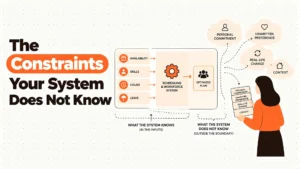
From where you're sitting that was a small administrative act. From where it lands, somebody who wasn't working Thursday is now working Thursday, and whatever they had arranged for Thursday has to be unarranged. Childcare booked. A medical appointment. A lift they'd organised. A second job they'd committed to. None of that is visible on your screen, and none of it took four seconds to set up.
That asymmetry is the whole subject. Making a change is nearly free and receiving one is not, and because the cost falls entirely on the other side, there's nothing in the act of changing a rota that communicates what it costs. You'd make fewer changes if the price were visible to you. It isn't, so you don't.
Best tools for Employee Scheduling
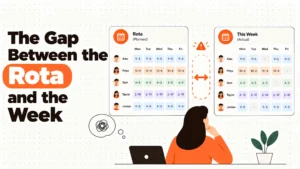
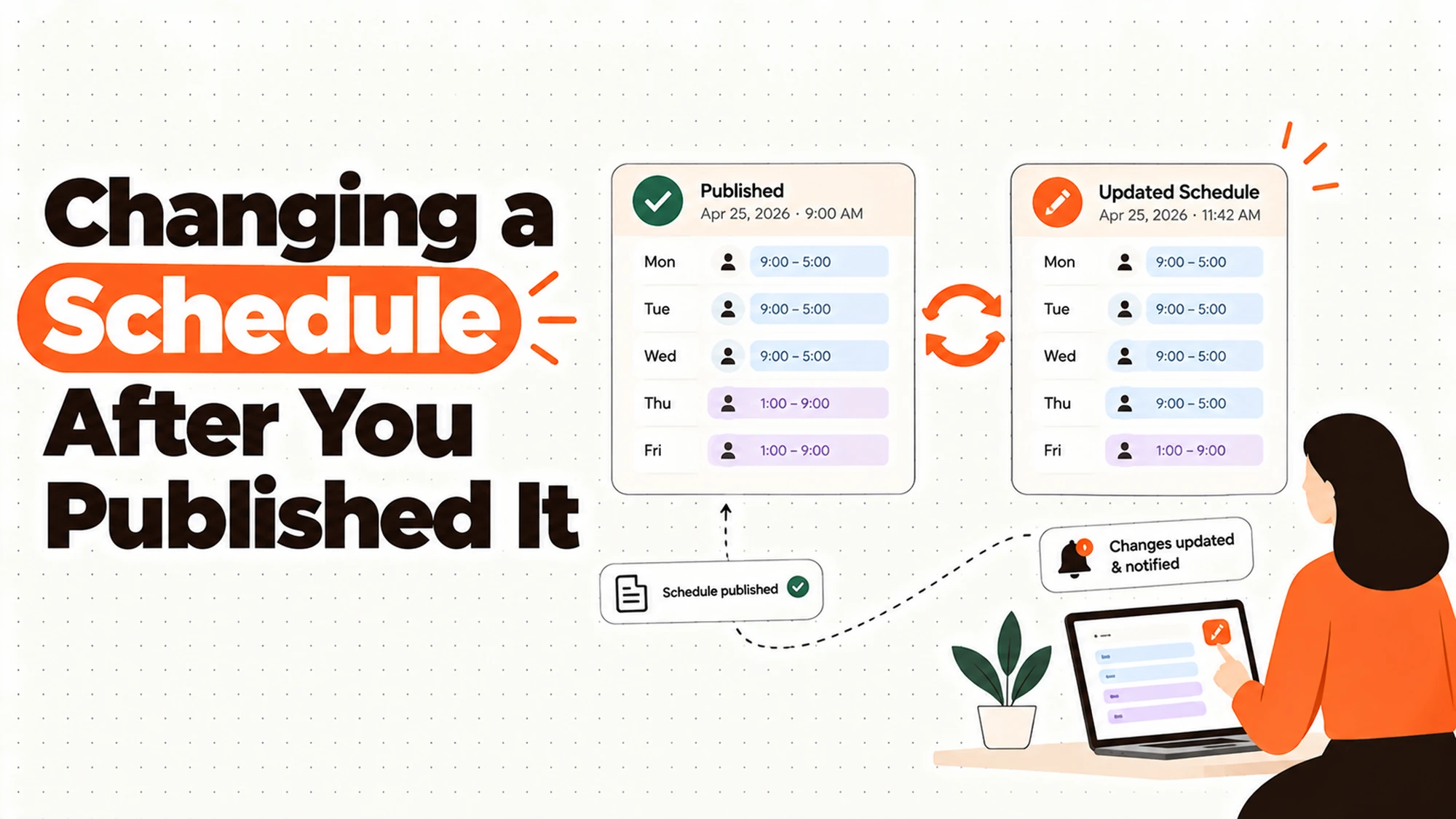
The reframe worth holding: a change to a published schedule is not an edit to a document. The document stopped being a document at the moment you published it. It became a set of commitments that people built their weeks around, and altering it is altering their week, not your plan.
That doesn't mean changes are avoidable. Things happen, people are ill, demand moves, and an operation that can't adapt is worse for everybody. It means the interesting questions are how many changes you're actually making, which of them were avoidable, and whether the one person affected reliably finds out.
One thing to settle before any of it. Some jurisdictions attach specific consequences to changes made after publication, including in some cases additional payment, and some set arrangements around cancellations or people being sent home. These differ, some are set by agreement rather than statute, and several have changed recently. Nothing here tells you what applies to you, or whether anybody may decline a changed shift. Establish it with local advice for each population you schedule.
When You Genuinely Do Not Need to Act Yet
Changes are rare and always reach the person. Whatever your volume, if the affected individual reliably knows, the mechanism is working.
Changes are frequent and handled well. People find out, they're asked rather than told where possible, and it's manageable. Worth looking at the volume anyway, because frequency has its own cost.
Somebody has turned up to a shift that moved. That's a delivery failure rather than a change problem, and it's the most damaging version of this.
The edge case that forces it. Somebody declined a change and nobody was sure where they stood. That's the moment to establish the position properly rather than deciding it under pressure.
Five Questions This Reader Asks at 11pm
How many changes are we actually making? Almost nobody knows, and it's the first thing worth finding out. The number is usually higher than anybody's impression of it, because each change is small and forgettable to the person making it and memorable only to the person receiving it.
What does a late change cost? In operational terms, usually very little, which is why they're easy to make. In terms of the person affected, it depends entirely on what they'd arranged, and the same change can be trivial for one person and genuinely disruptive for another. Separately, whether a late change carries a payment consequence differs by jurisdiction and by agreement and needs establishing locally.
Can we cancel a published shift? Operationally you can amend a rota. Whether you can cancel somebody's shift without consequence is a question about your contractual arrangements, any applicable agreement, and the jurisdiction, and it isn't safe to assume in either direction. Establish it before you need to know, not during.
How much notice does a change need? There's no general answer and there may be a specific one that applies to you. Operationally, the useful frame is that a change given more notice costs the person less, and a change given none costs them whatever they'd committed to.
Should we ask or tell? Ask where there's any choice, and the difference is larger than it seems. Somebody asked can decline or negotiate; somebody told has had their week altered by somebody else. Even when the answer is the same, the experience isn't, and it shapes whether people help you out next time.
Who Pays for the Change
| The change | What it costs the operation | What it costs the person |
|---|---|---|
| Cancelling a shift | Usually nothing, sometimes a saving | Income they had planned around |
| Adding a shift | Additional cost for the hours | Whatever they had arranged for that time |
| Moving a shift to a different time | Nothing, it's the same hours | Potentially everything around it |
| Changing the location | Sometimes nothing | Travel, time and cost they did not plan |
| Asking somebody to stay late | The additional hours | Whatever was waiting at the end of the shift |
| A change the person requested | Some coordination effort | Nothing, this is the good kind |
| Repeated changes to one person | Nothing visible | The ability to plan anything at all |
| A change that does not reach them | Nothing, until they do not arrive | An accusation they did not deserve |
The third row is the one that looks most innocuous and frequently isn't. Moving a shift from morning to evening costs the operation nothing at all, the hours are identical, and for the person it can invalidate every arrangement they'd made around that day. It's the change most likely to be made casually.
The seventh row is the one that accumulates invisibly. No single change is unreasonable, and somebody whose shifts move regularly loses the ability to commit to anything outside work, which is a substantial cost that never appears as a complaint about any particular change.
The last row is where a change becomes a disciplinary matter for somebody who did nothing wrong. They didn't see it, they turned up as originally published or didn't turn up at all, and the conversation that follows is about their reliability when the failure was in delivery.
Five Diagnostic Questions You Can Self-Assess Against
How many published shifts changed last month? Count them. The number is the foundation of everything else here and almost nobody has it.
How many were avoidable? Sort them: illness and genuine emergencies on one side, demand shifts and late decisions on the other. The second group is where the improvement lives.
Does the affected person get told automatically? Or does somebody have to remember to message them. If the second, that's a step that fails under pressure, which is exactly when changes happen.
Can you tell they've seen it? If not, every change carries a risk of somebody arriving for a shift that moved, or not arriving for one that was added.
Do the same people absorb most of the changes? Check. Changes concentrate on whoever is most flexible, most reachable, or most likely to say yes, and that's a pattern with a cost.
Ask these five of whoever makes the changes rather than whoever owns the system. They know instinctively who they call first, and that name is usually the answer to the fifth question before anybody counts anything.
Six Kinds of Change, Reviewed
Cancelling a shift
You remove a published shift from somebody's week. It earns its place when demand genuinely disappears, and it's the change that looks most like a favour from the operational side.
Where it falls short is that it removes income somebody had counted on, at short notice, with no opportunity to replace it. Somebody who budgeted for those hours cannot un-budget them, and for people on variable hours this is the change that does the most financial harm.
Handle with more care than it appears to need. Whether a cancellation carries any payment consequence differs by jurisdiction and by agreement, so establish that, and consider offering the choice rather than simply removing it.
Offering the choice is worth more than it costs. Somebody told the shift is quiet and asked whether they'd rather not come in has been given a decision; the same person simply removed from the rota has had income taken away.
The pattern to watch is cancellation concentrating on the same people. Quiet periods tend to produce cancellations aimed at whoever is newest or least essential, which means the person with the least secure position absorbs the most variable income.
Adding a shift
You ask somebody to work when they weren't scheduled. It earns its place as the most common response to a gap and, where the person wants the hours, it can be genuinely welcome.
Where it falls short is when it's framed as an instruction rather than an offer, or when the same people are always asked. It also lands on whatever they'd planned, and the fact that they say yes doesn't mean it cost nothing.
The one to be most careful about phrasing. Ask rather than assign, make declining genuinely acceptable, and watch who you're asking, because the answer is usually the same three people.
Genuinely acceptable is the operative phrase and people read it accurately. If declining has ever visibly affected somebody's hours afterwards, everybody knows, and the request stops being a request regardless of how it's worded.
Asking a wider group than you need to is usually better than asking the reliable few. It spreads both the disruption and the opportunity, and it tells you who actually wants additional hours rather than who finds it hardest to say no.
Moving a shift to a different time
The hours stay, the timing changes. It earns its place as operationally neutral, which is exactly what makes it dangerous: it costs the rota nothing, so it gets made casually.
Where it falls short is that the person's whole day was arranged around the original timing. A morning becoming an evening can invalidate childcare, transport, a class, or a second commitment, and the change register shows the same total hours.
Treat as a significant change despite appearances. Where the total hours are unchanged, it's tempting to regard it as minor, and that's not how it's experienced.
This is also the change most likely to be made without contacting anybody, precisely because it looks like a rearrangement rather than an imposition. The hours match, the rota balances, and somebody's day has been rebuilt.
Worth flagging these separately in whatever count you keep. An operation reporting few changes may be moving timings constantly and only counting additions and cancellations.
Changing the location or the work
Same time, different place or different task. It earns its place where you have multiple sites or varied work and genuine flexibility in who goes where.
Where it falls short is travel and capability. A different location means different journey time and cost that the person hadn't planned for, and different work means somebody may be doing something they're less comfortable with, without having chosen it.
Worth establishing what people expect here. Whether a change of location is within what somebody agreed to is a contractual question that differs by arrangement and needs local advice rather than assumption.
The practical cost is easy to underestimate from a desk. A different site can mean a longer journey, a more expensive one, or one that doesn't work at the hours involved, and none of that is visible when the change is a different name in a field.
Where you move people between sites regularly, it's worth knowing what each journey actually looks like. Operations that do this find some combinations are effectively impossible for particular individuals and had been assigned anyway.
Asking somebody to stay beyond the published end
The shift extends. It earns its place as the fastest possible response to an immediate problem and it's frequently the only realistic option in the moment.
Where it falls short is that it lands with zero notice on whatever was waiting at the end of the shift, which is frequently a collection, a connection, or somebody else's arrangement. It's also the change most likely to become habitual and least likely to be counted.
Count these specifically, because they rarely appear in any change record. If the same shift regularly overruns, that's a forecasting or design problem rather than a run of unlucky evenings.
They're also the hardest to decline. Somebody already at work, with the shift running late and colleagues depending on them, is not in a position to say no in the way they might to a request made in advance.
That makes repeated overruns the most quietly coercive item on this list. Nobody is being told they must stay, and the situation makes leaving difficult enough that it amounts to the same thing.
A change somebody requested themselves
The person asks for the change. It earns its place as the only category here where the cost genuinely sits with whoever chose it, and where the change improves somebody's week rather than disrupting it.
Where it falls short is coordination effort and, occasionally, knock-on effects on colleagues. Handling these well is also the thing that makes the other five categories easier, because an operation that accommodates requests has more goodwill to draw on.
Make this easy. Shift swaps as a practice are covered in our workforce management material; what matters here is simply that a requested change is a different thing from an imposed one and shouldn't be counted alongside them.
Mixing the two is how an operation convinces itself it has a change problem it doesn't, or misses one it does. A hundred changes of which most were requested by the people affected is a completely different picture from a hundred imposed ones.
Accommodating requests also builds the capacity to handle the other categories. People who have had changes granted are markedly more willing to accept one when something genuinely goes wrong.
The Decision Table
| Situation | Scale | Setup | Primary Pain | Recommended Starting Point |
|---|---|---|---|---|
| Rare changes, always delivered | Any | Any | None | Change nothing |
| Nobody knows how many changes | Any | Any | No baseline at all | Count last month |
| Notification is a manual step | Any | Any | Fails under pressure | Automatic, on every change |
| Cannot confirm they have seen it | Any | Any | Somebody will not arrive | Read confirmation |
| Same people absorb the changes | Any | Any | Concentrated cost, invisible | Check who you ask |
| Time moved, treated as minor | Any | Any | Same hours, different life | Treat as significant |
| Shifts regularly overrun | Any | Any | A design problem, not bad luck | Look at the forecast |
| Changes told rather than asked | Any | Any | Goodwill spent unnecessarily | Ask where there is a choice |
| Nobody knows the obligations | Any | Any | An assumed position | Local advice, per population |
The second row is the precondition for everything else. Operations are consistently surprised by their own change count, because each one is trivial to the person making it, and you cannot improve a number you've never seen.
The eighth row is the cheapest change on the list and the one with the largest effect on how any of this is received. It costs a sentence and it converts an instruction into a request.
The third row is the failure that produces the worst outcome on this list. Where telling the affected person is a separate action somebody has to remember, it will be skipped during a busy week, which is precisely when changes happen, and the result is somebody arriving for a shift that no longer exists or missing one they never knew about.
The seventh row is the one masquerading as bad luck. Shifts that regularly overrun are not a sequence of unfortunate evenings, they're a forecast or a design that doesn't match the work, and the people staying late are absorbing that difference on behalf of the plan.
Why It Looks Free From Here
The cost is entirely on the other side. Making the change is a few seconds at a screen. Receiving it means unpicking arrangements that took real effort to set up, and none of that effort is visible to the person making the change.
Which makes this a design problem rather than a discipline one. Nobody making changes is being careless; they simply cannot see what they are spending.
Small to you, whole day to them. Moving a shift by a few hours registers as a minor amendment and can invalidate everything somebody organised around that day. The register shows identical hours.
Nothing in the interface conveys that. The screen where the change is made shows a grid, and the consequences are in a life it has no view of.
Nothing pushes back. There's no friction, no cost line, no prompt asking whether this is necessary. Every other expensive thing in an operation has some brake on it, and changing a published rota generally has none.
The count is the brake. Not a restriction, just a number somebody sees, which turns out to be enough.
Frequency is the hidden cost. Any individual change is defensible, and somebody whose shifts move most weeks has effectively no schedule at all. That cost never shows up as an objection to a particular change.
Which is why the count matters more than any single case. You cannot see this by examining changes one at a time, and examining them one at a time is exactly what everybody does.
Asking is materially different from telling. The same alteration lands completely differently depending on whether somebody had a say. It also preserves the goodwill you'll need next time, which is a practical consideration rather than a sentimental one.
And it frequently produces a better answer. Somebody asked will sometimes offer an alternative you hadn't considered, because they know their own week and their colleagues' in ways the rota doesn't show.
Counting is the intervention. Simply knowing how many changes you make, and how many were avoidable, changes behaviour more than any policy. It makes visible the one thing that's structurally invisible.
And it needs no authority to start. A tally kept by whoever makes the changes, for a month, requires nobody's approval and produces the only number that matters here.
The useful conclusion is that this doesn't need a rule limiting changes. It needs a count, automatic notification, and a habit of asking rather than telling. Those three between them address most of the harm without reducing your ability to respond when something genuinely happens.
A rule would be the wrong instrument anyway. Operations need to be able to react, and a limit on changes would either be broken routinely or would prevent the responses that genuinely help everybody.
Where These Arrangements Go Wrong
| The failure | How it shows up | What would have to change |
|---|---|---|
| Change not delivered to the person | Somebody misses a shift they never knew about | Automatic notification |
| Delivery not confirmed | You find out on the day | Read confirmation |
| Changes never counted | Volume far higher than anybody thought | Count for a month |
| Time moves treated as minor | Casual changes with real consequences | Treat as significant |
| Same people always asked | Concentrated disruption, unnoticed | Check who absorbs them |
| Told rather than asked | Goodwill spent for no operational gain | Ask where there is a choice |
The first two rows are the same failure at different depths, and together they produce the situation where somebody is treated as unreliable for missing a shift they were never told about. That's a conversation that damages a relationship permanently and the fault was in the mechanism.
The fifth row is worth checking because the answer is always the same. Changes go to whoever is most reachable, most flexible and most likely to agree, which means a small group absorbs most of the disruption in any operation, and none of them have said anything about it.
The fourth row is the one that hides inside a low change count. An operation moving timings constantly while only counting additions and cancellations will report very few changes and be altering people's days every week.
What to Put in Writing
| Artefact | Who owns it | When it is written | What it prevents |
|---|---|---|---|
| Changes made last month, counted | Whoever runs the rota | Now | Improving a number nobody has seen |
| Which were avoidable | Whoever runs the rota | With the count | Treating all changes as inevitable |
| Who absorbs them | Whoever runs the rota | With the count | Concentrated cost, invisible |
| How the person is notified | Whoever owns the system | Before relying on it | A manual step that fails |
| Whether we can confirm receipt | Whoever owns the system | Before relying on it | Somebody not arriving |
| What applies, per population | You, with local advice | Before the question arises | Deciding under pressure |
The first three rows are one exercise and they take an hour. A month of changes, sorted by whether they were avoidable and by who received them, tells you almost everything actionable in this area, and it's the artefact operations are most consistently missing.
The sixth row is the one to produce before a difficult case rather than during one. Establishing what applies to a late change is a short piece of work when it's hypothetical and a fraught one when somebody specific is waiting for an answer.
Questions to Ask Before You Commit
On notification. Does a change automatically tell the person? A bad answer is the rota updates.
On confirmation. Can we see they've read it? A bad answer is it's delivered.
On counting. Can we report on changes made? A bad answer is it's in the audit trail.
On timing. Does it show how much notice a change gives? A bad answer is it timestamps.
On asking. Can we offer a change rather than impose it? A bad answer is they can query it.
On obligations. What applies to a late change here? A bad answer is the standard terms.
What Getting This Wrong Costs
The first cost is somebody being blamed for a failure that was yours. A change that never reached them means they arrive for a shift that moved, or miss one that was added, and the conversation that follows is about their reliability. They know they were never told. Whatever happens next, they've learned that the rota can't be trusted and that being let down by it becomes their problem.
The lesson spreads beyond the person it happened to. Colleagues hearing about it start checking the rota repeatedly for changes, which is unpaid vigilance that exists only because the notification mechanism can't be relied on.
The second cost is the ability to plan anything, lost gradually. Somebody whose published shifts change most weeks doesn't have a schedule, they have a provisional indication, and they can't commit to anything outside work with any confidence. No individual change caused that, which is why it never gets raised as an objection to any particular one, and it's a large part of why people leave shift work rather than a particular employer.
It also means your published notice is worth less than it appears. An operation publishing well ahead and amending heavily has the effective notice of whenever the last change lands, and everybody in the rota has already worked that out.
The third cost is goodwill spent on nothing. Changes told rather than asked, when asking was perfectly possible, use up the willingness people have to help you out. That willingness is the thing you need most when something genuinely urgent happens, and operations that spend it on routine amendments find it absent at the moment it matters.
It's also not recoverable quickly. A team that has stopped volunteering doesn't start again because one change was handled well, and the gap shows up precisely during whatever crisis prompted the reflection.
So do three things, and the first is a count. How many published shifts changed last month, how many of those were avoidable, and who absorbed them. Check whether the person affected is notified automatically rather than by somebody remembering. And establish what applies to a late change for your populations, with local advice, before the question arrives attached to a particular person.
The first two cost an hour between them and neither depends on a vendor. The third is a conversation worth having once and recording, because it's the one that becomes urgent without warning.
When You Are Ready to Go Further
Start by counting, because the number is the intervention. A month of changes, tallied, sorted into unavoidable and avoidable, and attributed to who received them. Operations are consistently surprised, and the surprise does more to reduce unnecessary changes than any policy would, because it makes visible something that's structurally invisible to the person making them.
Include timing changes and overruns in the tally, not just additions and cancellations. Those two categories are the ones most often left out and frequently the largest.
Then check the notification path end to end. Whether a change automatically reaches the affected person, or whether somebody has to remember to message them, and whether you can tell they've seen it. That's the mechanism behind the worst outcome in this area and it's usually fixable with a setting rather than a project.
Test it from an ordinary account rather than an administrator's. What matters is what arrives on the phone of somebody who isn't looking for it, at the moment the change is made, and that's frequently different from what the configuration screen implies.
Finally, get into the habit of asking rather than telling wherever there's any choice at all. It costs a sentence, it frequently produces the same outcome, and it treats the change as what it is: a request to rearrange somebody's week rather than an amendment to your document. That distinction is the whole of this piece.
Where there genuinely is no choice, saying so plainly is still better than presenting an instruction as a question. People can tell the difference, and a false request is worse received than an honest requirement.
HROpsLab publishes independent comparison work across HR tooling and workforce systems. We sell nothing, we take no vendor money, and we publish no paid placements. If the next step is understanding how your current tooling handles changes, our comparison work is one place to start.
Frequently Asked Questions
How should you handle changes to a published schedule?
Start by treating the change as an alteration to somebody's week rather than an edit to your rota, because that's what it is once the schedule has been published. Practically that means three things: make sure the affected person is notified automatically rather than relying on somebody remembering, be able to confirm they've seen it, and ask rather than tell wherever there's any choice. Separately, whether a late change carries obligations differs by jurisdiction and by agreement, so establish your own position with local advice.
What does a late schedule change cost?
To the operation, usually very little, which is precisely why they're easy to make. To the person, it depends entirely on what they'd arranged around that time: childcare, travel, a second job, a class, an appointment. The same change can be trivial for one person and genuinely disruptive for another, and nothing on the screen where the change is made shows which. There may also be a payment consequence depending on where you are and what agreements apply, which is a matter for local advice rather than assumption.
Can you cancel a published shift?
You can amend a rota. Whether you can remove somebody's shift without consequence is a different question that depends on your contractual arrangements, any applicable collective agreement, and the jurisdiction, and it's genuinely not safe to assume in either direction. Establish it with local advice before the situation arises rather than while somebody is waiting for an answer. Operationally, worth remembering that a cancellation removes income somebody had planned around, which for people on variable hours is the most financially damaging change on the list.
How much notice does a schedule change need?
Operationally, the more the better, since the cost to the person falls as notice rises: a change given days ahead may be manageable where the same change given an hour before is not. Whether a specific minimum applies to you is a separate question with an answer that differs by jurisdiction and sometimes by agreement, and some places attach consequences to changes made inside a particular window. That needs establishing locally for each population you schedule rather than inferring from general practice.
How do you reduce the number of schedule changes?
Count them first, because almost nobody knows their own number and it's consistently higher than the impression. Then sort them into genuinely unavoidable, meaning illness and real emergencies, and avoidable, meaning demand shifts and decisions made late. The second category is where the improvement is, and it usually points upstream at forecasting or at an internal decision arriving later than it needs to. The counting alone tends to reduce the total, because it makes visible something that's invisible to whoever makes each change.
What happens if somebody refuses a changed shift?
That depends on your contractual arrangements, any applicable agreement and the jurisdiction, and it's one to establish with local advice before it happens rather than during. What's worth thinking about separately is the operational reality: people who can decline will if the change is frequently imposed, and people who can't will often find an employer whose rota is more stable. Treating a change as a request where there's any choice tends to produce better answers than treating it as an instruction.
Should you let staff request schedule changes?
Yes, and it's the only category of change where the cost sits with whoever chose it. An operation that accommodates requests also builds the goodwill it needs when something genuinely urgent happens, which is a practical benefit rather than a soft one. The mechanics of swap handling are covered in our workforce management material. What matters here is keeping requested changes separate from imposed ones in any count, because they're different events and mixing them hides the number you actually want to see.
How do you track how often the rota changes?
Some systems report on amendments to published shifts, and where they do it's worth asking specifically for notice given as well as the count, since a change made a week out and one made an hour out are not the same event. Where the system won't tell you, a manual tally for a month is enough for a first look. Sort by whether the change was avoidable and by who received it, because the concentration on particular people is usually the more surprising finding.
Four seconds to make. Somebody else's Thursday to absorb.