
TL;DR
- The core decision: whether AI capability comes from what you own, a separate tool, or neither yet.
- When doing nothing is right: when no task would change, which is more often than it sounds.
- What has to be true: you know what each option costs to undo, not just what it does.
- How the options split: by commitment, from a switch you can flick to a contract and a migration.
- Decision rule: choose on reversibility, because capability moves faster than commitments unwind.
- Outcome to expect: a smaller first step, and the option to change your mind cheaply.
Three Ways to Get the Same Thing
Your HR system now includes AI features. There's also a separate tool that does one of those things properly. And somebody has mentioned a layer that would work across everything you own.
All three are being described as solving the same problem, and in a narrow sense they might. The awkward part is that they're wildly different commitments wearing similar descriptions, and the conversation tends to be about which is best rather than about what each one costs you if it turns out to be wrong.
That's the wrong axis. Capability in this area is moving quickly enough that a judgement about which product is better today has a short shelf life, and the decision you're making will still be in place long after that judgement has expired. What won't change is what each shape costs to undo, and that's knowable now.
Best tools for AI HR Tools
So the reframe: choose on reversibility. A feature bundled into a system you already own is a switch. A point tool is a contract, an integration and a body of data that will need extracting. A layer across several systems is all of that plus a dependency in the middle of everything. Those are three different bets, and the capability difference between them is usually smaller than the exit difference.
There's a fourth option people forget to put on the list, which is waiting deliberately. Not drifting, not avoiding the decision, but choosing not to act yet with a stated reason and a point to revisit. That has a cost too, and it's frequently lower than the alternatives.
One boundary. What's permitted where automated processing informs decisions about people, and what you owe anybody, differs by jurisdiction and is changing. Nothing here tells you what applies to you. Establish it with local advice before committing to anything, and take the governance framing from the AI in the workplace material.
When You Genuinely Do Not Need to Act Yet
No task would change. The clearest reason to do nothing, and more common than the market suggests. If you can't name the person and the task, no shape of purchase will help.
Somebody spends real time on it. A named person, a recurring task, a genuine cost. That's when the question becomes which shape rather than whether.
The work is limiting something. It can't be done at volume, or it depends on one person, or it isn't being done at all. At that point buying capability is a reasonable answer.
The edge case that forces it. A team has already bought something, or is using something unapproved, and the question arrives as a fact. Work out which shape you now have before deciding what to do about it.
Five Questions This Reader Asks at 11pm
Should you just use what's included? Usually the right first move, even where it isn't the best capability available, because it's the cheapest thing to try and the cheapest to abandon. Switching a bundled feature on tells you whether the task actually changes, which is the question you can't answer any other way.
When is a separate tool worth it? When one job matters enough to justify the integration, the contract and the eventual extraction, and when the included version has been tried and found genuinely insufficient. Buying a point tool before trying the bundled one is buying a commitment to solve a problem you haven't measured.
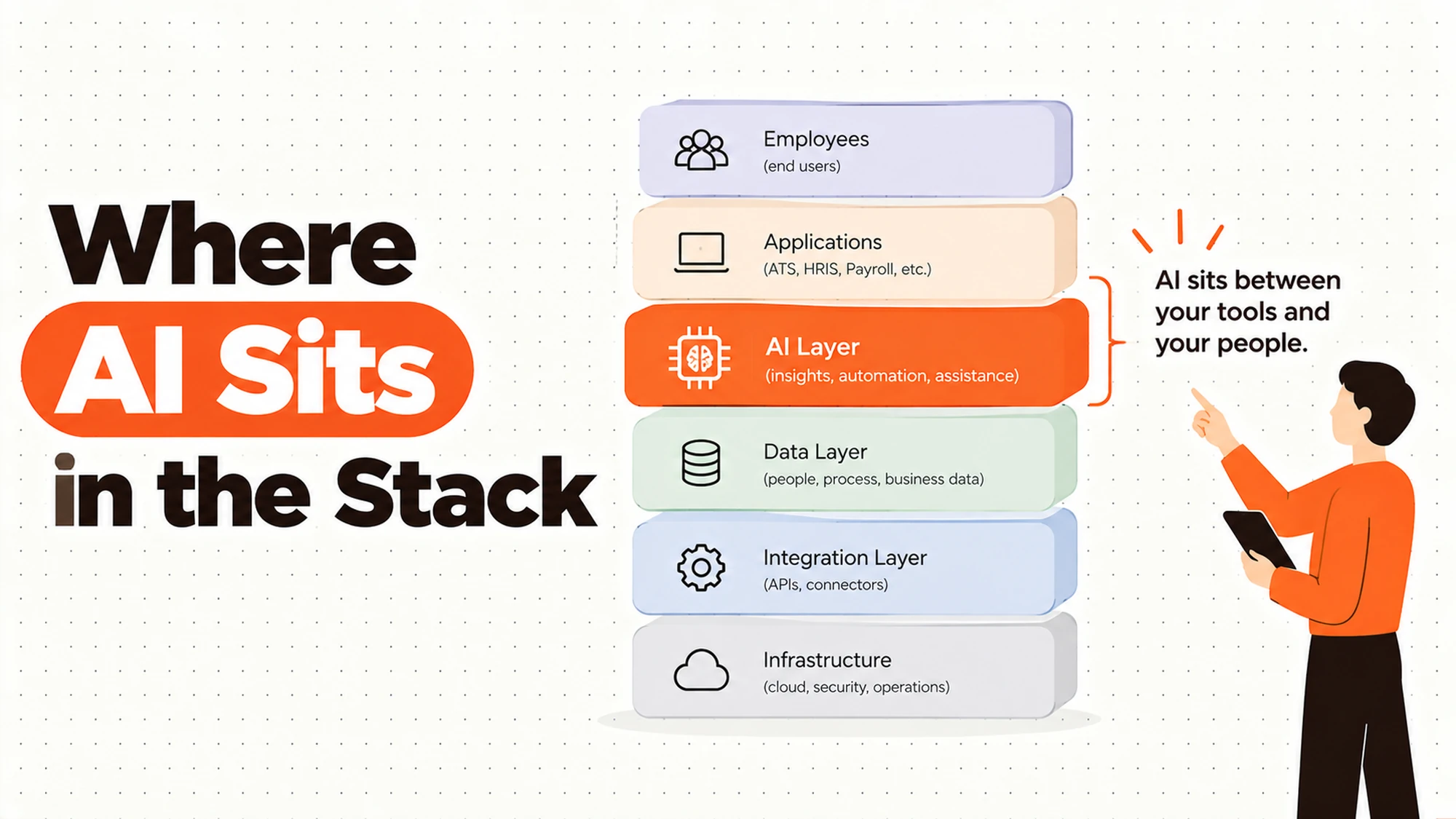
What does a layer across systems give you? Consistency and reach, which are real. It also puts a dependency in the middle of your arrangement, which is the hardest thing on this list to remove later, because by then several systems are routing through it.
Should you build anything? Rarely, and the reason isn't difficulty. It's that building means owning maintenance in an area that changes fast, and the people who built it will move on. There are situations where it's right, and they're narrower than enthusiasm suggests.
Is waiting a real option? Yes, and it deserves stating as a choice rather than happening by default. The cost of waiting is whatever the manual work costs for another period. The cost of committing early to a shape that's hard to unwind is larger and less visible.
What Each Shape Costs to Undo
| The shape | What you're committed to | What leaving looks like |
|---|---|---|
| Feature in a system you own | Nothing beyond the switch | Turn it off |
| Paid add-on from your existing vendor | A line on your renewal | Drop it at renewal |
| Separate point tool | Contract, integration, data held there | Extraction, migration, a gap in the meantime |
| Layer across several systems | Every system routing through it | Unpicking connections one at a time |
| Built internally | Maintenance, and the people who know it | It stops working when they leave |
| Deliberately waiting | Nothing | Nothing, that's the point |
| Bundled in a wider platform purchase | The whole platform | A replatforming exercise |
| An arrangement with a service provider | The relationship and its scope | Renegotiation, or a notice period |
The first and third rows are the gap that matters, and it's wider than most comparisons suggest. A bundled feature you dislike costs a click. A point tool you dislike costs a contract you're still paying, an integration somebody built, data that needs extracting and a period where the job isn't being done at all.
The fourth row is the one that becomes irreversible quietly. A layer starts as a sensible way to apply one capability consistently, systems get connected to it one at a time because each connection is individually reasonable, and eventually removing it means touching everything.
The fifth row is worth being honest about. Internal builds in this area tend to be created by one or two enthusiastic people, work well, and become unmaintainable the moment those people move on, at which point you have a dependency nobody understands and no vendor to call.
Five Diagnostic Questions You Can Self-Assess Against
What would you do if this turned out to be wrong? Ask it before buying rather than after. The answer varies from a click to a project, and it should be the main input to the decision.
Have you tried what's included? If not, you can't say the bundled version is insufficient, and that claim is usually the justification for the larger commitment.
Which task changes, and whose? Name the person and the task. If you can't, the shape question is premature.
How fast is this area moving for your use? Where capability is changing quickly, long commitments cost more than they appear to, because you're locking in a choice that will look dated.
What happens to the data if you leave? Anything held in a separate tool has to come out. Establishing how, before committing, is much easier than establishing it during an exit.
Run these five with whoever would have to do the work rather than whoever is sponsoring the purchase. The person who'd build the integration or perform the extraction has a much more accurate sense of what each option actually costs.
Six Shapes AI Arrives In, Reviewed
A feature switched on inside the system you already own
It's included, you enable it. It earns its place as the cheapest possible experiment: no contract, no integration, no procurement, and the data is already there.
Where it falls short is depth. Bundled features tend to be adequate rather than excellent, because they're one of many things the product does, and you have no influence over their direction. You also inherit whatever the vendor decides about behaviour and change.
Almost always the right first move. Even where you expect it to be insufficient, trying it tells you what the task actually needs, which makes any subsequent purchase better specified.
Give it a fair run rather than a glance. A feature tried for an afternoon by somebody sceptical will confirm the scepticism, and a fortnight of real use by the person who'd actually rely on it produces a judgement worth having.
Record what was missing, specifically. A note saying the summaries lacked a particular element, or that it couldn't handle a category of case, is worth far more when you go shopping than a general impression that it wasn't good enough.
A paid add-on from your existing vendor
The same system, a module you pay extra for. It earns its place as a small step up in commitment with most of the convenience: the data's already there, the integration exists, and the exit is a renewal decision.
Where it falls short is pricing and lock-in over time. Add-ons accumulate, each individually reasonable, and the combined arrangement becomes harder to leave than any single decision suggested.
Reasonable where the bundled version demonstrated the value and fell short on capability. Review these at renewal deliberately, because they're the easiest thing to keep paying for out of habit.
The accumulation is the thing to watch rather than any individual decision. Each add-on is justified on its own terms, none is expensive alone, and after a few years the combined arrangement is both a significant cost and considerably harder to leave than anybody intended.
Worth listing what you currently pay for in this category once a year. Organisations are routinely surprised by their own list, and some items turn out to have no active user at all.
A separate point tool doing one job well
A specialist product for a single job. It earns its place on depth. A product doing one thing is usually better at it than a feature inside something larger, sometimes substantially.
Where it falls short is everything around the capability. A contract, an integration somebody has to build and maintain, another vendor relationship, another place your data lives, and a genuine extraction problem if you leave.
Worth it where the job is important enough to justify all of that and the included option has actually been tried. Establish the exit before signing, because that conversation is much harder later.
The integration is the part most often underestimated. Somebody has to build it, somebody has to maintain it when either side changes, and that person is usually not accounted for in the business case at all.
Ask who else in your organisation would need to be involved. A point tool that requires work from a team with its own priorities can sit half-integrated for a long time, delivering a fraction of what was bought.
A layer sitting across several systems
Something applying capability consistently across tools you already run. It earns its place on coherence, because the alternative is the same job done differently in three places.
Where it falls short is that it becomes structural. Each connection is individually sensible and the accumulated result is a dependency in the middle of your arrangement, which is the hardest position to reverse on this list.
Justifiable at real scale with genuine consistency problems. Go in knowing it's the least reversible option and price that in rather than treating it as an implementation detail.
It's worth agreeing in advance which systems will connect to it and which won't. Left open, the answer becomes all of them over time, because each additional connection is easier to justify than the first one was.
The failure it's meant to solve is worth checking too. Inconsistency between systems is sometimes a real problem and sometimes just an untidiness that nobody is actually suffering from, and those warrant very different levels of commitment.
Capability built internally
Your own people build something. It earns its place where the need is genuinely specific to you and no product addresses it, which does happen.
Where it falls short is continuity rather than capability. These are usually built by one or two people, work well, and become unmaintainable when those people move on. In an area changing this fast, maintenance isn't optional, and a thing nobody understands is a liability rather than an asset.
Rarely the right answer for a standard need. Where you do it, the question to settle first is who maintains it in two years, and a vague answer is a reason not to start.
The honest version of that question is whether anybody other than the builder could pick it up. Something well documented and conventionally built can be inherited; something clever and undocumented cannot, whatever anybody intends at the time.
There's also an opportunity cost that rarely appears in the discussion. The people capable of building this are usually the people you most need on other things, and the maintenance claim on them is permanent rather than one-off.
Deliberately waiting
Choosing not to act yet, with a reason and a revisit date. It earns its place as a genuine option that gets left off lists, and its cost is simply the manual work continuing for another period.
Where it falls short is when it isn't a decision. Drift produces the same outcome without the benefit of anybody having chosen it, and it means nobody is watching for the point at which the answer changes.
The right answer more often than the market implies. Make it explicit, write down what would change your mind, and put a date on revisiting.
Writing down what would change your mind is the part that makes this a decision rather than an avoidance. A specific trigger, a volume, a complaint, a task somebody can no longer do, means the revisit happens on evidence rather than on whoever raises it most persistently.
It also gives you something to say. Waiting with a stated reason is a defensible position in a conversation with anybody asking why you aren't doing something; waiting with no reason isn't.
The Decision Table
| Situation | Scale | Setup | Primary Pain | Recommended Starting Point |
|---|---|---|---|---|
| No task would change | Any | Any | None | Wait, deliberately |
| Haven't tried the included version | Any | Any | Buying before measuring | Switch it on first |
| Included version tried, insufficient | Any | Any | A real capability gap | An add-on, or a point tool |
| One job matters a great deal | Any | Any | Depth genuinely needed | A point tool, exit established first |
| Same job done three ways | Large | Fragmented | Inconsistency | A layer, priced as irreversible |
| Need is specific, no product fits | Any | Any | Nothing off the shelf | Build only with named maintenance |
| A team already bought something | Any | Unmanaged | A decision already made | Work out which shape you have |
| Renewal approaching on add-ons | Any | Accumulated | Paying out of habit | Review each one deliberately |
| Long commitment, fast-moving area | Any | Evaluating | Locking in a dated choice | Shorten the commitment |
The second row is the one that saves the most money and gets skipped most often. Organisations routinely buy a specialist tool without having enabled the thing they already pay for, on the reasonable-sounding basis that the included version won't be good enough. Frequently it is, and where it isn't, trying it produces a far better specification for what to buy instead.
The assumption survives because nobody has to defend it. Saying the included version wouldn't be sufficient sounds like expertise, it's rarely challenged in a meeting, and testing it takes a fortnight that nobody has allocated.
The ninth row is the calibration that this whole piece is about. Where capability is moving quickly, the cost of a long commitment isn't just the money, it's being locked into a choice that will look dated while the exit terms still apply.
The seventh row is the situation most organisations are actually in. Somebody somewhere has already bought or started using something, and the useful first move is working out which shape it is rather than treating it as a policy breach.
Choosing on Reversibility
Capability comparisons expire. Whatever is best today is a statement about today, and your commitment will outlive it. Exit cost is the property that stays stable, which makes it the better basis for a decision.
Small steps produce better information. Switching on a bundled feature tells you what the task actually needs. That knowledge makes any later purchase better specified, and you can't get it from a demo or a business case.
It also reveals whether anybody wants it. A feature enabled and ignored has told you something important about the problem, at no cost, before a contract existed.
Irreversibility accumulates quietly. Nobody decides to become dependent on a layer. It happens one sensible connection at a time, and the point of no return passes without a meeting.
Which is why the boundary is worth agreeing early. Deciding in advance what will and won't connect to something is far easier than arguing about the tenth connection when nine already exist.
Ask about leaving before you arrive. How data comes out, what notice applies, what happens to anything the tool holds. These questions are easy during a sales conversation and difficult during an exit, and the difference in cooperation is considerable.
Get the answer in writing. Exit terms described in a meeting have a way of being remembered differently a year later, and a vendor who meant what they said loses nothing by confirming it.
Waiting has a price and it's usually visible. The manual work continues, and you can measure that. The cost of a commitment that turns out to be wrong is larger and harder to see in advance, which biases decisions towards acting.
Visible costs win arguments they shouldn't. A known monthly cost of doing something by hand is easy to put in a case; the cost of being locked into the wrong thing has no line to sit on.
Match commitment to how settled the need is. A job you've done the same way for years can support a longer commitment. Something you started doing recently, in an area changing quickly, shouldn't.
A shorter term costs something, and it's usually worth it. Vendors price longer commitments better, and the discount is frequently smaller than the value of being able to change your mind in an area moving this fast.
The practical version of all this is a preference rather than a rule. Start with what you own, step up only when you've demonstrated the gap, and treat anything that would take a project to undo as a decision that needs more evidence than a demonstration can provide.
The preference bends where a need is genuinely specific and long-standing. An organisation that has done the same thing the same way for years, at volume, has a settled requirement and can reasonably commit further than one exploring something new.
Where These Arrangements Go Wrong
| The failure | How it shows up | What would have to change |
|---|---|---|
| Point tool bought before trying the included one | Paying for a gap nobody measured | Enable what you own first |
| Exit never discussed | Data you can't get out easily | Ask before signing |
| Layer adopted as an implementation detail | A dependency nobody can remove | Price it as irreversible |
| Built internally, nobody maintains it | It breaks when somebody leaves | Name the maintainer, or don't build |
| Add-ons accumulate unreviewed | Paying for several things out of habit | Review each at renewal |
| Waiting by drift rather than decision | No reason, no revisit date | Make it explicit |
The first row is the most common and the most avoidable. It happens because the bundled feature is assumed to be inadequate without anybody testing that assumption, and because a specialist vendor is usually more persuasive than a feature list.
The fourth row is the one that arrives with no warning at all. Something built internally works until the person who built it leaves, and the failure tends to surface during whatever else is happening that month.
The sixth row is the failure that looks like caution and isn't. An organisation that hasn't decided anything isn't being careful, it's not watching, and the moment when the answer changes will pass unnoticed because nobody is looking for it.
The second row is the one that costs real money quietly. Data held somewhere with no established route out isn't a problem until the day you want to leave, at which point it becomes the whole negotiation.
What to Put in Writing
| Artefact | Who owns it | When it is written | What it prevents |
|---|---|---|---|
| The task that changes, and whose | Whoever owns the process | Before evaluating | Buying without a use |
| What you found when you enabled the included version | Whoever owns the system | Before buying anything else | An unmeasured gap |
| What leaving would take, per option | Whoever evaluates | Before committing | Discovering exit cost during exit |
| Who maintains anything you build | Named individual | Before building | A liability with no vendor |
| The revisit date, if waiting | Whoever owns the process | When you decide to wait | Drift mistaken for a decision |
| What applies to you, per jurisdiction | You, with local advice | Before committing | A position you assumed |
The third row is the one that changes decisions. Writing down, for each option, what it would take to leave puts the comparison on the axis that actually matters, and it frequently reorders a shortlist that was built on capability alone.
The second row is worth keeping even after you've moved on from it. A record of what the included version couldn't do is the clearest possible specification for anything you buy next, and it's the first thing anybody forgets.
Questions to Ask Before You Commit
On exit. What does leaving take? A bad answer is that customers don't leave.
On data. How does our information come out? A bad answer is that it's exportable.
On the included version. Have we tried what we own? A bad answer is that it wouldn't be enough.
On term. How long are we committing? A bad answer is that it's standard.
On dependency. What would route through this? A bad answer is everything, eventually.
On maintenance. Who owns this in two years? A bad answer is the team.
What Getting This Wrong Costs
The first cost is paying for a gap nobody measured. A specialist tool bought on the assumption that the included capability is insufficient, without anybody having switched the included capability on. That's a contract, an integration and an ongoing cost, incurred to solve a problem whose size was never established, and it's the single most common expensive mistake available in this area.
It's also hard to unwind once it's happened, because nobody wants to conclude that a purchase they championed was unnecessary. The tool stays, gets used, and quietly becomes part of the arrangement.
The second cost is a dependency nobody chose. Layers and integrations accumulate through individually sensible decisions, and at some point several systems are routing through something that would take a project to remove. Nobody approved that state. It emerged, and by the time anybody notices, undoing it competes with everything else for resources it won't get.
It also constrains decisions that have nothing to do with AI. A system you might otherwise replace becomes harder to replace because of what now depends on it, and that constraint shows up in conversations where nobody remembers how it got there.
The third cost is being locked into a dated choice. In an area moving this quickly, a long commitment signed on today's capability comparison will be carrying yesterday's answer while the terms still bind you. That's not an argument against committing, it's an argument for matching the length of the commitment to how settled the need actually is.
The awkward part is that the discount for a longer term is real and visible, while the cost of being locked in is neither. That asymmetry pushes decisions towards longer commitments than the situation warrants.
So do three things before signing anything. Enable what you already own and see what the task actually needs. Write down, per option, what leaving would take. And if you decide to wait, say so explicitly with a date on it, because waiting decided is a strategy and waiting by default isn't.
None of the three needs a budget or a vendor's cooperation, and all three are considerably easier before a shortlist exists than after one has developed its own momentum.
When You Are Ready to Go Further
Start with what you own, even where you expect it to disappoint. It costs a switch, it produces information no demonstration can, and the specification for anything you buy afterwards will be far better for having done it. The organisations that regret purchases in this area are overwhelmingly the ones that skipped this step.
Put somebody on it who'd actually use the thing, and give them a fortnight. A trial run by whoever is evaluating tools, rather than by whoever does the work, produces a verdict about the interface rather than about the job.
Then put exit cost next to capability in whatever comparison you're building. For each option: what leaving takes, how data comes out, what notice applies, what would have to be unpicked. That column reorders shortlists more often than not, and it's information vendors will give you readily before a contract and reluctantly afterwards.
Ask for it in writing rather than in a conversation. Exit terms described verbally during a sale have a way of being remembered differently later, and a short written answer costs a vendor nothing if they meant it.
Finally, be honest about which of these decisions is genuinely reversible. A switch you can flick is a low-stakes experiment and should be treated as one, quickly. Anything that would take a project to undo deserves more evidence than a demonstration and a good conversation, because you'll be living with it well past the point where today's capability comparison means anything.
The corollary is that reversible decisions should be made faster than they usually are. Organisations frequently apply the same evaluation weight to a setting and to a contract, which wastes effort on the first and rushes the second.
HROpsLab publishes independent comparison work across HR tooling. We sell nothing, we take no vendor money, and we publish no paid placements. If the next step is understanding what your current tooling already includes, our comparison work is one place to start.
Frequently Asked Questions
Should you use the AI already included in your HR system?
Usually yes, as a first step, even where you suspect it won't be good enough. It costs a switch rather than a contract, the data is already there, and it answers the question you genuinely can't answer any other way: whether the task in question actually changes. Where it turns out to be sufficient you've saved a purchase. Where it falls short, you now have a specific description of what's missing, which makes anything you buy afterwards far better specified than a shortlist built from demonstrations.
What's the difference between bundled AI and a separate tool?
Depth on one side and reversibility on the other. A specialist product doing one job is usually better at it, sometimes substantially, because it isn't one feature among many. What comes with it is a contract, an integration somebody builds and maintains, another vendor relationship, another place your data lives, and a genuine extraction problem if you leave. A bundled feature you dislike costs a click to abandon. A point tool you dislike costs considerably more, and that gap is wider than most comparisons show.
Should you build AI capability internally?
Rarely for a standard need, and the reason isn't technical difficulty. It's maintenance in an area that changes quickly, carried by people who will eventually move on. Internal builds here are typically created by one or two enthusiastic people, work well, and become unmaintainable when those people leave, at which point you have a dependency nobody understands and no vendor to call. Where the need is genuinely specific and nothing off the shelf fits, settle who maintains it in two years before starting.
What does an AI layer across systems mean?
Something that applies capability consistently across several tools you already run, rather than each tool doing its own version. The appeal is coherence, and it's real where the same job is currently done three different ways. The thing to understand going in is that it becomes structural: connections get added one at a time, each individually sensible, and eventually removing it means touching everything. It's the least reversible shape on the list, which is worth pricing rather than discovering.
Is it reasonable to wait before adopting AI in HR?
Yes, and it belongs on the list of options rather than being treated as a failure to decide. The cost of waiting is visible and measurable: the manual work continues for another period. The cost of committing early to something hard to unwind is larger and much harder to see in advance. What makes waiting work is making it explicit, with a stated reason and a date to revisit, because drift produces the same outcome without anybody watching for the point at which the answer changes.
What happens when you stop using an AI tool?
It depends entirely on the shape. A bundled feature stops when you switch it off. An add-on ends at renewal. A point tool means extracting whatever it holds, unpicking an integration, and a period where the job isn't being done while you arrange something else. A layer means unpicking every connection that grew into it. Those are very different exits, and the time to establish which one applies is during a sales conversation, where the answers come readily, rather than during a departure.
Which AI decisions are actually reversible?
Anything that's a setting in a system you already own. That's most of what's available to most organisations, and it's why starting there is sound. Anything involving a contract, an integration or data held somewhere new is meaningfully harder, and anything several systems come to depend on is harder again. The useful habit is asking what you'd do if this turned out to be wrong, before buying rather than afterwards, because the answer ranges from a click to a project and should shape how much evidence you require.
How do you avoid being locked into an AI tool?
Match the length of the commitment to how settled the need is, keep the amount of your arrangement that routes through any single thing modest, and establish how data comes out before it goes in. Also be alert to accumulation: nobody decides to become dependent on a layer or a stack of add-ons, it happens through individually reasonable decisions, and the point of no return passes without a meeting. Reviewing what you're paying for at each renewal, deliberately rather than by default, catches most of it.
Capability comparisons expire. Exit costs don't.