
TL;DR
- The core decision: which AI features in your HR software are worth switching on, and which are a word.
- When doing nothing is right: when nobody has a job the feature would change.
- What has to be true: you can say what the feature produces, not what it's called.
- How the options split: by output. Ranking, extraction, generation, prediction, classification, matching.
- Decision rule: ask what comes out, then ask what a wrong one looks like.
- Outcome to expect: a shorter list of features that matter, and clearer questions about each.
The Feature List That Explains Nothing
Your HR software sends a release note. Six new AI-powered features. You read the list twice and you still could not say what any of them do.
This isn't a failure of attention. The list says things like AI-assisted screening, intelligent matching, smart summaries, predictive insights. Every phrase describes a benefit rather than a behaviour, and the word doing the work in each of them is doing no work at all. AI isn't a capability. It is a family of techniques, and the same two letters sit in front of six things that behave differently, break differently, and need completely different questions asked about them.
So the release note tells you nothing you can act on, and the demo won't help either, because a demo shows you the feature succeeding.
Best tools for AI HR Tools
Here is the reframe that makes this tractable. Stop asking what the feature is and ask what it produces. Does it hand you an ordered list? A field pulled out of a document? A paragraph of text? A number about a person? A category? A pairing of two things? There are only a few answers, and once you know which one you're looking at, you know what it can be wrong about, who would notice, and what it would cost.
That is the whole of this piece. Six outputs, what each one genuinely is, and what changes about your questions depending on which you have bought.
One thing to settle before any of it. Whether a given use of automated processing about people is permitted, what you have to tell anybody, and what assessment you might owe are all questions whose answers differ by jurisdiction, differ by sector, and are changing quickly at the moment. Nothing here tells you what applies to you. Establish that with local advice, and take the governance side of it from the material we publish on AI in the workplace, which is where it belongs.
When You Genuinely Do Not Need to Act Yet
Nobody has a job the feature would change. The feature exists, it is included, and no task anybody does would be different with it on. That is a perfectly good reason to leave it alone rather than find a use for something you already paid for.
Somebody is doing the work the feature describes. A person spends real time ranking, summarising or extracting, and a feature claims to do that. Worth looking at properly, which starts with knowing which of the six you have.
The work is a genuine constraint. The manual version is limiting what the team can take on, or it is being skipped, or it depends on one person. At that point the feature is worth evaluating carefully rather than dismissed.
The edge case that forces it. Somebody has already switched something on, or a team is using an outside tool nobody approved, and the question arrives as a fact rather than a decision. Work out what it produces before working out what to do about it.
Five Questions This Reader Asks at 11pm
Is AI just a new word for automation? Sometimes it genuinely is, and that is worth knowing rather than resenting. Plenty of features labelled AI are rules somebody wrote, running the way rules have always run. The difference that matters is not the label, it is whether the behaviour was specified by a person or derived from data, because the first can be read and the second can only be observed.
Does it matter which kind I have? More than anything else you could ask. A generation feature can produce something confidently untrue. An extraction feature can quietly drop a field. A prediction can be perfectly reasonable about a population and wrong about the person in front of you. Same label, three completely different failures, three different people positioned to catch them.
Are these features actually good? Unanswerable as asked, and the honest answer is that it depends on what happens when they are wrong. A feature that is right most of the time and wrong invisibly can be worse than one that is right less often and obviously wrong, because the second gets corrected and the first does not.
Do I need any of this? Possibly not, and nobody selling it will say so. The test is whether a task in your week would change. If you cannot name the task, the feature is not going to find one for you.
What if I switch it on and it goes wrong? Then it depends entirely on where the output goes. Something that produces a draft for a person to work from is low risk. Something that produces a decision about an individual, or text that reaches them, is a different proposition, and the difference is worth drawing before you enable anything.
What the Word Does Not Tell You
| What a buyer assumes the label answers | What it actually answers | What you have to ask instead |
|---|---|---|
| Whether the feature is capable | Nothing about capability | What does it produce, in what form |
| Whether it is accurate | Nothing about accuracy | What does a wrong one look like |
| Whether it is new | Nothing, this may be old logic | Was the behaviour written or derived |
| Whether it will save time | Nothing, it may add checking | Which task changes, and for whom |
| Whether it can explain itself | Nothing | Can you see what it was working from |
| Whether it is safe to switch on | Nothing | Where does the output go next |
| Whether it improves over time | Nothing, it may also move | What changes it, and are you told |
| Whether it needs your data | Nothing | What does it read to answer this |
The first row is the one to hold on to, because it's the assumption underneath every other. The label describes a family of methods, and a family of methods is not a statement that this particular implementation does the thing you need. Two products can carry the same word and differ enormously.
The third row catches something people find irritating and should not. A feature whose behaviour was written by a person as a set of rules is frequently the better buy: you can read it, you can predict it, and it doesn't move. The word on the feature list doesn't distinguish these, and the distinction is one of the more useful ones available.
The last row is the question that most often goes unasked and most often matters. A feature that reads your records to answer a question is doing something different from one that answers out of what it was built on, and the difference determines what it can possibly know about your organisation.
Five Diagnostic Questions You Can Self-Assess Against
For each AI feature you have, what comes out of it? Write it down in plain words. A list, a field, a paragraph, a number, a category, a pairing. If you cannot answer for a feature, you do not know what you have switched on.
Which task does it change, and whose? Name the person and the task. Features that change nobody's work are not saving anything, whatever the release note says.
Where does the output go next? Into a draft somebody edits, into a decision, into a message to an employee, into a report. The answer tells you how carefully the rest of this needs to be thought about.
What would a wrong output look like here? Not whether it will be wrong. What it would look like. If a wrong one is indistinguishable from a right one at a glance, you have a detection problem rather than an accuracy problem.
Who would notice, and when? Trace it. The uncomfortable answer for many features is that the person who would notice is the employee the output was about, which is the worst detection mechanism available.
Six Things Wearing the Label, Reviewed
Ranking or scoring a set of items
You give it a set and it hands them back in an order, usually with a number attached. It earns its place when the set is genuinely too large to look at and the ordering is better than arbitrary, which is a lower bar than it sounds and a real benefit.
Where it falls short is that an order is not a judgement. The item at the top is the one the ordering put at the top, which is not the same as the best one, and the number beside it invites a confidence nothing supports. The items at the bottom are also invisible, so anything wrongly ranked low is wrongly ranked low permanently unless somebody deliberately looks.
Useful for deciding where to spend attention. Treat the order as a reading order and never as a verdict, and look at some of the bottom sometimes.
The number beside each item deserves particular suspicion. It looks like a measurement and it's a position, and the difference matters because a person reading a list will treat a higher number as a stronger claim when frequently the gap between the top item and the tenth is negligible.
The other thing worth establishing is what the ordering is even trying to optimise. Ranking always sorts by something, that something was chosen by somebody, and if nobody can tell you what it is, the order is being trusted without anybody knowing what it means.
Extracting structured fields from an unstructured document
It reads a document and pulls out values: dates, names, amounts, terms. It earns its place because the alternative is somebody typing, and typing is slow and produces its own errors.
Where it falls short is silence. A field that was not found frequently comes back empty rather than flagged, an empty field looks the same as a field that's genuinely blank, and a value read from the wrong part of a document looks entirely normal. The errors are quiet and they're structural rather than random, which means they repeat on documents of the same shape.
Good where documents are consistent. Check what it does with an unusual one before trusting it on the ordinary ones.
The test worth running is deliberately awkward. A document with an unusual layout, one where a value appears twice with different figures, one missing a section entirely. Ordinary documents pass everywhere, and the cases that break extraction are exactly the ones nobody thought to try.
Decide as well what an empty result should mean downstream. If a missing value silently becomes a blank field in a record, that blank will eventually be read as information, and nobody will remember it came from a document the system couldn't parse.
Generating text
You ask and it writes: a summary, a draft, a rewrite, a reply. It earns its place as a starting point, because starting is the expensive part of writing and a draft to react to is easier than a blank page.
Where it falls short is that it will produce something plausible regardless of whether it knows. Generated text does not indicate uncertainty in any reliable way, so a paragraph containing an invented detail reads exactly like one that does not. In HR this matters disproportionately, because the text is frequently read by the person it describes.
Fine for drafts somebody knowledgeable edits. The question is never the quality of the draft, it is who is answerable for the version that goes out.
The uncomfortable property is that a good draft is more dangerous than a poor one. Something obviously rough gets rewritten; something fluent and nearly right gets skimmed and approved, and the small invented detail inside it travels with it.
That makes the editor's knowledge the whole control. Somebody who knows the subject will catch an invented detail in a second. Somebody who doesn't will read the same paragraph and find nothing wrong with it, because there's nothing visibly wrong with it.
Predicting something about a person or a population
It produces a number or a category expressing a likelihood: who might leave, who might succeed, what headcount is coming. It earns its place at the population level, where it can point attention at a group worth thinking about.
Where it falls short is the step from population to individual. A statement about a pattern is not a statement about a person, and the score beside somebody's name reads like the second while only supporting the first. It is also the output most likely to change how somebody is treated, which is the point at which a prediction starts affecting its own outcome.
Useful for deciding where to look. Never let it stand as a fact about an individual, and establish with local advice what rules apply where predictions inform decisions about people.
The framing that keeps this safe is that a prediction is a question rather than an answer. Somebody scored as likely to leave is somebody worth having a conversation with, and the conversation is the point. Treating the score itself as the finding skips the only part that could have told you anything.
It's also the output where being wrong is least visible, because a prediction that doesn't come true was never falsified in any obvious way. Nobody can tell you afterwards whether the score was wrong or whether something changed.
Classifying an item into a category
It sorts things into buckets: this query is about leave, this document is a contract, this case is urgent. It earns its place on volume, because sorting is tedious, consistent-ish sorting is genuinely useful, and the consequences of a single misfile are usually small.
Where it falls short is at the boundaries and with the things that fit nowhere. Items sitting between two categories get assigned to one with no indication that it was close, and an item belonging to no available category will still be assigned to one. The categories also encode somebody's assumption about what kinds of thing exist.
Reliable for routing. Look at what lands in the least-used categories, because that's where the mistakes accumulate.
The other place to look is anything that was assigned with no good fit. A classifier given something belonging to none of its categories will still choose one, confidently, and the result looks identical to a correct assignment. Nothing in the output says this was a poor match.
Worth reviewing the category list itself once in a while. The buckets encode somebody's assumption about what kinds of thing exist, that assumption ages, and an obsolete category quietly collects things that should have gone somewhere else.
Matching two sets to each other
It pairs items across two sets: people to roles, people to courses, requests to resources. It earns its place when both sets are large enough that a person can't hold them together.
Where it falls short is that the match is only as meaningful as the description of each side, and both descriptions are usually thin. A match is a statement that two records resemble each other in the terms the system holds, which is a much weaker claim than that the pairing is a good idea. Everything unrecorded about both sides is absent from it.
Worth having where the sets are genuinely large. Read a match as a suggestion to consider, not a conclusion.
What determines quality here is the description on each side, and both are usually thinner than anybody admits. A record describing a person by the attributes a system happens to hold is a narrow account of them, and a match built on two narrow accounts inherits both gaps.
The absences are the interesting part. Everything true about somebody that was never recorded is invisible to the matching, which means it reliably favours whatever is well documented over whatever is not.
The Decision Table
| Situation | Scale | Setup | Primary Pain | Recommended Starting Point |
|---|---|---|---|---|
| No task would change | Any | Any | None | Leave it off |
| Cannot say what a feature produces | Any | Features enabled | Unknown behaviour | Write down the output, per feature |
| Somebody spends real time ordering | Any | Manual | Attention, not accuracy | Ranking, read as reading order |
| Somebody retypes from documents | Any | Manual | Slow, error prone | Extraction, tested on odd documents |
| Blank page is the bottleneck | Any | Manual | Starting, not quality | Generation, with a named editor |
| Want to know where to look | Any | Any | Attention across a population | Prediction, population level only |
| High volume of things to sort | Any | Manual | Tedium | Classification, watch the rare buckets |
| Two large sets to pair | Any | Manual | Cannot hold both | Matching, read as suggestions |
| Output reaches an employee directly | Any | Any | A person was told something | A named person answerable for it |
The second row comes before every other row. You can't evaluate a feature whose output you cannot describe, and a surprising number of enabled features fall into this category, because they arrived switched on in a release rather than through anybody's decision.
The last row is the one to treat differently from the rest. Everything above it is about usefulness. That row is about somebody being told something by their employer, and it deserves a named person rather than a process.
The ninth row is also the one where the feature category matters least. Whether the text was generated, the score predicted or the category assigned, what reaches the employee is a statement from you, and the person answerable for it has to be somebody rather than the system that produced it.
The Question That Sorts Them
Ask what comes out, not what it is. The output is observable, the category is marketing, and the output determines everything downstream: what a wrong one looks like, who can catch it, what it costs.
Written behaviour and derived behaviour are different purchases. Something a person specified as rules can be read, predicted and corrected at the rule. Something derived from data can only be observed. Neither is better, and the release note will not tell you which you have, so ask.
Confidence is presentation, not information. A number beside an output, a ranking position, a smoothly written paragraph: none of these carry a reliable indication of how sure the thing was. Reading them as confidence is the most common mistake in this area and the easiest to avoid.
The absent case is invisible. Whatever was ranked last, classified into a bucket nobody reads, or dropped silently from an extraction never appears in front of anybody. Every one of these six features has a category of output that nobody will ever look at unless somebody decides to.
The output's destination sets the stakes. The same generation feature is trivial when it drafts a note for an experienced person to rewrite and serious when its output is sent to an employee unedited. The feature did not change. What changed is what happens next, and that is the part you control.
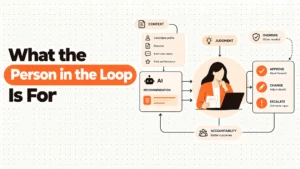
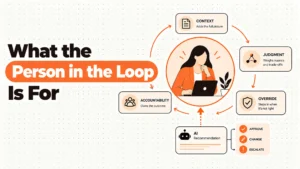
A person is the only thing that knows your organisation. None of these six features knows that a particular team is going through something, that a figure is unusual for a reason, or that somebody's record is out of date. That knowledge is what makes a human check worth anything, and it is the reason the check has to be done by somebody who actually has it.
The reason this sorting is worth doing at all is that it converts an unanswerable question into six answerable ones. Nobody can tell you whether AI is good for HR. Anybody can tell you what happens when an extraction silently drops a date.
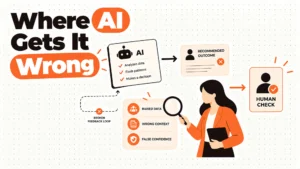
Where These Features Go Wrong
| The failure | How it shows up | What would have to change |
|---|---|---|
| Score read as a judgement | A decision resting on an ordering | Treat order as where to look |
| Extraction fails quietly | A missing value nobody noticed | Test on unusual documents |
| Generated text goes out unedited | An employee told something untrue | A named person answerable |
| Population claim applied to a person | Somebody treated by their score | Keep predictions at population level |
| Nothing ever looks at the bottom | Errors accumulate where nobody looks | Sample the low-ranked and rare buckets |
| Feature enabled by a release | Behaviour nobody decided on | Inventory what is actually on |
The second row is the quiet expensive one, because there's no error, no flag and no anomaly. A field that came back empty looks precisely like a field that was empty, and the difference only surfaces when somebody needs the value.
The sixth row is more common than it should be. Features arrive enabled by default in releases, nobody notices, and behaviour that nobody chose becomes part of how the organisation works. An inventory of what is actually switched on is an afternoon's work and usually surprises somebody.
The fifth row is the one that compounds. Anything ranked low, filed into an unread category or dropped from an extraction is not merely missed once, it's missed every time, because nothing about the arrangement will ever surface it. Sampling those places occasionally is the only thing that finds them.
What to Put in Writing
| Artefact | Who owns it | When it is written | What it prevents |
|---|---|---|---|
| Every AI feature enabled, and its output | Whoever owns the system | Now | Behaviour nobody decided on |
| Which task each one changes, and whose | Whoever owns the system | Now | Features that save nothing |
| Where each output goes next | Whoever owns the system | Now | A decision resting on a ranking |
| What a wrong output looks like | Whoever uses the feature | Before relying on it | A detection gap nobody named |
| Who is answerable for anything reaching a person | Named individual | Before it does | A draft nobody owned |
| What applies to you, per jurisdiction | You, with local advice | Before automated decisions | A position you assumed |
The first row is the one to do this week regardless of any decision. Listing the features that are actually on, and what each produces, takes an afternoon and routinely finds something enabled that nobody chose and nobody can describe.
The fourth row is the one people skip because it feels speculative. It isn't: describing what a wrong output would look like is a concrete exercise, it takes a few minutes per feature, and it tells you immediately whether anybody in your process is positioned to catch one.
Questions to Ask Before You Commit
On output. What does the feature produce? A bad answer is insights.
On behaviour. Was this written as rules or derived from data? A bad answer is that it is proprietary.
On failure. What does a wrong output look like? A bad answer is that it is highly accurate.
On sources. What does it read to answer this? A bad answer is your data.
On change. What makes the behaviour move? A bad answer is that it keeps improving.
On destination. Where does the output go? A bad answer is into the workflow.
What Getting This Wrong Costs
The first cost is a decision resting on something that was never a judgement. A ranking is an ordering and a score is a number, and when either gets treated as a conclusion about a person or a document, the organisation has made a decision on a basis nobody could defend if asked. The frustrating part is that the feature did nothing wrong. It produced an ordering, correctly, and somebody read it as a verdict.
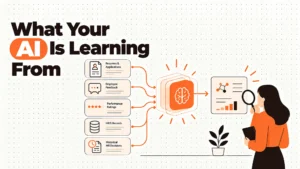
The second cost is the error that generates no signal. Extraction that silently drops a field, classification that files something into a bucket nobody reads, ranking that buries an item at the bottom: none of these throw anything, none appear in any report, and all are found later by somebody who needed the thing that went missing. This is the characteristic failure of the whole category, and it is why the detection question matters more than the accuracy question.
The third cost lands on an employee. Generated text that reaches somebody unedited, a score that changed how a manager treated them, an assistant's confident wrong answer that they acted on: these aren't inaccuracies, they're things a person was told by their employer. The damage is to trust, it is slow to repair, and it is out of proportion to how small the underlying technical failure was.
So before switching anything on, do three things. Write down what each enabled feature produces. Name the task it changes and the person whose task it is. And trace where each output goes, because everything that matters follows from whether it ends in a draft or in front of an employee.
When You Are Ready to Go Further
Start with the inventory, because it costs an afternoon and changes the conversation. Every AI feature currently enabled, what it produces in plain words, which task it changes, and where the output goes. Most organisations find at least one thing switched on that nobody decided on, and at least one that changes nobody's work.
Then take the features that survive that list and ask the failure question about each: what a wrong output looks like, and who is positioned to see it. That question does more to sort useful features from decorative ones than any comparison of capability, and it needs no technical knowledge to answer.
Finally, draw the line between outputs that produce a draft and outputs that reach a person or a decision. Everything on the first side can be adopted fairly freely and reversed easily. Everything on the second side needs a named person answerable for it, and needs you to have established, with local advice, what applies to you where automated processing informs decisions about individuals.
HROpsLab publishes independent comparison work across HR tooling. We sell nothing, we take no vendor money, and we publish no paid placements. If the next step is understanding what your current tooling actually offers here, our comparison work is one place to start.
Frequently Asked Questions
What does AI in HR software actually mean?
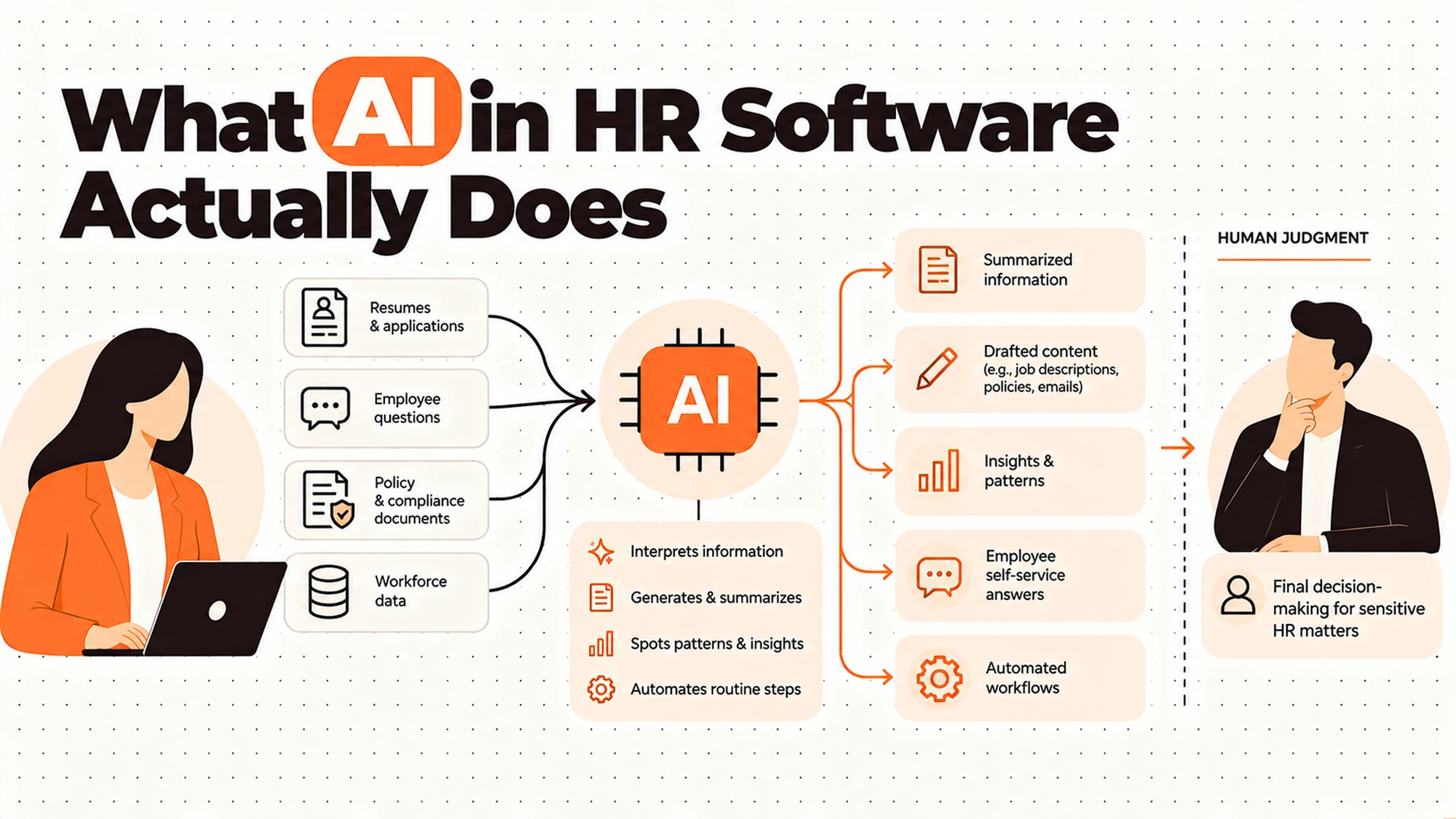
It is a label covering a family of techniques rather than a single capability, which is why a feature list using the word tells you very little. In practice the features behind it produce one of a small number of things: an ordered list, a field pulled out of a document, generated text, a prediction about a person or a population, a category assignment, or a pairing between two sets. Those six behave differently and fail differently, so the useful question about any feature is never what it is called but what comes out of it and in what form.
Is AI just a rebrand of automation that already existed?
Sometimes yes, and that is worth establishing rather than resenting, because the distinction is genuinely useful. Some features labelled AI are rules a person wrote, running as rules always have. Others derive their behaviour from data. The practical difference is that written behaviour can be read, predicted and corrected at the rule, while derived behaviour can only be observed from the outside. Neither is inherently better, and a feature list won't tell you which you have, so it is a reasonable thing to ask directly.
What is the difference between generation and prediction?
Generation produces text: a summary, a draft, a rewrite, something written. Prediction produces a statement about likelihood, usually a number or a category attached to a person or a population. They fail in opposite ways. Generated text is confidently fluent whether or not it is true, so its errors read as smoothly as its successes. A prediction is frequently reasonable about a pattern and unreliable about any individual within it, so its error is not falsity so much as the wrong level of claim, applied to one person.
What is a ranking feature actually doing?
Putting a set of items in an order, usually with a number attached to each. It is not deciding which is best, and this distinction carries most of the risk in the category. The item at the top is the one the ordering placed at the top, and the number beside it invites a confidence that nothing behind it supports. The other consequence worth planning for is that whatever lands at the bottom becomes invisible, so anything ranked low in error stays ranked low unless somebody deliberately goes and looks.
What does extraction mean in an HR tool?
Reading an unstructured document and pulling out structured values from it: dates, names, terms, amounts. It replaces somebody retyping, which is genuinely worth having. Its characteristic failure is silence rather than error. A value that could not be found usually comes back empty, and an empty field is indistinguishable from one that was genuinely blank. A value read from the wrong part of a document looks entirely normal. Both failures repeat on documents of the same shape, so they tend to be structural rather than random.
How do you tell what a feature actually does?
Ask what it produces and in what form, then ask what a wrong one would look like. Both questions are answerable without technical knowledge, and between them they establish almost everything that matters: what the feature can be wrong about, who is positioned to notice, and what it costs before anybody does. A vendor answer that describes a benefit rather than an output has not answered, and it is reasonable to keep asking until you get a plain description of the thing that comes out.
Do you need AI features in HR software at all?
Frequently not, and nothing in a sales conversation will tell you so. The test is whether a task somebody actually does would change. If you can name the person and the task, the feature is worth evaluating properly. If you cannot, the feature will not find a use on its own, and switching something on because it is included is how organisations end up with behaviour nobody decided on. Leaving a feature off is a legitimate decision and costs nothing but the sense that you're missing out.
Where should you be most careful with AI in HR?
Wherever the output reaches an employee or informs a decision about one. A feature producing a draft for a knowledgeable person to rework is low stakes and easy to reverse. The same underlying capability becomes serious when its output is sent to somebody unedited, or when a score changes how a manager treats them, because those aren't inaccuracies but things a person was told or had done to them by their employer. What is permitted where automated processing informs decisions about individuals differs by jurisdiction and is changing, so establish your own position with local advice.
The label is a family of techniques. The output is the thing you bought.