
TL;DR
- The core decision: which employee questions an assistant should answer and which it shouldn't.
- When doing nothing is right: when the volume is manageable and people get good answers now.
- What has to be true: it can say it doesn't know, and somebody is reachable when it does.
- How the options split: by whether answering correctly requires knowing anything about the asker.
- Decision rule: general questions yes, anything depending on the person's own record no.
- Outcome to expect: fewer routine queries, and a clear route for the ones that matter.
The Answer Somebody Believed
An employee asks what they're entitled to. They get an answer immediately, it's clear, it's confident, and it's wrong for them.
They don't query it. Why would they? It came from their employer's system, it sounded authoritative, and they have no reason to think their situation is unusual. So they plan around it. They book something, or they don't apply for something, or they tell their family a date. The error surfaces weeks later, when the plan meets reality, and by then it isn't a wrong answer any more. It's a person who arranged their life around something you told them.
This is the specific risk with assistants in HR, and it isn't really about the technology. It's that HR questions look general and are frequently specific. What's the notice period sounds like it has one answer. It has one answer for most people and a different answer for somebody who transferred in from an acquisition, or negotiated a variation, or sits under different terms nobody flagged.
Best tools for AI HR Tools
So the useful reframe is to sort questions not by topic but by what answering them correctly requires. Some questions have one answer that's the same for everybody. Some can't be answered correctly without knowing things about the asker. An assistant is genuinely good at the first kind and structurally unable to handle the second, and the second kind doesn't announce itself.
That sorting is most of the work, and it's work you do rather than something you buy.
One boundary worth stating. Nothing here tells you what any entitlement, notice period or benefit actually is, because those differ by jurisdiction, by employer and by individual contract. That's precisely the point of the piece. Establish your own position with local advice, and keep the governance questions about disclosure and monitoring with the AI in the workplace material.
When You Genuinely Do Not Need to Act Yet
Volume is manageable and answers are good. People ask, somebody answers, nobody waits long. That's a working arrangement and an assistant would be solving a problem you don't have.
The team is buried in repeat questions. The same handful of questions, constantly, taking time from work that needs judgement. That's the genuine case for an assistant and it's a good one.
People have stopped asking. Queries take days, so employees guess instead or ask a colleague who also doesn't know. That's worse than volume, because the wrong answers are already circulating without you.
The edge case that forces it. Somebody acted on an answer that was wrong for them. Whether that came from an assistant or a person, it's the signal to sort your questions by what they actually require.
Five Questions This Reader Asks at 11pm
What can an assistant usefully answer? Anything with a single answer that's the same for everybody: where to find a form, how a process works, what a policy says in general terms, who to contact. That's a real proportion of the volume and handling it well is a genuine improvement for everybody.
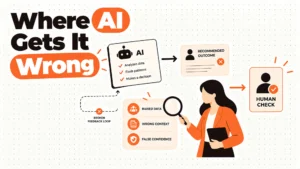
What will it get wrong? Anything where the correct answer depends on the asker's own record. It'll produce the general case, confidently, and the general case is wrong for exactly the people whose situations are unusual, which is also the people who most needed a careful answer.
Can it see the person's record? Sometimes, and that changes the risk rather than removing it. An assistant with access to somebody's record can be more specific and can also be confidently specific on the basis of a record that's out of date or incomplete, which is a worse failure than a general answer clearly labelled as general.
What happens when somebody asks something sensitive? They will. People disclose health circumstances, family situations and complaints to an assistant because it's available and feels private. Where that text goes, whether it's retained, and who can see it needs establishing before you switch anything on, with local advice on what applies to you.
Will people trust it? Initially, quite a lot, which is the problem. Trust is high until somebody gets a wrong answer, and then it collapses for that person and for everybody they tell. Trust in this area is easy to spend and slow to rebuild.
Sorting Questions by What They Require
| The question type | What answering it correctly needs | What happens if an assistant answers anyway |
|---|---|---|
| Same answer for everybody | The policy, and nothing else | Fine, this is what it's for |
| Depends on the asker's own record | Their actual terms and history | The general case, wrong for the unusual |
| About something not yet decided | Knowledge that no answer exists | A plausible answer to an open question |
| Really a complaint | Recognising it isn't a question | A policy response to a person who needed a hearing |
| A sensitive personal situation | Judgement, and a human | An efficient reply to something that wasn't administrative |
| Phrased misleadingly | Noticing the phrasing is off | A correct answer to the wrong question |
| About another person | Knowing what this asker may see | Information they weren't entitled to |
| Seeking permission, not information | Authority, which it doesn't have | Something read as approval |
The second row is the whole problem in one line. These questions look identical to the first row from the outside, they're extremely common in HR, and the people they go wrong for are the ones with non-standard arrangements, who are also the people least able to spot that an answer doesn't apply to them.
The fourth row is the one that does relational damage rather than factual damage. Somebody raising a difficulty is frequently not asking for information at all, and receiving a tidy policy summary in response tells them their employer wasn't listening, which is a worse outcome than no response.
The last row is subtle and worth designing against explicitly. A question like whether somebody can do something is a request for permission dressed as a request for information, and an assistant explaining the policy can be read as authorisation by somebody who wanted a yes.
Five Diagnostic Questions You Can Self-Assess Against
What do people actually ask? Take a month of real queries and sort them by the table above. This is the single most useful hour available here, and it usually shows that the general-answer proportion is smaller than expected.
Which of your answers depend on the individual? Anywhere a person's terms, history or arrangement changes the answer. Those are the questions to route to a person, and knowing which they are is your job rather than the vendor's.
How unusual are your unusual cases? An organisation that's grown by acquisition, or has several contract types, or has long-serving people on historic terms, has many more individual-dependent questions than a uniform one.
What happens when it doesn't know? Test it. Ask something it can't answer and see whether you get an honest admission or a confident guess. This is the most informative five minutes you'll spend on an evaluation.
Who's reachable when somebody needs a person? Trace it as an employee would. If the route from a wrong or unhelpful answer to a human is unclear, the assistant has become a barrier rather than a filter.
Do that trace from an ordinary employee account rather than an administrator's. The experience differs, and the version that matters is the one the people asking actually see.
Six Kinds of Question People Ask, Reviewed
A question with one answer that's the same for everybody
Where's the form, how does this process work, who do I contact, what does the policy say. It earns its place as exactly what an assistant is for, and handling these well is a real improvement, because they're the questions people are most embarrassed to ask repeatedly.
Where it falls short is only at the edges, where a question that appears general turns out to have exceptions. The policy applies to everyone except a group nobody mentioned.
Route these confidently. Where a policy has exceptions, the answer should say so and offer a path to check, rather than stating the general rule alone.
The honest caveat costs almost nothing and changes the reader's behaviour completely. A line saying this is the general position and some people have different terms turns an answer somebody would have acted on into one they'll confirm.
These are also the questions where being fast genuinely helps. Somebody who can't find a form at nine in the evening isn't going to raise a ticket, and an assistant that answers immediately has prevented a small frustration rather than created a risk.
A question whose answer depends on the asker's own record
What's my notice, how much have I got left, when does mine start. It earns a place on this list because it's the highest-volume category people most want automated.
Where it falls short is the gap between the general answer and the individual one. An assistant without record access gives the general case. One with record access gives an answer built on whatever the record says, which may be incomplete, out of date, or missing a variation that lives in a contract rather than a system.
The category to be most careful with. Either route these to a person, or answer with the general position clearly marked as general and an explicit route to confirm.
The temptation runs the other way, because this is the category people most want handled and the one a vendor will most want to demonstrate. Answering it well looks like the whole value of the product, which is why it needs deciding before anybody sees a demo.
How much of your volume falls here depends entirely on how uniform your arrangements are. An organisation that has grown by acquisition, or carries several generations of contract, has a much larger share of these than a uniform one and should be correspondingly more cautious.
A question about something that hasn't been decided
Asking about a change that's rumoured, a policy under review, a decision pending. It earns a place because people ask these constantly and the honest answer is frequently that there isn't one yet.
Where it falls short is that an assistant will rarely say nothing has been decided. It'll answer from whatever exists, which may be an old policy or a general pattern, and the answer will be read as a statement about the pending decision.
Worth explicitly handling. An assistant that says this hasn't been decided and here's who to ask is doing something genuinely useful in a situation where people are anxious.
These cluster around exactly the moments when people are most unsettled: a restructure, an announcement, a rumour. That's when query volume rises, when an assistant looks most valuable, and when a confidently wrong answer does the most damage.
Worth having a way to mark a topic as unsettled while it is. Being able to say plainly that something is under review, rather than answering from whatever policy predates it, is a small piece of configuration with a large effect.
A question that's really a complaint
Somebody asks about a process because something happened to them. It earns a place because it's more common than any query log suggests, since the complaint is usually implicit in how the question is asked.
Where it falls short is completely. A procedural answer to somebody raising a difficulty communicates that nobody registered the difficulty, and it's worse coming from an assistant because there's no person to have missed it. The employee concludes their employer is automating them away.
Design for detection rather than for handling. Where a question carries any sign of grievance, the right behaviour is a person, quickly, and an assistant that offers that easily is doing well.
The cost of getting this wrong is relational rather than factual, which makes it invisible in any accuracy measure. The answer was correct. The person concluded that their employer had automated them away at the moment they needed to be heard, and nothing in a query log will record that.
It's also worth accepting that detection will be imperfect. Offering a person readily on anything ambiguous costs a few unnecessary escalations and prevents the failure that actually matters.
A question about a sensitive personal situation
Health, family, money, something happening at work that's difficult. It earns a place because people absolutely will ask an assistant these things, frequently because it feels more private than asking a colleague.
Where it falls short is both in the answer and in the handling. The answer needs judgement and a relationship; the handling raises questions about where that disclosure now sits, who can see it, and what's retained, all of which differ by jurisdiction and need local advice.
Route to a person quickly and establish the handling before launch. Telling people plainly what happens to what they type is worth more than any policy document.
A short line at the point of typing does most of the work. Somebody about to describe a health situation, told plainly where that text goes, can decide for themselves whether to continue, and that's a better arrangement than any retrospective assurance.
The third-party dimension is worth thinking about too. People describing a difficulty usually describe somebody else's behaviour along with it, and that person made no choice about appearing in the system.
A question the asker has phrased misleadingly
Somebody asks about one thing meaning another, or uses a term differently from how your policies use it. It earns a place because it's one of the commonest sources of wrong answers and it's nobody's fault.
Where it falls short is that the assistant answers what was asked. The response is correct and irrelevant, the asker has no reason to think they were misunderstood, and both parties are satisfied while the wrong information travels.
Worth showing the asker what was understood. An answer that restates the question before answering it lets a person catch the mismatch themselves, which no amount of accuracy can do.
It's a small interface decision with a disproportionate effect, and it's worth asking about during an evaluation rather than assuming it's there. Plenty of products answer without restating, because it reads as more confident and slightly less cluttered.
The mismatches cluster around internal vocabulary. Organisations use words for their own arrangements that don't match how employees use them, and an assistant trained on your documents will answer in your vocabulary to a question asked in theirs.
The Decision Table
| Situation | Scale | Setup | Primary Pain | Recommended Starting Point |
|---|---|---|---|---|
| Volume manageable, answers good | Any | Any | None | Change nothing |
| Same questions repeatedly | Any | Manual | Time from work needing judgement | An assistant, for general questions only |
| People have stopped asking | Any | Manual | Wrong answers circulating already | Fix response times first |
| Many non-standard arrangements | Any | Any | Individual-dependent questions dominate | Route those to a person |
| Assistant has record access | Any | Deployed | Confidently specific, possibly stale | Show the source and its date |
| It never says it doesn't know | Any | Evaluating | Guesses look like answers | Test this before buying |
| Route to a human is unclear | Any | Deployed | A barrier rather than a filter | Make the route obvious |
| Sensitive disclosures arriving | Any | Deployed | Handling nobody established | Establish it, with local advice |
| Complaints answered procedurally | Any | Deployed | A person feels unheard | Detect grievance, route to a person |
The sixth row is the test to run before committing to anything. Ask the assistant something it can't possibly know and watch what comes back. A system that admits the limit is a different product from one that produces something plausible, and the difference determines how much of the rest of this you have to build yourself.
The fourth row is the one that decides whether this works for you specifically. Two organisations of the same size can have completely different proportions of individual-dependent questions, and an organisation with many historic contract variations will find far less of its volume safely automatable than a uniform one.
The third row is worth resolving before buying anything rather than after. Where people have stopped asking because responses take days, an assistant will produce an immediate improvement in the numbers and leave the underlying problem, which is that the human route behind it is still slow.
The Answer Somebody Acts On
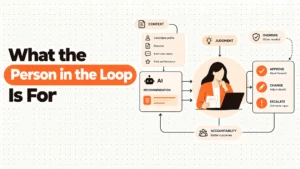
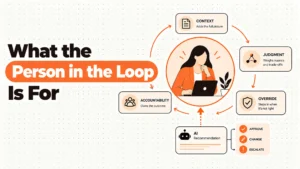
A wrong answer only costs something when it's believed. The harm isn't the error, it's the plan somebody made. That's why confident phrasing on an uncertain answer is the specific thing to design against.
People don't query answers from a system. A colleague saying something uncertain gets questioned. An immediate, well-formatted answer from your own tooling reads as settled, and most people won't think to check it.
Speed adds to the effect. An answer arriving instantly carries an authority a considered reply doesn't, which is the opposite of what the underlying certainty usually justifies.
The unusual cases are the vulnerable ones. Somebody whose arrangement is non-standard is both most likely to get a wrong answer and least likely to realise it, because they have no particular reason to think they're different.
Saying it doesn't know is a feature to pay for. An assistant that declines, hedges, or routes onward when it lacks a basis is handing you the uncertainty instead of hiding it. That's worth more than a higher hit rate on questions it should never have answered.
Coverage is the wrong thing to optimise. A product answering a greater share of questions is not obviously better, because the extra share is drawn from exactly the questions it should have declined.
Show the basis and the date. An answer accompanied by what it came from, and when that was last updated, lets a person judge for themselves. It also converts an assistant from an oracle into a lookup, which is a healthier relationship.
A link to the source does more than a confidence score. People can't calibrate a number and can read a policy, so pointing at the document beats expressing certainty about it.
The route to a person is part of the product. How easily somebody gets from an unsatisfying answer to a human determines whether the assistant is a filter or a wall, and employees work out which very quickly.
Availability sets the expectation. An assistant answering at any hour teaches people that HR responds instantly, and the human route behind it will not. Being clear about response times for escalated questions prevents the second disappointment.
The uncomfortable summary is that the failure here isn't technical. It's that a system answering confidently will be believed, HR questions look more general than they are, and the people who suffer are the ones whose circumstances were already unusual.
That last part is worth sitting with, because it isn't distributed randomly. People on historic terms, people who arrived through an acquisition, people who negotiated something: they get the general answer and they're the ones it fits least.
Where These Arrangements Go Wrong
| The failure | How it shows up | What would have to change |
|---|---|---|
| General answer to a specific question | Somebody plans around something untrue | Route individual questions to a person |
| Confident where it has no basis | A guess indistinguishable from an answer | Buy one that can decline |
| Record access without freshness | Specific and wrong, from a stale record | Show the source and its date |
| Complaint answered procedurally | A person concludes nobody listened | Detect grievance, route onward |
| No obvious route to a human | The assistant becomes a wall | Make it one click, visible always |
| Sensitive disclosure unhandled | Information somewhere nobody decided | Establish it before launch |
The first row is the failure this whole piece is about, and the only reliable fix is deciding in advance which questions an assistant may answer. Trying to make it handle individual questions well is the approach that produces the harm.
The fifth row is what turns a reasonable tool into a resented one. Employees who can't reach a person stop trying, which looks like reduced query volume and is actually people giving up, and that shows up much later as something else entirely.
The third row is the one that gets introduced as an improvement. Giving an assistant access to records makes it more useful on the ordinary cases and more confidently wrong on the ones where the record is incomplete, which is a trade worth making deliberately.
What to Put in Writing
| Artefact | Who owns it | When it is written | What it prevents |
|---|---|---|---|
| A month of real questions, sorted | Whoever handles queries now | Before choosing anything | Automating the wrong half |
| Which questions depend on the person | Whoever knows the contracts | Before launch | The general case, wrongly applied |
| What it says when it doesn't know | Whoever owns the assistant | Before launch | A guess presented as an answer |
| The route to a person | Whoever owns the assistant | Before launch | A wall instead of a filter |
| How grievance is detected and routed | Whoever owns the assistant | Before launch | A procedural reply to a complaint |
| Where disclosures go, and retention | You, with local advice | Before launch | Sensitive text nobody accounted for |
The first row is the hour that determines everything else, and it's worth doing before any vendor conversation. Real questions, sorted by what answering them requires, tells you what proportion of your volume is safely automatable, and that proportion varies enormously between organisations.
The second row is the one only you can produce. A vendor can tell you what their product handles; nobody outside your organisation knows which of your answers turn on somebody's individual terms, and that list is the actual boundary of what should be automated.
Questions to Ask Before You Commit
On limits. What does it say when it doesn't know? A bad answer is that it always helps.
On records. Does it see the person's own data? A bad answer is that it's personalised.
On freshness. Does it show when the source was updated? A bad answer is that data is live.
On escalation. How does somebody reach a person? A bad answer is that they can ask again.
On grievance. What happens if a question is a complaint? A bad answer is that it's routed.
On disclosures. Where does what somebody types go? A bad answer is that it's secure.
What Getting This Wrong Costs
The first cost is somebody arranging their life around a wrong answer. Not the error itself, which is trivial to correct, but the leave they booked, the job they didn't apply for, the date they told their family. By the time the mistake surfaces, the cost has already been incurred by a person who did nothing wrong except believe their employer's own system.
And the correction frequently can't restore the position. A decision made months ago on the strength of a wrong answer isn't always reversible, whatever anybody would like to do about it afterwards.
The second cost is trust, which behaves asymmetrically here. An assistant that's right repeatedly builds a habit of not checking, and that habit is exactly what makes the eventual wrong answer expensive. Worse, the person who gets it tells colleagues, and the story that circulates is the wrong answer rather than the hundred correct ones.
Trust is also hard to rebuild selectively. Somebody who has been told something wrong about their own entitlement tends to discount the next answer too, including the ones that were always going to be right.
The third cost is people giving up. When the route to a human is unclear, employees stop asking rather than persisting, and that reads in your metrics as reduced query volume, which looks like success. What's actually happening is that people are guessing, asking colleagues who also don't know, or simply not finding out, and the consequences of that surface somewhere else entirely.
It's worth being sceptical of the deflection number generally. A fall in questions reaching people can mean the assistant answered them well or that people stopped bothering, and the metric looks identical either way.
So do three things before evaluating anything. Take a month of real questions and sort them by what answering them correctly requires. Identify which of your answers depend on the individual, which is your knowledge and nobody else's. And decide what happens when the assistant doesn't know, because that behaviour matters more than anything it gets right.
When You Are Ready to Go Further
Start with the month of questions, because it's free and it changes what you're shopping for. Sorted properly, it tells you what proportion of your volume is genuinely general, and that number is usually lower than expected and varies hugely between organisations. It also tells you which topics carry the most individual variation, which is exactly what to keep away from an assistant.
Sort them with whoever currently answers them. They can tell at a glance which questions turn on somebody's individual terms, and that judgement is the entire value of the exercise.
Then test the limits before anything else in an evaluation. Ask the thing questions it cannot know: something about an individual it has no access to, something not yet decided, something phrased ambiguously. What comes back tells you more in five minutes than any demonstration of the cases it handles well.
Ask a few of your genuinely unusual cases too, the ones involving a historic contract or an arrangement nobody else has. Those are where the general answer does its damage, and they're the cases a demonstration will never include.
Finally, build the route to a person before you launch rather than after. Visible, always available, no dead ends, and staffed. An assistant with a good escape hatch is a genuine improvement even when it answers imperfectly. One without becomes the thing employees complain about, and that reputation attaches to HR rather than to the tool.
Staffed is the word doing the work there. A route that exists and takes days to produce a response teaches people the same lesson as no route at all, just more slowly.
HROpsLab publishes independent comparison work across HR tooling. We sell nothing, we take no vendor money, and we publish no paid placements. If the next step is understanding what these tools actually do, our comparison work is one place to start.
Frequently Asked Questions
What does an HR chatbot actually do?
It answers employee questions from whatever material it's been given, usually policies, guidance and sometimes the person's own record. Where it works well is questions with a single answer that's the same for everybody: where to find something, how a process runs, what a policy says in general terms. Those make up a real proportion of query volume and handling them well is a genuine improvement, partly because they're the questions people feel awkward asking repeatedly. The difficulty is everything that looks like that category and isn't.
Can an AI assistant answer HR policy questions?
General ones, yes, and that's a reasonable use. The problem is that many HR questions appear general while actually depending on the asker's own terms, history or arrangement, and they don't announce which kind they are. An assistant will answer both with equal confidence, producing the general case for somebody whose situation is unusual. Where a policy has exceptions, the best behaviour is an answer that says so and offers a route to confirm, rather than stating the general rule as though it settles the matter.
What happens when an assistant gives a wrong answer?
Usually nothing visible, immediately, which is the problem. People rarely query an answer from their employer's own system, so they act on it: booking something, not applying for something, telling their family a date. The error surfaces later when the plan meets reality, and by then the cost has been incurred by somebody who did nothing wrong. That's why confident phrasing on an uncertain answer is the specific thing to design against, rather than accuracy in the abstract.
Should an AI assistant see an employee's record?
It changes the risk rather than removing it, and it's worth thinking through. With record access an assistant can be specific, which is what people want, and it can also be confidently specific on the basis of a record that's incomplete, out of date, or missing a variation that lives in a contract rather than a system. A general answer clearly labelled as general is sometimes safer than a specific one built on partial information. Showing the source and when it was last updated helps considerably either way.
Which questions should be routed to a person?
Anything where the correct answer depends on the individual's own terms or history. Anything about something not yet decided. Anything that's really a complaint rather than a question, which is more common than query logs suggest because the grievance is usually implicit in the phrasing. And anything sensitive, meaning health, family, money or a difficulty at work. Knowing which of your own topics carry heavy individual variation is your knowledge rather than a vendor's, and it's the most valuable input to this decision.
Do employees trust HR chatbots?
More than is good for them, initially. An immediate, well-formatted answer from your own system reads as settled in a way that a colleague's uncertain reply doesn't, so people don't check. That trust builds a habit of not checking, which is precisely what makes the eventual wrong answer expensive. It also collapses asymmetrically: the person who gets a wrong answer tells colleagues, and the story that spreads is that one rather than the many correct ones.
What should an assistant say when it doesn't know?
That it doesn't know, and where to go instead. This sounds obvious and is genuinely the most important thing to test before buying, because plenty of these systems will produce something plausible rather than admit a limit. Ask it something it cannot possibly know during any evaluation and watch what comes back. A system that declines and routes onward is handing you the uncertainty instead of hiding it, which is worth more than a higher hit rate on questions it should never have attempted.
How should sensitive questions to an assistant be handled?
Route them to a person quickly, and establish the handling before you launch rather than afterwards. People will disclose health circumstances, family situations and workplace difficulties to an assistant precisely because it's available and feels more private than asking a colleague. Where that text goes, what's retained, and who can see it are questions with answers that differ by jurisdiction and sector, so take local advice. Telling people plainly what happens to what they type is worth more than any policy document nobody opens.
It looks like a question with one answer. For somebody, it isn't.