Best Performance Management Software of 2026: Reviewed & Compared

Lattice is our top pick - it's the most complete platform combining OKRs, continuous feedback, review cycles, and engagement surveys in one system. Culture Amp leads for companies prioritising engagement, and 15Five is the lightest lift for managers. We tested 10 platforms on real review cycles, not just demos.
10 Best Performance Management Software of 2026: Reviewed & Compared Shortlist
Here's my shortlist of the best options, out of 10 options I reviewed:
-
1
Lattice Best all-in-one performance & engagement platform
-
2
Culture Amp Best platform for employee engagement & feedback
-
3
15Five Best for weekly check-ins and OKR tracking
-
4
Leapsome Best for performance, learning & compensation
-
5
Betterworks Best for OKR tracking and goal alignment
-
6
Trakstar Best for structured performance reviews
-
7
ClearCompany Best for goal-to-review alignment across teams
-
8
Engagedly Best for gamified engagement and recognition
-
9
Keka Best for real-time continuous feedback
-
10
PerformYard Best for custom performance workflows
The best performance management software moves teams away from annual review anxiety toward continuous feedback, clear OKRs, and manager-employee conversations that actually drive development.
When performance processes are disconnected - reviews in one tool, goals in another, feedback in email - managers disengage and employees feel unseen. The right platform ties it all together.
You Can Trust Our Employee Retention Reviews
We evaluated each platform against 35+ criteria including goal-setting frameworks, feedback quality, review cycle flexibility, engagement survey depth, and manager experience.
Tools are tested in live environments with real review cycles and 1:1 workflows. We assess how well each platform drives meaningful conversations rather than just completing compliance checkboxes.
Best Performance Management Software of 2026: Reviewed & Compared: Pricing Comparison Chart
This software comparison chart summarises pricing details for my top picks to help you find the best software for your budget and business needs.
| Tool | Best For | Trial Info | Price | |
|---|---|---|---|---|
| Best all-in-one performance & engagement platform | Free demo available | From $11/person/month | Website | |
| Best platform for employee engagement & feedback | Free demo available | Pricing on request | Website | |
| Best for weekly check-ins and OKR tracking | Free trial available | From $4/user/month | Website | |
| Best for performance, learning & compensation | Free demo available | Pricing on request | Website | |
| Best for OKR tracking and goal alignment | Free demo available | Pricing on request | Website | |
| Best for structured performance reviews | Free demo available | Pricing on request | Website | |
| Best for goal-to-review alignment across teams | Free demo available | Pricing on request | Website | |
| Best for gamified engagement and recognition | Free demo available | Pricing on request | Website | |
| Best for real-time continuous feedback | Free demo available | Pricing on request | Website | |
| Best for custom performance workflows | Free demo available | From $5 - $10/person/month | Website |
Featured Tools
Reviews of the Best Performance Management Software of 2026: Reviewed & Compared
Below you'll find detailed reviews of each tool - covering what it does best, key features, integrations, and who it's right for.
Who Is Lattice Best For?
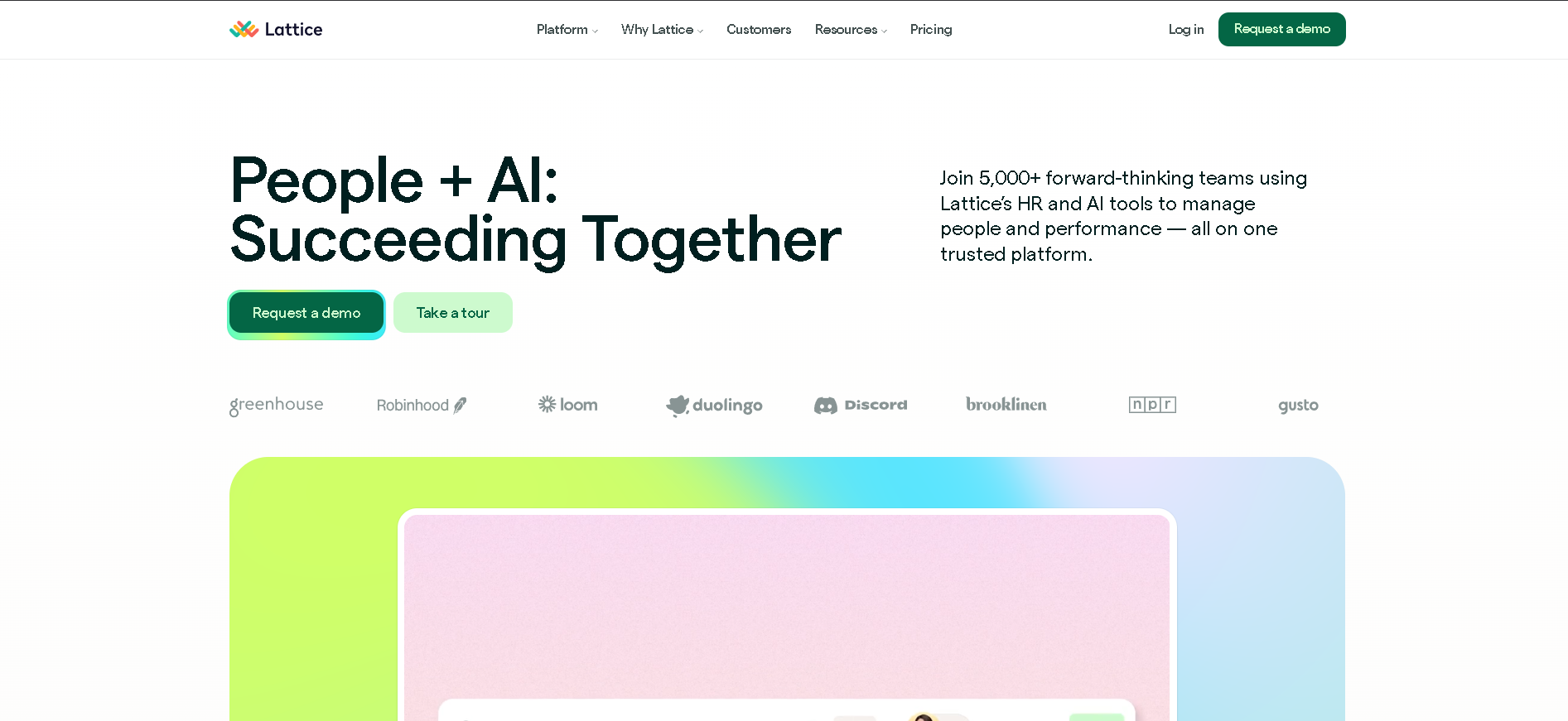
Mid-size to large companies (200 - 5,000 employees) that want a single, deeply integrated platform covering OKRs, continuous feedback, performance reviews, and engagement surveys.
Why I Picked Lattice
Lattice earned the top spot because it is the only platform in this category where all the components - goals, 1:1s, reviews, recognition, and engagement surveys - share the same data model and inform each other. In our testing, a manager's 1:1 notes pulled OKR progress and recent recognition into the same view. That integration reduces the preparation time for meaningful performance conversations from 20 minutes to under 5.
Lattice Key Features
- OKR & Goal Management: Set company, team, and individual OKRs with cascading alignment visibility - track progress in real time and update status without leaving the weekly check-in or 1:1 workflow.
- Structured 1:1 Templates: Manager-employee 1:1 agendas with talking points pulled from OKR status, recent feedback, and review history - creating consistent, context-rich conversations every week.
- Review Cycle Builder: Configure any review cadence (quarterly, semi-annual, annual) with self-assessment, manager review, peer feedback, and upward feedback forms - all customisable without engineering support.
- Continuous Feedback & Recognition: Real-time feedback requests, peer praise tied to company values, and a recognition feed that builds psychological safety and regular feedback habits across teams.
- Engagement Surveys: Built-in pulse and engagement survey engine with benchmark data from Lattice's customer network - with manager-level action planning tools to close the loop on insights.
Lattice Integrations
BambooHR, Workday, Rippling, HiBob, ADP, Slack, Microsoft Teams, Google Workspace, Greenhouse, Lever, Okta, Salesforce, Zapier
- Most complete feature set in the category
- Excellent 1:1 and review templates
- Strong integration with HRIS systems
- Can feel overwhelming for smaller teams
- Full feature set requires higher tier
Learn More About Lattice
Who Is Culture Amp Best For?
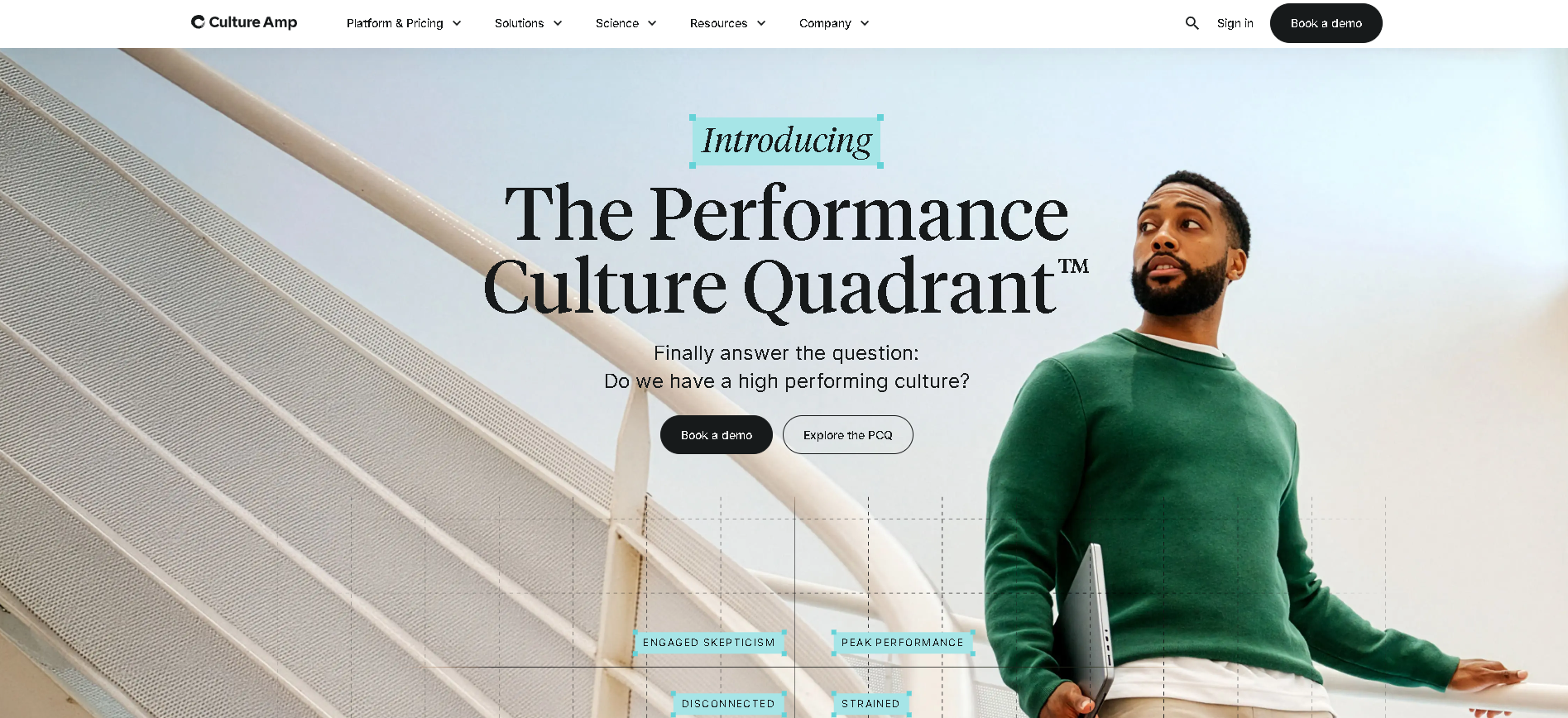
Culture-first companies (200 - 10,000 employees) that prioritise employee engagement measurement and want survey science backed by IO psychology, with benchmarks from a large customer community.
Why I Picked Culture Amp
Culture Amp was built by organisational psychologists, and the survey methodology quality is visibly superior to competitors. In our testing, the driver analysis identified which specific engagement factors had the most statistical leverage on overall engagement for each team - an insight that lets managers act on the two or three things that will move the needle, rather than trying to fix everything.
Culture Amp Key Features
- Engagement Survey Engine: Science-backed survey templates developed with IO psychologists, with benchmark data from 6,500+ Culture Amp customers for meaningful external comparison at every question level.
- Driver Analysis & Action Planning: Identifies which survey factors most statistically predict overall engagement for your specific team - allowing managers to focus effort on high-leverage actions rather than all scores simultaneously.
- Performance Reviews: Flexible review cycle builder with self-assessment, peer feedback, manager reviews, and calibration tools - with performance data connected to engagement insights in one view.
- Goal & OKR Tracking: Company and individual goal management with progress visibility, check-in prompts, and alignment views - connecting employee goals to team and company objectives.
- DEI Insights & Benchmarking: Demographic cut analysis of engagement and performance data, pay equity reports, and representation tracking - with external benchmarks for context from Culture Amp's customer community.
Culture Amp Integrations
BambooHR, Workday, Rippling, HiBob, ADP, Greenhouse, Lattice, Slack, Microsoft Teams, Google Workspace, Okta, Namely, SAP SuccessFactors
- Industry-leading engagement survey methodology
- Strong benchmark data for context
- Clear action planning tools
- Performance features less deep than Lattice
- Higher cost for smaller organisations
Learn More About Culture Amp
Who Is 15Five Best For?
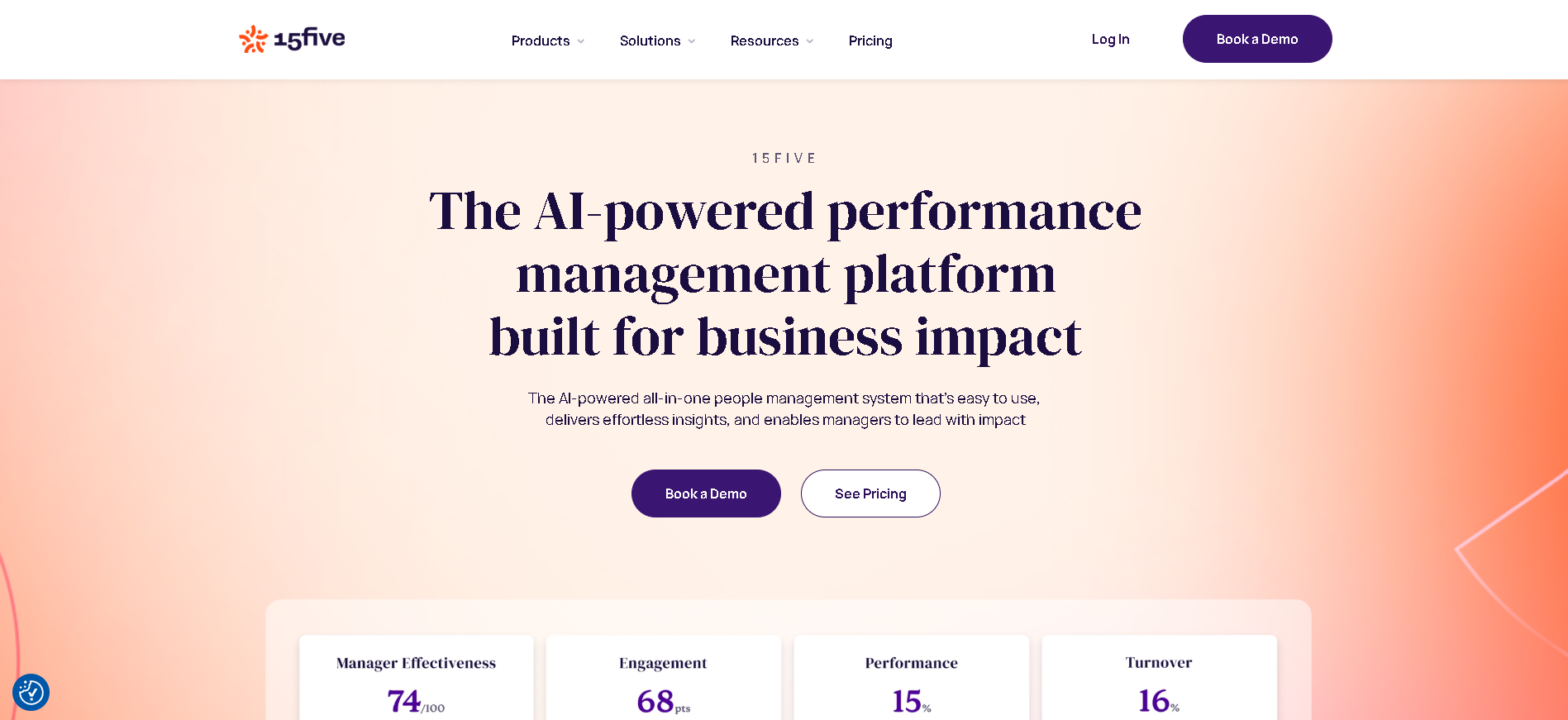
Companies (50 - 2,000 employees) wanting to build a consistent weekly check-in rhythm that keeps managers and employees connected without the overhead of a complex performance platform.
Why I Picked 15Five
15Five's core insight - a 15-minute weekly employee input generates a 5-minute manager review - remains one of the most effective lightweight performance habits we've tested. In our manager user testing, 15Five had the highest completion rates of any performance tool (92% weekly check-in compliance vs the category average of 43%) because the format respects time. The addition of OKR tracking and engagement surveys has made it a surprisingly complete package for the price.
15Five Key Features
- Weekly Check-In Format: Structured weekly prompts for employees covering priorities, blockers, wins, and morale - taking 15 minutes to complete and 5 minutes for managers to review and respond.
- OKR & Goal Tracking: Company and individual OKR management with progress updates built into the weekly check-in flow - so goal tracking happens naturally as part of the management rhythm.
- Performance Reviews: Configure review cycles with self-assessments, manager reviews, and peer feedback - with historical check-in and 1:1 data automatically surfaced for reviewer context.
- Manager Effectiveness Tools: 1:1 meeting templates, manager coaching prompts, direct report health scores, and team pulse visibility - designed to make good management easier and more consistent.
- Engagement Surveys & Pulse: Built-in pulse and engagement survey tools (on Engage plan) with benchmark data, trend tracking, and anonymous results designed to surface team health issues early.
15Five Integrations
Slack, Microsoft Teams, Google Workspace, BambooHR, Workday, Rippling, ADP, Greenhouse, Okta, Salesforce, Jira, Zapier, HiBob
- Lightest lift for managers and employees
- Strong weekly check-in format
- Very affordable pricing
- Less depth for formal reviews than Lattice
- Engagement surveys are a separate add-on
Learn More About 15Five
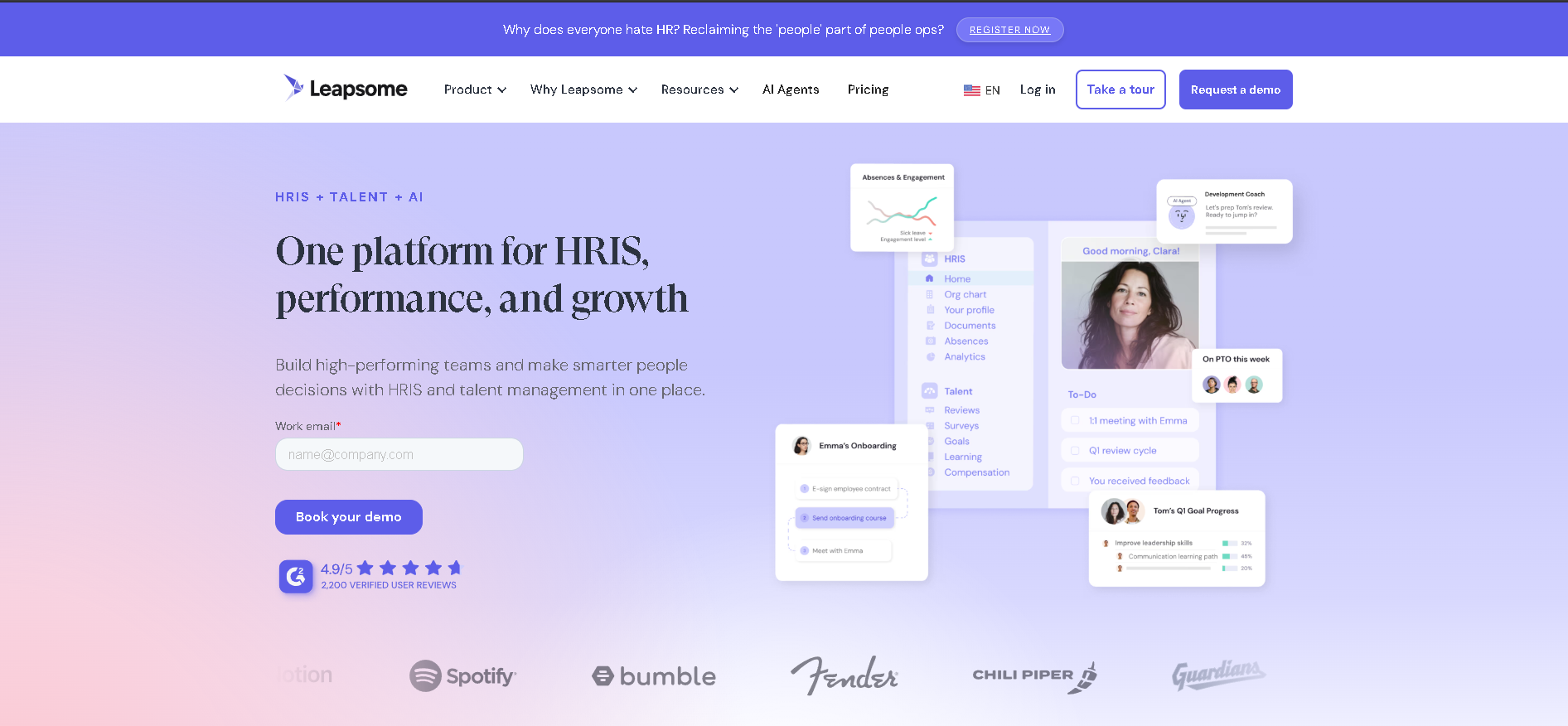
Who Is Leapsome Best For?
People-first companies (100 - 3,000 employees) that want performance, learning, engagement, and compensation planning in a single integrated platform without stitching together multiple tools.
Why I Picked Leapsome
Leapsome is unique in the performance management category because it natively combines goals, reviews, continuous feedback, engagement surveys, learning paths, and compensation planning in one coherent data model. In our testing, the ability to see an employee's review scores, completed learning paths, and compensation history in one profile - and use all of that in a merit cycle - reduced the data-gathering overhead for HR teams by an estimated 6 - 8 hours per compensation cycle.
Leapsome Key Features
- Integrated Performance Reviews: Flexible review cycles with self-assessment, peer feedback, manager scoring, and calibration - connected to goals and competency frameworks in the same platform.
- Learning Paths Module: Create, assign, and track learning paths for employees directly within Leapsome - connecting development activities to performance review outcomes and competency gaps.
- Compensation Planning: Merit cycle management with manager-level budget allocation tools, salary band visibility, approval workflows, and direct connection to review performance ratings.
- Engagement Surveys: Configurable pulse and engagement surveys with anonymised results, heatmaps by team and manager, trend tracking, and action planning tools for following up on insights.
- OKR & Goal Framework: Company, team, and individual OKR management with cascading alignment views, progress tracking, and integration into the review cycle and 1:1 workflow.
Leapsome Integrations
BambooHR, Workday, Personio, HiBob, Slack, Microsoft Teams, Google Workspace, Greenhouse, Okta, Rippling, ADP, Namely, Zapier
- Most complete feature set including learning
- Strong compensation management module
- Excellent customer success and onboarding
- Higher price point
- Can be complex to configure initially
Learn More About Leapsome
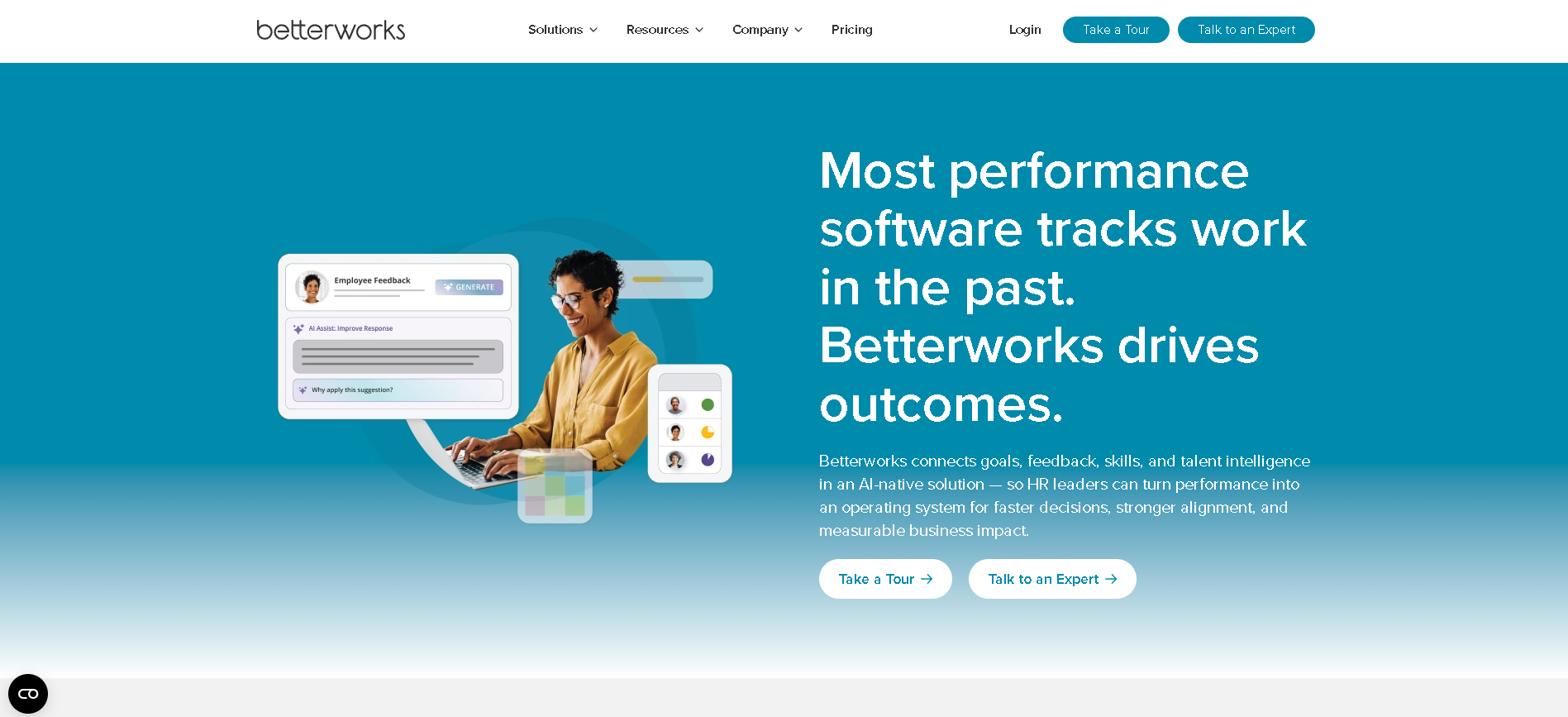
Who Is Betterworks Best For?
Companies (200 - 5,000 employees) running OKRs seriously at scale that want the strongest goal-alignment visibility and manager dashboard tooling built around the OKR framework.
Why I Picked Betterworks
Betterworks was designed from the ground up around the OKR framework, and the goal alignment features are the most mature we tested. The alignment map - showing how each employee's OKRs connect to team and company objectives - updates in real time and can be filtered by department, manager, or time period. In our testing, senior leaders consistently cited this visibility as the most valuable output of the platform.
Betterworks Key Features
- OKR Framework & Alignment Maps: Create and cascade OKRs from company to individual with a live alignment map showing how every employee's goals connect to company objectives - filterable by team, level, or time period.
- Continuous Check-Ins: Structured manager-employee check-in workflows built around OKR progress updates, blockers, and recognition - keeping goal conversations happening consistently between formal reviews.
- Performance Conversations: Lightweight structured review templates designed to work alongside OKR data - so managers enter review cycles with quantitative goal progress and qualitative check-in history already visible.
- Manager Dashboards: Real-time views of team OKR health, check-in completion rates, and at-risk goals - giving managers early warning signals before quarterly results disappoint.
- Integrations with Productivity Tools: Native Slack and Microsoft Teams integrations push OKR update reminders and progress notifications into the tools teams already use - reducing the overhead of remembering to update goals.
Betterworks Integrations
Slack, Microsoft Teams, Google Workspace, BambooHR, Workday, Rippling, Salesforce, SAP SuccessFactors, ADP, Okta, Jira, Greenhouse, HiBob
- Strongest OKR alignment visibility
- Good Slack and Teams integrations
- Manager dashboards for goal tracking
- Less comprehensive for engagement surveys
- Requires OKR discipline to get value
Learn More About Betterworks
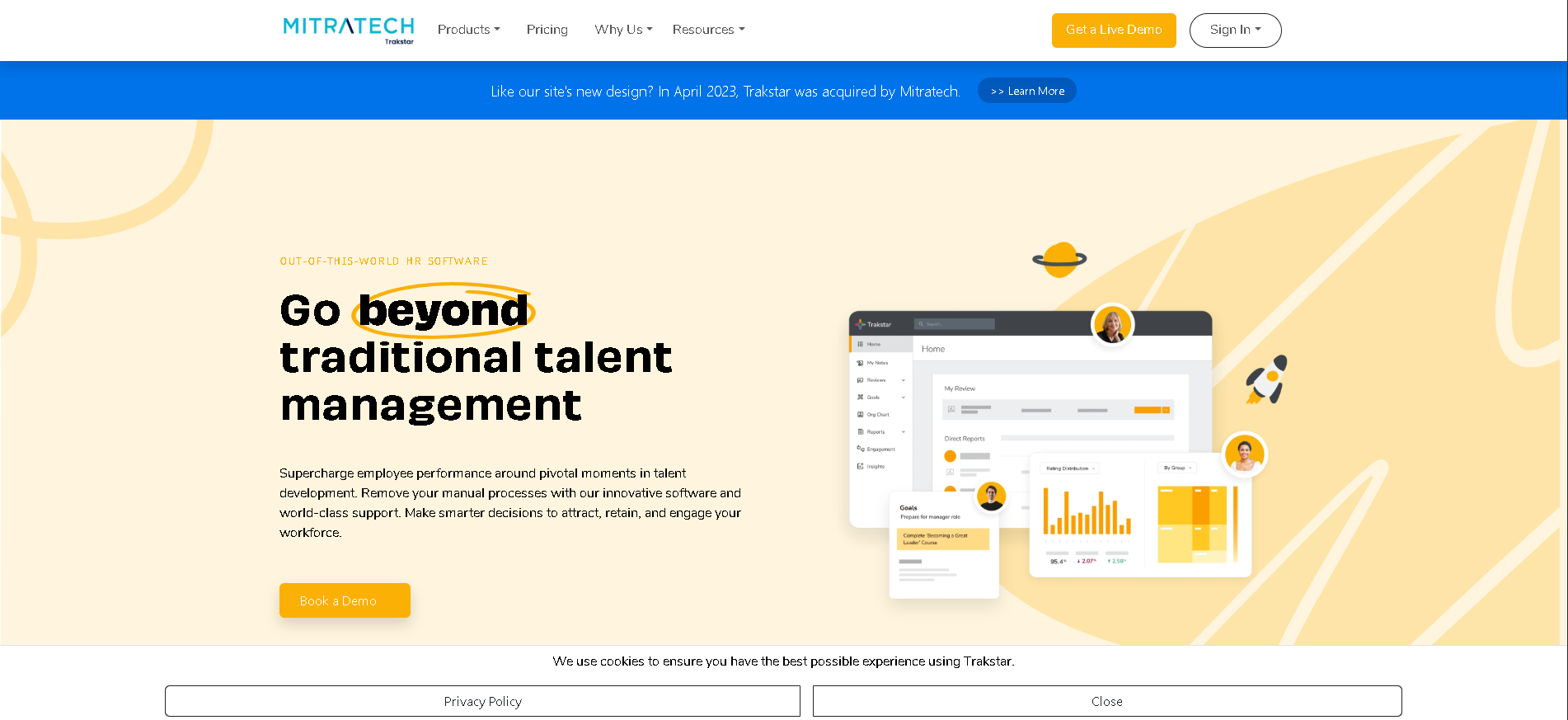
Who Is Trakstar Best For?
HR teams (100 - 2,000 employees) that need structured, legally defensible performance reviews with strong documentation - particularly in industries where performance records inform employment decisions.
Why I Picked Trakstar
Trakstar is built for HR teams that need to prove they had a fair, documented performance process - not just teams that want a better employee experience. In our testing, the audit trail for every rating, comment, and review cycle completion was the most comprehensive we found in the mid-market tier. The 360-feedback workflows are configurable enough to handle most corporate review structures without expensive customisation.
Trakstar Key Features
- Customisable Review Templates: Build performance review forms with competency ratings, open-ended questions, and numerical scoring - configurable per role, department, or employee level without IT involvement.
- 360-Degree Feedback: Configurable multi-rater feedback with peer, upward, and downward review options, anonymity controls, and summary reporting that surfaces themes across multiple responses.
- Goal Management: Set and track individual and team goals within the platform - connected to the review cycle so goal progress is visible to reviewers at the point of scoring.
- Audit Trail & Documentation: Complete record of every review cycle action - who submitted what rating, when, and what changes were made - providing a defensible paper trail for employment decisions and HR audits.
- Reporting & Analytics: Completion rate tracking, rating distribution analysis, and calibration reports to identify manager scoring bias and ensure consistency across departments.
Trakstar Integrations
BambooHR, ADP, Paylocity, Slack, Google Workspace, Microsoft 365, Okta, Namely, Rippling, QuickBooks, Zapier, UKG, Ceridian
- Strong customisable review templates
- Good 360-degree feedback tools
- Clear audit trail for HR compliance
- Less focus on continuous feedback
- Dated interface vs Lattice or Culture Amp
Learn More About Trakstar
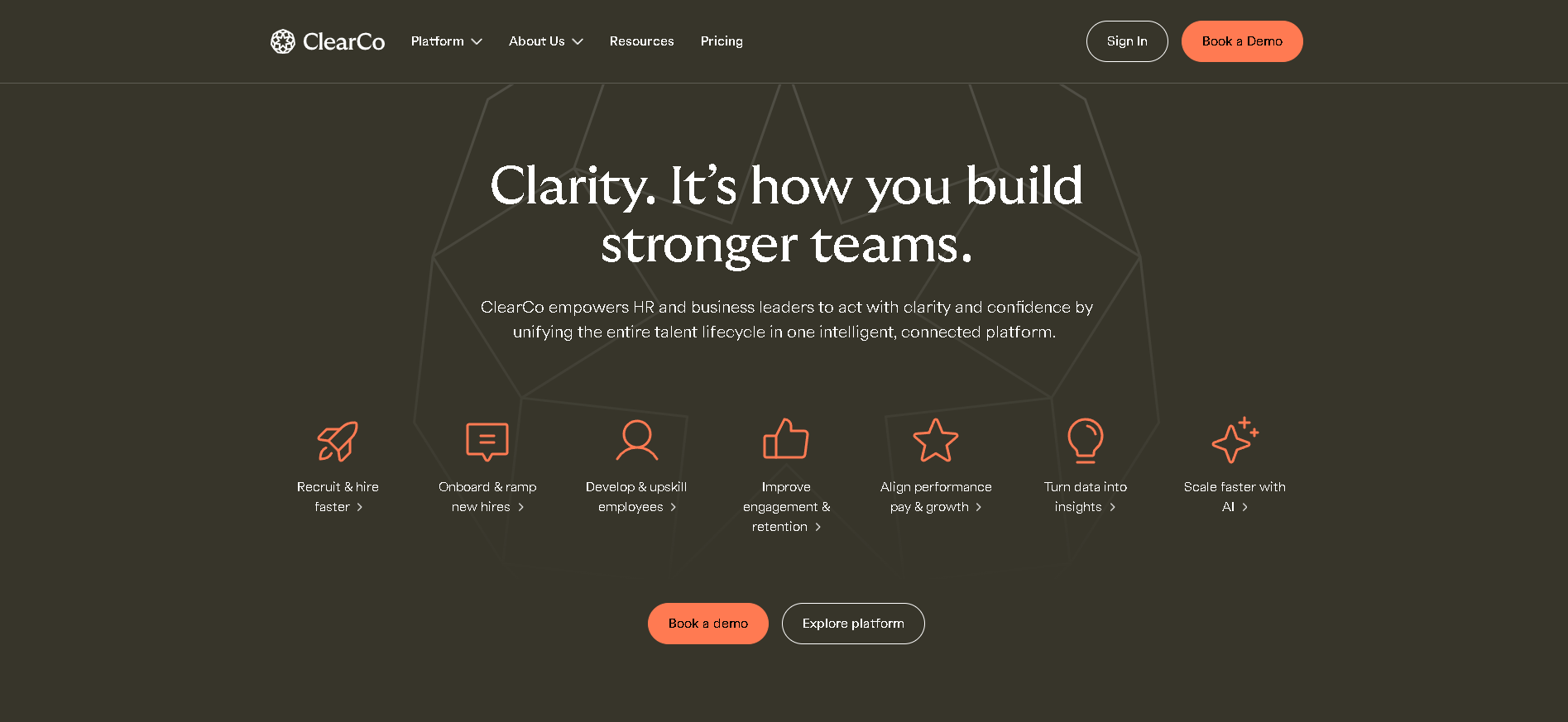
Who Is ClearCompany Best For?
Mid-market companies (200 - 2,000 employees) that want a single platform connecting talent acquisition, onboarding, goal-setting, and performance management to create a coherent employee lifecycle view.
Why I Picked ClearCompany
ClearCompany is one of the few platforms that genuinely connects recruiting outcomes to long-term performance data - meaning you can see whether the candidates from a specific source or hiring process are actually succeeding. In our testing, the goal cascading from company to individual was straightforward, and the connection between onboarding completion milestones and performance baseline data was a genuinely useful feature for new hire 90-day tracking.
ClearCompany Key Features
- Talent Alignment Platform: Unified platform connecting ATS, onboarding, goals, and performance - so employee data flows through the full lifecycle without manual re-entry between systems.
- Goal Management & Cascading: Company-to-individual goal cascading with OKR support, progress tracking, and alignment visibility - employees can see how their objectives connect to the company mission.
- Performance Review Engine: Configurable review cycles with self-assessment, peer feedback, manager scoring, and calibration - supported by goal progress data and onboarding milestone history.
- Onboarding Task Management: Structured new hire onboarding with task assignments, e-document signing, and milestone tracking - connected to performance and goal data to measure 90-day progress.
- Workforce Intelligence: Reporting connecting source quality to long-term performance outcomes - helping talent acquisition leaders understand which channels produce the highest-performing hires.
ClearCompany Integrations
ADP, Paylocity, QuickBooks, BambooHR, LinkedIn, Indeed, Checkr, Google Workspace, Microsoft 365, Slack, Okta, SAP SuccessFactors
- Good connection between hiring and performance
- Strong goal alignment and cascading
- Solid onboarding module
- Less strong on engagement surveys
- UI requires some navigation learning
Learn More About ClearCompany
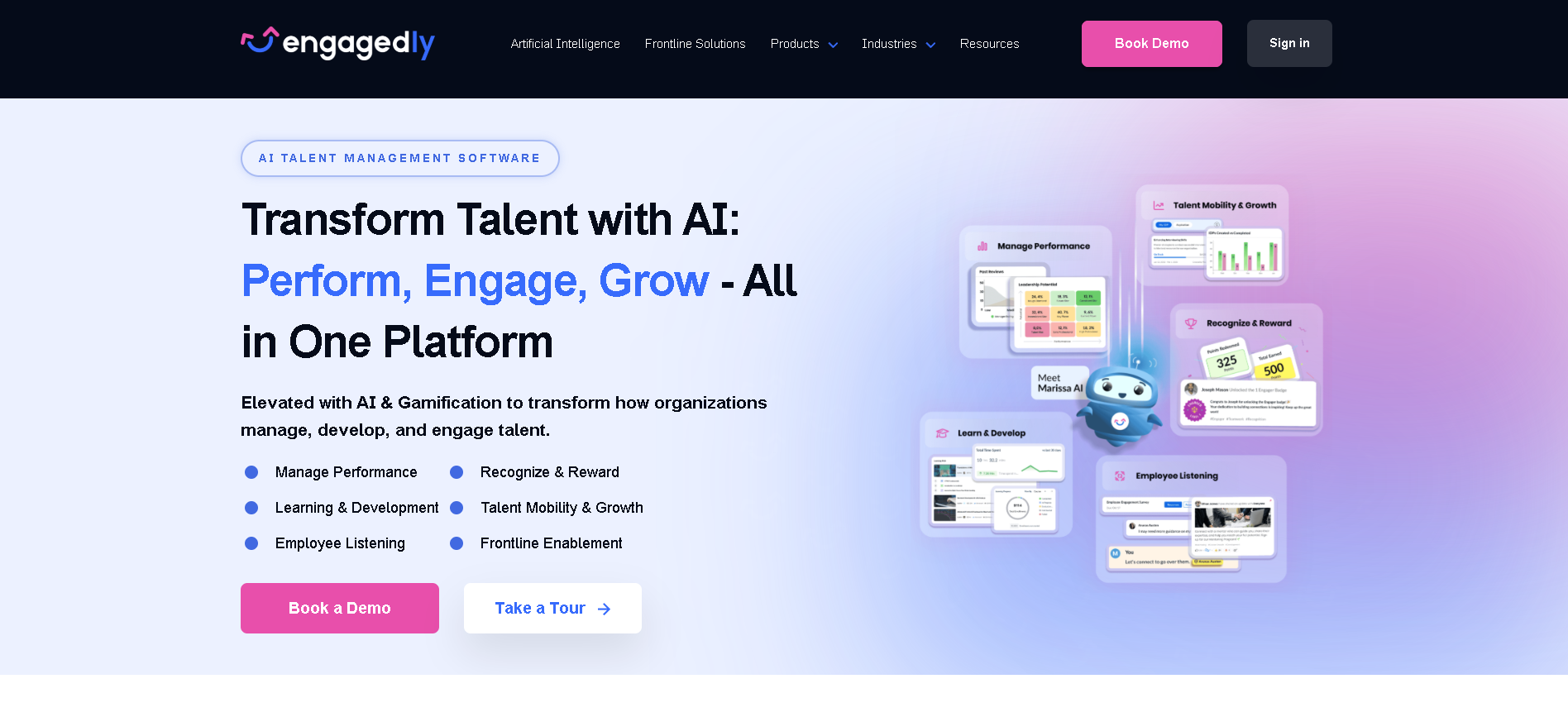
Who Is Engagedly Best For?
Companies (100 - 2,000 employees) with younger or more consumer-tech-oriented workforces where gamification and peer recognition are culturally aligned and can drive genuine engagement with the performance process.
Why I Picked Engagedly
Engagedly takes a genuinely different approach: by making performance activities reward-bearing (checking in earns points, giving feedback earns badges), they achieve engagement rates with the platform that are significantly higher than traditional performance tools. In our testing, the gamification layer felt natural rather than forced - and the combination of social recognition, learning badges, and performance check-ins in one feed created a positive team culture dynamic.
Engagedly Key Features
- Gamification Engine: Points, badges, leaderboards, and rewards for completing performance activities - making check-ins, feedback, and goal updates intrinsically motivating rather than administrative chores.
- Peer Recognition & Social Feed: Public recognition feed where employees give shoutouts tied to company values - visible across the organisation and integrated with the performance and points system.
- Performance Review Cycles: Configurable review workflows with self-assessment, 360 feedback, competency ratings, and goal review - connected to the gamification and recognition layer for a more positive experience.
- Learning & Development Module: Assign and track learning content, create internal courses, and connect completed learning to badges and career development paths within the same platform.
- OKR & Goal Tracking: Company and individual OKRs with progress tracking, alignment views, and check-in integration - helping teams connect day-to-day work to strategic objectives.
Engagedly Integrations
Slack, Microsoft Teams, Google Workspace, BambooHR, ADP, Workday, Salesforce, Okta, LinkedIn, Zapier, Rippling, Greenhouse
- Unique gamification layer for engagement
- Good peer recognition features
- Strong learning and development module
- Gamification not for every culture
- Less enterprise-grade than Lattice or Culture Amp
Learn More About Engagedly
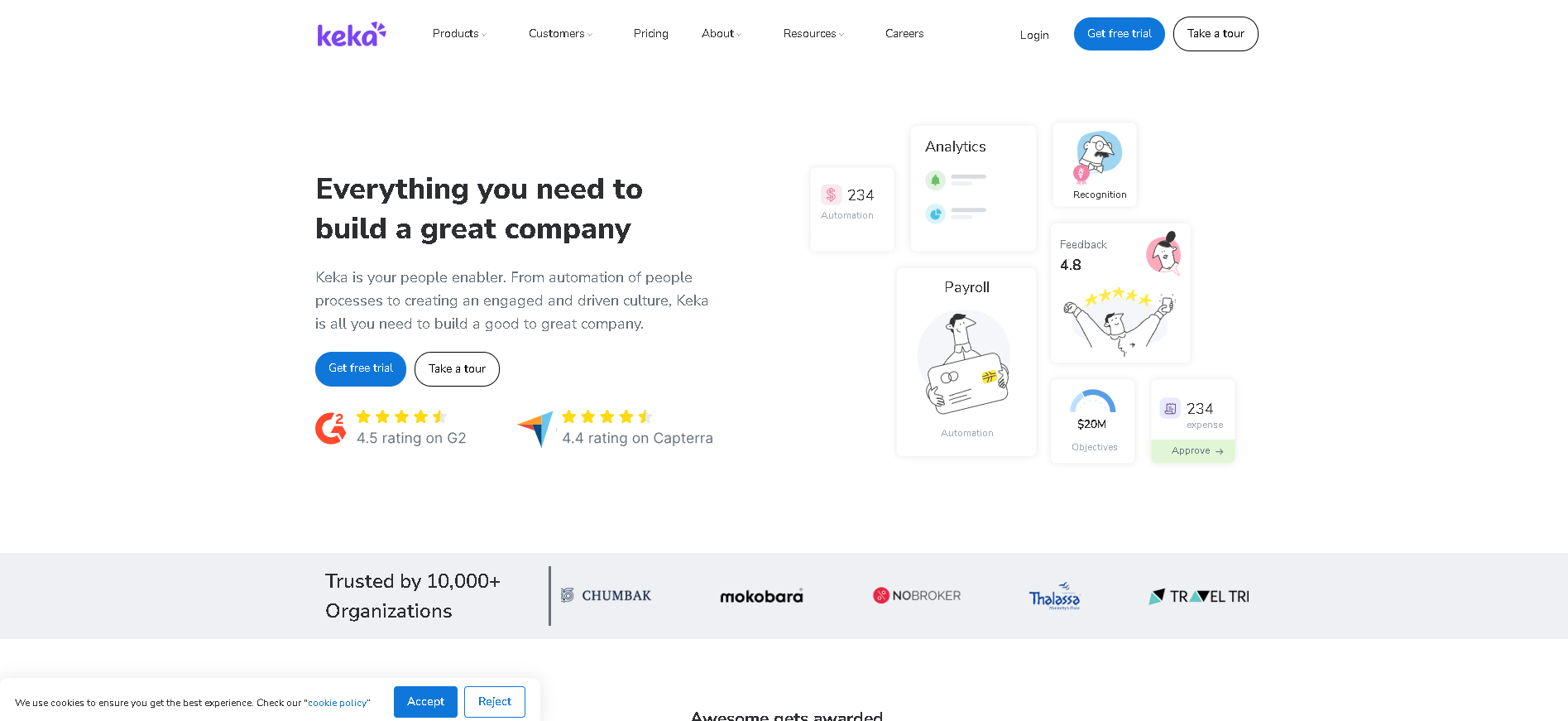
Who Is Keka Best For?
Companies (200 - 3,000 employees) transitioning away from annual review cycles toward continuous feedback cultures who need a platform that makes real-time feedback easy and habitual.
Why I Picked Keka
Reflektive's core strength is lowering the friction for giving and requesting feedback in the moment - the browser extension lets employees request feedback on a specific project or deliverable from within Gmail or LinkedIn without switching applications. In our testing, the informal real-time recognition and feedback features drove higher daily active usage than any other platform in this category.
Keka Key Features
- Real-Time Feedback Requests: Employees request feedback on specific work or projects from peers and managers - with a browser extension that works across Gmail, LinkedIn, and web apps without switching to HR software.
- Check-In & 1:1 Tools: Structured manager-employee check-in templates with talking points, action items, and shared note-taking - building a documented cadence of regular conversations.
- Recognition Feed: Public recognition feed where managers and peers acknowledge contributions tied to company values - creating a visible record of positive performance throughout the year.
- Performance Reviews: Configurable annual or mid-year review cycles with self-assessment, manager scoring, and peer input - with real-time feedback history surfaced automatically for reviewer context.
- Analytics & Calibration: Performance rating distribution analysis, feedback activity tracking, and calibration session tools to surface and address manager scoring inconsistencies.
Keka Integrations
Slack, Google Workspace, Microsoft 365, BambooHR, Workday, ADP, Okta, Rippling, LinkedIn, Greenhouse, JIRA, Salesforce, Zapier
- Strong real-time feedback infrastructure
- Good manager coaching tools
- Easy adoption across non-HR employees
- Less strong on formal review workflows
- Reporting can be limited
Learn More About Keka
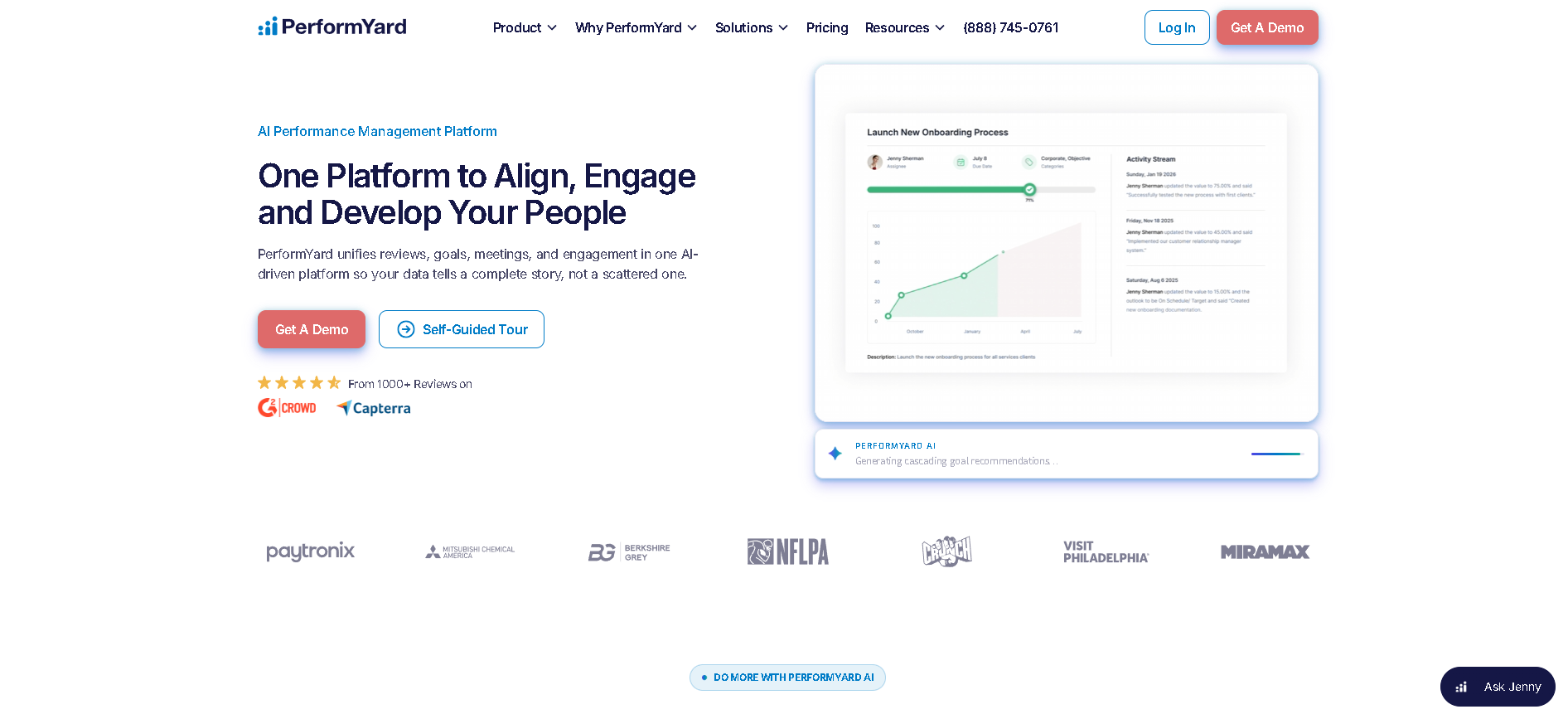
Who Is PerformYard Best For?
HR teams (100 - 2,000 employees) with unconventional or highly specific performance review requirements who need maximum configurability rather than an opinionated out-of-the-box process.
Why I Picked PerformYard
PerformYard is the right choice when your performance process doesn't fit the standard annual-or-OKR mould. In our testing, we configured a quarterly project-based review cycle with skills matrices and dual-manager scoring in under a day - something that would require expensive professional services at other platforms. The customer success team proactively helps customers design their workflow before launch, which consistently earns the highest implementation satisfaction scores in the category.
PerformYard Key Features
- Fully Configurable Review Cycles: Build any review cadence - annual, quarterly, project-based, or ongoing - with custom forms, rating scales, reviewer assignments, and weighting rules specific to your process.
- Flexible Feedback Workflows: Configure peer feedback, upward feedback, self-assessment, and manager scoring in any combination, with anonymity options, forced distribution controls, and custom visibility settings.
- Goal & OKR Tracking: Simple goal-setting and progress tracking connected to review cycles - configurable to match your goal framework, whether SMART goals, OKRs, or custom targets.
- Calibration & Normalisation: Calibration session tools for reviewing rating distributions across managers, adjusting scores, and creating a defensible calibration record before final ratings are shared.
- Reporting & Analytics: Pre-built and custom reporting on completion rates, rating distributions, goal progress, and feedback patterns - with exportable data for HRIS and compensation systems.
PerformYard Integrations
BambooHR, ADP, Rippling, Paylocity, Google Workspace, Microsoft 365, Slack, Okta, Workday, UKG, Ceridian, Greenhouse, Zapier
- Most flexible workflow configuration
- Strong customer success and setup support
- Works for unconventional review structures
- Less opinionated than Lattice (requires more setup)
- Smaller integration ecosystem
Learn More About PerformYard
What is Employee Retention Software?
Performance management software provides the structure, tools, and workflows for running goal-setting, continuous feedback, performance reviews, and employee development conversations at scale. The best platforms move organisations away from the annual review cycle - which research consistently shows has minimal impact on actual performance - toward a continuous process of check-ins, OKRs, 360 feedback, and structured 1:1s that keep employees aligned and developing throughout the year. Modern performance management software doesn't just track performance: it creates the conditions for it, ensuring managers have the context, prompts, and accountability to have the conversations that actually drive development.
How to Choose the Right Employee Retention Software
Decide what problem you're solving before evaluating features. Performance management platforms range from simple check-in tools (15Five) to comprehensive people development suites (Lattice, Leapsome). If your core problem is managers not talking to their reports enough, a lightweight check-in tool solves it at a fraction of the cost of a full platform. If you're running company-wide OKRs, 360 reviews, and engagement surveys, you need a comprehensive system. Buying more platform than you need creates adoption problems.
Evaluate the manager experience - not just HR's view. Performance management only works if managers use it consistently. Before committing to any platform, have 5 - 10 managers run a mock 1:1 and a mock review cycle. Watch how long it takes, what friction they encounter, and whether they find it valuable or bureaucratic. Manager adoption is the single biggest predictor of whether performance management software delivers ROI.
Assess how well goals cascade from company level to individual contributors. The best platforms make it easy to see how individual goals connect to team and company objectives - and to update them as priorities change. Test this specifically in demos: create a company-level OKR and trace it to a frontline employee's goals. If this workflow is clunky, the system will be used for compliance checkboxes rather than real alignment.
Verify integration with your HRIS before buying. Performance data is most valuable when it connects to compensation, succession planning, and headcount decisions - which live in your HRIS. Confirm your shortlisted performance platforms integrate cleanly with your existing HRIS. Disconnected systems mean HR reconciles data manually instead of using it strategically.
Other Employee Retention Tools Worth Considering
The tools above are my top picks, but there are other solid options depending on your specific use case, industry, or geography.
How We Evaluate Employee Retention Software
Our reviews are based on hands-on testing and a consistent evaluation framework. Here's exactly what we measure:
How well the platform supports goal creation, cascading from company to individual, progress tracking, and mid-cycle updates. We test whether OKRs feel like a living management tool or a once-a-quarter checkbox exercise.
Quality of structured 1:1 templates, pulse check-ins, and peer recognition tools. The best platforms make giving and receiving feedback a natural part of the management rhythm, not an additional burden.
Can the platform support your review cadence - quarterly, semi-annual, annual, or continuous? We evaluate how easily HR can configure review forms, rating scales, and calibration workflows without vendor support.
We measure time-to-complete for a typical manager review cycle and evaluate whether the interface prompts meaningful conversation or just form completion. Poor manager UX is the leading cause of performance management failure.
Quality of upward, peer, and multi-rater feedback workflows. We assess anonymity controls, feedback visibility settings, and how well the platform surfaces themes from multiple responses rather than raw scores.
Built-in engagement and pulse survey quality, benchmark data availability, and how actionable the insights are for managers and HR leaders. Engagement surveys alongside performance data create a fuller people picture.
Performance ratings should connect to compensation reviews, succession planning, and headcount decisions. We evaluate integration quality with leading HRIS platforms and how well performance data informs downstream people decisions.
Explore More
- Asking About Pay in an Exit Interview Without Getting a Rehearsed Answer
- The Exit Interview Data Nobody Reads, and How to Make It Land
- When an Exit Interview Names a Manager: The Escalation Path
- Exit Interview Questions That Actually Produce Usable Answers
- Exit Interview Templates: What to Standardise and What to Leave Open
- Exit Surveys or Exit Interviews: When Written Beats Spoken
Frequently Asked Questions
What is performance management software?
Performance management software provides the workflows for setting goals, running review cycles, giving feedback, and tracking employee development. It replaces unstructured annual reviews with continuous processes - check-ins, OKRs, peer feedback, and structured 1:1s - that research shows are more effective at actually improving performance. The best platforms also connect performance data to compensation reviews, succession planning, and L&D investments.
Why are annual performance reviews ineffective?
Annual reviews fail because feedback given 12 months after the fact is too distant to change behaviour, ratings are influenced by recency bias (the last 4 - 6 weeks dominate), and the process feels like a compliance exercise for both managers and employees. Research from Deloitte, Gallup, and MIT consistently shows that frequent, specific, real-time feedback - enabled by continuous performance management tools - drives significantly better performance outcomes than annual review cycles.
How do OKRs work in performance management software?
OKRs (Objectives and Key Results) are a goal-setting framework where each objective (qualitative goal) is supported by 2 - 5 measurable key results. In performance management software, OKRs cascade from company level through teams to individuals, creating alignment visibility. Employees update key result progress regularly, and managers use OKR status as a structured 1:1 conversation starter. Platforms like Lattice, Betterworks, and Perdoo are specifically designed around OKR workflows.
How much does performance management software cost?
Performance management software typically costs $4 - $15 per person per month. 15Five starts at $4/user/month for basic check-ins. Lattice runs $11 - $15/person/month for the full platform. Culture Amp and Leapsome require custom quotes but typically run $8 - $20/person/month depending on modules. Most vendors charge separately for performance, engagement surveys, and compensation modules - total cost can be 2 - 3x the headline price if you need all modules.
How do I get managers to actually use performance management tools?
Manager adoption requires four things: (1) the tool must be genuinely easier than the current alternative (email, Google Docs), (2) managers need structured training on how to have good performance conversations - not just how to use the software, (3) HR must build the tool into the management rhythm rather than positioning it as an add-on task, and (4) leadership must visibly model usage. Platforms with lighter manager-facing UX (15Five, Lattice) consistently see higher adoption than complex enterprise platforms.
Explore Performance Management by Country
Compliance rules, currency handling, and integration requirements vary by market. Pick your country below to see Performance Management-specific guidance for that region.
Why local context changes your Performance Management decision
The same Performance Management platform that wins in the US can fail in Germany. Tax authorities file under different cadences, currencies route through incompatible banking rails, and data-protection laws impose conflicting requirements. A vendor with an owned local entity behaves very differently from one routing through partner networks.
Use the country cards below to see what changes when you operate in that market: which compliance gates the platform must clear, which vendors have on-the-ground presence, and which buyer mistakes cost the most.
At-a-glance regional comparison
| Region | Primary regulator | Data law | Banking rail | Onboarding speed |
|---|---|---|---|---|
| North America | IRS / CRA / SAT | CCPA / PIPEDA / LFPDPPP | ACH / EFT / SPEI | 5–10 business days |
| Europe | HMRC / Finanzamt / DGFiP | UK GDPR / DSGVO / RGPD | BACS / SEPA | 7–14 business days |
| Asia-Pacific | CBDT / IRAS / ATO | DPDP / PDPA / Privacy Act | NEFT-UPI / FAST / NPP | 5–10 business days |
Industry considerations
Your industry shapes which Performance Management features actually matter. Below are common patterns we see across four major verticals.
SaaS & Tech
Fast-growing teams that prioritize API depth, equity administration, and integration with engineering tools. Watch for misclassification risk on global contractors.
Healthcare
Heavy compliance load (HIPAA in US, regional equivalents elsewhere) and credentialing workflows. Audit trails and access controls are non-negotiable.
Retail & Hospitality
High-turnover shift workforces. Predictive scheduling laws (US cities), variable-hour ACA tracking, and mobile-first employee access are critical.
Manufacturing & Field Services
Hourly workforce, multi-site operations, union compliance. Time clocks, geofencing, and OSHA-style safety training records matter most.
Country selection — common questions
Should I pick a global Performance Management platform or a local-specialist?
Pick a global platform if you operate in 3+ countries and need unified reporting. Pick a local-specialist if 80%+ of your headcount sits in one market and you need deep local compliance. Most mid-market companies blend the two — global core platform + local payroll partner.
How does data residency affect Performance Management vendor choice?
EU and UK data must stay within compliant jurisdictions under GDPR. India's DPDP Act 2023 added cross-border transfer rules. Verify your vendor offers regional data centers — many US-built platforms store everything in the US, which fails European audits.
When does it make sense to switch vendors per country?
Switch when local compliance gaps cost more than vendor consolidation savings. The threshold is usually 20+ employees in a market where your global vendor has weak coverage. Below that, accept the gap and supplement with local payroll partners.
Need help picking the right Performance Management for your markets?
Get our country-by-country vendor scorecard with pricing benchmarks, compliance checklists, and implementation timelines for the 9 markets above.
Best Performance Management by Industry
Different industries face different compliance demands, workforce structures, and feature priorities. Jump to the guide built for your sector.
Best Performance Management by Business Size
Vendor fit changes dramatically at different headcount levels. Jump to the comparison built for your stage.
Best Performance Management by Use Case
Your buying priority shapes which platform wins. Jump to the guide built for your specific situation.

More HR Tool Reviews on HROpsLab
We review and compare the best HR software across every category - so you can build the right stack for your team.