
TL;DR
- The core decision: whether anybody looks at the difference between the plan and what happened.
- When doing nothing is right: when the gap is small and somebody already knows why.
- What has to be true: you can compare a published rota against the week that followed.
- How the options split: by which kind of departure dominates, because each means something different.
- Decision rule: read the gap as information about the plan, not as a failure to eliminate.
- Outcome to expect: better forecasts, from data you already have.
Nobody Works the Rota You Published
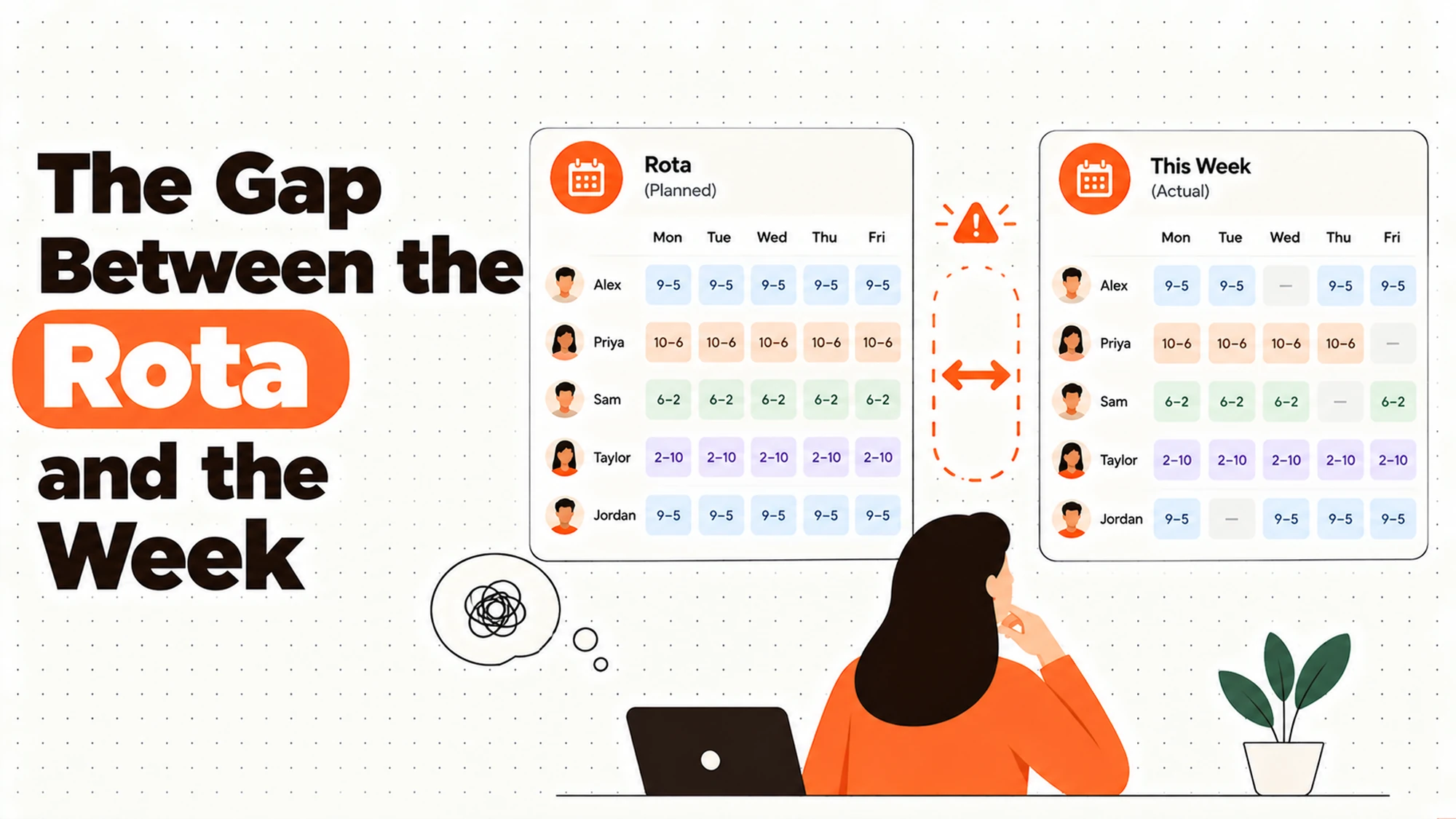
You publish a week. The week happens. Those are two different things, and almost nobody ever puts them side by side.
Somebody didn't arrive. Two people stayed later than scheduled. A shift got covered by a different person than the one printed on it. An extra pair of hands came in on Saturday because Saturday was busier than anybody expected. By the time the week is over, what actually occurred differs from what was published in a dozen small ways, each of which was handled competently at the time and none of which was recorded as a departure from anything.
Everybody knows this happens. What's unusual is treating the difference as a thing in itself, with a shape and a cause, rather than as the ordinary friction of operating.
Best tools for Employee Scheduling
Here's the reframe. The gap between the published rota and the worked week is the most informative artefact in scheduling, and it's the one nobody produces. It's a measurement of everything the plan couldn't account for: where the forecast was wrong, which shifts are systematically under-resourced, which roles are fragile, where your cover arrangements actually come from. All of that is sitting in the difference between two sets of numbers you already have.
And the useful stance is that the gap is not a failure. A plan that matched reality exactly would be a plan for a week with no events in it, which isn't the week anybody has. The gap is normal. What's worth knowing is its shape, because a gap made mostly of people staying late means something completely different from one made mostly of last-minute cover.
One boundary. How additional hours, overruns, on-call arrangements and cover are treated differs by jurisdiction and sometimes by agreement, and several of those have changed recently. Nothing here tells you what applies to you. Establish it with local advice. This piece is about reading the difference, not about what any of it obliges you to do.
When You Genuinely Do Not Need to Act Yet
The gap is small and somebody knows why. The week broadly runs as published and the exceptions are understood. That's the state everything else here is aiming at.
The gap is large and nobody has looked. Extremely common, and the reason it persists is that nothing in a normal process produces the comparison.
The same departure happens weekly. One shift always overruns, one always needs cover. That's not noise, it's a repeated signal, and it's the cheapest thing on this list to act on.
The edge case that forces it. A cost figure came in far above the plan and nobody could explain it. The explanation is in the gap, and it's only available if somebody was recording what actually happened.
Five Questions This Reader Asks at 11pm
Why does the week never match the rota? Because the rota is a prediction made before the week and the week is a sequence of events. People are ill, demand moves, tasks take longer, somebody's circumstances change. The plan was right when it was made and reality didn't consult it.
Is a gap normal? Yes, and a plan that matched perfectly would be suspicious rather than impressive. What matters isn't the existence of a difference but its size and its composition, because those tell you different things about the plan.
A perfect match would usually mean departures are being absorbed without being recorded, which is worse than having them.
What does the gap actually tell you? Where the forecast was wrong and in which direction. Which shifts are systematically under-resourced. Which people your cover depends on. Whether the work is what you thought it was. None of that is available from either number alone.
Who should be looking at it? Whoever builds the rota, because they're the only person who can act on it next week. A gap analysis produced for somebody senior, weeks later, informs nothing and generates a question instead.
Isn't this just time recording? No, and the distinction matters. Time recording captures what happened. This is the comparison between what happened and what was planned, and the comparison is where the information sits. Most operations have the first and have never produced the second.
Reading the Gap
| The departure | What causes it most often | What it tells you about the plan |
|---|---|---|
| Somebody did not arrive | Illness, or a change they never saw | Your absence rate, or your delivery mechanism |
| Somebody stayed longer | The work did not fit the shift | The shift length or the workload is wrong |
| A different person covered | Swap, or last-minute rearrangement | Where your real flexibility comes from |
| Extra people were called in | The forecast was low for that period | A specific, repeatable forecast error |
| A shift was cancelled on the day | The forecast was high, discovered late | The same error in the other direction |
| The work was different | The plan assumed the wrong activity | Your understanding of the work is drifting |
| The same shift always overruns | Structural, not incidental | That shift is designed wrongly |
| Cover always comes from one person | Everybody else is unavailable or unasked | A dependency nobody has named |
The second and seventh rows together are the most actionable finding available here. A shift that regularly runs over isn't a series of unlucky evenings, it's a shift whose length or workload doesn't match what the work requires, and it's costing you additional hours every week while the published rota continues to claim otherwise.
The fourth and fifth rows are your forecast error made visible, and they're the reason this comparison is worth building. Calling people in and sending people home are the two directions of the same mistake, and counting which happens more tells you which way your staffing numbers lean, which is otherwise almost impossible to know.
The last row is the dependency that surfaces only in this view. Cover arrangements feel distributed because each instance involves a different problem, and looking across a period frequently shows that the same one or two people absorb nearly all of it.
The sixth row is the slowest of the eight and the one with the largest implications. Work drifting away from what the plan assumes is a statement about the operation rather than about any week in it.
Five Diagnostic Questions You Can Self-Assess Against
Can you compare a published rota against the worked week? Not in principle, actually. In many operations the published version is overwritten by amendments, so the original no longer exists to compare against.
Check it before designing anything else, because a negative answer changes the order of everything that follows.
Which departure dominates? Overruns, cover, cancellations, no-shows. The composition matters more than the total, and it points at completely different fixes.
Most operations can guess this correctly before counting, and the counting matters anyway because it reveals which periods rather than which kind.
Which shift always departs? Every operation has one. It's known to everybody who works it and it's almost never been analysed.
The people on it can name it immediately if asked, and they've usually stopped expecting anybody to ask.
Who does your cover actually come from? Count it over a few months. The answer is usually a much shorter list than anybody expects.
It's also the question most likely to change how you feel about your own resilience, because operations consistently believe cover is broadly shared and consistently find it isn't.
Does the person who builds the rota see any of this? If the comparison goes to somebody else, or nowhere, then nothing changes next week.
Run these five with whoever operates the week rather than whoever reports on it. Shift leads and supervisors know which departures repeat and can usually name the two or three that account for most of the gap before anybody counts.
Six Ways the Week Departs From the Plan, Reviewed
Somebody does not arrive
A scheduled person isn't there. It earns its place as the most visible departure and the one with the most immediate operational consequence.
Where it's worth separating is cause. Genuine absence is one thing and belongs with our absence material. Somebody who didn't arrive because they never saw a change is a completely different problem wearing the same clothes, and treating both as absence means the second never gets fixed.
Split them in your records. The proportion that turns out to be delivery failure rather than absence is frequently higher than anybody expects.
The reason it matters beyond bookkeeping is that the two have opposite responses. Genuine absence is handled through whatever absence process you have; somebody who never received a change needs the notification mechanism fixing, and recording it as absence means that never happens.
It also affects the person. Being marked absent for a shift you were never told about is a mark against somebody who did nothing wrong, and it stays on a record that other people read later.
Somebody stays longer than scheduled
The shift overruns. It earns its place as the departure most likely to be treated as normal and least likely to be recorded anywhere.
Where it falls short as a way of operating is that it's invisible and cumulative. Nobody logs a shift finishing late, the additional hours may reach pay through a different route, and the person absorbing it is doing so at the end of their day with whatever was waiting.
Count these specifically. What applies to additional hours differs by jurisdiction and by agreement and needs establishing, and separately a shift that regularly overruns is telling you the shift is wrong.
The invisibility is the real problem here rather than the hours themselves. A shift ending late leaves no mark in the scheduling record, so an operation can run systematically longer than it publishes while every document says otherwise.
Watch where it concentrates too. Overruns are rarely spread evenly, and the same closing shift or the same role absorbing them every week is a design finding rather than a staffing one.
A different person covers the shift
The work gets done by somebody other than whoever was published. It earns its place because it usually reflects a team solving a problem sensibly without anybody escalating it.
Where it falls short is visibility. Informal cover means the rota on paper and the week in reality diverge with nobody recording it, and the flexibility that made it work is invisible until the person providing it leaves.
Worth recording even loosely. Knowing where cover comes from is knowing where your operation is actually resilient, and that's rarely where anybody assumes.
The informality is what makes it invisible. Each instance is two colleagues sorting something out, which is exactly what you want, and the accumulated pattern is a dependency on a small number of people that nobody has ever stated.
It's also worth knowing what the cover cost the person providing it. Somebody who repeatedly steps in is spending their own flexibility, and the fact that they keep agreeing is not evidence that it's free.
Extra people are called in
The published staffing wasn't enough and somebody added to it. It earns its place as the clearest available signal that a forecast was low for a particular period.
Where it falls short is that it's rarely counted as a forecast error. It gets handled as an operational event, the person called in is thanked, and nothing connects it back to the number that produced the shortfall.
The single most useful thing to count in this whole area. Tally these by period and you'll have a map of exactly where your staffing numbers are wrong.
The concentration is what makes the tally worth keeping rather than estimating. Call-ins are almost never spread evenly across the week, and a couple of months of counting will usually point at two or three specific periods that account for most of them.
Each of those is then a forecast correction rather than an operational habit. Adding a person to the published rota for a period that reliably needs one removes the scramble entirely and costs the same hours you were already paying for.
A scheduled shift is cancelled on the day
You've got more people than the day needs and somebody is stood down. It earns its place as the opposite signal to the one above and equally informative.
Where it falls short is what it does to the person. A shift cancelled on the day removes income they'd counted on with no chance to replace it, which is a real cost carried by them rather than by the operation.
Count these alongside the call-ins. The balance between the two is the direction of your forecast error, which is the thing nobody currently knows.
Be careful about where cancellations land as well as how many there are. If they consistently fall on the same people, usually whoever is newest or considered least essential, then one group is absorbing all the income variability while everybody else has a stable week.
That pattern is invisible in a total and obvious the moment anybody counts by person.
The work turns out to be different
The people were right and the work wasn't what was planned for. It earns its place as the departure that indicates something has changed about your operation rather than about any particular week.
Where it falls short is recognition. Nobody logs that the work was different, it gets absorbed by whoever was on, and it can continue for months before anybody notices the plan is describing an operation you no longer run.
The slowest signal and the most significant. Where this recurs, the forecast isn't wrong so much as answering an outdated question.
It tends to surface first as a vague sense that the plan doesn't fit any more, which is easy to dismiss because nobody can point to a specific failure. The rota is met, the hours are worked, and what people are doing has quietly diverged from what was planned for.
Asking whoever works the shift what they actually spend their time on is usually faster than any analysis, and it's a question nobody has put to them.
The Decision Table
| Situation | Scale | Setup | Primary Pain | Recommended Starting Point |
|---|---|---|---|---|
| Small gap, understood | Any | Any | None | Change nothing |
| Published version overwritten | Any | Any | No comparison possible | Keep the original |
| Nobody produces the comparison | Any | Any | Information sitting unused | Build it once, roughly |
| Same shift always overruns | Any | Any | The shift is designed wrongly | Change the shift, not the week |
| Calling people in regularly | Any | Any | Forecast low for that period | Tally by period |
| Cancelling on the day regularly | Any | Any | Forecast high, and a cost to people | Tally alongside call-ins |
| Cover comes from one person | Any | Any | An unnamed dependency | Count where cover comes from |
| Absence and delivery failure mixed | Any | Any | The second never gets fixed | Split them in the record |
| Comparison goes to somebody senior | Any | Any | Informs nothing, prompts a question | Give it to the rota builder |
The second row stops the exercise before it starts and it's more common than people expect. If amendments overwrite the published rota, the original is gone, and there's nothing to compare the worked week against. Retaining a snapshot at publication is usually a setting and it's the precondition for everything else.
The fourth row is the highest-return finding. A shift that overruns every week is a design problem being solved weekly by whoever is on it, at their own cost, and fixing the shift removes the whole pattern rather than managing it indefinitely.
The eighth row is the one that quietly protects somebody. Where absence and missed notifications are merged in the record, a person who never saw a change carries a mark they didn't earn, and the mechanism that failed them stays unexamined.
The Week That Never Runs to Plan
The gap is data, not failure. A plan matching reality exactly would describe a week in which nothing happened. The difference is expected; its composition is the information.
Treating it as failure produces the wrong response. An operation trying to eliminate the gap will pressure people into absorbing departures silently, which removes the signal rather than the cause.
Composition beats size. A large gap made of requested swaps is a healthy operation. A small one made entirely of one person covering everything is a fragile one. The total tells you very little on its own.
So sort before you measure. A single number for departures mixes categories that mean opposite things and points at nothing.
Call-ins and cancellations are your forecast error. They're the two directions of the same mistake, they're countable, and the balance between them answers a question about staffing levels that's otherwise almost unanswerable.
They're also cheap to count. A tally by period, kept for a couple of months, needs no system and produces the single most useful staffing number most operations will ever have.
Repeated departures are structural. Anything that happens most weeks at the same point isn't a run of bad luck, it's a feature of how that shift is designed, and it can be fixed once rather than handled repeatedly.
Competent handling is what hides them. Each rescue works, so nothing escalates, and the pattern survives precisely because the people involved are good at absorbing it.
Cover reveals where you're actually resilient. Not where the org chart says. Counting who covers over a period usually produces a much shorter list of names than anybody expects, and that list is a dependency.
It's also a list worth acting on before it acts on you. Two or three names carrying your flexibility is a risk, and broadening it is easier while everybody is still there.
The rota builder is the audience. They're the only person who can use this next week. A comparison produced for review somewhere else, weeks later, generates a question rather than an improvement.
Which is the same rule as everywhere else in scheduling. Information helps in proportion to how close it lands to somebody who can still act on it.
The practical version is small. Keep the published version, record what actually happened, and once a month put them next to each other. You'll find two or three repeated departures, and each one is a fix you can make rather than a week you have to keep rescuing.
Two or three is the realistic yield and it's enough. This isn't an analytics programme, it's a monthly hour that converts recurring operational pain into a short list of specific things that can be changed once.
Where These Arrangements Go Wrong
| The failure | How it shows up | What would have to change |
|---|---|---|
| Published rota overwritten | Nothing to compare against | Snapshot at publication |
| Comparison never produced | A month of information, unused | Build it once, roughly |
| Overruns unrecorded | Additional hours nobody can see | Count them specifically |
| Absence and delivery failure merged | The mechanism never gets fixed | Separate the causes |
| Repeated departure treated as luck | The same rescue, every week | Fix the shift |
| Analysis sent to the wrong person | A question nobody can act on | Give it to whoever builds rotas |
The third row is the one that hides real cost. Shifts that finish late frequently leave no trace in the scheduling record at all, the hours surface somewhere in pay, and nobody connects the two, so an operation can be systematically running longer than it publishes without any visibility of it.
The second row is the situation almost everybody is in. Both halves of the comparison exist, neither is hard to obtain, and nothing in any normal process ever brings them together.
The fifth row is the most expensive habit here. Rescuing the same shift every week is a permanent operating cost being paid to avoid a one-time fix, and it persists because each individual rescue is small and successful.
The sixth row is why so many of these findings go nowhere. A comparison sent upward produces a question about last month; the same comparison handed to whoever builds next week's rota produces a different rota.
What to Put in Writing
| Artefact | Who owns it | When it is written | What it prevents |
|---|---|---|---|
| The published rota, retained | Whoever owns the system | Before any of this | No basis for comparison |
| Call-ins, tallied by period | Whoever runs the rota | Ongoing | An invisible forecast error |
| Cancellations, tallied by period | Whoever runs the rota | Ongoing | Only seeing one direction |
| Who provided cover | Whoever runs the rota | Ongoing | An unnamed dependency |
| Which shifts regularly overrun | Whoever runs the rota | Monthly | Rescuing instead of fixing |
| What applies to additional hours | You, with local advice | Before it matters | An assumed position |
The first row is the precondition and it's frequently missing without anybody realising. Amendments that overwrite the published version leave you with a record of what happened and nothing to compare it against, which makes everything else on this list impossible.
The fourth row is the one that names a risk rather than an inefficiency. Knowing which two or three people your cover actually depends on is worth having before one of them leaves rather than during the week after.
Questions to Ask Before You Commit
On retention. Do we keep the rota as published? A bad answer is it's in the history.
On comparison. Can we see planned against actual? A bad answer is both are available.
On overruns. Does anything record a shift finishing late? A bad answer is it flows to pay.
On cover. Can we see who covered for whom? A bad answer is it shows the final version.
On cause. Can we distinguish absence from a missed notification? A bad answer is it's all absence.
On audience. Who receives this comparison? A bad answer is the monthly pack.
What Getting This Wrong Costs
The first cost is a forecast that can't improve. Every call-in and every cancellation is direct evidence about where your staffing numbers are wrong, it's generated every week, and in most operations it evaporates because nobody tallies it. You then discuss staffing levels on the basis of opinion when the evidence was sitting in the difference between two documents you already had.
Those conversations are also much harder to win without it. Asking for an additional person on a particular shift is a proposal; showing that the shift has required a call-in most weeks for three months is a finding.
The second cost is a shift that gets rescued forever. When a particular shift overruns most weeks, the pattern is solved each time by whoever is on it staying late, which is both a permanent additional cost and something being absorbed personally by whoever works it. The fix is usually to change the shift, once, and the reason it never happens is that no view exists in which the repetition is visible.
It also shapes who is willing to work that shift. Over time the people who can't stay late stop being available for it, so the rota narrows around a design problem nobody ever addressed.
The third cost is a dependency you find out about when it leaves. Cover in most operations comes from a much smaller group than anybody assumes, and because each instance looks like an individual favour, the concentration is invisible. The week that person leaves or is unavailable, several shifts become uncoverable at once and nobody saw it coming.
They're also frequently people nobody has thanked in any structured way, because each instance felt too small to mark. The cumulative contribution is substantial and entirely unrecorded.
So do three things, and the first is a precondition rather than an action. Check that your published rota is retained rather than overwritten by amendments. Start tallying call-ins and cancellations by period. And once a month, put the published week next to the worked week and look for anything that happens repeatedly.
The first is a five-minute check with whoever administers the system, and if the answer is wrong nothing else here is possible, which makes it the right place to start.
When You Are Ready to Go Further
Start by checking that a comparison is even possible. In a surprising number of operations the published rota is overwritten as it's amended, so what exists at the end of the week is a record of what happened with nothing to measure it against. That's usually a setting rather than a limitation, and it has to be right before anything else here works.
Ask the question specifically rather than assuming a history feature covers it. An audit log of edits is not the same as a retained snapshot of what was published, and only the second supports the comparison.
Then tally two things: call-ins and day-of cancellations, by period. They're the two directions of your forecast error, they're easy to count, and between them they produce a map of exactly which parts of your week are staffed wrongly and in which direction. That's better staffing information than most operations ever obtain, from data you generate anyway.
Keep the tally by period rather than as a running total. The whole value is in seeing that Thursday evenings account for most of your call-ins, and a single number for the month hides exactly that.
Finally, look once a month for anything that repeats. A shift that always overruns, a period that always needs cover, a person who always provides it. Each of those is a structural feature being managed weekly at some cost, and each can usually be fixed once. The monthly look is where the repetition becomes visible, and it's the only place it does.
Give it to somebody by name with a date, because a monthly review that belongs to a function is a monthly review that stops happening by about the third month.
HROpsLab publishes independent comparison work across HR tooling and workforce systems. We sell nothing, we take no vendor money, and we publish no paid placements. If the next step is understanding what your current tooling retains and compares, our comparison work is one place to start.
Frequently Asked Questions
Why does the rota never match the week?
Because a rota is a prediction made in advance and a week is a sequence of events. People are ill, demand moves, work takes longer than expected, somebody's circumstances change on the day. Each departure gets handled competently at the time and none of them is recorded as a deviation from anything, so by the end of the week the published version and the worked version differ in a dozen small ways that nobody has assembled. A perfect match would actually be suspicious, since it would describe a week in which nothing happened.
What does comparing schedule against actual hours show?
Where your forecast was wrong and in which direction, which shifts are systematically under-resourced, where your cover genuinely comes from, and whether the work has drifted away from what you plan for. None of that is visible in either the plan or the record on its own, which is why the comparison is the useful artefact rather than either document. Most operations have both numbers and have never put them side by side, so the information is generated every week and evaporates every week.
Is a gap between the plan and the actual week normal?
Entirely, and treating it as a failure to eliminate leads people in the wrong direction. What's worth examining is the composition rather than the size. A large gap made up of swaps people requested themselves describes a flexible team solving its own problems. A small gap made entirely of one person covering everything describes a fragile operation with an unnamed dependency. The total on its own tells you almost nothing; what the gap is made of tells you a great deal.
What should you do when people regularly stay late?
Count it first, because shifts finishing late frequently leave no trace in the scheduling record at all, with the hours surfacing somewhere in pay and nobody connecting the two. Then treat repetition as structural: a shift that overruns most weeks isn't a run of unlucky evenings, it's a shift whose length or workload doesn't match the work, and it can be fixed once instead of rescued weekly. Separately, what applies to additional hours differs by jurisdiction and by agreement and is worth establishing properly.
How do you reduce last-minute cover?
Find out where it's needed first, by tallying call-ins by period over a couple of months. The result is usually concentrated rather than random: particular days, particular shifts, the same points every week. That concentration is a forecast error you can correct at the source, which removes the need for cover rather than managing it. It's also worth counting who provides the cover, because the list is normally far shorter than anybody expects and represents a dependency nobody has named.
What does the gap tell you about forecasting?
Call-ins and day-of cancellations are your forecast error made visible, in both directions. Counting which happens more often, and in which periods, answers the question that's otherwise nearly impossible to answer: whether your staffing numbers lean high or low. That matters because the two errors are absorbed by different people. Over-forecasting produces a visible cost somebody queries; under-forecasting produces a harder shift that generates no record, which is why tallying it deliberately is the only way it becomes evident.
Who should look at the difference between plan and actual?
Whoever builds the rota, because they're the only person who can do anything with it next week. This routinely gets produced for a monthly management review instead, where it arrives weeks after the decisions, prompts a general question, and improves nothing. The same information in front of the person assembling next week's rota changes what they build. It's the same distinction that applies to cost visibility: data is useful in proportion to how close it lands to the person who can act.
How do you record what actually happened?
Time recording captures the worked hours, and that's a separate system and a separate job covered in our workforce management material. What this needs on top is two things most operations lack: the published rota retained rather than overwritten by amendments, so there's something to compare against, and a note of the cause of each departure, particularly whether an absence was genuine or somebody simply never saw a change. That second distinction matters because mixing the two means the notification problem never gets addressed.
The plan and the week are two documents. Nobody ever puts them together.