TL;DR
- The core decision: whether you know what your scheduler is trying to achieve.
- When doing nothing is right: when the generated rota goes out with light correction.
- What has to be true: somebody can name what the generator optimises for.
- How the options split: by which single thing the settings were tuned towards.
- Decision rule: find out what it's optimising, because somebody chose it once.
- Outcome to expect: the same generator, producing rotas people recognise.
It Made a Week and Nobody Knows Why
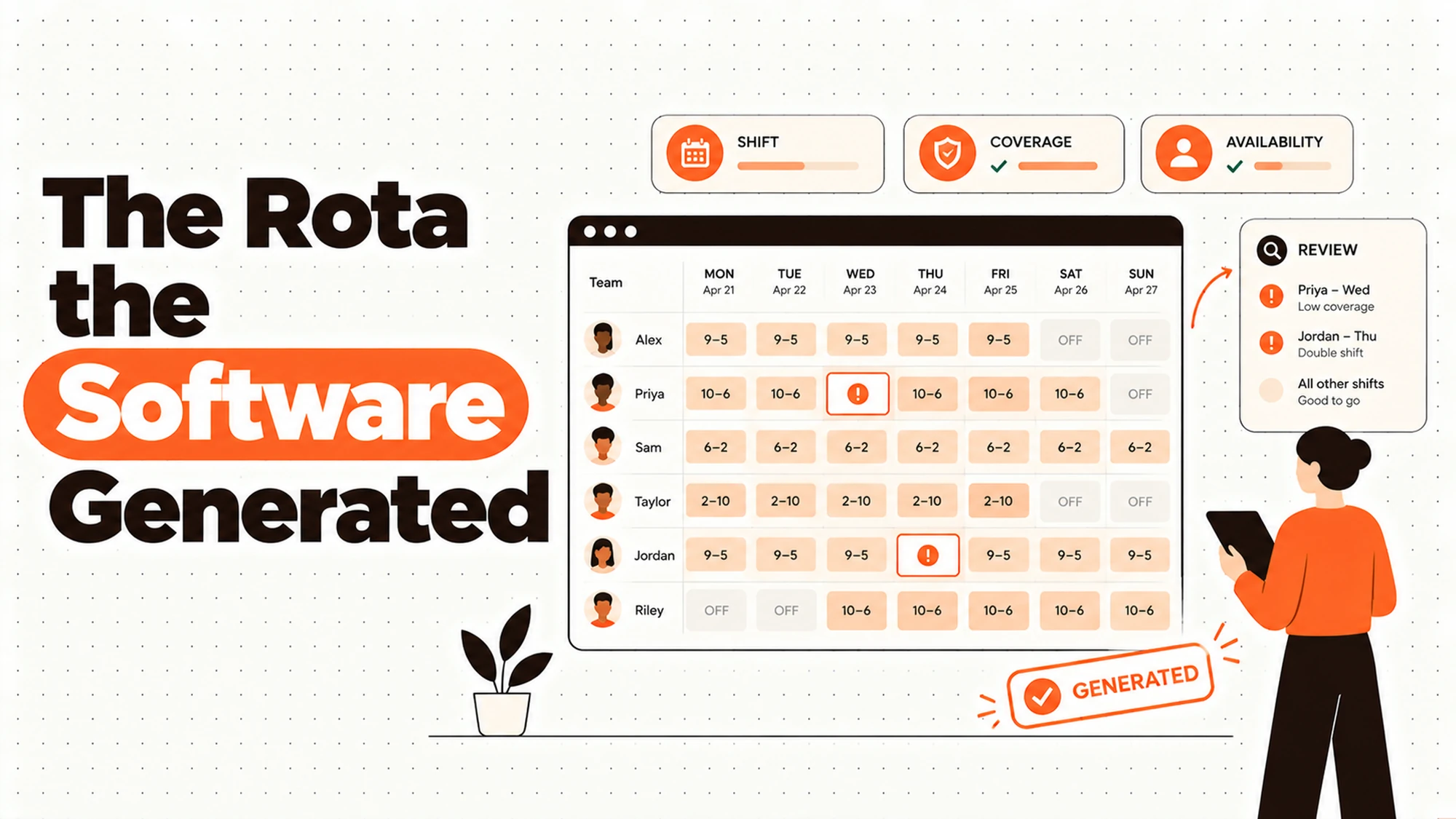
The system builds the rota. It takes seconds, it's valid, and everybody is broadly in the right places.
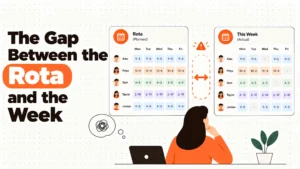
Then somebody looks properly. One person has four different start times across five days. Two people have gone from working together most weeks to never. Somebody who always did Saturdays isn't on any. None of it is wrong exactly. It's just a week nobody would have designed, and when you ask why it came out that way, nobody in the building can tell you.
The reason is simple and worth stating plainly. A generated rota is the answer to a question somebody configured, and that configuration is a set of choices about what matters more than what else. Cover every hour, or keep cost down. Spread hours evenly, or keep each person's week coherent. Honour every stated preference, or minimise changes from last week. Those pull against each other, the system resolves them according to settings, and the settings were chosen once, usually at setup, frequently by somebody who has since left.
Best tools for Employee Scheduling
So the reframe: automatic scheduling doesn't remove judgement from rota building. It relocates it. The judgement that used to happen weekly, by a person who could see the consequences, now happens once, in a configuration screen, and then repeats silently forever.
That's not an argument against it. A generator does genuine work and does it fast. It's an argument for knowing what yours is optimising for, because that single piece of knowledge explains most of what your rotas look like, and almost nobody using one of these systems can say what it is.
One boundary before we start. A generated rota can produce patterns that raise questions about working time, rest between shifts, notice and related matters, and what applies differs by jurisdiction and sometimes by agreement. Nothing here tells you what applies to you. Establish it with local advice, and check whether the generator can be configured to reflect it rather than assuming it already does.
When You Genuinely Do Not Need to Act Yet
The generated rota goes out with light correction. A few fixes and it's fine. That means the configuration matches your operation, and it's worth knowing that rather than assuming.
Every generated rota needs heavy rework. The generator is optimising for something that isn't what you want, or it lacks constraints it needs. Either way it's currently producing a document somebody then rebuilds.
People have started saying the rota feels different. A pattern changed and nobody announced it. That's usually a setting, sometimes one that moved when something else was updated.
The edge case that forces it. Somebody asks why they've been given a particular pattern and nobody can answer. That's the moment the configuration stops being a technical detail.
Five Questions This Reader Asks at 11pm
What is it actually optimising for? The question worth asking first, and the one most people have never put to their own system. There's a setting or a set of them, somebody picked them, and the answer explains the shape of every rota you've produced since.
Should we trust the generated version? As a draft, generally yes. As a finished week, only if your real constraints are in the system, and they mostly aren't. The useful test is how much gets changed by hand, which is a number you can watch rather than an opinion.
Why do staff say it feels worse? Frequently because it optimises across the whole rota rather than for any individual week. A solution that's efficient in aggregate can give one person a fragmented week, and the person experiencing that has no idea it was the price of somebody else's better one.
Does it save time? Usually yes at the building stage, and the saving is partly returned in checking and correcting. Where it genuinely saves is with large or complex populations, where manual building is slow and error-prone. At small scale the saving is modest and the risk of an odd result is the same.
Who should look at it before it goes out? Somebody who knows the people. A generated rota is valid by construction, so the only thing a reviewer adds is the knowledge the system didn't have, and a reviewer without that knowledge is confirming arithmetic.
What It Flattens
| What gets smoothed away | Why the system can't see it | Who notices |
|---|---|---|
| A week that hangs together for one person | It optimises across everybody | That person, every week |
| Consistent start times | Consistency isn't usually a target | Anybody with a commute or childcare |
| Working with the same colleagues | Relationships aren't in the data | The team, then the atmosphere |
| The shift somebody always does | History isn't a constraint unless configured | Them, and whoever relied on it |
| Informal cover arrangements | Never recorded, so never preserved | Everybody, when one breaks |
| Who can actually handle a hard slot | Capability is recorded, coping isn't | Whoever gets put there |
| Sensible gaps between shifts | Only handled if a rule was set | The person turning around quickly |
| Predictability week to week | Each week is solved fresh | Anybody trying to plan a life |
The first row is the source of most complaints about generated rotas and it's structural rather than a defect. An optimiser finds a good arrangement for the whole week across everybody, and that solution can hand one individual a scattered, incoherent set of shifts. Nothing is wrong with the rota. Something is wrong with that person's week, and they're the only one who can see it.
The last row is the one that accumulates. Solving each week independently means somebody's pattern can change every week for reasons that have nothing to do with them, which makes planning anything outside work difficult in a way a slightly worse but stable rota wouldn't.
The seventh row is worth checking explicitly. Whether the generator enforces sensible gaps between shifts depends on whether somebody configured a rule, and what's actually required differs by jurisdiction and by agreement, so this is one to establish with local advice and then verify in the settings rather than assume.
Five Diagnostic Questions You Can Self-Assess Against
Can anybody say what it optimises for? Ask around. If nobody can answer, that's the finding, and the answer is sitting in a configuration screen somebody can open.
How much gets changed after generation? Count it for a few weeks. Light correction means the configuration fits. Heavy rework means it's solving a different problem from yours.
Who set it up, and are they still here? Configuration made at implementation by somebody who has left is the common case, and it means the current behaviour reflects a judgement nobody can explain.
Has anything changed since? Settings move during upgrades, and a default can shift without anybody noticing. If rotas started feeling different at some point, that's usually why.
Does anybody look at an individual's week? The optimiser looks at the whole rota. Somebody has to look at one person's five days and ask whether it's a sensible week, because nothing else will.
Ask these five of whoever publishes the rota rather than whoever administers the system. The publisher sees what the generator produces every week and will have opinions about it that have never been written down anywhere.
Six Things a Generated Rota Optimises For, Reviewed
Covering every hour at least adequately
The system's first job is usually to leave no slot uncovered. It earns its place because an uncovered hour is a visible operational failure and the one thing nobody can absorb quietly.
Where it falls short is that adequate coverage says nothing about whether the right people are in the right places. A slot filled by whoever was available satisfies the constraint and can still leave a shift without the capability it needs.
Necessary and not sufficient. Worth checking whether coverage is defined by headcount or by capability, because the difference shows up on the day.
The other thing to establish is what it does when it can't cover something. Some generators leave the gap visible, some quietly extend somebody, and some produce a rota that meets the target by making an assumption nobody agreed to.
An uncovered slot shown plainly is far more useful than a covered one that shouldn't be. Ask to see what an impossible week looks like, because that's the case where the difference between systems is largest.
Keeping cost down
The generator produces the cheapest arrangement that meets the constraints. It earns its place because cost is real, it's measurable, and a scheduler that ignores it will produce weeks nobody can approve.
Where it falls short is that cost is the easiest thing to measure and therefore tends to dominate. Everything else on this list is harder to express as a number, so a configuration that weights cost heavily will quietly trade away consistency, coherence and pairing without anybody deciding that trade.
Fine as one objective among several. Worth knowing how heavily it's weighted relative to everything else, because that ratio is the actual policy.
The measurability problem is worth naming because it operates quietly and in one direction. Cost has a number attached, everything else on the list is a judgement, and anything competing against a number tends to lose to it over time regardless of what anybody intended.
If cost is genuinely the priority, saying so plainly is better than letting it win by default. People can work with a stated constraint and cannot work with one that shapes every week while officially being one consideration among many.
Spreading hours evenly across people
Everybody gets a similar share. It earns its place on a plain notion of even treatment and because it prevents the drift where the same people get all the hours.
Where it falls short is that even hours and even quality aren't the same. Somebody can receive exactly their share entirely in awkward slots, and the system will register that as balanced. Even distribution also ignores that people want different amounts, and the ones who want more find their availability doesn't convert into shifts.
Reasonable default. Check what it's equalising, because equal hours in unequal shifts is a common and invisible outcome.
The wanting-different-amounts problem is the other half. Even distribution assumes everybody wants the same share, and in most teams some people want more hours and some want fewer, so an evenly distributed rota is simultaneously giving somebody less than they need and somebody else more than they want.
Where the system can hold a desired amount per person rather than assuming parity, that's usually a better arrangement and worth asking about.
Honouring recorded availability
The generator respects what people said they can do. It earns its place as basic respect for the data you collected, and violating it is the fastest way to make people stop maintaining it.
Where it falls short is the quality of what's recorded. Availability is usually a mixture of genuine constraint and unexpressed preference, and it goes stale, so strict adherence to it can be strictly adhering to something inaccurate.
Keep it as a hard constraint. Its usefulness depends entirely on the underlying data being current, which is a separate piece of work.
The failure to watch for is a generator that treats availability as a preference it can override when the week is tight. Scheduling somebody outside their stated availability, even occasionally, teaches everybody that the record is decorative, and the data degrades quickly afterwards.
If the system can override, find out under what circumstances and whether anybody is told when it does.
Keeping each individual's week coherent
The system tries to give each person a sensible shape: similar start times, reasonable gaps, a pattern rather than scattered shifts. It earns its place because this is what people actually experience, and it's the thing most likely to be missing from a default configuration.
Where it falls short is that it costs efficiency. A coherent individual week constrains the optimiser, which means a slightly more expensive or slightly less neatly covered rota overall.
The objective most worth adding if it isn't there. Ask specifically whether the system can weight it, because plenty can and few are set up to.
It's also the objective that most improves how the rota is received for the least operational cost. A week that's slightly more expensive and visibly sensible to the person working it buys more goodwill than most things an operation can do deliberately.
Worth defining what coherent means for your setting before asking. Similar start times, a limited number of distinct patterns, consecutive days rather than scattered ones: these are different requests and a system may support some and not others.
Minimising changes from last week
The generator prefers to keep things as they were. It earns its place on predictability, which is worth a great deal to the people in the rota and costs the operation very little in most weeks.
Where it falls short is inertia. A rota anchored to last week carries forward whatever was in last week, including allocations nobody would choose now, and it adapts slowly to genuine change.
Frequently underrated. It's the cheapest way to give people a stable pattern without committing to a fixed one, and it's worth asking whether your system supports it.
The inertia risk is real and manageable. A rota anchored to last week will preserve last week's allocation indefinitely, including whoever ended up with the awkward shifts, so it needs an occasional deliberate reshuffle rather than being left to run.
Think of it as stability with a periodic reset. The people in the rota get predictability most of the time, and the allocation gets examined on a schedule rather than never.
The Decision Table
| Situation | Scale | Setup | Primary Pain | Recommended Starting Point |
|---|---|---|---|---|
| Light correction, rota goes out | Any | Generating | None | Change nothing |
| Nobody can say what it optimises for | Any | Generating | Policy nobody set | Open the settings and read them |
| Heavy rework every week | Any | Generating | Solving a different problem | Constraints, then objectives |
| Individual weeks look scattered | Any | Generating | Optimised in aggregate | Weight individual coherence |
| Start times vary constantly | Any | Generating | Consistency not a target | Ask whether it can be one |
| Rotas changed feel without announcement | Any | Generating | A setting moved | Check what changed, and when |
| Configured by somebody who left | Any | Generating | Judgement nobody can explain | Rebuild the reasoning |
| Even hours, uneven quality | Any | Generating | Balance measured wrongly | Check what is being equalised |
| Nobody reviews an individual's week | Any | Generating | The person is the only one who sees it | Add that check |
The second row comes before everything else and it's an afternoon's work. Somebody opens the configuration, reads what's set, and writes it down in plain words. That document explains the shape of every rota you've produced and most operations don't have it.
The ninth row is the cheapest addition on the list. Looking at one person's week costs a couple of minutes and catches the failure the optimiser is structurally unable to see.
The fourth row is the most common complaint and the most fixable. Scattered individual weeks are a direct consequence of optimising across everybody, and many systems can weight individual coherence if somebody asks them to. Whether yours can is a question for your vendor with a specific answer.
The seventh row is the one with a deadline that has usually passed. Where the configuration was set by somebody who has left, the reasoning went with them, and what remains is a set of weights nobody can defend or safely change without understanding what they were for.
The Settings Somebody Chose Once
The configuration is your scheduling policy. Whatever weights were set determine how every conflict between cost, coverage, fairness and coherence gets resolved, every week, forever. That's a policy, and it's usually written nowhere except in a settings screen.
Which means nobody approved it. A policy of that consequence would normally be discussed, and this one arrived as an implementation task.
It was chosen at the worst possible moment. Implementation, when nobody yet knew how the system behaved, frequently by a consultant or an administrator rather than by anybody who runs shifts. Then it was never revisited.
Nobody was hiding anything. It's a settings screen during a busy project, and the consequences only become legible after months of living with the output.
Cost dominates because it's measurable. Everything else on the objective list is hard to express numerically, so a configuration balancing cost against vaguer goods will tend to let cost win, not by intention but by the arithmetic of what's easy to specify.
Naming the others gives them a chance. An objective written down can be argued for; one that exists only as a feeling about what a good rota looks like cannot.
Defaults move. Upgrades change settings, new options arrive switched on, and a scheduler that behaved one way last year may not now. If people report that rotas feel different, look here before looking anywhere else.
And people notice before you do. The person whose start times changed has felt it for weeks by the time it reaches anybody who could check a setting.
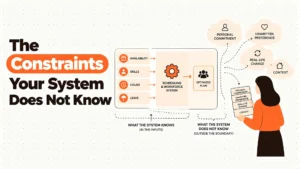
Nobody experiences the aggregate. The optimiser evaluates the whole rota. Every person in it experiences only their own five days, and a solution that's good overall can be poor for an individual with nothing in the system registering that.
Somebody has to look at one person's week. Not the rota, one person. That's the check the optimiser structurally cannot perform, and it's the one that catches the scattered week, the odd pattern and the shift that shouldn't have gone to that person.
Rotate whose week you look at. Checking the same person every time tells you about them; checking a different few each week builds a picture of what the configuration is actually producing across the team.
The practical consequence is small and specific. Open the settings, write down what they say in plain language, and decide whether that's the policy you'd choose. Most operations discover it isn't, and that the change required is modest.
Modest is worth stressing, because the size of the effect is out of proportion to the size of the change. Adjusting one weight can alter the shape of everybody's week, which is both the reason to do it carefully and the reason it's worth doing at all.
Where These Arrangements Go Wrong
| The failure | How it shows up | What would have to change |
|---|---|---|
| Objectives never examined | A policy nobody set, running weekly | Read the settings, write them down |
| Cost weighted by default | Coherence and consistency traded away | Rebalance deliberately |
| Aggregate optimisation only | One person's scattered week | Weight individual coherence |
| Constraints missing | Heavy rework, blamed on the software | Supply what it was never told |
| Settings moved in an upgrade | Rotas feel different, nobody knows why | Check after any release |
| Nobody reviews a person's week | Only the affected person sees it | Add that specific check |
The fourth row is the misdiagnosis that costs most. Heavy manual rework usually means the generator lacks constraints rather than that the generator is poor, and operations that conclude the software is at fault sometimes replace it, only to find the new one produces equally unusable rotas from the same incomplete information.
The fifth row is worth a habit rather than a project. Checking the scheduling configuration after any significant release takes minutes and catches a category of change that otherwise appears as an unexplained shift in how rotas feel.
The third row is the structural one and it never fully goes away. An optimiser will always be solving for the whole while every person lives in their part of it, so the individual check isn't a workaround for a bad system, it's the permanent counterpart to having one.
What to Put in Writing
| Artefact | Who owns it | When it is written | What it prevents |
|---|---|---|---|
| What the generator optimises for, in plain words | Whoever owns the system | This week | A policy nobody set |
| The relative weights, as configured | Whoever owns the system | With the above | Cost winning by default |
| What got changed after generation | Whoever builds the rota | Ongoing | Rework blamed on software |
| Who reviews an individual's week | Named individual | Before relying on generation | The scattered week nobody sees |
| Settings checked after each release | Whoever owns the system | As a habit | Unexplained drift |
| What applies to your populations | You, with local advice | Before configuring rules | A position you assumed |
The first row is the single most useful thing here. A plain-language description of what the system is trying to achieve, written down, converts an invisible configuration into something people can look at and disagree with, which is the only way it will ever get improved.
The second row is what makes the first one honest. Objectives listed without their relative weights read as a balanced set of good intentions, and the weights are where the actual decision lives.
Questions to Ask Before You Commit
On objectives. What does it optimise for? A bad answer is the best rota.
On weighting. How is cost balanced against everything else? A bad answer is configurable.
On individuals. Can it weight one person's week being coherent? A bad answer is it's fair overall.
On stability. Can it prefer keeping last week's pattern? A bad answer is it reoptimises.
On rules. Can it enforce gaps and limits we specify? A bad answer is it's compliant.
On change. Do settings move during upgrades? A bad answer is rarely.
What Getting This Wrong Costs
The first cost is a scheduling policy nobody set. The weights in that configuration decide how cost trades against coherence, how coverage trades against preference, every week, permanently. That's a significant policy for how people's working lives are shaped, it was chosen once by somebody who may not have understood the consequences, and in most operations it has never been read since.
It also can't be discussed while it's invisible. Anybody wanting to argue that the balance is wrong has nothing to point at, so the conversation stays at the level of the rota feeling off, which goes nowhere.
The second cost is the scattered individual week. An optimiser working across everybody can produce a solution where one person has four different start times, no consistency and no pattern, while the rota as a whole looks excellent. That person is the only one who experiences it, they have no way to know it was a side effect rather than a decision about them, and nothing in any report will show it.
Worse, they may well read it as deliberate. A week that looks punitive is hard to distinguish from one that is, and the absence of any explanation invites the least generous interpretation.
The third cost is replacing software that was never the problem. When generated rotas need heavy rework, the natural conclusion is that the generator is poor, and sometimes it is. Frequently the constraints that would have made the rota usable were never entered, and a replacement system fed the same incomplete information produces the same unusable weeks at considerable expense.
The replacement also resets the configuration question. Whatever weights the new system arrives with were chosen by its vendor rather than by you, and unless somebody reads them during implementation the whole cycle starts again from a fresh set of defaults nobody examined.
So do three things, none of which takes long. Open the configuration and write down what it's optimising for, in plain words. Look at one person's generated week rather than the whole rota, and ask whether it's a sensible five days. And count what gets changed by hand, because that number tells you whether you have a settings problem or a constraints problem.
The third of those is the diagnostic that tells you which of the other two to spend time on. Heavy correction points at missing constraints, odd but correctable output points at the objectives, and knowing which you have saves working on the wrong one.
When You Are Ready to Go Further
Start by reading the settings, because it's the cheapest thing here and almost nobody has done it. What the generator is weighting, and how heavily, written out in ordinary language. That document is your scheduling policy, and seeing it stated plainly is usually enough to prompt a conversation about whether it's the policy anybody would choose.
Do it with somebody who runs shifts in the room. An administrator can read the settings and only somebody who works the consequences can say whether the balance they describe is the right one.
Then look at individual weeks rather than at rotas. Pick a few people, look at their five days, and ask whether that's a reasonable shape for somebody's life. The optimiser has no capacity to do this, and it's where the complaints come from, so it's the check with the highest return on a few minutes.
Pick people with the least flexibility rather than a random sample. Somebody with a long commute, a second job or care responsibilities will show you the cost of a fragmented week most clearly, and they're the ones for whom it matters most.
Finally, before you conclude the software is the problem, check what it was told. Heavy rework is usually a symptom of missing constraints rather than a weak generator, and the way to tell them apart is the correction log: fixes you could have prevented by recording something are a data problem, and fixes you couldn't record even if you wanted to are a genuine product limit worth raising with a vendor.
That distinction also makes the vendor conversation productive. A specific list of things the system cannot express gets a real answer; a general report that the generated rotas need too much work does not.
HROpsLab publishes independent comparison work across HR tooling and workforce systems. We sell nothing, we take no vendor money, and we publish no paid placements. If the next step is understanding what your current tooling can be configured to do, our comparison work is one place to start.
Frequently Asked Questions
What does automated scheduling actually do?
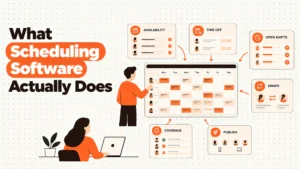
It produces a draft rota by resolving your recorded constraints against a set of objectives somebody configured. The constraints are things like availability, required skills and any rules that were set up. The objectives are the competing goods it's trying to balance: covering every hour, keeping cost down, spreading hours evenly, respecting availability, keeping individual weeks coherent, staying close to last week. Those pull against each other, and the settings decide which wins, which is why knowing what yours is weighted towards explains the shape of every rota it produces.
Should you trust a generated rota?
As a draft, usually. As a finished week, only if your real constraints are genuinely in the system, and in most operations a meaningful share of them aren't. The honest measure is how much gets changed by hand afterwards, which is a number you can watch over a few weeks rather than a judgement anybody has to make. Light correction means the configuration and the data fit your operation. Heavy rework means either the objectives are wrong for you or the system was never told something it needed.
What does auto scheduling optimise for?
Whatever was configured, which is the point of the question. Commonly a mixture of coverage, cost, even distribution of hours, respecting recorded availability, and sometimes individual coherence or similarity to the previous week. The balance between those is set in a configuration screen, usually at implementation, frequently by somebody who has since left, and rarely revisited. That configuration is effectively your scheduling policy, and in most organisations it exists nowhere in writing, which is why nobody can explain why the rotas look as they do.
Why do staff say generated rotas feel worse?
Because optimisers work across the whole rota while every person experiences only their own week. A solution that's efficient overall can hand one individual four different start times, no consistent pattern and awkward gaps, and that outcome is a side effect rather than a decision about them. They have no way to know that, and nothing in any report registers it. It's the most common complaint about generated scheduling and the most fixable, since many systems can weight individual coherence if anybody asks them to.
How do you find out what your scheduler is configured to do?
Open the settings and read them, then write down what they say in plain language. It takes an afternoon and it's the single most useful thing in this area, because it converts an invisible set of weights into something people can look at and argue with. If the answer isn't legible from the interface, it's a reasonable question to put to your vendor, phrased as what is this trying to achieve and how are the objectives balanced rather than as a request for technical detail.
Does automated scheduling save time?
At the building stage, generally yes, and some of the saving comes back as checking and correcting. The benefit is largest with big or complex populations, where manual construction is slow and mistakes are easy. At small scale the time saved is modest while the chance of an odd result is unchanged, which is why small operations sometimes find a generator adds a review step without removing much work. Watching how much you correct is the way to tell which situation you're in.
Who should review a generated rota before it goes out?
Somebody who knows the people, because that's the only thing a reviewer can add. The rota is valid by construction, so checking the arithmetic achieves nothing. What's needed is a person who can see that a particular week doesn't suit a particular individual, that two people shouldn't be on together, or that a slot has gone to somebody who can do it on paper and will struggle in practice. A reviewer without that knowledge is confirming what the system already guaranteed.
What can a generated rota not account for?
Anything not recorded, which is usually more than people expect: informal arrangements, who copes with a difficult slot, pairings that work, and anything somebody hasn't mentioned. It also can't evaluate an individual's week as a week, because it's solving across everybody. Separately, whether it enforces sensible gaps, limits or rest depends entirely on whether somebody configured rules to that effect, and what's actually required differs by jurisdiction and by agreement, so establish that with local advice and then verify the settings rather than assuming.
The generator answers a question somebody configured. Worth knowing which question.