
TL;DR
- The core decision: how desirable and undesirable time gets distributed across your team.
- When doing nothing is right: when you can see the distribution and it looks defensible.
- What has to be true: somebody can show what the allocation has actually been over time.
- How the options split: by what decides who gets what, and whether anybody chose it.
- Decision rule: make the pattern visible first, because you can't discuss what nobody sees.
- Outcome to expect: the same rota, with an answer when somebody asks why.
The Same People, Every Time
Somebody says the rota isn't fair. You look at last week and it seems reasonable enough. They're probably being oversensitive, and you move on.
Then a few months later it comes up again, from a different person, and this time you look properly. You go back through the rotas, and there it is: the same three people have had most of the weekend evenings since the spring. Nobody decided that. It emerged, one reasonable week at a time, from availability and convenience and who happened to be on the screen when a slot needed filling.
That's the thing about shift allocation. Every rota distributes desirable and undesirable time, whether or not anybody intends it to, and the distribution is a decision the organisation has made regardless of whether a person made it. What differs between operations isn't whether allocation happens. It's whether anybody can see what it has been.
Best tools for Employee Scheduling
Which is the reframe worth holding. The question isn't whether your method is fair in principle, because almost any method can be defended in the abstract. It's whether anybody can produce the pattern over a period and look at it. An allocation nobody can see can't be defended, can't be corrected, and can't be discussed with the person raising it, which is why these conversations go badly.
The reason it's invisible is structural. A rota is built and reviewed one week at a time, and one week never shows a pattern. It takes months of weeks laid side by side, and nothing in an ordinary scheduling process ever produces that view.
One boundary. Where the distribution of shifts touches protected characteristics, or where a collective or individual agreement governs how work is allocated, the position differs by jurisdiction and by agreement and is not something to infer. Nothing here tells you what applies to you or whether any method is lawful. Establish that with local advice. Everything below is about what each method does mechanically and what it makes visible.
When You Genuinely Do Not Need to Act Yet
You can see the distribution and it looks defensible. Somebody can produce the pattern over a period and it doesn't surprise anybody. That's the state worth reaching.
Somebody has said it isn't fair. Worth taking as information rather than as a complaint, because people generally raise this after tolerating it for a while, and the first person to speak is rarely the only one who noticed.
The same names keep appearing in the same slots. You've noticed it yourself. That's a pattern you can check, and checking is cheap compared with the conversation it prevents.
The edge case that forces it. Somebody has asked formally, or raised it through a process, and you need to be able to account for how shifts were allocated. That's a bad moment to discover nobody has ever looked.
Five Questions This Reader Asks at 11pm
How should shifts be allocated? There isn't a single right method, and operations reasonably use different ones. What matters more than the choice is that somebody made it deliberately, can state it, and can show what it produced. A defensible method applied invisibly is weaker than a rough method applied openly.
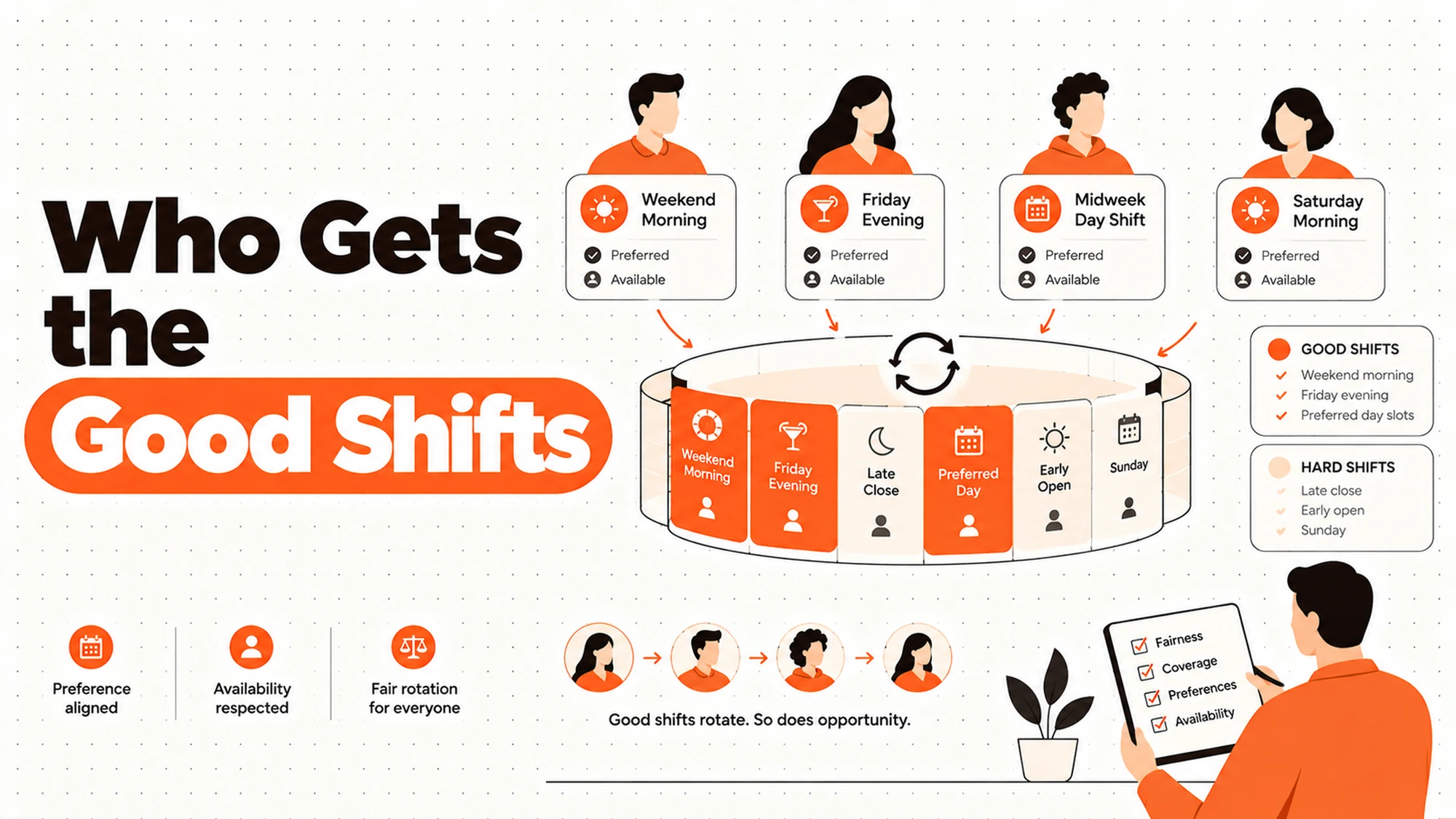
What counts as a good shift? Not the same thing to everybody, which is the complication. A late finish is terrible for somebody with a long journey and fine for somebody who prefers mornings free. Weekend work is unwelcome to most and valuable to a student. The system has no idea which is which, so any automatic balancing is balancing something it can't actually measure.
Is seniority a reasonable basis? It's common and it's defensible in some settings, and worth being clear that it's a choice rather than a natural order. It advantages people who've been there longest, which may be intentional, and it means new joiners inherit whatever nobody else wanted, which is worth knowing when you wonder why they leave.
How do you know if it's even? Look at a few months rather than a week. Nothing in a normal process produces that view, which is why the pattern accumulates unnoticed. It's usually a matter of counting rather than of any sophisticated analysis.
Somebody says it's unfair. Now what? Check before responding. A defensive answer given without looking is the worst available, because if they're right you'll find out later and the conversation will be worse, and if they're wrong you have nothing to show them.
What Counts as a Good Shift
| The attribute | Who values it | Why the system can't tell |
|---|---|---|
| Finishing early | Anybody with evening commitments | It holds the time, not what it's for |
| Weekend off | Most people, not all | Preferences aren't recorded |
| Weekend on | Students, second-job holders, some parents | Assumed undesirable by default |
| Working with particular colleagues | Almost everybody | Relationships aren't in the data |
| A consistent pattern | Anybody planning anything | Consistency isn't usually an objective |
| More hours | Whoever needs the income | Even distribution assumes parity |
| Fewer hours | Whoever has other commitments | Same assumption, opposite effect |
| The quieter shift | Varies, some prefer busy | Nothing captures this at all |
The second and third rows together show why automatic balancing is harder than it sounds. A system spreading weekend work evenly is assuming weekends are undesirable, and for some of your people they're the shifts they want. Balancing by that assumption takes shifts away from somebody who wanted them and gives them to somebody who didn't.
The sixth and seventh rows are the ones most likely to be handled wrongly by default. Even distribution of hours assumes everybody wants the same amount, and in most teams some people want more and some want fewer. An evenly distributed rota is simultaneously short-changing one person and over-committing another.
The last row is worth noting because it's invisible to everyone. Some people would rather be busy and some would rather not, that preference is real, and nothing in any scheduling system holds it, so it never enters any balancing calculation.
Five Diagnostic Questions You Can Self-Assess Against
Can you produce the pattern over three months? Not a week. If the answer is that it would take somebody a day of work, that's the finding, and it explains why nobody has looked.
What method are you actually using? Not what you'd say, what happens. Frequently the answer is a mixture of availability, whoever asked, and habit, which is a method nobody chose.
Who asked most recently? In a lot of operations, the people who get preferable slots are simply the people who ask. That's a real allocation method and it advantages the confident.
What do new joiners get? Whatever was left over, usually. Worth checking whether the pattern for somebody who joined this year is materially worse than for everybody else.
Has anybody raised it? And what happened. If somebody raised it and nothing visibly changed, everybody else has drawn a conclusion about whether raising it is worthwhile.
Ask these five of somebody in the rota as well as of whoever builds it. The people being allocated have been tracking the pattern informally for months, and they can usually tell you the answer to the first question without any counting at all.
Six Ways Shifts Get Allocated, Reviewed
Seniority or length of service
Longer-serving people get first choice. It earns its place on clarity and predictability: everybody knows the basis, it's easy to explain, and it rewards something people can see.
Where it falls short is at the bottom of the list. New joiners get whatever nobody else wanted, indefinitely, and in a stable team that can mean years. It's also the method most likely to be governed by an existing agreement in some settings, which is worth establishing rather than assuming.
Defensible where stated openly. Worth checking what the newest person's pattern actually looks like, because that's where the cost of this method lands.
The recruitment consequence is the one that goes unnoticed. If the pattern available to a new joiner is materially worse than everybody else's, that's what a candidate experiences in their first months, and it shapes whether they stay long enough to reach the better end of the list.
Worth considering whether some categories of shift sit outside the seniority order. Operations that apply it to most things and share the worst slots regardless of service tend to get the predictability without concentrating the cost entirely on newcomers.
A rotation that everybody takes in turn
Undesirable shifts cycle through the team. It earns its place because it's the most visibly even method available and it's easy for anybody to check, which removes most of the suspicion these arrangements attract.
Where it falls short is flexibility and the assumption underneath it. Rotation assumes everybody finds the same shifts undesirable, which isn't true, and it can hand a shift to somebody who dislikes it while somebody who'd have taken it happily waits their turn for something else.
Strong default. Allow swaps within the rotation, and let people opt into shifts they actually want rather than enforcing strict turn-taking against their preference.
The strictness is where good rotations fail. A turn-taking system enforced against somebody who would happily have taken the shift, and somebody else who dreads it, has achieved formal evenness at the cost of two worse outcomes.
Keep the record of whose turn it is visible to everybody. Half the value of rotation is that anybody can check it, and a rotation only one person can see is just an allocation with extra steps.
Whoever is available when the rota is built
Slots get filled by whoever the system shows as free. It earns its place on speed and on not requiring anybody to make a decision, which is also its problem.
Where it falls short is that availability isn't evenly distributed, so this method systematically advantages people with more constrained availability and disadvantages the flexible. The person who can work anything ends up working everything nobody else could, which is a penalty for being helpful.
Common and rarely chosen deliberately. Worth checking specifically whether your most flexible people are carrying the least desirable slots, because this method reliably produces that.
The effect compounds over time too. Somebody repeatedly given the shifts nobody else could do starts constraining their own availability to protect themselves, which is a rational response and removes the flexibility you were relying on.
It's also the method most likely to be in use without anybody describing it as a method. Ask how shifts get allocated and you'll be told about fairness and operational need; watch what happens and it's frequently whoever the screen showed as free.
Whoever asks
People request shifts and requests are honoured broadly in order. It earns its place because it accommodates actual preference, which is more than most methods manage, and the people who care most about a particular shift tend to get it.
Where it falls short is that it advantages the confident and the well-connected. Somebody newer, quieter, or less sure of their standing asks less, gets less, and has no way to know that asking was the mechanism.
Fine as a component. Make the fact that requests are possible explicit and equally known, because an informal request system that only some people know about is an allocation by confidence.
How requests are resolved matters as much as whether they're possible. Honouring them in order of arrival advantages whoever checks the rota most often, which is a different bias from advantaging the confident and just as arbitrary.
A stated approach to conflicts is worth having before you need one. Two people wanting the same shift is inevitable, and deciding it in the moment, repeatedly, is how a request system acquires a reputation for favouritism it may not deserve.
The manager's judgement about who copes
Somebody assigns the difficult shifts to whoever handles them best. It earns its place because it's frequently the right operational call: a hard slot covered by somebody who finds it manageable is better for everybody on it.
Where it falls short is that competence gets punished. The person who copes well with the difficult shift gets it every time, and being good at something becomes a reason to do more of it, which is a reliable way to lose your most capable people.
Use it, and watch the concentration. If one person is repeatedly on the hardest slots because they're good at them, that's a pattern worth naming to them openly rather than relying on.
Naming it changes the arrangement from something being done to somebody into something they're part of. People will frequently accept a heavier share of difficult work when it's acknowledged, and resent a lighter share that nobody has ever mentioned.
It's also worth asking whether the difficult shift is difficult for a fixable reason. Where one slot is hard because it's under-resourced or badly designed, allocating your most capable person to it every week is treating a symptom permanently.
Whatever the generator produced
A system assembles the rota and nobody examines the distribution. It earns its place on effort, and on being free of any individual manager's bias, which is a genuine benefit.
Where it falls short is that it's optimising for something else entirely, usually cost and coverage, and the allocation of desirable time is a by-product nobody specified. It will also reproduce whatever is in the availability data, including all the distortions in it.
Acceptable with a check. The generator isn't allocating deliberately, so somebody has to look at the distribution periodically, because nothing in the process will surface it.
The absence of individual bias is a real benefit and it's worth not overstating. A generator has no view about anybody, and it will faithfully reproduce whatever is in the availability data, including every distortion in how that data was collected.
Where the system can be weighted towards even distribution of particular categories rather than of hours, that's worth asking about. Evenness of hours and evenness of unpleasantness are different targets and most defaults aim at the first.
The Decision Table
| Situation | Scale | Setup | Primary Pain | Recommended Starting Point |
|---|---|---|---|---|
| Distribution visible and defensible | Any | Any | None | Change nothing |
| Cannot produce a three-month view | Any | Any | Pattern invisible by construction | Build the view first |
| Somebody has raised it | Any | Any | Information, not a complaint | Check before responding |
| Flexible people carry the worst slots | Any | Availability-driven | Helpfulness penalised | Look at your most available person |
| Requests honoured informally | Any | Ad hoc | Allocation by confidence | Make the route explicit to everybody |
| One person always on the hard shift | Any | Manager judgement | Competence punished | Name it, and rotate deliberately |
| New joiners on the leftovers | Any | Seniority | Cost concentrated at the bottom | Check a new joiner's pattern |
| Generator decides, nobody looks | Any | Generating | Allocation as a by-product | Periodic distribution check |
| Somebody raised it and nothing changed | Any | Any | Everybody drew a conclusion | Close the loop visibly |
The second row comes before everything else. You cannot have a sensible conversation about allocation without the pattern in front of you, and in most operations producing it is genuinely difficult, which is precisely why the pattern accumulates for months before anybody notices.
The third row is the moment that decides how the rest goes. Checking before answering costs a day and converts a defensive exchange into a factual one, whichever way the facts turn out.
The fourth row is the one that surprises people and it's checkable in ten minutes. Availability-driven allocation systematically loads the most flexible person with whatever nobody else could do, and they're frequently the person you'd least want to lose.
The sixth row does the same thing by a different route. Assigning the hardest work to whoever handles it best is operationally correct every single week and produces, over a year, a situation where competence has been steadily rewarded with the least pleasant rota in the team.
Nobody Can See the Pattern
One week never shows it. Rotas are built, reviewed and published weekly, and a single week is always defensible. The pattern only exists across months, and nothing in an ordinary process produces that view.
Which is why the complaint always sounds unreasonable at first. You're looking at the evidence available to you, and it genuinely shows nothing.
Which means the person raising it has better data than you. They've been living it. They know they've had most of the recent weekends because they were there for all of them, and you're looking at one week and seeing nothing wrong.
That asymmetry is worth naming in the conversation. Saying plainly that you'll go and look, rather than answering from the week in front of you, is both more accurate and better received.
Build the view before you need it. Counting who had which category of shift over a few months is not sophisticated, it's tedious, and doing it once tells you whether you have a problem and gives you something to show people.
Emergence isn't innocence. An allocation nobody decided is still an allocation your organisation produced, and explaining that nobody chose it doesn't help the person who has had every weekend since spring.
It's also not much of a defence. That nobody intended it is true and does nothing for anyone affected by it.
Check the extremes, not the average. The average person is fine by construction. Look at whoever has had the most of the undesirable category and whoever has had the least, because that gap is what anybody raising this will point at.
The gap is the number that matters. An average that looks fine is entirely compatible with two people having very different years.
The newest person is the one to check. Most allocation methods, deliberately or not, sort the leftover shifts towards whoever arrived last. If you look at one person's pattern, make it theirs.
And they are least likely to raise it. Somebody in their first months has no basis for comparison and every reason not to start by complaining, so the group most affected is the group least likely to tell you.
The practical consequence is narrow. Build the view, look at the extremes, and be able to say what your method is. That's the whole of a defensible position, and it's available in an afternoon.
Defensible is worth separating from perfect. An operation that can show what its allocation has been, explain the basis, and point at what it did when somebody raised a concern is in a strong position even where the distribution turns out to be uneven.
Where These Arrangements Go Wrong
| The failure | How it shows up | What would have to change |
|---|---|---|
| Pattern never examined | Months of drift, noticed by staff first | Produce a three-month view |
| Responding without checking | A defensive answer that turns out wrong | Look, then reply |
| Flexibility penalised | Your most available person has the worst rota | Check them specifically |
| Requests known to some | Allocation by who feels able to ask | Tell everybody the route |
| Competence concentrated | The capable person does every hard shift | Name it and share it |
| Raised once, nothing changed | Nobody raises it again, problem persists | Close the loop visibly |
The second row is the one that does lasting damage in a single conversation. Telling somebody the rota is fair without having checked, and being wrong, costs you more than the original imbalance, because they now know you answered without looking.
The last row is the quiet one. When somebody raises an allocation concern and nothing visibly follows, everybody else concludes that raising it achieves nothing, and the next person doesn't bother. The problem then continues with no further complaints, which looks like resolution.
The fourth row is the version of this that operates from the start. Where only some people know that requests are possible, the ones who don't never raise anything either, and their silence reads the same as contentment.
What to Put in Writing
| Artefact | Who owns it | When it is written | What it prevents |
|---|---|---|---|
| The distribution over three months | Whoever builds the rota | Now | A pattern nobody can see |
| What your actual method is | Whoever builds the rota | Now | A method nobody chose |
| How to request a shift, told to everybody | Whoever builds the rota | Now | Allocation by confidence |
| The newest joiner's pattern | Whoever builds the rota | Now | Cost concentrated invisibly |
| What happened when somebody raised it | Whoever handled it | At the time | Everybody concluding it is pointless |
| What applies to your populations | You, with local advice | Before setting a method | A position you assumed |
The second row is harder than it sounds and worth doing honestly. Most operations would describe their method as some combination of fairness and operational need, and what actually happens is availability plus habit plus whoever asked. Writing down the real one is the start of being able to choose a different one.
The fifth row is the one that protects the next conversation. A short note of what was raised, what you found and what followed means the second person to mention it isn't starting from nothing, and neither are you.
Questions to Ask Before You Commit
On visibility. Can we see the distribution over months? A bad answer is it's in the rotas.
On method. What decides who gets what? A bad answer is a mix of things.
On preference. Can people say which shifts they want? A bad answer is they can mark availability.
On extremes. Who has had the most of the worst? A bad answer is it's broadly even.
On requests. Does everybody know they can ask? A bad answer is they know who to speak to.
On obligations. What governs allocation for this group? A bad answer is nothing specific.
What Getting This Wrong Costs
The first cost is a conversation you handle badly because you had no information. Somebody raises it, you respond from an impression of last week, and you're either wrong or unable to show that you're right. Both outcomes are worse than the underlying imbalance, because the person now knows that their concern was answered without being examined, and they'll tell colleagues that.
The reputation of the rota is the thing being spent in that exchange. Once people believe allocation isn't examined, every subsequent pattern gets read as deliberate, including the ones that genuinely are coincidence.
The second cost is losing whoever is most flexible or most capable. Both of the common informal methods, filling from availability and assigning difficult shifts to whoever copes, concentrate the worst work on your best people. Nobody intends it, every individual instance is sensible, and the person on the receiving end experiences being good at their job as a reason to get the shifts nobody else wants.
They also tend to leave without explaining it that way. What gets said is that they wanted a change or better hours, which is true and incomplete, and the pattern that produced it stays in place for whoever replaces them.
The third cost arrives when somebody asks formally. At that point you need to account for how shifts were allocated over a period, and an operation that has never produced that view is assembling it under pressure, retrospectively, with whatever records exist. What applies in that situation differs by jurisdiction and by agreement and needs local advice, but the practical problem is the same everywhere: you're constructing the answer after the question.
The reconstruction is also least reliable at exactly the moment it matters most. Rotas that were amended during the week, cover arranged informally and swaps agreed between people may not all be in whatever record you end up working from.
So do three things this week, and the first is most of it. Produce the distribution over the last few months, however roughly. Look at the extremes rather than the average, and particularly at whoever joined most recently. And write down what your method actually is, because you can't choose a better one until you can state the current one.
Rough is genuinely enough for the first pass. A tally of who had how many of the least popular category will tell you within minutes whether there's anything here, and a more careful version is only worth building if there is.
When You Are Ready to Go Further
Start with the view, because everything else here depends on it and nobody has one. Who had how many of each category of shift over the last few months. It doesn't need to be sophisticated and it doesn't need to be a system: a count is enough, and doing it once tells you whether there's anything to address.
Pick two or three categories rather than trying to classify everything. Weekend work, late finishes and whatever your team regards as the worst slot will capture most of what anybody is actually concerned about.
Then look at two specific people rather than at the team. Whoever is most flexible, because availability-driven allocation loads them with everything nobody else could do. And whoever joined most recently, because almost every method sorts leftovers towards them. If both of those patterns look reasonable, your distribution is probably fine.
That shortcut is the reason this is worth doing at all rather than postponing it. Two people, a few months of rotas, and you have most of the answer without building anything.
Finally, make the request route explicit and equally known. A surprising share of allocation in most operations happens because somebody asked, which quietly advantages the confident and the long-standing. Telling everybody plainly that they can ask, and how, costs nothing and removes the most avoidable unfairness on this list.
Say what happens when two people ask for the same thing, too. A stated approach, even a simple one, prevents a request system from acquiring a reputation for favouritism that the individual decisions may not deserve.
HROpsLab publishes independent comparison work across HR tooling and workforce systems. We sell nothing, we take no vendor money, and we publish no paid placements. If the next step is understanding what your current tooling can show you about distribution, our comparison work is one place to start.
Frequently Asked Questions
How should you allocate shifts?
There's no single correct method, and operations reasonably use seniority, rotation, availability, requests, managerial judgement, or a system-generated arrangement. What matters more than the choice is that somebody made it deliberately, can state what it is, and can show what it has produced over a period. A rough method applied openly, where everybody knows the basis, tends to be received better than a defensible one applied invisibly, because the second gives nobody any way to check whether it's working as described.
Is seniority a good basis for allocating shifts?
It's common, clear and easy to explain, which are genuine advantages, and it's worth treating as a choice rather than as a natural order. The cost falls entirely at the other end of the list: whoever joined most recently gets whatever nobody else wanted, and in a stable team that can persist for years. If you use it, check what the newest person's pattern actually looks like, because that's where the method's cost is concentrated and it's frequently worse than anybody realised.
What counts as a desirable shift?
Not the same thing to everybody, which is what makes automatic balancing harder than it looks. A late finish is difficult for somebody with a long journey and fine for somebody who values free mornings. Weekend work is unwelcome to most people and actively wanted by students and those holding second jobs. Some people prefer being busy and some don't. Scheduling systems hold the time rather than what it means to the person, so any balancing they do rests on an assumption about desirability that may be wrong for a good share of your team.
How do you tell whether shift distribution is even?
Count it across a few months rather than looking at a week, because a single week is always defensible and the pattern only exists over time. Nothing in an ordinary scheduling process produces that view, which is exactly why imbalances accumulate unnoticed. When you do produce it, look at the extremes rather than the average: whoever has had the most of the undesirable category and whoever has had the least. That gap is what anybody raising the issue will be pointing at.
Why do the same people keep getting the awkward shifts?
Usually because of one of two informal methods, neither of which anybody chose. Filling slots from whoever is available loads your most flexible person with everything nobody else could cover, so being helpful becomes a penalty. Assigning hard shifts to whoever copes best means competence gets rewarded with more of the same. Both are individually sensible every single week and both produce a concentration that only becomes visible across months, by which point the person affected has noticed long before you have.
Should you let people request shifts?
It's one of the few methods that accommodates what people actually want, so yes as a component, with one condition. An informal request system advantages whoever feels able to ask, which tends to mean longer-serving and more confident people, while somebody newer or quieter gets less and has no idea that asking was the mechanism. Making the route explicit and telling everybody it exists costs nothing and removes the most easily avoidable unfairness in this whole area.
How do rotation systems work in practice?
Undesirable shifts cycle through the team in turn, which makes the arrangement visibly even and easy for anybody to verify, removing most of the suspicion these things attract. The limitation is the assumption underneath it: rotation treats a shift as equally unwelcome to everybody, and it isn't, so it can hand somebody a slot they dislike while another person who'd have taken it willingly waits their turn. Allowing swaps and letting people opt into shifts they actively want keeps the fairness and removes the rigidity.
What should you do when somebody says the rota is unfair?
Check before you answer. A defensive response given from an impression of last week is the worst available option, because if they're right you'll discover that later in a worse conversation, and if they're wrong you have nothing to show them. Producing the distribution over a few months takes a while the first time and gives you either a finding or a straightforward answer. Whatever you conclude, close the loop visibly, because if somebody raises it and nothing appears to follow, everybody else stops bothering.
Nobody decided it. Your organisation still did it.