
TL;DR
- The core decision: whether the requisition defines the role or merely records a decision somebody already made.
- When doing nothing is right: when one person approves every hire and knows about all of them.
- What has to be true: somebody can state what the person will be doing and how the role will be judged, before anybody applies.
- How the options split: by whether approval happens before or after the search starts, which changes what it's for.
- Decision rule: if the search can't conclude because nobody agrees what good looks like, that was a requisition problem.
- Outcome to expect: fewer searches that stall at the shortlist, and no roles finance didn't know about.
The Role Finance Found Out About
Somebody in finance is reconciling something and notices a search running for a role that isn't in the plan. They ask about it.
It turns out there was a conversation two months ago, in which a manager described a gap and somebody senior said that sounds reasonable, get it moving. Nobody wrote anything down. The manager, entirely reasonably, took that as approval and briefed a recruiter. A search has been running since, three people have been interviewed, and one of them is expecting an offer this week.
Now there's an awkward conversation. Not because anybody did anything wrong, but because the organisation committed to a substantial ongoing cost through a verbal exchange nobody recorded, and the first time that commitment became visible was when somebody stumbled across it.
Best tools for Applicant Tracking (ATS)
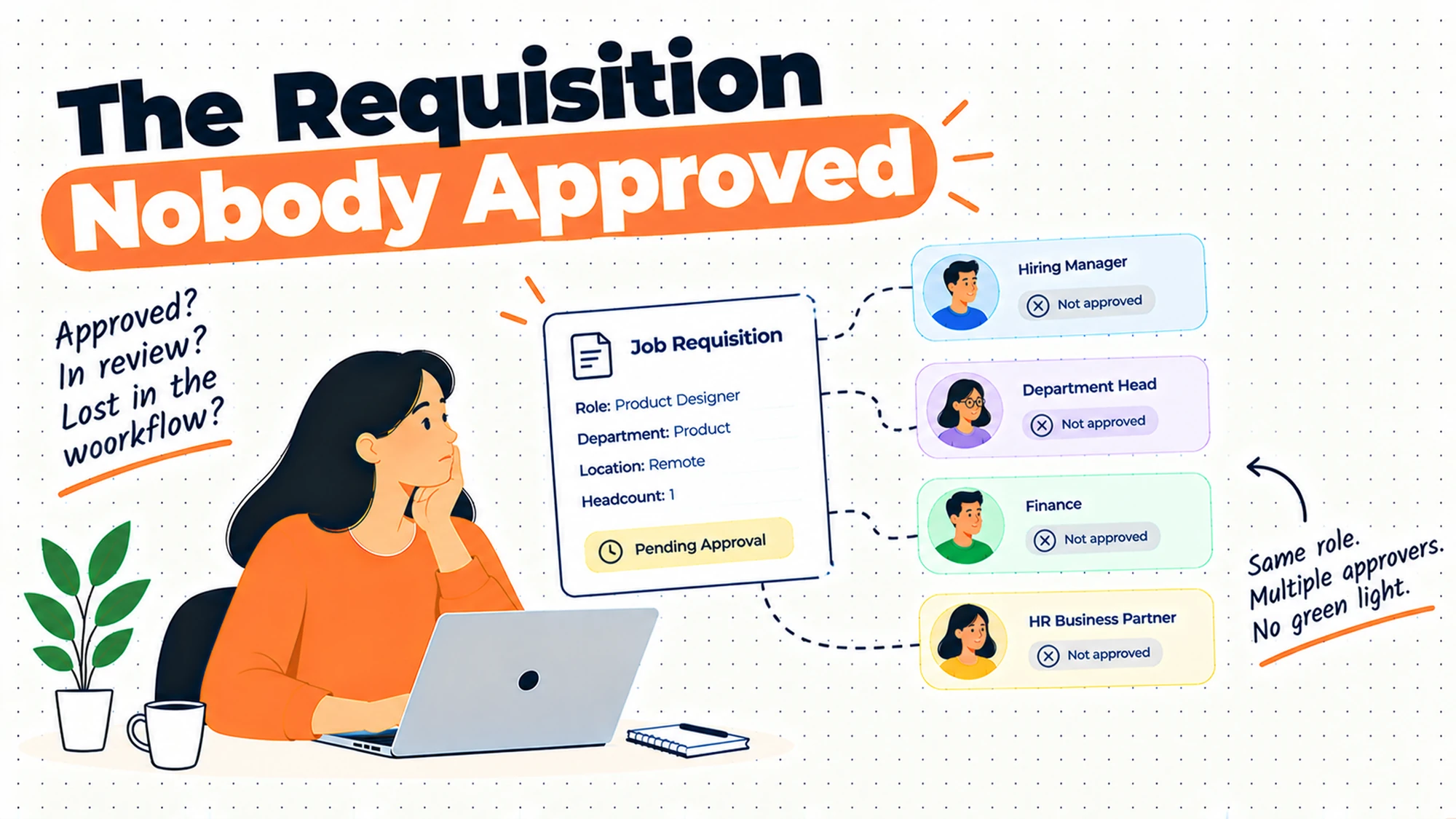
The opposite failure is just as common and less visible. A requisition is approved properly, with a form and a signature, and the form contains a job title, a salary band and a start date. Four months later the search has stalled at the shortlist, because three people are interviewing candidates against three different ideas of what the role is for, and the requisition settled none of that.
So the requisition sits between two failures. It's either a formality performed after the real decision, which means it controls nothing, or it's a control that records money without defining the job, which means it controls the wrong thing.
The reframe worth holding is that this is the moment the organisation commits to spending real money on a person, and the moment the role gets defined precisely enough to be hired against. Both matter, and most processes do only one.
When You Genuinely Do Not Need to Act Yet
Your current setup is genuinely fine. One person approves every hire, they know about all of them, and the roles are clear enough that searches conclude. Below a certain size a requisition process is documentation of a conversation that's already happening properly.
Friction is starting to show. Somebody was surprised by a role, or a search took longer than it should because the brief kept changing, or a manager wasn't sure whether they were allowed to start. These are early signals and they point at agreement rather than at bureaucracy.
It has become a real cost. Finance has been surprised more than once, searches stall at the shortlist because nobody agrees what good looks like, or roles are opening that don't match any plan anybody remembers. At this point the absence of a definition step is producing waste you can observe.
The edge case that forces it. You're growing fast enough that headcount decisions have become a genuine financial planning problem, or you operate somewhere with obligations about how roles are advertised, what must be recorded about a vacancy, or how internal candidates are treated. Those requirements differ by jurisdiction and by sector, so establish what applies where you hire with local advice rather than designing around assumptions.
Five Questions This Reader Asks at 11pm
What is a job requisition, exactly? The formal record that a role exists, is approved, and is being recruited for. In most organisations it's a form capturing a title, a reporting line, a budget and a start date. What it should also capture, and usually doesn't, is what the person will actually do and how anybody will recognise a good candidate.
Who should approve one? Whoever is accountable for the money and whoever is accountable for the work, which are usually two different people. The finance approval is about whether this cost is planned and affordable. The other approval is about whether the role makes sense as described, and it's the one that tends to be missing.
What's the difference between a requisition and a job description? The requisition is the internal authorisation and definition; the job description is the external-facing description of the role. They're frequently conflated, which is why so many requisition forms contain marketing copy and no internal specifics about what the role is for or how it will be judged.
Do backfills need approval? Yes, and they're the category most often waved through. A departing person's role gets refilled automatically on the assumption that the work still needs doing in the same shape, which is sometimes true and frequently not examined at all. The moment somebody leaves is the cheapest opportunity you'll get to ask whether the role should change.
What if we need to move fast? Have a fast path rather than an exception, because exceptions become the process. A named person who can approve urgently, with the definition work still done, handles genuine urgency without the requisition becoming decorative. What you want to avoid is urgency being the reason nobody wrote down what the role is.
What a Requisition Should Settle Before Anybody Applies
Most requisition forms capture the commercial facts and skip the definitional ones. These are the questions worth settling, because each one left open surfaces later as a stalled search.
| The question | Who answers it | What goes wrong when it is left open |
|---|---|---|
| What will this person actually do | The hiring manager | Interviewers assess against different jobs |
| What does good look like, specifically | The hiring manager | A shortlist nobody can choose from |
| Which requirements are genuine | The hiring manager | Filters that exclude people who could do it |
| Who decides, and who advises | Whoever approves | A decision that cannot be reached |
| What is this role replacing or adding | Whoever approves the money | Costs that were never planned |
| How will we know in six months | The hiring manager | No basis for judging the hire |
| What is the actual urgency | The hiring manager | Everything treated as urgent |
The second row is the one that determines whether a search can conclude. When nobody has written down what distinguishes a strong candidate from an adequate one, every interviewer applies their own version, and the debrief becomes a negotiation between incompatible standards. That doesn't look like a requisition problem at the time. It looks like a shortlist problem, and it gets solved by seeing more candidates, which doesn't help.
The fourth row is the most common cause of a search that runs past its conclusion. Roles with an unclear decision-maker accumulate opinions, because everybody consulted feels entitled to a view and nobody has the standing to close it. Naming the decider at the requisition stage costs a line and prevents a month.
The last row is worth including precisely because urgency is usually asserted rather than examined. A role described as urgent with no stated consequence gets the same treatment as everything else after the first fortnight, and genuinely urgent roles then can't be distinguished from the rest.
Five Diagnostic Questions You Can Self-Assess Against
Could somebody other than the hiring manager screen against this requisition? If not, the definition isn't sufficient, and every screening decision depends on a conversation somebody had. That's workable with one search and doesn't survive several.
When was the approval given relative to the search starting? Trace a real one. If approval consistently arrives after recruiting is underway, the requisition is a record rather than a gate, and you should know that rather than believing otherwise.
What happened to the last backfill? Check whether anybody asked if the role should change. In most organisations the answer is that the previous job description was reused, which means the organisation's shape is determined by who happens to leave.
Can you list every open role and its approval state? If not, finance can't either, and the chance of a surprise is proportional to how long that's been true.
How many roles have changed during the search? Some change is legitimate and a pattern of it means the definition work is happening during recruitment, which is expensive and produces candidates assessed against a moving target.
Six Ways Roles Get Opened, Reviewed
A conversation, and then recruiting starts
Somebody describes a need, somebody senior agrees, work begins. It earns its place on speed, which is genuine: no form, no delay, and the people involved understood each other at the time.
Where it falls short is everything that depends on a record. Nobody else knows the role exists, the agreement was about a general shape rather than specifics, and both parties will remember it slightly differently in two months. It's also the mechanism behind the surprise in the opening scene.
Acceptable when one person approves everything and knows about all of it. It stops being acceptable at the point where somebody can be surprised, which arrives earlier than most organisations notice.
The threshold is not really about headcount, it is about whether the people who need to know are in the same conversations. An organisation of forty where finance sits in the weekly leadership meeting may be fine. One of twenty-five where the approver and the budget holder are different people who speak occasionally is already past it, and the first surprise is usually the thing that reveals this.
A form completed after the decision
The paperwork follows the conversation, capturing what was agreed. It earns its place because it creates a record, which is genuinely better than nothing, and because it lets finance see commitments that would otherwise be invisible.
Where it falls short is that it controls nothing, since the decision was already made and the search may already be running. It also encourages a particular kind of thin form, because a form filled in after the fact gets filled in quickly by somebody who considers the matter settled.
If this is your process, be honest that it's a record rather than a gate. Then put the definition work somewhere it will actually happen, which is usually the briefing conversation with whoever is recruiting.
That briefing is worth treating as the real requisition, in that case, and worth writing down afterwards. Whoever is recruiting is asking exactly the right questions anyway, because they cannot do their job without the answers. Capturing what emerged from that conversation gives you the definition the form did not, at no additional cost, and it exists at the moment it is needed rather than weeks earlier.
An annual headcount plan that roles are drawn from
Roles are agreed in a planning cycle and released during the year. It earns its place because it connects hiring to financial planning properly, which is what finance actually wants, and because it forces prioritisation at a moment when trade-offs are visible.
Where it falls short is rigidity and staleness. A role planned nine months ago may no longer be the right role, and the plan encourages filling it as specified rather than reconsidering. It also handles genuine changes in circumstance badly, which produces an off-plan exception process that gradually becomes the main route.
Good as the financial frame. Pair it with a definition step at the point the role actually opens, because that's when you know what you need.
Build in a way to challenge a planned role too, not only to release it. A plan agreed three quarters ago encodes assumptions about the work, the team and the market that may no longer hold, and the default behaviour is to fill what was approved because approval is scarce and nobody wants to give a slot back. A short question at the point of opening, asking whether this is still the right role, costs nothing and occasionally saves an entire hire.
A formal approval chain per role
Each role goes through defined approvals before recruiting starts. It earns its place where headcount decisions are genuinely consequential and where the organisation needs a reliable record of what was authorised by whom.
Where it falls short is speed and what gets checked. Chains grow, each approver adds a delay, and most approvals become rubber stamps because the approver has no basis to disagree. It also tends to check the money and not the definition, which means it prevents unplanned cost and not stalled searches.
Keep the chain short, make one approver responsible for the definition rather than the budget, and check whether anybody has ever actually declined one.
That last check is more informative than it sounds. A chain in which nothing has ever been declined is not necessarily catching anything, and the delay it introduces is being paid for nothing. It may still be worth keeping for visibility, and in that case it should be treated as a notification step rather than an approval, which allows it to happen in parallel rather than in sequence.
A backfill treated as automatic
Somebody leaves, the role is refilled as it was. It earns its place on simplicity and on the reasonable assumption that the work still needs doing, which is frequently true.
Where it falls short is that it's the largest unexamined decision most organisations make. The role was shaped around a person who is leaving, the work has probably drifted, and the team's needs may have changed. Automatic refilling means your organisational shape is determined by turnover rather than by any decision.
Treat a departure as the cheapest opportunity you get to ask whether the role should change. Ten minutes, with the manager and one other person, is usually enough.
The second person matters, because a manager on their own will tend to describe the role as it was defined rather than as it was lived. Somebody who worked alongside the departing person usually has a clearer view of what they actually spent their time on, which is frequently different from both the job description and the manager's impression.
A role created because somebody good became available
An opportunistic hire when a strong person appears. It earns its place more often than process-minded people admit: exceptional people are genuinely scarce, and rigid planning can mean losing somebody you'd have created a role for if you'd been asked.
Where it falls short is that the role is defined around the person rather than the need, which makes it hard to evaluate, hard to replace when they move on, and hard to explain to everybody else. It also tends to skip approval entirely on the grounds of urgency.
Have a route for this rather than pretending it doesn't happen. Require the same definition work, and be explicit that the role is being created for this reason, so it can be examined honestly later.
Being explicit also protects the person being hired. A role created around an individual, with no record of why, leaves them in an ambiguous position later when somebody asks what the role is for and nobody can answer. Writing down what was seen in them and what the organisation expected to gain gives the arrangement a basis that survives the enthusiasm of the moment.
The Decision Table
| Situation | Scale | Setup | Primary Pain | Recommended Starting Point |
|---|---|---|---|---|
| One approver who knows every role | Under thirty | Single decision-maker | None | Change nothing |
| Finance surprised by a search | Any | Verbal approval | No record before recruiting | A short form before the search starts |
| Searches stalling at the shortlist | Any | Any | No agreed definition of good | Add the definition questions |
| Approval arrives after recruiting begins | Any | Any | A record, not a gate | Be honest about which it is |
| Backfills refilled automatically | Any | Any | Shape determined by turnover | Ten minutes of examination per departure |
| Roles changing during the search | Any | Any | Definition work happening late | Settle it before advertising |
| Approval chain nobody declines | Over five hundred | Formal chain | Rubber stamps and delay | Shorten it, assign definition ownership |
| Off-plan roles becoming the norm | Any | Annual planning | Plan too rigid for reality | A fast path, with definition intact |
| Opportunistic hires with no record | Any | Any | Roles nobody can evaluate later | Same definition, stated reason |
The third row is worth catching because it's diagnosed wrongly almost every time. A search that stalls at the shortlist looks like a candidate quality problem, and the response is to see more people. What's actually happened is that three interviewers are applying three different standards, and no volume of additional candidates resolves a disagreement about criteria.
The fifth row is the one with the largest cumulative effect and the least attention. Over several years, an organisation that refills every departing role as it was has let its structure be determined entirely by who happened to leave, which is not a strategy anybody would choose deliberately.
Backfills, Which Nobody Examines
Backfills deserve their own section because they're usually the majority of hiring and almost never questioned.
The logic is intuitive. Somebody was doing a job, they're leaving, the job still needs doing. Refill it. That reasoning is frequently correct and it skips three questions worth thirty minutes.
Has the role drifted? People shape jobs around themselves over time. Somebody who joined to do one thing may have spent the last two years doing something adjacent, because they were good at it or because it needed doing. The job description in the system describes what they were hired for, which may bear little relation to what they were actually doing when they left.
Is this the right shape now? The team has changed since the role was created. Work may have moved, tools may have removed some of it, and an adjacent team may now need something this role could cover. Refilling as-is assumes none of that happened.
Should the level change? A departure is an opportunity to consider whether the role should be more senior, less senior, or split. That's difficult to do at any other moment, because changing a role somebody currently occupies is a much harder conversation than defining a vacant one.
Splitting is the option people forget exists. A role that has grown over several years frequently contains two jobs that were never meant to be one, held together by a capable person who absorbed both. Refilling it as a single role means looking for somebody with an unusual combination, which is slow and expensive, when two more ordinary roles would be easier to fill and better defined.
The practical approach is a short conversation with the departing person's manager and somebody who works alongside them, asking what the person actually spent their time on, what they wish had been different about the role, and what they'd change if they were designing it now. That last question, asked of the person leaving, produces unusually candid answers because they have nothing to protect.
Write down what comes out of it, even in a few lines, because the value evaporates otherwise. The conversation usually happens weeks before recruiting starts, by which point the manager is dealing with the gap rather than the design, and whatever was agreed has softened into an intention to look at it properly. A note attached to the requisition survives that gap and is the thing that makes the refilled role different from the old one.
One caution. There are circumstances where changing a role at the point somebody leaves needs care, particularly where the change could be read as being about the departing individual, or where internal candidates have expectations. What's appropriate differs by jurisdiction and by circumstance, so where a backfill involves a substantive change, take local advice rather than treating it as purely a design decision.
The same care applies to the timing of the conversation. Asking a departing person to help redesign their own role is valuable and can land badly depending on why they are leaving, so read the situation rather than applying it as a rule. Where somebody is leaving on good terms and has been asked properly, the answers are usually generous and specific. Where they are not, the exercise is better done with colleagues.
Where Requisitions Go Wrong
| The failure | How it shows up | What would have to change |
|---|---|---|
| Approval after the search starts | Commitments visible only by accident | A gate before recruiting begins |
| Money checked, definition skipped | Searches that stall at the shortlist | Definition questions on the form |
| No named decision-maker | Opinions accumulate, nothing closes | Name the decider at approval |
| Backfills refilled unexamined | Structure determined by turnover | Thirty minutes at each departure |
| Requirements listed without ranking | Filters excluding capable people | Mark genuine versus preferred |
| Urgency asserted, never defined | Everything urgent, nothing prioritised | State the actual consequence of delay |
The second row explains most of the frustration in this area. Requisition processes are designed by finance, so they check what finance needs, which is cost and headcount. Nobody owns the definitional half, so it happens informally or not at all, and its absence surfaces months later as a search that can't conclude.
The fix does not require taking the process away from finance, which would be a fight for no benefit. It requires adding a second approver whose job is explicitly the definition rather than the money, and giving that person the standing to send a requisition back. In most organisations that is whoever runs hiring, and it is a change to one field and one expectation rather than a redesign.
The fifth row costs candidates rather than time. A requirements list where nothing is marked as essential or preferred gets treated as all-essential by whoever screens, and by any filter configured against it. People who could do the job are removed for lacking something nobody would have insisted on if asked directly.
What to Put in Writing
| Artefact | Who owns it | When it is written | What it prevents |
|---|---|---|---|
| What the person will actually do | The hiring manager | Before the search starts | Interviewers assessing different jobs |
| What distinguishes strong from adequate | The hiring manager | Before the search starts | A shortlist nobody can choose from |
| Which requirements are genuinely essential | The hiring manager | Before advertising | Capable people filtered out |
| Who decides, and who only advises | Whoever approves | At approval | Opinions with no route to a decision |
| What this role replaces or adds | Whoever approves the money | At approval | Costs nobody planned |
| What changed, if this is a backfill | The manager, with the leaver | Before refilling | Structure set by turnover |
The second row is the single highest-value line in this article. It takes a paragraph, it's uncomfortable to write because it forces precision, and it's the difference between a search that concludes and one that runs until somebody gives up. If you add one thing to your requisition process, add this.
Questions to Ask Before You Commit
On definition. Could a stranger screen against this? A bad answer is that the manager will brief them.
On the standard. What separates strong from adequate? A bad answer is that you'll know it.
On requirements. Which of these are genuinely essential? A bad answer is all of them.
On the decision. Who decides? A bad answer is the panel.
On the backfill. What did the leaver actually spend time on? A bad answer is what's in the description.
On urgency. What happens if this takes three months? A bad answer is that it can't.
On splitting. Could this be two roles? A bad answer is that it always has been one.
What Getting This Wrong Costs
The first cost is the search that can't conclude. A role approved without an agreed definition produces interviewers working to different standards, a shortlist that generates disagreement rather than a decision, and a search that runs long while everybody looks for a candidate who satisfies everyone. The additional candidates don't help, because the problem is upstream, and the eventual hire is frequently a compromise nobody is confident about.
The second cost is the commitment nobody saw. Roles opened through conversation are invisible until somebody encounters them, and by then a search is underway and a candidate may be expecting an offer. Unwinding that is unpleasant for everybody and damages the organisation's credibility with a candidate who did nothing wrong.
The third cost accumulates slowly and is the largest. An organisation that refills every departing role as it was has outsourced its structural decisions to turnover. After a few years the shape of the organisation reflects who happened to leave and who happened to stay, rather than any decision about what work needs doing, and reshaping it deliberately then requires a restructure rather than a series of small choices nobody had to make.
There is a fourth cost that falls on candidates and is invisible to you. A search run against an undefined role produces interviews where people are assessed on shifting criteria, feedback that contradicts itself between stages, and rejections nobody can explain. Candidates experience that as arbitrary, which it effectively is, and the ones who are most capable of judging a process are the ones most likely to notice.
So before your next role opens, add two things to whatever process you have. A paragraph on what distinguishes a strong candidate from an adequate one, written by the person who'll make the decision. And a name against the question of who decides. Those two cost ten minutes and prevent most of what goes wrong here.
When You Are Ready to Go Further
None of this needs a system. It needs the definition questions added to whatever form or conversation you already use, a named decider, and a short examination at every departure before the role gets refilled.
The sequencing matters more than the formality. Whatever approval you have should happen before recruiting starts rather than after, because approval that follows a live search is a record rather than a decision, and everybody involved can tell.
Then look at your last three searches that took longer than expected and ask what the requisition said about what good looked like. If the answer is nothing, you've found the cause of something that gets blamed on the market every time it happens.
That exercise is worth doing with the hiring managers involved rather than alone, because the conclusion lands differently when they reach it themselves.
HROpsLab publishes independent comparison work across HR tooling, applicant tracking and payroll. We sell nothing, we take no vendor money, and we publish no paid placements. If the next step is looking at what your current tooling actually supports here, our comparison work is one place to start.
Frequently Asked Questions
What is a job requisition?
The internal record that a role exists, has been approved, and is being recruited for. In most organisations it captures a title, a reporting line, a budget and a target start date. What it should also settle, and usually doesn't, is what the person will actually do and what distinguishes a strong candidate from an adequate one. The first set of facts controls cost; the second controls whether the search can conclude, and most requisition processes are designed by people who need the first and don't own the second.
What should a job requisition include?
Beyond the commercial facts, four things: what the person will actually do on an ordinary week, what separates a strong candidate from an adequate one, which of the listed requirements are genuinely essential rather than preferred, and who makes the final decision as opposed to who advises. Each of those, left open, surfaces months later as a specific failure: interviewers assessing different jobs, a shortlist nobody can choose from, capable people filtered out, and a decision that can't be reached.
Who should approve a job requisition?
Two people with different responsibilities. Whoever is accountable for the money, which is about whether this cost is planned and affordable. And whoever is accountable for the work, which is about whether the role makes sense as described and whether the definition is sufficient to hire against. The second approval is the one usually missing, because requisition processes are typically designed around financial control, so nobody owns the question of whether the role has been defined well enough to recruit for.
What is the difference between a requisition and a job description?
The requisition is the internal authorisation and definition; the job description is the outward-facing description used to attract applicants. They're routinely conflated, which is how requisition forms end up containing marketing copy about the organisation and nothing about what the role is for internally or how it will be judged. Keeping them separate is useful because they have different audiences and different purposes, and the internal one is the one that determines whether the search can reach a conclusion.
Do backfills need to go through approval?
Yes, and they're the category most often waved through on the reasonable assumption that the work still needs doing. That assumption skips three questions worth thirty minutes: whether the role has drifted from its description because the person shaped it around themselves, whether it's the right shape now given how the team has changed, and whether the level should be different. A departure is the cheapest opportunity to ask these, because changing a role somebody currently occupies is a much harder conversation.
What happens when a role changes during the search?
You end up assessing candidates against a moving target, and people interviewed early were evaluated against a different job from people interviewed later. Some change is legitimate, particularly when early conversations reveal something about the market. A pattern of it means the definition work is happening during recruitment rather than before it, which is expensive: it wastes candidate time, produces inconsistent assessment, and usually ends with a shortlist that can't be compared.
How do you handle an urgent hire without skipping the process?
Build a fast path rather than making exceptions, because exceptions gradually become the route everybody uses. A named person who can approve quickly, with the definition work still done, handles genuine urgency without the requisition becoming decorative. The thing to protect is the definition rather than the approval: a role approved in an hour with a clear statement of what good looks like will run better than one approved over a fortnight with none.
How long should a requisition stay open?
Long enough to run a real search and not so long that it becomes a permanent fixture nobody examines. The more useful discipline than a fixed limit is a review point: if a role has been open past the point you expected, something has changed and it's worth asking what. Frequently the answer is that the definition was never sufficient, or the requirements were unrealistic together, or the urgency that justified it has passed and nobody has said so.
The requisition is where the role gets defined. Most processes only check the money.
Add one paragraph about what good looks like and most stalled searches stop happening.