
TL;DR
- The core decision: which fields earn their place by changing a decision somebody makes at that stage.
- When doing nothing is right: when applications are plentiful, suitable, and nobody has complained about the form.
- What has to be true: somebody can name who reads each answer and what they do with it.
- How the options split: by whether a field informs the next decision or collects information for later.
- Decision rule: if the answer is only read after an interview, it belongs after the interview.
- Outcome to expect: a shorter form, more completed applications, and fewer people you never knew were interested.
The Form That Grew
Nobody designed your application form. It accumulated.
It started as contact details and a CV. Then somebody in the team wanted to know notice periods, because a hire fell through once. Then a manager asked for a question about a specific skill, because they were tired of interviewing people who didn't have it. Then there was a question added for reporting, and one for a compliance reason somebody can no longer explain, and a free-text box asking why the candidate wants to work here.
Each addition was reasonable and took thirty seconds to configure. None was ever removed, because removing one requires arguing with whoever added it, and nobody has the appetite.
Best tools for Applicant Tracking (ATS)
So now the form takes a while, and the people most likely to abandon it are the ones with options, who are applying to several places on a Sunday evening and will simply close the tab. You never see them. There is no queue of abandoned applications to review, no notification, nothing in the pipeline. The cost is entirely invisible, which is exactly why the form keeps growing.
The reframe worth holding is that every field is a tax paid by everybody who applies, collected to serve somebody internal who may read the answer once, later, or never. That's not an argument for collecting nothing. It's an argument for each field having to justify itself against a specific decision somebody makes at that specific stage.
Most forms fail that test on at least half their fields. And the ones that fail hardest are usually the ones added most recently, for the most sympathetic reasons.
When You Genuinely Do Not Need to Act Yet
Your current setup is genuinely fine. You get plenty of suitable applications, the form is short, and nobody has mentioned it. Redesigning a form that isn't costing you anything is effort spent on tidiness.
Friction is starting to show. Somebody mentioned the form was long, or you've noticed people starting and not finishing, or a field keeps getting filled in with a placeholder because candidates can't answer it sensibly. Those are cheap signals and the fix is usually deleting something.
It has become a real cost. Roles are hard to fill and you suspect you're losing people before they finish, or the form is long enough that applying is a genuine commitment, or somebody senior has asked why applications are low. At that point the form is worth an hour of proper attention.
The edge case that forces it. You're hiring somewhere with specific requirements about what may be asked, what must be offered, or how demographic information is collected and separated from the assessment. What you may ask, what you must ask, what has to be voluntary and how any of it may be used differ sharply by jurisdiction and by sector, and several have changed recently. Establish what applies where you hire with local advice, and let that define the form rather than copying one from elsewhere.
Five Questions This Reader Asks at 11pm
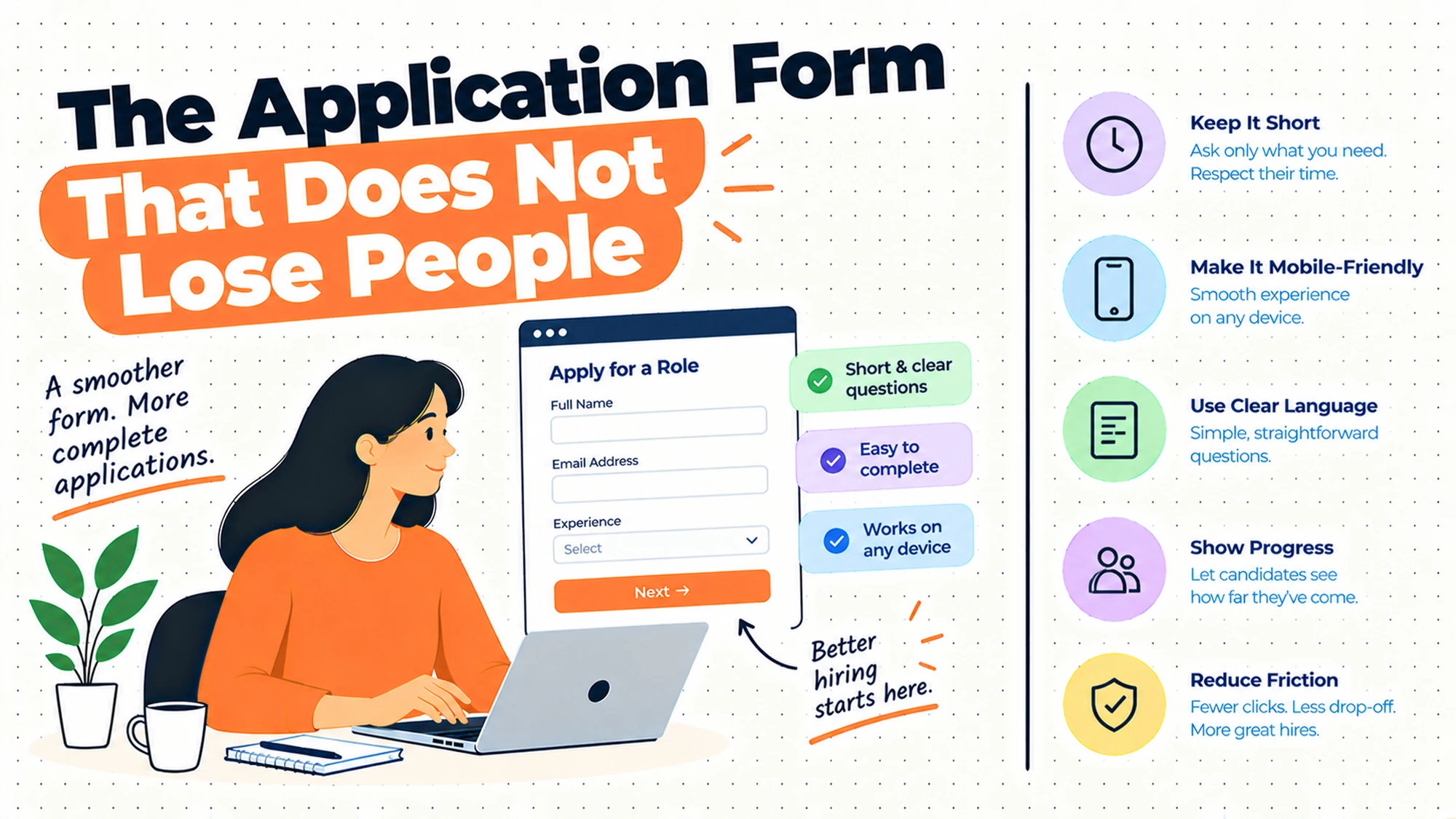
How long should an application take? Shorter than yours, almost certainly. The useful framing isn't minutes, it's decisions: what does somebody reviewing this application at this stage need in order to decide whether to speak to this person? That's usually contact details, something demonstrating relevant experience, and occasionally one or two genuine qualifying questions. Everything else can be asked of the smaller group who progress.
Should we ask for a CV and a form? Not both covering the same ground, which is the most common version of this mistake. Asking somebody to upload a CV and then retype their work history into fields is the single most reliable way to lose applications, because it's visibly pointless work. Either the CV is the record and you parse or read it, or the fields are the record and you don't need the upload.
Is a cover letter worth requiring? Rarely as a requirement, sometimes as an option. Required cover letters filter for people with time and confidence rather than for suitability, and they produce a lot of generic text that nobody reads carefully. A specific question about something that genuinely matters gets you more signal in less space, for both sides.
What about screening questions? Useful when they're genuinely disqualifying and harmful when they're preferences. A question with a clear yes or no that would actually end the conversation is worth asking early. A question about a nice-to-have becomes a filter somebody applies later, or worse, an automatic exclusion that removes people you'd have wanted to see.
Should we ask demographic questions? This is the one place where the answer is genuinely local rather than a matter of design. What may be collected, whether it must be voluntary, how it must be separated from the assessment, and what it may be used for differ by jurisdiction and by sector. Establish the position where you hire with proper advice before adding or removing anything here, because both directions carry consequences.
What Each Field Costs and What It Buys
The exercise that fixes most forms is going field by field and answering the middle column honestly. It takes an hour and usually removes a third of the form.
| Field type | Who actually wants it | When the answer gets used |
|---|---|---|
| Name and contact details | Everybody | Immediately, always |
| CV or work history | Whoever screens | At the first review |
| Same history retyped into fields | The system, for searching | Rarely read by a person |
| A genuinely disqualifying question | Whoever screens | Immediately, to end or continue |
| A preference question | A hiring manager | Later, informally, as a tiebreak |
| Long-form written answers | Whoever screens, in theory | Often not before an interview |
| Cover letter | Tradition | Skimmed, if read |
| Notice period and availability | Whoever schedules or offers | At offer stage |
| Demographic questions | Reporting, where required | Never in the assessment |
The third row is the one to attack first. Retyping a CV into fields is work the candidate can see is redundant, which makes it the most annoying kind of effort, and it's usually there because somebody wanted searchable data. If the searching genuinely matters, parse the document or accept a shorter structured summary. Don't ask for both versions of the same information.
The eighth row is the most commonly misplaced field on any form. Notice period and availability matter enormously and they matter at offer stage, not at application. Asking on the form collects an answer that will have changed by the time it's relevant, from people who mostly won't reach that point.
The last row is genuinely different from everything above it and should be treated separately. Where demographic information is collected, the handling requirements around separation, voluntariness and permitted use differ by jurisdiction. That's a question for local advice rather than form design, and it's one where copying another organisation's approach is a poor idea.
Five Diagnostic Questions You Can Self-Assess Against
Have you completed your own form recently? On a phone, as a stranger, without your logins. Most people responsible for a form have never been through it. The experience is usually surprising, and the problems are specific rather than general.
Can you name who reads each answer, and when? Go field by field. The ones where you hesitate are the ones to remove. A field nobody can attribute to a decision is a field that was added for a reason that has since evaporated.
Does anything ask for the same information twice? Upload a CV and enter your employment history. Enter your email and confirm your email. Each duplication is visible to the applicant and reads as carelessness about their time.
What happens if somebody stops halfway? In most setups, nothing: the partial application vanishes and you never know it existed. That's worth knowing, because it means your form's cost is invisible by design and you have no feedback loop telling you it's too long.
Is anything on the form there for a reason nobody can state? There's usually at least one, often described as a compliance requirement by somebody who inherited it. Establishing what's actually required where you hire, with local advice, will either confirm it or let you delete it.
Six Things Application Forms Ask For, Reviewed
Contact details and the basics
Name, email, phone, sometimes location. It earns its place obviously and completely: you cannot run a process without being able to reach somebody, and location frequently determines whether a role is viable at all.
Where it falls short is over-collection at the edges. Full postal address at application stage is rarely needed and is personal data you now hold about somebody who probably won't be hired. Location can usually be a question about eligibility or proximity rather than a precise address.
Keep it to what you need to make contact and assess viability. Collect the rest at offer, when the relationship is real.
One field in this group deserves separate thought, which is how you ask about location for roles that are remote or partly remote. A free-text city is usually enough to establish whether somebody is in a workable time zone or jurisdiction, and it avoids implying that a precise address matters. Where somebody can lawfully work is a question with a different answer in every country, so treat it as an eligibility question and take local advice rather than inferring it from an address.
A CV upload plus the same information retyped
Asking for the document and the structured version. It earns its place in exactly one circumstance: when you genuinely need structured data for volume filtering and parsing is unreliable enough that you can't depend on it.
Where it falls short is everywhere else, and it fails loudly. This is the most visible waste on any application form, because the candidate can see they're transcribing a document they just uploaded. It's also the point where applications from people with options are most likely to stop, since those are exactly the people least willing to do redundant work.
Pick one. If you need structure, ask for a short structured summary instead of the full history, and let the CV carry the detail.
If the structured data exists to support searching later, be honest about whether anybody searches. A large number of organisations collect employment history in fields on the theory that the pool will be searchable, and then never run a single search against it, because when a role opens they advertise rather than look inward. That is worth checking before you defend the fields, and it is checkable in an afternoon.
Screening questions that gate the application
Yes-or-no questions that determine whether somebody can proceed. They earn their place when the answer genuinely ends the conversation: an eligibility condition, a required certification for regulated work, a fundamental constraint about the role.
Where they fall short is when preferences get dressed as requirements. A question about a desirable skill, set to exclude, removes people who could have done the job and would have been worth meeting. The exclusions are invisible, so nobody ever learns what the filter cost.
Use them only where a no genuinely ends it. Everything else should inform a review rather than prevent one, and if you use them to exclude automatically, establish what that means where you hire, because rules on automated decisions that affect individuals differ by jurisdiction and have been changing.
There is a wording problem worth watching too. Questions written as requirements get answered strategically, because candidates can see which answer keeps them in the process. A question asking whether somebody has a particular qualification will be answered yes by people who have something adjacent, which means the gate both excludes people unfairly and admits people inaccurately. Asking what somebody has, rather than whether they have a specific thing, produces better information and no incentive to shade it.
Demographic questions
Information collected for reporting or monitoring rather than assessment. This one is different in kind from everything else here, because whether you collect it, how, and what you may do with it are governed rather than designed.
What may be asked, whether responses must be voluntary, how the data must be separated from the people making hiring decisions, and what it may be used for all differ by jurisdiction and by sector. Some places require collection, some restrict it, and the details have been changing.
Establish the position where you hire with proper local advice. Then implement it precisely rather than approximately, and be explicit with candidates about what it's for, because an unexplained demographic question at the end of a form is where a lot of goodwill gets spent.
The explanation matters as much as the handling. A short, plain sentence saying why the information is being collected, who sees it and that it plays no part in the decision does more for completion than any change to the questions themselves. Candidates are generally willing when they understand the purpose, and the discomfort comes almost entirely from being asked something personal by an organisation that has not said why.
Long-form written answers
Questions asking for a paragraph or several. They earn their place when the writing is the job, or when a specific question genuinely discriminates between candidates in a way a CV doesn't.
Where they fall short is the asymmetry. A question taking a candidate twenty minutes to answer well takes a reviewer thirty seconds to skim, and at application stage most of them aren't read carefully at all. That ratio is worth being honest about, because it's a large cost imposed for a small benefit, and it falls hardest on people applying to several roles.
If you ask one, ask one, make it specific, and make sure somebody actually reads it before deciding. A question nobody reads is worse than no question.
Specificity is what separates a useful question from a wasted one. Asking why somebody wants the role produces answers assembled from the job advert. Asking about a concrete situation they have actually handled produces something only that person could have written, which is both more informative and considerably faster to read. The second kind also tends to be shorter, because there is an actual answer rather than an amount of enthusiasm to demonstrate.
A cover letter
The traditional open-ended accompaniment. It earns its place as an option for people who have something specific to say, and occasionally as a genuine signal in roles where written persuasion is the work.
Where it falls short as a requirement is that it selects for time and confidence rather than capability. People with caring responsibilities, people applying while working, and people less accustomed to self-presentation are disadvantaged in ways unrelated to whether they'd do the job. It also produces a large volume of generic text, because candidates know it's expected and not read closely.
Make it optional or replace it with one specific question. The specific question gets you more and costs everybody less.
If you do keep it optional, say plainly that it is optional and that not submitting one carries no disadvantage. Otherwise candidates assume the opposite, since an optional field on an application form reads to most people as a test of how much they want it, and you end up imposing the cost on everybody while believing you removed it.
The Decision Table
| Situation | Scale | Setup | Primary Pain | Recommended Starting Point |
|---|---|---|---|---|
| Plenty of suitable applications | Any | Any | None | Leave the form alone |
| People start and do not finish | Any | Any | Length, invisible cost | Delete fields, starting with retyped history |
| CV upload plus full history retyped | Any | Any | Visibly redundant work | Pick one, keep the CV |
| Required cover letter | Any | Any | Selects for time, not fit | Make it optional or ask one question |
| Preference questions used to exclude | Any | Any | Invisible exclusions | Inform the review, do not gate |
| Notice period asked at application | Any | Any | Answer expires before use | Move it to offer stage |
| Hard-to-fill roles, low applications | Any | Any | Possibly the form, possibly the role | Complete your own form first |
| High volume, review capacity exceeded | Over five hundred | Volume hiring | Genuine triage need | Structure, plus check what filters removed |
| Demographic questions in scope | Any | Regulated or multi-country | Governed, not designed | Take local advice before changing anything |
The seventh row is worth handling in order. When a role isn't attracting applications, the form is one candidate explanation and the role itself is usually a bigger one. Completing your own form on a phone takes ten minutes and will tell you whether the form is plausibly the problem before you go looking at anything else.
The second row has an uncomfortable property worth stating plainly: you cannot measure it in most setups, because abandoned applications aren't recorded anywhere you look. That means the argument for shortening a form is never supported by data from your own system, which is exactly why forms keep growing.
Where People Give Up
Abandonment isn't evenly distributed across a form. It clusters at specific points, and knowing them tells you where to look first.
The account creation step. Being asked to create a login before applying is the earliest and largest barrier on most forms. From the candidate's side, they wanted to send a CV and are now being asked to establish a relationship with a system, remember a password, and possibly verify an email. Some systems require this; where yours allows applying without it, that's usually the single highest-value change available.
The moment redundancy becomes visible. Somebody uploads their CV, clicks next, and sees empty fields for employment history. That's the point where a person with three other applications open closes the tab, because the remaining effort just became visible and obviously unnecessary.
The first long-form question. A text box with a substantial prompt changes the nature of the task from submitting to writing. People who were going to apply in five minutes now need thirty, and many of them defer it, which in practice means never.
Anything they can't answer confidently. A question with no obvious right answer, an unclear field, a required box where none of the options fit. Uncertainty at any point in a form produces hesitation, and hesitation late on a Sunday evening ends the session.
The mobile break. Anything that works poorly on a phone, including file upload, long dropdowns and multi-column layouts. A substantial share of applications are started on phones, and a form that assumes a desktop loses that group silently.
The unexplained sensitive question. A demographic or personal question appearing without explanation at the end. Even where collection is entirely proper, an unexplained request for sensitive information at the last step reads badly and costs completions.
None of these produce a signal in your system. The person simply doesn't appear, and their absence is indistinguishable from never having been interested. That's the core difficulty in this area: the cost is real, continuous, and invisible unless somebody goes looking for it deliberately.
Some systems do record partial submissions, and it is worth finding out whether yours does before assuming otherwise. Where that data exists it is among the most useful information available about your own process, because it names the exact step people stopped at. Where it does not, the substitute is asking new hires where they nearly gave up, which produces the same answer from a much smaller sample.
Where Application Forms Go Wrong
| The failure | What the candidate experiences | What would have to change |
|---|---|---|
| Fields added, never removed | A form that keeps getting longer | A deletion required for each addition |
| CV upload plus retyped history | Obviously redundant work | Keep one, drop the other |
| Account creation before applying | A relationship demanded before interest | Allow application without an account |
| Preferences used as gates | Silent exclusion they never learn about | Inform the review instead |
| Questions nobody reads | Effort spent for nothing | Ask fewer, read them properly |
| Sensitive questions with no explanation | Discomfort at the final step | Say what it is for, take local advice |
The first row is the mechanism behind all the others, and it has a simple counter: require a deletion whenever somebody adds a field. That forces the comparison that never otherwise happens, between the new field and the least useful existing one. It's mildly annoying and it stops the drift permanently.
The third row is worth checking even if you assume it doesn't apply. Many systems allow application without account creation and are configured to require it anyway, because the default was never revisited. It costs nothing to check and it's the largest single barrier on most forms.
Where an account genuinely cannot be avoided, the next best thing is to move it after the application rather than before. Somebody who has already submitted has a reason to create a login, because it gets them a status view of something they have invested in. Somebody who has not submitted has no reason at all, and is being asked to register with an organisation they may never hear from again.
What to Put in Writing
| Artefact | Who owns it | When it is written | What it prevents |
|---|---|---|---|
| Who reads each field, and when | Whoever owns the form | Before the next addition | Fields serving nobody |
| The rule that additions require deletions | Whoever owns the form | Once | A form that only grows |
| Which questions genuinely disqualify | Whoever screens | Before configuring gates | Preferences excluding people silently |
| What is asked at offer rather than application | Whoever runs hiring | Before redesigning | Collecting answers that expire |
| What may be asked where you hire | HR, with local advice | Before any change | A form copied from elsewhere |
| How demographic data is handled | HR, with local advice | Before collecting any | Design decisions on a governed matter |
The second row is the smallest intervention with the longest-lasting effect. Every form problem in this article follows from additions being cheap and removals being expensive. Making them cost the same thing fixes the incentive, and it converts a vague argument about length into a specific comparison between two fields.
Questions to Ask Before You Commit
On each field. Who reads this, and when? A bad answer is that it's useful to have.
On the CV. Are we asking for the same thing twice? A bad answer is that the fields are searchable.
On gates. Would a no genuinely end this? A bad answer is that it's preferred.
On timing. Could this be asked at offer? A bad answer is that we might as well ask now.
On the account. Can somebody apply without creating one? A bad answer is that it's required.
On sensitive questions. What does local advice say? A bad answer is what another organisation does.
On mobile. Have you completed it on a phone? A bad answer is that it is responsive.
What Getting This Wrong Costs
The first cost is the applications you never see, and its defining property is invisibility. Nobody appears in your pipeline with a note saying they abandoned at step three. They simply aren't there, and their absence looks identical to a lack of interest. This is why forms grow unchecked: every addition has a visible advocate and the cost has none.
The second cost falls disproportionately on the people you'd most want. Somebody with several options, applying in the evening around other commitments, is exactly the candidate least willing to spend twenty minutes retyping a CV. A long form doesn't filter for motivation, whatever anybody says about it; it filters for available time and low opportunity cost, which correlates with almost nothing you're trying to select for.
The third cost is the first impression, which is set before anybody in your organisation has said a word. The form is frequently a candidate's first real interaction with how you operate, and an obviously redundant, poorly working or unexplained one communicates something. That impression is hard to reverse later, and the people who notice it most are the ones with comparisons to draw.
There is a fourth cost that lands on your own team and gets attributed elsewhere. A long form does not only reduce applications, it changes who applies, and the resulting pool tends to look thinner in ways nobody connects to the form. The conclusion drawn is usually that the market is difficult or the role is unattractive, and effort goes into advertising more widely rather than into the step that was quietly removing people.
So before adding anything, do the cheap diagnostic. Complete your own form on a phone as a stranger. Then go field by field and name who reads each answer and when. Most forms lose a third of their fields to that question alone, and the third they lose is rarely the third anybody expected.
When You Are Ready to Go Further
None of this needs a project. It needs somebody to complete the form themselves, a field-by-field pass naming who uses each answer, and a rule that any new field displaces an old one.
Check the account requirement specifically, because it's the largest single barrier and it's frequently a default nobody chose. Then look at whether you're asking for a CV and its contents, which is the most visible waste and the easiest thing to remove.
After that, the useful habit is to ask new hires what the application was like while they still remember. They're the only people who completed it and are willing to tell you, and they'll name specific things: a field that didn't make sense, a step that failed on their phone, a question they weren't sure how to answer. That's the feedback loop the form otherwise doesn't have.
HROpsLab publishes independent comparison work across HR tooling, applicant tracking and payroll. We sell nothing, we take no vendor money, and we publish no paid placements. If the next step is looking at what your current tooling actually supports here, our comparison work is one place to start.
Frequently Asked Questions
What should a job application form include?
As little as will let somebody decide whether to speak to the applicant. In practice that's contact details, something demonstrating relevant experience, and occasionally one or two genuinely disqualifying questions. Everything else can be asked of the much smaller group who progress, and most of it is better asked then anyway because the answers are fresher and the person has a reason to give them. The test for any field is whether you can name who reads it and at which point they use it.
How long should a job application take?
Shorter than most, and the useful measure isn't minutes but decisions: what does a reviewer need in order to decide whether to have a conversation? Anything beyond that is being collected for later, which means it can be asked later. The reason forms drift long is structural rather than careless: adding a field takes thirty seconds and has an advocate, while removing one requires an argument with whoever added it. Requiring a deletion for every addition fixes the incentive.
Should you ask for a CV and an application form?
Not both covering the same ground, which is the most common and most damaging version of this. Asking somebody to upload a CV and then retype their employment history into fields is visibly redundant work, and it's the point where applications from people with other options most often stop. Either the CV carries the detail and you read or parse it, or a short structured summary carries it and you don't need the upload. Asking for both signals that nobody has thought about the candidate's time.
Should a cover letter be required?
Rarely. As a requirement it selects for available time and confidence in self-presentation rather than for capability, which disadvantages people applying while working or around caring responsibilities for reasons unrelated to whether they'd do the job well. It also generates a large volume of generic text that reviewers skim. One specific question about something that genuinely differentiates candidates produces more signal, costs the applicant less, and is more likely to actually be read before a decision.
What screening questions should you use on an application?
Only ones where a particular answer genuinely ends the conversation: an eligibility condition, a certification required for regulated work, a fundamental constraint of the role. The failure to avoid is dressing preferences as requirements, because a gate set on a desirable skill removes people who could have done the job and nobody ever sees what was lost. If you use questions to exclude automatically, establish what that means where you hire, since rules on automated decisions affecting individuals differ by jurisdiction and have been changing.
Why do candidates abandon applications?
It clusters at identifiable points rather than being spread evenly. Account creation before applying is usually the largest barrier and is frequently a system default nobody chose. The moment redundancy becomes visible, typically empty employment history fields after a CV upload, is the second. Then the first long-form question, which changes a five-minute task into a thirty-minute one; anything that can't be answered confidently; anything that works poorly on a phone; and an unexplained sensitive question at the end.
Should you ask demographic questions on an application form?
This is the one area where the answer is genuinely governed rather than a design choice, and it differs by jurisdiction and by sector. What may be collected, whether responses must be voluntary, how the data must be separated from the people making hiring decisions, and what it may be used for are all set externally, some places require collection and others restrict it, and several of these rules have changed recently. Establish the position where you hire with proper local advice, then implement it precisely rather than copying another organisation's form.
How do you test your own application form?
Complete it yourself, on a phone, as a stranger, without any of your logins, at the time of day candidates actually apply. Most people who own a form have never been through it, and the problems it surfaces are specific rather than general: a field that fails on mobile, a dropdown missing an obvious option, a step that assumes a desktop. Then ask recent hires what it was like while they still remember, since they're the only people who completed it and will tell you honestly.
Every field is a tax on everybody who applies. Most forms collect more than they spend.
Go field by field and ask who reads it. A third of them will not survive the question.