
TL;DR
- Most products called an applicant tracking system are built for an employer filling its own roles. Agency work breaks three assumptions in that design, and no amount of configuration fixes them.
- The assumptions are that there is one employer, that a candidate belongs to one pipeline, and that filling a role produces no revenue event. All three are wrong for an agency.
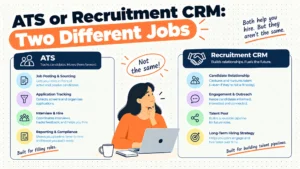
- The category that fits is a recruitment CRM rather than an ATS, and the difference is which object is central: the job in one, the candidate relationship in the other.
- Candidate ownership is a commission problem before it is a software problem. Decide the rules first, because a tool will enforce whatever you tell it and will not tell you what is fair.
- A corporate ATS is genuinely right in two cases: embedded recruiting for a single client, and very low volume retained search where the database is small enough to be held in people's heads.
- Only one of the well-known employer-side platforms publishes a price you can read. That matters less than it sounds, because if you are an agency it is the wrong category anyway.
The Same Candidate, Three Clients, One Pipeline
A nine-person agency moved off spreadsheets and bought a well-reviewed applicant tracking system. The product was good, the implementation was quick, and within two months the team had stopped using it for the thing it had been bought for.
The breaking point was an engineer who was a credible candidate for three different clients at once. The system modelled a candidate as somebody progressing through a pipeline attached to a job, so the only way to represent the situation was three candidate records, one per client's job. Three sets of notes, three interview histories, three sets of availability, all describing one person who was having one conversation with one recruiter.
Then a client asked for a shortlist and the system produced a view designed for a hiring manager inside the company that owned the system. There was no way to show a client three candidates without also showing them that the system belonged to somebody else, and no way to stop a consultant seeing another consultant's client pipeline, because the product assumed everybody in it worked for the same employer. The agency went back to a spreadsheet for shortlists and kept the ATS for job postings.
Best tools for Applicant Tracking (ATS)
Nothing about that product was deficient. It was built for a company filling its own roles, which is a different business from placing people into other companies, and the two look similar enough from outside that the mistake is made constantly.
Why a Corporate ATS Resists Agency Work
Three assumptions sit underneath almost every employer-side product, and each is reasonable for the buyer it was designed for.
One employer. Users all work for the same company, so permissions are about seniority and function rather than about separation. There is no concept of a wall between two groups of users who must not see each other's work, because inside a company that requirement barely exists.
The job is the central object. A candidate exists in relation to a vacancy. Their history is the history of their progression through it. When the vacancy closes, the candidate becomes an archived application. That is correct for an employer, where last year's applicants are a talent pool at best.
Filling a role is the end. The outcome is a hire, which triggers onboarding. There is no revenue event, no fee, no margin, no invoice, because the employer is not being paid to fill the role.
For an agency, all three are inverted. There are many clients and they must be separated. The candidate relationship is the asset and it outlives every individual vacancy, frequently by years. And the placement is a revenue event with a fee, a payment term, a rebate period and a commission split, which is the part the business is actually run on.
| Assumption | True for an employer | True for an agency | What breaks |
|---|---|---|---|
| One employer, one set of users | Yes | No | No separation between consultants or clients |
| The job is the central object | Yes | No | One person becomes several records |
| A hire ends the process | Yes | No | No fee, margin, rebate or commission |
| Candidates are applicants | Yes | No | The database, which is the actual asset |
| Hiring managers are colleagues | Yes | No | Nothing client-facing to share |
So the question is not which applicant tracking system is best for an agency. It is whether you should be buying one at all, and for most agencies the answer is no.
The Three Things That Break
Separation between clients and consultants
Two requirements, usually conflated. Client separation, so that what you hold for one client is not visible in a view you show another. And consultant separation, so that one person's pipeline, candidates and client relationships are visible to them and their manager and not to a colleague who might approach the same candidate.
Employer-side products have the second requirement weakly, usually as a hiring-manager restriction, and essentially never have the first. An agency that tries to build it with tags and naming conventions has built a convention rather than a control, and conventions fail at exactly the moment they matter, which is when somebody is in a hurry in front of a client.
The candidate as a long-lived relationship
An agency's database is the business. A person placed three years ago is a potential client contact today, a candidate again in two years, and a source of referrals throughout. That requires a record of a person, with a history of every conversation, every submission to every client, every role they were considered for and the reason each did not proceed.
An employer-side product models the application rather than the person, so the same individual appearing against four roles over five years is four records with four partial histories. The cost is not administrative tidiness; it is that the institutional memory of the business is fragmented and therefore unsearchable, which is the one capability an agency cannot do without.
Revenue, fees and commission
A placement produces a fee, on terms, with a rebate period, split between a consultant who sourced the candidate and one who held the client relationship, and sometimes a third who ran the process. For contract and temporary placement there is a margin per hour, a timesheet and an ongoing billing relationship rather than a single event.
Employer-side products have none of this and should not. The result is that an agency using one keeps the commercial side in a spreadsheet, which means the system that holds the activity and the system that holds the money are different, so nobody can see which clients or which consultants are actually profitable without assembling it by hand each month.
When a Corporate ATS Is Genuinely Fine
Embedded recruiting for one client
If you place people into one company, working as an extension of their team, often inside their systems, then you have one employer and the assumptions hold. Many embedded and project-based recruiting arrangements work precisely this way, and in that situation an employer-side product is the right tool and is frequently the client's own.
Very low volume retained search
An executive search practice doing a handful of assignments a year, where every candidate conversation is held by one of three partners who remember all of them, does not need a database. It needs good notes and a clean way to present a shortlist. A simple tool plus a disciplined document structure beats a platform here, and the platform's separation features solve a problem that does not exist at three people.
When you are really a staffing desk inside a company
Internal talent teams that describe themselves as an agency because they operate on a service model are employers, and the whole of this article is beside the point for them. The test is who signs the employment arrangement at the end, and whether anybody raises an invoice.
The edge case that forces the other way
A second client, in almost all cases. The move from one client to two is the structural change, not the move from ten to twenty, because it is the point at which separation becomes a requirement rather than an aesthetic preference.
Five Questions Agencies Ask First
"Can we not just configure an ATS for this?" Partly, and the parts you cannot configure are the ones that matter. You can create a field for the client, tag candidates and build naming conventions. You cannot create a separation control where the data model has no concept of separate organisations, and you cannot make a candidate-centred history out of an application-centred one. Configuration handles presentation; this is a modelling problem.
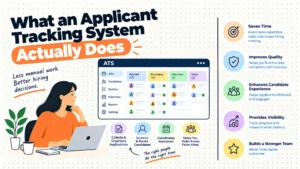
"What is the difference between an ATS and a recruitment CRM?" Which object is central. In an applicant tracking system it is the job, and candidates exist in relation to it. In a recruitment CRM it is the relationship, with people and companies as long-lived records and individual vacancies as events against them. The names are used loosely by vendors in both categories, so the useful question in a demo is to ask to see a person's five-year history across four clients.
"Do we need something that handles contract placement?" Only if you place contractors, and then it is not optional. Timesheets, margin per hour, ongoing billing and extensions are a different commercial model from a single permanent fee, and a tool built only for permanent work will push that entire side of the business into a spreadsheet. Agencies that do both should treat this as a hard requirement rather than a nice-to-have.
"How do we handle candidate consent and data retention?" The obligations around holding personal data, and how long it may be kept, differ by jurisdiction and by circumstance, so take local advice on what applies to you rather than relying on a vendor's summary or on this article. The systems requirement is narrower and worth specifying: the ability to record when and how somebody agreed to be represented, to find everything held about one person quickly, and to delete it on request without breaking the placement record.
"Is the expensive one worth it?" At an agency, the thing to compare is not licence against licence. It is licence against the time consultants spend not selling. A platform that saves each of eight consultants two hours a week is worth considerably more than the difference between any two products in this market, and a platform that costs each of them an extra hour is worth less than free.
Candidate Ownership, Which Is a Commission Problem
This is the section most likely to save an implementation, because the software question has no answer until the business question is settled.
Ownership rules decide who is credited when a placement happens, and every agency has them, usually informally and usually inconsistently. The common version is that whoever first added a candidate owns them for a period, that whoever owns the client relationship takes a share, and that disputes go to a manager. Written down, that is three rules with several undefined terms.
A platform will enforce whatever you tell it and will not tell you what is fair. So the decisions have to be made first, and there are five.
What counts as adding a candidate. A CV in the database, a conversation, or a submission to a client. This is the single most contested definition and the one that determines whether people race to add names, which is a behaviour you can create accidentally.
How long ownership lasts. A fixed period, a period from last contact, or indefinitely. Indefinite ownership accumulates until the database is divided among people who no longer work there, which is the state most mature agencies have to unwind at some point.
What happens when somebody leaves. The rule you will need and the one nobody writes until the first time it is needed, at which point it is a negotiation rather than a rule.
How a split works when three people touch a placement. Sourcer, client owner, process runner. Percentages, or a ranking, or a manager's discretion. Discretion is workable at six people and corrosive at twenty.
What happens when two consultants have the same candidate from different sources. Genuinely common, and the rule that most needs to exist before the dispute rather than after it.
Write those five down as a page, agree them, then configure the tool to match. Because the tool will make the rules visible and enforceable, any unfairness in them becomes louder rather than quieter after implementation, which is why agencies that implement before agreeing frequently blame the software for a conversation they had been avoiding.
What the Client Sees
The client-facing surface is where agency tools differ most from employer ones, and it is worth more attention than it usually gets, because it is the part of your operation the client experiences directly.
Three things a client wants, in order.
A shortlist they can read and respond to. Candidate summaries, your assessment, the reason each is a fit, and a way to say yes or no per candidate. Not a login to an unfamiliar system with a password reset, which is the arrangement that reliably produces a client who replies by email instead and breaks your audit trail.
Status on the roles they have given you. Where each role stands, how many submissions, what is in progress. Clients ask for this constantly and answering it by hand is one of the larger uses of consultant time at any agency that has not automated it.
Nothing else. Specifically not other clients, not other candidates, not your internal notes, and not any indication of how many other places their candidate is being submitted. This is the separation requirement in its most visible form, and it is the one that embarrasses an agency when it fails.
So the thing to test in any demo is a client-facing view, sent to somebody who is not in your organisation, viewed on a phone. Ask what the client has to do to see it and what they can do without logging in, because every step between the email and the shortlist reduces the response rate and therefore the speed of your process.
And ask what the client view looks like when there is bad news. A process with no submissions this week still needs a status, and a tool that only shows progress makes a quiet week look like neglect.
How to Choose: Five Questions Before You Talk to Any Vendor
How many clients and how many consultants? Two clients and two consultants makes separation a requirement. Twenty and twelve makes it the central requirement. One client makes the whole category question different and may legitimately point you at an employer-side product.
Permanent, contract, or both? If both, the contract side has to be in scope from the start, because adding timesheets, margin and ongoing billing to a permanent-only tool later is not a configuration exercise. Agencies frequently scope this out to simplify a purchase and then run half the business on spreadsheets for three years.
How large is the database and how much of it is worth keeping? Count the records. Then estimate how many have had any contact in two years. The gap matters because migrating a large database of stale records costs real effort and delivers little, and the decision to carry only the active portion is much easier to make before a migration than during one.
Are your ownership rules written down? If not, that is the first deliverable and it is not a software task. The five decisions above, on one page, agreed.
What will consultants stop doing? Name the tasks and the hours. Chasing client feedback by email, retyping candidate details, assembling shortlists by hand, producing the weekly client update. If the answer is vague, the tool will be adopted by the operations team and ignored by the people whose time the business sells.
The Options
Two categories here, and the honest ranking puts the second one first for most agencies.
Recruitment CRM platforms, the category that fits
Tools built for agency work treat the person and the company as long-lived records, support separation between consultants and clients, include client-facing presentation, and handle fees, margin and commission. Well-known names in the category include Bullhorn, JobAdder, Vincere, Loxo and Recruit CRM, and the category also contains a long tail of regional and specialist products.
We have not audited this category's pricing or module scope for this article, and nobody should take a general comparison's word for either: both vary by region, by module mix and by whether contract placement is in scope. Verify the current figures and what is included on each vendor's own site, with the date you read it, and ask specifically whether timesheets and margin are in the quote.
Where this category struggles: the products are generally less polished than the best employer-side tools, the candidate-facing experience is often weaker, and the breadth means implementations touch commercial processes rather than just recruiting ones, which makes them longer.
Workable
Best for an agency only in the embedded case, or for a small agency whose immediate problem is job distribution rather than a database.
It is the only employer-side platform here that publishes list pricing. Read on 10 October 2026, Standard is $299 per month or $3,588 per year, Premier is $599 per month or $7,188 per year, and Enterprise is $719 per month or $8,628 per year. The annual figures are labelled as a saving against monthly.
Where it struggles for an agency: it is an employer-side product, so the three assumptions described earlier all apply. Flat monthly pricing is genuinely attractive against per-seat models, which is why small agencies look at it, and it does not change the modelling problem.
Ashby
Best for a well-funded employer with a data-led talent function, which is a precise description and not an agency.
Worth naming because agencies encounter it on the client side and because it publishes something, which is unusual. Its pricing page is a configurator rather than a list: at the default company size and payment selection it returned around $400 per month for its all-in-one foundations tier when read on 10 October 2026, with candidate texting at $90 per additional thousand messages and single sign-on at $100 per month as add-ons. The headline figure depends on the company size and term you select, so treat it as a configurator output rather than a list price.
Where it struggles for an agency: the entire product is oriented around one employer's hiring funnel and its analytics, which is its strength and makes it the wrong category here.
Greenhouse
Best for mid-market and larger employers building a structured, consistent hiring process across many teams.
It publishes no price, confirmed on its own site on 10 October 2026. Note also that greenhouse.io now redirects to greenhouse.com, which is worth knowing if you hold old links or documentation.
Where it struggles for an agency: employer-side by design, with no client separation, no candidate-centred history across clients and no commercial model.
Lever
Best for employers wanting candidate relationship management alongside tracking, which sounds closer to agency needs than it is.
It publishes no price, confirmed on its own site on 10 October 2026. The relationship-management framing is genuine and is still about one employer's relationship with a talent pool rather than many clients.
Where it struggles for an agency: the same three assumptions, and the relationship model is built around nurturing candidates for your own roles.
The spreadsheet and the inbox
Worth naming honestly because it is what most small agencies actually use and it is not always wrong.
Right at up to about four consultants with a database small enough that people remember it. It is fast, free and shapes itself to how you work. It fails on three specific things, and each is a signal rather than an inconvenience: you cannot find somebody you spoke to two years ago, you cannot separate what one consultant sees, and you cannot tell which clients are profitable without a monthly assembly exercise.
The Comparison
| Option | Category | Publishes a price | Client separation | Candidate-centred history | Fees and margin |
|---|---|---|---|---|---|
| Recruitment CRM platforms | Agency | Varies, verify per vendor | Yes, by design | Yes, by design | Yes, usually per module |
| Workable | Employer | Yes, list pricing | No | No | No |
| Ashby | Employer | Configurator output | No | No | No |
| Greenhouse | Employer | No | No | No | No |
| Lever | Employer | No | No | Partly, one employer | No |
| Spreadsheet and inbox | Neither | Free | By discipline only | By memory only | By hand, monthly |
The second column is the one that should settle it. Four of the six rows are the wrong category for an agency, and the fact that one of them publishes a readable price is not a reason to choose it. A cheap tool that cannot represent your business is more expensive than a quoted one that can.
The Decision Table
| Situation | Scale | Setup | Primary Pain | Recommended Starting Point |
|---|---|---|---|---|
| One client, working as their team | Any | Employer-side product, often theirs | None, the assumptions hold | Use the client's ATS or a simple employer one |
| Three partners, retained search, low volume | Under 5 | Documents plus a simple tool | Nothing structural yet | Keep it. Spend the money on research instead |
| Two or more clients, two or more consultants | 2 to 10 | Recruitment CRM | Separation, and one person as several records | A recruitment CRM, verified on pricing yourself |
| Permanent and contract placement both | Any | CRM with timesheets and margin in scope | Half the business living in a spreadsheet | Put contract in the requirement from day one |
| Ownership disputes between consultants | 5 plus | Written rules, then configuration | A commission problem, not a software one | Write the five rules before any demo |
| Clients chasing status by email | Any | Client-facing view, no login required | Consultant time spent on updates | Test the client view on a phone, as an outsider |
| Large database, mostly stale | Any | Migrate the active portion only | Effort spent carrying dead records | Count records with contact in two years first |
| Job distribution is the only real problem | Under 10 | Posting tool, flat monthly cost | Reach, not relationship management | Workable, with the modelling limits accepted |
Migrating From a Corporate ATS Without Losing the Database
Agencies that have already bought the wrong category face a specific problem, which is that their database now exists as applications attached to jobs rather than as people. This is recoverable and the order matters.
Deduplicate on the person before you export anything. Match on email first, then phone, then name plus one other field. Expect one person to appear several times, once per role they were considered for. The merge decisions are yours and nobody else can make them, so do them in the old system where you can see the context rather than in a spreadsheet afterwards.
Decide what the person's history is. When four application records merge into one person, you have four sets of notes and four timelines. The useful output is one chronological history with the client and role attached to each entry. Doing this by hand for an active database is feasible; doing it for everything is not, which brings up the next point.
Carry the active portion, archive the rest. Count records with any contact in the last two years. That is usually a small fraction of the total and it is where essentially all the value is. Export the remainder to a flat file, keep it somewhere searchable, and migrate only the active set. This single decision is the difference between a two-week migration and a two-month one.
Keep the consents and their dates with the person. Where you hold a record of somebody agreeing to be represented, that record has to survive the merge and stay attached to the person. What obligations apply to you differs by jurisdiction and by circumstance and is a matter for local advice, but losing the evidence during a migration is avoidable and irreversible, so treat it as a hard requirement rather than a field to map later.
And export your placement history separately, as a flat file with dates, clients, fees and consultants. It will not map into a new system's commercial model cleanly and it is the record of how the business has performed, so it is worth having as a standalone artefact regardless of where it ends up.
Working Out Which Clients Actually Make Money
This article says three times that an agency cannot tell which clients and which consultants are profitable without a monthly assembly exercise. Here is the exercise, because it is worth doing once by hand before buying anything, and because the answer usually changes a shortlist.
Take the last twelve months. For every client, three numbers.
Fee revenue billed. From invoices, not from placements, because a placement that was rebated is not revenue. Include contract margin where you have it, and if contract margin lives only in a spreadsheet then this is the first evidence of what that costs you.
Submissions made. Count every candidate sent to that client, across every role. This is the number nobody has, and it is the one that produces the finding.
Roles taken and roles filled. Both, because a client who gives you many roles and fills few is consuming more capacity than one who gives you three and fills three.
Then compute two ratios per client. Revenue per submission, which tells you how much work each pound of revenue costs. And fill rate, which tells you whether the roles are real.
Expect two uncomfortable results. A client everybody likes, with a high headline revenue and a submission count so large that the revenue per submission is among your worst, usually because they interview slowly and reject broadly. And a quiet client nobody talks about with a small revenue and the best ratio in the book, who should be getting more of your attention.
So repeat the same two ratios by consultant rather than by client, using the same twelve months. The distribution is almost always wider than managers expect, and the reason is rarely effort. It is usually which clients each consultant happens to hold, which makes it a management decision rather than a performance one.
And then write down how long the exercise took. That number is the business case for the tooling, because the whole point of a recruitment CRM holding fees alongside activity is that these two ratios become a report rather than an afternoon. An agency that has done this once by hand asks much better questions in a demo, because it knows exactly which report it wants and can tell within a minute whether the product produces it.
What Getting This Wrong Costs
The visible cost is a tool nobody uses, and at agency scale the licence is rarely the painful part.
The second cost is consultant time, which is the only thing the business sells. A tool that fits the work saves each consultant a few hours a week on updates, shortlists and searching. A tool that does not fit adds time, because every task has a workaround and the workarounds are manual. At eight consultants, a two-hour weekly difference in either direction is a material change to the capacity of the firm, and it dwarfs every licence figure in this article.
The third is the database, and it is the one that is hard to undo. Five years of running an application-centred product leaves you with institutional memory that cannot be searched by person, which means the asset the agency has been building is partly inaccessible. Recovering it is the merge exercise above, and the cost of that exercise grows every year the wrong tool is in place.
And the reframing question: if a consultant left tomorrow, how much of what they knew about their clients and candidates would remain in the business, and in what form? At an agency, that answer is the strategy. A tool that makes the answer worse is expensive whatever it costs.
When You're Ready to Move Beyond the Spreadsheet and the Inbox
The honest position is that the spreadsheet works for longer than vendors suggest and fails in three specific ways rather than gradually.
The first failure is search. The moment somebody says they are sure they spoke to a suitable person about eighteen months ago and cannot find them, the database has stopped being an asset. The second is separation, which arrives with the second consultant who could approach the same candidate. The third is profitability, which arrives when you cannot say which clients or which consultants make money without assembling it by hand each month.
One of those is a reason to look. Two is a reason to move. Headcount is not a trigger, which is why a disciplined four-person agency can be in better shape than a disorganised twelve-person one.
The sequence that works costs nothing and does not start with a vendor. Write the five ownership rules and agree them, because that is the one deliverable no tool provides and the one that makes or breaks the implementation. Count your records and how many have had contact in two years, so you know what you are migrating. Decide whether contract placement is in scope. Name the tasks consultants will stop doing, with hours.
Then look at recruitment CRM products rather than applicant tracking systems, verify pricing and module scope yourself on each vendor's own site with the date you read it, and ask every one of them to show you a single person's five-year history across four different clients. That one demo request separates the two categories faster than any feature list, and it is the question your business actually turns on.
Frequently Asked Questions
What is the best ATS for a recruitment agency?
For most agencies the honest answer is that an applicant tracking system is the wrong category and a recruitment CRM is the right one. Employer-side products assume one employer, treat the job as the central object and have no concept of a fee, and all three assumptions are inverted in agency work. Products built for agencies, such as Bullhorn, JobAdder, Vincere, Loxo and Recruit CRM, model the person and the company as long-lived records with separation between consultants and clients. Verify current pricing and module scope on each vendor's own site, since both vary by region.
What is the difference between an ATS and a recruitment CRM?
Which object sits at the centre. In an applicant tracking system it is the job, and a candidate exists as an application progressing through it, which is correct for an employer filling its own roles. In a recruitment CRM it is the relationship, with people and companies as records that outlive any individual vacancy and with each role appearing as an event against them. Vendors in both categories use the terms loosely, so the test in a demo is to ask to see one person's five-year history across four different clients.
Can you configure a normal ATS for agency use?
Partly, and the parts you cannot configure are the ones that matter. You can add a client field, tag candidates and build naming conventions, which handles presentation. You cannot create a separation control in a data model with no concept of separate organisations, so one consultant will be able to see another's pipeline and a client-facing view will reveal more than it should. And you cannot turn application-centred history into person-centred history, which is the capability an agency database depends on.
How should agencies handle candidate ownership in a recruiting tool?
Decide the rules before configuring anything, because a tool enforces what you tell it and will not tell you what is fair. Five decisions are needed: what counts as adding a candidate, how long ownership lasts, what happens when somebody leaves, how a split works when three people touch a placement, and what happens when two consultants hold the same candidate from different sources. Implementing before agreeing these makes any unfairness in them louder rather than quieter, which is why the software usually gets blamed for an avoided conversation.
Which applicant tracking systems publish their pricing?
Among the well-known employer-side platforms, Workable publishes a readable list with a monthly and an annual rate for each of its three tiers, read on 10 October 2026 and given in full earlier in this article. Ashby publishes a configurator rather than a list, so its headline figure depends on the company size and payment term you select and should never be quoted as a flat price. Greenhouse and Lever both publish nothing, confirmed on their own sites on 10 October 2026, and greenhouse.io now redirects to greenhouse.com. For agency-specific platforms, verify each vendor's own page with the date you read it.
Does an agency need a tool that handles contract placement?
If you place contractors, yes, and it should be in scope from the beginning. Contract work involves timesheets, a margin per hour, extensions and an ongoing billing relationship, which is a different commercial model from a single permanent fee. Adding that to a permanent-only tool afterwards is not a configuration exercise, so agencies that scope it out to simplify a purchase commonly end up running half the business on spreadsheets for years. Ask explicitly whether timesheets and margin are included in the quote rather than available as a module.
When is a spreadsheet still the right answer for an agency?
Up to about four consultants with a database small enough that people genuinely remember it, which is more common than vendors suggest. It is fast, free and shapes itself to how you work. It fails in three specific ways, and each is a signal to act rather than an inconvenience: you cannot find somebody you spoke to two years ago, you cannot separate what one consultant sees from another, and you cannot say which clients or consultants are profitable without assembling it by hand every month.
HROpsLab takes no vendor money and publishes no paid placements, which is why this article says plainly that four of the six options compared are the wrong category for the reader.