
TL;DR
- The core decision: whether you want a plan or a conversation, because the document is only useful as a record of the conversation.
- When doing nothing is right: when the role is well understood and the manager already says clearly what good looks like.
- What has to be true: somebody can state what should be different at a named point, and would notice if it wasn't.
- How the options split: by who writes it, which determines whether it describes the job or describes an ambition.
- Decision rule: if nobody will read it again after it's written, don't write it.
- Outcome to expect: a new person who knows what they're being judged on, which most of them don't.
The Document Written for an Audience of One
The 30-60-90 day plan has an unusual property among management artefacts: most of the ones that exist were written to win something rather than to guide anything.
Candidates write them for final-round interviews, where the exercise is genuinely useful as a demonstration of how somebody thinks about a role they haven't done yet. Managers write them for new hires, usually the weekend before a start date, and file them. New hires write them in week one because somebody asked for one. In all three cases the document is produced for a moment, and the moment passes.
That's a shame, because the underlying idea is sound and unusually cheap. Somebody new arrives with no idea what they're being judged on, and the organisation has a rough idea it has never articulated. A short written statement of what should be true at a couple of named points closes that gap, and closing it is worth more than almost anything else that happens in the first months.
Best tools for Onboarding & LMS
The format itself is arbitrary. There's nothing special about thirty days, and the three-part structure exists because it's memorable rather than because work divides that way. Some roles are meaningfully assessable at a month and some aren't close. But the arbitrariness isn't the problem, and swapping thirty days for six weeks doesn't fix anything. The problem is that the document is usually produced instead of the conversation rather than as a record of it.
So this is worth assessing on one question: does writing it cause somebody to say something they'd otherwise have left unsaid. When it does, it's one of the better uses of an hour available in onboarding. When it doesn't, it's a file nobody opens.
When You Genuinely Do Not Need to Act Yet
Your current setup is genuinely fine. The role is well understood, the manager already tells new people what they should be able to do and by when, and nobody has been surprised in a first review. The plan would be documenting a conversation that already happens properly, which is effort without a return.
Friction is starting to show. A new person has asked what they should be focusing on, or a manager has struggled to answer how somebody is getting on. Both suggest the expectations exist in somebody's head and haven't been said out loud, which is exactly the gap this format is good at closing.
It has become a real cost. Somebody has reached a first review and been surprised, or a hire has been let go for reasons that were never stated to them, or two people in the same role were assessed against visibly different standards. At that point the absence of a written expectation is doing measurable damage.
The edge case that forces it. The role is new, ambiguous, or was reshaped during a long recruitment process. When nobody has done this job before, or when the job that was advertised isn't quite the job that exists, the new person has no way to infer what's expected, and inference is what they'll otherwise do. Writing something down is the only way to find out whether you and they have the same job in mind.
Five Questions This Reader Asks at 11pm
Who should write the 30-60-90 day plan? The manager drafts it, the new person revises it in their first fortnight, and both agree the revised version. A manager-only plan describes the job as the manager imagines it, which is usually a little wrong in ways only the person doing it will notice. A new-hire-only plan is a guess made by somebody with no information. The draft-and-revise sequence produces the useful thing, which is a disagreement surfaced early.
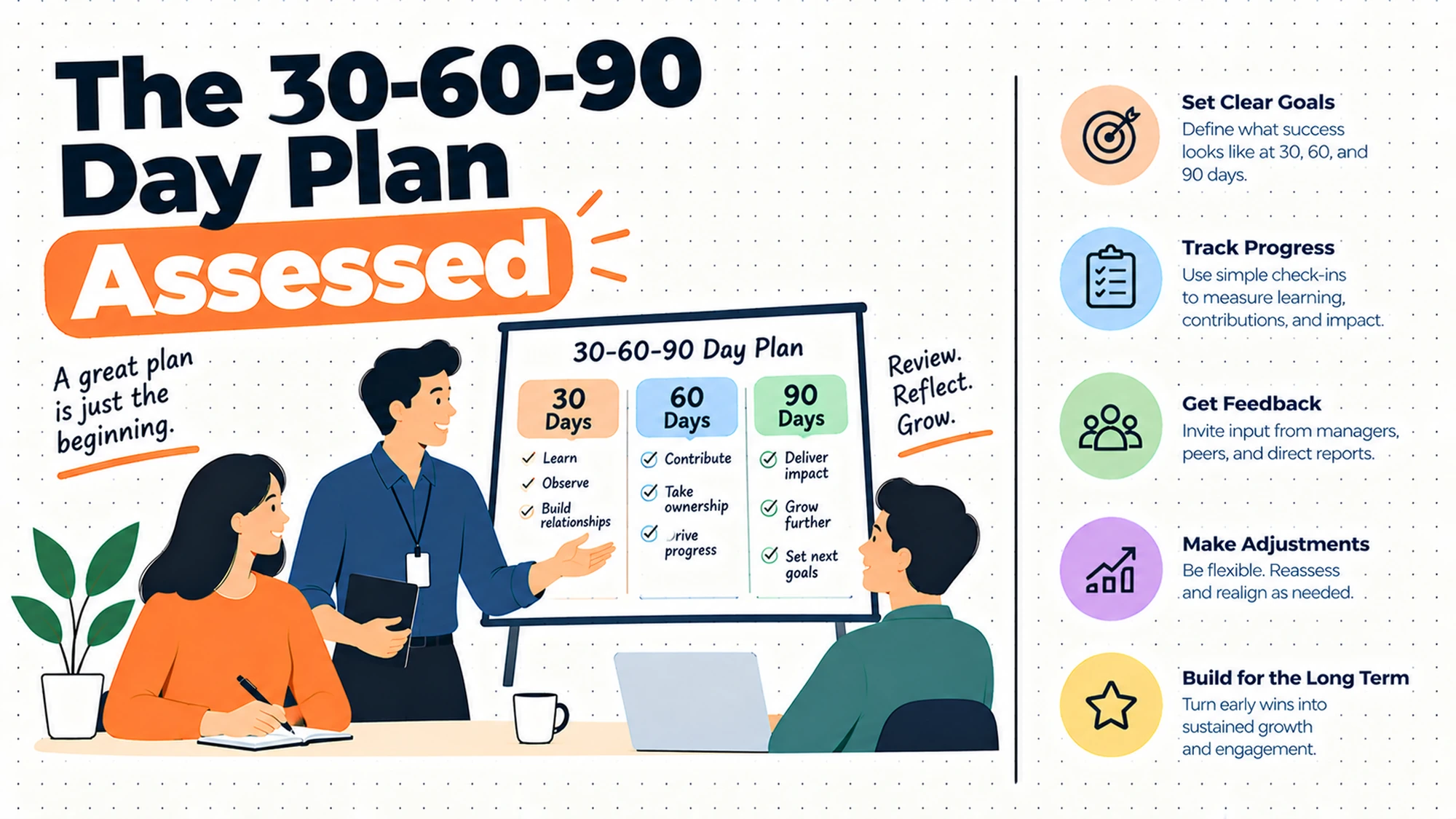
What goes in each section? Something that can be observed. The first period is usually about understanding: who does what, how the work actually flows, where the problems are. The second is about contributing in a bounded way. The third is about operating independently. What matters is less the theme than whether each item has a condition somebody could check.
How detailed should it be? Short. A page, or less. Detail is the enemy here, because a long plan is a prediction about a period nobody can predict, and it will be wrong in specifics within weeks, at which point the whole document gets abandoned rather than adjusted. A few clear statements survive contact with reality; a detailed schedule doesn't.
Is it worth doing if nobody checks it? No, and that's the honest answer. A plan nobody revisits is a writing exercise. The value comes entirely from somebody sitting down at the stated points and asking whether the stated things happened. If you're not going to do that, skip the document and have the conversation instead, which is most of the benefit anyway.
What about the plans candidates write for interviews? They're a different artefact with a different purpose, and they're often quite useful for the hiring decision, because they show how somebody thinks about a problem with incomplete information. What they aren't is a plan for the actual job, since they were written without access to anything real. Don't hand a candidate's interview plan back to them on day one and treat it as agreed.
Five Diagnostic Questions You Can Self-Assess Against
Could somebody else tell whether an item happened? Take each line and ask it. Build relationships with key stakeholders fails this test, and so does most of what appears in these documents. Have met each of the four team leads and understood what they need from this role passes it, and it's the same intention expressed in a way that can be checked.
Does the manager know what they'd do if it didn't happen? Ask them. If there's no answer, the plan isn't being used for anything, and it's worth knowing that before spending time on it. This isn't about consequences in a disciplinary sense; it's about whether anybody would notice and act.
Was the new person allowed to change it? If they received it and never touched it, you have a document about the manager's assumptions rather than an agreement. The revision is the part that produces value, because it's where the new person says the thing that turns out to matter, which is usually that one of the items is impossible for a reason nobody outside the role knew about.
Is anything in it dependent on people outside the team? Those items are the ones that slip, and they slip for reasons the new person can't control. A plan that holds somebody to an outcome requiring three other teams to cooperate is a plan that will make a capable person look slow.
When was the last one looked at again? If the honest answer is never, the format isn't working here and the fix isn't a better template. It's either a calendar entry at each checkpoint or a decision to stop producing them.
Six Versions of the Plan, Reviewed
Written by the candidate before they're hired
Produced for a final interview, describing what they'd do in the role. It earns its place as a selection tool rather than an onboarding one, and at that it's genuinely informative: you learn how somebody structures an unfamiliar problem, what they think matters, and whether they've understood the business well enough to say anything specific.
Where it falls short is being mistaken for a plan. It was written without access to the systems, the team, the actual constraints or the history, so its specifics are necessarily guesses, and some of them will be wrong in ways that would embarrass anybody who knew the context. Treating it as binding after the hire punishes somebody for not having had information they couldn't have had.
Use it to decide. Then put it away, and start the real one from what's actually true.
It's worth reading again once, though, a few weeks after they've started. Comparing what somebody assumed about the role from outside with what they've found inside it is genuinely informative, and not mainly about them. The places where an intelligent outsider guessed wrong are usually places where the organisation describes itself inaccurately, and that's a finding about your job adverts rather than about the person.
Written by the manager before the start date
The manager drafts what they expect at each point and hands it over on the first day. It earns its place because it forces the manager to articulate something they usually leave implicit, and that articulation is most of the value regardless of what happens to the document afterwards. It also gives the new person something concrete in a week where very little is concrete.
Where it falls short is that it's one-directional. It describes the job as imagined by somebody who isn't doing it, and it arrives at the moment the new person is least equipped to challenge it, which means they'll accept items that turn out to be unrealistic and then quietly fail against them.
Draft it, hand it over, and say explicitly that you expect it to come back changed. Without that instruction, it won't.
There's a timing point that matters here too. Handing it over on the first day means it arrives alongside everything else and gets read in a state of information overload, which is the worst possible moment for a document somebody is supposed to think hard about. Giving it at the end of the first week, when they've met people and seen some of the work, gets a considerably more useful reaction.
Written by the new hire in their first weeks
The new person is asked to produce a plan once they've had a look around. It earns its place because it's a genuine test of understanding, and reading somebody's version of what matters in their role tells you a great deal about whether they've got it. It also gives them ownership, which makes them considerably more likely to follow it.
Where it falls short is that it puts the burden on somebody with the least information and the most pressure to impress. Plans written this way are almost always too ambitious, because the new person is signalling commitment rather than making an estimate, and an over-ambitious plan sets up a failure that wasn't necessary.
If you use it, respond to the draft honestly, including by taking things out. A manager who accepts an unrealistic plan without comment has agreed to it.
The other risk with this version is that it rewards a particular kind of new person. Somebody confident and quick to form opinions will produce an impressive document in week one, and somebody more careful will produce a thinner one, and the difference tells you about their disposition rather than their ability. Reading the draft as evidence about the person, rather than as a first attempt at a shared plan, gets that backwards.
Co-written, drafted and then revised
The manager drafts, the new person revises after a fortnight, and both agree the result. It earns its place because it's the only version that reliably surfaces disagreement, and the disagreement is the point. The revision conversation is where somebody says that an item depends on a system that doesn't work, or that the thing described as straightforward is where all the difficulty lives.
Where it falls short is effort and timing. It requires two conversations rather than one, and the second has to happen when the manager is busiest with the practical side of a new arrival. It also fails if the revision is nominal, which it will be unless the manager makes clear that cutting things is allowed.
This is the version worth doing. The rest of this article assumes it.
A standard template filled in
A fixed format used for every hire, with sections to complete. It earns its place on consistency and on not starting from a blank page, which matters more than it should: managers who'd never write one from scratch will fill in a form.
Where it falls short is that templates produce template answers. The prompts are generic, so the responses are generic, and you get a document full of items like understand the company culture that satisfy the form and mean nothing. The format also implies that every role divides the same way, which few do.
A template is a reasonable prompt if it asks for specifics and rejects abstractions. Most don't, and the ones circulating online are mostly designed for candidates rather than employers.
No plan, just a clear conversation
The manager sits down and says what they expect, at what point, and how they'll know. Nothing is written beyond a few lines in a message afterwards. It earns its place because it's most of the benefit for a fraction of the effort, and because it avoids the failure mode where producing the document substitutes for meaning it.
Where it falls short is memory and continuity. Neither party will recall the detail in two months, and if the manager changes, everything agreed disappears. It also can't be checked, which means it can't be used for anything beyond the moment.
Perfectly adequate for a straightforward role with a manager who does this well. Write down the three things at the end and you've got the document anyway.
The caveat is that managers who do this well are rarer than managers who believe they do. The test is not whether the conversation happened, it's whether the new person could repeat back what they're being judged on a fortnight later. Asking them is a few seconds of work and the answer is usually informative.
The Decision Table
| Situation | Scale | Setup | Primary Pain | Recommended Starting Point |
|---|---|---|---|---|
| Role well understood, manager articulates it | Any | Any | None | A short written note, not a plan |
| New person asking what to focus on | Any | Any | Expectations unsaid | Manager drafts, new person revises |
| New or ambiguous role | Any | Any | Nobody knows what good looks like | Write it, expect to change it twice |
| Role changed during recruitment | Any | Long hiring process | Two different jobs in mind | Agree the job before the plan |
| Somebody surprised at a first review | Any | Any | Nothing was stated in advance | State it, in writing, at the start |
| Candidate submitted one at interview | Any | Any | Written without real information | Use it to decide, then start again |
| Manager unlikely to revisit it | Any | Any | The document is the whole exercise | Have the conversation, skip the plan |
| Plans exist but nobody opens them | Any | Any | No checkpoint in anybody's calendar | Book the checkpoints when you write it |
| Several people in the same role | Over fifty | Any | Inconsistent standards | One shared version of what good looks like |
The seventh row is worth being honest about. If the manager won't sit down at each checkpoint and ask whether the stated things happened, the plan has no mechanism and won't do anything. That isn't an argument against the format, it's an argument for booking the checkpoints at the same moment you write it, because a plan with two calendar entries attached is a different object from a plan without them.
Where 30-60-90 Plans Go Wrong
| The failure | What the new person experiences | What would have to change |
|---|---|---|
| Written and never reopened | A document produced for its own sake | Checkpoints booked when it is written |
| Items nobody could tick | Effort spent on things that cannot be shown | A completion condition for every line |
| Handed over, never revised | Agreeing to something they know is wrong | An explicit instruction that cutting is allowed |
| Depends on other teams | Looking slow for reasons outside their control | Only items the person can actually move |
| Too detailed to survive a month | Abandoning the whole thing when part slips | A page or less, few items |
| Confused with the interview version | Held to guesses made with no information | A fresh plan from what is actually true |
The third row is the one that quietly does the most damage. A new person handed a plan on their first day is in the worst possible position to push back on it: they don't know the manager, they don't know what's negotiable here, and disagreeing on day one feels like a poor opening move. So they accept it, spot the impossible item in week two, say nothing, and fail against it in month two. The manager reads that as capability. It was a document nobody was allowed to argue with.
The fourth row produces the same outcome by a different route. Items that require other teams to deliver are the ones that slip, and the new person carries the appearance of the slip without the ability to prevent it. If something genuinely depends on another team, the item belongs to whoever can chase that team, which is rarely the person who just arrived.
Why Thirty Days Is Arbitrary and Sometimes Useful Anyway
It's worth saying plainly that the numbers have no basis. Work doesn't divide into equal thirds, roles differ enormously in how long they take to become productive in, and a month is far too short for some jobs and far too long to wait for a first checkpoint in others.
So why does the format persist? Because arbitrary boundaries are still boundaries, and boundaries force decisions. Asked what somebody should achieve eventually, a manager will describe the role. Asked what should be true in a month, they have to choose, and choosing is the thing that produces information. The specific number matters much less than the fact that there is one.
The second reason is that it creates a reason to meet. A checkpoint that exists on a date will usually happen, and a conversation about progress that has no date attached usually doesn't, because both parties are busy and neither wants to be the one to raise it. The format's real function is scheduling.
That suggests an adjustment worth making rather than abandoning the format. Choose intervals that match the role instead of defaulting to the numbers. For work with a short cycle, checkpoints at two weeks and six weeks will tell you more. For a role where nothing meaningful can be assessed inside a quarter, three monthly checkpoints are honest and thirty-day items will be busywork. Keeping the name and changing the intervals is fine, though it's worth saying which you've done so nobody is confused.
One thing worth preserving from the standard shape: the progression from understanding to contributing to operating. That sequence is right even when the timings aren't, and plans that skip the understanding phase produce people who start changing things before they know why things are as they are. That failure is most common with senior hires, who are frequently brought in to change something and feel the pressure to demonstrate it quickly. A plan that explicitly makes the first period about understanding gives them permission to wait, which is a thing experienced people often need granting rather than granting themselves.
Writing One That Is Not Theatre
The difference between a useful plan and a filed one comes down to a handful of choices, none of which are about the template.
Keep it to a page and few items per period. The instinct is to be comprehensive, and comprehensiveness is what kills these documents, because a plan with a dozen items per phase can't be held in anybody's head and will be wrong in enough particulars that the whole thing gets set aside. A small number of clear statements survives.
Write each item so somebody else could tell whether it happened. This is the single most valuable discipline and the one most consistently skipped. Most drafts are full of verbs like understand, build, establish and develop, which describe directions rather than destinations. The repair is to ask what you'd point at as evidence, and then write that instead.
Put the checkpoints in the calendar before you finish writing. Two entries, with both people invited, booked while the plan is still open rather than afterwards. Without them the plan has no mechanism, and everything else about it is beside the point. The entries also survive a change of manager, which the intention to check in does not.
Say explicitly that items can be removed. A manager who hands over a plan and doesn't say this has handed over an instruction, whatever they intended, and the new person will treat it as one. The sentence to use is something like: come back in two weeks and tell me which of these is wrong, because some of them will be.
Keep anything that depends on other teams off the individual's plan. Those items are real and somebody should own them, but the owner should be the person with the standing to chase. A new starter holding an item that requires another function to act is holding an item they can't complete.
And expect the second version to be better than the first by a visible margin. That's not a sign the first was poor, it's the entire mechanism working: the revision is where the plan stops describing an imagined job and starts describing the real one.
What to Put in Writing
| Artefact | Who owns it | When it is written | What it prevents |
|---|---|---|---|
| What should be true at each checkpoint | The manager, drafted | Before the start date | Expectations that live in one head |
| The revised version, after a fortnight | The new person | Once they have looked around | A plan nobody was able to argue with |
| The evidence that would show each item is done | Both, together | As each item is written | Lines that cannot be ticked |
| Checkpoint dates, in both calendars | The manager | At the same moment as the plan | A document that is never reopened |
| Which items depend on other teams | The manager | During the revision | Somebody looking slow for others' delays |
| Whether the role has changed since the advert | The manager | Before the plan is drafted | Two people planning different jobs |
The last row is the one that gets skipped and occasionally matters more than everything above it. Roles get reshaped during long recruitment processes, and a plan drafted against the original brief will describe a job that no longer exists. Confirming the job before planning it takes a few minutes and prevents a whole quarter of misdirected effort.
Questions to Ask Before You Commit
On purpose. What will this document be used for? A bad answer is that it's good practice.
On evidence. How would you know an item happened? A bad answer is that you'd see it.
On revision. Can they remove things? A bad answer is that they can raise concerns.
On checkpoints. When are the two conversations? A bad answer is that you'll find time.
On dependencies. Does anything need another team? A bad answer is that it should be fine.
On the role. Is this still the job that was advertised? A bad answer assumes so.
What Getting This Wrong Costs
The first cost is a capable person who fails against something they never agreed to. Handed a plan on day one, spotting an impossible item in week two, and saying nothing because disagreeing early feels risky is an extremely common sequence, and it ends with a manager forming a view about capability from evidence that was never about capability. That view is hard to reverse, because first impressions of competence set the interpretation of everything afterwards.
The second cost is the time spent producing documents that are never opened. A plan is an hour or two of a manager's attention plus the new person's, and where the checkpoints don't happen, all of it is spent for nothing except the appearance of structure. The appearance is worse than the absence, because it satisfies the instinct that something should be done here and stops anybody looking for something that would work.
The third cost is the one nobody attributes correctly. When new people consistently take longer to become effective than expected, the diagnosis is usually about hiring or about training. Frequently it's that nobody ever told them what they were supposed to be achieving, so they spent their first months optimising for what seemed to be valued, which they inferred from incidental signals and sometimes got wrong. That's not a capability problem and no amount of better selection fixes it.
So before producing anything, answer one question honestly: will somebody sit down at the stated points and ask whether the stated things happened. If yes, this format is among the cheapest useful things available in onboarding. If no, have the conversation, write three lines afterwards, and skip the rest.
When You Are Ready to Go Further
None of this needs a template. It needs a manager who drafts a few observable statements, a new person who's genuinely allowed to cut the wrong ones, and two dates in a calendar.
The step beyond individual plans, if you're hiring into the same role repeatedly, is to keep a shared version of what good looks like at each stage and start each new plan from it. That stops every manager reinventing the standard and quietly applying a different one, which is how two people in the same role end up assessed against different bars. Keep it with the team rather than centrally, because the team is the only group that notices when the role changes.
HROpsLab publishes independent comparison work across HR tooling, applicant tracking and payroll. We sell nothing, we take no vendor money, and we publish no paid placements. If the next step is looking at what your current tooling actually supports here, our comparison work is one place to start.
Frequently Asked Questions
What is a 30-60-90 day plan?
It's a short written statement of what should be true at three points in somebody's first months, usually structured as understanding first, contributing next, and operating independently by the end. The intervals are arbitrary and there's nothing special about thirty days, but arbitrary boundaries still force a decision: asked what somebody should achieve eventually, a manager describes the role, and asked what should be true in a month, they have to choose. The choosing is where the value is. The document itself is only useful as a record of the conversation that produced it.
Who should write the 30-60-90 day plan?
The manager drafts it before the start date and the new person revises it after a fortnight, with both agreeing the result. A manager-only version describes the job as imagined by somebody who isn't doing it, and it arrives when the new person is least able to push back, so unrealistic items get accepted and quietly failed against. A new-hire-only version is a guess made with no information and tends to be over-ambitious, because the person is signalling commitment rather than estimating. The revision conversation is the part that produces value.
What should go in each 30-60-90 day section?
Items somebody else could verify. The first period usually covers understanding how the work actually flows and who does what, the second covers contributing in a bounded way, and the third covers operating without unusual support. What matters more than the themes is whether each line has a condition that can be checked, since most drafts are full of words like understand, build and establish, which describe directions rather than destinations. The repair is to ask what you would point at as evidence and write that instead.
How detailed should a 30-60-90 day plan be?
A page or less, with few items per period. Detail is actively harmful here, because a long plan is a prediction about a period nobody can predict, and it will be wrong in enough specifics within weeks that the whole document gets abandoned rather than adjusted. A small number of clear statements survives contact with reality. If you find yourself writing a schedule rather than a set of expectations, the document has already changed into something that will not be used.
Are 30-60-90 day plans actually useful?
They are when somebody revisits them and useless when nobody does, and that single factor matters more than anything about how they are written. The mechanism is the checkpoint conversation, not the document, so the practical test is whether the manager will sit down at the stated points and ask whether the stated things happened. If they will, this is one of the cheapest worthwhile things available in onboarding. If they will not, have the conversation instead and write three lines afterwards.
Should candidates write a 30-60-90 day plan for an interview?
It's a reasonable selection exercise, because it shows how somebody structures an unfamiliar problem and whether they have understood the business well enough to say anything specific. What it isn't is a plan for the actual job, since it was written without access to the systems, the team or the real constraints, so its specifics are necessarily guesses. Employers should use it to decide and then put it away, rather than handing it back on day one and treating it as something the person has committed to.
What if thirty days is the wrong interval for the role?
Then change it and say that you have. For work with a short cycle, checkpoints at two weeks and six weeks will tell you considerably more than waiting a month. For a role where nothing meaningful can be assessed inside a quarter, monthly checkpoints are honest and thirty-day items will be invented busywork that makes everybody look productive. What's worth keeping from the standard shape is the progression from understanding to contributing to operating, which is right even when the timings are not.
What is the difference between a 30-60-90 day plan and an onboarding checklist?
A checklist prevents specific tasks from being forgotten by whoever is responsible for them, and it's mostly complete within weeks. A plan states what the new person should be achieving and by when, and it runs for months. They have different audiences, different lifespans and different failure modes, and combining them produces a document that does neither job well: too task-focused to say anything about what the person is for, and too long to work from under time pressure. Keep them separate.
The format is arbitrary. Being made to say what good looks like at a named point is not.