
TL;DR
- The core decision: when the paperwork happens, not what it contains, because the contents are largely fixed and the timing is entirely yours.
- When doing nothing is right: when you hire rarely, nothing is late, and nobody is asked for the same detail twice.
- What has to be true: somebody can say which items must exist before the first day and which genuinely can wait.
- How the options split: by who does the typing and when, which determines both the error rate and the first-day experience.
- Decision rule: anything that can be completed before the start date should be, and most of it can.
- Outcome to expect: a first morning spent meeting people rather than filling in forms.
The Folder on the Desk
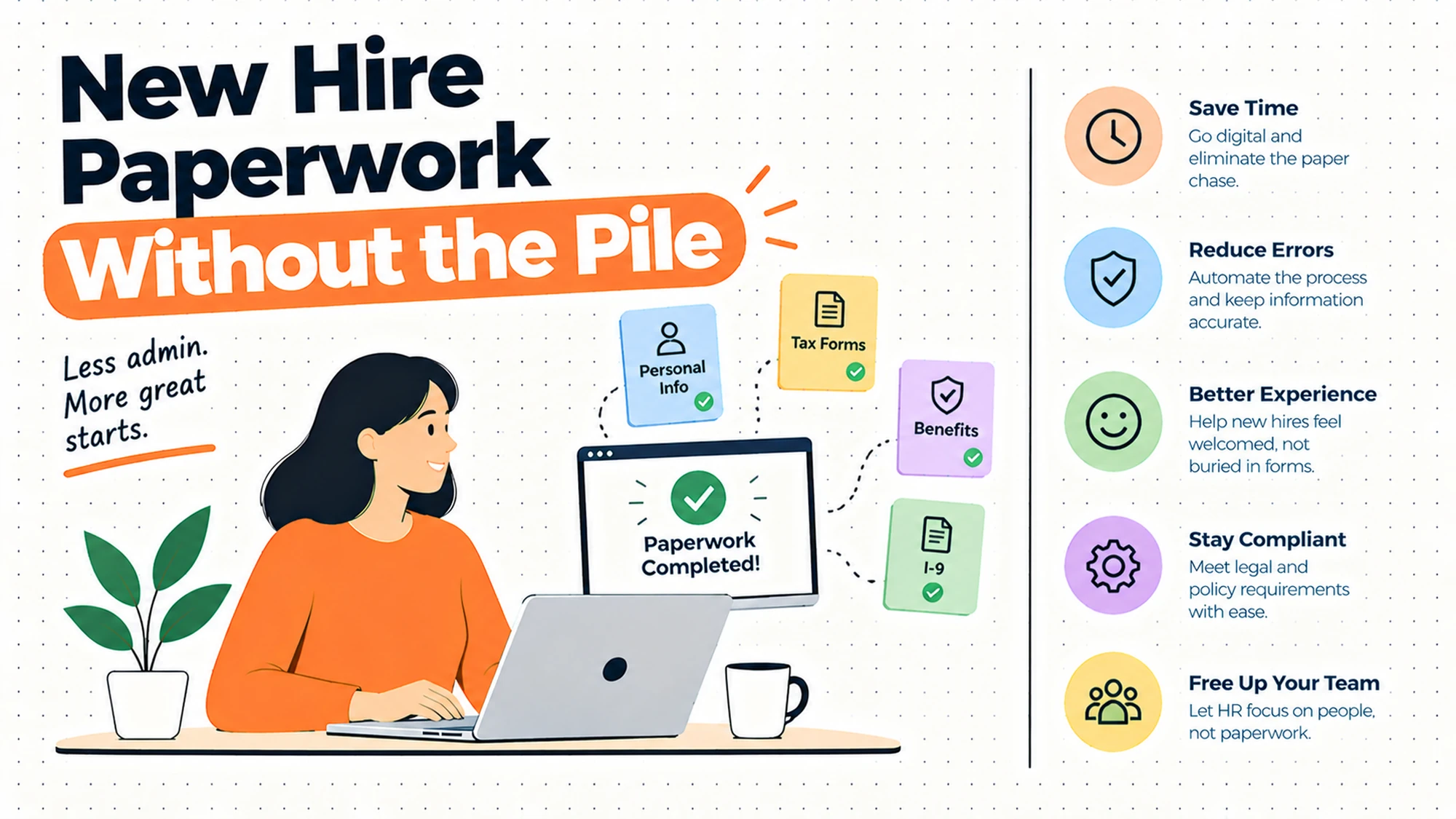
Somebody arrives on their first day and finds a folder waiting for them. Inside is a stack of forms, several of which ask for their address, two of which ask for their bank details, and one of which requires a document they were not told to bring.
They spend their first ninety minutes on it. Somebody from HR sits nearby answering questions. At the end they hand it back, and over the following week the contents are typed into three different systems by three different people, one of whom will transpose a digit.
Nobody designed this. It accumulated. Each individual form has a reason to exist, each was added by somebody solving a real problem, and the pile is simply what happens when items are added over years and nothing is ever removed or resequenced. The first day became the collection point because it's the first moment the organisation is certain the person will turn up, which is a reasonable instinct and a poor design.
Best tools for Onboarding & LMS
It's worth being clear about what's actually fixed here. What you must collect, how identity and eligibility to work must be established, what must be registered with which authority, what consent is required to hold personal data, and how long any of it must be kept all differ sharply by jurisdiction and often by sector. None of that is a matter of preference, and this article won't tell you what applies to you. Establish that locally, with advice, for each place you employ people.
What is entirely yours to decide is the sequencing, the number of times you ask for the same thing, who does the data entry, and whether any of it has to happen while somebody is trying to make a first impression. That's where the pile comes from, and it's the part you can fix.
When You Genuinely Do Not Need to Act Yet
Your current setup is genuinely fine. You hire a few people a year, one person handles it, nothing has been late or wrong, and new starters don't spend their morning on it. Rebuilding this because it looks unsophisticated is effort with no return attached.
Friction is starting to show. Somebody has been chased for a missing item twice, or a new starter mentioned filling in the same details repeatedly, or payroll queried something in a first month. Those are small signals and the fix is usually sequencing rather than systems.
It has become a real cost. The same handful of items is always outstanding, somebody spends hours per hire chasing, or a first-month pay run has been wrong. At this point the process has a defect that recurs, and recurring defects are worth an afternoon of redesign.
The edge case that forces it. You're hiring into more than one jurisdiction, engaging people on a mix of employment and contract arrangements, or operating in a sector with role-specific checks attached. Complexity here is genuinely not manageable from memory, the requirements differ by location, and the cost of getting it wrong falls on the organisation rather than on the individual. Take local advice per jurisdiction rather than extending what you do at home.
Five Questions This Reader Asks at 11pm
What paperwork does a new hire need? This is the question everybody asks and the one nobody online should answer for you. What must be collected, verified, registered and retained depends on where the person will work, where you are established, what kind of engagement it is, and in some sectors on the role itself. Get the list from a local source who is accountable for it being right, then treat that list as fixed and design everything else around it.
Can we do it all before they start? Most of it, though not necessarily all. Some items genuinely depend on the employment having begun or on something being physically checked, and which those are varies by location. The useful exercise is to take your list and mark each item as must-be-before, must-be-after, or free to place, and you'll usually find the third category is the largest and has been sitting on day one by habit.
Why do we ask for the same details several times? Because each system owns its own record and nothing passes between them. Payroll, the HR record, benefits and whatever the manager keeps all want the same name, address and contact details, and each collects them separately. It's the single most visible defect in the whole process from the new person's side, and it's the one most likely to be fixable by deciding which system is the source and populating the others from it.
Should they fill it in or should we? They should enter their own personal details, because they're the only one who knows them and every hand they pass through adds a transcription error. Anything that's about the organisation rather than about them should be pre-filled, because asking somebody to supply information you already hold is how a short process becomes a long one.
What if something is still missing on day one? Decide in advance which items actually block starting and which don't, and make sure whoever greets the person knows the difference. Most organisations treat every outstanding item as equally urgent, which produces a first morning of chasing, and a smaller number treat none of them as urgent, which produces a problem later. Knowing which is which requires the local advice mentioned above, and it's worth having before you need it.
What You Can and Cannot Decide
It's worth separating these explicitly, because the two get discussed as one thing and only one of them is yours.
Not yours. What must be collected. How identity and eligibility must be established, and by whom. What must be reported or registered, and within what period. What lawful basis you need to hold and process personal information. How long records must be retained and how they must be disposed of. What additional checks attach to particular roles or sectors. All of these vary by jurisdiction, some vary within a jurisdiction, and several have changed in the last few years in places that had been stable. This is advice territory and it needs to be current.
Yours entirely. When each item happens, within whatever constraints the above imposes. How many times you ask for the same information. Whether the person types their own details or somebody types them on their behalf. What the first morning looks like. Which system is the authoritative record. Who chases what, and when chasing starts. Whether anybody explains what each item is for.
The last one is underrated. A new person handed a form asking for personal information with no explanation of why it's needed or who will see it forms a view about how this organisation handles their data, and the view is usually worse than the reality. A single line of plain explanation next to each request costs nothing and removes most of that.
Five Diagnostic Questions You Can Self-Assess Against
How many times does a new starter supply their address? Count it honestly across every form and system. If the answer is more than once, you have a data flow problem rather than a paperwork problem, and adding a portal on top of it will simply move where the duplication happens.
Which items are genuinely blocking, and does the person greeting them know? If everything is treated as urgent, the first morning goes to chasing. If nothing is, something will be discovered late. The distinction has to be established from local requirements and then written down where the person on reception can see it.
When does the collection start? If the answer is the first day, or a few days before, you're compressing something that could have had weeks. Almost every outstanding item on a first morning was requested late rather than ignored.
Who types the data into each system? Every additional person in that chain is an additional opportunity for a wrong digit in a bank account or a misspelled name on a payroll record. Those errors are small individually and unpleasant for the person they happen to.
Can you say where a given piece of personal information is held? Not in detail, but at the level of which systems hold it. If nobody can list them, you can't answer a deletion or access request properly, you can't clean up when somebody leaves, and you're unlikely to be meeting whatever local obligations apply.
Six Ways Organisations Handle It, Reviewed
Paper, completed on the first day
The traditional arrangement: a folder, a pen, and somebody available to help. It earns its place in one real respect, which is that a person sitting in front of you completing a form will finish it, and anything ambiguous gets resolved immediately by the person sitting next to them. Completion is effectively guaranteed, which is more than any other method can claim.
Where it falls short is everything else. It spends the first morning, which is the one piece of a new person's experience you can never repeat, on administration. It generates transcription work afterwards, because everything on paper has to be entered somewhere by somebody. And it produces physical records that then have to be stored and eventually disposed of according to whatever local rules apply, which is a small ongoing obligation nobody enjoys.
If you keep any of it on paper, keep the items that genuinely require a physical signature or a document to be seen, and move the rest.
Be careful about assuming which those are. Requirements for wet signatures and for physically presented documents have loosened in a number of places and not in others, and organisations frequently keep a paper step for years after it stopped being necessary because nobody thought to ask. It is worth checking against current local advice rather than against what was true when the process was built, since removing even one paper item usually removes the reason for having a folder at all.
A pack sent in advance to be returned
Everything is emailed ahead, completed at home, and brought back or sent back before the start date. It earns its place as the cheapest possible improvement on the folder: no systems, no purchases, and it reclaims the first morning. It also lets people complete things at their own pace with their documents to hand, which reduces errors.
Where it falls short is completion and chasing. Items sent by email to somebody who has not yet started are competing with their notice period, and a proportion will come back late or partial. It also creates a chasing job that nobody wants and everybody defers, and the chasing falls on whoever happens to notice rather than on somebody whose job it is.
It works if one person owns the chase and starts early. It fails quietly if the pack is sent and nobody watches for the return.
There is a small thing that improves return rates more than any amount of chasing, which is saying what happens if an item is late. A pack that arrives with a list of dates and no consequences reads as optional, and somebody working a notice period will treat it accordingly. A pack that says plainly which two items need to be back before a particular date, and why, gets those two items back.
A portal the new starter completes themselves
The person is given access to a system and enters their own information directly. It earns its place on data quality above all: the person who knows their own bank details types them once, into the system that will use them, with no intermediary. It also handles chasing without anybody being awkward about it, and it gives you a clear record of what is outstanding.
Where it falls short is the assumption that the portal covers everything. Most do not, so a smaller pile persists alongside it and the organisation believes the problem is solved. Portals can also be unpleasant to use for somebody who has not used one before, at a moment when they very much want to make a good impression, and a confusing interface with no obvious person to ask produces a worse experience than a form.
Worth it at any real volume. Give them a named person to contact when something in it does not make sense.
The other thing worth checking before buying one is what it does with the information afterwards. A portal that collects details and then requires somebody to export them and key them into payroll has moved the transcription step rather than removed it, which is the main thing you were paying for. Ask specifically where each field ends up and whether it gets there without a person retyping it.
Collected progressively, as each item becomes relevant
Nothing is collected until it is needed, so the items that matter for the first pay run are gathered before it, benefit elections before the enrolment window, and so on. It earns its place because it's the least burdensome arrangement from the individual's side, and because it improves the quality of decisions that genuinely deserve thought rather than being made on day one alongside everything else.
Where it falls short is tracking. Spreading items over months means somebody has to keep track of what is due when, and without a real owner this arrangement degrades into items that were never collected at all. It also sits badly with anything that has a deadline attached from outside the organisation, and those deadlines differ by jurisdiction.
It's the right shape for the genuinely optional items. It's the wrong shape for anything with an external clock on it.
The items it suits best are the ones that involve a real choice: how somebody wants to arrange things that have alternatives, where the decision improves considerably once they have met their colleagues and understood how the place works. Asking for those on a first morning gets an answer, but it gets a worse one, and in many cases the person cannot easily change it afterwards.
HR sits down and completes it together
A scheduled session where somebody from HR goes through each item with the new person. It earns its place for complexity: where the choices are genuinely difficult, where the person is new to working in this country, or where an error would be expensive, having a knowledgeable person present is worth the time it costs.
Where it falls short is scale and consistency. It consumes an HR hour per hire, and what gets explained depends on who is doing the explaining and how their day is going. There's also a boundary worth watching: somebody being helpful about a form that involves tax or benefits can drift into advice they aren't qualified to give, and the person will remember it as guidance from their employer.
Reserve it for the genuinely complicated cases rather than making it standard. Where it happens, be clear about where help stops and independent advice starts.
One signal that it has become standard when it should not be: if the session exists because the forms are confusing rather than because the choices are difficult, you are using a person to compensate for a document nobody has rewritten. Fixing the wording is cheaper, it helps everybody rather than the people who happen to get a session, and it removes the risk of somebody being helpfully wrong.
Handed to a provider
A payroll bureau, employment services provider or similar handles collection and registration. It earns its place where you're employing in places you don't have expertise in, because the requirements differ by jurisdiction and building that knowledge for a handful of people is disproportionate.
Where it falls short is the seam between them and you. The provider handles their part, you handle yours, and the new person experiences both as one organisation, so a gap between the two reads as disorganisation on your side. Responsibility for compliance also does not transfer as cleanly as it sometimes appears, and what remains with the employer differs by arrangement and location. That's worth establishing before signing rather than after.
Where you use one, be specific about which items are theirs, which are yours, and who the new person contacts when something is wrong.
The Decision Table
| Situation | Scale | Setup | Primary Pain | Recommended Starting Point |
|---|---|---|---|---|
| A few hires a year, nothing late | Under twenty | Single jurisdiction | None | Change nothing |
| First morning spent on forms | Any | Any | Timing, not content | Send everything that can go early |
| Same details asked repeatedly | Any | Several systems | No source of truth | Decide which system is authoritative |
| Items always outstanding on day one | Any | Any | Collection starts too late | Trigger at offer acceptance |
| Errors reaching the first pay run | Any | Manual entry | Transcription, not carelessness | Let the person enter their own details |
| Hiring in several countries | Any | Multi-jurisdiction | Requirements differ everywhere | Local advice per jurisdiction, before hiring |
| Nobody can say where data is held | Any | Any | Accumulated systems | List the systems before anything else |
| Considering a portal | Over fifty | Any | Volume of chasing | Map what it will not cover first |
| Regulated role with extra checks | Any | Regulated sector | Not discretionary | Establish requirements, build backwards |
The fourth row is the one to act on first, because it's free. Almost every item outstanding on a first morning was requested days before the start rather than weeks, and moving the trigger from the start date to the offer acceptance costs nothing and removes most of the pressure from everything else in this table.
Where Paperwork Goes Wrong
| The failure | What the new person experiences | What would have to change |
|---|---|---|
| Collection triggered by the start date | A rushed first morning, chasing afterwards | Trigger at offer acceptance |
| Each system collects separately | Supplying the same details several times | One authoritative record, others populated from it |
| Somebody retypes what was written | A misspelled name, a wrong account digit | Direct entry by the person themselves |
| No explanation of why anything is asked | Unease about how their data will be handled | One plain line of purpose beside each request |
| Everything treated as equally urgent | A first day of chasing what did not block | A written list of what genuinely blocks |
| Nobody owns the chase | Repeated requests from different people | One named person, starting early |
The fourth row is the cheapest fix on this list and the one almost nobody does. Somebody handing over identity documents, bank details and personal contact information in their first week is extending a fair amount of trust, and a single sentence next to each item saying what it is for and who will see it changes the experience of the whole exercise. It also tends to improve whatever local obligations you have around transparency, though what those require specifically is a question for local advice.
The Same Information, Asked Four Times
This is the defect new starters mention most often, and it's rarely on anybody's list of problems, because from inside the organisation it isn't visible. Each system's owner sees one collection.
The cause is straightforward. Systems arrive one at a time, each solving a real problem, each bringing its own record of a person. Payroll needs a name, address, bank details and tax identifiers. The HR record needs a name, address and emergency contact. Benefits administration needs a name, address and dependants. Whatever the team uses needs a name and contact details. Nobody ever decided that these should be four separate collections; they simply were never one.
The fix is less technical than it sounds and starts with a decision rather than a purchase. Pick which system holds the authoritative version of a person's core details, collect them once into that, and populate everything else from it, by integration where that exists and by a deliberate manual step where it doesn't. A manual copy from one source is still better than four collections, because there's exactly one place to correct when something changes.
That last part is the underrated benefit. The duplication problem doesn't only affect new starters, it affects everybody who moves house, and in most organisations changing an address means telling several systems separately and discovering the ones you missed later. An authoritative record fixes both, and the second is the larger ongoing saving.
One caution. Consolidating personal data into a single authoritative record is a change worth thinking about before making, because it concentrates information that was previously scattered, and what you're permitted to hold, for how long, and who may access it is governed by rules that differ by jurisdiction. Establish that before you design the flow rather than after.
What to Put in Writing
| Artefact | Who owns it | When it is written | What it prevents |
|---|---|---|---|
| The list of required items, per jurisdiction | HR, with local advice | Before hiring in that place | Discovering an obligation afterwards |
| Which items block a start and which do not | HR, from that advice | Before any hire | Treating everything as equally urgent |
| Which system holds the authoritative record | Whoever owns the systems | Before adding another one | The same details asked four times |
| Who chases, and from when | HR | At offer acceptance | A chase that falls to whoever notices |
| What each item is for, in plain words | HR | Once, then reused | Unease that nobody ever addresses |
| What is the provider's and what is yours | Whoever signs the contract | Before signing | A seam the new person experiences as chaos |
The second row is the one worth having before you need it. In the moment, with somebody sitting in reception and an item missing, nobody wants to work out whether it actually blocks anything, so the default is to treat it as urgent and create an unpleasant first hour. Deciding it in advance, from proper advice, turns that moment into a short conversation.
Questions to Ask Before You Commit
On the list. Where did our list of required items come from? A bad answer is that it has always been that.
On timing. What starts collection? A bad answer is the start date.
On duplication. How many times do we ask for an address? A bad answer is that nobody has counted.
On entry. Who types the bank details? A bad answer is anybody other than the person they belong to.
On blocking. Which items stop somebody starting? A bad answer is all of them.
On data. Which systems hold personal information? A bad answer is a partial list.
What Getting This Wrong Costs
The first cost lands on the new person and is paid on a day you can't repeat. A first morning spent on forms, or spent waiting while somebody works out whether a missing item matters, is a first impression formed about competence, and it's formed before anybody has had a chance to demonstrate anything else. It's a small thing that is remembered disproportionately, because it's the only part of the day that felt like it was about the organisation rather than about them.
The second cost is errors reaching pay. Getting somebody's first payment wrong, or late, is among the more damaging things an employer can do in a first month, and it is almost always a transcription problem rather than a payroll one. Every hand that personal information passes through is a place a digit changes, and the fix is structural rather than a matter of being more careful.
The third cost is the one that surfaces years later. Personal data collected without a clear record of what was collected, where it sits and how long it's kept becomes a problem when somebody asks for a copy, asks for deletion, leaves, or when an obligation is reviewed. Rules on all of this differ by jurisdiction and have been tightening in many places, so a system assembled by accumulation is unlikely to satisfy them, and the work to untangle it grows with every year of records.
So before redesigning anything, separate the two questions. What must be collected and kept is not yours to decide and needs current local advice. When it happens, how often you ask, and who does the typing are entirely yours, and that's where nearly all of the pain in this process actually comes from.
When You Are Ready to Go Further
None of this needs a platform. It needs a current list of what is genuinely required where you hire, a decision about which of it can happen before the start date, and one person who begins the collection when the offer is accepted rather than when the start date approaches.
The step after that, once the sequencing is right, is the duplication. Deciding which system holds the authoritative version of a person's details, and populating the rest from it, removes the defect new starters mention most and quietly fixes the same problem for everybody who moves house. It's a decision more than a purchase, and it's worth making before you buy anything, because a system laid over four uncoordinated collections produces five.
HROpsLab publishes independent comparison work across HR tooling, applicant tracking and payroll. We sell nothing, we take no vendor money, and we publish no paid placements. If the next step is looking at what your current tooling actually supports here, our comparison work is one place to start.
Frequently Asked Questions
What paperwork does a new hire need to complete?
This genuinely depends on where the person will work, where you are established, what kind of engagement it is and in some sectors on the role itself, and it changes over time in ways that catch out organisations who set their list once. What must be collected, how identity and eligibility to work must be established, what must be registered with which authority and how long anything must be retained all differ by jurisdiction. Get the list from a source who is accountable for it being correct in your specific situation, keep it current, and treat everything in this article as being about sequencing rather than contents.
Can new hire paperwork be completed before the start date?
Much of it usually can, though some items genuinely depend on employment having begun or on something being physically presented, and which those are varies by location. The useful exercise is to take your list and mark each item as must-happen-before, must-happen-after, or free to place. Most organisations find the free category is the largest and has been sitting on the first day out of habit rather than necessity. Moving it is the single highest-value change available here and costs nothing but a decision about when the collection is triggered.
Why do new starters have to give the same details several times?
Because each system holds its own record of a person and nothing passes between them. Payroll, the HR record, benefits administration and whatever the team uses each collect a name and address separately, and nobody ever decided that should be four collections, it simply was never one. It's the defect new starters notice most and the one least visible from inside, since each system owner only sees their own form. The fix starts with deciding which system holds the authoritative version rather than with buying something.
Should new hires enter their own information?
For anything personal, yes. The person is the only one who knows their own bank details and the spelling of their own name, and every additional hand that information passes through is another place a digit or a letter changes. Those errors are small individually and land unpleasantly, since a wrong account number means a first payment that does not arrive. Anything that is about the organisation rather than about them should be pre-filled instead, because asking somebody to supply information you already hold is how a short task becomes a long one.
What happens if paperwork is not finished on the first day?
That depends entirely on which item is missing, and the important thing is to know the answer in advance rather than working it out with somebody sitting in reception. Some items genuinely prevent a start or prevent payment, and what those are differs by jurisdiction and is a question for local advice. Others can follow within days without consequence. Most organisations treat all of them as equally urgent, which produces an unpleasant first hour, and the fix is a short written list of what actually blocks, established from proper advice before you need it.
Is a digital onboarding portal worth it?
At real hiring volume, usually, for two specific reasons: the person enters their own details directly into the system that will use them, which removes transcription errors, and outstanding items become visible without anybody having to chase awkwardly. The caution is that portals rarely cover everything, so a smaller pile persists alongside one while the organisation believes the problem is solved. Map what it will not handle before you buy, and give new starters a named person to contact when something in it does not make sense to them.
How long should new hire records be kept?
Retention periods are set by rules that differ by jurisdiction, by the type of record, and sometimes by sector, and several places have changed theirs in recent years. There is no general answer that is safe to act on, and keeping everything indefinitely is not the cautious option it appears to be, since holding personal data longer than you are permitted to is itself a problem in many places. Establish the periods that apply to each location you employ in, write them down alongside the list of items, and include how records should be disposed of at the end.
Who should own new hire paperwork?
One named person for the chase and the completeness, usually within HR, and one named source of truth for what is actually required, which should be whoever can get current local advice. Those are different jobs and conflating them is how lists go stale. The chasing role matters more than it sounds, because where nobody owns it, it falls to whoever happens to notice something is missing, which means it happens late, inconsistently, and often twice from two different people to the same slightly confused new starter.
The contents are not yours to choose. The timing is entirely yours, and that is where the pile comes from.