
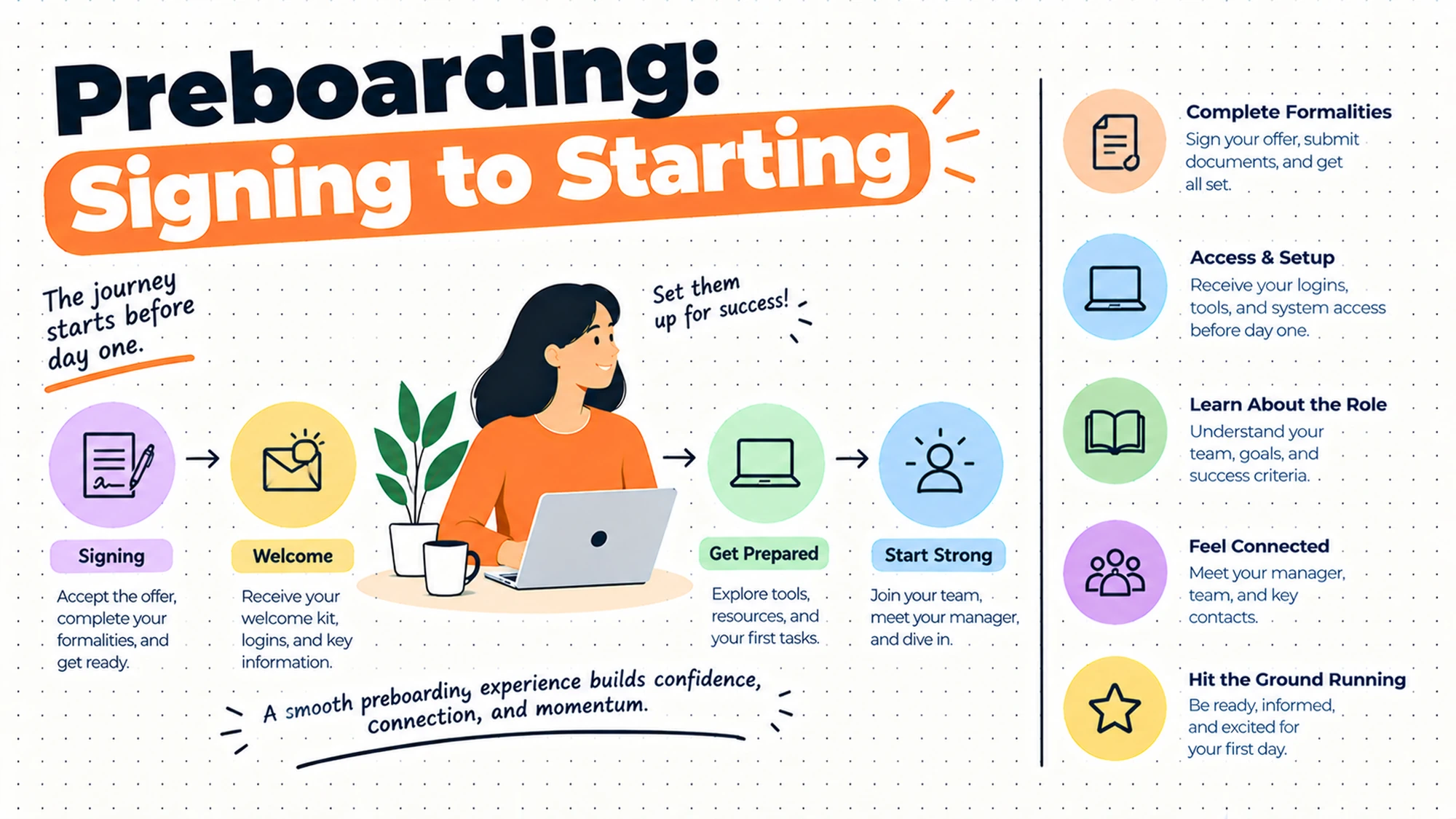
TL;DR
- The core decision: whether the weeks between acceptance and arrival are used or left empty, because they're currently the emptiest part of the whole process.
- When doing nothing is right: when the gap is short and the manager is already in touch.
- What has to be true: somebody owns this period, which almost nowhere assigns to anybody.
- How the options split: by who makes contact, since a recruiter, an HR mailbox and the manager land completely differently.
- Decision rule: trigger everything operational at acceptance and keep the human contact light.
- Outcome to expect: fewer people arriving cold, and almost nothing outstanding on the first morning.
The Weeks Where Nothing Happens
Somebody accepts an offer. Over the preceding weeks they've had more attention from this organisation than they'll get for a long time afterwards: calls, interviews, follow-ups, somebody selling them a future. Then they sign, and it stops.
For the next month or two, depending on their notice period, they hear almost nothing. Perhaps a contract. Perhaps a form. Then a message a few days before they start confirming what time to arrive.
Meanwhile they're working out a notice period at a job they've resigned from, which is usually the most uncomfortable stretch of anybody's working life: their current employer knows they're leaving, their colleagues are adjusting, their responsibilities are being handed over, and the thing they're heading towards has gone quiet. It's an unusually good environment for doubt, and a counteroffer or a second approach lands on fertile ground.
Best tools for Onboarding & LMS
At the same time, the organisation is wasting the only period in the whole process where it has time to spare. Everything that will be late on the first day, the equipment, the accounts, the access, could have been started weeks ago. Instead it gets triggered by the start date approaching, which is how a first morning becomes a scramble.
So the gap has two separate problems, and they're solved by different people. The operational one is about triggering work early, which is straightforward and almost entirely upside. The human one is about staying in touch without being strange about it, which is a judgement call and where most preboarding programmes go wrong by doing far too much.
When You Genuinely Do Not Need to Act Yet
Your current setup is genuinely fine. The gap is short, the manager already sends a message or two, and nobody has arrived to find things missing. A programme for a two-week gap is a solution looking for a problem.
Friction is starting to show. The gap has got longer because you're hiring people with substantial notice periods, or somebody arrived and said they'd heard nothing since signing, or the same items were outstanding on two recent first days. Those are signals for two small changes rather than a programme.
It has become a real cost. Somebody has withdrawn between accepting and starting, or first days consistently begin with things not working, or a new starter mentioned having wondered whether the job was still happening. Any of those is worth a deliberate fix.
The edge case that forces it. Notice periods are long, the role requires checks or arrangements that take weeks, or the person is relocating or being engaged in another jurisdiction. Long lead times make the gap load-bearing rather than incidental, and what can be arranged before somebody starts, including whether anything can be asked of them, differs by location and by the nature of the engagement. Take local advice rather than assuming.
Five Questions This Reader Asks at 11pm
What is preboarding? Everything between somebody accepting an offer and their first day. It covers two quite different jobs that get discussed as one: triggering all the operational setup that would otherwise be late, and maintaining enough contact that the person doesn't spend their notice period wondering whether this was a good idea. The first is uncontroversial and the second is where judgement is required.
How much contact is the right amount? Less than most programmes send and more than most organisations manage, which is usually nothing. A few genuine touches over a month is about right: a message from the manager after acceptance, something useful if there's something useful, and a practical note about the first day. What isn't right is a scheduled sequence of content, which reads as marketing and is treated accordingly.
Can we ask them to do things before they start? Be careful here. Administrative items that they need to complete for their own employment are one thing. Asking somebody to read material, attend anything, or do work before their start date is a different matter, and whether that's acceptable, whether it has to be paid, and what it implies about when employment began differ by jurisdiction. Get local advice before building anything that assumes it.
Do people really withdraw after accepting? It happens, and it happens most often to organisations that go silent, because silence is the condition under which somebody re-examines a decision. A counteroffer from a current employer, or a second process that concludes late, arrives into either a warm relationship or a void. You can't prevent all of it. You can avoid contributing to it.
What should we send them? Anything genuinely useful and nothing that isn't. Practical first-day information, confirmation that the role is what they discussed, an introduction to their manager if they haven't already met properly. What to avoid is the branded welcome pack with no information in it, which costs money and communicates that somebody wanted to do something rather than that somebody thought about what would help.
Five Diagnostic Questions You Can Self-Assess Against
What was triggered on the day the offer was accepted? If the honest answer is a contract and nothing else, you're leaving weeks of lead time unused and then compressing everything into the days before the start. Almost every item late on a first morning was ordered late.
How many times does the person hear from a human between signing and starting? Not automated messages. Actual contact from somebody they'll work with. If it's zero, the most uncomfortable weeks of their year are being spent without any signal that this is still happening.
Does the person who greets them on the first day know their name? It sounds trivial and it's the most reliable indicator of whether this period was owned by anybody. Somebody arriving to a reception that has no record of them has learned something specific.
Has anybody confirmed the job hasn't changed? Roles get reshaped during long recruitment processes, and where the gap is also long, the job somebody accepted can differ from the one waiting for them. They'll notice in their first fortnight and say nothing.
Who owns this period? Recruitment considers it finished at acceptance, HR considers it started at the start date, and the manager considers it to be somebody else's. If nobody answers, the answer is nobody, and that's why nothing happens.
Six Approaches to the Gap, Reviewed
Nothing until the start date
Contract out, then silence until a message about arrangements. It earns its place in exactly one situation: a short gap, where there's genuinely nothing useful to say and the person is starting in a fortnight. In that case contact for its own sake is noise.
Where it falls short is everywhere else. A month or two of silence after an intense recruitment process is a stark contrast, and the person notices it as a contrast rather than as an absence. It also wastes all the lead time, which means the first day starts with things that don't work.
The minimum defensible version is one message from the manager and everything operational triggered on the day of acceptance. That's a low bar and a lot of organisations don't clear it.
It's worth separating the two halves when you assess yourself here, because they fail for different reasons. Nobody objects to ordering equipment earlier; it doesn't happen because no process step exists at acceptance. The contact half is different: people avoid it deliberately, out of a reasonable worry about being intrusive, and then overcorrect into nothing at all. Knowing which of the two you're actually doing badly changes what you fix.
An administrative pack, and nothing else
Contract, forms and required items sent out, completed and returned. It earns its place because it moves the paperwork off the first day, which is the single most valuable thing available in this period, and because it's the part with genuine deadlines attached.
Where it falls short is what it communicates when it's the only contact. Somebody who hears from a new employer three times and all three are requests for documents has been treated as an administrative object during the weeks they were most open to being made to feel welcome. It also tends to be chased impersonally, which compounds it.
Do the pack, and make sure at least one contact in this period isn't a request for something.
The chasing deserves a moment's thought too. Documents sent to somebody working a notice period will come back late more often than not, and the instinct is to send reminders from whichever mailbox is handling it. A single named person who chases once, personally, with an explanation of which items actually matter by when, gets a better return than three automated reminders and doesn't make the relationship feel administrative.
Periodic contact from the recruiter
Whoever ran the hiring process stays in touch until the start date. It earns its place because the relationship already exists, and because recruiters are generally good at this and usually willing. For a candidate who has been through a long process, this is the person they actually know.
Where it falls short is that it's the wrong relationship for what comes next. The recruiter won't be part of the person's working life, so the contact maintains a connection to the process rather than to the job. There's also an incentive problem worth being aware of: whoever is measured on placements has a reason to keep things warm that isn't identical to the person's interests.
Useful as a bridge. It shouldn't be the only contact, and it shouldn't extend past the first day.
There's a handover worth making explicit here. If the recruiter has been the main point of contact and then disappears at the start date, the person loses the one relationship they had just as everything else becomes unfamiliar. Introducing whoever takes over, by name and before the last contact, converts an ending into a handover and costs a sentence.
The manager staying in touch directly
The person's future manager sends a few messages over the gap. It earns its place because it's the relationship that matters, it's the one the person is most uncertain about, and a short note from the person you'll report to does more than anything a programme can produce.
Where it falls short is consistency and effort. Managers are busy and this is invisible work with no deadline, so it happens for some hires and not others, and nobody notices the ones where it didn't. It can also be overdone: a manager who messages frequently during somebody's notice period creates an obligation to respond at a time when the person has nothing to say.
The workable version is two or three light touches, with no expectation of a reply, and one of them being an actual conversation rather than a message.
The conversation is the one that carries the weight, and it doesn't need an agenda. Twenty minutes in which the manager says what the first week will look like and answers whatever the person has been wondering about is worth more than anything written, largely because it lets somebody ask the questions they didn't want to raise during a hiring process in case it counted against them.
A structured preboarding portal
A system delivering content, tasks and material across the gap. It earns its place at volume, where there are genuinely many people in this period at once and tracking who has completed what is otherwise unmanageable. It also makes the administrative half visible, which is worth something.
Where it falls short is the temptation to fill it. Portals that deliver a sequence of content to somebody who hasn't started yet tend to produce completion rates that flatter the system and mean little, because the person is working a notice period and this is not their priority. Anything that asks for time before the start date also runs into the question of what may be asked of somebody not yet employed, which differs by jurisdiction and isn't a question a platform answers for you.
Worth it for tracking. Be sparing about what you put in it.
One question to ask any vendor in this space: what does the system do on the day an offer is accepted, without anybody logging in. If the answer is that somebody has to set up a workflow for each hire, the tracking will be as good as the person remembering to do it, which is the problem you were buying a system to avoid.
Inviting them in before they start
A social event, a team lunch, or an informal visit before the first day. It earns its place because it removes the hardest part of a first day, which is arriving somewhere as a stranger, and because people who have met the team once arrive as somebody returning rather than somebody appearing.
Where it falls short is that it has to be genuinely optional and genuinely social. Somebody in a notice period may not be able to attend, may not want their current employer to know, and shouldn't feel that declining counts against them. The line between an invitation and an expectation is thinner than it looks from the organisation's side, and anything resembling attendance at work before a start date raises questions that differ by jurisdiction.
Offer it, make declining easy, and keep it social rather than useful.
The practical form that causes least difficulty is something outside working hours with a small number of people, offered once, with no follow-up if the answer is no. Large events are worse, both because the person meets nobody properly and because being introduced repeatedly as the new joiner who hasn't started yet is an uncomfortable thing to spend an evening doing.
The Decision Table
| Situation | Scale | Setup | Primary Pain | Recommended Starting Point |
|---|---|---|---|---|
| Short gap, manager already in touch | Any | Any | None | Trigger setup at acceptance, nothing else |
| Long notice periods becoming normal | Any | Any | Weeks of silence | Two or three light touches from the manager |
| Items outstanding on recent first days | Any | Any | Lead time unused | Everything operational triggered at acceptance |
| Somebody withdrew after accepting | Any | Any | Silence during a reconsidering period | Contact that is not a request for documents |
| Only contact is requests for forms | Any | Any | Treated as an administrative object | One contact that asks for nothing |
| Many people in the gap at once | Over two hundred | Any | Tracking who has done what | A portal, kept sparse |
| Relocation or engagement abroad | Any | Multi-jurisdiction | Long lead times, local rules | Local advice, started early |
| Role changed during recruitment | Any | Long hiring process | Two different jobs in mind | Written confirmation before the start |
| Nobody owns this period | Any | Any | The gap between two functions | Name one person, at acceptance |
The last row explains most of the rest. Recruitment considers its work finished when the offer is accepted, HR considers the person to exist from the start date, and the gap between those two views is precisely the period in question. Naming one person to own it, even nominally, is the change that makes every other row possible. It doesn't have to be a new role or a large commitment: it has to be somebody who could be asked how a particular incoming starter is being looked after and would have an answer rather than a referral.
Where Preboarding Goes Wrong
| The failure | What the new starter experiences | What would have to change |
|---|---|---|
| Setup triggered by the start date | A first day of things that do not work | Trigger everything at acceptance |
| Silence after an intense process | A stark contrast, during a doubting period | Two or three genuine touches |
| Every contact is a request | Feeling processed rather than expected | One contact that asks for nothing |
| A branded pack with no information | Effort visible, thought absent | Practical information instead |
| Contact only from the recruiter | A connection to the process, not the job | The manager, at least once |
| Nobody confirmed the role | Arriving to a job they did not accept | Written confirmation before the start |
The third row is the one worth fixing first because it's free. Most organisations do make contact during this period; it's just that every instance is a request for a document, a signature or a piece of information. One message that asks for nothing, from a person rather than a mailbox, changes the character of the whole period and costs a few minutes.
The fourth row is worth naming because it's where budget tends to go. A welcome package with branded items arrives, and the person appreciates the gesture and still doesn't know where to park, what time to arrive, or who they're asking for. Practical information is cheaper and lands considerably better, and it can be sent alongside the gesture rather than instead of it if somebody insists on the gesture. If you do send something physical, sending it to a personal address rather than a work one is worth remembering, since a parcel from a new employer arriving at somebody's current desk is not a favour.
The Line Between Welcoming and Intruding
This is the part programmes get wrong, and they get it wrong in the same direction every time, which is too much.
The person is not yet working for you. They're working for somebody else, usually in a slightly awkward situation, with a full workload and a handover to complete. Contact that assumes their attention, asks for time, or expects engagement is landing into a schedule that has no room, and it produces obligation rather than warmth.
Three tests are worth applying to anything you're considering sending.
Does it require a response? If yes, it's a demand on somebody's time during their busiest and most divided period. A message that explicitly says no reply needed is a different object from the same message without that line.
Is it useful to them, or useful to us? Practical first-day information is useful to them. A sequence of content about the organisation's story is useful to you. The second kind reads as marketing when it arrives in somebody's personal inbox while they're finishing another job.
Would it be awkward if their current employer saw it? This one is underrated. Messages to a personal address are fine; anything that turns up during the working day or assumes availability at work isn't. The same applies to social invitations, which some people genuinely can't attend without complications.
What works within those tests is a small set of things. A short note from the manager after acceptance, saying they're looking forward to it and inviting questions with no obligation. Practical first-day detail, sent about a week out, covering arrival, timing and who to ask for. Confirmation that the role is what was discussed. And whatever administrative items genuinely need to be done, sent once, with clear deadlines and one person named to chase.
Sending them once matters as much as what's in them. Items that arrive in several batches over a month create the impression of an organisation that hasn't worked out what it needs, and each arrival is another small demand on somebody who is busy elsewhere. Working out the full list before the first message costs half an hour and is noticed.
What doesn't work is the escalating sequence: a welcome message, then a video, then a culture document, then a task, then a survey about how the preboarding experience has been. Each is individually harmless and together they communicate that this organisation wants attention it hasn't earned yet.
Somebody Can Still Change Their Mind
It's worth treating this plainly rather than as an unlikely edge case, because it happens and it's expensive.
A signed acceptance isn't the end of somebody's decision. They may receive a counteroffer, a second process may conclude late, their circumstances may change, or they may simply reconsider during a notice period that gives them a great deal of time to think. Contract terms around this vary by jurisdiction and are rarely the practical protection anybody imagines, since a person determined not to start generally doesn't.
What you can affect is whether the weeks work for you or against you. Someone who hears nothing for a month has a decision that's fully open again, made in the absence of any reminder of why they chose this. Someone who has exchanged a couple of messages with their future manager, knows their first day is arranged, and has had one genuine conversation is in a different position, not because they've been persuaded but because the thing has stayed real.
Two specific moments are worth attention. The first is immediately after acceptance, when a counteroffer is most likely to arrive: a message that same week from the manager is well placed. The second is a week or so before the start date, when practical uncertainty peaks and a clear note about arrangements resolves it.
If somebody does withdraw, it's worth asking why, briefly and without pressure. The answers cluster: a counteroffer, a role that turned out to be different from the one they thought they'd accepted, or a process that went quiet long enough to feel disorganised. Only the first is genuinely outside your control, and the other two are findings about your process rather than about the individual.
Ask whoever they dealt with most, rather than sending a form. Someone who has decided not to join has no reason to complete a survey and every reason to be polite in a short conversation, and the polite version still contains the useful detail if the question is specific enough.
What to Put in Writing
| Artefact | Who owns it | When it is written | What it prevents |
|---|---|---|---|
| Who owns the gap for this hire | HR, at acceptance | The day the offer is accepted | A period belonging to nobody |
| Everything triggered at acceptance | HR, with IT | Same day | A first morning of things not working |
| The manager's first message | The manager | That week | Silence during a reconsidering period |
| Confirmation the role is unchanged | The manager | Before the start date | Arriving to a different job |
| Practical first-day detail | Whoever greets them | About a week before | Uncertainty at the worst moment |
| What may be asked before starting | HR, with local advice | Before designing anything | Assuming something not permitted here |
The second row is the whole operational half of this article in one line, and it's the one worth acting on today if you act on nothing else. Moving the trigger for equipment, accounts and access from the start date to the acceptance date costs nothing, requires no system, and removes most of what goes wrong on first days.
Questions to Ask Before You Commit
On ownership. Who owns the gap? A bad answer names a function.
On triggers. What starts at acceptance? A bad answer is the contract.
On contact. How many times does a human get in touch? A bad answer counts automated messages.
On tone. Does anything we send ask for nothing? A bad answer is that they're all quite friendly.
On the role. Has anybody confirmed the job? A bad answer is that nothing has changed.
On limits. What can we ask of them before day one? A bad answer assumes anything.
What Getting This Wrong Costs
The first cost is the hire you lose between signing and starting, which is the most expensive possible point to lose one. The entire recruitment cost has been spent, the role is no longer being advertised, other candidates have been declined and have usually moved on, and the process restarts from the beginning with weeks lost. That outcome is rarely caused entirely by silence, and silence reliably contributes.
The second cost is the first day that starts badly and didn't need to. Equipment, accounts and access ordered in the days before a start date arrive when they arrive, which means a proportion of first mornings begin with somebody waiting. All of that was preventable weeks earlier at no extra cost, and the reason it wasn't is that nobody owned the period in which it could have been done.
The third cost is quieter and applies to everybody who does start. The contrast between an attentive recruitment process and a silent gap is the new person's first genuine information about how this organisation behaves when it isn't selling, and people take it as such. It's a small thing that shapes how they read everything in their first weeks, including things that have nothing to do with it.
So the practical division is straightforward. The operational half is all upside and should be done immediately: trigger everything at acceptance, name somebody to own it, confirm the role. The human half needs restraint rather than effort, and the failure mode is doing too much rather than too little.
When You Are Ready to Go Further
None of this needs a system. It needs a trigger at acceptance rather than at the start date, one named owner for the weeks in between, two or three light touches from the manager, and practical first-day information about a week out.
The step beyond that, if you want to know whether it's working, is to ask the people who've just been through it. Two questions do most of the work: was there any point where you wondered whether this was still happening, and was there anything you wanted to know and couldn't ask. Ask in the first fortnight while it's still fresh, because within a month the whole period blurs and nobody remembers the specifics.
HROpsLab publishes independent comparison work across HR tooling, applicant tracking and payroll. We sell nothing, we take no vendor money, and we publish no paid placements. If the next step is looking at what your current tooling actually supports here, our comparison work is one place to start.
Frequently Asked Questions
What is preboarding?
It's everything that happens between somebody accepting an offer and their first day, a period most organisations leave almost entirely empty. It covers two quite separate jobs that tend to get discussed as one. The operational job is triggering all the setup that would otherwise be rushed: equipment, accounts, access, paperwork. The human job is maintaining enough contact that the person doesn't spend their notice period wondering whether this was a good decision. The first is straightforward and almost entirely upside. The second requires restraint, and most programmes overdo it.
What is the difference between preboarding and onboarding?
Preboarding is the gap before employment starts; onboarding is the arc from the first day to being fully capable in the role. The boundary matters more than it sounds, because it's where accountability disappears: recruitment considers its work finished at acceptance, HR considers the person to exist from the start date, and nobody owns the weeks in between. It's also where the two have different constraints, since somebody who hasn't started isn't yet employed, and what can be asked of them differs by jurisdiction.
What should you send a new hire before they start?
Practical information they'll actually use, and at least one message that asks for nothing. A short note from their future manager after acceptance, a confirmation that the role is what was discussed, and clear first-day detail about a week out covers most of it. What tends to land badly is a branded welcome package with no information in it, which shows effort without thought, and a sequence of company content, which reads as marketing when it arrives in a personal inbox while somebody is finishing another job.
Can you ask new hires to complete work before their start date?
This needs local advice rather than a general answer. Administrative items that the person needs to complete for their own employment sit differently from asking somebody to read material, attend anything, or do work before they're employed, and whether that's acceptable, whether it must be paid, and what it implies about when employment began all differ by jurisdiction and by the nature of the engagement. Establish what applies to you before designing anything that assumes it, particularly if you're planning content or tasks delivered through a portal.
How do you stop new hires dropping out before they start?
You can't prevent all of it, and you can avoid contributing. A signed acceptance isn't the end of somebody's decision: counteroffers arrive, second processes conclude late, and a long notice period gives people a great deal of time to think. Silence is the condition under which a decision gets reopened, so the practical response is a small amount of genuine contact at two moments in particular: the week of acceptance, when a counteroffer is most likely, and about a week before the start, when practical uncertainty peaks.
How much contact is appropriate during the notice period?
Less than most programmes send and more than most organisations manage. Three tests help: does it require a response, because the person is busy and divided; is it useful to them or useful to you, because content about the organisation is the second kind; and would it be awkward if their current employer saw it, since anything assuming availability during the working day can be. Two or three light touches over a month, explicitly not requiring a reply, is about right.
Who should own preboarding?
One named person, decided at the moment the offer is accepted. The reason it needs naming is that this period sits in the gap between two functions that each consider it the other's: recruitment regards the work as done and HR regards the person as not yet existing. In most organisations the practical owner is whoever handles the administrative setup, with the manager responsible for the human contact, and the important part is that somebody could be asked how a specific incoming starter is being looked after and would have an answer.
Should you invite new hires to team events before they start?
It's genuinely valuable if it's genuinely optional, because arriving somewhere having already met people is a very different first day from arriving as a stranger. The cautions are real though. Somebody in a notice period may not be able to attend, may not want their current employer to know, and shouldn't feel that declining counts against them, and the line between an invitation and an expectation is thinner from the organisation's side than from theirs. Keep it social rather than work-like, and make declining easy and unremarked.
The gap belongs to nobody, which is why nothing happens in it. Name somebody, move the trigger to the day of acceptance, and most of this solves itself without anybody buying anything.