TL;DR
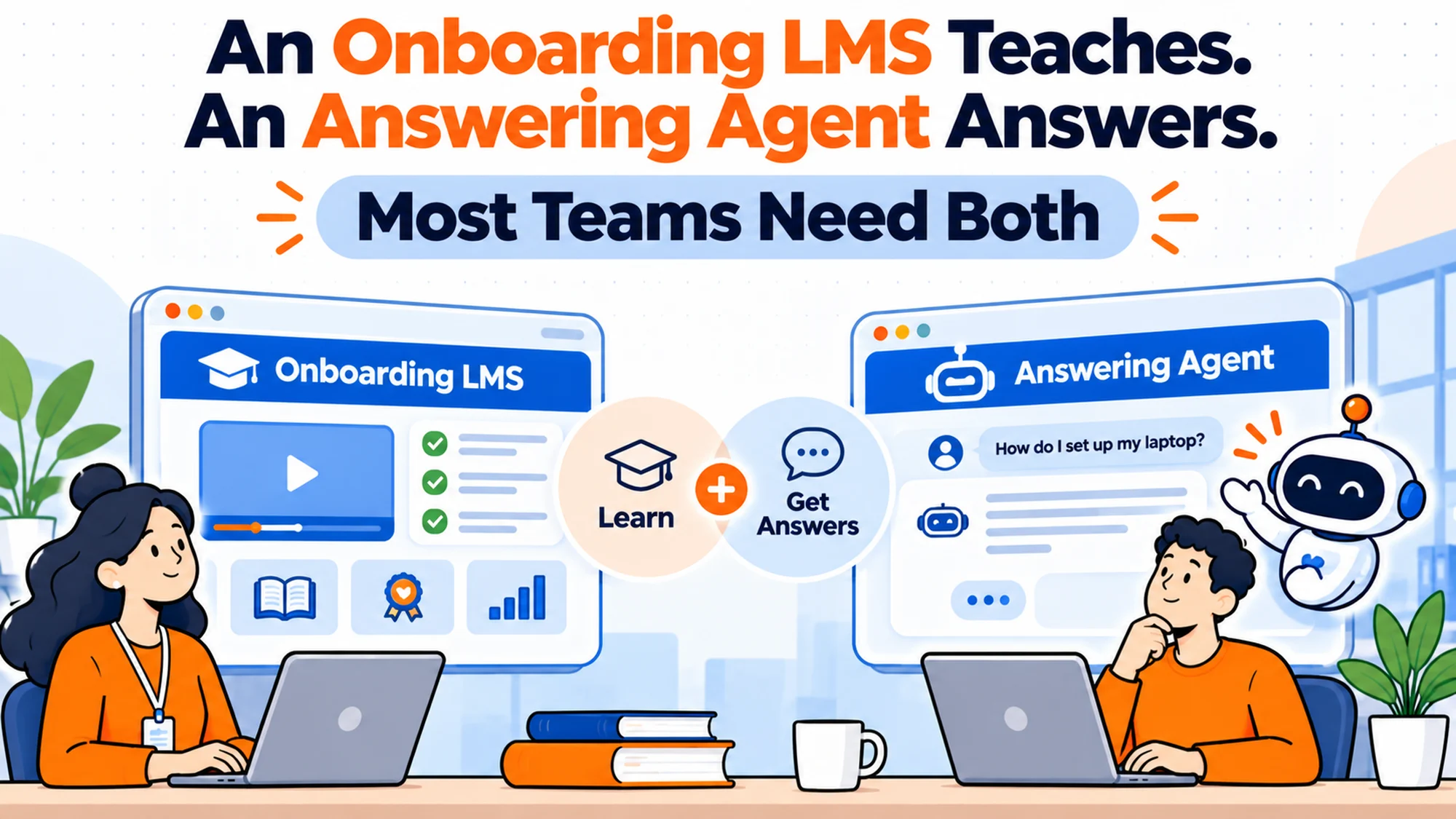
- An onboarding LMS delivers a curriculum you decided in advance. An answering agent responds to questions you did not anticipate. These are opposite shapes.
- Buy the LMS when there is something everybody must learn and you need to evidence that they did. Buy the agent when people already know what to do and cannot find out how.
- The most common mistake is putting reference material into a course, where it becomes something to complete rather than something to consult.
- Completion rates measure attendance, not learning, and they are the metric most likely to make a failing programme look healthy.
- If your course content is mostly policy and process documentation, it was never training and the LMS is the wrong container for it.
- Most teams of any size need both, with a clear rule about which content goes where.
A company buys an onboarding LMS, builds nine modules and assigns them to every new starter. Completion runs at ninety four per cent, which looks excellent.
Six months later the HR channel is carrying the same questions it carried before. People are completing the modules and still asking where the expense form is, because the expense form was mentioned in module four, in week one, alongside forty other things, at a moment when none of it was yet relevant. The information was delivered. It was not retained, because nothing about the delivery was timed to the moment of need.
The real issue is not the quality of the modules. It is that reference material was put into a format designed for curriculum, and those two things behave completely differently in somebody's head.
Best tools for Onboarding & LMS
The distinction that decides everything
A curriculum is something you decide in advance that everybody needs, delivered in an order you control, at a time you choose. Health and safety, code of conduct, the regulated training your sector requires, the explanation of how your particular product works. It has a defined end and a defined assessment.
Reference material is something a person needs at an unpredictable moment, which they will look for only when the need arrives, and which they will not retain in advance because there is no hook for it. The expense limit, the approval chain, the name of the system that holds something, the process for requesting a tool.
An LMS is built for the first and is routinely loaded with the second. It is a delivery mechanism with a completion state, which is exactly wrong for content whose entire value is being available later. Putting the expenses policy into module four converts it from something to consult into something to finish, and once finished it is closed.
An answering agent is built for the second and is useless for the first. It cannot make anybody learn something they have not asked about, it has no concept of completion, and it will not tell you who has been trained.
| Content | Curriculum or reference | Belongs in |
|---|---|---|
| Code of conduct, with acknowledgement | Curriculum | LMS |
| Regulated or certified training | Curriculum | LMS |
| How our product actually works | Curriculum | LMS |
| Expense limits and process | Reference | Documents, retrieved on demand |
| Who approves what | Reference | Documents, retrieved on demand |
| System names and where things live | Reference | Documents, retrieved on demand |
| Security awareness | Both | Curriculum for the training, reference for the rules |
When you do not need an onboarding LMS
Below about twenty hires a year with no mandatory training, the LMS is overhead. You are maintaining a platform and a content set for a handful of people, and the authoring cost per starter is high enough to be hard to justify. A document and a conversation cover it.
If nothing has to be evidenced, the completion tracking is doing no work. The main structural advantage an LMS has over a document is that it records who completed what and when. If nobody will ever ask you for that record, you are paying for a feature you do not use and accepting a worse reading experience in exchange.
If your content changes more often than quarterly, authoring becomes the bottleneck. Courses are expensive to edit relative to documents, because the content is wrapped in structure. Teams with fast moving processes end up with courses that are out of date and a separate document that is current, which is the worst configuration available.
And the edge case that argues the other way. In regulated sectors, or anywhere you may need to demonstrate that a named person received specific instruction on a specific date, the LMS is not optional and the question does not arise. That is a records requirement rather than a learning one, and it justifies the platform regardless of how good your documentation is.
There is a fifth situation worth naming because it is the most common misdiagnosis. If starters are completing everything and still asking constant questions, that is not an LMS failure and more modules will not fix it. It is evidence that the questions were never curriculum, and the fix is on the other side of this article.
What a new starter needs from each
From the LMS, they need to know why this is mandatory. Compliance content delivered without context is completed without attention, and the completion record then certifies something that did not happen. A single sentence explaining why the module exists changes engagement more than any amount of production value.
From the LMS, they need it to be short and finite. A nine module programme assigned on day one competes with the actual job during the week when somebody is most anxious to look useful. Spreading it across the first month, with the genuinely urgent items first, consistently works better than front loading.
From reference material, they need it at the moment of need. Nobody wants to learn the expense policy. They want to know, at the moment they are holding a receipt, whether this particular thing is claimable. Any delivery that is not available at that moment has failed regardless of how well it was written.
From reference material, they need confidence it is current. A new starter cannot distinguish a maintained document from an abandoned one. A visible review date does more for trust than restructuring ever does.
And from both, they need to know which is which. A starter who does not know whether something is a rule or a suggestion will treat everything as a suggestion or everything as a rule, and both are wrong. Label it.
The three configurations teams actually run
LMS only. Everything goes into courses, including reference material. This is common in organisations that bought the platform first and then looked for content to fill it. It produces high completion rates and no reduction in questions, because the reference content was delivered once and is now behind a completed course that nobody reopens. The tell is that your question volume did not move after launch.
Documents only. Everything lives in files or a wiki and nothing is tracked. This works surprisingly well for teams without mandatory training, right up until somebody asks you to demonstrate that a specific person read a specific policy, at which point you cannot. It also tends to decay, because nothing forces a review.
Both, with a rule. Curriculum in the LMS, reference in documents with retrieval in front of them, and a written rule about which is which. This is more moving parts and it is the configuration that actually works, because each piece of content sits in the container matched to how it will be used.
The rule matters more than the tools. Without it, content gets placed according to who authored it rather than how it will be consumed, and within a year you have policy documents inside courses and training material in a wiki.
Five questions to settle before choosing
Does anything have to be evidenced? If yes, you need the LMS and the question is only how much goes in it. If no, be honest that the completion tracking is decoration and weigh the platform on its reading experience alone, where it usually loses to a document.
What proportion of your course content is actually reference material? Open your modules and count the slides that state a fact somebody will need later rather than teaching a skill. In most onboarding programmes this is over half, and all of it is in the wrong place.
How often does your content change? Quarterly or less, courses are fine. Monthly, and the authoring overhead will beat you, because every change requires reopening a module rather than editing a line.
Are people completing and still asking? This is the diagnostic that settles the whole thing. High completion with unchanged question volume is definitive evidence that the content people need is reference material trapped in a curriculum container.
Who maintains each one in month nine? Courses decay more quietly than documents because reopening them is a chore. Name an owner for each and a review cadence, or accept that the certified content will drift from reality while the certificate remains valid.
Security awareness, the case that is genuinely both
The table above lists security awareness as belonging in both containers, and it is worth working through because it is the clearest example of why the split is about use rather than subject.
The training half is real curriculum. There is a set of things everybody must understand about how attacks actually arrive, it is the same for everyone, you decide when it happens, and in many organisations you must be able to show that it happened. That is an LMS job and no amount of good documentation substitutes for it.
The reference half is everything that follows. What do I do if I think I have clicked something. Who do I tell, right now, at nine on a Sunday. Is this request from somebody claiming to be finance legitimate. Am I allowed to use this particular tool for work data. These are questions asked at a specific moment, under mild panic, by somebody who completed the training six weeks ago and cannot now remember which of the four things they were told applies.
Putting the reporting procedure inside the course is the mistake, and it is close to universal. At the moment somebody most needs to know who to tell, they are not going to open a learning platform, find the module, and click through to slide eleven. They are going to ask a colleague, or more often do nothing for an hour while they decide how bad it is, which is the hour that matters.
So split it. The training is a module with a completion record. The reporting procedure, the tool approval list and the what do I do right now instructions are documents, retrievable in the channel people already use, phrased as the questions people actually ask. The training can then reference the documents, which also means a reader who does remember the training knows where to look.
This pattern generalises. Anywhere you find content that is both taught and consulted, the teaching goes in the curriculum and the consulting goes in reference, and the two cross reference each other. Expenses has the same shape, as does anything involving an approval chain.
Extracting content that only exists inside a course
The hardest part of the audit is the content that lives nowhere else. A fact was written as a slide, the slide went into a module, and no document ever existed. It has been formally delivered to everybody and is practically unavailable to anybody.
Start by exporting. Most learning platforms will produce the text of a module in some form, and whatever comes out is a draft rather than a document. The content will be written in the register of a slide, which is to say fragmentary, dependent on whatever the narration said, and often missing the sentence that made it make sense.
Then rewrite each extracted item as an answer to a question rather than a statement of a fact. A slide that reads Expense claims must be submitted within thirty days becomes a page called How long do I have to submit an expense claim. This is not cosmetic. It makes the content findable by somebody using the words they would naturally use, and it forces you to notice when a slide was too vague to answer the question it implied.
Work in order of demand rather than in order of the module. Take your ten most asked questions, find the slides that cover them, and extract those first. The remainder of the module can stay where it is until something tells you it is needed, and quite a lot of it never will be.
Two things commonly surface during this work. The first is that some content in the course contradicts a document elsewhere, usually because one was updated and the other was not, and somebody now has to decide which is correct. The second is that some content is wrong outright and has been certified as delivered for years, which is uncomfortable and is the strongest argument available for doing the audit at all.
Keep a record of what you extracted and where it went. When somebody later asks why the module is shorter, the answer should be a list rather than a recollection.
What a completion record actually certifies
Teams lean on completion records more heavily than the records can bear, and it is worth being precise about what they establish.
A completion record says that an account belonging to a named person reached the end of a module on a given date. That is genuinely useful and it is the whole of what it says. It does not establish that the person read the content, understood it, retained it, or could apply it. In practice a meaningful share of completions are somebody clicking through at speed while doing something else, which everybody involved knows and nobody writes down.
This matters in two directions. If you need the record for a regulatory or evidential purpose, the record does that job and the limitations do not reduce its value for that purpose. You need to show instruction was delivered, and it was.
But if you are using completion as a measure of whether onboarding is working, it is close to useless and actively harmful, because it is a number that goes up when you add modules. A programme that doubles in length and holds its completion rate looks twice as successful and is probably worse. The metric rewards the thing you should be reducing.
The honest alternative is to measure what people can do rather than what they attended. The cheapest version is to take the five facts you most need starters to know and ask ten of them, informally, in week four. It takes an hour and tells you something a completion rate never will. Teams that do this usually find retention is much lower than they assumed and concentrated in whatever was taught closest to the moment it was needed, which is itself the argument for spacing the curriculum rather than front loading it.
Assessments inside the module sit between the two. A question somebody answers immediately after reading the slide measures short term attention, not knowledge, and a score of ninety per cent on that is not evidence of anything durable. If you want an assessment to mean something, put it two weeks later, accept that the scores will drop, and treat the drop as information rather than as a problem with the assessment.
Spacing the curriculum instead of front loading it
Almost every onboarding programme assigns everything in week one, and it is the single most addressable design flaw in the category.
Week one is the worst available moment to deliver information. The person is absorbing names, systems, norms, their actual job and a new commute or a new home working setup, all simultaneously. None of the content is yet attached to a situation they recognise, which is the mechanism by which anything is retained. And they are under social pressure to appear capable, which competes directly with the attention that learning requires.
The content also has wildly different urgency and it is being treated as uniform. Something a person could encounter on day two, such as how to report a security concern, genuinely needs to be there on day one. Something they will not encounter for a month, such as the performance review cycle, is delivered at the point of minimum relevance and will be completely gone by the time it matters.
The repair is to sort the programme by first point of need and deliver each item shortly before it. Security basics and anything safety related in the first days. Expenses before the first expense is likely, which for most roles is week two or three. Performance and development in the month before the first cycle, not in week one.
This produces a smaller week one, which has a second benefit nobody plans for. A starter who is given three things in their first week does them properly. A starter given nine clicks through all nine, and the three that mattered get the same treatment as the six that did not.
The objection is that spacing is more work to administer, and it is, slightly. Most platforms can schedule assignment by days since start date, which is the whole of the mechanism. The real obstacle is that front loading feels thorough and spacing feels like withholding, which is a perception problem rather than a design one.
There is one genuine complication, which is that spacing interacts badly with people who leave early. A starter who departs in month two has completed only part of a programme, and if something in the unfinished portion was a real obligation you have a gap in your records rather than a gap in their knowledge. The handling is straightforward once you have separated obligation from custom: anything genuinely required stays in the first days regardless of when it becomes relevant, and only the customary content gets spaced. That usually leaves a very short mandatory block at the start, which is a better programme anyway.
The tools, and where each one struggles
Matram is our own product, stated here rather than in a footnote, and judged on the same criteria as everything else. It is an answering agent and explicitly not a learning platform: it reads the documents you point it at, answers questions from them in the channel people already use, and declines to answer outside them. Pricing is flat at $29, $69 and $199 a month with unlimited seats and a 30 day trial that needs no card.
The limits are directly relevant to this comparison. It has no free tier. It is not an HRIS, so it holds no records and runs no approval chains. Its actions reach HubSpot, Zendesk and webhooks only, meaning it can open a ticket but will not grant anything or write back to a system of record. WhatsApp is coming soon rather than available. Most importantly for this article, it has no concept of completion and cannot evidence that anybody learned anything. If your requirement is proving a named person received specific instruction on a specific date, this is the wrong half of the pairing and an LMS is the right one.
BambooHR publishes Core at $10.25 per employee per month, Pro at $17.50 and Elite at $25 above twenty five employees. It sequences onboarding tasks and its Pro tier bundles an assistant that answers from your own policy documents, which makes it unusual in covering both halves within one platform. Where it struggles is that both halves assume your content lives inside it, so teams with established documentation elsewhere face a migration they may not want.
Rippling starts from $8 per employee per month plus a monthly base fee. Its onboarding strength is reaching into devices and application access rather than into learning content, so it solves an adjacent problem well and this one only partly.
Workday publishes no public rate, its pricing URL returning a 404, so any per employee figure attributed to it is an estimate rather than a published price. Appropriate at enterprise scale and implemented over quarters.
Enboarder focuses on the onboarding experience, sequencing and manager prompts rather than either courses or retrieval, and publishes no price. It is the right answer when the problem is that onboarding feels disconnected rather than that information is hard to deliver or find.
Leena AI and Moveworks are enterprise agents, neither publishing a price. The Moveworks pricing page presents a Forrester study rather than a rate card, and the figures on it are claimed savings rather than costs.
| Tool | Published price | Which half | Where it struggles |
|---|---|---|---|
| Matram | $29, $69 or $199 flat | Answering only | No completion tracking, no free tier |
| BambooHR | $17.50 per employee per month | Both, inside the platform | Content must live there |
| Rippling | From $8 plus a base fee | Neither, adjacent | Not a learning or retrieval tool |
| Workday | None published | Both at enterprise scale | Quarters to implement |
| Enboarder | None published | Experience and sequencing | Not a content tool |
| Leena AI | None published | Answering | Procurement cycle |
| Moveworks | None published | Answering | Only an ROI study is public |
When the training requirement differs by person
The split gets more awkward once not everybody needs the same curriculum, and most organisations reach that point sooner than they plan for.
The usual axes are location, contract type and role. A statutory training requirement in one country may not exist in another. A contractor may be outside some of your internal requirements and inside others, often in a way nobody has written down. A role handling payment data carries obligations that an adjacent role does not.
The failure this produces is specific and quiet: a single programme is assigned to everybody because that is simpler, so some people complete training that does not apply to them while others miss something that does. The completion rate is unaffected, because it measures the programme rather than the requirement, and the gap is invisible until somebody audits it.
The repair starts outside the tooling. Write down, per role and per location, what is actually required, and separate genuine obligations from things that are merely customary. Teams that do this routinely discover that a third of their mandatory programme is not mandatory for anyone and was added because somebody thought it was a good idea, and that one genuine requirement is being missed for a group nobody considered.
Then assign against that list rather than against a default. The administrative cost is real but modest, because the number of distinct combinations is usually small, perhaps four or five rather than the dozens people fear.
Reference material works the other way and should generally not be segmented. A person reading about a policy that does not apply to them loses nothing, whereas a person who cannot find the policy because it was filtered out of their view loses a great deal. Keep retrieval wide and keep assignment narrow.
The one exception is where the correct answer genuinely differs by location, in which case the reference content has to state which audience it applies to in its first line, or an answering layer reading it will give one group the other group's answer with no signal that it has done so.
Who writes it, and why that is the real constraint
Both halves of this depend on somebody producing content, and in most organisations that person does not exist as a role. Understanding who actually writes determines what is realistic far more than which platform you choose.
Course content is usually authored by whoever owns the subject, in addition to their day job, under mild protest. It is slow work, it requires a tool they use three times a year, and the output is judged by people who did not have to make it. The predictable result is that courses are written once, thoroughly, at launch, and almost never revised, because revision means reopening the whole apparatus for a sentence.
Reference documentation has the opposite profile. It is cheap to write, cheap to amend, and gets produced reactively when somebody is asked the same thing twice. This is why documentation tends to be more current than course content in the same organisation, and why a fact that exists in both places will be right in the document and wrong in the module.
That asymmetry should drive the design. Put the minimum possible into courses, because course content is expensive to keep true. Put as much as you can into documents, because document content is cheap to keep true. A programme designed around authoring cost rather than around completeness will be more accurate two years later, which is when accuracy actually matters.
It also argues for a specific division of labour. Subject owners should write short documents in whatever tool they already use, and a single person should be responsible for turning the small amount that genuinely needs to be curriculum into modules. Asking twelve subject owners each to build a course produces twelve courses of wildly varying quality that nobody maintains. Asking twelve subject owners for a page each, and having one person build three modules from the material that needs it, produces something sustainable.
If nobody owns that consolidation role, the honest planning assumption is that your course content will be accurate at launch and decreasingly so thereafter, and you should keep it as small as the evidential requirement allows.
Where the manager fits, and what not to take from them
There is a version of this where the tooling absorbs so much of onboarding that the manager has nothing left to do, and it is worth steering away from deliberately.
A great deal of what makes somebody's first month work is a specific person explaining how things actually operate here: what the team cares about, which rules are enforced and which are formalities, who to approach when something is urgent, what good work looks like in this particular group. None of that is curriculum, almost none of it is written down, and the attempts to capture it in a module produce something nobody recognises.
The risk is not that a platform does this badly. It is that having a platform makes it look handled. A manager who sees a nine module programme assigned reasonably concludes that onboarding is covered, and the conversation that would have happened does not. The content was never the thing the conversation provided.
So the division worth protecting is that the tooling covers what is documented and uniform, and the manager covers what is contextual and specific. Writing that down helps, because it converts the manager's part from something they might do into something expected of them, with a short list attached.
A practical shape that works: the manager owns a first week conversation about how the team operates, a second week conversation about what the person will be working on and what good looks like, and a fourth week check that is a direct question rather than an open invitation. None of this is a course and none of it should be.
The thing that genuinely helps here is removing the trivia from the manager's plate so the conversations are about something. A manager spending their first week with a new starter answering where the expense form is has spent the most valuable hour of the relationship on the least valuable content, and that is the specific trade an answering layer makes worthwhile.
The decision table
| Situation | Scale | Setup | Primary Pain | Recommended Starting Point |
|---|---|---|---|---|
| Mandatory training to evidence | Any | Regulated | Records | An LMS, no question |
| High completion, questions unchanged | Any | LMS in place | Wrong container | Move reference out of courses |
| No mandatory training | Under 20 hires | Documents only | Findability | Retrieval, not a platform |
| Content changes monthly | Any | Courses exist | Authoring cost | Documents plus retrieval |
| Starters miss steps | Any | Documents only | Sequencing | Platform onboarding tasks |
| Onboarding feels cold | Any | Both in place | Experience | Manager time, not tooling |
The cost of getting this wrong
The visible cost is two licences where one would do, and it is the least interesting one.
The expensive failure is a completion rate that certifies something untrue. If reference material sits inside a course, a ninety four per cent completion figure says that ninety four per cent of starters clicked through a module containing the expense policy. It does not say they can find the expense policy, and the organisation will read it as though it does. You now have a metric that is accurate, auditable and actively misleading, which is worse than no metric because it ends the conversation.
The second cost is content drift between containers. When the same fact exists in a course and in a document, one of them gets updated. The course is the one that does not, because editing a module is a project and editing a line is a minute. Your certified content is then older than your reference content, and the certificate is attached to the stale version.
The third cost falls on the new starter and is invisible to everybody else. They complete nine modules in week one, retain almost none of the reference content because none of it was relevant yet, and then feel they should already know things they were technically told. That feeling makes them less likely to ask, which is exactly the outcome the programme was meant to prevent.
So the question is not which tool to buy. It is this: of the content in your onboarding programme today, how much is a thing somebody must learn, and how much is a thing somebody will need to look up, and are those two currently in the same place?
Doing the audit that settles it
This takes an afternoon and it resolves the question better than any vendor comparison.
Open your onboarding programme and go through it item by item. For each one, ask a single question: will a starter need this again after the first week? If the answer is no, it is curriculum and it belongs in the LMS. If the answer is yes, it is reference and it belongs somewhere retrievable.
Most teams find the split is heavily weighted toward reference, often two thirds or more, which explains why completion rates and question volume have no relationship to each other. The modules were doing their job. The job was just the smaller half of the problem.
Then take the reference items and check whether a current document exists for each. Usually some do, scattered, and some exist only inside the course, which is the worst case because the content exists in a form nobody can consult. Those need extracting into documents before anything else happens.
What you should not do is move everything at once. Take the ten most asked questions from your support channel, confirm those ten have current documents, and connect only those. A narrow set that answers ten things reliably is worth more than a complete set that answers everything with varying accuracy, and it is far easier to diagnose when something goes wrong.
The LMS then gets smaller, which is almost always an improvement. A three module programme that everybody completes attentively is better than a nine module one that everybody clicks through, and the six modules you removed were mostly reference material that is now in a better place.
Frequently asked questions
What is an onboarding LMS?
It is a learning platform used to deliver and track a defined set of content to new starters, typically courses with completion records and sometimes assessments. Its structural advantage over a document is the record of who completed what and when. Its disadvantage is that content inside it has a completion state, which suits training and suits reference material very poorly.
Can an answering agent replace our LMS?
Not if you need to evidence that specific people received specific instruction, because an agent has no concept of completion and keeps no training record. It can replace the portion of your LMS that was never really training, which in most onboarding programmes is the majority. The realistic outcome is a much smaller LMS alongside retrieval, rather than one replacing the other.
Why do completion rates look good while questions continue?
Because completing a module and being able to find a fact later are different things, and the first does not produce the second. Reference material delivered once in week one, before any of it is relevant, is not retained, and the module is then closed. High completion with flat question volume is the clearest available signal that reference content is sitting in a curriculum container.
How do we decide what goes where?
Ask whether a starter will need the item again after their first week. If no, it is curriculum and belongs in the LMS. If yes, it is reference and belongs somewhere they can consult on demand. Write the rule down, because without it content gets placed according to who authored it rather than how it will be used.
Is it worth running both?
For most teams above about twenty hires a year with any mandatory content, yes, and the cost is lower than it looks because the LMS gets smaller once reference material leaves it. The thing that makes it work is the placement rule rather than the tooling, and teams that skip the rule end up maintaining the same facts in two places.
What happens to content that only exists inside a course?
It needs extracting into a document first, and this is usually the largest task in the whole exercise. Content trapped in a module is content nobody can consult, which means it has been formally delivered and is practically unavailable. Extract the items behind your ten most asked questions before anything else.
Does this change at small scale?
The principle holds and the tooling changes. Below about twenty hires a year with nothing mandatory, a document and a conversation outperform both an LMS and a retrieval tool, and the platform cost is hard to justify for a handful of people. The audit is still worth doing, because knowing which of your content is reference is useful whatever you do with it.