
TL;DR
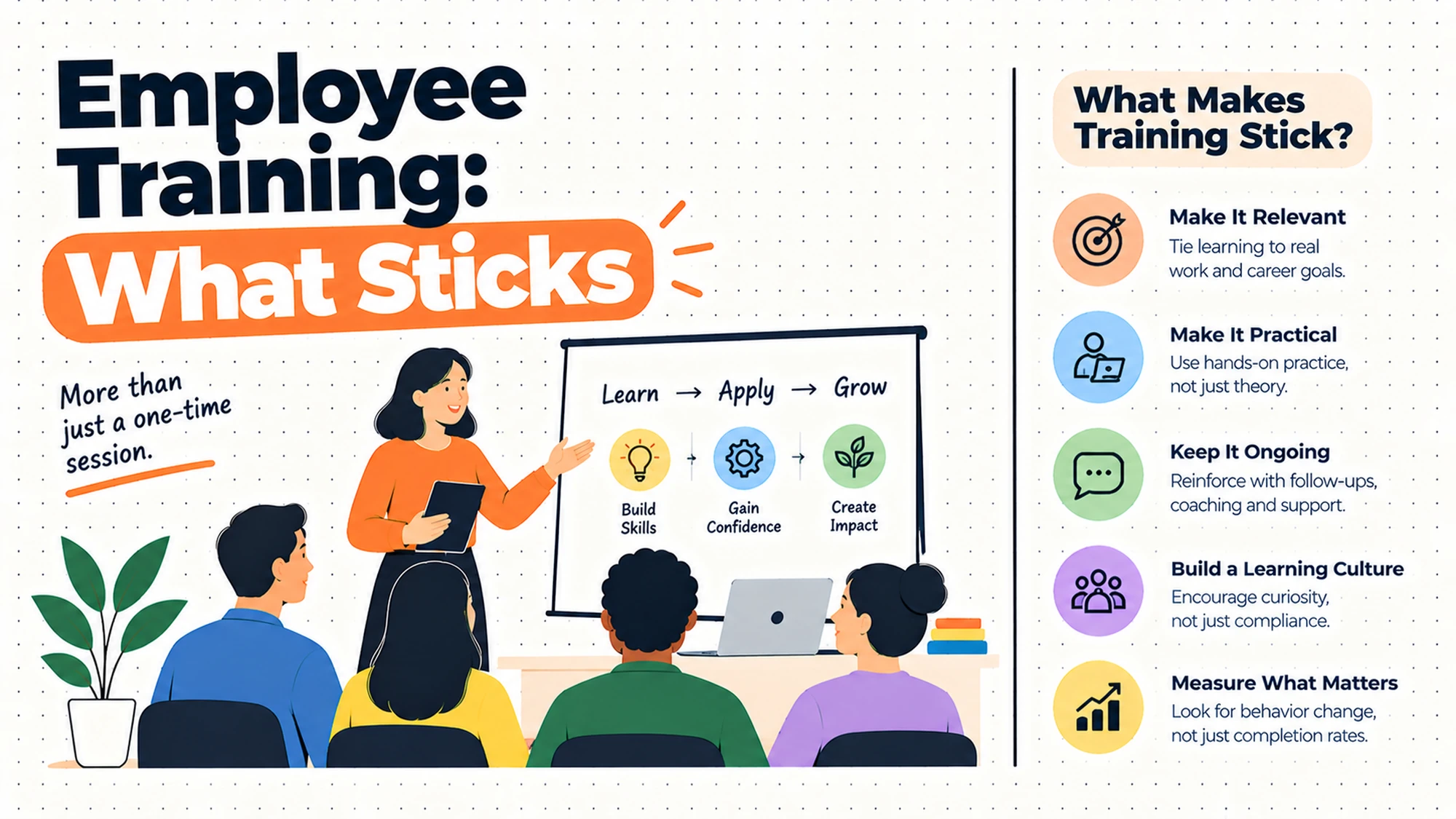
- The core decision: whether you're commissioning a session or designing the conditions around it, because the conditions determine whether anything changes.
- When doing nothing is right: when people can already do the work and nobody has identified a specific gap.
- What has to be true: somebody can name what a person will do differently, and when they'll first do it.
- How the options split: by how close the learning sits to the actual work, which predicts retention better than quality does.
- Decision rule: if there's no occasion to use it within days, the training will be forgotten regardless of how good it was.
- Outcome to expect: less training, closer to the work, with somebody expecting the person to use it.
The Session Everybody Enjoyed
A training session runs. The trainer is good, the material is relevant, and the feedback afterwards is genuinely positive: people found it useful, they'd recommend it, several said it was the best session they'd been to.
Three months later, ask what anybody does differently. In most organisations nobody can say. Not because the session was poor, but because the people who attended went straight back to the work they were doing before, in a week that had already filled up while they were out, and never had an occasion to use what they'd learned. By the time a situation arose where it would have helped, the specifics had gone.
The response is usually to improve the training. Better trainer, better materials, more interactive, more relevant examples. Sometimes that helps at the margin. Mostly it produces a better session with the same outcome, because the session was never the constraint.
Best tools for Onboarding & LMS
The real problem is that training is commissioned as an event and judged on satisfaction, while what determines whether behaviour changes sits almost entirely outside the room. Did the person need this when they got it. Did they use it within days. Does anybody expect them to. Get those three right and a mediocre session works. Get them wrong and an excellent one changes nothing.
When You Genuinely Do Not Need to Act Yet
Your current setup is genuinely fine. People can do the work, nobody has flagged a capability gap, and when somebody needs to learn something they find a way. Training commissioned because it seems like something an organisation should do is the most reliably wasted budget in this area.
Friction is starting to show. The same mistake keeps happening across different people, or somebody senior has said a team needs upskilling without naming what for. The first is a genuine signal. The second usually means somebody has noticed an outcome they don't like and reached for training as the response, which may or may not be right.
It has become a real cost. A specific gap is producing errors, or slowing work, or preventing you from taking on something you want to do. At this point there's something to aim at, and training has a chance of working because you can say what should be different afterwards.
The edge case that forces it. Training is required by regulation, by a client contract, or as a condition of somebody performing particular work. Those are external requirements rather than development choices, and what's required, how often, and what records must be kept differ sharply by jurisdiction and sector. Establish what applies to you specifically and take local advice rather than assuming a general approach transfers.
Five Questions This Reader Asks at 11pm
How do I make training stick? Put it next to the work. The single strongest predictor of whether somebody uses what they learned is how soon they have an occasion to use it, and a session delivered weeks before the need is a session delivered to somebody who'll have forgotten. Schedule from the need backwards rather than from the calendar forwards.
Does classroom training work? For some things, genuinely. It's efficient for transmitting the same material to many people, it's good where the value is in the questions people ask, and it creates a shared reference a team can point back to. It fails when it's used for skills, because you can't learn to do something by watching somebody explain it, and most of what organisations call training is skills.
How do I measure whether it worked? By what people do afterwards, which requires you to have said in advance what that would be. Satisfaction scores tell you whether an hour was pleasant. The useful measure is whether the specific thing you wanted to change has changed, observed a month or two later by somebody who'd notice.
Who should deliver it? Whoever does the thing well, wherever that's practical. Internal delivery has an advantage no external provider can match, which is that the examples are real and the person can be asked follow-up questions next week. External delivery earns its place where genuinely nobody internal has the capability, or where an outside voice carries weight that an internal one doesn't.
What do I do when people don't complete it? Ask what happens to them if they don't, and if the answer is nothing, you've explained the completion rate. Then ask whether the training addresses something they actually need. Non-completion is usually one of those two, and neither is fixed by more reminders.
Three Honest Categories the Approaches Split Into
Delivered, where somebody teaches. Sessions, courses, workshops, whether live or recorded. It's right where the same knowledge must reach many people, where there's regulated content to cover, and where the material genuinely benefits from someone explaining it and answering questions. It fails on skills and on timing. Watching somebody demonstrate a skill doesn't produce the skill, and material delivered on a schedule arrives when the calendar allowed rather than when anybody needed it. The completion certificate then stands in for capability, which is a substitution nobody intends and everybody accepts.
Embedded, where the work is the training. Doing the real thing, supported, with somebody available when it goes wrong. It's right for almost anything that's a skill rather than a body of knowledge, because the only reliable way to learn to do something is to do it badly a few times with help. It's also free of the timing problem, since the need and the learning are the same moment. It fails on capacity, because it requires somebody experienced to be available, and on consistency, because what gets learned depends entirely on what came up.
Referenced, where material exists to be consulted. Written guides, recorded walkthroughs, documentation people find when they need it. It's right for anything infrequent, anything procedural, and anything where the person will have forgotten by the time they need it again, which is most procedures. It's the most efficient form of training that exists, because it's consumed precisely at the point of need. It fails when nobody can find it, when it's out of date, and when it's used for things that genuinely need a person, such as anything requiring judgement or practice.
Five Diagnostic Questions You Can Self-Assess Against
What will somebody do differently, and when will they first do it? Answer both before commissioning anything. If you can't name the occasion, there probably isn't one, and the training will be consumed and forgotten. This single question kills a surprising proportion of proposed training, which is the point.
Is this a knowledge gap or a skill gap? They need opposite approaches and get treated identically. Knowledge can be transmitted and looked up. Skill has to be practised with feedback, and no session produces it. Most of what's commissioned as training is skill, and most of what's delivered is knowledge transmission.
Could this be a reference instead of a session? Ask it of everything. A substantial amount of what gets taught in sessions is procedural material that people will forget and need to look up anyway, and a good written reference outperforms a session for all of it, at a fraction of the cost in everybody's time.
What happens if somebody doesn't do this training? If nothing happens, you've explained your completion rate. That's not a moral failing on anybody's part, it's a rational response, and the fix is either to attach a genuine consequence or to accept that this is optional and stop chasing it.
Is the manager expecting anything different afterwards? Ask them specifically. Training that the manager doesn't follow up on is training the person correctly identifies as unimportant, and manager expectation is a better predictor of behaviour change than anything about the session itself.
Six Training Formats, Reviewed
The scheduled session, live or virtual
Somebody teaches a group at a fixed time. It earns its place for efficiency and for shared reference: the same material reaches many people at once, and afterwards a team has a common vocabulary and a moment they can refer back to. It's also where questions get asked, and the questions are frequently worth more than the prepared content.
Where it falls short is the timing problem, which is structural rather than fixable. A session runs when the calendar allows, which is almost never when any individual attendee needs the material, so most people leave with knowledge they'll have lost before they use it. It also has an opportunity cost that's rarely counted: everybody in the room is not doing their job, and the week they return to has filled up without them.
Use it where the value is genuinely in the discussion. Where the value is in the content, a document costs less and can be consulted twice.
One adjustment makes sessions noticeably more useful for very little effort, which is to send the material afterwards rather than only presenting it. People remember that a session happened and forget what was in it, and a short written version they can find later converts a one-off event into something with a second life. Most organisations do the opposite and circulate the slides, which are notes for the speaker rather than a document anybody can read cold.
Self-paced material people work through alone
Recorded content, modules, written material completed independently. It earns its place on flexibility and cost: people take it when it suits, it scales to any number, and it removes the scheduling problem that makes live sessions so hard to arrange.
It falls short on completion and on depth. Without a fixed time, it competes with actual work and loses, which is why completion rates are what they are. It also can't adapt: somebody who doesn't understand something has nowhere to go, and somebody who already knows it sits through it anyway. And it's weakest at exactly what most organisations use it for, which is anything requiring practice.
It's a reasonable container for material people genuinely need to have seen. It's a poor substitute for either practice or a conversation.
The failure worth watching for is the module that exists to record that something was covered. Once the purpose of a piece of training is to produce a completion record, the content stops being designed for the learner and starts being designed for the audit, and everybody involved can tell. People click through it, the record shows completion, and nothing about their work changes. If that is genuinely what a requirement needs, make it short and say plainly what it is for, rather than dressing it as development.
Learning by doing the real work with support
The person does the actual job, with somebody available when they get stuck. It earns its place as the only approach that reliably produces skill, and it solves the timing problem completely, since the learning happens at the moment of need. It also produces something useful, which no other format does.
It falls short on the support, which is the whole thing. Without somebody available, this isn't training, it's being left to work it out, and the difference between those two is entirely whether help arrives when it's needed. It's also inconsistent: two people learning this way learn different things depending on what came up, which matters where certain knowledge is non-negotiable.
It's the default worth reaching for. Pair it with a short reference for the things that must be covered regardless of what happens to come up.
What makes or breaks it is how quickly help arrives. Somebody stuck for ten minutes is learning; somebody stuck for two days has stopped learning and started avoiding the task, and will find a workaround that becomes permanent. The practical version of this is naming one person as the first call, telling the new person that interrupting them is expected rather than tolerated, and telling that person the same thing so they treat it as work rather than interruption.
Pairing with an experienced colleague
Somebody works alongside a person who does the thing well. It earns its place because it transmits the part that's hardest to write down: judgement, the small decisions, the reasons behind how things are done. A written procedure tells you the steps, and pairing tells you which step people skip and why.
It falls short on the cost, which lands on your most capable people. Pairing takes real time from somebody whose time is valuable, and where that isn't acknowledged it either doesn't happen or happens badly. It also depends on the experienced person being able to explain what they do, which is a separate skill that not everybody has.
Where you use it, reduce the experienced person's other work and say explicitly that this is part of their job rather than an addition to it.
It is also worth choosing the pair deliberately rather than by availability. The most capable person is not automatically the best one to learn from, because fluency makes the reasoning invisible: somebody who has done a thing for years no longer notices the decisions they are making. A person who learned it recently often explains it better, because the difficulty is still fresh and they remember which part was confusing.
A short written reference people consult when needed
Documentation, guides, walkthroughs kept where people will find them. It earns its place as the most efficient training format available, because it's consumed at the moment of need by somebody actively looking for it, which is the ideal condition for retention. It's also the only format that works for the infrequent task, which is the one people always forget.
It falls short on maintenance and on findability. Documentation decays, and material describing a process that's changed is worse than nothing, because somebody will follow it. It also fails if nobody knows where it is, and organisations reliably underestimate how hard their own material is to find.
Write less of it, keep it current, and put the effort into making it findable rather than into making it comprehensive.
The cheapest way to keep it current is to let the people using it fix it. If somebody follows a guide and finds a step has changed, the correction should take them a minute and require nobody's approval, because anything slower means the correction does not happen and the document decays quietly until somebody follows it into a wall. Documentation that only a designated owner can edit is documentation that is out of date.
Formal certification
External or internal accreditation with an assessment. It earns its place where it's required, which is the honest main case: regulated work, client contracts, insurance conditions. It also provides genuine portability for the individual, which matters to them and is worth acknowledging.
It falls short as a measure of capability. Certification demonstrates that somebody passed an assessment at a point in time, which is related to but not the same as being able to do the work, and the gap between those two widens with time since certification. Treating a certificate as evidence of current capability is a substitution that's convenient and frequently wrong.
Where it's required, meet the requirement and don't confuse it with development. What's required differs by jurisdiction and sector, so establish what applies to you rather than assuming.
There is a narrower use that does work, which is certification as a commitment device. Somebody who has told colleagues they are working towards something, with an assessment date attached, studies in a way that somebody working through optional material does not. That is a real effect and worth using where the subject genuinely matters, as long as everybody understands that the date is doing the work rather than the certificate.
The Decision Table
| Situation | Scale | Setup | Primary Pain | Recommended Starting Point |
|---|---|---|---|---|
| People can do the work, no gap identified | Any | Any | None | Do not commission training |
| Same mistake recurring across people | Any | Any | A genuine, specific gap | Reference material, then check it worked |
| Somebody senior wants upskilling, unspecified | Any | Any | An outcome, mistaken for a training need | Ask what should be different afterwards |
| The gap is a skill | Any | Any | Sessions cannot produce skill | Real work with support, or pairing |
| The gap is a procedure people forget | Any | Any | Wrong format, not wrong content | A findable written reference |
| Many people need the same knowledge | Over fifty | Any | Efficiency genuinely matters | A session, with material provided after |
| Completion rates are poor | Any | Any | No consequence, or no real need | Ask which, before sending reminders |
| Training required by regulation or contract | Any | Regulated sector | Not a choice | Establish local requirements, take advice |
| Nothing changed after the last session | Any | Any | The conditions, not the content | Fix timing, occasion and manager expectation |
The third row is worth catching early, because it's how most wasted training starts. Somebody senior observes a result they don't like, reaches for training as the response, and by the time it's commissioned nobody can say what the session is meant to change. Asking that question once, at the start, saves the whole exercise.
Why Training Does Not Change Behaviour
Five failures account for almost all of it, and none is about the quality of the teaching.
| The failure | What the learner experiences | What would have to change |
|---|---|---|
| No occasion to use it | Interesting session, nothing to apply it to | Schedule from the need, not the calendar |
| It was knowledge, the gap was skill | Understanding what to do, still unable to do it | Practice with feedback, not explanation |
| Nobody expects anything different | Returning to a week that assumes nothing changed | The manager naming what they expect to see |
| The old way still works | Effort required to change, none required not to | Remove or discourage the previous route |
| Too much at once | A day of content, one or two things remembered | Fewer things, closer to when they are needed |
| It addressed the wrong cause | Being trained on something that was not the problem | Diagnose before commissioning |
The third row is the one organisations consistently underestimate. Somebody returns from training to a manager who doesn't mention it, a workload that assumed they'd be back, and no expectation that anything will differ, and they draw the obvious conclusion about how much it mattered. A manager asking about it once, in the following fortnight, does more for behaviour change than any improvement to the session.
The fourth row explains why so much system training fails. If the old method still works, using the new one costs effort and saves nothing immediately, so people revert under any pressure. Training that isn't accompanied by removing the alternative is training competing with convenience, and convenience wins.
Training for Work That Is Mostly Judgement
A large proportion of valuable work can't be taught as a procedure. Deciding what to prioritise, reading a situation, knowing when to escalate, judging whether something is good enough: none of that reduces to steps, and training designed as if it does produces people who can recite principles and still get it wrong.
The approach that works is examining real decisions. Take something that actually happened, ideally recent and ideally not straightforward, and work through it: what was known at the time, what the options were, what was chosen, what followed. Doing that regularly builds judgement in a way no session does, because judgement is pattern recognition and patterns come from cases.
The second is exposure to somebody else's reasoning while it's happening. Sitting with a person as they work through a decision, hearing why they discounted the obvious option, is the transmission mechanism for everything that isn't written down. It's also why pairing outperforms instruction for this kind of work, and why remote arrangements have to create the equivalent deliberately.
The third is making mistakes survivable. Judgement improves through being wrong and finding out, which requires an environment where being wrong in a bounded way is acceptable. Where every error carries a cost, people avoid making decisions at all, which stops the development entirely and produces a team that escalates everything.
What doesn't work is the common approach, which is to write down the principles and deliver them as content. The principles are usually true, they're easy to agree with, and they provide almost no help in the specific situation, because the difficulty was never understanding the principle. It was knowing which one applies here.
One practical note. If you're developing judgement, the most useful thing to record isn't the decision, it's the reasoning: what somebody thought at the time, including the parts that turned out to be wrong. That's the material future learning is built from, and it's lost within weeks unless somebody writes it down while it's fresh.
What to Put in Writing
Training decisions are usually made in a conversation and executed months later by somebody who wasn't in it.
| Artefact | Who owns it | When it is written | What it prevents |
|---|---|---|---|
| What somebody will do differently afterwards | Whoever commissions it | Before anything is arranged | Training with no stated purpose |
| When they will first have occasion to use it | The manager | Before scheduling | A session delivered weeks before the need |
| Whether the gap is knowledge or skill | Whoever diagnoses it | Before choosing a format | Explaining a skill and expecting capability |
| What the manager will look for afterwards | The manager | Before the training | A return to a week that assumes nothing changed |
| Whether the old method is being removed | Operations | At the same time | New training competing with an easier habit |
| What is required locally, and how it is recorded | HR, with local advice | Before any regulated training | Discovering an obligation after an inspection |
The second row is the cheapest thing on this list and the one that would prevent the most waste. Asking when somebody will actually use this, before booking anything, either produces a date worth scheduling around or reveals that there isn't one.
Questions to Ask Before You Commit
On purpose. What will somebody do differently? A bad answer describes what they'll understand.
On timing. When will they first use it? A bad answer is at some point.
On type. Is this knowledge or skill? A bad answer treats them as the same thing.
On format. Could this be a document? A bad answer is that people prefer sessions.
On expectation. What will the manager look for? A bad answer is that they'll be supportive.
On the alternative. Does the old way still work? A bad answer hasn't checked.
What Getting This Wrong Costs
The first cost is the time of everybody in the room, and it's larger than the training itself. A session takes people away from their work, and the week they return to has compressed while they were out, so the real cost is the session plus the catching up plus whatever slipped. Where nothing changes afterwards, all of that is spent for nothing, and it's spent on the people you most wanted to develop.
The second cost is what it teaches about training generally. People who've attended several sessions that changed nothing form a reasonable view about what this activity amounts to, and they bring that view to the next one. Attendance becomes compliance, engagement drops, and the organisation concludes its people aren't interested in development, which is precisely the wrong lesson from the evidence.
The third cost is that the underlying problem persists while everybody believes it's been addressed. Training is a satisfying response to a difficulty because it's visible, it's finite, and it can be completed. Where the actual cause was a badly designed process, an unclear expectation or a tool that makes the wrong thing easy, the training changes nothing and the problem continues, now with a completed action against it.
So before you commission anything, work out which of three things you have. A knowledge gap means people don't know something, and the answer is usually a reference rather than a session. A skill gap means they know and can't yet do, and the answer is practice with feedback. A system problem means they know, can do, and still don't, and the answer isn't training at all, it's whatever makes the wrong behaviour easier than the right one.
The third of those is the one most often misdiagnosed, because it presents identically to the first two. People are not doing the thing, so it looks like they cannot. Ask one question before accepting that reading: has anybody done it correctly here, under the same conditions, recently. If the answer is yes, capability is not the constraint and no amount of training will change the outcome, because the person you would be training is already able to do it and is responding to something else in their situation.
When You Are Ready to Go Further
None of this needs a platform. It needs a written answer to what somebody will do differently, an honest answer about when they'll first need it, and a manager who asks about it once in the following fortnight.
The step beyond individual sessions is the reference layer, which most organisations underinvest in badly. A small set of short, current, findable documents covering the procedures people forget will outperform a training programme for a fraction of the cost, because it's consumed exactly when somebody needs it. The work is in keeping it current and making it findable, and both are less effort than running the sessions it replaces.
HROpsLab publishes independent comparison work across HR tooling, applicant tracking and payroll. We sell nothing, we take no vendor money, and we publish no paid placements. If the next step is looking at what your current tooling actually supports here, our comparison work is one place to start.
Frequently Asked Questions
What is employee training?
It's any deliberate activity intended to change what somebody can do at work, which is broader than the sessions and courses the word usually calls to mind. The useful distinction isn't between formats but between what's being addressed: a knowledge gap, where somebody doesn't know something and can be told or can look it up, and a skill gap, where they know what to do and can't yet do it. Those need opposite approaches and are routinely treated identically, which is why so much training produces people who can describe the right behaviour and don't exhibit it.
How do you make training stick?
Put it next to the work. The strongest single predictor of whether somebody uses what they learned is how soon they have a real occasion to use it, which means scheduling backwards from the need rather than forwards from the calendar. Two other conditions matter nearly as much: somebody has to expect them to use it, which usually means their manager asking about it within a fortnight, and the old way of doing things has to stop being the easier option. Get those three right and an ordinary session works. Get them wrong and an excellent one changes nothing.
Does classroom training actually work?
For some purposes, genuinely. It's efficient when the same knowledge must reach many people, it's strong where the value lies in the questions attendees ask, and it leaves a team with a shared reference point. Where it fails is skills, because watching a demonstration doesn't produce the ability to do something, and most of what organisations commission as training is a skill. It also carries a timing problem that can't be designed away: a session happens when the calendar allows, which is almost never when any particular attendee needs the material.
How do you measure training effectiveness?
By whether the specific thing you wanted to change has changed, which requires naming that thing before the training rather than after. Satisfaction scores measure whether an hour was pleasant, which is worth knowing and tells you nothing about behaviour. The practical approach is to state in advance what somebody should be doing differently, then have a person who'd notice check a month or two later. Completion rates are similarly weak as a measure, since they record attendance rather than capability, and the gap between those two is where most training budgets disappear.
Who should deliver employee training?
Whoever does the thing well, wherever that's practical. Internal delivery has two advantages no external provider can match: the examples are from your actual work, and the person is still available next week when somebody has a follow-up question. External delivery earns its place when nobody internal genuinely has the capability, when an outside voice carries weight an internal one wouldn't, or when the content is specialised enough that building it yourself makes no sense. What's worth avoiding is external delivery chosen because it's easier to arrange than asking a capable colleague.
How much training does a new person need?
Less formal training and more supported work than most onboarding programmes assume. New starters are frequently given a dense schedule of sessions in their first weeks, which is exactly the period when they have no context to attach the material to and no occasion to use it, so retention is at its lowest. The better pattern is a small amount of essential material early, then real work with somebody available to unblock them, then further training at the points where a genuine need appears. Anything mandatory or regulated is a separate matter, and requirements there differ by jurisdiction and sector.
Should you build training content or buy it?
Build where the content is specific to how you work, because that's the part nobody else can supply and it's usually the part that matters. Buy where the subject is genuinely general, such as a widely used tool or a common professional skill, since rebuilding that internally is expensive and the result is rarely better. The mistake worth avoiding is buying general content and expecting it to address a specific problem, which produces attendees who learned something true and unrelated to what they actually needed.
What do you do when people don't complete training?
Ask two questions before sending any more reminders. First, what happens if they don't, because if the honest answer is nothing, you've explained the completion rate and it's a rational response rather than a failure of engagement. Second, does the training address something they actually need right now, because people reliably complete things that solve a current problem and reliably defer things that don't. Non-completion is almost always one of those two, and neither responds to chasing. If the material is genuinely required, the consequence has to be real; if it isn't, stop describing it as mandatory.
Most training fails outside the room. The session was never the constraint.