
TL;DR
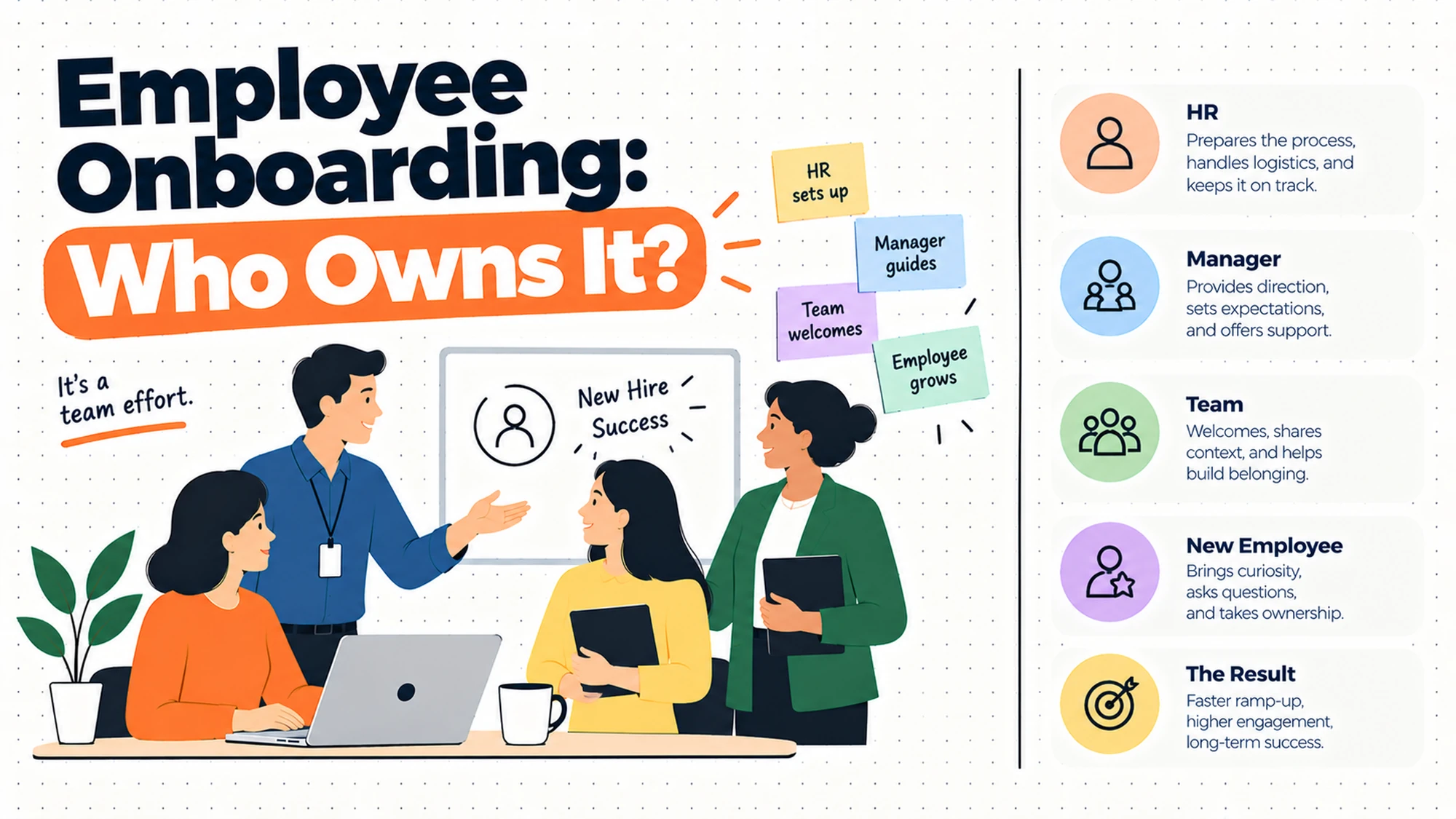
- The core decision: who is accountable when a new person's first weeks go badly, because in most organisations the honest answer is nobody.
- When doing nothing is right: when you hire rarely and the manager already handles it well without being asked.
- What has to be true: one named person can be asked how a specific new starter is getting on and can answer.
- How the options split: by where accountability sits rather than by who does the tasks, which are different questions.
- Decision rule: if more than one function owns it, none of them does, and the gaps will appear in the same places every time.
- Outcome to expect: fewer things falling through, because somebody is responsible for noticing that they did.
The Week Nobody Owned
Ask any organisation who owns onboarding and you'll get an answer. Ask three people separately and you'll get three answers, all given confidently, all different.
HR says HR owns the process and managers own the individual experience. The manager says HR runs onboarding and they get involved once the person is up and running. IT says they respond to tickets. Everybody is describing the part they can see, and the description is accurate from where they're standing.
The result is a new starter whose first fortnight depends on a set of handoffs that nobody is watching. The contract goes out, the equipment request goes in, the system access is requested from one team and granted by another, the manager blocks out a first-day conversation, and somewhere in that chain a step waits on a step that nobody has flagged as late. The new person notices, because they're the only one for whom all of this is a single experience.
Best tools for Onboarding & LMS
What makes this hard to fix is that nothing here is anybody's fault. Each function is doing its part competently. The failure is structural: the process crosses four or five boundaries, accountability doesn't cross with it, and the person who experiences the whole thing has no authority over any of it.
So the useful question isn't how to design a better process. It's who gets asked when it doesn't work, and whether that person has any ability to fix the parts that go wrong. Far fewer organisations have an answer to that than believe they do.
What Onboarding Actually Covers
The word covers at least four separate jobs that happen to overlap in time, and most disagreements about onboarding are really disagreements about which of the four somebody means.
Getting them legally and administratively set up. Contracts, identity and eligibility checks, tax and payroll registration, whatever records must be kept. This is the part with actual external requirements attached, and what those are, how documents must be verified, and how long anything must be retained differ sharply by jurisdiction and sector. It's also the part most likely to be genuinely owned, because somebody is usually accountable for it being wrong.
Getting them operationally able to work. Equipment, accounts, access, the physical or virtual things without which nothing else can start. Usually split across IT, facilities and whoever administers each system, which is why it's the part that fails most often and the part nobody owns end to end.
Getting them oriented. Who people are, how the place works, what the unwritten rules are, where things live. Traditionally delivered as sessions and documents, mostly retained in whatever proportion the new person had an immediate use for.
Getting them capable of the job. The actual work: what they're for, what good looks like here, how their part connects to everything else. This is the only one of the four that determines whether the hire succeeds, and it's the one with the least structure around it.
The confusion that follows from this is worth naming. When somebody says onboarding is going well, they usually mean the first two are done. When somebody says the new person isn't working out, they're usually talking about the fourth. Those are different jobs owned by different people, and an organisation can be excellent at one and absent at the other while believing it has a single process.
| The job | Usually owned by | Fails when | Noticed by |
|---|---|---|---|
| Legal and administrative setup | HR or payroll | Rarely, because somebody is accountable | An audit, eventually |
| Operational access and equipment | Split across IT and system owners | Constantly, at the handoffs | The new person, on day one |
| Orientation to the organisation | HR, as sessions | Immediately, through forgetting | Nobody, for months |
| Capability in the actual job | The manager, in theory | Quietly, over weeks | The manager, too late |
The third row is the one worth sitting with. Orientation content is delivered at the point of lowest possible retention, to somebody with no context to attach it to and no occasion to use it, and its failure is invisible because nobody checks. That isn't an argument for dropping it. It's an argument for moving most of it to a place people can find it later.
When You Genuinely Do Not Need to Act Yet
Your current setup is genuinely fine. You hire occasionally, the manager treats it as their job without being told to, and new people describe their start as unremarkable. Unremarkable is the correct outcome. Building a programme around a handful of hires a year is effort spent on documentation nobody will read.
Friction is starting to show. Two managers do it very differently, or something has been missed twice. That's the point at which a short written agreement about who does what earns its cost, and it's still far short of needing a system or a programme.
It has become a real cost. New people are slower to contribute than they should be, leavers in the first months mention their start, or somebody spends hours each hire chasing the same handful of steps. Now there's a case for naming an owner and fixing the handoffs, which is a different exercise from buying anything.
The edge case that forces it. You're hiring into several jurisdictions, or into regulated work where specific checks, training or records attach to the role. The administrative half stops being a convenience question at that point. Requirements vary considerably by location and sector, so establish what applies to each place you hire into and take local advice rather than generalising from one country's rules.
Five Questions This Reader Asks at 11pm
Who should own onboarding? One named person for accountability, several for delivery. The distinction matters more than the name: the owner isn't the person doing the tasks, they're the person who can be asked how a specific new starter is getting on and can answer without checking with three other people first. In most organisations that should be the hiring manager, with HR owning the parts that are genuinely administrative.
How long should onboarding last? Longer than the first week and shorter than the first year, which is unhelpful because the honest answer depends on the role. A more useful framing is that it ends when the person no longer needs anything unusual, which for a straightforward role is weeks and for a complex one is months. Deciding this in advance matters mainly because it determines when somebody stops paying special attention.
What's the difference between onboarding and orientation? Orientation is the introductory part, usually a session or a day, covering who we are and how things work. Onboarding is the whole arc from accepting the offer to being fully able to do the job. Orientation is a component, frequently mistaken for the entirety, which is how organisations end up with a well-run first day and nothing after it.
Should we buy software for this? Only once you can say who owns it and what the steps are. A system is good at tracking a process that exists and useless at creating one, and organisations that buy before deciding get an accurate record of a process that wasn't working. Write the steps and name the owner first; then a tool will either help visibly or turn out to be unnecessary.
How do we know if ours is any good? Ask people who started in the last few months two specific questions: what were you waiting for, and what did you have to find out by asking someone. The answers are concrete, they point at particular broken handoffs, and they're far more useful than a satisfaction score. Do it individually rather than as a survey, and the same two or three items will come up repeatedly.
Five Diagnostic Questions You Can Self-Assess Against
If a new starter's first week goes badly, who gets asked about it? If there's no answer, or the answer is that it depends, you've found the problem. Accountability that lands on a process rather than a person doesn't land anywhere, and nothing that falls through gets picked up because nobody's job includes noticing.
Can you name every step that has to happen before day one, and who does each? Most organisations can name most of them from memory and miss the same few every time. The missing third is exactly where things fail, because it's the steps that live in one person's head and get done from habit rather than from a list.
What does the new person's first week depend on that you don't control? Usually equipment arriving, an account being created by a team with its own queue, or a signature from somebody who is away. Those dependencies are where the delays come from, and they need to be started earlier rather than managed better.
Does the manager know what they're responsible for? Ask one directly. The common answer is a general sense of being supportive, which is not a responsibility and cannot be checked. If they can't name three specific things they're accountable for, they'll do what feels reasonable in the time available, which varies enormously between managers.
When does somebody stop being new? If nobody has decided, special attention stops whenever the manager gets busy, which is usually week two. Naming an end point is worth doing precisely because it forces you to say what has to be true by then.
Six Ownership Arrangements, Reviewed
HR owns the whole thing
One function is accountable end to end, running the process and chasing the parts other teams deliver. It earns its place on consistency: everybody gets the same start, nothing depends on which manager you got, and the administrative half is handled by people who know what it requires. Where you hire into several jurisdictions or at volume, this is close to necessary.
Where it falls short is the part that matters most. HR can own the process and cannot own the job, because they don't know what the person is supposed to be doing well enough to tell whether it's happening. So the arrangement reliably produces strong administration and weak capability, and organisations running it tend to have excellent completion records alongside managers who were barely involved.
It also creates a quiet incentive problem. If HR owns onboarding, the manager is a participant rather than an owner, and participants attend when they can. Use it, but make the manager's part explicit and separate rather than a contribution to somebody else's process.
The version of this that works best keeps HR accountable for everything that is the same for every hire and pushes everything role-specific back to the team. That boundary is easier to hold than a boundary drawn in time, because it can be tested: if a step would be written identically for an engineer and an accountant, it belongs to the central process, and if it would not, it was never going to survive being run centrally anyway.
The hiring manager owns it
Accountability sits with the person the new starter reports to, with HR supplying the administrative parts as a service. It earns its place because it puts ownership where the knowledge and the consequences already are. The manager knows what the job requires, sees the person daily, and is the one who suffers if it goes badly, which is the correct alignment.
Where it falls short is variability and capacity. Two managers will do this very differently, and the difference is invisible to everybody except the people it happens to. It also lands on somebody with a full workload and no training in it, so the parts that can be deferred get deferred, and the first casualty is usually the second and third week.
It's the right default for most organisations. It needs two things to work: a short explicit list of what the manager is accountable for, and somebody outside the team who notices when it isn't happening.
Split by phase
HR owns everything up to the first day, the manager owns everything after. It earns its place because the split matches a real boundary: the pre-start work is administrative, repeatable and best done by specialists, while everything after is specific to the job.
Where it falls short is the handoff itself, which is where the arrangement puts its single point of failure. Anything that arrives late, such as equipment or an account, crosses the boundary just as accountability does, and both sides reasonably regard it as the other's. The new person spends their first week chasing items that belong to a phase that's officially over.
It works if one thing is true: somebody carries unfinished items across the boundary explicitly, by name, rather than assuming they've been handled. Without that, this arrangement generates the same three failures every time.
A dedicated coordinator
One person runs onboarding across the organisation as their actual job, or a substantial part of it. It earns its place at volume, where the sheer number of handoffs justifies somebody whose role is to watch them. Coordinators catch things nobody else would, because they're the only person for whom the whole sequence is visible.
Where it falls short is that it can absorb responsibility that shouldn't move. Once a coordinator exists, managers reasonably conclude that onboarding is handled, and the capability half suffers exactly as it does under full HR ownership. It's also a single point of failure in the human sense, since the process lives in that person's head and goes with them.
Worth it where hiring is continuous. Write down what the coordinator does, both because it's the only defence against the knowledge walking out and because the act of writing it reveals how much of it shouldn't be theirs.
There is a second-order effect worth knowing about before you create the role. A coordinator who is good at the job will quietly absorb work from every function they touch, because it is faster for them to do it than to chase somebody. That makes the process run better and makes it steadily more fragile, and the drift is invisible until they are away.
Buddy-led
An experienced colleague takes responsibility for the new person's practical integration. It earns its place for the category of thing nobody writes down: which meetings matter, who to ask, what the actual norms are. A new person will ask a peer things they won't ask a manager, and that alone justifies the arrangement.
Where it falls short is that it isn't ownership and shouldn't be treated as one. A buddy has no authority to fix a late account or an unclear objective, and where the arrangement is used as the primary structure, it puts an inexperienced volunteer in front of problems they can't solve. It also fades reliably, because it's an addition to somebody's real work with no end point attached.
Use it alongside a real owner, name what it covers, give it a duration, and acknowledge the time it takes.
Choosing who does it matters more than the arrangement itself. The obvious candidate is the most experienced person on the team, and they are frequently the wrong one, because somebody who joined recently still remembers which parts were confusing and has not yet stopped noticing the things everybody else takes for granted.
Nobody owns it
The most common arrangement, and rarely described as one. Tasks happen because individuals remember them, the process exists in habit, and it works acceptably until somebody is away, until a hire is unusual, or until two arrive in the same week.
It earns its place at genuinely small scale, where the entire sequence fits in two people's heads and both are present. That's a real situation and not worth over-engineering.
Where it falls short is that it degrades without any signal. Nothing announces that you've outgrown it; you simply start missing things occasionally, then regularly, and each individual miss looks like an isolated slip rather than a pattern. The tell is repetition: when the same step is missed for the third time, the problem is structural rather than personal, and the arrangement has already stopped working.
The Decision Table
| Situation | Scale | Setup | Primary Pain | Recommended Starting Point |
|---|---|---|---|---|
| A few hires a year, managers handle it | Under twenty | Single site | None | Change nothing |
| Same step missed repeatedly | Any | Any | No owner, not carelessness | Name one accountable person |
| Strong first day, weak second week | Any | Any | Ownership stops at the handoff | Give the manager the weeks after |
| Access and equipment always late | Any | Multiple internal teams | Dependencies started too late | Trigger them at offer acceptance |
| Two managers do it very differently | Any | Any | Variability nobody can see | A short written list of manager duties |
| Hiring continuously | Over two hundred | Any | Volume of handoffs | A coordinator, with the manager's part kept |
| Hiring into several countries | Any | Multi-jurisdiction | Requirements differ by location | Establish local requirements, take advice |
| New people leave in the first months | Any | Any | Usually the job, not the welcome | Ask leavers what they expected |
| Considering onboarding software | Any | Any | A process that is not yet written | Write the steps and the owner first |
The second row is the one that reliably gets misdiagnosed. A step missed once is somebody having a bad week. The same step missed three times is a step that belongs to nobody, and no amount of reminding the individuals will fix it, because the next person in that seat will miss it too.
Where Onboarding Falls Through the Gaps
Almost every failure sits at a boundary between two functions rather than inside either one.
| The gap | What the new person experiences | What closes it |
|---|---|---|
| Offer accepted, nothing starts | Silence for weeks, then a scramble | Acceptance triggers the setup, not the start date |
| Requested from IT, granted by system owners | Working on day four, not day one | One list of every account, owned by one person |
| HR finishes, manager begins | Chasing items nobody now owns | Named handover of anything unfinished |
| Orientation ends, the job begins | A friendly week, then nothing to do | Real work ready before they arrive |
| Manager gets busy in week two | Attention stops without explanation | A date when being new officially ends |
| The role changed during recruitment | Doing a different job from the one described | Confirm the job in writing before day one |
The first row is worth acting on before anything else, because it's the cheapest fix available and it removes most of the pressure from the rest. Almost every late item on a first day was requested too late, and almost every request was late because the trigger was the start date rather than the acceptance. Moving the trigger costs nothing and buys weeks.
The last row is rarer and more damaging than the others. A role that was reshaped during a long recruitment process, or filled by a candidate stronger or weaker than the original brief, produces a new person doing something other than what they agreed to. They notice in the first fortnight, they usually say nothing, and the mismatch surfaces months later as a performance conversation that should have been a scoping conversation.
The Manager Is the Whole Thing
Whatever arrangement you choose, the manager determines the outcome, and no structure compensates for their absence.
This is uncomfortable because it's the part hardest to systematise. You can require a manager to attend and you cannot require them to be useful, and the difference between a good start and a poor one is mostly a handful of small things a manager either does or doesn't do in the first fortnight.
Three of those things do most of the work. The first is being present on the first day, genuinely rather than nominally. A manager who is in back-to-back meetings on somebody's first day has communicated something they'd never say aloud, and the new person will remember it long after they've forgotten anything from orientation.
The second is giving real work early. New people are frequently protected from anything that matters for weeks, which is intended as kindness and read as doubt. A genuine task with a deadline, small enough to finish, teaches more about how the place works than any amount of shadowing and gives the person something to be useful about.
The third is saying what good looks like, specifically. Not values, not a job description, but what this person should be able to do by a stated point and how the manager will know. Most new people spend their first months inferring this from indirect signals, and a proportion of them infer it wrongly and find out in a review.
None of these requires a programme. All of them require a manager who understands that the first weeks are part of their job rather than an interruption to it, which is a question about what the organisation expects of managers generally. If managers here are measured entirely on output, onboarding will lose to output every time, and nothing in a process document changes that.
One practical note. If you're going to ask managers to do this properly, reduce something else in the weeks around a start. A manager absorbing a new person's questions while carrying an unchanged workload will do the parts that fit in the gaps, and the parts that fit in the gaps are the shallow ones.
What to Put in Writing
Onboarding is unusually dependent on things everybody assumes somebody else has handled.
| Artefact | Who owns it | When it is written | What it prevents |
|---|---|---|---|
| Who is accountable for this hire | HR, at offer stage | Before the offer is accepted | A first week nobody is watching |
| Every account and item needed, and who grants each | The manager, with IT | At offer acceptance | Day one spent waiting for access |
| What the manager is responsible for, specifically | HR, once, for all hires | Before any hiring | Support that varies by manager |
| What the person should be able to do, and by when | The manager | Before day one | Inference, followed by a surprise review |
| Anything unfinished at the handoff | Whoever hands over | The day before they start | Items that belong to a phase that ended |
| What is required in each jurisdiction | HR, with local advice | Before hiring there | Discovering an obligation afterwards |
The second row produces the largest single improvement for the least effort. The list of accounts and equipment is different for every role, lives in several people's heads, and is reconstructed from memory each time, which is precisely why the same two items are always missing. Writing it once per role type, and updating it the first time something is missed, closes most of the operational gap permanently.
Questions to Ask Before You Commit
On accountability. Who gets asked if this goes badly? A bad answer names a function.
On the trigger. What starts the setup? A bad answer is the start date.
On the manager. What are they specifically responsible for? A bad answer is being supportive.
On the end. When does being new stop? A bad answer is when they're settled.
On the handoff. Who carries unfinished items across? A bad answer assumes there won't be any.
On evidence. What did the last three starters have to chase? A bad answer is that nobody asked.
What Getting This Wrong Costs
The first cost is time that never gets recovered. A person waiting on access, or unclear about what they're for, is being paid to wait, and the delay compounds because everything they'd learn in that period is also delayed. That cost is invisible in any system, which is why it persists: nothing records the week somebody spent half-occupied.
The second cost is the impression, which forms faster than most organisations assume and revises slowly. Somebody whose first fortnight was disorganised concludes something about how this place runs, and it colours how they interpret everything afterwards, including things that have nothing to do with onboarding. The people best equipped to notice are the experienced hires you worked hardest to attract, because they have something to compare it against.
The third cost is the hire that doesn't work out for reasons that had nothing to do with the hiring. A capable person placed in an unclear role with an absent manager and no stated expectations will underperform, and the organisation will read that as a selection error and change its interview process. The mistake compounds, because the actual cause remains and the next hire meets it too.
So before you redesign anything, establish which of three things you have. If steps are missed, that's an ownership problem and the fix is to name somebody. If steps happen but people are still slow to contribute, that's the capability half and the fix sits with managers. If people arrive, start well and leave anyway, onboarding probably isn't your problem and something about the role or the recruitment promise is.
When You Are Ready to Go Further
None of this needs a platform. It needs one named person per hire, a written list of what has to exist before day one, and a manager who treats the first fortnight as part of their job.
The step beyond that, once those are stable, is to track two things rather than a dashboard of many. The first is how often a step is missed, which tells you whether ownership is real. The second is what new starters had to chase, gathered by asking a handful of them directly, which tells you where the gaps actually are rather than where you assume they are. Those two, reviewed occasionally, will surface more than any completion report.
HROpsLab publishes independent comparison work across HR tooling, applicant tracking and payroll. We sell nothing, we take no vendor money, and we publish no paid placements. If the next step is looking at what your current tooling actually supports here, our comparison work is one place to start.
Frequently Asked Questions
What is employee onboarding?
It's the whole arc from somebody accepting an offer to being fully able to do the job, which in practice covers four separate things that happen to overlap in time: the legal and administrative setup, the operational business of equipment and access, orientation to how the organisation works, and building capability in the actual role. Most confusion about onboarding comes from people meaning different ones of those four. Somebody saying it went well usually means the first two were completed; somebody saying the hire isn't working usually means the fourth never happened.
Who is responsible for onboarding?
Delivery is shared and accountability should not be. The practical test is whether one named person can be asked how a specific new starter is getting on and answer without consulting three others. In most organisations that person should be the hiring manager, because they know what the job requires and they bear the consequences, with HR owning the parts that are genuinely administrative and specialised. What doesn't work is accountability assigned to a function rather than a person, because a function cannot notice that something has fallen through.
How long should onboarding last?
Until the person no longer needs anything unusual, which is weeks for a straightforward role and months for a complex one. The value in deciding it in advance isn't the date itself, it's that naming an end point forces you to say what has to be true by then, and it stops special attention from ending whenever the manager happens to get busy. In most places nobody decides, attention quietly stops somewhere in the second week, and the person is left to work out the remainder on their own.
What is the difference between onboarding and orientation?
Orientation is the introductory portion, usually a session or a first day, covering who we are and how things work here. Onboarding is the entire process from offer acceptance to full capability, of which orientation is one early component. The distinction matters because the two are routinely treated as the same thing, which is how organisations end up with a well-produced first day followed by nothing, and how orientation content ends up carrying expectations it was never going to meet.
What should happen before a new starter's first day?
Everything that can, which is more than most organisations attempt. The single most valuable change available is to trigger the setup from the moment the offer is accepted rather than from the start date, because almost every item that arrives late on a first day was requested too late. Beyond that: confirm in writing that the job is still the job that was described, since roles change during long recruitment processes, and make sure somebody has prepared actual work for them rather than a schedule of introductions.
Do you need onboarding software?
Not until you can say who owns the process and what the steps are, because a system tracks a process rather than creating one. Organisations that buy first end up with an accurate record of something that wasn't working, plus a new belief that onboarding is now handled. Write down the steps and name the accountable person first. After that, a tool either removes visible chasing or turns out to be unnecessary, and you'll be able to tell which within a couple of hires.
How do you onboard somebody who is remote?
The same jobs apply, but nothing happens by proximity, so everything informal has to be arranged deliberately. The parts that fail hardest are the ones nobody plans: overhearing how things are discussed, asking a small question without booking time, and meeting people you have no immediate reason to meet. The practical responses are to name one person whose job is to be interrupted, to schedule the introductions that would otherwise happen by accident, and to accept that equipment logistics need to start considerably earlier than they would on site.
How do you tell whether your onboarding is any good?
Ask people who started in the last few months two specific questions: what were you waiting for, and what did you have to find out by asking somebody. Both produce concrete answers that point at particular broken handoffs, which a satisfaction score never will. Ask individually rather than by survey, because the useful detail comes out in conversation, and expect the same two or three items to recur. Those recurring items are your actual process, whatever the documented one says.
The process is usually fine. The ownership is the thing that isn't.