
TL;DR
- The core decision: which of the four jobs is actually failing, because the phrase covers four of them and the annual cycle gets blamed for all four.
- When doing nothing is right: when people know what's expected, hear how it's going before the review, and nobody is surprised at the end of the year.
- What has to be true: you can say where each of the four jobs happens today, even if the answer for three of them is nowhere.
- How the options split: by which job they're built to serve, which is why products that look alike behave so differently.
- Decision rule: diagnose from the symptom you can observe this quarter. Redesigning the cycle rarely fixes a job the cycle was never doing.
- Outcome to expect: a narrower problem than the one you were handed, and usually a cheaper fix.
Everybody in the Room Means Something Different
Somebody inherits performance management. It arrives as a single responsibility, usually after a specific complaint: managers say the review takes too long, or somebody senior noticed that a poor performer has been in place for two years, or the ratings came in and every team looks excellent.
So they start asking what the current process is, and the answers don't match. One person describes the annual review form. Another means the rating scale and how it feeds pay. A third talks about the software. Somebody in HR means the documentation trail, and one manager means the conversation they have with their team every month, which isn't in any system at all.
They're all describing something real, and none of them is describing the same thing. Then a project starts, usually aimed at whichever version the loudest person meant, and it changes the form or the software or the cycle length. A year later the original complaint is unchanged, because the complaint was about a different one of the four.
Best tools for Performance Management
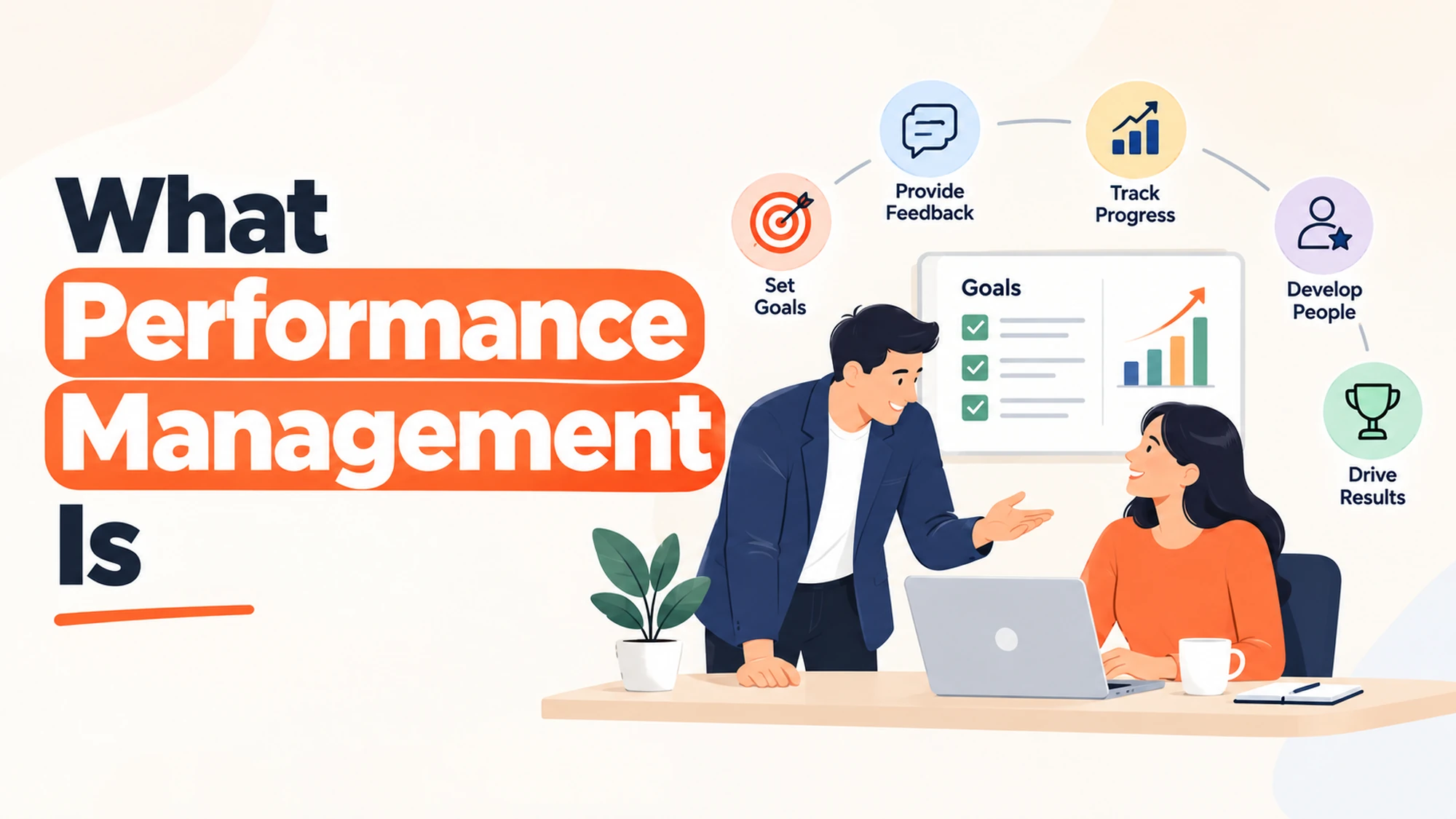
The real problem isn't that performance management is badly designed. It's that the phrase covers four separate jobs that share a calendar: agreeing what somebody should achieve, telling them how it's going, deciding what follows, and building what they can do. Most organisations are failing at exactly one, and almost every redesign changes the cycle rather than the job.
When You Genuinely Do Not Need to Act Yet
Your current setup is genuinely fine. People can say what's expected of them, they hear how it's going while there's still time to act, nothing at the review is a surprise, and decisions about pay and promotion are made without anybody having to reconstruct a year from memory. That's rare and it means the thing is working.
Friction is starting to show. Managers are describing the review as admin, or somebody has said they didn't know what they were being measured against, or a rating conversation went badly. None of that is urgent. The cheapest check is to ask three people what they're expected to achieve this period and see whether the answers are specific and consistent.
It has become a real cost. A poor performer has been in place long enough that colleagues have noticed, or a pay decision couldn't be explained, or somebody left because a promotion went to a person they considered weaker. At this point one of the four jobs has failed in a way that's costing you people, and it's worth identifying which before changing anything.
The edge case that forces it. A performance decision is being challenged, or somebody's employment is at stake, or a pattern in your ratings has attracted attention. Requirements around documentation, fairness and discrimination in employment decisions differ sharply by jurisdiction and have been changing, so establish what applies where you operate and take local advice rather than relying on a process inherited from elsewhere.
Five Questions This Reader Asks at 11pm
Is this the same as performance reviews? No, and the conflation causes most of the confusion. The review is an event where several of these jobs get attempted at once. Performance management is the whole set of activities, most of which happen outside that meeting or don't happen at all. An organisation can run flawless reviews and still fail completely at three of the four jobs.
Who should own it? Managers own the practice, HR owns the design and the consistency. The common failure is HR owning the practice, which produces a well-administered process that managers complete rather than use. The second failure is nobody owning the design, so every manager runs a private version and two people doing the same job have entirely different experiences.
Do we need annual reviews at all? Not necessarily, and that's the wrong question to start with. The annual cycle is a container. The useful question is which of the four jobs you need it to do, because some of them genuinely benefit from a fixed point in the year, particularly anything feeding a pay decision, and others are actively damaged by being deferred to one.
What does the software actually do? Mostly the administration: forms, reminders, records, reporting. That's genuinely useful for the record-keeping job and for consistency across managers. It does very little for the other three, which depend on conversations. Buying a system to fix a feedback problem produces better-documented silence.
Where do I start if nothing exists? With expectations, always. Everything else depends on somebody knowing what they're meant to achieve: feedback needs something to be feedback about, consequences need a basis, and development needs a gap to close. Starting with a rating scale, which is the common instinct, means scoring people against a standard nobody stated.
Three Honest Categories the Approaches Split Into
Cycle-led, organised around a calendar. Goals at the start, a review at the end, sometimes a mid-point. It's right where you need consistency across many managers, where pay decisions have to be made on a comparable basis, and where a fixed point is the only thing that reliably makes the conversations happen. It fails because a calendar can't hold feedback. Anything that needs saying in March said in December has lost its value, and the cycle creates a reasonable-seeming excuse to defer it. It also concentrates several incompatible purposes into one meeting, which is where most of the dread comes from.
Continuous, organised around conversations. Regular one-to-ones, feedback close to the event, direction adjusted as things change. It's right for the feedback job and for development, both of which work far better in small pieces near the event than in a summary months later. It fails at the decision job. When pay or promotion has to be decided, somebody has to compare people on a common basis at a common time, and a process with no fixed point produces either a hurried reconstruction or decisions made on recency and impression.
Split, with the jobs deliberately separated. Expectations set once and revisited, feedback continuous, consequences decided at a fixed point, development held in its own conversation. It's right almost always, because it stops the four jobs interfering with each other, and it's what most organisations arrive at eventually after two redesigns. It fails on discipline: the separation has to be maintained, and the natural drift is for everything to collapse back into the one meeting that has a deadline attached, since that's the only one anybody is chased about.
Five Diagnostic Questions You Can Self-Assess Against
Ask three people what they're expected to achieve this period. Do it separately and listen for specificity. Vague or inconsistent answers mean the expectations job is failing, and nothing downstream can work: you can't give useful feedback against an unstated standard, and any rating you produce is a judgement against a private one.
Was anything in the last review a surprise? Ask managers and ask their reports, because the answers differ. A surprise at the review is a feedback failure that's been running for months, and it's the single most diagnostic question in this article. Nothing in a review should be new, and when something is, the review is being used to do a job it can't do.
How long has your weakest performer been in place? Count honestly. Where the answer is years and everybody knows, the consequences job is failing, and no amount of better forms addresses it. This is usually a managerial courage problem wearing a process costume, and the process gets redesigned repeatedly because that's easier than the conversation.
What changed for anybody as a result of last cycle? Not ratings, not pay, but what somebody can now do that they couldn't before. If the answer is nothing across a whole team, the development job isn't happening, which is worth knowing because it's the only one of the four that changes future capability.
Could you explain a specific pay decision to the person who didn't get it? Try composing the explanation. If it depends on impressions, recency or a manager's advocacy rather than on anything recorded, your decision job is running on material that won't survive being questioned, which is a fairness problem before it's anything else.
The Four Jobs Performance Management Is Doing
Setting expectations
Agreeing what somebody is meant to achieve, to what standard, by when. It earns its place as the foundation, because all three other jobs depend on it: feedback needs a reference point, decisions need a basis, and development needs a gap between current and required. It's also the cheapest to fix, since it needs a conversation and a written record rather than any system.
Where it falls short is in being assumed. Most managers believe expectations are obvious, and most people report that they aren't, and both are describing the same situation from different ends. Expectations also decay: what somebody was hired to do drifts over eighteen months, and unless somebody restates it, the person is being assessed against a standard that changed without announcement.
Fix this first if three people give you three different answers, and expect the fix to be a conversation rather than a template.
The part that's usually missing isn't the what, it's the standard. Plenty of people know which tasks are theirs and have no idea what good looks like on them, which means they're working to a bar they've inferred. That gap produces the specific unfairness where somebody is doing exactly what they understood was required and is assessed as falling short, and neither person is being unreasonable.
Giving feedback
Telling somebody how it's going while there's still time for it to matter. It earns its place because it's the only job that operates in time to change an outcome. Everything else is retrospective: a rating describes what happened, a pay decision responds to it, and development addresses the next period. Feedback is the one that can alter the thing in progress.
It falls short when it's attached to the cycle. A calendar creates a legitimate-seeming reason to save something for the review, and saved feedback is worth a fraction of immediate feedback, because the person has been doing the thing wrong for months and the specifics have blurred. Delivered as a collection at the review, it also lands as a case rather than as help.
This is the job most damaged by being put in the annual container, and the one most organisations think they've addressed by adding a mid-year checkpoint, which moves the delay from months to weeks without removing it.
There's also a direction problem worth naming. Feedback is nearly always designed to travel downward, so a manager working from a wrong assumption can hold it for a year with nothing in the process that would correct them. Where the only upward channel is an annual survey, the manager gets a score rather than the specific thing they're getting wrong, which isn't actionable and is frequently discounted.
Deciding consequences
Determining pay, promotion, and whether somebody continues in the role. It earns its place because these decisions get made regardless, and the only question is whether they're made on a stated basis or on impression and advocacy. A structured decision is more defensible and usually fairer, particularly for people who are less visible or less inclined to push their own case.
It falls short by contaminating everything near it. Once a conversation can affect somebody's money, they stop being open in it, and any attempt to combine that conversation with development produces two poor halves. It also drives the ratings problem: a decision needs comparability, comparability pushes towards a scale, and a scale compresses a year into a symbol that nobody hears past.
Requirements around how these decisions are documented and justified differ considerably by jurisdiction, and pay and promotion patterns can attract scrutiny, so this is the job to have reviewed locally rather than designed from a template.
It's also the job with the longest memory attached to it. People forget most feedback and remember every decision, in detail, for years, along with whatever explanation they were given and whether it held up. That asymmetry is worth knowing when deciding where to spend effort: a badly handled feedback conversation is recoverable, and a pay decision that couldn't be explained is still being discussed long after everyone involved has moved on.
Developing capability
Building what somebody can do that they couldn't before. It earns its place as the only job with a compounding return: the other three manage the current state, and this one changes it. It's also the one people most want from their manager, and the one that most reliably keeps somebody in a role they'd otherwise leave.
It falls short by being the easiest to skip. It has no deadline, nobody chases it, and it competes with three other jobs that do have deadlines. It also can't survive proximity to the consequences job: nobody describes their weaknesses honestly to the person deciding their raise, so a development conversation held inside a review is a performance of development.
If you only protect one thing, protect this one's separation from the pay conversation, by a period long enough that both people have stopped thinking about the money.
The other thing that kills it is treating development as a course booking. A conversation that ends with a training recommendation has usually skipped the diagnosis, because most capability gaps aren't addressed by a course, they're addressed by different work: a project with an unfamiliar constraint, a handover that forces a decision somebody has been avoiding, or time alongside a person who does the thing well. Those are free and they require a manager to arrange them, which is why the course gets booked instead.
Creating a record
The documentation of what was expected, what was said, and what was decided. It earns its place because it's the only part with an external consequence, and because the moment it's needed is the moment it's too late to start.
It falls short by being nobody's job. It's assumed to be a byproduct of the other four, which it is only if they were designed with it in mind. What must be recorded and retained differs by jurisdiction and by the kind of decision involved, so this is worth establishing deliberately with local advice rather than trusting that a system's defaults match your obligations.
Treat it as a requirement on the other four rather than as a fifth activity. In practice that means asking, for each of the other jobs, what it would need to leave behind: what was expected and when it was agreed, what was said and when, and the basis for any decision that followed. Designed in at the start, that costs almost nothing. Retrofitted onto a process already running, it becomes a documentation exercise that managers experience as pure overhead, which is how it usually arrives.
The Decision Table
| Situation | Scale | Setup | Primary Pain | Recommended Starting Point |
|---|---|---|---|---|
| Expectations clear, no surprises, decisions explainable | Any | Any | None | Leave it alone |
| Three people give three different answers | Any | Any | Expectations are assumed, not stated | Expectations, in writing, before anything else |
| Something at the review was a surprise | Any | Any | Feedback is being saved for the cycle | Separate feedback from the calendar |
| Weakest performer in place for years | Any | Any | Consequences job is not operating | The conversation, not a new form |
| Nobody can do anything they could not before | Any | Any | Development is being skipped | Its own conversation, away from pay |
| Pay decision could not be explained | Any | Any | Decisions run on impression | A stated basis, with local advice |
| Every team rates itself excellent | Over one hundred | Multi-manager | No comparability across managers | Calibration, and check what ratings feed |
| Managers each run a private version | Any | Any | Nobody owns the design | HR owns design, managers own practice |
| Records cannot be produced on request | Any | Any | Record keeping was nobody's job | Establish local requirements, take advice |
The third row is the most common and the most misdiagnosed. A surprise at the review gets treated as evidence that the review needs redesigning, when it's evidence that feedback isn't happening between reviews. Changing the form cannot fix a job that happens in the eleven months the form isn't involved in.
Which of the Four Is Actually Broken
The symptom is usually visible without analysis. What's missing is the step from symptom to job, which is where most redesigns go wrong.
| Symptom you can observe | Which job it points to | What people wrongly change instead |
|---|---|---|
| People cannot say what they are measured on | Expectations | The rating scale, which needs a standard to work |
| Something at the review was new information | Feedback | The review form or its length |
| A poor performer has been in place for years | Consequences | The documentation process |
| Nobody has grown in a year | Development | The goal template |
| Every team rates itself highly | Comparability of decisions | Manager training on how to rate |
| Managers say the review is admin | Usually feedback, sometimes all four | The software |
| A promotion decision could not be explained | Consequences, and the record | The promotion criteria only |
| High performers leaving quietly | Development, or consequences that reward the wrong thing | Pay, which rarely addresses either |
| The same conversation feels pointless annually | Expectations and feedback together | The cycle length |
The sixth row is worth reading twice, because buying software is the most common response to a performance management complaint and it addresses the record-keeping job almost exclusively. If managers experience the process as administration, a better interface makes the administration more pleasant. It doesn't give anybody a reason to have the conversation.
The last row is the diagnostic that catches an organisation running the cycle for its own sake. Where a review feels pointless every year to both participants, the likeliest explanation is that neither expectations nor feedback is doing any work, so the meeting has nothing to be about except restating what both already know.
Why Development and Consequences Fight Each Other
These two jobs are routinely put in the same conversation, and it's the single most damaging design choice in this area. The reasoning is efficient and the effect is that both fail.
Development requires somebody to talk openly about what they can't do yet. That's the entire input: without an honest account of the gap, there's nothing to build a plan around. It asks the person to be candid about weakness in front of their manager.
Consequences require the manager to form a judgement that determines money, advancement, and sometimes whether the person stays. Everybody involved understands this, including the person being asked to describe their weaknesses.
Put those in one meeting and the outcome is determined before anybody speaks. A person facing a pay decision will present the strongest available version of their year, because that's the rational response, and describing a genuine gap would be acting against their own interest. So the development half produces a list of safe, minor improvement areas, and the manager, who knows this, stops expecting anything else. Both people perform the conversation.
Separating them works, and the separation has to be by time rather than by agenda item. Putting development at the end of the same meeting doesn't help, because the money is still in the room. A gap of several weeks is usually enough that both people have stopped thinking about the decision, and the development conversation can be about the work rather than about the case being made.
There's a second reason to separate them that gets less attention. A manager who has to deliver a rating is usually building their justification during the year, which changes how they observe: they're gathering evidence rather than noticing what would help. Managers with no rating to defend describe their people differently, and more usefully. The same effect shows up in what gets written down during the year. Notes kept to support a forthcoming judgement are a record of incidents; notes kept to help somebody improve are a record of patterns and what was tried. Both look like documentation and only one of them is useful to the person it is about.
What to Put in Writing
Most performance management runs on undocumented convention, which is why every new manager reinvents it and why decisions are hard to explain afterwards.
| Artefact | Who owns it | When it is written | What it prevents |
|---|---|---|---|
| What each person is expected to achieve | The manager, with the person | At the start, revisited when things change | Assessment against a standard nobody stated |
| Which of the four jobs each meeting is for | HR, in the design | Before the cycle runs | One conversation attempting four things badly |
| What feedback was given, and when | The manager | At the time | A review where something is new information |
| The basis for each pay and promotion decision | The manager and the approver | At the decision | Explanations that depend on impression |
| What the person can do now that they could not | The manager | At the end of the period | Development that nobody can evidence |
| Local requirements on documentation and fairness | HR, with local advice | Before the process is used | A process that cannot support a challenged decision |
The second row is the one almost nobody has and the one that would prevent the most damage. Stating explicitly that this meeting is about the pay decision and that one is about development, and holding to it, does more than any redesign of what's in either.
Questions to Ask Before You Commit
On diagnosis. Which of the four jobs is failing, and what's the symptom? A bad answer names the cycle.
On expectations. Would three people give the same answer about what they're measured on? A bad answer is that it's in their objectives.
On surprises. Was anything at the last review new to the person? A bad answer is that it shouldn't have been.
On consequences. How long has your weakest performer been in place? A bad answer is that it's complicated.
On separation. Do pay and development happen in the same meeting? A bad answer is that they're different agenda items.
On the record. What are you required to keep where you operate, and who confirmed it? A bad answer is that the system handles it.
What Getting This Wrong Costs
The first cost is a redesign that changes nothing, and it's expensive in a way that compounds. A performance management project consumes senior attention, manager time in training and transition, and often a system purchase, and if it addressed the wrong job the original complaint survives intact. The larger cost is credibility: after one failed redesign, managers treat the next as another round of the same, and participation drops before the new process has had a chance.
The second cost lands on the people who are least visible. Where decisions run on impression and advocacy rather than on a stated basis, the beneficiaries are people who are good at making their case, work near decision-makers, or share a background with them. That's not usually anybody's intention and it's the reliable result, and it shows up as a promotion pattern that's difficult to explain and difficult to defend if somebody asks.
The third cost is the one that takes longest to appear. An organisation where the development job never happens manages its current capability well and never increases it, so the skill gap that made hiring difficult stays exactly as wide as it was. That gets diagnosed as a market problem, and the response is to spend more on recruitment, which addresses the symptom of a capability the organisation could have built.
So before you change anything, work out which of three things you have. A clarity problem means people don't know what's expected, and the fix is a conversation and a written record. A courage problem means everybody knows what's wrong and nobody will say it, and no process fixes that, though a process is what usually gets bought. A comparability problem means individual judgements are fine and can't be compared across managers, and that's the one where structure genuinely helps.
When You Are Ready to Go Further
None of this needs a system to begin. It needs three people asked what they're measured on, an honest answer about whether anything at the last review was a surprise, and a decision about which meeting is for pay and which is for development.
The step beyond your own diagnosis is consistency across managers, which is where the organisational version of this problem lives. Two people doing the same job under different managers frequently have completely different experiences of all four jobs, and neither knows that. Making the design consistent while leaving the judgement local is the work that produces the most durable improvement, and it's a question of what's expected of managers rather than what's in the form.
HROpsLab publishes independent comparison work across HR tooling, applicant tracking and payroll. We sell nothing, we take no vendor money, and we publish no paid placements. If the next step is working out which of these jobs your current tooling actually supports, our comparison work is one place to start.
Frequently Asked Questions
What does performance management mean?
It's an umbrella term for four separate activities that happen to share a calendar: agreeing what somebody is meant to achieve, telling them how it's going while there's still time to act, deciding what follows in terms of pay, promotion and continued employment, and building capability they don't currently have. A fifth concern, keeping a record that would support a decision if it were questioned, runs through all of them. The reason the definition matters is practical: most organisations are failing at exactly one of the four, and almost every redesign changes the cycle instead of the job, which is why the original complaint usually survives the project.
Is performance management the same as performance reviews?
No, and treating them as the same explains a lot of failed redesigns. The review is a scheduled event where several of these jobs get attempted simultaneously, usually the decision about consequences and some version of feedback and development. Performance management is the whole set of activities, most of which either happen outside that meeting or don't happen at all. An organisation can have an immaculate review process, completed on time with well-designed forms, while nobody knows what's expected of them and nobody has developed a new capability in two years.
Who should own performance management?
Managers own the practice and HR owns the design, and swapping those is the most common structural error. When HR owns the practice, the result is a well-administered process that managers complete rather than use, because the activity has become something done for another department. When nobody owns the design, every manager runs a private version, which means two people in the same role under different managers have entirely different experiences of what's expected and how they're assessed. The useful division is that HR decides what the process is for and how it stays consistent, and managers do the actual work of it.
Do you need annual performance reviews?
Not necessarily, and starting from that question tends to produce the wrong answer. The annual cycle is a container, and the useful question is which of the four jobs you need it to hold. Anything feeding a pay or promotion decision genuinely benefits from a fixed point, because comparing people fairly requires a common basis at a common time. Feedback is actively damaged by being deferred to one, since a calendar provides a legitimate-sounding reason to save something that needed saying in March. Most organisations that abolish the annual review and do nothing else lose the decision job and keep the feedback problem.
What does performance management software actually do?
Mostly administration: forms, reminders, storage, reporting and consistency of format across managers. That's genuinely valuable for the record-keeping job and for making sure things happen at all in a large organisation. What it does very little for is the three jobs that depend on conversations, which is expectations, feedback and development. Buying a system to address a feedback problem produces better-documented silence, and buying one because managers describe the process as administration makes the administration more pleasant without giving anyone a reason to have the conversation. Diagnose the job first, then ask what tooling would support it.
What is the difference between performance management and performance appraisal?
Appraisal is the assessment part: forming a judgement about how somebody has performed, usually expressed as a rating or a written summary, and usually feeding a decision about pay or advancement. Performance management is the wider activity that appraisal sits inside. The distinction matters because appraisal is the most visible piece and the one organisations spend most of their design effort on, while the jobs that determine whether appraisal is even possible, namely stated expectations and ongoing feedback, get far less attention. An appraisal conducted without those is a judgement against a private standard, formed from whatever the manager happens to remember.
What does a good performance management cycle look like?
Less like a cycle than most designs assume. Expectations get set once and revisited when circumstances change, which is a conversation rather than a calendar event. Feedback happens close to the thing it's about, continuously, because its entire value is being early enough to matter. Decisions about pay and promotion happen at a fixed point, because comparing people fairly needs a common basis and a common time. Development sits in its own conversation, separated from the pay decision by enough weeks that both people have stopped thinking about the money. The discipline is maintaining that separation, since everything naturally collapses back into the one meeting with a deadline attached.
Where should you start if you have no performance management at all?
With expectations, without exception. Everything else depends on somebody knowing what they're meant to achieve: feedback needs a reference point, decisions need a defensible basis, and development needs a gap between current and required capability. The common instinct is to start with a rating scale or a form, because those are the visible artefacts, and it produces scoring against a standard nobody stated. Begin by having each manager agree three things with each person, write them down, and revisit them when circumstances change. That single step resolves more complaints than any subsequent process design, and it costs nothing but the conversations.
Performance management isn't one process. It's four jobs sharing a calendar, and you're probably only failing at one.