

TL;DR
- The core decision: whether you're writing to record a judgement or to tell somebody something they can act on. Most phrase banks serve the first.
- When doing nothing is right: when your written reviews already contain dates, specific instances and a stated request, and people act on them.
- What has to be true: every substantive point names something that happened, what it caused, and what you want instead.
- How the options split: by whether the sentence describes the person or describes the work.
- Decision rule: if the sentence could have been written about somebody else on your team, delete it. It carries no information.
- Outcome to expect: shorter reviews, harder to write, and considerably more likely to change something.
Six Reviews Due Friday
It's Wednesday and there are six reviews to write. Each needs to be fair, accurate, defensible, and not so discouraging that somebody resigns over it. So the search begins: performance review phrases, examples, wording for difficult feedback.
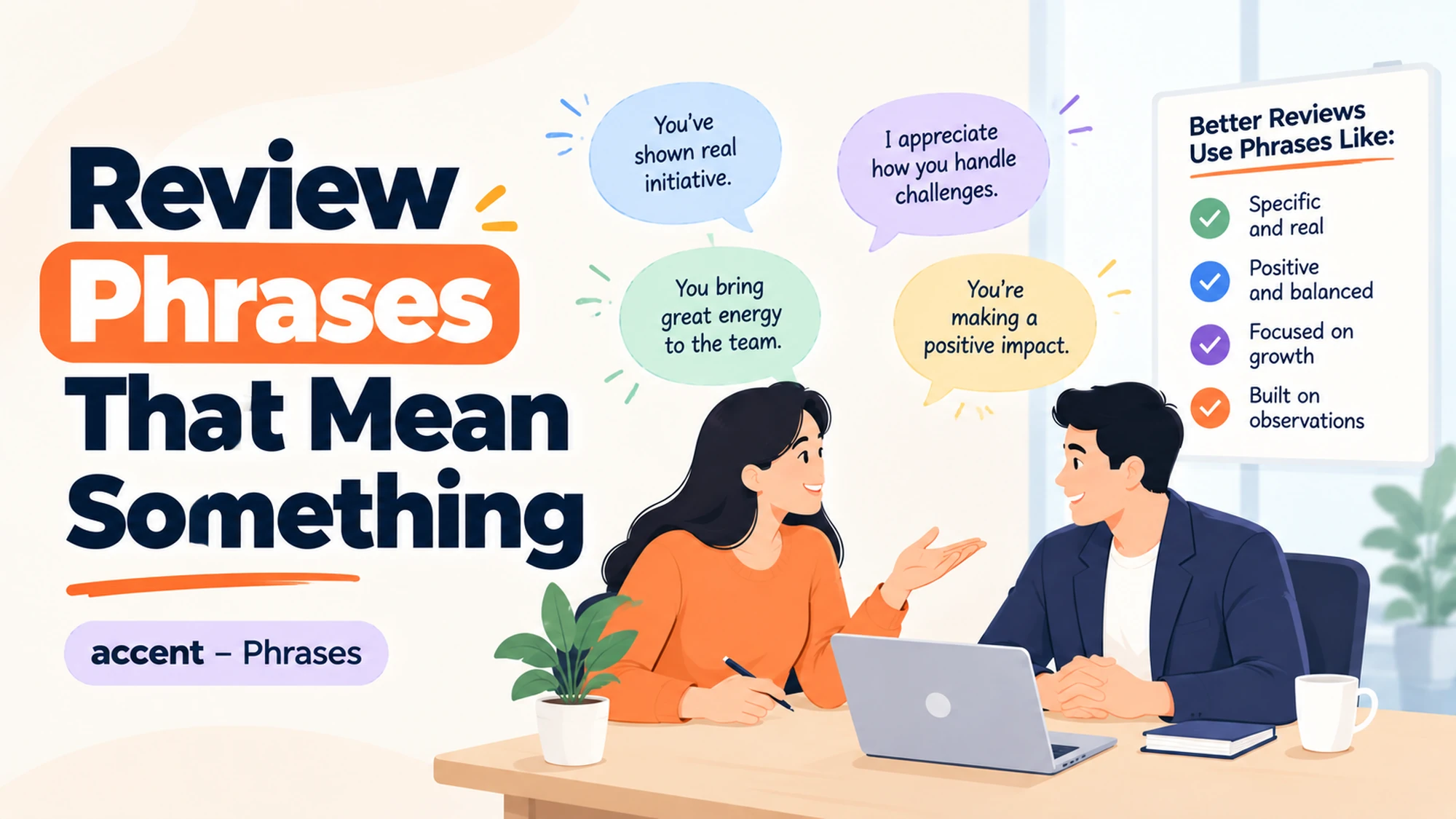
The lists that come back are long and they all have the same quality. Demonstrates a strong work ethic. Could benefit from improved attention to detail. Consistently meets expectations while showing room for growth in communication. They're smooth, they're safe, and after ten minutes of reading them it becomes hard to remember what any of them actually mean.
They get used anyway, because they solve the immediate problem, which is that six documents need to exist by Friday. The reviews are completed. The people receiving them read a page of sentences that could have been written about anybody, conclude that their manager had to write something, and file it.
Best tools for Performance Management
The real problem isn't that the phrases are badly written. It's that they're built to do a different job from the one you need. A phrase bank exists to help you say something in a way that's defensible and inoffensive, which means stripping out the specifics, and the specifics are the entire value. What you observed, what it caused, and what you want instead cannot be supplied by a list, because the list doesn't know what happened.
When You Genuinely Do Not Need to Act Yet
Your current setup is genuinely fine. Your written reviews contain dates, specific instances and a clear statement of what should be different, and people act on them. If that's true you're already doing the hard part, and no advice on phrasing will improve it.
Friction is starting to show. Somebody has asked what a comment meant, or you've reread a review from last year and couldn't remember what prompted a particular line. Both mean the writing has drifted towards the general. The cheapest check is to take one review and count how many sentences name a specific thing that happened.
It has become a real cost. A written review has been disputed, or somebody has said the document didn't reflect anything they'd been told, or a manager's reviews are visibly all the same. At this point the writing isn't just unhelpful, it's creating work and damaging trust.
The edge case that forces it. The written record may support a decision about somebody's employment, pay or promotion, or it may be examined by somebody outside the organisation. What's expected in that documentation, how it can be used, and what wording creates exposure differ sharply by jurisdiction. Establish what applies where you operate and take local advice before writing anything intended to support a formal decision.
Five Questions This Reader Asks at 11pm
What do I actually write? Three things per point: what you observed, what effect it had, and what you want instead. That structure does almost all the work, and it's why phrase banks fail, because they can supply the grammar and not the content. A sentence containing all three is useful even if it's clumsy. A polished sentence missing them is decoration.
How do I phrase criticism without it landing badly? By being more specific rather than softer. Vagueness feels kinder and is received worse, because the person can't tell how serious it is or what to do, so they assume the worst and can't act. A precise, narrow criticism attached to one instance is easier to hear than a general statement about their standard of work.
How long should a written review be? Short. A page that makes three specific points a person can act on beats four pages of coverage, and length is frequently a symptom of avoidance: where the substantive message is uncomfortable, it gets surrounded by supporting material. If you can't say the main point in the first paragraph, the document probably isn't ready.
Should I include examples? Yes, and this is the single highest-value habit in review writing. An example converts a claim into an observation, which is both fairer and harder to dispute. It also forces you to check: managers who sit down to find an example for a general impression quite often discover they can't, which is useful information about the impression.
What about reviews for people doing well? These are usually the worst documents produced in the whole cycle, and they're the ones where good writing has the most upside. A strong performer told they're excellent learns nothing. Told specifically what they do that others don't, they can do more of it deliberately, and they can explain it to somebody else.
Three Honest Categories the Approaches Split Into
Descriptive, written about the person. Sentences about what somebody is like: reliable, conscientious, a strong communicator. It's right in one narrow case, which is capturing something genuinely characteristic that shows up across contexts and is worth naming. It fails as the main mode because a description of a person can't be acted on. Being told you're not detail-oriented offers nothing to do on Monday, and it tends to be heard as a judgement about identity rather than about work, which makes it both harder to accept and harder to change.
Narrative, written about the year. A chronological account of what the person worked on. It's right for context, particularly where somebody's work has been invisible to whoever else reads the document. It fails because narration isn't evaluation. A list of projects with no assessment attached leaves the reader to infer what you thought, and the inference is usually wrong in whichever direction they're already inclined. These documents also grow long, since there's always more to describe.
Evaluative, written about specific work and its effect. Sentences naming something that happened, what it produced, and what you want next. It's right almost always, and it's harder to write, which is why the other two are more common. It fails when the specifics aren't available, which happens when a manager hasn't been close enough to the work or hasn't recorded anything during the year. In that situation the honest move is to say so rather than to substitute generalities that imply an observation you didn't make.
Five Diagnostic Questions You Can Self-Assess Against
Could this sentence have been written about somebody else on your team? Apply it line by line. Anything that passes this test carries no information about the person it's about, and it's occupying space that a specific observation could use. In most reviews this removes a surprising proportion of the text, and what's left is the part worth reading.
Does every point name something that actually happened? Look for the dates and the instances. A review with no specific events in it is a record of impressions, and impressions formed over a year drift towards recency and towards whatever supports the rating you'd already decided.
Would the person know what to do differently on Monday? Read the criticism and ask what the first action would be. If the answer isn't obvious, the point isn't finished. This is the test that separates a comment from a request, and reviews are full of comments.
Did you write this before or after deciding the rating? Be honest. Writing to a decided rating produces a document that selects evidence for a conclusion, and the person can usually tell, because the examples feel curated and the balance feels arranged.
How much of the document is about the most recent quarter? Check the distribution. Memory favours the recent, so reviews written from recollection over-represent the last few months, and somebody who had a difficult autumn after a strong year gets assessed on the autumn.
Six Ways Managers Write Reviews, Reviewed
Copying from a phrase bank
Sentences selected from a list of ready-made review language. It earns its place under genuine time pressure, and it prevents one real failure: a manager who doesn't know how to express something writing it in a way that causes unnecessary offence. Phrase banks are calibrated to be safe, and safety has value when the alternative is clumsy.
Where it falls short is that the safety is achieved by removing specifics, and the specifics are the content. A phrase designed to be usable by any manager about any employee is, by construction, free of anything particular to this person. The person receiving it recognises the register immediately. Many have read the same lists.
Use one for the grammar if you're stuck on how to say something, then replace every general noun with what actually happened. The sentence structure can be borrowed. The content can't.
There's a second-order problem with phrase banks that's worth knowing about. Because everybody draws on the same limited set of formulations, the phrases acquire agreed meanings that nobody stated. Consistently meets expectations reads to most people as the assessment given when there's nothing to say, regardless of whether you meant it as praise. You're writing in a code you didn't design and can't control, and the person is decoding it against whatever they've heard elsewhere.
Describing the person rather than the work
Assessments of character and disposition: proactive, reliable, lacking initiative. It earns its place occasionally, where a trait is genuinely consistent across contexts and naming it is more honest than pretending the pattern is situational.
It falls short in two ways that compound. Character descriptions can't be acted on, because there's no first step towards being more proactive in the abstract. And they're heard as claims about identity, which triggers defensiveness in a way that comments about specific work don't. There's a third problem worth stating plainly: character language is where bias most easily enters a review, because the descriptions are subjective and unanchored, and patterns in who gets described as aggressive or difficult or not a natural leader are worth examining rather than assuming.
Where you're tempted to write a character description, ask what the person did that produced the impression, and write that instead.
Sometimes that exercise produces nothing, and the nothing is the finding. An impression with no retrievable behaviour behind it is usually about fit, style or familiarity rather than about performance, and putting it in a document gives it a weight it hasn't earned. Managers who do this honestly quite often delete the point, which is the correct outcome and considerably better than discovering the same thing during a dispute.
Narrating the year without evaluating it
A chronological account of the work. It earns its place as context, especially where the document will be read by somebody who doesn't know what the person does, and it's genuinely useful for making invisible work visible.
It falls short because it isn't a review. Narration without evaluation leaves the reader to infer the assessment, and people infer according to their existing expectations, so a confident person reads a neutral account as positive and an anxious one reads it as criticism. It also produces long documents that take hours to write and don't say anything anybody disagreed with, which is a lot of effort for a record.
Narrate briefly if context is needed. Then say what you thought about it.
The test for whether the narration is earning its place is who else will read the document. Where a review travels to a promotion panel or a calibration discussion, context about what the person actually worked on is genuinely necessary, because those readers have no other source. Where it stays between two people who both lived through the year, narrating it back is filling space, and both of them know it.
Writing only about the most recent quarter
A review dominated by the last few months. It earns its place never, deliberately, but it happens constantly and it's worth understanding rather than just condemning, because it's a memory artefact rather than a choice. Without notes, the recent is what's available.
It falls short by producing systematically unfair assessments in both directions. Somebody whose strong year ended with a difficult project is assessed on the project. Somebody who coasted and then delivered well in the autumn is assessed on the autumn. Neither is a judgement anybody would defend if it were stated explicitly, and both are extremely common.
The fix is notes during the year, and it doesn't take much: a line after anything notable, good or bad, with a date. Twenty minutes across a year prevents the single most common distortion in review writing.
One caution about what to record. Notes taken to help somebody improve read differently from notes taken to support a future judgement, and the difference is visible to anybody who later reads them. Record what happened and what you said about it rather than accumulating a list of failures, both because it's more useful and because a file consisting only of negatives invites an obvious question about what else occurred that year.
Writing to the rating already decided
The assessment is settled first and the document assembles support for it. It earns its place in one sense only, which is honesty about what usually happens: many managers do know the rating before they write, and pretending otherwise doesn't help.
It falls short because the writing stops being an assessment and becomes an argument. Evidence gets selected, counter-examples get omitted, and the balance is arranged rather than discovered. The person can usually tell, and the document is weak precisely where it needs to be strong, which is if the decision is ever questioned.
The discipline that helps is to write first and rate afterwards, and to notice when the written account doesn't support the rating you expected. That happens often enough to be worth the sequence. It is also the only sequence that lets a review change your mind, which is presumably the point of writing one. A document produced to justify a conclusion cannot tell you anything you did not already believe.
Describing specific observed behaviour and its effect
What happened, what it caused, what should be different. It earns its place as the only approach that produces a document somebody can act on, and it's fairer, because it rests on observations rather than impressions. It's also the most defensible if it's ever examined, for the same reason.
It falls short on effort and on availability. It takes longer to write, and it requires that you have the specifics, which means having paid attention during the year. Where a manager hasn't been close to the work, this approach exposes that immediately, which is uncomfortable and is also the correct signal.
If you can't find a specific example for a point you want to make, that's information. Either the point is weaker than you thought, or you need to observe before you assert it. A third possibility is worth allowing for: the example exists and you were not there to see it. Where somebody's work happens largely outside your line of sight, the honest route is to ask people who were, which takes two short conversations and produces material you could not otherwise have had.
The Decision Table
| Situation | Scale | Setup | Primary Pain | Recommended Starting Point |
|---|---|---|---|---|
| Reviews contain dates, instances and requests | Any | Any | None | Leave it alone |
| Sentences could describe anybody | Any | Any | No information is being transferred | Replace general nouns with what happened |
| Criticism is soft and nobody acts on it | Any | Any | Vagueness read as serious, but unactionable | More specific, not gentler |
| Document is four pages and says little | Any | Any | Length is standing in for substance | Three points, one page |
| All the content is from the last quarter | Any | Any | Memory, not judgement | Notes during the year, with dates |
| Written after the rating was decided | Any | Any | The document assembles a case | Write first, rate second |
| Character words dominate | Any | Any | Unactionable, and where bias enters | Name the behaviour that caused the impression |
| Strong performer's review says nothing | Any | Any | Praise without specifics teaches nothing | Name what they do that others do not |
| Record may support a formal decision | Any | Any | Wording carries exposure | Establish local requirements, take advice |
The second row is the whole article in one line. The test costs nothing, applies to every sentence, and removes most of what makes review documents feel hollow to the people who receive them.
Vague Phrase to Specific Statement
The common phrases aren't wrong exactly. They're compressed to the point where the information has been squeezed out, and they can usually be unpacked back into something useful.
| The common phrase | What it usually means when managers write it | What to write instead |
|---|---|---|
| Needs to improve communication | Something specific went wrong that you have not named | Name the instance: what wasn't said, to whom, and what it caused |
| Lacks attention to detail | A particular kind of error recurs | Name the error type, how often, and where it was caught |
| Could show more initiative | You wanted them to act without being asked, in a case you remember | Describe that case, and what you'd have wanted |
| Demonstrates a strong work ethic | They work hard, which you noticed and cannot evidence | Name what they delivered, and what it required |
| Is a great team player | They helped somebody, or they are easy to work with | Name the help, who received it, and what it made possible |
| Meets expectations | Nothing went wrong and nothing stood out | Say that plainly, then say what would make it exceed |
| Needs to be more strategic | They are operating at a level below the one you want | Name a decision they made tactically that needed a wider view |
| Struggles under pressure | Something happened during a specific difficult period | Describe that period and what you observed |
The last two rows are the ones that do the most damage when left compressed. Needs to be more strategic is the most common unactionable comment in professional reviews, and almost nobody who receives it can say afterwards what they were supposed to do. Struggles under pressure is a character claim derived from a specific event, and unpacking it into the event usually reveals something more limited and more addressable than the phrase implies.
A warning on the second column. It's describing what managers typically mean, and that's not always what's actually happening. Sometimes needs to improve communication means the manager found somebody difficult to read, or that a single interaction went badly, or that somebody didn't communicate in the style the manager prefers. Unpacking the phrase honestly sometimes reveals that there's nothing underneath it, which is worth discovering before it goes in a document.
Writing About Somebody You Think Is Doing Well
Positive reviews are usually the least useful documents in the cycle, and it's worth understanding why, because the fix is straightforward.
The reason is that praise doesn't have to be precise to feel good. A person told they're excellent will accept the assessment without interrogating it, so the writing is never tested, and managers under time pressure quite reasonably put their effort where the document might be disputed. The strong performer gets a warm page of general approval and learns nothing.
What they've lost is specific. Somebody who doesn't know exactly what they do well can't do it deliberately, can't do more of it, and can't teach it to anybody else. That last point is worth dwelling on, because a strong performer who can articulate their own method is one of the most valuable things a team can have, and a review is one of the few occasions anybody would think to name it.
The second loss is direction. A review that's entirely positive with no development content tells somebody they've reached the ceiling of what this job can tell them, which is one of the more reliable precursors to a resignation. It isn't necessary to manufacture criticism. It is necessary to say what the next thing is, and that's a different conversation from what went wrong.
The third is fairness over time. Where strong performers get vague positive reviews and weaker performers get specific critical ones, the written record across a team becomes systematically uneven: detailed evidence for the negative cases and impressions for the positive ones. If those documents are ever compared, the picture they present is misleading.
The practical version is to hold positive reviews to exactly the same standard as critical ones. Name the specific thing, name what it produced, and name what you'd like them to do next with it. It takes the same effort and it's the difference between a document somebody enjoys and one they use.
What to Put in Writing
The review document is the artefact, and a few things around it determine whether it's any good.
| Artefact | Who owns it | When it is written | What it prevents |
|---|---|---|---|
| Dated notes of specific instances | The manager | Throughout the year, at the time | A review written entirely from the last quarter |
| What was already said to the person, and when | The manager | At the time | A written document containing new information |
| The written assessment, before the rating | The manager | Before deciding the rating | A document that assembles a case |
| What the person is asked to do differently | The manager | In the document itself | Criticism with no action attached |
| What a strong performer does that others do not | The manager | In the document itself | Praise nobody can use or repeat |
| Local requirements on wording and records | HR, with local advice | Before the cycle runs | Wording that creates exposure in a formal process |
The first row is the cheapest habit in this article and the one that fixes the most. A line with a date after anything notable, kept privately by the manager, takes a few minutes across a year and eliminates the recency distortion that otherwise dominates review writing.
Questions to Ask Before You Commit
On specificity. Could this sentence describe somebody else on the team? A bad answer is that it's a fair general description.
On evidence. Does each point name something that happened? A bad answer is that the pattern is well known.
On action. Would they know what to do on Monday? A bad answer is that they'll understand what's meant.
On sequence. Did you write before or after deciding the rating? A bad answer is that it doesn't matter.
On the positives. Does the strong performer's review name anything they could repeat deliberately? A bad answer is that they know they're doing well.
On exposure. Has anybody checked the wording against local requirements? A bad answer is that it's a standard template.
What Getting This Wrong Costs
The first cost is that the document does nothing. A review full of phrases that could apply to anybody transfers no information, so nothing changes, and the hours spent writing it are spent producing a record that exists only to have existed. Across a team and a year that's a serious amount of manager time, and it's the kind of waste that never gets identified because the artefact was produced on schedule.
The second cost is the trust it spends. People can tell when a document was assembled rather than written, and the particular signal is generality: sentences that don't fit them specifically read as evidence that nobody was paying attention. That's frequently a more damaging message than the criticism the review contains, and it applies to positive reviews too, where vague praise reads as polite dismissal.
The third cost is what happens if the document is ever examined. Character language, unevidenced claims and patterns in how different people are described are exactly the things that come under scrutiny when a decision is challenged, and a review written for speed is not written for that. What creates exposure differs by jurisdiction and the wording matters more than most managers expect, which is why a template borrowed from elsewhere is a poor substitute for something checked locally.
So before you write the next set, work out which of three problems you have. An observation problem means you don't have the specifics because you weren't close enough to the work, and the answer is notes during the year rather than better phrasing. A courage problem means you have the specifics and are softening them, and the answer is precision rather than gentleness. A structure problem means you're describing people instead of work, and the answer is to name the behaviour that produced the impression.
When You Are Ready to Go Further
None of this needs a template or a tool. It needs a dated note after anything notable, three specific points per review instead of a page of coverage, and the written assessment completed before the rating is decided.
The step beyond your own writing is the comparison nobody makes. Read the reviews written across your organisation for people at the same level and look at the differences: whose documents contain evidence, whose contain character descriptions, and whether those patterns track anything they shouldn't. That exercise takes an afternoon and produces findings no review training will surface.
HROpsLab publishes independent comparison work across HR tooling, applicant tracking and payroll. We sell nothing, we take no vendor money, and we publish no paid placements. If the next step is looking at what your current tooling encourages managers to write, our comparison work is one place to start.
Frequently Asked Questions
What should you write in a performance review?
Three things for every substantive point: what you observed, what effect it had, and what you want to be different. That structure carries the entire value of a review document, and it's the reason phrase banks don't help, since a list can supply the sentence shape but not the content. A useful test is whether the sentence could have been written about somebody else on your team. If it could, it's telling the reader nothing about the person it's supposed to be about, and it's taking up space a specific observation could occupy.
How do you phrase criticism in a review?
By being more specific rather than more gentle, which is counter-intuitive and reliably true. Vague criticism feels kinder to write and lands worse, because the person can't tell how serious it is or what to do about it, so they assume the worst available interpretation and have nothing actionable. A narrow criticism attached to one named instance is easier to receive than a general statement about somebody's standard of work. Name what happened, name what it caused, and name what you'd want instead, then stop. Softening language added around that usually just makes the message harder to locate.
How do you write a performance review for a strong performer?
Hold it to exactly the same standard as a critical one, which almost nobody does. Praise doesn't need to be precise to feel good, so it rarely gets tested, and the result is a warm page of general approval that teaches the person nothing. What they need is the specific: what do they do that others don't, what did it produce, and what should they do next with it. Somebody who can articulate their own method can repeat it deliberately and teach it to a colleague, and a review is one of the few moments anybody thinks to name it out loud.
What phrases should you avoid in a performance review?
Anything describing the person rather than the work, since character language can't be acted on and is where bias enters most easily. Patterns in who gets described as difficult, aggressive or not a natural leader are worth examining rather than assuming, and these descriptions carry real exposure if a decision is ever challenged. Also avoid the compressed standards: needs to improve communication, lacks attention to detail, could show more initiative. None of them is wrong, they're just squeezed to the point of carrying no information, and each can be unpacked into the specific instance that prompted it.
How long should a written performance review be?
Short enough that the main point is unmissable, which usually means a page making three specific points rather than four pages of coverage. Length is frequently a symptom of avoidance: where the substantive message is uncomfortable, it gets surrounded by supporting material until it's hard to find, and the reader then has to work out which part was the actual message. If you can't state the main point in the first paragraph, the document probably isn't finished. Long reviews also take hours to write, and that time is better spent finding one good example than producing more prose.
Should you include specific examples in a review?
Yes, and it's the single highest-value habit in review writing. An example converts a claim into an observation, which is fairer to the person, harder to dispute, and considerably more useful if the document is ever examined. It also serves as a check on the manager: sitting down to find an example for a general impression quite often reveals that you can't, which is important information about the impression rather than about the person. If a point can't be evidenced, either it's weaker than you believed or you need to observe before asserting it.
How do you write a review for someone you manage poorly?
Start by acknowledging it internally, because it changes what the document can honestly contain. If you haven't been close to the work, you don't have the specifics, and writing generalities that imply observations you didn't make is the wrong solution. The honest version says what you did observe, says plainly where your visibility was limited, and asks the person to fill the gaps. That's uncomfortable and it's far better than a confident assessment built on impressions, which the person will recognise and which won't survive being questioned.
Should the employee see the written review before the meeting?
Usually yes, a day or two ahead, because it lets somebody absorb an uncomfortable message privately rather than while being watched. It also changes what the meeting is for: instead of delivering content, you're discussing a response, which is a better use of the hour. The risk is that a written document read alone lands in the reader's least generous interpretation, with no tone and no chance to ask a question, so anything significant should have been said in person already. If the written review contains something the person hasn't heard before, sending it in advance is not the problem to fix first.
A review sentence that could describe anybody has told the reader one thing only: that you had to write something.