

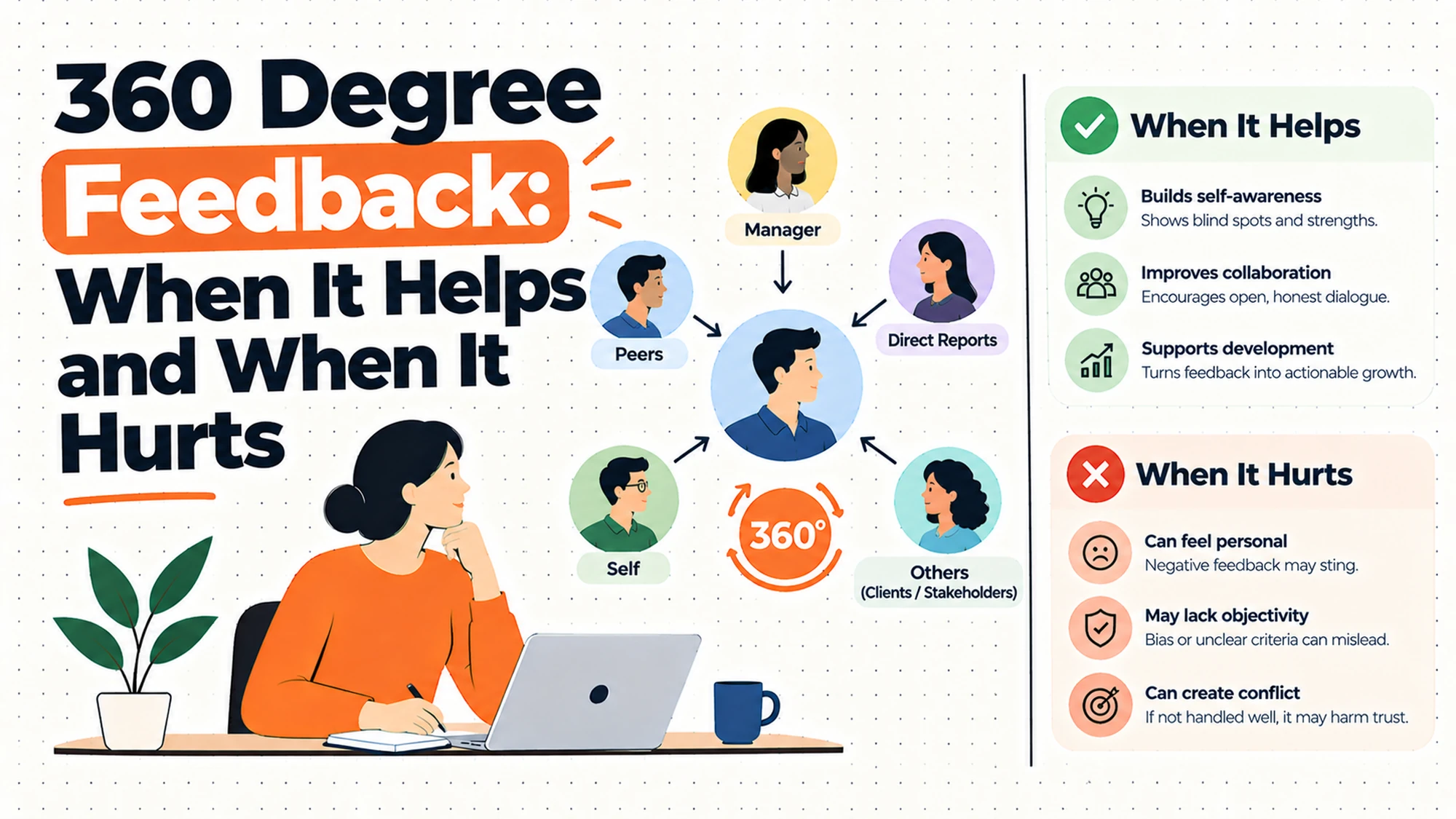
TL;DR
- The core decision: whether the results feed a decision about somebody, because that single choice determines whether the input will be honest.
- When doing nothing is right: when managers already know how their people are experienced by colleagues, and nobody has asked for more.
- What has to be true: somebody can say what will happen to the results before anybody is asked to contribute.
- How the options split: by who contributes, whether they're named, and whether the output touches pay or promotion.
- Decision rule: attach it to development and it produces honesty. Attach it to consequences and it produces trading, retaliation and careful blandness.
- Outcome to expect: information a manager genuinely didn't have, and a delivery conversation that needs more care than the collection did.
The Report Nobody Can Use
An organisation runs a multi-source feedback exercise. The intention is good: managers only see one angle on somebody's work, and the people around them see things the manager never will. Colleagues, reports and internal customers all contribute, anonymously so they can be candid.
The reports come back and they're strange documents. Most scores cluster near the middle. A few comments are specific and genuinely useful. One or two are clearly written by somebody with a grievance, and the person receiving the report can usually work out who. The overall picture doesn't resolve into anything: the person is rated highly on some things, poorly on others, and the free text contradicts itself.
Then the reports get delivered, often in a short meeting, sometimes by email. Somebody who's just read that unnamed colleagues find them difficult to work with has no way to ask what happened, no context, and no route to respond. The most common outcome is that they fixate on the single worst comment and discard everything else, including the useful parts.
Best tools for Performance Management
The real problem isn't that multi-source feedback is a bad idea. It genuinely answers a question nothing else answers, which is how somebody is experienced by the people around them. What breaks it is attaching it to a decision, and what wastes it is treating the delivery as an afterthought. Both are fixable, and both are usually decided by default rather than deliberately.
When You Genuinely Do Not Need to Act Yet
Your current setup is genuinely fine. Managers have a good sense of how their people are experienced by colleagues, feedback moves between teams without needing a mechanism, and nobody has raised a gap. A formal exercise adds ceremony to something already working.
Friction is starting to show. A manager has been surprised by how somebody is regarded elsewhere, or a promotion discussion revealed that colleagues had a different view from the manager's. Both suggest a genuine information gap. The cheapest check is for the manager to ask two or three people directly, which takes a morning and no system.
It has become a real cost. Somebody has been promoted into a role where their effect on colleagues turned out to be a problem nobody had recorded, or a pattern of complaints emerged that the manager hadn't seen. At this point the manager's single viewpoint is demonstrably insufficient, and a structured way to gather other views is worth the effort.
The edge case that forces it. You're considering attaching results to pay, promotion or any formal decision, or running it in teams small enough that anonymity can't be preserved. Both raise questions about data protection, confidentiality and how feedback may be used in employment decisions, and requirements differ sharply by jurisdiction. Establish what applies where you operate and take local advice before collecting anything.
Five Questions This Reader Asks at 11pm
Should it be anonymous? It depends entirely on what you want. Anonymity buys candour on things people won't say openly, particularly about somebody senior, and it costs specificity, because anonymous comments can't be followed up and a person can't ask what happened. Named feedback is more actionable and much narrower in what it will contain.
Should it affect pay or promotion? No, in almost every case, and this is the decision that determines whether the whole exercise works. The moment results carry consequences, contributors start calculating: they moderate criticism of people they depend on, inflate for friends, and occasionally settle scores. You'll still get a report, and it'll describe your organisation's politics rather than somebody's work.
How many raters do you need? Enough that no single response dominates, which usually means a handful at minimum, and few enough that the exercise doesn't become a burden on everybody's week. Beyond a certain point additional raters add noise rather than signal, particularly people with limited exposure to the person's actual work.
Who should choose the raters? Both, jointly. Letting the person pick produces a friendly sample and a comfortable report that tells nobody anything. Letting the manager pick alone can look targeted, particularly if the person's relationship with their manager is already strained. Agreeing the list together, with a requirement to include people the work genuinely depends on, is the version that holds up.
How often should we run it? Rarely. Once a year is frequent, and every couple of years is defensible for most organisations. These exercises cost significant time across everybody who contributes, and the useful findings don't change quickly. Running it more often produces survey fatigue and progressively less thoughtful responses.
Three Honest Categories the Approaches Split Into
Anonymous and broad. Many raters, unnamed, usually with a scored questionnaire and free text. It's right where you're looking for patterns that individuals wouldn't state openly, and particularly for upward feedback where the power difference makes named input unrealistic. It fails on actionability and on what it does to the recipient. Unattributed criticism can't be explored, so a person is left with a negative statement, no context, and no way to respond, which is why the single worst comment so often dominates their reading. In small teams it also fails at anonymity itself, since the author is usually identifiable from the content.
Named and narrow. Fewer contributors, identified, giving specific feedback they're willing to own. It's right where the culture can support it and where you want something the person can actually act on, because a named comment can be discussed. It's also more honest about what's happening: feedback given anonymously about a colleague is a peculiar arrangement when both people work together daily. It fails where candour genuinely requires protection, which is most upward feedback and anything involving a person who reacts badly to criticism.
Manager-gathered and summarised. The manager asks several people informally and presents the themes themselves. It's right as a first step and for small organisations, because it costs a morning, needs no system, and the manager can ask follow-up questions that a questionnaire can't. It also puts a person between the raw comment and the recipient, which is usually a good thing. It fails on trust and on bias: contributors may soften what they say to a manager, and the manager's own view inevitably shapes which themes get reported.
Five Diagnostic Questions You Can Self-Assess Against
What will happen to the results? Answer before anybody is asked to contribute, and say it in the invitation. Contributors behave completely differently depending on whether this informs somebody's development or somebody's pay, and leaving it ambiguous means they'll assume the version that makes them careful.
Could a contributor be identified from what they write? Test it honestly against your actual team sizes. Where somebody is one of three people who could possibly have made a particular observation, anonymity is nominal, and promising it anyway is a promise you can't keep. That matters both for the contributor's safety and for what they'll be willing to say.
Who's delivering the results, and how long do they have? If the answer is by email, or in fifteen minutes at the end of another meeting, the exercise will do more harm than good. The delivery is not the last step of the process. It's most of the value, and most of the risk.
Has anything ever changed because of a previous round? If you've run this before and nobody can name a change, contributors have learned that, and their effort this time will reflect it. That's the main reason second and third rounds produce thinner responses than the first.
Would you run this on yourself first? It's a reasonable test of whether the design is humane. Leaders who've been through their own process tend to fix the delivery step, because they've experienced what it's like to read an unattributed criticism with no route to ask about it.
Five Multi-Source Approaches, Reviewed
Full anonymous 360 with many raters
Input from managers, peers, reports and sometimes internal customers, unnamed, usually scored. It earns its place by producing the widest view available and by allowing things to be said that wouldn't be said openly. For somebody genuinely unaware of how they're experienced, it can be the first honest signal they've received.
Where it falls short is in the gap between information and action. Scores cluster, comments contradict, and the recipient has no route to ask what any of it refers to. The volume also creates a problem of its own: a report with many dimensions and many comments invites the reader to focus on the worst line, which is exactly what most people do. And the anonymity that enables candour also enables the occasional comment written out of grievance, which is impossible to distinguish from legitimate criticism and does disproportionate damage.
If you run this, the design questions that matter are how few questions you can get away with and how much time you're giving the delivery conversation.
Questionnaire length deserves more attention than it gets. A long instrument produces worse data rather than more of it, because contributors answering a fortieth item are no longer thinking about the person, they're finishing a task. Ratings towards the end of a long form cluster around whatever the respondent has been choosing so far, which is why so many reports show suspiciously flat profiles with the interesting variation concentrated near the top.
Upward feedback on managers only
Reports give feedback about their manager, anonymously, aggregated. It earns its place because it addresses the sharpest information asymmetry in any organisation: a manager's effect on their team is the thing they can least observe and the thing that matters most about their job.
It falls short on group size and on what follows. A manager with two or three reports cannot receive anonymous feedback in any meaningful sense, and running it anyway exposes the contributors. It also fails where nothing visible happens afterwards, which teaches a team that saying something costs effort and produces nothing, and the next round will be blander. Where a manager reacts badly to what they read, the damage extends beyond that team.
The version that works aggregates across a minimum group size, goes to the manager's own manager as well, and is followed by something the team can see.
That last element is what separates this from an exercise in measurement. A manager who reads their results, tells the team what they heard, names one thing they're going to change and comes back to it later has done something no report achieves on its own. It also creates an accountability the team can observe, which is the only reason anybody would contribute honestly a second time.
Peer feedback with named contributors
Colleagues give feedback they're willing to attach their name to. It earns its place on actionability. A named comment can be discussed, which means the recipient can ask what happened, understand the context, and respond, and that conversation is frequently where the actual value appears.
It falls short on range. People will not say certain things with their name attached, particularly about somebody more senior, somebody they depend on, or somebody who reacts badly. So the feedback you get is real and it's a subset, weighted towards the safe end. It also puts a social cost on the contributor, which some will decline to pay and others will pay unevenly.
It works best in teams that already discuss work openly, where it formalises something that already happens rather than introducing something new.
Where it's introduced into a team that doesn't already work that way, the first round tends to be uniformly positive and largely useless. That's not a failure so much as a reasonable response to an unfamiliar request, and it means the exercise needs several rounds before it produces anything. Organisations that expect substance immediately usually abandon it after the first attempt and conclude their people aren't candid.
The manager gathering input informally
The manager asks several colleagues about somebody, synthesises it, and presents the themes. It earns its place as by far the cheapest option and often the most useful: it takes a morning, needs no tooling, and allows follow-up questions that no form can ask. It also filters out the single spiteful comment before it reaches anybody.
It falls short on what people will say to a manager and on what the manager does with it. Contributors moderate, particularly if they suspect it might affect a colleague's pay, and the manager's existing view shapes which themes they hear and report. There's also no record, which matters if the picture is ever contested.
For most organisations most of the time, this is the right starting point, and the honest framing is that it's a manager doing their job rather than a process.
The questions matter more than the format. Asking what somebody is like to work with produces a character assessment nobody can act on. Asking what this person does that makes your work easier, and what they do that makes it harder, produces specific behaviour, and both halves get answered, which is rarely true of a general request for feedback.
Doing none of it
Relying on the manager's own observation. It earns its place more often than the market for these exercises suggests, particularly in small organisations where a manager genuinely works alongside their people and sees the interactions directly.
It falls short as soon as somebody's work happens mostly outside the manager's view, which is most professional work. It's especially weak for the thing multi-source feedback is best at, which is detecting somebody whose results are good and whose effect on colleagues is costing the organisation something. That pattern is close to invisible from above and obvious from beside. It is also the pattern most likely to be discovered too late, usually after the person has been promoted on the strength of their results and the complaints start arriving from a larger group.
If you're not going to gather other views formally, at least make it a habit to ask two people before any significant decision about somebody.
The moment that matters most is promotion into a role with more authority over others. That's precisely where a manager's view is least sufficient and where the cost of being wrong lands on people who had no say in the decision. Two conversations beforehand is a small amount of effort against an outcome that's expensive and slow to reverse.
The Decision Table
| Situation | Scale | Setup | Primary Pain | Recommended Starting Point |
|---|---|---|---|---|
| Managers already know how people land | Under thirty | Co-located | None | Do not run an exercise |
| Manager surprised by an outside view | Any | Any | One viewpoint is insufficient | Manager asks three people directly |
| Work happens outside the manager's sight | Any | Distributed, matrixed | Structural blind spot | Named peer feedback, kept developmental |
| Results would feed pay or promotion | Any | Any | Input will stop being honest | Do not attach it. Decide separately |
| Teams smaller than about five | Any | Any | Anonymity cannot be preserved | Named, or manager-gathered instead |
| Manager effect on team is the question | Any | Any | Sharpest asymmetry in the organisation | Upward feedback, aggregated, minimum group size |
| Previous round changed nothing | Any | Any | Contributors have learned that | Fix the follow-through before running again |
| Strong results, difficult to work with | Any | Any | Invisible from above | This is what the exercise is best at |
| No time to deliver results properly | Any | Any | Delivery is most of the value and risk | Postpone. A rushed delivery does harm |
The fourth row is the one decision that determines everything else. Once results carry consequences, you're no longer collecting observations, you're collecting positioning, and the report will be a reasonably accurate description of your organisation's relationships rather than of anybody's work.
Anonymous or Named
This is the design choice with the largest effect and it's usually made by habit. Both options are defensible and they buy different things.
| The choice | What it makes possible | What it costs |
|---|---|---|
| Anonymous | Criticism of senior people, and things nobody would say openly | Specificity, since nothing can be followed up |
| Anonymous | Contributors protected from consequences | The occasional grievance comment, indistinguishable from fair criticism |
| Anonymous | Wider participation, since it asks less courage | A recipient left with a statement and no route to understand it |
| Named | Feedback the person can discuss and act on | A narrower range, weighted towards what is safe to say |
| Named | Accountability for what is written | Reluctance where power differences are real |
| Named | A conversation rather than a report | A social cost on the contributor, unevenly borne |
The second row is the one that gets underestimated. In any exercise of reasonable size, at least one comment will be written from frustration rather than assessment, and the recipient has no way to weigh it. It will occupy more of their attention than everything else combined, which is a known feature of how people read feedback about themselves.
The fourth row explains why named exercises feel disappointingly mild. That mildness isn't a failure of the design, it's an accurate reflection of what people are willing to own, and it's worth knowing in advance rather than concluding afterwards that your culture lacks candour.
There's a middle option worth considering: anonymous to the recipient, attributed to a facilitator. That keeps contributors protected while letting somebody follow up for context, which addresses the specificity problem without exposing anyone. It costs more time and it's the version most likely to produce something usable.
It does require somebody trusted enough to hold both sides, which is the constraint. In a small organisation there may be nobody in that position, and appointing somebody who isn't trusted produces the worst of both arrangements: contributors who suspect they're identifiable and a recipient who still can't ask about anything.
Delivering the Results Without Damage
The collection is the easy half. Whether anybody benefits is decided almost entirely in how the results are delivered, and this is where most exercises fail.
Give it a proper meeting with a prepared person. Not the last fifteen minutes of a one-to-one, and never by email alone. Somebody reading unattributed criticism of themselves with nobody present will do what everybody does, which is fix on the worst line and rehearse a defence against an author they can't identify.
Go through the aggregate before any individual comment. Reading verbatim comments aloud one after another is the most common delivery mistake, and it guarantees that whichever one stings most becomes the whole meeting. Patterns are the finding; individual comments are illustrations of patterns or they're noise. Starting with the overall shape gives the person a frame to place the comments into, and it prevents a single outlier from defining the session.
Say out loud that some of it will be wrong. Managers frequently skip this, worried that it gives the person licence to dismiss everything, and in practice it does the opposite: somebody who has been told they can discard the unfair parts engages far more readily with the rest. This is true, and saying it does not undermine the exercise. Multi-source feedback contains observations from people with partial views, occasional grievances, and different standards, and acknowledging that gives the recipient permission to engage rather than defend. The useful question is not whether every statement is accurate but why several people independently formed a similar impression.
That reframing does a specific piece of work. It moves the conversation off the question of whether the feedback is fair, which is unresolvable and where most delivery meetings get stuck, and onto what somebody might be doing that produces this effect. Those are different questions, and only the second has an action attached to it.
Separate what they should act on from what they should know. Most reports contain more than anybody can address. Picking one or two things, together, is the difference between a conversation that changes something and one that produces a resolve to be better in general, which changes nothing. Choosing together matters as much as choosing few. A person who selects their own focus from the report is committing to something, whereas one who is handed two items has been given an instruction, and the difference shows up in whether anything is still happening two months later.
And decide what happens next before the meeting ends. A follow-up conversation in a couple of months, with something specific to review, is what converts a report into a change. Without it the document goes in a drawer, and the next round will produce thinner responses because contributors will have noticed. Contributors notice this faster than most organisations expect. People who took twenty minutes to write something considered can tell within a few months whether anything came of it, and they calibrate their effort accordingly the next time they are asked.
What to Put in Writing
These exercises generate a lot of material and very little of the useful kind.
| Artefact | Who owns it | When it is written | What it prevents |
|---|---|---|---|
| What the results will and will not be used for | Whoever runs it | In the invitation to contributors | Contributors calculating instead of observing |
| The minimum group size for reporting | Whoever runs it | Before collection | Exposing contributors in small teams |
| Who chose the raters, and on what basis | The manager, with the person | Before collection | A friendly sample, or a targeted one |
| The one or two things to act on | The manager, with the person | At the delivery meeting | A report that produces general resolve |
| What changed after the last round | Whoever runs it | Before running it again | Thinner responses each cycle |
| Local requirements on anonymity and use | HR, with local advice | Before any collection | Promising confidentiality you cannot deliver |
The first row is the cheapest and most consequential. Stating plainly in the invitation that this informs development and will not be used in pay or promotion decisions changes what contributors write, and it's only worth saying if it's true, because the first time it isn't, every subsequent exercise in that organisation is compromised.
Questions to Ask Before You Commit
On purpose. What will the results be used for, and have you said so? A bad answer is that it's for development, offered without checking what happens downstream.
On anonymity. Could a contributor be identified from their comment? A bad answer is that the system anonymises it.
On delivery. Who delivers this, and how long do they have? A bad answer is that the report is self-explanatory.
On the raters. Who chose them? A bad answer is the person being assessed.
On history. What changed after the last round? A bad answer is that people found it useful.
On the rules. What applies where you operate on confidentiality and use in decisions? A bad answer is that the vendor handles compliance.
What Getting This Wrong Costs
The first cost is what happens to the person who receives a poorly delivered report. Anonymous criticism, read alone, with no context and no route to ask, is a genuinely difficult experience, and the predictable response is defensiveness rather than reflection. Organisations that run this badly frequently produce the opposite of what they intended: people become more guarded, less open to feedback generally, and suspicious of colleagues they now believe wrote something.
The second cost is the honesty you spend. Once contributors learn that their input affects somebody's pay, or that nothing ever happens as a result, the quality of what they write drops and doesn't recover easily. That's a durable loss, because the next exercise inherits the reputation of the last one, and an organisation with two failed rounds behind it cannot easily run a good third. Recovering from that takes a visible change in how the exercise is run and an explicit acknowledgement that the earlier rounds were handled poorly, which organisations are generally reluctant to make.
The third cost falls on people who are already less advantaged by informal systems. Multi-source feedback measures how somebody is experienced, which is correlated with how much people interact with them, how similar they are to their colleagues, and how comfortable colleagues feel commenting on them. Patterns in who receives harsher unattributed feedback are worth examining rather than assuming, and where results touch decisions, those patterns start to matter in ways that carry real exposure.
So before you run anything, work out which of three things you want. An information problem means the manager genuinely can't see something, and the cheapest fix is the manager asking three people directly. A fairness problem means decisions rest on one person's view and you want more inputs, which is a legitimate aim and the one most likely to corrupt the feedback if handled through this mechanism. A development problem means somebody needs to understand their effect on others, which is what this is actually good at.
When You Are Ready to Go Further
None of this needs a platform to begin. It needs a manager asking three colleagues a direct question, a stated purpose given to contributors, and a proper meeting to deliver whatever comes back.
The step beyond an individual exercise is the follow-through, which is where nearly all the value is created or lost. Book the second conversation at the time you deliver the first, with one specific thing to review, and make sure something visible happens after an upward feedback round. An organisation that does that well can run these usefully for years. One that doesn't will find each round producing less than the last.
HROpsLab publishes independent comparison work across HR tooling, applicant tracking and payroll. We sell nothing, we take no vendor money, and we publish no paid placements. If the next step is looking at what these exercises actually require from your tooling, our comparison work is one place to start.
Frequently Asked Questions
What is 360 degree feedback?
It's a process for gathering assessments of somebody from multiple directions rather than from their manager alone: peers, direct reports, internal customers and sometimes people outside the immediate team. The rationale is straightforward and sound, since a manager sees only one angle on somebody's work and frequently the least informative one when it comes to how that person is experienced by colleagues. The name refers to the range of viewpoints rather than to any particular method, and the practical decisions that determine whether it works are about anonymity, rater selection, what the results feed, and how they're delivered.
Should 360 feedback be anonymous?
Both options are defensible and they buy different things. Anonymity enables criticism that wouldn't otherwise be voiced, particularly about senior people, and it costs specificity, because an unattributed comment can't be followed up and leaves the recipient with a statement they can't understand or discuss. Named feedback is far more actionable and considerably narrower, since people won't say certain things with their name attached. A middle option worth considering is anonymous to the recipient but attributed to a facilitator, which protects contributors while allowing somebody to follow up for the context that makes a comment usable.
Should 360 feedback affect pay or promotion?
No, in almost every case, and this single decision determines whether the whole exercise produces anything worth having. The moment results carry consequences, contributors stop observing and start calculating: moderating criticism of people they depend on, being generous to friends, and occasionally settling a score. You'll still receive a report, and it will describe your organisation's relationships more accurately than anybody's work. Keep the exercise developmental and make pay and promotion decisions through a separate process with its own inputs, and say so explicitly in the invitation to contributors.
How many raters do you need for 360 feedback?
Enough that no single response can dominate the picture, which in practice means a handful at minimum, and few enough that contributing doesn't become a significant demand on everybody's week. Past a certain point additional raters add noise rather than signal, particularly people with limited exposure to the person's actual work, whose contributions tend towards general impressions. Group size also determines whether anonymity is real: in a team of three or four, the author of a distinctive comment is usually identifiable, so promising confidentiality in that situation is a promise you can't keep.
Who should choose the raters?
The person and their manager together, with an explicit requirement to include people the work genuinely depends on rather than only those it's pleasant to work with. Letting the individual choose freely produces a friendly sample and a comfortable report that teaches nobody anything. Letting the manager choose alone can look targeted, especially if that relationship is already strained, and it undermines the credibility of whatever comes back. Agreeing the list jointly takes one short conversation and removes most of the objections that get raised afterwards about whether the sample was fair.
How often should you run 360 feedback?
Rarely. Annually is frequent, and every couple of years is reasonable for most organisations. These exercises consume real time across everybody who contributes, and the findings don't change quickly enough to justify running them often. More frequent rounds produce fatigue and progressively less considered responses, particularly if nothing visible changed after the last one. The useful rhythm is to run it, act on it properly, review what changed, and only then consider running it again, which naturally produces a longer gap than most calendars assume.
What do you do when 360 results contradict each other?
Treat the contradiction as the finding rather than as a flaw in the data. Somebody experienced very differently by two groups is telling you something specific and usually important: they may be excellent with peers and difficult with reports, or effective with their own team and unhelpful to other departments. That pattern is invisible in any single-source assessment and it's one of the most valuable things this exercise produces. Resist averaging, which destroys exactly the information you collected, and look instead at which groups saw what.
How should 360 feedback results be delivered?
In a proper meeting with somebody prepared for the conversation, never by email alone and never in the last fifteen minutes of something else. Start with the aggregate patterns rather than individual comments, since patterns are the finding and individual comments are either illustrations or noise. Say plainly that some of it will be wrong, which is true and gives the person permission to engage rather than defend. Then pick one or two things to act on together, and book a follow-up with something specific to review, because that second conversation is what converts a report into a change.
Attach it to somebody's pay and you stop collecting observations. You start collecting positioning.