
TL;DR
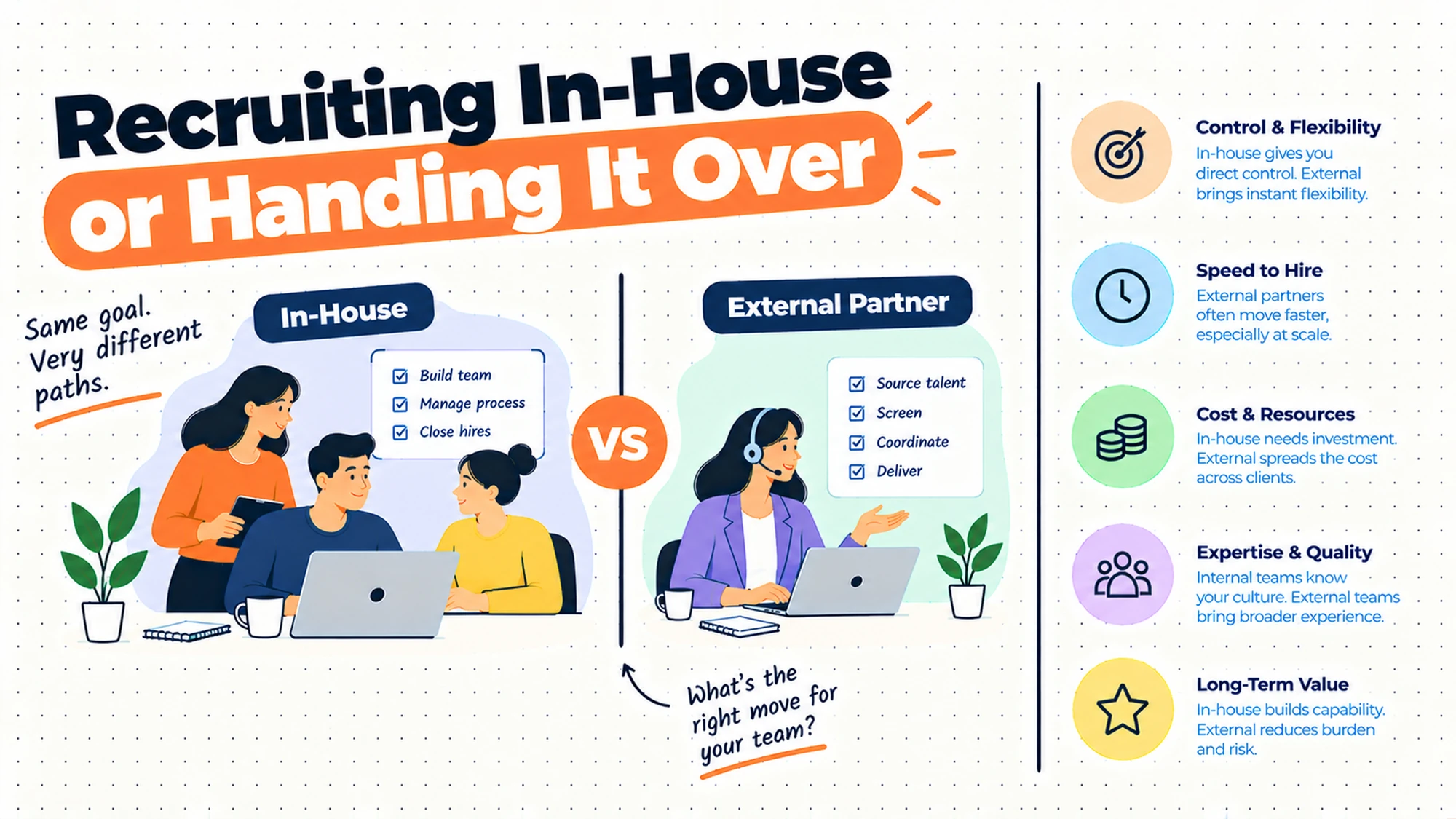
- The core decision: which parts of hiring depend on knowing your organisation, because those transfer badly whoever you engage.
- When doing nothing is right: when your current volume fits the people you have and nothing is slipping.
- What has to be true: somebody can say what you're buying, in one sentence, before anybody quotes.
- How the options split: by whether you're buying capacity, expertise, or the removal of a function you no longer want to run.
- Decision rule: if the bottleneck is decisions rather than throughput, adding external capacity makes it worse.
- Outcome to expect: a smaller thing outsourced than you expected, and better results from it.
The Quarter Where Hiring Doubled
Somebody commits to a growth plan. The hiring number roughly doubles, starting next quarter, and the recruiting team is two people who are already fully occupied.
The options get discussed in a meeting. Hire more recruiters, which takes a quarter and requires recruiting recruiters. Use agencies, which is expensive and happens per role. Or hand a chunk of the process to somebody whose job is absorbing exactly this kind of surge.
What usually doesn't get discussed is which parts of the work are actually the bottleneck. It's assumed to be throughput: more roles, more people needed. Frequently it isn't. The constraint is hiring managers who take a week to give feedback, a scheduling process that eats a day per candidate, and decisions that wait for people who can't get in a room.
Best tools for Applicant Tracking (ATS)
Adding external capacity to a decision bottleneck produces a larger pipeline arriving at the same closed door, and a bill. The candidates get sourced faster and then wait exactly as long, and everybody concludes that the arrangement didn't work.
So the honest reframe is that this decision isn't primarily about cost, and it isn't all or nothing. It's about which parts of hiring depend on knowing your organisation, because those parts transfer badly regardless of who you engage or how good they are. Sourcing transfers well. Judging whether somebody will work out here transfers barely at all.
Get specific about what you're buying, in one sentence, before anybody quotes for anything.
When You Genuinely Do Not Need to Act Yet
Your current setup is genuinely fine. Roles fill in acceptable time, nothing is slipping, and the team isn't drowning. Bringing in external help because it seems like what growing organisations do is spending money on an unstated problem.
Friction is starting to show. A couple of roles have taken longer than they should, or somebody is working late to keep up, or a hiring manager has complained about pace. Worth being precise here, because the fix is frequently a process change rather than more capacity. Find out where the time actually goes before deciding you need more people to spend it.
It has become a real cost. Roles are staying open long enough to affect delivery, the team is turning down work it should be doing, or you're paying per role repeatedly for searches that will recur. Now the case is real and it's worth asking what shape of help fits.
The edge case that forces it. A step change in volume, a market you have no presence in, or a specialised search nobody internal has run before. These are genuine reasons and they point at different arrangements from each other. Note that any arrangement involving a third party handling candidate data raises questions about responsibilities that differ by jurisdiction, so establish what applies where you hire with local advice before signing.
Five Questions This Reader Asks at 11pm
What is recruitment process outsourcing, exactly? An arrangement where somebody outside your organisation runs part or all of the hiring process, usually under an ongoing agreement rather than per role. The scope varies enormously, from sourcing only to an entire function, which is why comparisons between arrangements are frequently comparisons between completely different things.
How is that different from using an agency? Mainly the commercial shape and the depth of involvement. An agency is typically engaged per role, paid on a placement, and works from a brief. An outsourced arrangement is ongoing, priced differently, and the people involved usually work more closely with your team and systems. Both are external; the difference is whether they're filling a role or running a process.
What should never be outsourced? The decision, and anything that depends on knowing your organisation. Whether somebody will be effective in your specific environment is a judgement that requires context nobody acquires from a briefing, and every arrangement that tries to transfer it produces shortlists that look reasonable and don't convert.
Is it cheaper? Sometimes, and cost is the wrong first question. External arrangements usually cost less than the equivalent internal headcount at high volume and more at low volume, with the crossover depending on how much work there actually is. The more useful question is what you're buying: capacity, expertise you lack, or the removal of a function. Those have different answers and different prices.
What happens when it ends? The question most worth asking before it starts. Candidate records, pipeline relationships, market knowledge and process documentation can all end up held by the other party, and getting them back is either straightforward or not, depending entirely on what the agreement says. Settle it at the start, when you still have something to trade.
Which Parts Transfer and Which Do Not
This is the table worth working through before scoping anything, because the answer determines what arrangement makes sense.
| Activity | How well it transfers | What is lost when it does |
|---|---|---|
| Finding candidates in a known market | Well | Little, if the brief is good |
| Initial contact and interest | Well | Some authenticity about the role |
| Structured screening against clear criteria | Reasonably | Nuance in borderline cases |
| Scheduling and coordination | Very well | Nothing, this is pure logistics |
| Judging fit for your environment | Badly | Most of it, whoever does it |
| Selling the role in a difficult conversation | Badly | The credibility of an insider |
| Offer negotiation | Badly | Knowledge of what is actually possible |
| Keeping hiring managers moving | Badly | The standing to chase somebody senior |
| Market intelligence about a new sector | Well, and worth buying | Nothing, you did not have it |
The fourth row is the most underrated opportunity here. Scheduling and coordination consume an enormous amount of recruiting time, transfer completely, require no organisational context, and are the least interesting part of the work. If you want a quick win from external capacity, this is usually it.
The eighth row explains a failure that looks like poor performance and isn't. An external recruiter cannot effectively chase a hiring manager who isn't responding, because they have no standing in your organisation and no route to escalate. If your bottleneck is manager responsiveness, no external arrangement fixes it, and the arrangement will be blamed for a delay it cannot influence.
The fifth row is where the most expensive mistakes happen. Judging whether somebody will be effective in your particular environment depends on knowing what that environment rewards, tolerates and punishes, none of which is in a job description. Arrangements that outsource this produce candidates who are objectively qualified and don't work out, and the diagnosis usually lands on assessment quality rather than on the transfer being impossible.
Five Diagnostic Questions You Can Self-Assess Against
Where does the time actually go? Take three recent searches and map where the days went: sourcing, waiting for review, scheduling, waiting for a decision, offer. Most teams that believe they have a throughput problem find the majority of elapsed time in waiting rather than in doing, which points at a completely different intervention.
Can you write the brief? Try it for a role you'd hand over. If you can't specify what good looks like precisely enough for somebody without context to screen against, nobody external will do it well, and the shortlists will be disappointing for reasons everybody will misattribute.
Is the bottleneck decisions or capacity? These need opposite responses. Capacity problems are helped by more hands. Decision bottlenecks get worse with more hands, because a larger pipeline arriving at a stalled review stage produces more waiting candidates, not more hires.
What happens to the pipeline when this ends? Ask it before you start, because the answer is negotiable at the beginning and fixed by the end. Candidate records, contact history and the relationships built during the arrangement are all things you might reasonably expect to keep.
Who owns the candidate experience? In split arrangements, candidates interact with both parties and frequently can't tell which is which. If nobody owns the overall experience, the seams show, and they show most at the points that matter: silence between stages, inconsistent information, being asked the same thing twice.
Six Arrangements for Getting Hiring Done, Reviewed
An internal team doing everything
Recruiters on your payroll, running the whole process. It earns its place on context, which is the thing nothing else provides. An internal recruiter knows what the team is actually like, can tell a candidate something true and specific, and has the standing to chase a hiring manager who has gone quiet.
Where it falls short is elasticity. Volume moves in steps and headcount doesn't, so you're either over-resourced for the quiet period or under-resourced for the surge, and hiring a recruiter to handle a surge takes a quarter you don't have. Specialised searches are also a problem: an internal generalist running a search in an unfamiliar market starts from nothing.
The right default for stable, predictable volume. Supplement it rather than replacing it when volume moves.
There is a second argument for keeping some internal capacity that only becomes visible when you do not have it. An internal recruiter accumulates knowledge about your own market: who turned you down and why, which competitors people keep coming from, what candidates consistently ask about. None of that appears in any report and all of it informs how roles get positioned. Organisations that outsource entirely stop learning those things about themselves.
Contract recruiters embedded for a period
Experienced recruiters working inside your team, on your systems, for a defined period. It earns its place because it comes closest to internal capacity while remaining elastic: they attend your meetings, learn your context, and can chase people because they're visibly part of the team.
Where it falls short is depth of context and the end. Somebody arriving for a few months acquires a working understanding of your organisation rather than a deep one, and everything they learn leaves when they do unless somebody deliberately captures it. Quality also varies considerably and the person you meet may not be the person who works.
Good for a known surge with a known end. Ask who specifically is coming, and plan what gets written down before they leave.
The writing down is worth scheduling rather than intending, because the last fortnight of any contract is busy and the handover is the thing that gets dropped. A short document naming who was approached, who declined and why, and which routes worked is more valuable than the roles they filled, and it is the only part of their work that compounds.
Agencies engaged per role
External firms filling specific roles, typically paid on placement. They earn their place on reach and speed for a defined search: a firm specialising in a market has relationships you don't and can move immediately without any ramp.
Where they fall short is alignment and repetition. Payment on placement rewards filling the role rather than filling it well, which is fine when your assessment is strong and less fine when you're relying on their judgement. The cost also recurs every time, so a search that comes round annually is paid for annually, and nothing accumulates on your side.
Use them where reach genuinely matters and your own assessment is solid. Watch for the pattern where the same search is outsourced repeatedly and nothing is ever built internally.
Be careful about the briefing conversation too, because it is where most of the value is decided and it usually gets an hour. A firm that asks uncomfortable questions about why the last person left, what the manager is like to work for and what the role genuinely offers is doing the job properly. One that takes the job description and leaves is going to send you people who match the document rather than the situation.
An outsourced function running the process end to end
An external party operating hiring as an ongoing arrangement, usually across many roles. It earns its place at sustained high volume, where the operational machinery of hiring is substantial and specialised, and where you'd rather not build and maintain it yourself.
Where it falls short is the parts that don't transfer. A function running end to end still cannot judge fit for your environment, cannot chase your managers with any authority, and cannot sell the role with an insider's credibility. Those gaps are structural rather than performance issues. There's also a dependency question: once the function is outside, rebuilding it internally is a project.
Viable at genuine scale. Keep the decision and the final conversation internal, and make sure somebody inside still understands how hiring works here.
That last point is the one that matters in three years rather than three months. When the whole function sits outside, the internal knowledge of how hiring actually works decays: nobody knows what the process is, which steps exist for a reason, or what would be involved in bringing it back. Keeping one person internally who genuinely understands the operation is insurance against an arrangement you may eventually want to change.
Hiring managers recruiting for themselves with light support
Managers run their own searches, with someone providing tooling, templates and occasional help. It earns its place in small organisations and technical teams, because the manager has the context, the network and the strongest interest in getting it right.
Where it falls short is consistency and time. Managers do this rarely, so each one reinvents the process, and quality varies by how much attention any individual gives it. It also competes with their actual job, which means searches stall during busy periods and candidates wait.
Workable at small scale with light structure: a shared process, a template, somebody to handle scheduling. It stops working once several managers are hiring simultaneously.
The failure arrives earlier than most organisations expect, and it arrives as inconsistency rather than as delay. Two managers hiring for similar roles run visibly different processes, ask different things, and move at different speeds, which candidates notice when they talk to each other and which becomes awkward when somebody internally compares the two hires. A shared minimum is cheap and prevents most of it.
A hybrid where sourcing is external and everything else is internal
The split that maps onto the transfer table: external help finds and approaches candidates, everything from assessment onwards stays inside. It earns its place because it outsources precisely the part that transfers well and keeps precisely the parts that don't.
Where it falls short is the handover and the experience. Candidates move between two parties and notice if the tone or information changes, and the sourcing party needs enough of a brief to approach people credibly, which takes real effort to produce.
This is the arrangement worth considering first, because it matches the shape of the problem. Write the brief properly and own the candidate experience from first contact onward.
One detail decides how it feels to candidates: whether the first approach is made in your name or theirs. Both are legitimate and they set different expectations. An approach in your name requires the sourcing party to represent you accurately, which needs a genuine brief. An approach in theirs is more honest about the arrangement and slightly colder. Choose deliberately rather than letting the provider's default decide it.
The Decision Table
| Situation | Scale | Setup | Primary Pain | Recommended Starting Point |
|---|---|---|---|---|
| Volume fits the team, nothing slipping | Any | Any | None | Change nothing |
| Elapsed time is mostly waiting | Any | Any | Decisions, not capacity | Fix the review and decision steps |
| Known surge with a known end | Any | Any | Elasticity | Embedded contract recruiters |
| One specialised search, no internal knowledge | Any | Unfamiliar market | Reach and intelligence | An agency for that search |
| The same hard search every year | Any | Any | Paying repeatedly for the same reach | Build a list internally instead |
| Sustained high volume, no desire to build | Over one thousand | Continuous hiring | Operational machinery | An outsourced function, decision kept in |
| Several managers hiring at once | Any | Manager-led | Inconsistency and stalling | Central coordination, at minimum |
| Sourcing is the constraint, assessment is strong | Any | Any | Reach only | Outsource sourcing, keep the rest |
| Third party will hold candidate data | Any | Any | Responsibilities differ locally | Establish obligations before signing |
The second row is the one that saves the most money and is checked least often. Mapping where elapsed days actually go on three recent searches takes an afternoon, and most teams discover that the majority is spent waiting for internal review and decisions rather than doing recruiting work. Buying capacity for that problem adds cost without changing the outcome.
The fifth row is a quiet pattern worth catching. A search outsourced every year is an annual payment for reach you could have accumulated, and the accumulation is cheap: a list of the people you met, why they were interesting, and when to try again. The agency's real asset in a repeat search is relationships, and you could have been building your own the whole time.
What Happens to the Record
This is the part settled at the start or not at all, and it's the part people regret.
Any external arrangement generates material: candidate records, contact history, notes about who was interested and why, market intelligence about who's available and what they want. That material is genuinely valuable and its ownership is entirely a matter of what the agreement says.
Four questions are worth settling explicitly before anybody starts.
Who holds the candidate records, and where? Some arrangements work entirely in your system, which is cleanest. Others work in the provider's, which means the pipeline lives somewhere you don't control. Both are workable and only one of them is obvious at the end of a contract.
What comes back when the arrangement ends? Candidate records, notes, the history of who was approached and what they said. Specify it in writing, because a general expectation that you'll get your data is not the same as an agreed list.
What may the provider do with the candidates afterwards? People sourced for your role are now known to the provider, who may work with other clients. What they may do with those relationships is a commercial question you can address at the start and cannot address later.
Who is responsible for candidate data, and for what? This one isn't a commercial preference. Where a third party processes personal data about candidates on your behalf, responsibilities and obligations differ by jurisdiction and by the nature of the arrangement, and several regimes have been changing. Establish what applies where you hire with local advice, and make sure the agreement reflects it rather than assuming.
The practical position that avoids most difficulty is for the work to happen in your system wherever possible. It keeps the record where you can see it, makes the end of the arrangement a smaller event, and removes most of the ambiguity about who holds what. Providers who resist it are telling you something about how they see the relationship.
There is a reasonable objection to that position and it is worth hearing before insisting. A provider working across several clients has their own tooling, their people are fast in it, and forcing them into an unfamiliar system slows them down and costs you some of what you are paying for. Where that argument is genuine, the compromise is that candidate records land in your system at a defined point, usually when somebody is put forward, so the pipeline you care about is yours even if the earlier work is not.
Where These Arrangements Go Wrong
| The failure | How it shows up | What would have to change |
|---|---|---|
| Capacity bought for a decision bottleneck | Bigger pipeline, same delays | Fix the internal steps first |
| Fit judgement outsourced | Qualified candidates who do not work out | Keep assessment and the decision inside |
| Brief too vague to screen against | Shortlists that disappoint everybody | Write what good actually looks like |
| Nobody owns the candidate experience | Visible seams, repeated questions | Name one owner across both parties |
| External recruiter chasing your managers | Requests ignored, delays blamed outward | Internal person owns the chasing |
| Data ownership unsettled at the start | Nothing to take away at the end | Agree it in writing before starting |
The third row is the failure that gets misattributed most consistently. When shortlists disappoint, the provider is assumed to be weak, and frequently the brief was a job description plus a conversation. Nobody without context can screen accurately against criteria that were never made explicit, and the organisation usually couldn't have written them either, which is the real finding.
The fifth row produces an unfair and predictable outcome. An external recruiter has no standing to escalate when a hiring manager doesn't respond, so the search stalls and the delay appears in their numbers. Whoever is internal needs to own that chasing, because it requires organisational authority rather than recruiting skill.
What to Put in Writing
| Artefact | Who owns it | When it is written | What it prevents |
|---|---|---|---|
| What you are buying, in one sentence | Whoever runs hiring | Before anybody quotes | Scope decided by a proposal |
| Where the elapsed time currently goes | Whoever runs hiring | Before deciding on capacity | Buying throughput for a queue problem |
| The brief, specific enough to screen against | The hiring manager | Before any external work | Shortlists nobody is happy with |
| Who owns the candidate experience | Whoever runs hiring | Before first contact | Seams the candidate feels |
| Who chases hiring managers | Somebody internal | Before the first search | Delays blamed on the wrong party |
| What comes back at the end, and in what form | Whoever signs | Before signing | Discovering the pipeline is not yours |
| Data responsibilities, per jurisdiction | HR, with local advice | Before signing | Obligations assumed rather than agreed |
The second row is the one that changes decisions. Teams arrive at this question convinced they need more capacity, and the map of where days actually go frequently shows something different. That map costs an afternoon and occasionally saves an entire arrangement.
Questions to Ask Before You Commit
On the purchase. What are we buying, in one sentence? A bad answer is help with hiring.
On the bottleneck. Where do the days actually go? A bad answer is sourcing.
On the brief. Can somebody without context screen against this? A bad answer is the job description.
On chasing. Who moves a manager who has gone quiet? A bad answer is the provider.
On the end. What do we keep? A bad answer is our data, obviously.
On data. What does local advice say about responsibilities? A bad answer is that it is standard.
On the people. Who specifically will do this work? A bad answer names the firm.
What Getting This Wrong Costs
The first cost is capacity bought for a problem it cannot solve. An arrangement that adds sourcing throughput to a process bottlenecked on review and decisions produces more candidates waiting longer, a larger bill, and a shared conclusion that outsourcing doesn't work here. The underlying problem survives untouched and is now harder to diagnose, because everybody has a theory about the provider.
The second cost is the hire that's qualified and wrong. When judgement about fit gets transferred, the shortlists look defensible and the outcomes disappoint, because the thing that makes somebody effective in your environment isn't in any brief. That cost lands months later as a hire who leaves or underperforms, and it's almost never traced back to the scoping decision that caused it.
The third cost is discovered at the end. An arrangement that concludes with the candidate records, the contact history and the market knowledge held by somebody else leaves you restarting from nothing, having paid for years of accumulation you don't own. That's entirely avoidable at the start and entirely unavoidable at the finish.
The fourth cost is the capability you stop having. A function run externally for long enough leaves an organisation that no longer knows how it hires: which steps exist for a reason, what a good brief looks like, how long things actually take. Bringing it back then becomes a project rather than a decision, which is fine if you never want to and expensive if circumstances change.
So before scoping anything, do two things. Map where the elapsed time actually goes on three recent searches, because it frequently isn't where you think. And write down what you're buying in one sentence, because capacity, expertise and function removal are three different purchases that get discussed as one.
When You Are Ready to Go Further
None of this needs a provider conversation to begin. Map three searches by elapsed day. Write a brief for one role specific enough that a stranger could screen against it. Those two exercises will tell you whether you have a capacity problem and whether anybody could help with it.
If you do engage somebody, start with the parts that transfer well. Scheduling and coordination are pure logistics, consume a surprising amount of recruiting time, and require no context at all. Sourcing transfers well where the brief is good. Everything from assessment onwards is worth keeping inside, not out of caution but because it genuinely doesn't work elsewhere.
Then settle the record before anybody starts. Where the work happens, what comes back, and who is responsible for candidate data. Those are cheap conversations at the beginning and expensive ones at the end, and the second and third are the ones people skip.
Build one more thing into the arrangement from the start: a short handover note produced at the end, naming who was approached, who declined and why, and which routes actually worked. It is the part of the work that compounds, it costs a provider very little to produce, and asking for it afterwards is a negotiation rather than a request.
HROpsLab publishes independent comparison work across HR tooling, applicant tracking and payroll. We sell nothing, we take no vendor money, and we publish no paid placements. If the next step is looking at what your current tooling actually supports here, our comparison work is one place to start.
Frequently Asked Questions
What is recruitment process outsourcing?
An arrangement where an external party runs part or all of your hiring process, typically under an ongoing agreement rather than per role. The scope varies so widely that comparisons are frequently between completely different things: one arrangement might cover sourcing only, another the entire function including coordination, screening and offer administration. That variability is why the first useful step is stating what you're buying in a sentence, since capacity, specialist expertise and removing a function you no longer want to run are three different purchases.
What is the difference between RPO and a recruitment agency?
Mainly the commercial shape and the depth of involvement. An agency is generally engaged for a specific role, paid on placement, and works from a brief with limited contact with your team. An outsourced arrangement is ongoing, priced on a different basis, and the people involved usually work inside your systems and closer to your process. The practical difference is whether somebody is filling a role or running a process, which changes what they need from you and what accumulates on your side.
What parts of recruiting should stay in-house?
Anything depending on knowing your organisation, which is a shorter list than people expect but contains the decisive parts. Judging whether somebody will be effective in your specific environment requires context that isn't in any brief. Selling the role credibly in a difficult conversation requires being an insider. Negotiating an offer requires knowing what's genuinely possible. And chasing an unresponsive hiring manager requires organisational standing that no external party has. Sourcing, coordination and structured screening against clear criteria all transfer considerably better.
Is outsourcing recruitment cheaper than hiring recruiters?
Sometimes, and it's the wrong first question. External arrangements generally cost less than equivalent internal headcount at sustained high volume and more at low volume, with the crossover depending on how much work there actually is. The bigger risk is buying capacity for a problem that isn't capacity: if your elapsed time is mostly spent waiting for internal review and decisions, adding external sourcing produces a larger pipeline arriving at the same closed door, plus a bill.
How do you know whether you have a capacity problem?
Map three recent searches by elapsed day: sourcing, waiting for review, scheduling, waiting for a decision, offer. Most teams that believe they're short of capacity find the majority of elapsed time sitting in waiting rather than in doing, which points at process and decision-making rather than at headcount. This takes an afternoon and it's the single most useful thing to do before any provider conversation, because it either confirms the diagnosis or saves you an entire arrangement.
What should be in the brief for an external recruiter?
Enough that somebody without any context could screen accurately: what the role actually does day to day, what distinguishes a strong candidate from an adequate one, which requirements are genuine and which are preferences, and what the environment is like in specific terms. A job description plus a conversation is the usual standard and it isn't sufficient. When shortlists disappoint, a vague brief is the most common cause, and the provider gets blamed for a gap the organisation created.
What happens to candidate data when an arrangement ends?
Whatever the agreement says, which is why it needs settling at the start, while you still have something to trade. Specify where the work happens, what comes back at the end and in what form, and what the provider may do with candidates they sourced for you afterwards. Separately, where a third party handles personal data about candidates on your behalf, the responsibilities differ by jurisdiction and by the nature of the arrangement, so establish what applies where you hire with proper local advice rather than assuming a standard clause covers it.
What is the best arrangement to start with?
Usually a hybrid: external help with sourcing and coordination, everything from assessment onwards kept inside. That split maps onto what actually transfers, which is the useful organising principle. Coordination in particular is pure logistics, requires no organisational context, consumes a surprising share of recruiting time, and is the least interesting part of the work. Start there, write the brief properly, and own the candidate experience from first contact so the seams between two parties don't show.
Sourcing transfers. Judgement about your organisation does not. Scope the arrangement to that line.
And map where the days actually go before you buy capacity for a queue.