
TL;DR
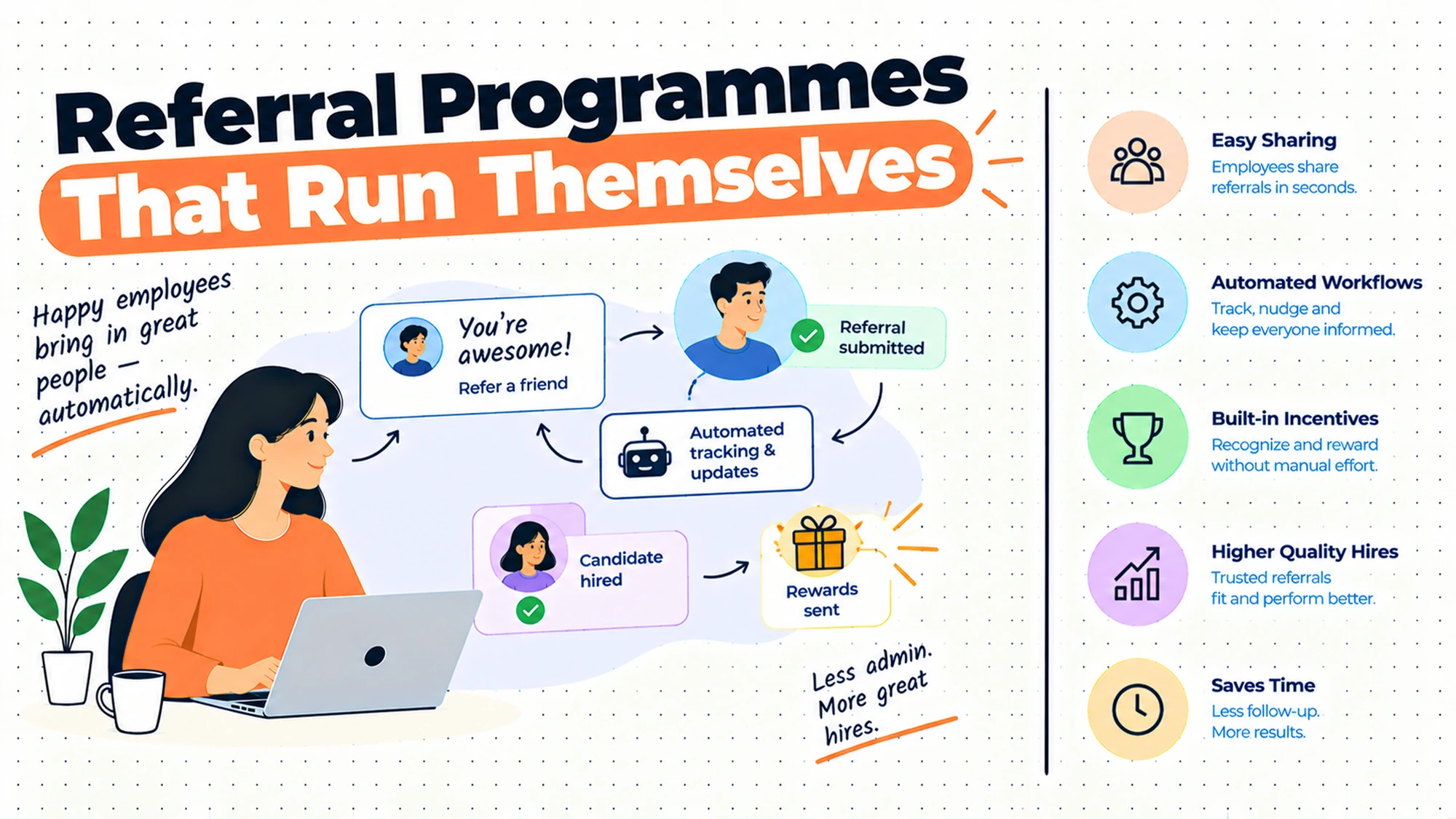
- The core decision: whether referring is cheap enough to do casually, because effort is what stops it, not motivation.
- When doing nothing is right: when referrals already arrive without a scheme and nobody has asked for one.
- What has to be true: an employee can find out what's open and refer somebody in about a minute.
- How the options split: by how much work the referrer has to do, which predicts volume better than any reward.
- Decision rule: if the referrer never hears what happened, they won't refer again.
- Outcome to expect: a steady trickle rather than a launch spike, which is the shape you actually want.
The Scheme That Worked for Three Weeks
A referral programme launches. There's an announcement, a reward, and a burst of enthusiasm. Eleven referrals arrive in the first fortnight, two are genuinely strong, one gets hired.
Then it goes quiet. Not abruptly, just steadily: a few the next month, one the month after, then nothing. Six months later somebody asks whether the scheme is still running and nobody is quite sure.
The usual diagnosis is motivation. The reward isn't big enough, people have forgotten, we need to promote it again. So there's another announcement, another spike, another decline, and eventually a conclusion that referrals don't really work here.
Best tools for Applicant Tracking (ATS)
That diagnosis is almost always wrong. The people who referred in week one were not more motivated than the people who didn't refer in month four. They were people who happened to know somebody suitable at the moment they were reminded, which is a small and fluctuating population, and the programme did nothing to reach anybody else.
Three mechanical things are usually going on. Employees don't know what's open, because nobody looks at a careers page for their own employer. Referring is more effort than it looks, involving finding a link, writing something, and possibly asking their contact for a CV. And nobody hears what happened, so the whole exercise feels like putting a name into a void.
The reframe worth holding is that a referral is a favour one person does for a colleague, and the programme's only job is to make that favour cheap to perform and visibly worth having done. Neither of those is about money.
When You Genuinely Do Not Need to Act Yet
Your current setup is genuinely fine. Referrals arrive, people introduce candidates when they know somebody, and nobody has asked for a scheme. Formalising something that works informally usually adds administration and occasionally suppresses the thing it was meant to encourage.
Friction is starting to show. Somebody said they'd have referred if they'd known a role was open, or a referral got lost, or a referrer asked awkwardly what happened to their friend. Those are the useful signals and the fixes are small: tell people what's open, and tell referrers what happened.
It has become a real cost. Hard roles are staying open, you're paying externally for reach into a market your own people are already in, or you've noticed hires arriving through personal connections in a completely undocumented way. Now a deliberate arrangement is worth building.
The edge case that forces it. You're hiring at a volume or in a market where personal networks are genuinely the main route, or you're growing fast enough that employees know more suitable people than your process can reach. Note that referral schemes interact with equal opportunity considerations in ways that differ by jurisdiction, particularly where a workforce is not diverse and referrals reproduce its composition. Establish what applies where you hire with local advice.
Five Questions This Reader Asks at 11pm
Why do referrals dry up? Because the population who know somebody suitable right now is small, and once it's exhausted the programme has nothing left to work with unless it keeps reaching new people at new moments. The launch spike isn't enthusiasm, it's a backlog of latent referrals being cleared. Everything after that depends on somebody being reminded at the moment they think of a person.
Should we pay a bonus? Usually yes, and it's the least important design decision. Money makes people slightly more likely to act on an intention they already had. It does not make them think of somebody, and it does not overcome a process that takes fifteen minutes. The organisations with the healthiest referral flow are frequently not the ones paying most.
When should we pay it? Later than feels generous and earlier than feels safe. Paying at hire is standard and creates an incentive to refer anybody. Paying after a period reduces that and introduces a delay that makes the reward feel notional. The more useful lever is paying something small at the point of a genuine conversation happening, which rewards the behaviour you actually want rather than an outcome the referrer doesn't control.
How do employees know what's open? They mostly don't, and this is the single biggest constraint. Nobody browses their own employer's careers page. If roles aren't pushed into somewhere people already look, the programme depends entirely on somebody remembering to check, which nobody does.
Do referrals narrow the candidate pool? They can, and it's worth being honest about rather than defensive. People tend to know people like themselves, so a referral programme run in a homogeneous team will reproduce that composition. How this interacts with your obligations differs by jurisdiction. Establish the position locally, and separately, watch the composition of what referrals actually produce rather than assuming.
Why Referrals Stop Arriving
The decline follows a consistent pattern, and each cause has a different smallest fix.
| Cause | What it looks like from the employee side | The smallest change that addresses it |
|---|---|---|
| Nobody knows what is open | I would have referred if I had known | Push roles where people already look |
| Referring takes real effort | I will do it later, then forgetting | One link, one box, one minute |
| No idea what happened | Feels like it went into a void | Tell the referrer at every stage |
| A referral was handled badly | Embarrassment in front of a friend | Treat referrals with visible care |
| The reward is the only message | Feels transactional, slightly grubby | Lead with helping a colleague |
| Only announced at launch | Forgetting it exists | A recurring, low-key reminder |
The third row does more damage than anything else on this list, and it's the cheapest to fix. Somebody who refers a friend has taken a small social risk, and hearing nothing leaves them unable to answer when that friend asks how it's going. Once that's happened, they won't do it again, and they'll quietly tell others it's not worth the awkwardness.
The fourth row is the version that spreads. A referred candidate who was ignored, rejected without acknowledgement, or put through a process that visibly didn't consider them properly generates a story the referrer tells. One badly handled referral can suppress a programme across a team for a year, and nobody in recruiting ever learns it happened.
Five Diagnostic Questions You Can Self-Assess Against
Ask three employees what roles are open right now. Not whether they know the scheme exists. What's open. If they can't name anything, your constraint is visibility and no amount of reward design will help.
Time yourself referring somebody. From deciding to refer to having done it. If it takes more than a minute or two, or requires finding something, that's your answer. Effort is the binding constraint in almost every programme that has gone quiet.
Ask the last three referrers what they heard back. If the answer is nothing, or eventually, you've found the reason the flow stopped. This is the question that produces the most uncomfortable and most useful answers.
What happens to a referral that isn't suitable? There's a version of this that protects the relationship and a version that damages it. If your process rejects a referral the same way as any application, the referrer finds out from their friend, which is the worst possible sequence.
Is anybody actually asked? Broadcast requests reach everybody and land on nobody. Asking a specific person about a specific role, because you think they might know somebody, is a completely different act and produces a completely different response rate.
Six Ways Referral Schemes Are Run, Reviewed
An announcement and an email address
The minimum: tell people the scheme exists and give them somewhere to send names. It earns its place on cost, which is nothing, and on being better than no route at all.
Where it falls short is everything that depends on the employee remembering. There's no reminder, no visibility of what's open, and the effort of composing an email is exactly the friction that stops casual referrals. It also produces inconsistent information, since people send whatever they think is relevant.
Fine as a starting point if you also solve visibility. Useless on its own, because it asks the employee to do all the work of remembering, finding and describing.
If this is all you have, one adjustment doubles what it does for no cost: name a person rather than an address. Sending somebody's details to a named colleague feels like a normal thing to do, and sending them to a functional mailbox feels like filing a form. The difference sounds trivial and it changes both the volume and the quality of what arrives, because people include context when they are writing to a person.
A reward paid on a hire
Money attached to a successful referral. It earns its place as a signal that the organisation values this, which matters more than the amount, and as a nudge that converts an intention into an action.
Where it falls short is the assumption that it drives behaviour. It doesn't make anybody think of a person, which is the actual bottleneck, and it can make the exchange feel transactional in a way some people dislike. Paying only on a hire also means most referrers get nothing, having done real work, which is a poor ratio for something you want repeated.
Pay something, don't over-engineer the amount, and consider recognising the referral itself rather than only the outcome the referrer doesn't control.
There is a category of employee who will not take a payment at all, and it is worth having a way to accommodate them rather than treating it as an anomaly. Some people are uncomfortable being paid to recommend a friend, and the discomfort is about the relationship rather than the money. Offering a donation to something instead, or simply visible recognition, keeps those people participating, and they are frequently the ones with the strongest networks.
A portal where employees see roles and refer
A place showing what's open with a one-click way to refer. It earns its place because it addresses both mechanical constraints at once: visibility and effort. A referral that takes a link and a name will happen; one that takes a composed email frequently won't.
Where it falls short is that a portal is still somewhere people have to go. Anything requiring a deliberate visit competes with everything else, and employees visit their own careers page approximately never. The other failure is a portal that shows roles without any context about what the team is like, which is exactly what the referrer needs to decide whether their contact would want it.
Build it if you can, and push from it rather than waiting for visits.
The thing worth including that most portals omit is a sentence per role about the team rather than the requirements. A referrer is not deciding whether their contact is qualified, they are deciding whether their contact would want it, and that judgement needs to know what the work is actually like and who they would be working with. A list of requirements answers the wrong question and is the reason well-intentioned referrals arrive badly matched.
A periodic push when a role is hard to fill
Reaching out when a specific search is struggling. It earns its place because it's timely and specific, which is the combination that produces responses. A request naming one role and explaining why it's difficult gets more attention than any standing scheme.
Where it falls short is that it only operates when somebody remembers to do it, and it tends to happen after a search has already been open too long. There's also a fatigue risk if it becomes frequent, since a request that arrives constantly stops registering as a request.
Use it for genuinely hard roles, make it specific, and don't use it so often that it becomes background noise.
Say why it is hard, too, rather than only that it is. People respond to a real problem described honestly, and they can help more usefully when they understand the constraint. Knowing that a role needs somebody who has done a particular unusual thing lets somebody scan their contacts against that specific thing, whereas a general appeal for help with a difficult search gives them nothing to match against.
Asking specific people for specific roles
Somebody goes to individuals who plausibly know the market and asks directly. It earns its place because it's the highest-yield version of any of this by a considerable margin. A direct, personal ask to somebody likely to know the right people converts at a rate no broadcast approaches.
Where it falls short is that it takes time and doesn't scale, and it depends on somebody knowing who to ask. It also has to be genuine, because a personalised request that's obviously a template reads worse than a broadcast.
Do this for the roles that matter most. It's the version of referrals that actually works and it's the version nobody builds a programme around, because it looks like work rather than a system.
It also produces something the broadcast version never does, which is a conversation. Somebody asked directly will frequently say that they do not know anybody, and then mention where such people tend to be, or who else to ask, or why the role as described would be a hard sell. That information is worth as much as a referral and it only arrives when a real person asks a real person.
No scheme at all
Referrals happen or they don't, with no structure around them. It earns its place in small organisations where everybody knows what's being hired for because they're in the conversation anyway.
Where it falls short is at the point of growth where people stop knowing what's open. That transition happens without announcing itself, and the signal is somebody saying they'd have referred if they'd known.
The transition doesn't require a programme. It requires telling people what's open, somewhere they already look, and making it easy to send a name.
The moment worth watching for is the first time somebody says they would have referred if they had known. That sentence is the signal that the organisation has grown past the point where everybody is in the conversation, and it usually arrives well before anybody thinks to build anything. Acting on it then costs almost nothing, and waiting means a year of referrals that never happened.
The Decision Table
| Situation | Scale | Setup | Primary Pain | Recommended Starting Point |
|---|---|---|---|---|
| Referrals arrive without a scheme | Under fifty | Everybody in the conversation | None | Change nothing |
| Somebody says they did not know | Any | Any | Visibility | Push roles where people already look |
| Referrals arrive, then stop | Any | Existing scheme | Effort or silence, usually both | Time yourself referring, then ask referrers |
| A referral was handled poorly | Any | Any | Social risk not repaid | Fix the handling before promoting again |
| One hard role, network-dependent | Any | Any | Broadcast reaches nobody | Ask specific people directly |
| Reward increased, nothing changed | Any | Existing scheme | Not a motivation problem | Look at effort and feedback instead |
| Referrals reproduce team composition | Any | Any | Interacts with local obligations | Establish the position, watch the output |
| Employees do not know it exists | Any | Launched once | No recurring reminder | A low-key recurring prompt |
| Growing past everybody knowing | Over one hundred | Informal | The transition nobody notices | Tell people what is open |
The sixth row is the most common expensive mistake in this area. When a scheme goes quiet, increasing the reward is the visible lever, it feels decisive, and it reliably does nothing, because the constraint was never that people didn't want the money. Spend the same energy on making referring take a minute and on telling referrers what happened.
The third row deserves both diagnostics rather than one. Time yourself referring somebody, and separately ask the last three referrers what they heard back. Those two questions locate the problem in nearly every programme that has gone quiet, and they take an afternoon between them.
The Part Nobody Designs: What the Referrer Hears Back
This is the half of the programme that determines whether it survives, and almost nobody builds it.
When somebody refers a friend, they've done something socially consequential. They've told a person they respect that this is a decent place to work, put their own judgement behind it, and created an expectation that something will happen. From that moment they have an interest in the outcome that has nothing to do with any reward.
What usually happens next is nothing. The referral enters the pipeline and behaves like any other application. The referrer hears about progress from their friend rather than from the organisation, which is precisely backwards, and when there's no news they can't tell whether the process is slow or the referral was ignored.
Four moments are worth communicating, and they cost almost nothing.
That it arrived. Immediately, to the referrer, confirming the name and that somebody will look. This alone removes most of the void feeling.
That a conversation is happening. When the candidate reaches a real stage. The referrer doesn't need details, and they do need to know their judgement was taken seriously.
That it isn't progressing. Before the candidate finds out, ideally, or at the same time. Telling the referrer their friend isn't progressing is uncomfortable and it's far better than them hearing it secondhand and having to react in the moment.
That it worked. Obviously, and specifically, because this is the moment that produces the next referral from that person and from everybody they tell.
There's a judgement call in the third one worth naming. How much you tell a referrer about why their friend isn't progressing is constrained by what you may say about a candidate, which differs by jurisdiction and by what the candidate has agreed. The safe version is telling the referrer the outcome without the reasoning, and being explicit that you can't go further. That's usually enough, because what the referrer actually wants is not to be blindsided.
One more thing protects the relationship. Referred candidates who aren't suitable should be handled with more care than the process default, not less: a real reply, ideally from a person, ideally slightly warmer. The referrer is going to hear about that interaction, and it's the version of your process that gets discussed in the office.
It is worth naming the awkward case explicitly rather than hoping it does not arise. Sometimes a referred candidate is clearly unsuitable, and the referrer's judgement was poor. Handling that without damaging the relationship means separating the two things: thanking them genuinely for the referral, which is the behaviour you want repeated, while being straightforward that this particular person is not progressing. Most people take that well when it is not dressed up.
Where Referral Programmes Go Wrong
| The failure | What the employee experiences | What would have to change |
|---|---|---|
| Roles never visible | Not knowing anything is open | Push roles into existing channels |
| Referring takes more than a minute | An intention that expires | One link, one name, done |
| Silence after referring | A social risk with no repayment | Tell them at each stage |
| Referred candidate handled carelessly | Embarrassment with a friend | Handle referrals with visible care |
| Reward as the entire message | A transaction rather than a favour | Lead with the colleague, not the payment |
| Launched once, never mentioned again | Forgetting it exists | A recurring low-key prompt |
The second row is the one to fix first because it's measurable in a way the others aren't. Time the referral process yourself, honestly, including finding out what's open. Anything over a minute or two is suppressing volume, and every step you remove has a direct effect.
Time it on a phone as well, because that is where a lot of this happens. Somebody thinks of a person during a conversation, or while reading something, and the referral either happens in that moment or becomes an intention that expires. A process that works on a laptop and not on a phone is losing precisely the referrals that were most spontaneous, which are usually the good ones.
The fifth row is subtle and affects who participates. Framing the whole scheme around money attracts people motivated by money and slightly repels people who'd have referred as a favour, which is frequently the group with the better contacts. Mention the reward and lead with the ask.
What to Put in Writing
| Artefact | Who owns it | When it is written | What it prevents |
|---|---|---|---|
| Where open roles get pushed, and how often | Whoever runs hiring | Before promoting the scheme | A programme depending on people checking |
| What a referrer is told, at which points | Whoever runs hiring | Before the first referral | Referrals disappearing into silence |
| How a referred candidate is handled differently | Whoever screens | Before the first one arrives | A story that suppresses the programme |
| What may be said to a referrer about an outcome | HR, with local advice | Before anybody asks | Saying more than you should |
| Who asks specific people about hard roles | Whoever runs hiring | When a role is opened | Broadcast requests reaching nobody |
| Whether referrals affect pool composition | HR, with local advice | Periodically | Discovering a pattern nobody watched |
The second row is the highest-value line on this list. A programme with four short communications back to the referrer will outperform one with a large reward and none, and the communications cost minutes rather than money. Write down what gets sent at each point so it survives whoever set it up.
Questions to Ask Before You Commit
On visibility. Can three employees name an open role? A bad answer is that it's on the careers page.
On effort. How long does referring take? A bad answer is not long.
On feedback. What does a referrer hear, and when? A bad answer is when there's news.
On handling. How is a referred candidate treated? A bad answer is the same as everybody.
On the ask. Who gets asked directly? A bad answer is everybody, in an announcement.
On composition. What are referrals actually producing? A bad answer is that nobody looks.
On the awkward case. What do you say when a referral was poor? A bad answer is nothing.
What Getting This Wrong Costs
The first cost is the reach you had and didn't use. Your employees collectively know a large number of people in exactly the market you hire from, and a programme that fails mechanically leaves all of that unreachable while you pay externally for access to the same population. That cost is invisible because there's no record of the referral that didn't happen.
The second cost is the relationship damage that suppresses future volume. A referrer whose friend was ignored, or who found out secondhand that their referral was rejected, doesn't just stop referring. They tell people, and the story circulates in a way recruiting never sees. One badly handled referral genuinely can quiet a team for a year, which is why handling them with visible care is a programme decision rather than a courtesy.
The third cost is the conclusion drawn when it fails. Organisations that run a scheme badly conclude that referrals don't work in their market, shelve the idea, and keep paying externally. The mechanism does work almost everywhere; what fails is a programme that asked people to remember what was open, do fifteen minutes of work, and hear nothing back.
There is a fourth cost that falls on the people who did participate. Somebody who referred a friend, heard nothing, and had to field questions from that friend has been put in an uncomfortable position by their own employer. It is a small thing and it is the kind of small thing people remember, because it happened in front of somebody whose opinion they care about.
So before relaunching anything, do the two diagnostics. Time yourself referring somebody, start to finish. And ask the last three referrers what they heard back. Those two answers will tell you what's wrong, and neither of them will point at the reward.
When You Are Ready to Go Further
None of this needs a platform. It needs open roles pushed into wherever people already look, a way to refer that takes a minute, and four short messages back to the referrer at the points that matter.
Then add the thing that actually works: ask specific people directly about specific roles. It doesn't scale and it isn't a programme, and for the two or three roles that matter most each quarter it will outperform everything else combined. Keep a note of who knows which markets, because that knowledge is the real asset and it currently lives in somebody's head.
That note does not need to be elaborate: a name, the market or type of role they seem well connected in, and roughly when they were last asked. Its value is that it survives the person who compiled it, and it turns an instinct about who to approach into something a colleague can act on when a hard role opens and the usual person is away.
Finally, look at what the programme produces rather than how much of it there is. Volume is easy to celebrate and the more useful questions are whether referred candidates are progressing further than others, and what the composition of the referred pool looks like compared with everybody else. The second question has obligations attached that differ by jurisdiction, so establish the position locally rather than inferring it.
Both questions are worth asking periodically rather than once, because the answers move as the organisation changes. A referral programme in a team of twelve behaves differently from the same programme in a team of eighty, and the composition effect in particular compounds quietly over time rather than appearing suddenly.
HROpsLab publishes independent comparison work across HR tooling, applicant tracking and payroll. We sell nothing, we take no vendor money, and we publish no paid placements. If the next step is looking at what your current tooling actually supports here, our comparison work is one place to start.
Frequently Asked Questions
How does an employee referral programme work?
An employee tells the organisation about somebody they know who might suit an open role, that person enters the process, and the referrer is usually rewarded if a hire results. The mechanics that determine whether it works are less about the reward and more about three things: whether employees know what's open, how much effort referring takes, and whether the referrer ever hears what happened. Programmes that fail almost always fail on those three rather than on motivation, which is why increasing the bonus so rarely changes anything.
Why do employee referrals dry up after a launch?
The launch spike is a backlog being cleared rather than a burst of enthusiasm. At any moment, only a small number of employees happen to know somebody suitable, and an announcement reaches all of them at once. After that, continued flow depends on reaching new people at the moment they think of a person, which requires roles to be visible where people already look and referring to be cheap enough to do casually. Without both, the programme has nothing left to work with.
Should you pay a referral bonus, and when?
Pay something, and treat the amount as the least important design decision. Money converts an existing intention into an action; it doesn't make anybody think of a person, which is the actual bottleneck. On timing, paying only at hire means most referrers get nothing despite doing real work, which is a poor ratio for behaviour you want repeated. Recognising the referral itself, or a genuine conversation happening, rewards what the referrer actually controls rather than an outcome they don't.
What should you tell an employee who referred someone?
Four things, at four moments: that the referral arrived and somebody will look, that a real conversation is happening, that it isn't progressing, and that it worked. The third is the one people avoid and the one that matters most, because the alternative is the referrer hearing it from their friend and being blindsided. How much you can say about why is constrained by what you may disclose about a candidate, which differs by jurisdiction, so the safe version is the outcome without the reasoning.
How should you handle a referred candidate who isn't suitable?
With more care than your process default, not less. The referrer took a social risk by vouching for this person and will hear about the interaction afterwards, which means a careless rejection generates a story that circulates and suppresses future referrals across a team. A real reply, ideally from a person rather than a template, is the minimum. Then tell the referrer the outcome before or at the same time as the candidate finds out, so they aren't reacting to news they didn't have.
Do employee referrals narrow your candidate pool?
They can, and it's worth examining rather than defending. People tend to know people like themselves, so a referral programme running in a homogeneous team will tend to reproduce that composition, which is a mechanical property rather than anybody's intention. How this interacts with your obligations differs by jurisdiction and by sector, so establish the position where you hire with local advice. Separately, watch what your referrals actually produce compared with other routes rather than assuming either way.
How do you tell employees what roles are open?
Push, don't publish. Nobody browses their own employer's careers page, so a programme that depends on people checking depends on something that doesn't happen. Roles need to appear where employees already are, in whatever channels they read anyway, at a frequency that registers without becoming background noise. This is the single biggest constraint in most referral programmes and it's usually treated as a communications afterthought rather than as the central mechanism.
How do you restart a referral scheme that has gone quiet?
Don't relaunch it with a bigger reward, which is the standard move and reliably does nothing. Run two diagnostics first: time yourself referring somebody from start to finish, and ask the last three referrers what they heard back. Those two answers almost always locate the problem, and it's usually effort and silence rather than motivation. Fix those, then restart with direct asks to specific people about specific roles rather than another broadcast announcement.
A referral is a favour between colleagues. Make it cheap to do and visibly worth having done.
The reward is the smallest part of it.