
TL;DR
- The core decision: how a published rota actually reaches the person working it.
- When doing nothing is right: when everybody reliably knows and nobody is chasing.
- What has to be true: you can tell whether a specific person has seen a specific shift.
- How the options split: by what each method assumes about the person receiving it.
- Decision rule: test from their side, not from the administrator's screen.
- Outcome to expect: the same rota, arriving where somebody will actually see it.
It Was on the Wall
Somebody doesn't turn up. You check, and they were definitely on the rota. The rota went up on Thursday, the way it always does.
They say they didn't know. You point out it was on the wall. They point out they weren't in on Thursday, or Friday, and the first time they came in after that was the shift they're now standing in, which is the one after the one they missed. Both of you are right, and there's no version of this conversation that ends well.
This is the failure that matters most in scheduling and the one that gets least attention, because from the system's point of view nothing went wrong. The rota was built, checked, approved and published. Every box in the process is ticked. What didn't happen is the only part that counts: a specific person didn't learn about a specific shift.
Best tools for Employee Scheduling
The reframe is blunt. A schedule that hasn't reached somebody hasn't been published, whatever your system says. Publication is a claim about delivery, not about an action you took, and the gap between those two is where almost all the practical damage in this area happens.
There's a structural reason it's hard, and it's worth naming. The people being scheduled are usually the people your systems serve worst. No work email, no desk, no company device, no reason to log into anything, and frequently no expectation that they should be checking things in their own time. Every convenient method assumes something about the recipient, and the assumptions that hold for office staff generally don't hold here.
One thing to establish before any of it. Whether you can expect people to use personal devices or personal phone numbers, what you may send and when, and what any of it means for time outside working hours are questions whose answers differ by jurisdiction and by agreement. Nothing here tells you what applies to you. Establish it with local advice, because the delivery method you'd choose operationally may not be one you can simply adopt.
When You Genuinely Do Not Need to Act Yet
Everybody reliably knows and nobody is chasing. Whatever the method, if it works, it works. Printed rotas are fine where everybody is in regularly.
People ask what they're working. Frequent questions about shifts mean the rota isn't reaching them, and the questions are the visible part of a larger gap.
Somebody has missed a shift they didn't know about. That's the failure this is about, and once it's happened it's usually happened before without being attributed correctly.
The edge case that forces it. Somebody was disciplined for a no-show and it emerged they'd never seen the change. That's a delivery failure that became a conduct matter, and it's the outcome worth never repeating.
Five Questions This Reader Asks at 11pm
Isn't a printed rota enough? It can be, and it depends entirely on how regularly people are physically present. A wall rota reaches whoever walks past it, which is fine for full-time staff and fails for exactly the people most likely to be caught out: part-timers, people on irregular patterns, and anybody who was off when it went up.
Can we just use a group chat? Lots of operations do and it works reasonably, and it's worth being aware of what it assumes. That everybody is in the group, that everybody reads it, that a message doesn't scroll away, and that people are comfortable with a channel that mixes work and personal. Whether you can require any of that is worth establishing locally.
Can we make people install an app? Whether you can require it is a question with an answer that differs by jurisdiction and by arrangement, so establish it rather than assuming. Practically, an app people haven't installed delivers nothing, and adoption is usually the constraint rather than capability.
How do we know they've seen it? The single most useful thing to ask of any method. A system that can tell you a specific person has viewed their shifts turns an assumption into a fact, and most of the damage in this area comes from assuming.
What about people without smartphones? They exist in most operations and they're frequently the people who've been there longest. Any approach that has no answer for them has a gap, and it'll be a gap concentrated among particular people rather than spread evenly.
The Last Few Metres
| The method | What it assumes about the person | How it fails |
|---|---|---|
| Printed rota on a wall | They are physically present regularly | Whoever was off never sees it |
| Message in a group chat | They are in it, and read it | It scrolls away, or they muted it |
| Email to a personal address | They read personal email, promptly | It goes unread for days |
| An app | They installed it and open it | Adoption, notifications turned off |
| Text message | They have the number and keep it | Costs, changed numbers, message limits |
| Telling them individually | Somebody has time to do it | Fails exactly when the week is busy |
| Any of the above, one channel only | Nothing goes wrong with that channel | One failure means nobody is told |
| No confirmation of receipt | It arrived because it was sent | You find out on the day |
The first row is the one most operations start with and it's better than its reputation for a stable full-time team. What it can't do is reach somebody who wasn't there, which means it systematically fails part-time and irregular staff, who are also the people whose shifts change most.
The sixth row is the method that's excellent when it happens and unreliable by construction. Telling people individually is the most certain delivery available and it depends on somebody having time, which they don't during exactly the weeks when changes are most frequent.
The last row is the one to fix regardless of which method you use. Without confirmation, every delivery is an assumption, and the assumption is only tested when somebody doesn't arrive.
Five Diagnostic Questions You Can Self-Assess Against
Trace one person, one shift. From the rota being published to that specific individual knowing. Count the steps and name where it can break. Do it for somebody part-time rather than somebody who's in every day.
Who was off when the rota went up? Those are the people your current method didn't reach, this week, and it's the same categories of people every week.
Can you tell who has seen it? If not, you're relying on people telling you when they haven't, which is the opposite of how it works.
What happens on a personal device? Whether people are using their own phones, whether that's been agreed, and what it costs them. Worth knowing both operationally and because obligations here differ by jurisdiction.
Who has no good route? Every operation has somebody: no smartphone, poor signal, a language issue, a shared phone. Naming them is the first step to having an answer for them.
Ask these five of somebody who works irregular hours rather than of whoever publishes the rota. The publisher sees the sending; only the recipient can tell you what arriving actually looks like.
Six Ways a Schedule Reaches People, Reviewed
A printed rota on a wall
The week goes up somewhere everybody passes. It earns its place on simplicity and universality: no device, no account, no adoption problem, and everybody can see the whole team's week, which helps people sort cover among themselves.
Where it falls short is anybody not physically present when it appears or changes. It also can't be updated reliably, so a printed rota with handwritten amendments is a common and genuinely dangerous artefact, since nobody can tell which version they're looking at.
Fine as one channel for a stable team. Never as the only channel where people work irregular patterns, and never as the mechanism for changes.
The handwritten amendment is the specific thing to prohibit. Once a printed rota carries corrections in pen, anybody who saw it before the pen arrived is working from a superseded version and has no way to know, which is worse than the original problem.
It's also worth thinking about where it's posted. A rota in a staff area everybody passes reaches more people than one in an office, and the difference is entirely about whose route through the building it sits on.
A message in a group chat
The rota gets posted to a shared group. It earns its place on immediacy and reach: most people check messages, it arrives rather than waiting to be collected, and it costs nothing.
Where it falls short is that it's a stream. Yesterday's rota scrolls away under today's conversation, somebody who muted a busy group misses it, and there's no way to tell who read what. It also mixes work into a personal space, which some people mind more than others.
Workable as a notification that something has been published. Weaker as the place the rota actually lives, and worth establishing what you can expect of people regarding personal messaging accounts.
Group membership is the failure nobody audits. People leave, join and change numbers, and a group assembled some time ago will quietly have gaps in it that only become visible when somebody misses a shift.
The tone problem is real too. A channel that mixes rota posts with general chat trains people to skim it, and the one message that mattered gets skimmed along with everything else.
An email to a personal address
The schedule goes to whatever address you hold. It earns its place on record: it's durable, searchable, and there's a clear trail of what was sent and when.
Where it falls short is that personal email is checked slowly and irregularly by many people, particularly younger workers who may barely use it. An email sent on Thursday about a Friday shift is frequently unread when the shift starts.
Reasonable for the weekly rota. Poor for anything urgent, and poor for changes.
The timing mismatch is the whole issue. Personal email is checked on a rhythm that suits the person rather than the operation, and something sent the evening before a shift may not be opened until well after it started.
Addresses also decay quietly. People change providers, abandon accounts and mistype addresses at induction, and a bounce going to a mailbox nobody monitors means somebody has been receiving nothing for months.
An app people have to install
A purpose-built application with the schedule in it. It earns its place because it's the only method that reliably does the things that matter: notifications that arrive, a schedule that's always current, and usually some way of knowing who has looked.
Where it falls short is adoption and the assumptions underneath it. It needs a device, storage, a working connection and somebody willing to install it, and whether you can require any of that is a question that differs by jurisdiction and by arrangement. An app half the team hasn't installed is worse than a wall rota, because you'll believe people have been told.
The strongest option where adoption is genuinely achieved. Measure adoption rather than assuming it, and have a route for whoever isn't on it.
Notification settings are the second adoption problem and it's invisible. Somebody who installed the app and turned notifications off is counted as adopted and receives nothing, which produces exactly the confident wrong record the whole exercise was meant to avoid.
It's also worth knowing what it costs the person. Storage on an older device, data for somebody on a limited plan, and battery are real considerations for people you may be requiring to carry this, and what you can require differs by jurisdiction.
A text message
Shifts or changes sent directly to a phone number. It earns its place as the method with the fewest assumptions: it works on any phone, needs no installation, no account, and no data connection.
Where it falls short is cost, length and currency. Messages cost something at volume, a full rota doesn't fit well in the format, and phone numbers change without anybody updating the record. There's also no way to send a correction to something already sent.
Excellent for changes and for anything urgent. Less suited to the weekly rota itself, and worth pairing with somewhere the current version always lives.
Number currency is the maintenance job that decides whether this works. Phone numbers change more often than anybody expects and nothing prompts an update, so a list assembled at induction degrades steadily and silently.
Worth checking periodically that messages are actually arriving. A number that has been reassigned will accept messages indefinitely, and somebody else is receiving your rota changes.
Telling people individually
Somebody speaks to each person. It earns its place as the most reliable delivery there is and the one that allows a conversation, which matters particularly for a change somebody might want to discuss.
Where it falls short is capacity. It works when the week is calm and fails when it's busy, and busy weeks are when changes happen, so it's least available exactly when it's most needed.
Keep it for the things that deserve it. A significant change to somebody's week is worth a conversation, and using this method for routine publication will exhaust whoever is doing it.
It's also the only method that lets somebody respond properly. A change delivered as a message invites acceptance; the same change delivered in person invites a reply, and the reply is frequently useful.
Be realistic about who ends up doing it. Individual notification tends to fall on one person, usually a shift lead already stretched, and it disappears entirely the week they're away.
The Decision Table
| Situation | Scale | Setup | Primary Pain | Recommended Starting Point |
|---|---|---|---|---|
| Everybody knows, nobody chasing | Any | Any | None | Change nothing |
| Part-timers miss the wall rota | Any | Printed | Presence assumed | Add a channel that travels |
| Group chat, rota scrolls away | Any | Chat | A stream, not a record | Somewhere permanent for the current version |
| App installed by some | Any | App | Belief that everybody was told | Measure adoption, route for the rest |
| No way to confirm receipt | Any | Any | Every delivery is an assumption | Read confirmation |
| Changes go by the same slow route | Any | Email or wall | Urgency mismatched to method | Text or direct for changes |
| One channel only | Any | Any | A single failure reaches nobody | A second route |
| Somebody has no good route | Any | Any | A gap concentrated on individuals | Name them, arrange something |
| Personal devices, nothing agreed | Any | App or chat | An assumed position | Establish it, with local advice |
The fourth row is the failure that partial adoption creates and it's worse than not having the app. When the system says people were notified and a share of your team never installed it, you now have a confident delivery record that's wrong, which is more dangerous than knowing you're relying on a wall.
The third row is the version of that problem inside a working channel. A rota posted to a busy group is technically delivered to everybody and read by whoever happened to be looking at the time.
The seventh row is the structural principle behind most of this. Any single channel fails sometimes, and where it's your only one, its failure means a person genuinely wasn't told. Two routes with different failure modes makes the combined failure much rarer.
The eighth row is the one that turns every other row into a guess. Without confirmation you cannot distinguish a method that works from one that has been failing quietly for months, because both look identical from the administrator's side.
Knowing They Have Seen It
Sending is not receiving. Every method above can report that something was sent. Only some can tell you that a particular person looked at it, and that difference is the whole of the reliability question.
A delivery report is about your system, not about a person. It describes what left, which is the half you already knew.
Confirmation converts assumption into fact. Knowing that four people haven't opened their shifts lets you do something on Wednesday. Not knowing means finding out on the day, from an empty shift.
And the doing is small. Four names is four messages, which is a task rather than a project.
The unconfirmed list is short and actionable. In practice most people see the rota promptly, so what you're left with is a handful of names, which is a phone call rather than a project.
And it's usually the same names. Which makes it a route problem for particular people rather than a general one, and those are fixable individually.
A read receipt is not agreement. Somebody having seen a shift is not the same as them accepting it, particularly for a change. Worth keeping those separate in your own thinking, and worth taking local advice on what any acknowledgement means where you are.
Conflating them is tempting and unsafe. A system that records a view is telling you about delivery, and treating that as consent to a changed shift is a step it does not support.
Two channels beat one. Not because people need telling twice, but because channels fail independently. A published rota somewhere permanent plus a notification that it's changed covers most failure modes between them.
Pick two that fail differently. Two digital channels on the same phone are one channel with extra steps.
Somebody always has no good route. No smartphone, a shared phone, poor signal, a language difficulty. The answer is usually an individual arrangement rather than a system feature, and it needs naming rather than leaving to chance.
And they are rarely the people who complain. Somebody already at the edge of your systems is unlikely to raise that the rota reaches them badly, which is why the gap has to be found rather than reported.
The practical position is unglamorous. One place the current rota always lives, one channel that actively notifies, and some way of seeing who hasn't looked. That combination handles nearly everything, and none of it requires a large purchase.
It's also achievable incrementally. Any one of the three improves things on its own, and an operation that adds only the confirmation capability has already converted its biggest assumption into something checkable.
Where These Arrangements Go Wrong
| The failure | How it shows up | What would have to change |
|---|---|---|
| Single channel, no backup | One failure means nobody was told | A second route |
| Partial app adoption | Confident delivery record that is wrong | Measure adoption, cover the rest |
| Changes sent by the slow route | Somebody arrives for a shift that moved | Urgent route for changes |
| No read confirmation | You find out on the day | Confirmation, and a Wednesday check |
| Printed rota amended by hand | Nobody knows which version is current | Never amend the printed one |
| Nobody has a route for some people | A gap concentrated on individuals | Name them, arrange something specific |
The third row is the mismatch that produces most missed shifts. Operations frequently use a reasonable method for the weekly rota and then use the same one for a change made the night before, where its timing characteristics are completely wrong.
The fifth row is worth stating plainly because it's so common. A printed rota with amendments written on it means there are now two sources of truth in the same building, and anybody who saw the original before the pen arrived is working from something that has been superseded without their knowledge.
The sixth row is the one that concentrates rather than spreading. A general delivery gap affects everybody occasionally; an unaddressed route for a few individuals affects the same people repeatedly, and they're frequently the least likely to say so.
What to Put in Writing
| Artefact | Who owns it | When it is written | What it prevents |
|---|---|---|---|
| The path from publication to one person | Whoever runs the rota | Now | Assuming delivery works |
| Who was off when the rota went up | Whoever runs the rota | Weekly, informally | The same people missing out |
| Adoption, if you use an app | Whoever owns the system | Now, and ongoing | A confident and wrong record |
| Who has no good route | Whoever runs the rota | Now | A gap left to chance |
| Which channel carries changes | Whoever runs the rota | Before the next change | Urgency on a slow route |
| What applies to personal devices | You, with local advice | Before requiring anything | An assumed position |
The first row is the exercise worth doing today. Trace publication through to one part-time person knowing about one shift, step by step, and count the places it can fail. Most operations have never done this and find at least two points where it plausibly breaks.
The fifth row is the decision that prevents the most missed shifts for the least effort. Deciding, in advance, that changes travel by a different and faster route than the weekly rota costs nothing and addresses the commonest cause.
Questions to Ask Before You Commit
On confirmation. Can we see who has viewed their shifts? A bad answer is it's delivered.
On changes. Does a change notify separately from the rota? A bad answer is the rota updates.
On adoption. Can we see who has actually installed it? A bad answer is it's rolled out.
On devices. What does this need from the person? A bad answer is any smartphone.
On the gap. What happens for somebody without a device? A bad answer is they can ask.
On fallback. What if the main channel fails? A bad answer is it's reliable.
What Getting This Wrong Costs
The first cost is somebody being treated as unreliable for a failure that was yours. They missed a shift they never knew about, the conversation is about their attendance, and from their position they did nothing wrong. Whatever the outcome, they've learned that the rota can't be trusted and that its failures become their problem, and that's a lasting change in how they relate to the schedule.
What follows is usually defensive checking. People who have been caught once start verifying the rota repeatedly in their own time, which is unpaid effort created entirely by a delivery mechanism that cannot be relied on.
The second cost is the confident wrong record. Partial app adoption, or any system reporting that notifications were sent, produces a belief that people were told, and that belief is more dangerous than knowing your method is imperfect. Operations that know they're relying on a wall rota compensate. Operations that believe everybody has the app don't.
It also changes how a missed shift gets interpreted. With a delivery record showing a notification sent, the natural reading is that the person ignored it, and that reading is frequently wrong in a way nobody thinks to check.
The third cost falls on a specific few and never appears in any summary. There's always somebody with no good route, usually the person with no smartphone or a shared phone or poor signal, and because they're a small number they get handled informally, which means inconsistently. They miss things more often than everybody else and nobody ever reports it as a pattern.
Over time it also shapes how they're regarded. Somebody who misses more shifts than average acquires a reputation for unreliability that belongs to the delivery arrangement rather than to them.
So do three things. Trace one part-time person's path from publication to knowing, and count where it breaks. Find out whether you can tell who has actually seen their shifts. And name the people who have no good route, because they exist and an informal arrangement is better than none at all.
The third is the one to do first if you only do one. It takes a conversation, it affects a handful of named individuals, and it's the gap most likely to be producing repeated problems for the same people.
When You Are Ready to Go Further
Start with the trace, from their side rather than yours. Take one person who works irregular hours, follow the path from the rota being published to them knowing about a particular shift, and write down every step. It takes twenty minutes, and it usually surfaces at least one point where the whole thing depends on somebody being in that day or remembering to check something.
Better still, ask that person how they actually find out. The described process and the real one differ often enough that the answer is worth hearing directly, and it takes one conversation.
Then separate the rota from changes, because they need different channels. The weekly schedule can live somewhere permanent that people go to. A change made on Tuesday for Wednesday needs to arrive, actively, on something the person will look at. Using one method for both is the most common cause of missed shifts, and it's a design choice rather than a limitation.
Say which is which to people as well. Knowing that the rota lives in one place and that changes will always come by a particular route means somebody who receives nothing knows nothing has changed, which is itself useful information.
Finally, get to the point where you can see who hasn't looked. That single capability converts every delivery from an assumption into a fact, and the resulting list is short enough to act on with a few phone calls. Where obligations around personal devices and messaging are involved, establish what applies to you with local advice, because the most convenient method operationally isn't automatically one you can require.
Build a habit around the list rather than leaving it as a capability. A glance on Wednesday at who hasn't opened the week, with a message to each of them, is the whole practice and it takes minutes.
HROpsLab publishes independent comparison work across HR tooling and workforce systems. We sell nothing, we take no vendor money, and we publish no paid placements. If the next step is understanding how your current tooling delivers to people, our comparison work is one place to start.
Frequently Asked Questions
How do you get a rota to staff without work email?
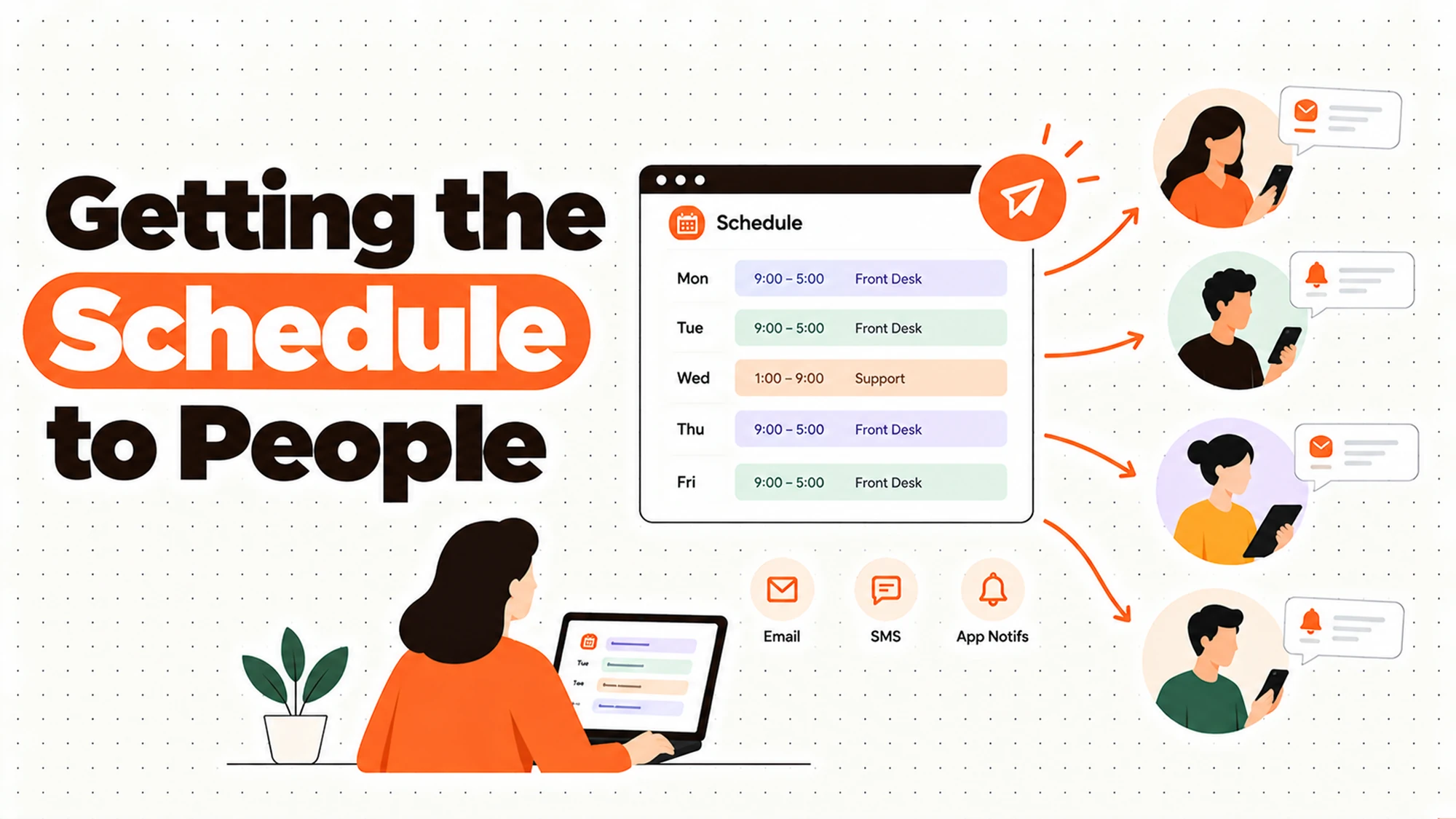
Usually by combining two things rather than finding one perfect method: somewhere permanent the current version always lives, and an active notification when it's published or changed. The permanent place can be a printed rota, an app, or a shared location people can check. The notification has to arrive rather than wait to be collected, which in practice means a message or a text. The reason for two is that single channels fail, and when your only channel fails somebody genuinely was not told.
Should you use a group chat for schedules?
Plenty of operations do and it works reasonably as a notification, with limits worth knowing. A chat is a stream, so the rota scrolls away under later conversation, there's no way to tell who read it, and somebody who muted a busy group will miss things. It also brings work into a personal space, which some people mind. Whether you can expect people to use a personal messaging account is worth establishing with local advice rather than assuming. Best as an alert that something has been published, with the rota itself living somewhere permanent.
Can you require employees to install a scheduling app?
Whether you can require it, and what you'd have to provide or compensate, differs by jurisdiction and by the arrangements you have, so establish it locally rather than assuming either way. The practical point is separate and just as important: an app that people have not installed delivers nothing, and partial adoption is worse than no app, because the system will report that notifications were sent and you will believe people were told. Measure actual adoption and keep a route for whoever is not on it.
How do you know somebody has seen their shifts?
Ask any prospective system this specifically, because it's the single most useful capability in this area and not every product has it. Being able to see that a particular person has viewed their schedule converts every delivery from an assumption into a fact, and the list of people who haven't looked is typically short enough to handle with a few phone calls on a Wednesday. Without it, the first time you discover a delivery failure is when somebody doesn't arrive, which is the most expensive possible moment.
What do you do about people without smartphones?
Name them and arrange something specific, because every operation has a few and the informal handling they currently get means they miss things more often than anybody else. It might be a printed copy given directly, a text to a basic phone, or somebody telling them each week. The important part is that it's a named arrangement rather than a hope, since these people are a small enough group to be forgotten in any general solution and a concentrated enough one for the failures to land repeatedly on the same individuals.
Should you text schedules to staff?
Text is the method with the fewest assumptions, since it works on any phone with no installation, no account and no data connection, which makes it strong for changes and anything urgent. Its limits are that a full rota doesn't fit the format well, messages cost something at volume, phone numbers go out of date without anybody updating the record, and you can't correct something already sent. Best used for alerts and changes alongside somewhere permanent the current rota lives.
How should you handle schedule questions outside working hours?
Decide it deliberately and tell people what to expect, because otherwise it gets answered by whoever happens to see a message, inconsistently. Worth being aware that expecting people to receive or respond to work messages in their own time raises questions whose answers differ by jurisdiction and by agreement, so establish your position with local advice. Operationally, the thing that reduces out-of-hours questions most is publishing reliably and making the current rota easy to check, since most of those messages are somebody trying to find out what they're working.
What actually counts as publishing a schedule?
Practically, somebody knowing about their shift, rather than an action you took in a system. That distinction is the whole of this subject: a rota that has been built, approved and released but has not reached a particular person has not been published to them, whatever any record says. It's why confirmation of receipt matters more than any feature of the delivery method, and why the useful test of any arrangement is tracing it from the perspective of somebody who has no work email and no reason to log into anything.
The rota went up. That isn't the same as anybody knowing.