
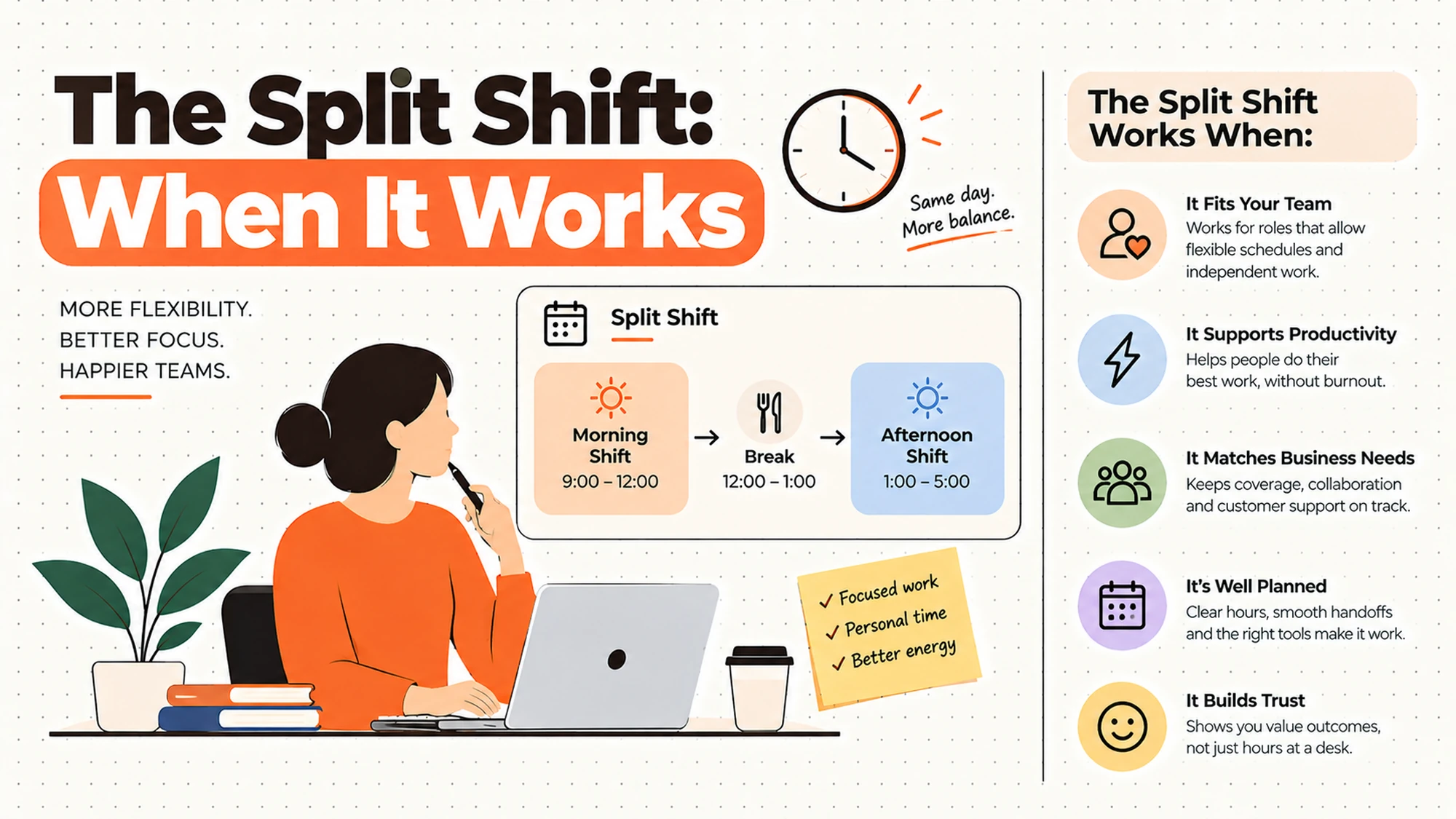
TL;DR
- The core decision: whether the gap in the middle is a cost you're moving onto your staff, or one you've designed around honestly.
- When doing nothing is right: when people volunteer for the pattern, the gap is genuinely usable, and nobody is trying to leave it.
- What has to be true: somebody can say what a person is meant to do during the unpaid middle, in specific terms, for the people who actually work it.
- How the options split: by who absorbs the dead hours, which is either the employer through overstaffing or the worker through an unpaid gap.
- Decision rule: if the gap is too short to go home and too long to wait through, you haven't split the shift, you've extended the day unpaid.
- Outcome to expect: either a pattern people choose, or an honest acknowledgement of what you're asking and something paid in return.
Two Peaks and a Dead Middle
Somebody looks at a demand curve. It has two peaks with very little between them, which is the ordinary shape in restaurants, in transport, in some care settings and in parts of retail. Staffing for the peaks means paying people to stand around in the middle. Staffing for the middle means the peaks fall over.
The split shift presents itself as the obvious answer. The same person works both peaks and goes away in between, so you get coverage where you need it and pay nothing for the hours you don't. On a staffing grid it looks elegant, and in labour cost terms it genuinely is.
What the grid doesn't show is where the dead hours went. They didn't disappear. They moved onto the person working the shift, who now has a working day that stretches across most of the daytime with an unpaid hole in it, and who often can't use that hole for anything because it isn't long enough to get home and isn't short enough to wait out comfortably.
Best tools for Workforce Management
That's the honest description of the arrangement: it solves a real problem by transferring the cost from the employer to the employee. Sometimes that transfer is acceptable, particularly where people choose it and the gap is genuinely usable. The failure is in not naming it, because a pattern whose cost is hidden never gets weighed against the alternatives, and the alternatives are frequently cheaper than they look.
When You Genuinely Do Not Need to Act Yet
Your current setup is genuinely fine. People volunteer for the split, the gap is long enough to be worth something, and nobody is trying to move off it. Some workers actively prefer this pattern, particularly where the gap is usable and the alternative is fewer hours, and if that describes your team then you have a working arrangement rather than a problem.
Friction is starting to show. The split shifts are the ones that take longest to fill, or the same people always end up on them, or somebody has asked whether they'll be paid for the middle. Each of those is a sign that the cost is landing somewhere and being noticed. The cheapest check is to ask what people actually do during the gap.
It has become a real cost. You're losing people who work the pattern, or you can only staff it with overtime, or turnover on split shifts is visibly worse than on straight ones. At this point the arrangement is costing more in recruitment than it's saving in wages, and the comparison is worth doing properly rather than assuming.
The edge case that forces it. You're introducing splits where they didn't exist, or extending the gap, or the pattern involves travel between two locations. All of these touch rules that differ by jurisdiction: some places require additional payment for split arrangements, some set minimum rest between shifts, and the treatment of travel time varies. Establish what applies where you operate and take local advice before you design the pattern, not after somebody asks.
Five Questions This Reader Asks at 11pm
Do we have to pay for the gap? That's jurisdiction-specific and the answer varies considerably: some places require a premium for split arrangements, some treat the span of the day as relevant, and some leave it entirely to the contract. Establish the local position first. Beyond the requirement, there's a separate question about whether you should, and the answer usually depends on whether the gap is genuinely free time.
How long should the gap be? Long enough to be usable or short enough not to matter, and the worst designs sit between. A gap of an hour is a long break. A gap of several hours is an afternoon. A gap that's too short to travel home and too long to sit through is the one people describe as the worst part of the job, and it's the most commonly designed.
Is it fair? It depends almost entirely on whether it was chosen. A worker who prefers this pattern, perhaps because it fits around something else in their day, is in a completely different position from one assigned to it because they were newest. Same hours, same gap, opposite experience, and the difference is entirely about choice.
Which industries actually need this? Genuine twin-peak demand exists in food service, in school transport, in some care and cleaning contracts, and in parts of retail. What's worth checking is whether your curve is genuinely twin-peaked or whether it's merely uneven, because an uneven curve is usually better handled by staggering start times than by splitting the day.
What if people like it? Then you're in good shape, and the thing to preserve is the choosing rather than the pattern. Check periodically that the preference still holds, since circumstances change and somebody who chose this two years ago may now be stuck with it because nothing in your process contemplates moving off.
Three Honest Categories the Approaches Split Into
Split the person's day. One worker covers both peaks with an unpaid gap between. It's right where the alternative is genuinely fewer hours for that person, where the gap is long enough to be useful, and where people volunteer. It's the cheapest option in direct wage terms and it keeps experienced staff on both peaks, which matters where the work needs judgement. It fails when it's assigned rather than chosen, and it fails hardest where the gap is unusable, because you've then extended somebody's day without extending their pay. It also concentrates the cost on whoever has least ability to refuse, which is usually the newest or most precarious person.
Split the coverage between people. Two shorter shifts filled by different workers. It's right when you can recruit for short shifts, which depends heavily on your local labour market and on whether the hours suit people with other commitments. Nobody's day gets stretched, and the arrangement is straightforward to explain and to staff fairly. It fails on recruitment and on continuity: short shifts attract a specific group and not always enough of them, and having different people on each peak means handovers, duplicated briefing, and less consistency for customers who come in regularly.
Absorb the middle. Keep people on through the quiet period and accept the overstaffing. It's right more often than it's considered, particularly where the quiet hours can absorb work that would otherwise happen elsewhere: preparation, cleaning, admin, training, maintenance. The cost is visible and calculable, which is what makes it unpopular, since a visible cost is easier to argue against than an invisible one. It fails where the quiet period is genuinely long or where there's nothing useful to do, at which point you're paying people to wait and both sides know it.
Five Diagnostic Questions You Can Self-Assess Against
How long is the gap, really? Measure from the end of the first shift to the start of the second, then subtract travel both ways for somebody who doesn't live nearby. What's left is the actual free time, and it's frequently close to nothing. That number, not the one on the rota, is what determines whether this pattern is tolerable.
What do people do during it? Ask, specifically. If the honest answer is that they wait on site, or sit in a car, or go somewhere to kill time, then the gap isn't a break, it's unpaid presence, and you should know that's the arrangement you've designed.
Who works the splits? Look at the list. If it's consistently the newest, the most junior or the people least able to refuse, the pattern is being allocated by ability to refuse rather than by preference, which is a fairness problem independent of the pattern itself.
Is the demand curve genuinely twin-peaked? Plot it honestly rather than from memory. Many curves that people describe as twin-peaked are actually uneven, with a quieter middle rather than an empty one, and an uneven curve is usually better served by staggered starts than by splitting anybody's day.
What's the turnover on split shifts against straight ones? Compare directly. If it's meaningfully worse, you have a number for what this arrangement costs, and it belongs in the comparison against the alternatives rather than being treated as a separate recruitment problem.
Five Alternatives to Splitting the Day, Reviewed
The split shift itself
One person works both peaks with an unpaid gap between. It earns its place where the gap is genuinely usable, where the person has chosen it, and where the alternative for them is fewer total hours. It also keeps your experienced people on both peaks, which matters in work that depends on judgement or on knowing regular customers.
Where it falls short is in the gap that isn't usable. Too short to get home, too long to wait out, and the worker has effectively been kept at work without being paid for the middle of it. The other failure is allocation: splits assigned to whoever can least object turn an operational arrangement into a fairness problem, and everybody on the team can see who's carrying it.
It works as a genuine option people opt into. It works badly as something you put people on.
There's a variant worth knowing about where the two periods are genuinely different work. Somebody doing preparation in the morning and service in the evening has a day with two distinct halves rather than the same job twice, and people often describe that as more tolerable than two identical stints. It doesn't change the gap, but it changes what the day feels like, and where the work allows it the split is easier to fill.
Two shorter shifts, different people
The peaks are covered by separate workers on short shifts. It earns its place by leaving nobody's day stretched, and by being much simpler to explain and to allocate fairly. Short shifts also suit some people well, particularly those fitting work around study, caring or another job.
It falls short on recruitment and on continuity. The pool of people wanting short shifts at specific times of day is smaller than the pool wanting full ones, and in a tight labour market it may not exist at the scale you need. You also lose continuity across the day: two sets of people means two briefings, a handover, and less consistency for anybody who experiences both peaks.
It's the better option wherever you can actually staff it, and the constraint is almost always whether you can.
Before concluding you can't, check what you'd be advertising. A short evening shift described as such, at a fair rate, reaches a different pool from a vaguely worded role that turns out to be a split, and operations that struggle to recruit for short shifts have sometimes never tried advertising one honestly. Students, people with daytime caring responsibilities and anybody holding a second job are all looking for exactly this shape, and they won't recognise it from a generic posting.
Staggered starts, tapering coverage
Rather than splitting the day, start people at different times so coverage rises and falls with demand instead of stopping. It earns its place because most demand curves aren't actually empty in the middle, they're quieter, and a tapered pattern matches that shape without anybody's day being broken.
It falls short where the middle really is dead, since staggering only redistributes people and doesn't remove them. It's also more complex to build: multiple start times mean more moving parts, more to explain, and a rota that's harder to construct each week than a simple split.
This is the option most worth checking before designing a split, because it addresses the common case where the curve is uneven rather than twin-peaked, and it costs nobody an unpaid gap.
It also degrades more gracefully than a split when something goes wrong. If somebody calls in sick on a staggered pattern, the coverage thins rather than disappearing, because there are people either side of the gap in their shift. On a split pattern an absence removes somebody from both peaks at once, which is why a single absence on a split rota so often produces two problems in one day.
Part-time roles built around one peak
Recruit specifically for the busy period rather than for the day. It earns its place by being honest about what the job is, which makes it easier to fill than an awkward pattern dressed up as a full shift. It suits people whose availability genuinely matches your peak, and those people exist in most markets.
It falls short on progression and on commitment. A role that's only ever a few hours at the same time each day offers little to somebody who wants more, so you'll lose people as their circumstances change, and you may find it harder to build the kind of experience that longer-serving staff bring. It also increases headcount and the administration that goes with it.
Where the peak is the job, this is more honest than a split and usually easier to staff.
The progression problem is worth taking seriously rather than accepting, because it's the main reason these roles churn. Somebody good at a peak-hours job will eventually want more hours, and if the only route to them is a pattern that doesn't suit their life, they'll go elsewhere. Having a stated way for a peak-hours worker to move into fuller hours as they come up keeps people who would otherwise be lost, and costs nothing beyond saying it.
Accepting the overstaffing
Keep people on through the quiet period. It earns its place by putting the cost where it originates, with the operation rather than the worker, and by buying flexibility: staff on site through the middle can absorb preparation, cleaning, restocking, training and the small tasks that otherwise get squeezed into the peaks.
It falls short when the quiet period is long or when there's genuinely nothing to do, at which point you're paying for waiting, and both sides know it. The cost is also fully visible, which makes it politically harder than an arrangement whose cost sits invisibly on somebody's afternoon.
Before dismissing it, do the arithmetic against turnover, recruitment and overtime on the split pattern. The gap between the two is usually narrower than it looks, and occasionally it's the wrong way round. The arithmetic is also worth redoing whenever wages move. Absorbing the middle gets more expensive as rates rise, but so does the overtime covering unfilled splits, and the two do not move at the same speed because overtime is paid at a premium. An answer settled several years ago on numbers that no longer apply is worth checking rather than inheriting.
The Decision Table
| Situation | Scale | Setup | Primary Pain | Recommended Starting Point |
|---|---|---|---|---|
| People volunteer, gap is usable | Any | Twin-peak demand | None | Leave it alone, check preference periodically |
| Gap too short to go home, too long to wait | Any | Any | Unpaid presence dressed as a break | Redesign the gap, or pay for it |
| Splits always fall to the newest people | Any | Any | Allocated by ability to refuse | Decide the rule, or make it voluntary |
| Demand uneven rather than twin-peaked | Any | Retail, service | Splitting solves the wrong shape | Staggered starts instead |
| Can recruit for short shifts locally | Any | Urban, student or part-time market | None, this is the easier answer | Two separate shifts |
| Turnover on splits worse than on straight shifts | Any | Any | The saving is going to recruitment | Do the arithmetic properly |
| Quiet middle has useful work in it | Any | Any | Overstaffing is not actually idle | Absorb it, and count the flexibility |
| Pattern involves travel between two sites | Any | Multi-site | Travel treatment varies by jurisdiction | Establish local rules before designing |
| Introducing splits where none existed | Any | Any | Specific obligations may apply | Take local advice first |
The second row is the most common design and the least defensible. A gap that can't be used is not a break, and describing it as one doesn't change what the person experiences. Either make the gap long enough to be genuinely free time, or shorten it to a break and pay for it.
Who Actually Pays for the Gap
The appeal of the split shift is that the dead hours stop appearing in the wage bill. They don't stop existing, and it's worth being explicit about where they land.
| The cost | Who bears it | Is it visible in any budget? |
|---|---|---|
| The unpaid middle hours | The worker, as unpaid time away from home | No |
| Travel, where the gap forces two journeys | The worker, in money and in time | No |
| A working day spanning most of the daytime | The worker, as lost availability for anything else | No |
| Childcare that must cover the whole span | The worker, often at more than the shift pays | No |
| Higher turnover on the pattern | The employer, as recruitment and training | Yes, but rarely attributed here |
| Overtime to cover unfilled splits | The employer, at a higher hourly cost | Yes, usually attributed to staffing levels |
| Reduced consistency across the day | The customer, and the operation | No |
The fourth row is the one that removes people from your workforce without anybody discussing it. Childcare usually has to cover the whole span rather than the hours worked, so a split shift can cost a parent more to work than a straight shift paying the same, which means the pattern quietly selects against anybody with young children. That shows up as individual resignations, never as a pattern.
The fifth and sixth rows are the ones that appear in your accounts, and they're routinely attributed to something else. Where turnover and overtime concentrate on the split pattern, the saving on the unpaid gap has usually been spent twice over somewhere that doesn't name it.
Making a Split Shift Less Bad
Where the pattern genuinely is the answer, a handful of things separate a split people accept from one they leave over. None of them requires abandoning the arrangement.
Make it voluntary, and keep it voluntary. A worker who chose this pattern experiences it completely differently from one assigned to it, and the difference is not sentimental: choosing means the gap fits something in their life. Maintain a route to move off it when circumstances change, reviewed at a known point rather than whenever somebody finds the nerve to ask.
Get the gap length right. Either keep it short enough to be an ordinary break, in which case pay for it and stop calling it a split, or make it long enough that going home is realistic. The middle length is where the damage sits, and it's the one that gets designed by accident because it follows the demand curve exactly.
Deal with the second journey. If the gap forces two round trips, the worker is paying twice to do one day's work, and that cost falls hardest on whoever lives furthest away. Options include contributing to travel, scheduling splits for people who live nearby where that's genuinely voluntary, or providing somewhere on site that's actually worth spending the gap in.
Provide somewhere to be. Where people wait on site, the quality of that space is most of their experience of the arrangement. Somewhere with a chair, a kettle, a door and no expectation of being available is the minimum, and it's cheap compared with what turnover costs. Where people regularly spend the gap on site, it is also worth asking whether they are genuinely off duty during it, because a space people are pulled out of when things get busy is not a break at all and creates a problem well beyond morale.
And pay something for it. This is the single change most likely to convert an assigned pattern into a volunteered one, which resolves the fairness problem underneath most complaints about splits without redesigning anything operational. Whether a premium is required differs by jurisdiction, and separately from that, paying something acknowledges that you're asking for a span rather than for hours. It also makes the pattern easier to fill voluntarily, which removes the allocation problem underneath most of the complaints.
What to Put in Writing
Split shifts are usually inherited rather than designed, which means the reasoning is gone and the arrangement persists unexamined.
| Artefact | Who owns it | When it is written | What it prevents |
|---|---|---|---|
| Whether splits are voluntary, and how to come off | Operations | Before the pattern runs | Allocation by ability to refuse |
| The actual gap length, travel subtracted | Operations | At design | A gap that looks usable on a grid and is not |
| What the worker is expected to do in the gap | Operations | At design | Unpaid presence being described as a break |
| Local rules on premiums, rest and travel | HR, with local advice | Before introducing splits | Designing something that cannot lawfully run |
| Turnover on splits against straight shifts | Whoever reports staffing | Quarterly | A saving that is being spent on recruitment |
| The demand curve the pattern is built on | Operations | At design, reviewed yearly | A split that outlived the demand shape |
The last row is the one that catches organisations out. Demand curves change, and a split shift designed for a pattern of trade that no longer exists will persist indefinitely, because nobody revisits a rota that's covering the hours. Check the curve against the pattern once a year and you'll occasionally find you're splitting people's days for a peak that stopped being a peak.
Questions to Ask Before You Commit
On the gap. How long is it after travel, and what do people actually do? A bad answer is that it's their own time.
On choice. Did the people on this pattern choose it? A bad answer is that it's part of the role.
On the curve. Is demand genuinely twin-peaked, or just uneven? A bad answer comes from memory rather than data.
On the arithmetic. What's the turnover difference, and what does it cost? A bad answer is that it hasn't been compared.
On the rules. What applies where you operate on premiums, rest and travel? A bad answer is that nobody has asked.
On the alternative. What would staggered starts cost? A bad answer is that it wouldn't work, given without modelling it.
What Getting This Wrong Costs
The first cost is turnover concentrated on one pattern, and it's usually recorded as a general recruitment difficulty. Split shifts are harder to fill and harder to keep filled, so the same roles cycle repeatedly, and each cycle costs advertising, selection, training and the productivity of somebody learning the job. Where nobody compares turnover on splits against straight shifts, that cost is never attributed to the pattern that produced it.
The second cost is who you end up with. A pattern that stretches across the daytime with an unpaid gap systematically excludes anybody with caring responsibilities, anybody studying, anybody with a second job, and anybody who lives far enough away that two journeys are unaffordable. They don't argue, they decline the shift or they leave. What remains is a workforce shaped by the rota rather than chosen by you, and it's usually a narrower one than you'd have picked.
The third cost lands on the people who stay, which is the group you can least afford to lose. Where splits are hard to fill, the shortfall is covered by the same reliable few, through overtime or through simply being asked again. That's expensive per hour and considerably more expensive in what it does to people who were already carrying the least popular pattern in the operation.
So before you design or defend one, work out which of three situations you're in. A genuine twin peak with nothing in the middle is the case splits exist for, and the question is how to make the pattern liveable. An uneven curve with a quieter middle is better answered by staggering, and splitting it is solving the wrong shape. And a curve that changed some time ago leaves you with a pattern that's costing people their afternoons for a peak that no longer arrives.
When You Are Ready to Go Further
None of this needs a system. It needs the real gap length with travel subtracted, an honest answer about whether the people on splits chose them, and a plot of the actual demand curve rather than the remembered one.
The step beyond that is the comparison nobody runs: what the split pattern costs in turnover and overtime, set against what absorbing the middle would cost in wages. Most operations assume the answer without calculating it, and the calculation takes an afternoon.
HROpsLab publishes independent comparison work across HR tooling, applicant tracking and payroll. We sell nothing, we take no vendor money, and we publish no paid placements. If the next step is looking at what your scheduling tooling can model, our comparison work is one place to start.
Frequently Asked Questions
What is a split shift?
It's a working day divided into two separate periods with an extended unpaid gap between them, rather than a single continuous shift with a normal break. Somebody might work a morning period, leave for several hours, and return for an evening one. It exists to match staffing to demand that arrives in two distinct peaks with very little trade between, which is the ordinary shape in food service, in school transport, in some care and cleaning contracts and in parts of retail. The defining feature isn't the length of the day but the gap in the middle, and whether that gap is genuinely the worker's own time is what determines how the arrangement is experienced.
Why do employers use split shifts?
Because demand in some operations genuinely arrives in two peaks, and staffing continuously through the quiet middle means paying for hours with very little work in them. A split lets the same experienced person cover both busy periods without the employer paying for the gap, which is the cheapest arrangement in direct wage terms and keeps continuity across the day. The part that's less often stated is where the dead hours actually go: they move from the wage bill to the worker's afternoon. That transfer is sometimes a reasonable trade, particularly where people choose the pattern, but it's a transfer rather than a saving.
Are split shifts fair?
It depends almost entirely on whether the person chose the pattern, which does more to determine the answer than the hours or the gap length. Somebody who prefers a split because it fits around something else in their day is in a completely different position from somebody assigned to it because they were the newest hire and least able to object. The second situation is where most complaints originate, and it's visible to everybody on the team. If splits exist in your operation, the single most useful thing you can do is make them genuinely voluntary and provide a route to move off them.
Do workers get paid for the gap in a split shift?
That varies considerably by jurisdiction and is not simply a matter of contract in every place. Some require an additional payment where a day is split, some take the total span of the day into account, and some leave it entirely to the employment agreement. Establish what applies where you operate and take local advice rather than assuming, since this is an area where requirements differ and have been changing. Separately from the legal question, there's a practical one: if the gap is too short for the person to go home, it isn't free time in any meaningful sense, and paying something for it makes the pattern much easier to fill voluntarily.
Which industries use split shifts?
They cluster wherever demand is genuinely twin-peaked: restaurants and food service with lunch and dinner trade, school and community transport with morning and afternoon runs, some domiciliary care with morning and evening calls, certain cleaning contracts scheduled around occupied buildings, and parts of retail with commuter peaks. The pattern is legitimate in all of those. What's worth checking before adopting it is whether your own curve is truly twin-peaked or merely uneven, because a quieter middle is a different problem from an empty one, and it's usually better answered by staggering start times than by splitting anybody's day.
How long should the gap between split shifts be?
Either short enough to be an ordinary break, in which case pay for it and don't call it a split, or long enough that going home and doing something is realistic for somebody who doesn't live next door. The damaging design is the one in between: too short to travel home, too long to sit through, and it's also the most commonly designed because it follows the demand curve precisely. Measure the gap with travel subtracted at both ends before deciding it's usable, since the figure on the rota and the free time the worker actually has are often very different numbers.
Should split shifts be voluntary?
Yes, wherever the operation allows it, because choice is what separates a pattern people are content with from one they leave over. Making them voluntary also solves the allocation problem that causes most of the resentment, since splits that aren't volunteered for tend to drift towards whoever has least ability to refuse. Two things make voluntary arrangements work in practice: something paid for the split, which widens the pool of people willing to take it, and a stated route to come off the pattern when circumstances change, reviewed at a known point rather than depending on somebody asking.
What are the alternatives to a split shift?
Four are worth modelling before committing. Two separate short shifts covered by different people, which leaves nobody's day stretched but depends on being able to recruit for short hours locally. Staggered start times so coverage tapers rather than stops, which fits an uneven curve much better than a split does. Part-time roles built honestly around a single peak, which are often easier to fill than an awkward pattern presented as a full shift. And simply absorbing the quiet middle, which costs visible wages but buys flexibility for preparation, cleaning and training, and is frequently closer in total cost than people assume once turnover is counted.
A split shift doesn't remove the dead hours. It decides who pays for them.