
TL;DR
- The core decision: whether the rota is judged on coverage alone, or on the three things that actually determine whether people stay.
- When doing nothing is right: when people can plan their lives around the pattern, and you're not losing anybody over it.
- What has to be true: somebody can say how far ahead the rota is published, and the answer is the same every week.
- How the options split: by how predictable the pattern is and who controls which shifts somebody gets.
- Decision rule: predictability is worth more than almost any other improvement you could make, and it's usually free.
- Outcome to expect: the same hours covered by people who can plan around them, and fewer resignations that arrive without warning.
The Rota That Covers the Hours
Somebody inherits a rota. It works, in the sense that every hour has a name against it and the operation runs. It's been like this for years, because the person who built it left and nobody had a reason to change it.
Then people start leaving. Not dramatically, and not all at once, but steadily, and the exit conversations are vague. The pay isn't the issue, or not the main one. The work is fine. Nobody says anything specific enough to act on, so the pattern gets recorded as a market problem, and recruitment is asked to work harder.
What's usually happening is that the rota is asking something of people that nobody has examined, because it's never been judged on anything except whether the hours are covered. Coverage is the easy test and the least predictive. A rota can cover every hour and still be one that nobody can plan a life around, and the people who leave first are the ones with the most options and the most going on outside work.
Best tools for Workforce Management
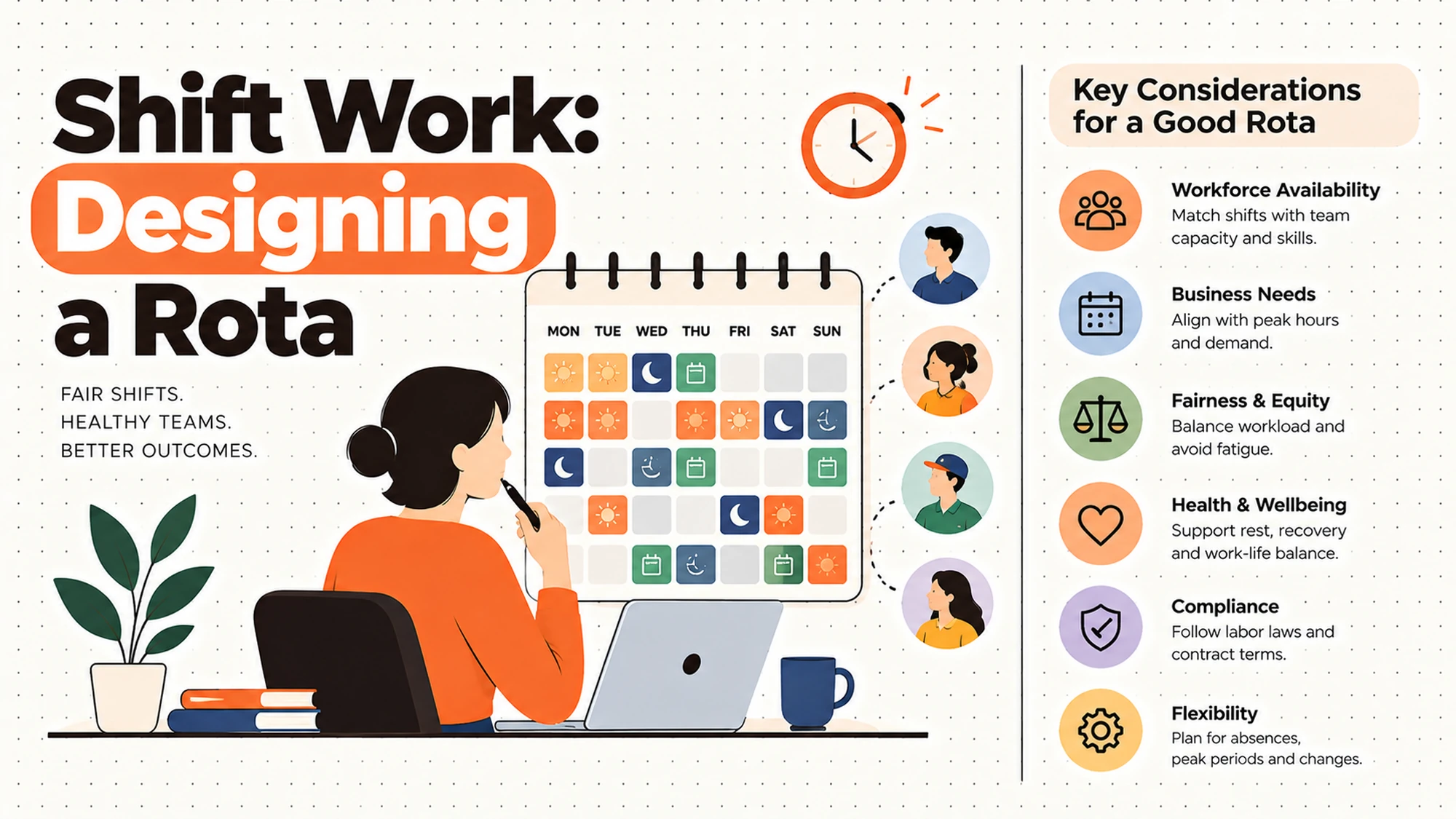
The real problem isn't that shift work is hard. It's that rotas are designed against one criterion and experienced against three: whether you can predict your life, whether you get enough recovery between shifts, and whether the pattern lets you do the things that require planning ahead. All three can be improved substantially without adding headcount, and most rotas have never been looked at against any of them.
When You Genuinely Do Not Need to Act Yet
Your current setup is genuinely fine. People know their shifts far enough ahead to plan, nobody is routinely working a late followed by an early, and you're not losing people for reasons you can't explain. Whatever pattern you've got is working, and redesigning a rota that people have built their lives around is disruptive in a way that's easy to underestimate.
Friction is starting to show. Swap requests are rising, or one particular shift is hard to fill, or somebody has mentioned that they can't commit to anything outside work. Each of those is specific and each points somewhere. The cheapest check is to ask three people on different patterns how far ahead they know their shifts, and whether that's enough.
It has become a real cost. You're losing people and the exit conversations don't produce a clear reason, or overtime is filling gaps every week, or a particular shift can only be covered by the same two people. At this point the pattern is costing you in recruitment and in goodwill, and it's worth examining directly rather than working around.
The edge case that forces it. You're introducing night work, or extending into hours you don't currently cover, or changing a pattern that people have organised their lives around. All three touch obligations that differ by jurisdiction, and night work in particular carries specific requirements in many places, including around health assessments and hour limits. Establish the position where you operate and take local advice before you design anything.
Five Questions This Reader Asks at 11pm
Which rotation direction is better? Most operational guidance favours rotating forwards, from earlier shifts to later ones, on the basis that it's easier to adjust to a later start than an earlier one. It's worth trying if you rotate, and it costs nothing to change the direction. What matters more is how quickly the rotation moves and whether the person gets a genuine break at the turn, since the transition is where the difficulty concentrates.
How much rest between shifts? Enough that the gap is usable rather than technically a gap. A late shift followed by an early one may leave a number of hours that looks adequate on paper and includes commuting both ways, which is why people describe it in terms nobody would guess from the rota. Minimum rest requirements differ by jurisdiction and some are stricter than the arrangement you might design, so establish what applies before setting a pattern.
Fixed or rotating? Fixed suits people who've built their life around a known pattern and creates a fairness problem, because somebody has the permanent nights. Rotating spreads the unpleasant shifts and gives everybody an unpredictable life. Neither is right in general. The question is whether your unpopular shifts can be volunteered for, because a fixed pattern chosen by the person is completely different from one assigned to them.
How far ahead should the rota be published? Further than you currently do, in most operations. This is the single most valuable improvement available in this whole subject and it usually costs nothing but discipline. Several jurisdictions now regulate how far in advance schedules must be published and what's owed when they change, and the rules have been changing, so find out what applies where you operate.
How do I handle the shifts nobody wants? Three honest options: pay more for them, rotate them so everybody takes a turn, or let people volunteer and accept that a few will take them permanently. What doesn't work is quietly allocating them to whoever complains least, which is what happens by default and which everybody can see.
Three Honest Categories the Approaches Split Into
Fixed patterns, known indefinitely. Everybody works the same shifts week after week. It's right when your demand is stable and when people can choose their pattern, because a known schedule is the single thing that makes shift work compatible with the rest of a life: childcare, study, a second job, anything that requires committing in advance. It fails on fairness when the unpopular shifts are assigned rather than chosen, since somebody is then permanently on nights so that others never are. It also fails when demand genuinely varies, because a fixed pattern against variable demand produces a rota that's wrong in both directions.
Rotating patterns, everybody takes a turn. The pattern cycles so that unpopular shifts are shared. It's right when you need coverage of genuinely unpleasant hours and can't fill them voluntarily, and it's defensible on fairness grounds in a way fixed patterns aren't. It fails on the body and on the calendar. Rotation means nobody ever settles, recovery is interrupted at every turn, and planning anything more than a few weeks out requires consulting a grid. Where the rotation is fast, it produces the worst of both: no stability and no genuine adaptation.
Flexible scheduling, published shortly in advance. Shifts are built to demand each period and published close to the date. It's right for operations where demand genuinely can't be predicted far out, and it minimises over-staffing, which is a real cost nobody complains about. It fails on the thing that matters most to the people working it. A schedule published shortly before the week it covers makes planning impossible, which pushes out anybody with caring responsibilities or commitments, and it's increasingly regulated: several jurisdictions now require minimum notice and compensate changes, so check the local position before relying on it.
Five Diagnostic Questions You Can Self-Assess Against
Ask three people how far ahead they know their shifts. Ask people on different patterns, separately. If the answers differ, or if the honest answer is that it depends, you have a predictability problem, and it's almost certainly the biggest single thing you could fix.
Look at the gaps between consecutive shifts. Find the shortest one in your pattern and add the commute at both ends. That's the real rest period, and it's frequently much less than the rota suggests. If a late-to-early transition exists in your pattern, that transition is doing more damage than anything else in it.
Which shift takes longest to fill? The one that needs chasing, or that always falls to the same people, is your problem shift, and it's worth treating as a specific question rather than as part of a general rota review. Usually there's a single feature making it unattractive, and occasionally that feature is fixable.
Who can't work the pattern any more? Look at who's left in the last year and what their circumstances were. Shift patterns select: a pattern that requires availability at short notice systematically removes people with caring responsibilities, and the selection is invisible because it shows up as individual resignations with individual reasons.
Are swaps concentrated on particular shifts? Pull the swap requests and look at which shifts get traded away. That's your team telling you, in the only channel available to them, which parts of the pattern don't work. It's more honest than any survey because nobody is answering a question.
Six Rota Patterns, Reviewed
The fixed pattern, known indefinitely
Everybody works the same shifts every week, unchanged until something forces a change. It earns its place because predictability is the thing shift workers value most, and this delivers it completely. Somebody on a fixed pattern can arrange childcare, enrol in a course, hold a second job, or commit to anything that meets weekly. No other pattern allows that.
Where it falls short is distribution. If the unpopular shifts are fixed too, somebody holds them permanently, and unless they chose them that's a standing unfairness that everybody can see. It also can't flex: when demand changes, the fixed pattern is wrong in both directions until somebody redesigns it, and redesigning a pattern people have built their lives around is far more disruptive than changing a flexible one.
The version that works pairs fixed patterns with genuine choice, including a route to change pattern when circumstances change. A fixed shift somebody picked is a benefit; the same shift assigned is a sentence.
The route out is the part usually missing. People's circumstances change, and somebody who chose evenings when they had no children may be stuck with them three years later with no way to ask, because nothing in a fixed system contemplates movement. A stated way to request a change, reviewed at a known point rather than whenever somebody plucks up the courage, keeps the pattern voluntary rather than merely voluntary at the moment it was set.
Forward rotation, earlier to later
The pattern moves in the direction of later starts: mornings, then afternoons, then nights. It earns its place as the better of the two rotation directions in most operational guidance, because adjusting to a later start is generally easier than adjusting to an earlier one, and because it spreads unpopular shifts across everybody.
It falls short on the transitions and on planning. Every turn of the cycle is an adjustment, so somebody on a rotating pattern never fully settles, and the longer the cycle runs the more people describe a permanent low-grade tiredness. Planning anything is hard: a rotating worker consulting a grid to find out whether they can attend something next month is a different relationship to their own time than a fixed worker has.
If you rotate, rotate forwards, allow a genuine break at the turn rather than a token one, and publish the cycle far enough ahead that people can read their own life off it.
Backward rotation, later to earlier
The pattern moves the other way: nights, then afternoons, then mornings. It earns its place mainly in operations where it's already established and the workforce has adapted, and changing an established pattern carries its own costs that shouldn't be dismissed.
It falls short on the transitions specifically. Moving to an earlier start compresses the available rest at every turn, so the gap between finishing one shift and starting the next is at its tightest exactly when the adjustment is hardest. Where this pattern exists, the transition points are usually where the complaints and the swap requests concentrate.
If you have it and it's working, the case for change is weaker than the theory suggests. If you're designing from scratch, there's little reason to choose it. Where it exists for a reason nobody can now recall, which is common, it's worth asking whether the reason was ever operational. Backward rotation sometimes persists because it suited a handover arrangement that no longer exists, or because a previous manager preferred it, and the pattern outlived both. That is a cheaper thing to change than a pattern with a live constraint behind it.
The compressed week, fewer longer days
The same hours in fewer, longer shifts. It earns its place through the thing people actually want, which is consecutive days off. A pattern that produces genuine multi-day breaks is valued highly, and it reduces commuting, which for some people is a significant part of what the job costs them.
It falls short at the end of long shifts, and the degree depends heavily on the work. Long shifts in physically demanding or safety-sensitive roles are a different proposition from long shifts in low-intensity monitoring work, and the same pattern can be fine in one setting and unwise in another. Maximum hours and required breaks differ by jurisdiction, so the design isn't purely a matter of preference.
Where it suits the work, it's one of the few changes that's genuinely popular. Establish the local limits first, and be honest about whether your work belongs in the category where this is sensible.
Fully flexible, published shortly in advance
Shifts are built against demand each period and published close to the week. It earns its place where demand is genuinely unpredictable, and it's the most efficient pattern in labour-cost terms, since you staff what you need rather than what you planned.
It falls short in a way that's easy to miss from the management side, because the cost lands entirely on the worker. Someone who doesn't know next week's shifts can't commit to anything, and over time the people who need to commit to things leave. That looks like turnover and is actually selection. Several jurisdictions now require minimum advance notice of schedules and compensate late changes, and the rules have been changing, so confirm the local position rather than assuming flexibility is yours to take.
If you use it, the improvement available is almost always notice period rather than anything structural.
Self-scheduling, the team fills the grid
Shifts are published as a grid and people claim them within stated rules, with a manager resolving what's left. It earns its place because it hands control of the thing people care about to the people affected, and because the resulting rota tends to fit actual preferences better than any allocation could.
It falls short on the leftovers. The unpopular shifts don't fill themselves, so somebody still has to allocate them, and if that's done by asking for volunteers repeatedly the same people end up carrying them. It also needs rules that are stated rather than assumed, covering minimum hours, skill mix on each shift, and rest between claimed shifts, or the grid fills in a way that doesn't work.
It's the best-received pattern in most operations that try it, provided the difficult part, which is the residue, is handled openly rather than left to pressure.
It asks more of the manager than it appears to, which is worth knowing before starting. Somebody has to check the resulting grid for skill mix, for rest between claimed shifts, and for the person who has quietly claimed far more hours than is sensible. Those checks are the job, and a self-scheduling system left entirely unsupervised produces a rota that satisfies preferences and fails the operation, usually in the first month.
The Decision Table
| Situation | Scale | Setup | Primary Pain | Recommended Starting Point |
|---|---|---|---|---|
| People can plan, nobody leaving over it | Any | Any | None | Leave it alone |
| Nobody knows their shifts far ahead | Any | Any | Predictability, the biggest single factor | Extend the notice period, first |
| One shift always falls to the same people | Any | Any | Unpopular shifts allocated by default | Decide explicitly: pay, rotate, or volunteer |
| Late shift followed by an early one | Any | Any | Rest that is technically a gap | Remove the transition, check local rest rules |
| Losing people with caring responsibilities | Any | Variable scheduling | The pattern selects who can stay | Predictability, and fixed options for those who want them |
| Demand genuinely unpredictable | Any | Retail, hospitality | Cannot plan far ahead honestly | Improve notice within what is possible, check local rules |
| Swap requests concentrated on one shift | Any | Any | The team is telling you something | Look at that shift specifically |
| Introducing night work | Any | Any | Specific obligations may apply | Establish local requirements, take advice first |
| Stable demand, people want consecutive days off | Any | Any | Pattern does not produce real breaks | Consider a compressed week, check hour limits |
The second row is the one to act on before anything else. Extending how far ahead the rota is published is usually free, it's the change people value most, and it's the one that determines whether somebody with a life outside work can stay in the job.
The Three Things a Rota Is Actually Judged On
Coverage is what rotas are designed for and it's not what they're judged on by the people working them. Three other things determine whether a pattern is liveable, and each produces a distinct complaint.
| The factor | What people experience when it is wrong | What to change |
|---|---|---|
| Predictability | Cannot commit to anything outside work, ever | Publish further ahead, and stop changing published shifts |
| Recovery between shifts | Permanently tired in a way sleep does not fix | Remove the tightest transition in the pattern |
| Ability to plan a life | Missing recurring things: classes, clubs, family | Consistent days off, or a fixed option for those who want it |
| Fairness of allocation | Watching the same people always get the good shifts | Decide the allocation rule and state it |
| Control over your own pattern | Being told, never asked | Self-scheduling, or a route to request a change |
The first row is worth more than the other four combined, and it's the cheapest to fix. The difference between knowing your shifts two weeks ahead and knowing them the week before is the difference between being able to arrange childcare and not, and it requires no additional staff, only a decision to freeze the schedule earlier.
The fourth row is the one managers most often get wrong by accident. Where unpopular shifts are allocated informally, they drift towards whoever complains least, which is usually the newest or least confident person, and everybody else notices. Any stated rule, even one people dislike, is better received than a pattern that looks like favouritism.
Night Shifts and Recovery
Night work is the hardest part of any rota and the part where design choices matter most. It's also where obligations most commonly attach: many jurisdictions have specific requirements covering night workers, including limits on hours and entitlements around health assessments, and these differ considerably. Establish what applies where you operate before designing a night pattern, and take local advice.
Beyond the requirements, a few design choices consistently separate a night pattern people can sustain from one they can't.
Consecutive nights, in a block, are generally easier than nights scattered through a pattern. Somebody working several nights in a row can establish a rhythm of sorts, whereas a single night dropped into a week of days requires two adjustments for one shift. Where the operation allows it, blocks are usually the better design.
What follows the block matters as much as the block. A genuine break afterwards, long enough to reset, is the difference between a pattern that's demanding and one that accumulates. A single day between a run of nights and a run of earlies is not a break in any meaningful sense, and patterns built that way generate the tiredness people describe as permanent.
The practical conditions matter too, and they're cheaper to change than the pattern. Whether there's real food available, whether the break space is somewhere anybody would choose to sit, whether getting home at that hour is safe and possible, and whether a night worker can reach somebody if something goes wrong. Those aren't peripheral comforts, they're most of what distinguishes a tolerable night shift from a grim one, and they're within the gift of the operation.
And be careful with volunteers. Some people genuinely prefer nights and choose them deliberately, which is a good outcome for everybody. It's worth checking periodically that the preference still holds, because circumstances change and a pattern somebody chose three years ago can become one they're stuck in.
What to Put in Writing
Rota decisions are usually held in one person's head and inherited by whoever comes next, which is why patterns persist long after the reason for them has gone.
| Artefact | Who owns it | When it is written | What it prevents |
|---|---|---|---|
| How far ahead the rota is published | Operations | Now, and honoured | A notice period that quietly shortens under pressure |
| The rule for allocating unpopular shifts | Operations | Before it is tested | Allocation drifting to whoever complains least |
| What happens when a published shift changes | Operations, with local advice | Before it happens | Disputes, and possible obligations nobody checked |
| Minimum gap between shifts in this pattern | Operations, with local advice | At design | A transition that looks fine on a grid |
| Who may request a pattern change, and how | Operations | When the pattern is set | People leaving rather than asking |
| Local requirements for night work | HR, with local advice | Before any night pattern | Designing something that cannot lawfully run |
The first row is the one that decays without anybody deciding it should. A published notice period erodes under operational pressure, one week at a time, until it's gone, and nobody can point to the moment it changed. Writing it down makes the erosion visible.
Questions to Ask Before You Commit
On predictability. How far ahead do people know their shifts, and is it the same every week? A bad answer is that it depends.
On the gap. What's the shortest turnaround in your pattern, with commuting included? A bad answer quotes the rota rather than the reality.
On allocation. How do the unpopular shifts get filled? A bad answer is that it works itself out.
On selection. Who's left in the past year, and could they have worked this pattern? A bad answer treats each departure separately.
On swaps. Which shifts get traded away most? A bad answer is that swaps aren't tracked.
On night work. What applies where you operate, and who confirmed it? A bad answer is that other employers do it this way.
What Getting This Wrong Costs
The first cost is turnover that reads as a market problem. People rarely resign citing a rota, partly because it sounds like a complaint about the job itself and partly because the effect is cumulative rather than attributable to any single thing. So the reasons given are vague, the pattern gets recorded as competitive pressure, and the organisation spends on recruitment to replace people it was losing for a reason it never identified.
The second cost is selection, and it's the one nobody measures because it's invisible by construction. A pattern requiring availability at short notice systematically removes people who need to plan: those with children, with caring responsibilities, with studies, with anything that meets at a fixed time. They don't complain, they leave, and each departure has its own individual explanation. What remains is a workforce shaped by the rota rather than by hiring.
The third cost is the overtime that fills the gaps. Where a pattern is hard to staff, the shortfall gets covered by extra hours from the people already there, which costs more per hour and lands on the same small group who were already carrying the difficult shifts. That's expensive in money and more expensive in the thing it does to those people, who are usually the ones you can least afford to lose.
So before you redesign anything, work out which of three problems you have. A predictability problem means people can't plan, and the fix is notice, which is nearly free. A recovery problem means the pattern doesn't allow enough real rest, and the fix is a transition, which is a design change. A fairness problem means the good and bad shifts are distributed in a way people can see and resent, and the fix is a stated rule. Different problems, different answers, and only the third needs anybody to agree to anything unpopular.
When You Are Ready to Go Further
None of this needs a system. It needs an honest answer about how far ahead the rota is genuinely published, a look at the tightest turnaround in your pattern, and a stated rule for who gets the shifts nobody wants.
The step beyond that is asking the people on the pattern, specifically rather than generally. Not whether they're satisfied, but which single change to the rota would make the most difference to them. The answers cluster quickly, they're usually cheaper than expected, and they'll tell you which of the three problems you actually have.
HROpsLab publishes independent comparison work across HR tooling, applicant tracking and payroll. We sell nothing, we take no vendor money, and we publish no paid placements. If the next step is looking at what your scheduling tooling can actually support, our comparison work is one place to start.
Frequently Asked Questions
What is shift work?
It's any arrangement where the working day is covered by successive groups of people rather than by everybody working the same hours, which is how most operations run when they need coverage beyond a standard day: healthcare, manufacturing, hospitality, retail, transport, emergency services and utilities among others. The term covers a wide range of arrangements, from a fixed evening shift that never changes to a rotating pattern that moves through mornings, afternoons and nights. That range matters more than the label, because the difference between a predictable fixed shift and a rotating one that changes weekly is enormous for the person working it.
Is forward or backward rotation better?
Forward rotation, moving from earlier shifts to later ones, is generally the preferred direction in operational guidance, on the reasoning that adjusting to a later start is easier than adjusting to an earlier one. If you rotate and currently go backwards, changing direction costs nothing and is worth trying. That said, the direction matters less than two other things: how much genuine rest sits at each transition, and how quickly the cycle turns. A forward rotation with a tight turnaround at the change point will be experienced as worse than a backward one with a proper break, so fix the transitions before worrying about direction.
How much rest should there be between shifts?
Enough that the gap is usable once travel is subtracted at both ends, which is a stricter test than it sounds. A turnaround that looks adequate on a grid can leave very little once someone gets home, sleeps, and travels back, and the late-to-early transition is where this bites hardest. Minimum rest periods are set by law in many jurisdictions and the requirements differ considerably, with additional rules often applying to night workers, so establish what applies where you operate rather than designing from first principles. Then check your own pattern for its tightest transition, because that one is doing most of the damage.
Are fixed or rotating shifts better?
Neither, in general, and the honest answer depends on whether people can choose. A fixed pattern is the best thing available for planning a life, since it lets somebody arrange childcare, study or anything that meets weekly, and people on fixed patterns they chose are usually the most settled group in any operation. The problem is distribution: if the unpopular shifts are also fixed, somebody holds them permanently. Rotation shares the burden fairly and takes predictability from everybody. The best arrangement most operations can reach is fixed patterns where people have genuinely chosen, with rotation only for what nobody will take.
How far in advance should a rota be published?
Further ahead than most operations currently manage, and this is the single most valuable improvement available in this whole subject because it usually costs nothing but discipline. The difference between knowing your shifts a fortnight ahead and knowing them a few days ahead determines whether somebody can arrange childcare, commit to a course, or hold a second job. Several jurisdictions now regulate minimum advance notice and require compensation when published shifts change, and these rules have been spreading and changing, so establish what applies where you operate. Then treat your stated notice period as fixed, because it erodes under pressure otherwise.
Do compressed working weeks work for shift patterns?
They're popular where they suit the work, because the thing people value most after predictability is consecutive days off, and a compressed pattern delivers that along with fewer commutes. The question is whether your work belongs in the category where longer shifts are sensible. Physically demanding or safety-sensitive work at the end of a long shift is a different proposition from lower-intensity work, and the same pattern can be reasonable in one setting and unwise in another. Maximum hours and break requirements differ by jurisdiction too, so establish the local limits before designing rather than after.
How do you make night shifts more bearable?
Start with the local requirements, since many jurisdictions have specific rules for night workers covering hours and health assessments, and these vary. Beyond that, a few design choices consistently help: run nights in blocks rather than scattering single nights through a pattern, and put a genuine break after the block rather than a single day before a run of earlies. Then attend to the conditions, which are cheaper to change than the pattern: real food available, a break space somebody would choose to sit in, a safe way home at that hour, and somebody reachable if a problem arises. Those practical things account for a surprising amount of the difference.
How should you allocate the shifts nobody wants?
Pick one of three and say which: pay more for them, rotate them so everybody takes a turn, or let people volunteer and accept that some will hold them permanently. Each is defensible and each has an obvious cost. What causes damage is the fourth option, which is what happens by default: the unpopular shifts drift towards whoever complains least, usually the newest or least confident members of the team, and everybody else can see it happening. A stated rule people dislike is received far better than an unstated pattern that looks like favouritism, because the second one implies something about how the place is run.
A rota that covers every hour can still be one nobody can build a life around. Coverage is the easy test.