
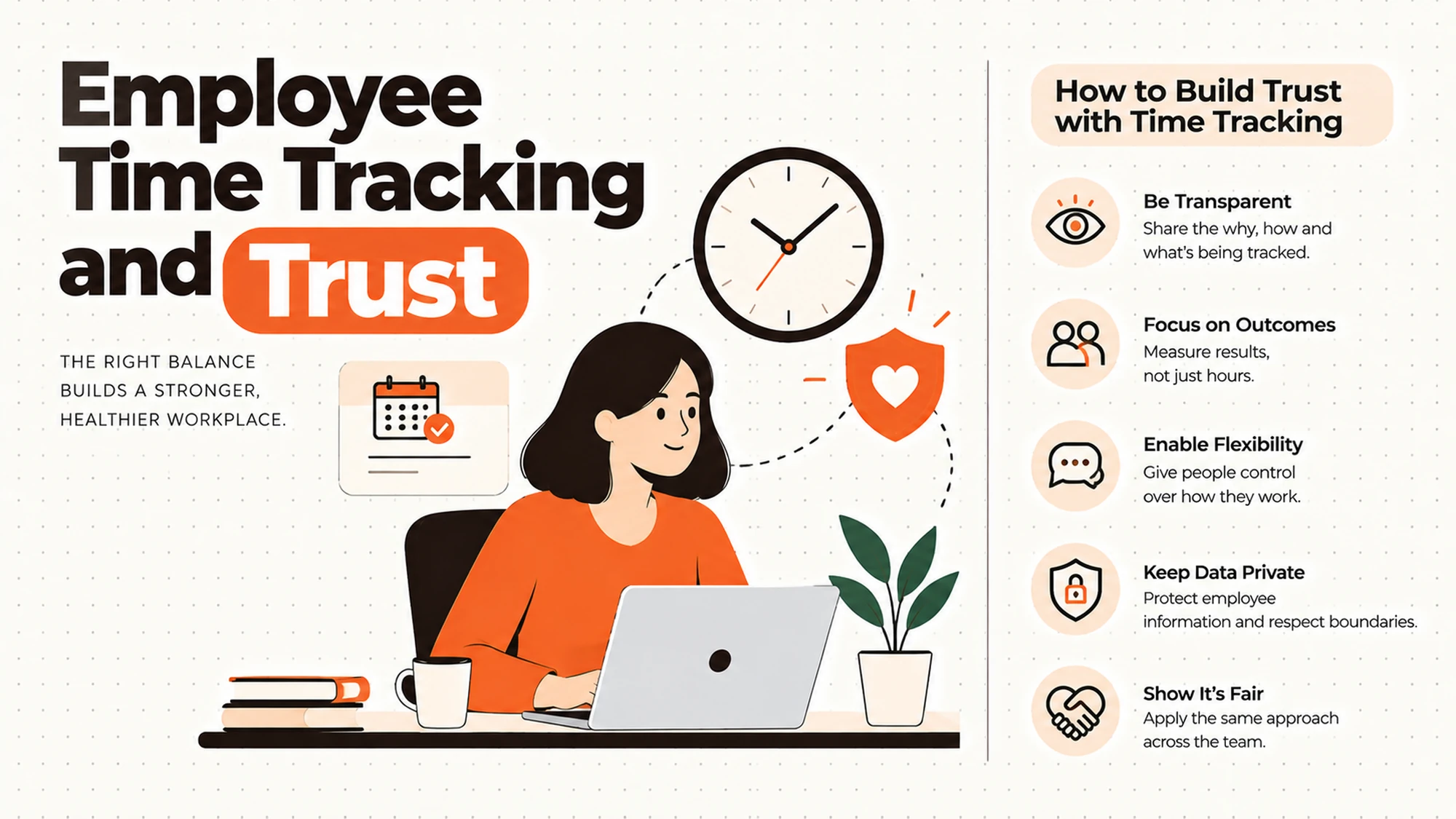
TL;DR
- The core decision: whether you're recording time to pay or bill for it, or observing time to judge effort. The same tool does both, and they're different things.
- When doing nothing is right: when nobody is paid by the hour, no client is billed by the hour, and nothing external requires the record.
- What has to be true: you can state the purpose in one sentence, and it doesn't contain the word accountability.
- How the options split: by what the data is used for, which determines what you're entitled to collect.
- Decision rule: if you can't say what decision the data will inform, you're collecting it to reassure yourself, and people will read it that way.
- Outcome to expect: either a narrow, boring, accepted system, or an unhappy team. Rarely anything in between.
The Question Behind the Question
A founder or a manager starts looking into time tracking. The trigger is usually vague: work seems slower than it should be, or somebody senior asked how the team's time is spent, or a project ran long and nobody could say where the hours went.
They look at the options, and the options are impressive. Some record hours against tasks. Some capture activity levels, or take periodic screenshots, or log which applications were open. There's a spectrum, and the further along it you go, the more the product promises to tell you.
What almost never happens at this point is the question being made explicit. Are we recording time because somebody needs to be paid or billed for it, which is administration, or are we observing time because we want to know whether people are working, which is supervision? Those are different activities with different justifications, and the same software serves both, which is exactly why they get conflated.
Best tools for Workforce Management
The real problem is that you can leave that question unanswered internally and it will still be answered externally. Your team will decide which one this is, usually within a week of the announcement, and in the absence of a stated purpose they'll assume the second. Once they've assumed it, the behaviour you get is the behaviour you'd expect from people who believe they're being watched, and that's true whether or not you meant it.
When You Genuinely Do Not Need to Act Yet
Your current setup is genuinely fine. Nobody is paid by the hour, no client is billed by the hour, and nothing external requires a record of time. If all three hold, time tracking has no administrative purpose in your organisation, and whatever is prompting the question is about something else. Work out what that something else is before reaching for a tool.
Friction is starting to show. A project ran significantly over and nobody can say where the effort went, or you're quoting new work with no idea what similar work actually cost. That's a genuine information gap and it has a proportionate answer, which is usually a short, bounded exercise rather than a permanent system.
It has become a real cost. You're consistently under-quoting, or a client has queried an invoice you can't substantiate, or you genuinely cannot tell which of your services makes money. At this point you need time data attached to work, and the case is clear enough to state to the team without it sounding like suspicion.
The edge case that forces it. A client contract requires detailed time records, or you work in a setting where record keeping obligations attach to particular activities. Those are external requirements rather than management choices, and saying so plainly changes how the request lands. Note that obligations differ by jurisdiction and by sector, so establish what applies to you specifically rather than assuming.
Five Questions This Reader Asks at 11pm
Is it legal to monitor employees? It depends heavily on where you are and on what you're collecting. Some jurisdictions require notice, some require a specific basis, some restrict particular categories of data, and several have been changing. The gap between what's technically possible and what's permitted is wide, and vendor claims about compliance apply to the product rather than to your use of it. Establish the local position before you enable anything, and take advice.
Should I track salaried staff? Only if there's a purpose beyond pay, and you should be able to name it. Billing a client, understanding project cost, or meeting an external requirement are all legitimate and worth stating. Asking salaried people to account for their hours when their pay doesn't vary is, functionally, supervision, and describing it as anything else fools nobody who has to do it.
How do I introduce this without damaging trust? Say the purpose, say what's collected and what isn't, and say what it won't be used for. Then hold to the last one. Most of the damage in this area comes not from tracking but from scope creep: data gathered for costing that later appears in a performance conversation teaches everybody that stated purposes aren't reliable.
What about screenshots and activity monitoring? They measure the appearance of work rather than work, and people adapt to them quickly. The more significant problem is what they signal: these tools exist because somebody suspected something, and installing one communicates that suspicion more clearly than any message. If there's a specific performance concern, the honest route is a conversation about it.
Will tracking make people more productive? In the narrow sense that measured activity tends to rise, sometimes. In the sense you probably mean, rarely, and it frequently reduces the parts of work that don't record well: helping a colleague, thinking about a problem, or noticing something that wasn't your task. What tracking reliably produces is better information about where time goes, which is useful, and it's a different thing from more output.
Three Honest Categories the Approaches Split Into
Recording time for pay or billing. Hours are captured because somebody is paid or invoiced on the basis of them. It's right wherever that's true, it needs no justification beyond the arithmetic, and it's generally accepted without friction because the purpose is obvious to everybody involved. It fails only when it's used for a second purpose nobody mentioned, at which point the acceptance disappears and doesn't come back. The other failure is precision beyond the need: recording to the minute when you invoice by the half-day generates administration and mild resentment for no benefit.
Recording effort to understand cost. Time is attached to projects or services so the organisation can see what things actually take. It's right when you're quoting new work blind, or when you genuinely don't know which services make money, and the information it produces is frequently surprising in a useful way. It fails on granularity and on duration. Categories fine enough to be interesting are usually too fine to record accurately, so people guess, and the data becomes a confident-looking fiction. It also fails when it's permanent: the question is usually answered by a bounded exercise, and running it forever produces diminishing information at constant cost.
Observing activity to assess whether people are working. Screenshots, application logging, idle detection, activity scoring. It's right in a genuinely narrow set of circumstances, principally where a specific external obligation requires it. It fails in most other cases for a reason that's worth stating plainly: it addresses a management problem with a technical instrument, and management problems don't respond to instruments. If somebody isn't performing, monitoring produces evidence of that fact while making the situation worse for everybody who was performing all along.
Five Diagnostic Questions You Can Self-Assess Against
What decision will this data inform? Name it specifically. Better pricing on the next quote is a decision. Knowing whether the support service covers its cost is a decision. Visibility isn't a decision, and if that's the honest answer then the data will be collected, looked at once, and used mainly to reassure whoever asked for it.
Would you be comfortable showing the team exactly what's collected? Not the policy summary, the actual data. If the answer is no, you already know how it'll be received, and the discomfort is telling you something worth listening to before you deploy rather than after.
Is there one person you're worried about? Be honest, because this is the real origin of a lot of tracking. If the answer is yes, you're proposing to monitor everybody to avoid one conversation with one person, and the cost of that trade is paid by the people who weren't the problem. Have the conversation.
How precise does this actually need to be? Match the granularity to the decision. If you quote in days, recording to the quarter hour adds administration and no information. Over-precision is the most common design error here, and it's the one that turns an acceptable system into a daily irritation.
What will you commit to not using it for? Write the answer down and share it. A stated boundary is the single most effective thing you can do to make tracking acceptable, and breaking it once is the single most effective way to make everything you say afterwards suspect.
Five Reasons Organisations Track Time, Reviewed
Paying hourly people correctly
Hours are recorded because pay depends on them. It earns its place immediately and needs no defence: if somebody's pay varies with hours worked, those hours have to be recorded, and everybody involved understands why. It's also the use with the clearest boundary, since what's needed is the total, not the composition.
Where it falls short is in scope creep, and this is where most organisations damage something that was working. A system installed for payroll accumulates features: task categories, location checks, activity indicators. Each addition is small and defensible in isolation, and collectively they convert an accepted administrative system into monitoring. The team notices the direction of travel well before anybody acknowledges it.
Keep it to what pay requires. If you want something else, ask for it separately and explain why.
There's a version of this worth guarding against specifically, because it arrives with good intentions. Somebody notices that the payroll system could also capture which job or site the hours were spent on, at no extra cost, and enables it. That's a genuinely useful thing for costing and it's also a change of purpose, made by configuration rather than by decision. Announce it as the change it is, or you've quietly widened the collection and nobody was asked.
Billing a client for work done
Time is recorded against a client or matter because that's the basis of the invoice. It earns its place for the same reason as payroll, with the added benefit that clients frequently require the detail, which removes any ambiguity about purpose. It also produces a useful byproduct: over time you learn what kinds of work actually take.
It falls short on the categories. Billing codes are usually designed for the invoice rather than for the person filling them in, so the work that doesn't fit a code gets forced into the nearest one, and that's the work you most needed to see. It also creates a documented gap between billable and total hours, which is fine when treated as information and corrosive when treated as a target.
The thing to watch is what happens to the non-billable remainder. If it becomes a performance measure, people will stop recording it accurately, and you lose the only view you had of where the rest of the time goes.
The design choice that helps most is providing honest codes for the non-billable work rather than a single residual category. Time spent on recruitment, on internal systems, on helping somebody in another team and on genuine slack are four different things, and collapsing them into one bucket called non-billable makes all of them look like waste. Where the categories exist and are legitimate, people use them, and what you get back is a real picture of where the organisation's effort goes.
Understanding where project effort actually goes
Time is attached to internal projects so the organisation can see what things cost. It earns its place when quoting is guesswork or when nobody knows which services are profitable, and the findings are often genuinely surprising: the work everyone assumed was cheap frequently isn't.
It falls short on accuracy and on permanence. Retrospective allocation across many small categories is guessing with a form attached, and the more categories you offer the more guessing there is. It's also usually a question rather than a permanent condition. Once you know what the work takes, continued collection mostly confirms it, at a recurring cost in everybody's attention.
The proportionate version is a bounded exercise: a few weeks, broad categories, a stated question, and a stated end date that's actually honoured.
Honouring the end date matters more than it appears to, and it's where these exercises usually come apart. A study that quietly continues because the data turned out to be interesting has become a permanent system without anybody deciding it should be, and the team learns that a time-limited commitment from this organisation isn't one. If you find you want to keep going, stop anyway, then propose it again as a new thing with its own case. The cost of that is a fortnight. The cost of the alternative is every future assurance.
Meeting an external record keeping obligation
Records exist because something outside the organisation requires them: a contract, a funder, a sector-specific obligation. It earns its place by not being a choice, and saying so plainly is the most useful thing you can do, since a requirement imposed from outside lands completely differently from one that appears to be a management preference.
It falls short when the internal implementation exceeds the external requirement, which is common. Somebody designs for the strictest possible reading, adds margin, and the result is considerably more onerous than what was actually asked for. It also fails when nobody re-reads the requirement for years, so a process continues in a form that stopped being necessary.
Find out precisely what's required, where you operate, and build to that rather than to a cautious interpretation of it. Requirements differ by jurisdiction and sector, so this is worth confirming locally.
It's also worth separating the requirement from the system that satisfies it. Organisations frequently buy a product because an obligation exists, when what the obligation actually needs is a record in a particular form for a particular period, which an existing system may already produce. Read what's required first, then ask what you already hold. The answer is often that the gap is narrower than the procurement that was about to start.
Monitoring whether people are working
Activity levels, screenshots, application use, idle time. It earns its place in a genuinely narrow band: specific regulated environments where activity records are required, and occasionally in disputes where an external body expects evidence. Outside that, it's honest to say it exists because somebody wanted reassurance.
It falls short comprehensively. It measures the appearance of work, which people adapt to faster than any organisation adapts its measures. It penalises exactly the work you most want: thinking, helping somebody, reading something that turned out to matter. And it makes an announcement about how the organisation regards its people that no subsequent communication can retract. Where a specific performance concern exists, this is a slow and indirect substitute for a conversation that would take twenty minutes.
Rules on monitoring differ sharply by jurisdiction and several places require notice or a specific basis, so if you're considering it, establish the local position first and take advice.
There's one argument for it that deserves a fair hearing, which is remote work: managers who can no longer see their team sometimes reach for this as a substitute for the observation an office provided incidentally. The instinct is understandable and the substitute is poor. What an office gave was ambient knowledge of how work was going, and what activity monitoring gives is a record of keyboard use, which answers a question nobody actually had. The thing that genuinely replaces it is a regular conversation about the work.
The Decision Table
| Situation | Scale | Setup | Primary Pain | Recommended Starting Point |
|---|---|---|---|---|
| Nobody paid or billed hourly, no obligation | Any | Any | None | Do not track. Find the real question |
| Hourly workforce | Any | Any | Pay depends on hours | Record hours only, nothing else |
| Billing clients by time | Any | Professional services | Invoices must be substantiated | Record against client, keep codes broad |
| Quoting new work blind | Any | Any | No idea what similar work costs | Bounded exercise, broad categories, end date |
| Cannot tell which service makes money | Any | Any | Cost per service is unknown | Bounded exercise, then stop |
| External contract or sector obligation | Any | Any | Not a choice | Build to the requirement, confirm it locally |
| One person you are worried about | Any | Any | You are avoiding a conversation | Have the conversation |
| Considering activity or screenshot monitoring | Any | Any | Wanting reassurance | Establish local rules, and reconsider |
| Salaried staff, pay does not vary | Any | Any | No pay purpose exists | Only with a named purpose, stated out loud |
The seventh row is the most common unstated reason for a tracking project and the one worth naming directly. Monitoring an entire team to avoid a single difficult conversation is a poor trade: the conversation costs twenty minutes and affects one person, while the monitoring costs a permanent change in how everybody else experiences their work.
Stating the Purpose Before the Tool
The purpose determines what you're entitled to collect, and stating it narrows the question usefully. Most tracking projects go wrong because the purpose is assumed rather than declared.
| The purpose | What it justifies collecting | What it does not |
|---|---|---|
| Paying hourly people | Start, end, breaks, total hours | What was worked on, or how actively |
| Billing a client | Time against client or matter | Activity levels, screenshots, location |
| Understanding project cost | Time against broad categories, for a period | Permanent collection, or individual comparison |
| An external obligation | Precisely what the obligation names | Anything added for internal comfort |
| Assessing whether people work | Very little, and only with a specific basis | Most of what these tools offer by default |
The second column is the useful discipline. Each purpose justifies a specific and fairly small amount of data, and anything beyond it is being collected for a reason that hasn't been stated. Working through this table before looking at products tends to eliminate most of the feature list, which makes the eventual choice both easier and cheaper.
The third column is the one to share with the team. Saying what you won't collect is more persuasive than any assurance about intent, and it's checkable, which is precisely why it works. It also gives somebody a way to raise it if the boundary moves. A team that has been told plainly that location will not be collected has a specific thing to point at if location appears in a later release, and that is a healthier arrangement than one where nobody is quite sure what was promised.
What Tracking Does to the Work Itself
Measurement changes what's measured, and in this area the changes are predictable enough to plan for.
The first is that recorded time converges on expected time. Where somebody knows roughly what a task should take, and knows their record is visible, the entries drift towards that figure. It doesn't require dishonesty, just the ordinary uncertainty of recalling how long something took plus a mild preference for looking reasonable. The effect is largest with retrospective entry, which is also the most common kind.
The second is that unrecordable work quietly stops. Helping a colleague who's stuck, reading something outside your immediate task, thinking about a problem away from the keyboard, noticing that something upstream is broken: none of it fits a category cleanly, and where time has to be accounted for, the things that can't be accounted for get squeezed. Organisations then observe that people have become less collaborative and rarely connect it to the change they made.
The third is that the granularity you choose becomes the granularity people think in. Fine-grained categories produce fragmented attention, because somebody switching between four codes an hour is aware of the switching. Broad categories produce less precise data and less distorted behaviour, which is usually the better trade.
And the fourth is what happens to the number over time. Any figure that becomes a target stops describing reality and starts describing what people believe the target requires. Utilisation is the clearest example: once it's reviewed rather than merely recorded, it rises, and what rises is the recording rather than the work.
None of this argues against tracking where there's a genuine purpose. It argues for collecting the minimum that serves that purpose, keeping categories broad, and being careful about which numbers get looked at in a way people can see.
One practical consequence is worth drawing out. If you want data that describes reality, keep it away from anything that feels like assessment for as long as you can. Data collected purely to answer a costing question is reasonably accurate, because nobody has a reason to shade it. The moment the same figures appear in a conversation about somebody's performance, accuracy drops across the whole dataset, including for the people who were never in question.
What to Put in Writing
Tracking is an area where the stated boundaries matter more than the configuration, because the boundaries are what determine how it's received.
| Artefact | Who owns it | When it is written | What it prevents |
|---|---|---|---|
| The purpose, in one sentence | Whoever is introducing it | Before choosing a tool | Collecting data with no decision attached |
| What is collected, specifically | Whoever is introducing it | Before launch, shared with the team | People assuming the worst, usually correctly |
| What it will not be used for | The leadership team | Before launch, shared | Scope creep that destroys the stated purpose |
| Who can see individual data | Whoever owns the system | At configuration | Managers browsing colleagues out of curiosity |
| The end date, for a bounded exercise | Whoever commissioned it | At the start | A temporary study becoming permanent by inertia |
| What the local rules require | HR, with local advice | Before enabling anything | Collecting something you were not permitted to |
The third row is the one that determines whether this works. A commitment not to use costing data in performance conversations is easy to make and easy to break, and breaking it once permanently changes how every future statement from the organisation is received. If you can't commit to it, don't say it.
Questions to Ask Before You Commit
On purpose. What decision will this data inform? A bad answer is visibility.
On the honest reason. Is there one person prompting this? A bad answer denies it quickly.
On scope. Would you show the team exactly what's collected? A bad answer hesitates.
On precision. Does the granularity match the decision? A bad answer is that more detail is better.
On boundaries. What will you commit to never using this for? A bad answer is a general assurance.
On the rules. What applies where you operate, and who confirmed it? A bad answer cites the vendor.
What Getting This Wrong Costs
The first cost is the one that arrives immediately and is usually misread. Introduce monitoring without a stated purpose and productivity appears to rise, because recorded activity rises. What's actually happened is that people have started demonstrating work alongside doing it, and the two consume the same hours. The organisation records a success and has slightly less output than before.
The second cost lands on the work that doesn't fit a box. Every useful team has a quantity of unallocated effort in it: the person who helps somebody stuck, the one who notices a problem outside their remit, the one who reads something that turns out to matter. That work is invisible to any tracking system and it's the first thing to go when time must be accounted for. It's also the work that distinguishes a team from a set of individuals, and its loss shows up much later as a culture problem.
The third cost is to the currency of what you say. An organisation that states a purpose and then uses the data for something else has taught everybody a general lesson about the reliability of its statements, and that lesson doesn't stay confined to time tracking. It applies to the next policy, the next assurance and the next explanation, all of which are now discounted. That's an expensive thing to spend on a reporting convenience.
So before you install anything, work out which of three things you have. An administrative need means somebody must be paid or billed, and the answer is narrow and uncontroversial. An information need means you don't know what work costs, and the answer is a bounded exercise with an end date. A performance concern means somebody isn't doing their job, and the answer is a conversation. Only the first two are solved by a tool, and the third is the most common reason a tool gets bought.
When You Are Ready to Go Further
None of this needs a purchase to start. It needs the purpose written in one sentence, a list of what will and won't be collected, and an honest answer about whether this is really about one person.
The step beyond that, for organisations with a genuine costing question, is to run it as an exercise rather than as a system. A few weeks, broad categories, a specific question, an agreed end. You'll learn most of what permanent tracking would have told you, at a fraction of the cost to everybody's experience of their work, and you'll still have the option of making it permanent if the answer turns out to need updating.
HROpsLab publishes independent comparison work across HR tooling, applicant tracking and payroll. We sell nothing, we take no vendor money, and we publish no paid placements. If the next step is comparing what these tools actually collect by default, our comparison work is one place to start.
Frequently Asked Questions
What is employee time tracking?
It's the recording of how long people spend working, and sometimes what they spend it on. The label covers two activities that are worth separating because they justify very different things. Recording time so somebody can be paid or a client invoiced is administration, it has an obvious purpose, and it's generally accepted without much friction. Observing time to form a view about whether people are working is supervision, and it behaves like supervision regardless of what it's called. The same products serve both, which is why the distinction so often gets lost, and why teams tend to assume the second unless the first is stated explicitly.
Is it legal to monitor employees?
It depends substantially on where you operate and on what you're collecting, and this is an area where the rules differ sharply and have been changing. Some jurisdictions require notice before monitoring begins, some require a specific lawful basis, some treat particular categories such as location or biometric data as needing additional justification, and some restrict certain techniques outright. A vendor's compliance claim covers their product, not your particular use of it in your particular place. Establish the local position and take advice before enabling anything, rather than after somebody raises it.
Should you track time for salaried employees?
Only where there's a purpose that isn't about pay, and you should be able to say what it is. Billing a client, understanding what a service costs to deliver, or meeting an external obligation are all legitimate, and stating the reason changes how the request is received. What doesn't work is asking salaried people to account for their hours when their pay doesn't vary and offering no explanation, because functionally that's supervision and everyone doing it will recognise it as such. If the honest reason is that somebody senior wants reassurance, that's worth examining before it becomes a system.
How do you introduce time tracking without damaging trust?
State the purpose, state exactly what's collected, and state what it won't be used for. The third is the one that does the work, because it's specific and checkable rather than a general assurance about intent. Then hold to it, since the real damage in this area comes from scope creep rather than from tracking: data gathered for costing that later appears in a performance conversation teaches everybody that stated purposes are unreliable, and that lesson doesn't stay contained. Keep the granularity no finer than the decision requires, and be prepared to show people the actual data rather than a summary of it.
Are screenshots and activity monitoring reasonable?
Rarely, outside a few specific regulated settings where activity records are genuinely required. They measure the appearance of work rather than work itself, and people adapt to them faster than organisations update them, so what you get is a record of adaptation. The larger issue is the signal: these tools exist because somebody suspected something, and deploying one communicates that suspicion more effectively than any accompanying message. If there's a genuine performance concern about a specific person, a twenty-minute conversation is faster, fairer and considerably more likely to change anything.
How is time tracking different from timesheets?
Timesheets are one method of tracking time, usually self-reported and completed periodically. Time tracking as a category covers that plus more continuous methods: a timer somebody starts, automatic capture from a device, or activity logging that requires no action at all. The distinction that matters isn't the mechanism, though, it's when the record is made. Something recorded at the time is a record; the same thing filled in on Friday about Tuesday is a recollection, and recollections drift towards whatever the person expected the answer to be. If accuracy matters, the timing of entry matters more than the technology.
Does time tracking improve productivity?
It reliably improves recorded activity, which isn't the same thing and is easily mistaken for it. What tends to happen is that people start demonstrating work alongside doing it, and both consume the same hours. The second effect is that work which doesn't fit a category gets squeezed out: helping a colleague, thinking about a problem, following up something outside your immediate task. Those are frequently the highest-value things a team does. Tracking genuinely does improve information about where time goes, which is valuable for quoting and costing, and that's a different benefit from more output.
What should you do with time tracking data?
Answer the question you collected it for, then stop looking at it. Most of the harm in this area comes from data gathered for one purpose drifting into another, particularly into individual performance review, which changes how people record and destroys the accuracy you were after. If it was collected for costing, use it to price work and to decide which services are worth doing. If it was collected for billing, use it for invoices. Comparing individuals against each other on hours recorded is the fastest route to a dataset that describes recording behaviour rather than work.
The tool doesn't decide what this is. You do, and if you don't say so out loud, your team will decide for you.