
TL;DR
- The core decision: whether swaps happen where you can see them, or in a channel the rota never hears about.
- When doing nothing is right: when trades are visible, coverage holds, and nobody is confused about who owes what.
- What has to be true: somebody can say who is responsible for a shift after it's been traded, and the answer is the same every time.
- How the options split: by how much approval is required, which determines whether trading happens in the open or privately.
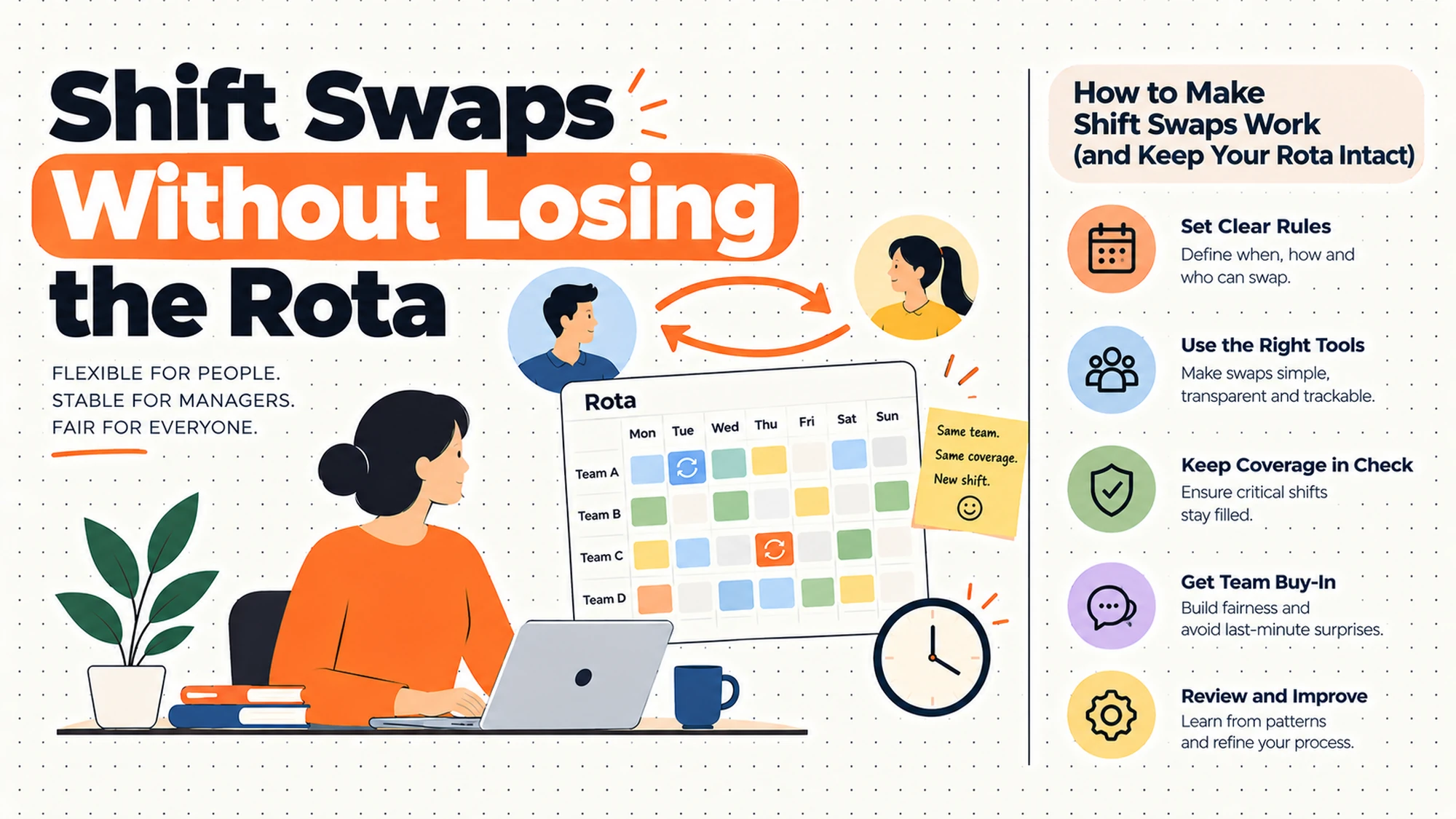
- Decision rule: make swapping easy and visible. Restricting it doesn't stop it, it just moves it somewhere you can't see.
- Outcome to expect: fewer uncovered shifts, and a clearer picture of which parts of your rota don't work.
The Shift Nobody Turned Up For
A shift goes uncovered. Working backwards, it turns out two people had agreed a swap by message on Tuesday. One of them believed it was settled, the other believed it was conditional on a third person confirming, and nobody told the manager because swaps between the team were normal and had never been a problem before.
The reaction is predictable. Swaps now require approval. Every trade goes through the manager, who is expected to check it and record it, and for a few weeks that holds. Then it becomes a bottleneck, because the manager isn't always reachable and a swap agreed on Tuesday for a shift on Wednesday can't wait for Thursday. So people go back to arranging it privately, and now the manager doesn't know about any of them rather than just some.
Most operations land somewhere on this cycle. Trading is the cheapest flexibility available in a shift-based business, it happens constantly whether or not it's sanctioned, and the instinct when something goes wrong is to control it more tightly, which reliably drives it further out of view.
Best tools for Workforce Management
The real problem isn't that people swap. It's that swaps happen in a channel the rota never sees, so the published schedule and the actual one drift apart quietly. The fix isn't approval, it's visibility plus a small number of constraints that people can apply themselves.
When You Genuinely Do Not Need to Act Yet
Your current setup is genuinely fine. Swaps happen, they're recorded somewhere, coverage holds, and nobody has been confused about who's responsible. If trading is working in your operation, adding process to it will slow something that's currently solving problems for you at no cost.
Friction is starting to show. A swap has caused a small coverage problem, or you've noticed the rota you're looking at isn't what's actually running, or the same person seems to be trading away a lot of shifts. The cheapest check is to ask three people how they'd arrange a swap and see whether they describe the same process.
It has become a real cost. A shift has gone uncovered, or payroll has been wrong because somebody was paid for a shift they traded, or a swap has pushed somebody into hours you didn't intend. At this point the informal system has produced a real failure, and the useful response is a small number of stated rules rather than a general tightening.
The edge case that forces it. A swap moves somebody across a rest period, into a different pay category, or over an hours limit. Those situations carry obligations that differ by jurisdiction: rest requirements between shifts, thresholds where premium pay applies, and limits on total hours. Establish what applies where you operate before devolving swapping, because a trade that breaches one of those is your responsibility regardless of who arranged it.
Five Questions This Reader Asks at 11pm
Should every swap need approval? No, and requiring it is the most common mistake in this area. Approval creates a bottleneck at exactly the moments when swaps are most urgent, and when the bottleneck bites people arrange trades privately instead. Approve nothing routinely, state the constraints clearly, and require that every trade is recorded where the rota can see it.
Who's responsible if a swapped shift is missed? Decide this in advance and write it down, because everybody assumes a different answer. The workable rule is that responsibility transfers once the swap is recorded and confirmed, and stays with the original person until then. That gives both parties a clear moment when the handover happens and makes recording the swap something they're motivated to do.
Can a swap create overtime? Yes, and this is the part people forget. Somebody picking up an extra shift may cross a threshold where different pay rules apply, and where that happens differs by jurisdiction. It's worth knowing which trades could have that effect before you devolve the decision, and either building a check into the process or accepting the cost knowingly.
How do I stop the same people always swapping out? First work out whether it's the person or the shift. If one individual trades away most of their shifts, that's a conversation about whether the pattern suits them. If everybody trades away the same shift, that's your rota telling you something, and no swap policy will fix it.
Should I use a board where people offer shifts? It works well where the team is large enough that a shift offered will find a taker, and it removes the coordination problem of finding somebody who wants exactly what you have. It fails in small teams, where an offer sits unclaimed and the person ends up asking individually anyway.
Three Honest Categories the Approaches Split Into
Restrict it. Swaps require approval, or aren't permitted, and cover is arranged through the manager. It's right where the work is highly regulated, where skill matching is genuinely complex, or where a previous failure has made the cost of a bad swap unacceptable. It gives you complete visibility of what the rota is. It fails because it doesn't reduce trading, it relocates it: people arrange swaps privately and simply don't mention them, which means you have less information than you did under an informal system. It also consumes manager time on decisions that are usually obvious.
Devolve it within stated limits. People trade freely provided the swap satisfies a small number of rules, and records it. It's right for most operations, because it keeps the flexibility that makes swapping valuable while protecting the things that actually matter: skill mix, rest, and total hours. It fails when the limits aren't stated, so people apply their own judgement and occasionally get it wrong, and it fails when recording is inconvenient, because a rule that's awkward to comply with will be complied with inconsistently.
Open it up entirely. A board or channel where shifts are offered and claimed by anybody eligible. It's right in larger operations, where the pool is big enough that offered shifts get taken and where matching individuals to each other would otherwise be a coordination problem. It also surfaces demand for hours you didn't know existed. It fails in small teams, where offers go unclaimed, and it fails without eligibility rules, because an open board will happily let somebody claim a shift they're not trained for or that leaves them with no rest.
Five Diagnostic Questions You Can Self-Assess Against
Ask three people how they'd arrange a swap. If they describe different processes, you don't have a system, you have several conventions, and one of them will eventually produce an uncovered shift. This takes five minutes and usually surprises whoever asks.
Compare the published rota to what actually ran last week. The differences that weren't absences are swaps. If there are more than you expected, or if some don't appear in any record, trading is happening outside your view and the rota you're looking at is a work of fiction.
Which shifts get traded away most? Pull the pattern. Swap requests are the most honest feedback available about a rota, because nobody is answering a question, they're solving a problem. A shift that's consistently traded away has something wrong with it, and that's worth more than any survey.
Who trades away, and who picks up? Look at both sides. A small group who consistently pick up other people's shifts is carrying the operation's flexibility, and they're usually the same people covering absence too. That's worth knowing before they leave.
Could a swap put somebody over a limit? Check whether your process notices. If two people trade and one ends up working more consecutive days than intended, or with too little rest between shifts, nothing in an informal system will catch it, and the obligation still sits with you.
Five Ways Swaps Get Handled, Reviewed
Informal trades, nobody told
People arrange swaps between themselves and the rota is never updated. It earns its place through speed, and it's worth acknowledging that it usually works: two colleagues sorting out a problem in two messages is efficient, and in a small stable team it can run for years without incident.
Where it falls short is everything downstream of the rota. Payroll pays the wrong person, coverage checks are performed against a schedule that isn't real, and when something does go wrong nobody can reconstruct what was agreed. It also fails silently, which is the dangerous part: the system appears to be working right up until the shift nobody turned up for.
The fix isn't to ban it. It's to make recording a swap so easy that there's no reason to skip it, because people aren't hiding these trades, they're just not doing an extra step nobody made simple.
It's worth noticing what the informal version gets right, because a replacement that loses it will be resisted. It's immediate, it requires nobody's permission, and it lets two people settle something privately without explaining their circumstances to a manager. That last part matters more than organisations assume: somebody trading a shift for a reason they'd rather not discuss will choose the channel that doesn't ask, every time.
Manager approval for every swap
Each trade is submitted and approved before it takes effect. It earns its place in genuinely complex operations, where skill matching matters, where a wrong swap has real consequences, or where a specific failure has already happened. You know exactly what the rota is at all times.
It falls short on availability and on volume. Swaps are often needed at short notice, and a manager who isn't reachable becomes the reason a trade doesn't happen, which pushes people back to arranging it privately. It also spends manager time on a queue of decisions that are usually obvious, and the obviousness is what eventually turns approval into rubber-stamping, at which point you have the delay without the scrutiny.
Where it's genuinely needed, name a deputy so approval doesn't depend on one person being awake.
There's a middle version that keeps most of the benefit. Require notification rather than approval: the trade goes ahead once both people confirm and the rota is updated, and the manager is told rather than asked. That preserves visibility, removes the delay, and leaves the manager able to intervene in the rare case where a specific swap is genuinely a problem. It's a smaller change than it sounds and it resolves most of what makes approval unworkable.
An open board where shifts are offered and claimed
Shifts are posted to a channel or board and claimed by anybody eligible. It earns its place by solving the matching problem: instead of finding one specific person who wants exactly your Thursday, you offer it and let the interested party find you. It also reveals something useful, which is how much appetite there is for extra hours.
It falls short on size and on rules. In a small team an offered shift often goes unclaimed, which leaves the person back where they started having wasted a day. And an open board with no eligibility checks will let somebody claim a shift they're not trained for, or one that leaves them without adequate rest, which is a problem that belongs to you rather than to them.
It's the strongest option where the pool is large enough, provided eligibility and rest constraints are enforced rather than assumed.
One behaviour to watch for on an open board is the shift that nobody claims. Where an offer sits for days, that's public information about which shifts the team doesn't want, and it can be demoralising for whoever is scheduled on it every week. Some operations handle this by removing unclaimed offers after a period rather than leaving them visible indefinitely, which keeps the mechanism useful without turning it into a running commentary on the rota.
Pre-approved swapping within a defined group
People may trade freely with anybody in a group agreed in advance, usually defined by role or training. It earns its place as the practical middle: it removes the approval bottleneck, and the group definition handles skill matching automatically, which is the constraint that most often matters.
It falls short at the group boundary. Somebody who could genuinely cover a shift but sits outside the defined group can't, which produces exactly the kind of sensible trade that then happens informally because the rule looked arbitrary. It also needs maintaining: groups go stale as people train up or change roles, and a stale group quietly becomes a restriction nobody intended.
Review the groups when anybody completes training, which is the moment they change.
The groups also make a useful diagnostic if you look at their size. A swap group with only two or three people in it means the role has almost no coverage depth, which is the same weakness that turns one absence into a full rebuild. Where you find one, the answer isn't a broader swap rule, it's training somebody, and the swap group is simply where the problem became visible.
Refusing swaps, using a cover request instead
No trading. Somebody who can't work a shift requests cover, and the manager arranges it. It earns its place where trades genuinely can't be managed safely, and it puts the coordination burden on the organisation rather than on the individual, which for a worker dealing with something difficult is arguably the fairer arrangement.
It falls short by removing the flexibility that makes shift work tolerable. The ability to trade is one of the few forms of control a shift worker has over their own time, and taking it away is felt disproportionately to its administrative cost. It also loads all the coordination onto managers, and where they can't fill a gap, the shift goes to overtime or goes uncovered.
Where it exists, it's worth checking whether the original reason still applies, since this is usually a rule introduced after one bad incident and never revisited.
If you keep it, the thing to get right is response time. A cover request that sits unanswered for two days is worse than a swap, because the person still doesn't know whether they're working and has lost the ability to solve it themselves. Whoever owns cover requests should have a stated turnaround, and where that can't be met the honest move is to let people trade directly after all.
The Decision Table
| Situation | Scale | Setup | Primary Pain | Recommended Starting Point |
|---|---|---|---|---|
| Swaps visible, coverage holds | Any | Any | None | Leave it alone |
| Rota does not match what ran | Any | Any | Trades happening out of view | Make recording trivial, do not restrict |
| A swapped shift went uncovered | Any | Any | Responsibility was never defined | State when responsibility transfers |
| Approval has become a bottleneck | Any | Any | Trades move to private channels | Devolve within stated limits, name a deputy |
| Same shift traded away repeatedly | Any | Any | The rota is the problem | Look at that shift, not at the swapping |
| One person trades away most shifts | Any | Any | The pattern may not suit them | A conversation, not a rule |
| Large team, matching is the difficulty | Over fifty | Any | Finding a taker takes longer than the shift | Open board, with eligibility enforced |
| Swaps can cross rest or hours limits | Any | Regulated or safety-critical | The obligation remains yours | Build the check in, take local advice |
| Small team, offers go unclaimed | Under fifteen | Any | A board has nobody to claim | Direct trades within a defined group |
The second row is the one that matters most and the one that gets the wrong treatment. When the rota doesn't match reality, the instinct is to require approval, which drives trading further underground. Making the recording step trivial achieves the opposite, because nobody is concealing these swaps, they're just skipping an inconvenient form.
The Constraints Worth Enforcing
Devolving swaps works when a small number of things are stated rather than assumed. The list should be short, because a long one gets ignored.
| The constraint | Why it matters | What happens when it is left implicit |
|---|---|---|
| Both people can do the role | Skill mix on the shift has to hold | A shift covered by somebody who cannot do half of it |
| Rest between shifts is preserved | Requirements differ by jurisdiction and bind you | A trade that leaves somebody with almost no turnaround |
| Total hours stay within limits | Limits and premium thresholds vary locally | Somebody quietly over a limit you are responsible for |
| The swap is recorded before it happens | Payroll and coverage both read the rota | The wrong person paid, and a coverage check against fiction |
| Responsibility transfers at a defined point | Both parties need the same understanding | Each believing the other was covering it |
| Trades are between comparable shifts | Otherwise it is a favour, not a swap | A pattern of one person absorbing the worse end |
The fourth row is the one that fixes most of the damage on its own. If the rota is updated at the moment of the trade rather than afterwards, payroll is right, coverage checks are meaningful, and the argument about who was responsible has a documented answer. Everything else on this list is secondary to that habit. The reason it works is that it removes the reconstruction step entirely. A rota updated at the moment of the trade needs nobody to remember anything afterwards, whereas one updated later depends on somebody recalling a conversation from three days ago, which is where the disagreements come from.
The second and third rows are the ones with an obligation attached. A swap that leaves somebody without adequate rest, or takes them over an hours limit, is your responsibility even though two employees arranged it between themselves, and the rules differ considerably by jurisdiction. Find out what applies where you operate before you devolve, and if your system can't check it automatically, make it one of the few things a person does check.
When Swapping Becomes a Signal
Swap data is the most honest feedback a rota ever produces, and almost nobody looks at it. People arranging trades aren't answering a survey question, they're solving a real problem at some social cost, since asking a colleague to take your shift is a favour that has to be repaid.
Concentration on a particular shift is the clearest signal. Where the same shift is traded away week after week by different people, the shift has a problem: the hours, the day, the work on that shift, or who else is rostered on it. That's worth investigating directly, and it's information you'd otherwise have to run a survey to get, less reliably.
Concentration on a particular person points somewhere else. Somebody trading away most of their shifts is telling you the pattern doesn't fit their life any more, and the usual causes are a change in circumstances: childcare, study, a second job, a health matter, a change in how they travel. That's a conversation rather than a rule, and it frequently ends with a pattern change that solves the problem permanently.
The other direction is worth watching too. A small group who consistently pick up other people's shifts are carrying your operation's flexibility, usually alongside covering absence, and they're doing it voluntarily. They're also at the highest risk of accumulating more hours than is sensible, and of being taken for granted until they stop. Knowing who they are is worth more than most staffing reports. It is also worth checking that picking up shifts is genuinely voluntary for them rather than a reputation they have become trapped in. Somebody known as the person who always says yes gets asked first and asked often, and declining becomes progressively harder the longer the pattern runs, which is a form of pressure nobody intended to apply.
And a rise in overall swap volume, without any of those patterns, usually means the rota has drifted away from the workforce. Either the pattern changed, or the people did, and the trading is the workforce correcting it privately. That's a prompt to look at the rota itself rather than at the trading. Rising swap volume is also worth separating from rising absence, because the two can look similar in a coverage report and mean opposite things. People trading shifts are solving a problem in advance and keeping the shift covered. People calling in are not, and a team that shifts from the first pattern to the second has usually lost either the ability or the willingness to arrange trades.
What to Put in Writing
Almost none of this needs a policy document. It needs a handful of things stated somewhere people will see them.
| Artefact | Who owns it | When it is written | What it prevents |
|---|---|---|---|
| The constraints a swap must satisfy | Operations, with local advice | Before swapping is devolved | Trades that breach rest or hours limits |
| When responsibility transfers | Operations | Before it is tested | Two people each believing the other was covering |
| How a swap is recorded, and by whom | Operations | At the same time | A rota that diverges from reality |
| Who may approve an exception | Operations | Before it is needed | A sensible trade blocked because nobody was reachable |
| Which shifts are traded away most | Whoever runs the rota | Reviewed quarterly | Losing the best feedback a rota produces |
| Local rules on rest, hours and premiums | HR, with local advice | Before devolving | An obligation breached by an arrangement you devolved |
The third row is the one to make effortless. If recording a swap takes more than a few seconds, it will be skipped, and every downstream problem in this article follows from that. Whatever your system, the question worth asking is how many steps a swap takes, and whether that number can be reduced.
Questions to Ask Before You Commit
On visibility. Does the rota match what actually ran last week? A bad answer is that it mostly does.
On responsibility. Who owns a swapped shift, and when did it transfer? A bad answer is that it depends.
On effort. How many steps does recording a swap take? A bad answer is that there's a form.
On the pattern. Which shifts are traded away most, and why? A bad answer is that swaps aren't tracked.
On limits. Could a swap push somebody over a rest or hours limit, and would you know? A bad answer is that people are sensible.
On the rule. If swaps are restricted, what incident caused that and does it still apply? A bad answer is that it's always been the policy.
What Getting This Wrong Costs
The first cost is a rota that isn't true, and everything downstream inherits the error. Payroll pays the person who was scheduled rather than the person who worked. Coverage is checked against a schedule that doesn't describe the day. Anybody asking who was on shift gets an answer that's confidently wrong. None of that is caused by swapping, it's caused by swapping that isn't recorded, and the two get conflated whenever something goes wrong.
The second cost is the flexibility you lose by restricting it. Trading is the cheapest form of resilience a shift operation has: two people solving a coverage problem between themselves, at no cost to the organisation and no manager time. Restrict it and that problem doesn't disappear, it arrives at the manager instead, as a cover request or an absence, and it's considerably more expensive in both forms.
The third cost is an obligation breached by an arrangement you devolved without checking. A swap can leave somebody with insufficient rest, take them over an hours limit, or move them into a different pay category, and the responsibility for that sits with the employer regardless of who arranged it. Rules on all three differ by jurisdiction, which is why this is worth establishing before devolving rather than after.
So before you change anything, work out which of three situations you're in. A visibility problem means trades are happening and you can't see them, and the fix is making recording effortless rather than making trading harder. A responsibility problem means nobody agreed when a shift changes hands, and the fix is one sentence. A rota problem means people are trading their way out of a pattern that doesn't work, and no swap process addresses that at all.
When You Are Ready to Go Further
Nothing here needs a system. It needs the constraints stated, the transfer point defined, and recording made so easy that skipping it would be more effort than doing it.
The step beyond that is reading the swap data rather than just collecting it. Which shifts get traded away, by whom, and who picks them up are three questions that tell you more about whether your rota works than any staff survey, and the data already exists in whatever channel your team currently uses.
HROpsLab publishes independent comparison work across HR tooling, applicant tracking and payroll. We sell nothing, we take no vendor money, and we publish no paid placements. If the next step is looking at what your scheduling tooling can actually enforce, our comparison work is one place to start.
Frequently Asked Questions
How should shift swapping work?
The workable arrangement is that people trade freely within a small number of stated constraints and record the swap where the rota can see it. The constraints that actually matter are few: both people can do the role, rest between shifts is preserved, total hours stay within limits, and the trade is recorded before it happens. Everything else is usually over-specification. The reason to devolve rather than approve is practical rather than philosophical: swaps are needed at short notice, approval creates a bottleneck at exactly those moments, and when the bottleneck bites people trade privately instead, which leaves you with less visibility than an informal system gave you.
Should managers approve every shift swap?
Generally no, because requiring approval doesn't reduce trading, it relocates it. The pattern is consistent: approval becomes a bottleneck when the manager isn't reachable, a swap that needs settling today can't wait, and people arrange it between themselves without mentioning it. You then have no record of any trades rather than a record of some. Approval is genuinely warranted where skill matching is complex, in regulated or safety-critical settings, or where a specific failure has made the cost of a bad swap unacceptable. Where you do require it, name a deputy so the process doesn't depend on one person being available.
Who is responsible if a swapped shift is not covered?
Whoever your rule says, which is why having one matters more than which one you pick. Without a stated rule both people will assume different answers, usually each assuming the other, and that's the ambiguity that produces uncovered shifts. The most workable version is that responsibility transfers at the point the swap is recorded and confirmed, and stays with the original person until then. That gives both parties a clear moment when the handover happens, and it has a useful side effect: it makes recording the swap something the person handing it over actively wants to do.
Can shift swapping cause overtime?
Yes, and it's the consequence most often overlooked when swapping is devolved. Somebody picking up an additional shift may cross a threshold where different pay rules apply, or accumulate more consecutive days than intended, and where those thresholds sit differs by jurisdiction. The obligation sits with the employer even though two employees arranged the trade between themselves. Establish what applies where you operate before devolving, and either build an automatic check into whatever records swaps or make it one of the few things a person is expected to verify.
How do you stop the same people always swapping out of shifts?
Work out first whether it's a person or a shift, because the two need opposite responses. If one individual is trading away most of their shifts, the pattern probably no longer fits their life, and the usual causes are a change in circumstances such as childcare, study or travel. That's a conversation, and it often ends with a pattern change that resolves it permanently. If different people are all trading away the same shift, the shift is the problem, and no swap policy will address it. Treating the second case as an individual issue removes your only signal about a rota that isn't working.
Should you use a shift board where people offer shifts?
It works well once the team is large enough that an offered shift reliably finds a taker, because it solves the matching problem: instead of hunting for the one person who wants exactly your Thursday, you post it and let the interested party come forward. It also surfaces genuine appetite for extra hours that you otherwise wouldn't see. In small teams it works poorly, since offers sit unclaimed and the person ends up asking individually anyway, having lost time. Whatever the size, eligibility has to be enforced rather than assumed, or somebody will claim a shift they're not trained for.
How do you handle swaps between different roles?
Cautiously, and usually by defining who may swap with whom rather than by assessing each trade. The practical approach is pre-approved groups based on role or completed training, within which people trade freely. That handles skill matching automatically and removes most of the approval burden. The maintenance matters, though: groups go stale as people train up or change roles, and a stale group becomes a restriction nobody intended, which produces exactly the sensible-looking trade that then happens informally. Review the groups whenever somebody completes training, since that's the moment they change.
What should be recorded when a shift is swapped?
Who was originally scheduled, who is working it now, when the change was agreed, and who confirmed it. That's enough for payroll to be right, for coverage checks to mean something, and for any later question about responsibility to have an answer. The more important design question is how long recording takes. If it's more than a few seconds, it'll be skipped, and every downstream problem follows from that skipping rather than from the swapping itself. Whatever system you use, count the steps involved and reduce them, because effort is the only thing that determines whether this actually happens.
Restricting swaps doesn't stop them. It just moves them somewhere you can't see.