TL;DR
- The core decision: whether you're building a schedule to be correct on publication, or one that can absorb a normal week without a rebuild.
- When doing nothing is right: when the published rota is still broadly the rota on Friday, and nobody spent the week fixing it.
- What has to be true: you know how many changes a typical week produces, even roughly, because that number is what you're designing for.
- How the options split: by what the schedule is built from, and by who gets to shape it.
- Decision rule: design for the week you actually have, including its absences and swaps, rather than for the one on the grid.
- Outcome to expect: the same coverage with far less midweek rebuilding, and a rota people trust enough to plan around.
Perfect on Friday, Gone by Wednesday
The rota goes out on Friday. Every shift has a name against it, the hours balance, the skill mix works, and the person who built it has spent most of a day getting there. By any reasonable measure it's a good schedule.
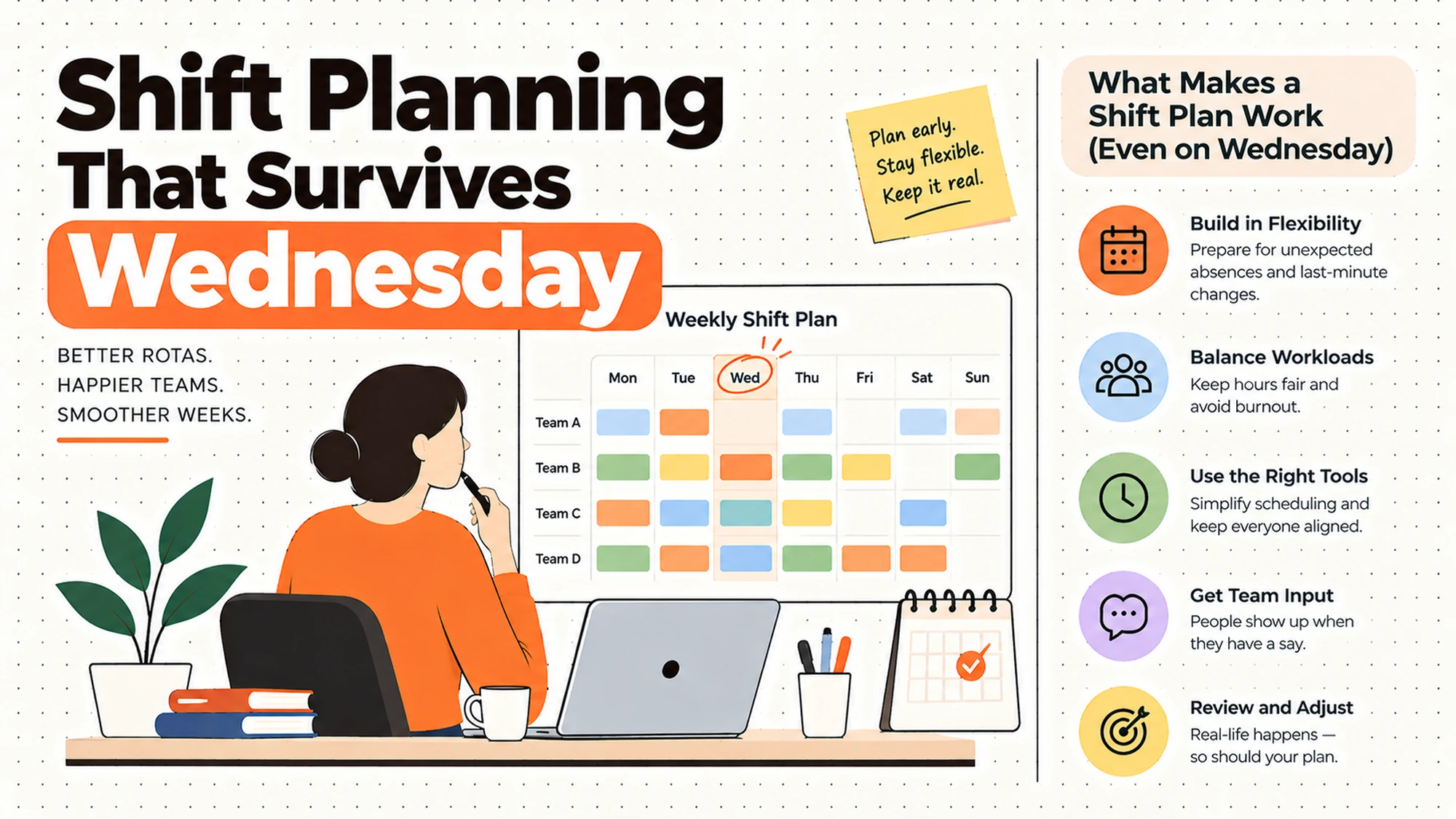
Then Monday happens. Somebody is ill. On Tuesday two people want to swap, which is fine until you notice one of them can't do the other's shift. By Wednesday the demand is clearly not what was forecast and Thursday is looking thin. The rebuild happens by message, in fragments, and by Friday the actual rota bears only a family resemblance to the published one.
Everybody treats this as normal, which it is, and as unavoidable, which it isn't. The schedule wasn't wrong on Friday. It was built as though the week would go as planned, and no week does. A plan with no capacity to absorb ordinary disruption isn't a plan, it's a snapshot of an ideal week, and the difference shows up as a manager spending their Wednesday doing the job again.
Best tools for Workforce Management
The real problem isn't that things change. It's that most scheduling effort goes into optimising the published version, and almost none goes into designing what happens when it's disturbed. The second is where the time actually goes, and it's the part that can be improved.
When You Genuinely Do Not Need to Act Yet
Your current setup is genuinely fine. The rota you published is broadly the rota that ran, changes are occasional rather than routine, and nobody spent the week rebuilding it. Whatever you're doing works, and process improvements aimed at a problem you don't have will mostly generate administration.
Friction is starting to show. You've noticed the same conversation happening every Wednesday, or one absence produces a chain of changes rather than a single swap. Neither is a crisis. The cheapest check is to count the changes in a single week against the published version, because most people have never counted and are surprised by the number.
It has become a real cost. Somebody is spending a substantial part of their week on rescheduling, or overtime is filling gaps regularly, or the published rota has stopped being trusted because everybody knows it'll change. At this point the schedule isn't functioning as a plan, and the fix is structural rather than a matter of working harder at it.
The edge case that forces it. You're operating where schedules are regulated, which increasingly matters: several jurisdictions now require minimum advance notice of shifts and compensate workers when published shifts change, and the rules have been spreading and changing. If that applies where you operate, midweek rebuilding stops being an operational irritation and starts having a direct cost attached. Establish the position locally and take advice.
Five Questions This Reader Asks at 11pm
How far ahead should I publish? As far as you can hold to, which is a different question from as far as possible. A rota published three weeks out and changed twice is worse than one published two weeks out and left alone, because the first teaches people the schedule isn't real. Pick the horizon you can actually freeze, then defend it. Where local rules set a minimum, that's a floor rather than a target.
How do I forecast staffing needs? Start much cruder than you think you need to. The same period last year, adjusted for what you know has changed, beats copying last week forward, and you can build it by hand. Sophisticated forecasting only pays once somebody is actually comparing the forecast to what happened, and most operations aren't doing that with a simple one.
Should I build from a template? Templates are fine as a starting shape and dangerous as a finished product. A template carries whatever assumptions were true when it was made, and it'll carry them for years after they stop being true. Use one to avoid starting from a blank grid, then check it against actual demand at least seasonally.
How much slack should I build in? Enough to absorb the ordinary week, which you can calculate from your own history rather than guess. If a typical week produces a certain number of absences and swaps, a rota with no capacity for them is guaranteed to need rebuilding. Slack costs money and looks like inefficiency, which is why it gets stripped out, and the cost of not having it appears as overtime instead.
What do I do when the forecast is wrong? Have a decided response rather than an improvised one. The two useful mechanisms are a short on-call or standby arrangement and an agreed way to release people early when it's quiet. Both need to be agreed in advance, and on-call arrangements in particular carry obligations that differ by jurisdiction, so check before relying on one.
Three Honest Categories the Approaches Split Into
Repetition, building from what you did last time. Copy last week or apply a fixed template. It's right where demand genuinely is stable, and it's dramatically faster than building from scratch, which matters when scheduling is one task among many for somebody who has a day job. It fails by carrying errors forward indefinitely. A template built for a demand pattern that changed two years ago will keep producing that shape until somebody deliberately checks, and nobody checks a rota that's covering the hours. It also fails to improve: repetition cannot learn, so whatever the pattern gets wrong, it gets wrong forever.
Prediction, building from expected demand. Forecast the work, then staff against it. It's right where demand varies meaningfully and where you have enough history to predict it, and it's the only approach that addresses over-staffing, which is invisible because nobody complains about being over-covered. It fails on data and on belief. Without reliable demand history, the forecast is a guess with a chart attached, and where the forecast is produced centrally and the schedule is built by somebody who doesn't trust it, you get the appearance of forecasting with none of the effect.
Participation, building around people's availability and choices. Collect availability or let people claim shifts within rules. It's right because it produces a rota that fits actual lives, which reduces swaps, absence and turnover at once, and because it moves work from the scheduler to the people who care most about the outcome. It fails on the residue: popular shifts fill instantly and unpopular ones don't fill at all, so somebody still has to allocate the difficult part. It also needs constraints stated explicitly, or the grid fills in ways that break skill mix or rest requirements.
Five Diagnostic Questions You Can Self-Assess Against
Count the changes in one week. Take the published rota and the rota that actually ran and count the differences. Most schedulers have never done this and the number is usually higher than they'd have guessed. That number is your design target: a schedule that can't absorb it will be rebuilt every week regardless of how well it was built.
How long does building take, and how long does rebuilding take? Ask whoever does it to split their time. A large rebuild portion means the problem is resilience rather than construction, and buying a tool that makes building faster will address the smaller half.
What triggers a rebuild rather than a swap? Trace one. Usually it's a single absence in a role only a few people can cover, which turns one gap into a chain of moves. If that's the pattern, the constraint is skill coverage rather than scheduling, and the fix is training rather than software.
When was the template last checked against actual demand? If nobody can say, it's carrying assumptions from whenever it was made. Compare the shape of the template against the last few months of actual demand and look for the hours where they've diverged.
Does anybody compare forecast to actual? Not scheduled to actual hours, but predicted demand to the demand that arrived. If nobody does, the forecast can't improve, and it'll drift steadily while continuing to look plausible.
Six Ways Schedules Get Built, Reviewed
Copying last week forward
The previous rota is duplicated and adjusted for known changes. It earns its place on speed and on continuity. It takes a fraction of the time of building from scratch, and it produces a stable pattern for staff, who get broadly the same shifts each week and can plan accordingly. For a genuinely stable operation it's a reasonable answer.
Where it falls short is that it can't learn. Every assumption baked into the original rota is carried forward indefinitely, including the ones that stopped being true, and because the result always covers the hours nobody has a reason to question it. Demand shifts gradually, the rota doesn't, and the gap is absorbed by the people working it: busier than they should be at some times, standing around at others.
Use it, and put a date in the calendar to check the underlying shape against real demand at least a couple of times a year.
There's a second problem with copying that's less obvious than the demand drift. Whatever unfairness existed in the original allocation gets copied too, week after week, so the person who happened to have the worst shifts when the pattern was set keeps them indefinitely. Nobody decided that and nobody revisits it, because the rota looks the same as last week and last week was accepted. Worth checking who has actually been on which shifts over a quarter rather than over a week.
Building from a demand forecast
Expected volume drives the staffing. It earns its place wherever demand genuinely varies, because it's the only approach that addresses both failure directions at once. Under-staffing is loud and self-correcting. Over-staffing is silent and expensive, and nothing but a forecast comparison will ever surface it.
It falls short on inputs and on trust. It needs demand history you may not have in usable form, and the accuracy depends entirely on whether anybody checks it afterwards. The more common failure is social: a forecast produced centrally and handed to a supervisor who thinks it's wrong will be quietly overridden, so the organisation believes it's forecasting while the rota is still built on intuition.
Start crude, check it against what happened, and involve whoever builds the rota in producing it rather than in receiving it.
One caution about the inputs. Demand history reflects the staffing you had, not the demand you could have served, so a period where you were short-staffed records lower volume and gets read as lower demand. Forecast from that and you'll staff the quiet version of a busy period permanently. Where you know a period was under-covered, mark it, or the forecast will faithfully reproduce your worst weeks.
A fixed template applied every week
A standard pattern that's applied regardless, with names slotted in. It earns its place on predictability, which for staff is worth a great deal: the same shape every week means people can plan indefinitely, and it removes most of the anxiety that variable scheduling produces.
It falls short as demand moves away from the shape. A template is a forecast that's been frozen, and freezing it has the benefit of stability and the cost of being wrong in a fixed direction. It also makes genuine peaks harder to handle, since the pattern doesn't flex, so exceptional periods need handling entirely outside the system.
It's a good choice where stability matters more than efficiency, which is more situations than the optimisation-minded assume. Review the template seasonally rather than never.
The review is easier than it sounds and rarely done, which is why templates persist unchanged. Lay the template's staffing against the last quarter's actual demand, hour by hour, and look for the places they've come apart. You're looking for two shapes: hours where you're consistently thin, which staff will already have told you about, and hours where you're consistently heavy, which nobody will have mentioned because over-coverage generates no complaints.
Self-scheduling with approval
Shifts are published as an open grid and people claim them within stated rules, with a manager resolving the remainder. It earns its place because people choose shifts that fit their lives, which reduces swaps, late absences and turnover simultaneously. It also shifts a large part of the construction work away from the scheduler.
It falls short on the leftovers and on the checking. Unpopular shifts don't claim themselves, so the hardest part of the job remains, and repeatedly asking for volunteers loads it onto the same willing few. It also needs somebody to verify the resulting grid for skill mix, rest between claimed shifts and anybody who's claimed an unwise number of hours. Those checks are the job, not an afterthought.
Where it works it's the best-received approach in this list, provided the residue is handled openly and the rules are written rather than assumed.
Seniority or rotation-based allocation
Desirable shifts are allocated by a stated rule, whether length of service or a rotation everybody moves through. It earns its place by being transparent. Any rule people can see beats an unstated process that looks like favouritism, and it removes the manager from a decision that otherwise costs them goodwill weekly.
It falls short on fit. A rule allocates without reference to whether the shift suits the person, so somebody gets a shift they don't want while somebody who did want it doesn't, and both then arrange a swap, which is the system telling you it's mismatched. Seniority rules in particular concentrate the worst shifts on newer staff, which is exactly the group with the least reason to stay.
It's a reasonable fallback for the residue after people have expressed preferences, and a poor primary method.
If you do use seniority, be honest internally about what it's doing. It's a rule that rewards tenure, which is defensible and is also a decision to load your least attractive shifts onto your newest people, at precisely the point when they're deciding whether to stay. Where turnover in the first months is a problem, this rule is worth examining as a possible cause rather than treated as a neutral piece of administration.
Building around collected availability
People state when they can work, in advance, and the schedule is built within those constraints. It earns its place as a middle path: the scheduler retains control, and the rota reflects real lives, which means fewer swaps and fewer late problems.
It falls short on collection and on honesty. Availability has to be gathered before each period and kept current, which is administrative work that decays quickly, and people gradually narrow their stated availability once they learn it's binding. It also can't work if too many people are unavailable at the same time, which usually means the underlying pattern doesn't fit your workforce.
It's the pragmatic option for operations that can't run fully open self-scheduling but want the rota to reflect something real. The way to keep the collected availability honest is to treat it as information rather than as a contract. Where people learn that a stated availability will be used against them the moment it suits the operation, they narrow what they declare, and within a few rounds you are building from a picture considerably more restrictive than the truth. Asking what suits rather than what is possible gets a more useful answer and keeps getting one.
The Decision Table
| Situation | Scale | Setup | Primary Pain | Recommended Starting Point |
|---|---|---|---|---|
| Published rota is broadly the rota that ran | Any | Any | None | Leave it alone |
| Rebuilding every midweek | Any | Any | No capacity to absorb a normal week | Count the changes, design slack for that number |
| One absence produces a chain of moves | Any | Specialist roles | Skill coverage, not scheduling | Cross-train, before changing any process |
| Template unchanged for years | Any | Stable demand | Carrying assumptions that expired | Compare the shape against actual demand |
| Over-staffed in quiet hours, nobody notices | Any | Variable demand | No forecast, no comparison | Crude forecast, then check it against reality |
| Swaps concentrated on the same shifts | Any | Any | The allocation does not fit people | Collect availability, or open the grid |
| Unpopular shifts fall to the same few | Any | Any | Volunteering has become pressure | State the rule: pay, rotate, or seniority |
| Schedules regulated where you operate | Any | Retail, hospitality | Changes may carry a direct cost | Establish local rules, lengthen the freeze |
| Nobody trusts the published rota | Any | Any | It has changed too often to be believed | Publish later but freeze it, and hold to that |
The last row is the counter-intuitive one and it's frequently the right move. Publishing further ahead is valuable only if the published version survives. Where a rota changes repeatedly after publication, pulling the horizon in and genuinely freezing it produces something people can plan around, which is worth more than a longer notice period nobody believes.
Designing Slack You Can Actually Use
Slack is the difference between a plan and a snapshot, and it's the first thing removed when somebody looks at labour cost. The useful question isn't whether to have any, it's which kind, because they cost different amounts and protect against different things.
| Buffer type | What it costs | What it protects against |
|---|---|---|
| An extra person on shift | Full hours, every time, whether needed or not | Any absence, immediately, with no arrangement |
| A named standby, contactable but not present | A retainer or premium, plus obligations in some places | Absence, with a short delay to arrive |
| A shift that can start late or end early | Nothing, if agreed in advance | Demand coming in lower than forecast |
| Cross-trained staff who can cover two roles | Training time, once | The chain reaction from one specialist absence |
| A pool of people wanting extra hours | Nothing to hold, but needs maintaining | Absence, where somebody is genuinely available |
| Deliberate under-scheduling of the quiet period | Slightly worse service in quiet hours | Over-staffing, which nobody ever reports |
The fourth row is the highest-return entry and it isn't a scheduling measure at all. Most rebuild cascades start with one absence in a role only a couple of people can perform, so the gap can't be filled by anyone available and the whole day gets rearranged. Training two more people to cover that role removes the cascade permanently, at a one-off cost.
The fifth row is the cheapest thing on the list and it's usually informal. A maintained list of people who genuinely want additional hours, with their real availability, turns a two-hour phone chase into a single message. Most operations have this knowledge distributed across several managers' heads rather than written down anywhere.
The Midweek Rebuild, and How to Stop Doing It
Rebuilding is where the scheduling time actually goes, and most of it traces back to a small number of decisions that were never made.
Decide who can authorise a change, and make sure that person is reachable. A large share of rebuild delay is not the change itself but waiting for permission, and the delay is what turns one adjustment into several as the available options close off.
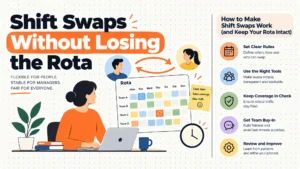
Let people swap directly within stated constraints. Where every trade requires approval, the approval becomes the bottleneck and people arrange swaps privately anyway, which means the rota and reality diverge without anybody knowing. State the constraints that actually matter, which are skill mix, rest between shifts and total hours, and let trades happen freely within them.
Make the record update at the moment of the change. This single habit removes most payroll corrections and most coverage surprises. Whoever makes the change updates the schedule then, rather than intending to later, because the version that gets updated later is the version that doesn't.
Have a decided response for low demand, not just for high. Most operations have a mechanism for getting more people in and none for standing people down, so a quiet day is absorbed as over-staffing and nobody records it. Whether you can release people early, and on what terms, differs by jurisdiction and may carry obligations, so establish that before relying on it.
And hold the freeze. Once a rota is published, treat changes as exceptions requiring a reason rather than as ordinary administration. The freeze is what makes the published version worth reading, and where changes are routine people stop planning around the rota entirely, which produces more late absence rather than less.
What to Put in Writing
Scheduling knowledge tends to live entirely in the head of whoever does it, which is why a change of scheduler is so disruptive.
| Artefact | Who owns it | When it is written | What it prevents |
|---|---|---|---|
| The publication horizon, and that it is frozen | Operations | Now, and defended | A notice period that erodes quietly under pressure |
| Typical changes per week, from your own history | Whoever builds the rota | Once, reviewed yearly | Designing a plan with no capacity for a normal week |
| The constraints a swap must satisfy | Operations, with local advice | Before swaps are devolved | Trades that breach rest rules or skill mix |
| Who may authorise a change, and their contact | Operations | Before it is needed | Delay converting one change into several |
| What the template assumes about demand | Operations | When the template is made | Carrying an expired demand shape for years |
| Local rules on notice, changes and standby | HR, with local advice | Before relying on any of them | A direct cost attached to routine rebuilding |
The second row is the one nobody has. Designing a schedule without knowing how much disruption a normal week produces is designing for an imaginary week, and the number takes one hour to establish from records you already hold.
Questions to Ask Before You Commit
On resilience. How many changes does a typical week produce? A bad answer is that it varies.
On time. How much of the scheduling effort is building, and how much is rebuilding? A bad answer is a single total.
On the cascade. What turns one absence into five changes? A bad answer is bad luck.
On the template. What demand shape is it built on, and when was that checked? A bad answer is that it's always worked.
On swaps. Can people trade directly, and what are the stated limits? A bad answer is that everything needs approval.
On the rules. Does anything local govern notice or changes to published shifts? A bad answer is that it hasn't come up.
What Getting This Wrong Costs
The first cost is a manager's week, and it's almost never counted as a scheduling cost. Rebuilding a rota by message, chasing coverage and negotiating swaps is real work performed by somebody with another job, and it appears in no budget. It shows up instead as a manager who seems overloaded, which gets diagnosed as a span-of-control problem and answered with a restructure.
The second cost is that the rota stops being believed. A published schedule that changes routinely teaches people not to plan around it, and once they've learned that, two things follow: they stop arranging their lives around their shifts, and they stop treating a published shift as a commitment. The second produces more late absence, which produces more rebuilding, and the loop tightens.
The third cost is overtime standing in for design. Where a schedule has no capacity to absorb ordinary disruption, every disruption is covered by extra hours from people already working, at a premium rate and concentrated on the same reliable few. Organisations in this position often have an overtime line they'd like to reduce and a scheduling process that guarantees it, without anybody connecting the two.
So before you change anything, work out which of three problems you have. A resilience problem means the plan can't absorb a normal week, and the fix is slack of some kind, chosen deliberately. A coverage problem means too few people can do a particular role, and the fix is training rather than scheduling. A trust problem means the rota has changed so often that nobody reads it, and the fix is to publish less far ahead and actually hold to it. Only the first is what most people mean by shift planning.
When You Are Ready to Go Further
None of this needs a system. It needs one week's changes counted against the published rota, an honest split of building time against rebuilding time, and a stated freeze that gets defended.
The step beyond that is the comparison that makes scheduling improve rather than merely run: what you forecast against what arrived, and what you scheduled against what was worked. Both are available from records you already hold, and neither requires a purchase. A rota that nobody checks afterwards will be exactly as good next year as it is today.
HROpsLab publishes independent comparison work across HR tooling, applicant tracking and payroll. We sell nothing, we take no vendor money, and we publish no paid placements. If the next step is looking at what your scheduling tooling actually supports, our comparison work is one place to start.
Frequently Asked Questions
How far in advance should you publish a shift schedule?
As far ahead as you can genuinely hold to, which is a different question from as far as possible. A rota published three weeks out and then changed twice is worse than one published two weeks out and left alone, because the first teaches people the schedule isn't real and they stop planning around it. Pick a horizon you can freeze and defend it, treating post-publication changes as exceptions that need a reason. Several jurisdictions now set minimum advance notice and require compensation when published shifts change, and these rules have been spreading, so establish what applies where you operate and treat any legal minimum as a floor rather than a target.
How do you forecast staffing needs?
Start far cruder than the topic suggests. The same period last year, adjusted for anything you know has changed, will usually beat copying last week forward, and you can build it by hand from records you already hold. The sophistication only pays once somebody is comparing the forecast against what actually happened, which is the step nearly everybody skips, and an operation that won't check a simple forecast won't check a complex one either. Whoever builds the rota should be involved in producing the forecast rather than receiving it, because a forecast the scheduler doesn't believe gets quietly overridden.
Should you build shift schedules from a template?
A template is a good starting shape and a poor finished product. It saves the blank-grid problem and gives staff a predictable pattern, which is genuinely valuable, but it's a forecast that's been frozen, so it carries whatever demand assumptions were true when it was made and keeps carrying them. Because the output always covers the hours, nobody has a reason to question it, and the divergence gets absorbed by the people working: busier than they should be at some times, standing around at others. Use one, and diarise a comparison against real demand at least seasonally.
How do you handle last-minute absence in a shift schedule?
Design for it rather than reacting to it, because a certain number of absences per week is a normal feature of any operation and a plan with no capacity for them will be rebuilt every time. Establish how many changes a typical week actually produces, then choose a buffer deliberately: an extra person on shift, a standby arrangement, a maintained list of people genuinely wanting extra hours, or cross-trained staff who can cover more than one role. The last is usually the highest return, because most rebuild cascades start with an absence in a role only a couple of people can perform.
How should you allocate unpopular shifts?
Choose a rule and state it, because the default is worse than any of the options. Left unstated, unpopular shifts drift towards whoever complains least, which is usually the newest or least confident person, and everybody else watches it happen. The three defensible approaches are paying a premium for them, rotating so everybody takes a turn, or letting people volunteer and accepting that a few will hold them. Each has an obvious cost and each is received far better than an arrangement that looks like favouritism, even by people who dislike the particular rule chosen.
Does self-scheduling actually work?
It's the best-received approach in most operations that try it, because people claim shifts that fit their lives, which reduces swaps, late absence and turnover at the same time. Two things determine whether it works. The rules have to be written rather than assumed, covering skill mix on each shift, rest between claimed shifts and maximum hours, or the grid fills in ways that don't work operationally. And somebody has to handle the residue, since unpopular shifts don't claim themselves and repeatedly asking for volunteers loads them onto the same willing few, which is the same fairness problem in a different wrapper.
What should you do when the demand forecast is wrong?
Have a decided response for both directions, which most operations don't. There's usually a mechanism for getting more people in when it's busy and none at all for standing people down when it's quiet, so an over-forecast is absorbed silently as over-staffing and never recorded. Decide in advance whether people can be released early and on what terms, since this affects somebody's pay and may carry obligations that differ by jurisdiction. For the busy direction, a standby arrangement or a maintained list of people wanting extra hours both work, though standby in particular can carry specific requirements, so check locally before relying on it.
How much slack should a shift schedule have?
Enough to absorb an ordinary week, which you can calculate rather than guess. Take your own history, count the absences and changes a typical week produces, and design for that number rather than for a perfect week. Slack is usually the first thing removed when somebody reviews labour cost, because it looks like inefficiency on a grid, and its absence shows up later as overtime at a premium rate, which costs more. The cheapest forms aren't extra people at all: cross-training so one absence doesn't cascade, and a maintained list of people who genuinely want extra hours, both cost almost nothing to hold.
A rota is judged on the day it's published and experienced on the Wednesday it falls apart.