TL;DR
- The core decision: whether to respond to the total or to find out where it's concentrated, because those lead to opposite actions.
- When doing nothing is right: when the rise is one long absence in a small team, which is arithmetic rather than a trend.
- What has to be true: you can cut the figure by team and by shift pattern before anybody proposes a response.
- How the options split: by whether they treat absence as a behaviour to discourage or as a symptom to investigate.
- Decision rule: a rise is almost never evenly distributed. Find the concentration first, because the concentration is the finding.
- Outcome to expect: a narrower problem than the one on the report, usually located in one team or one pattern.
The Number That Demands a Response
The absence figure is up. Somebody presents it at a meeting, there's a comparison to last year, and the direction is clearly wrong. The room agrees something needs doing.
What gets proposed next is almost always the same: tighten the policy, introduce a threshold, remind managers to have conversations, perhaps an incentive for good attendance. All of it applies to everybody, because the number applies to everybody, and the number is the only thing anybody in the room has seen.
Here's what that misses. Absence is essentially never evenly distributed. It clusters, in one team, on one shift pattern, in one period, among people doing one particular job. The organisation-wide figure is an average across populations behaving completely differently, and responding to the average means applying a remedy everywhere for something happening in one place.
Best tools for Workforce Management
The cost of that is worse than inefficiency. A company-wide tightening lands on people who've done nothing unusual, which is experienced as an accusation, and it removes the thing you actually needed, which is the signal telling you where the problem is. The real question isn't how to reduce absence. It's where this absence is coming from, and that's answerable before anybody decides anything.
When You Genuinely Do Not Need to Act Yet
Your current setup is genuinely fine. The figure moves around a bit, nothing is concentrated anywhere, coverage isn't suffering and no manager has raised it. Absence fluctuates for ordinary reasons, and a quarter that looks worse than the last one is frequently noise rather than a trend.
Friction is starting to show. One team looks different from the others, or a particular shift is generating more short absences than the rest. That's worth looking at specifically, and it's early enough that a conversation with the manager will usually explain it. The cheapest check is to split long-term from short-term and see whether the rise survives the split.
It has become a real cost. Coverage is being affected regularly, or overtime is filling absence gaps most weeks, or the same team has been noticeably worse for several months. At this point something structural is likely, and the investigation is worth doing properly before any policy response.
The edge case that forces it. The absence involves a health condition, a disability, or a pattern that may connect to something about the work environment. Those situations carry specific requirements that differ sharply by jurisdiction, and a blanket policy change applied to them can create real exposure. Establish the local position and take advice before changing anything that would apply to those cases.
Five Questions This Reader Asks at 11pm
How do I calculate an absence rate? The arithmetic is straightforward, usually days or occurrences lost against days scheduled. The decisions that matter are about what you separate before calculating. Long-term and short-term absence behave completely differently and combining them produces a figure that describes neither, so split those first and treat them as two measures rather than one.
What causes absenteeism? More things than the framing usually allows. Genuine illness, which is most of it. Caring responsibilities. A shift pattern that doesn't allow recovery. A physically demanding role with no rotation. A specific manager. And occasionally a pattern that's about the job being unbearable rather than about the person. The response that fits depends entirely on which, and the data will point you at the where rather than the why.
Do attendance bonuses work? They reliably change attendance and rarely in the direction intended. What they most directly reward is coming in when unwell, which is a poor outcome in any customer-facing, food or care setting. They also produce resentment among people whose absence was genuinely unavoidable, and they're difficult to apply where some absence is protected.
What's a normal level? Not a useful comparison to chase. Absence varies legitimately by the nature of the work: physical roles, shift patterns, public contact and the age profile of a team all move it for reasons management doesn't control. Your own history, split by team and pattern, tells you far more than any external figure.
When does absence become a performance issue? Later than most policies imply, and the honest answer requires distinguishing capability from conduct. Somebody genuinely unable to attend reliably because of a health matter is a different situation from somebody whose pattern has no explanation, and the first carries requirements that vary by jurisdiction. Take advice before treating any persistent absence as a performance matter.
Three Honest Categories the Approaches Split Into
Treat it as behaviour and discourage it. Tighten policy, lower thresholds, introduce consequences or rewards. It's right in the narrow case where you've established that a specific pattern has no other explanation, which requires the investigation first. It has one genuine advantage: it's fast, visible, and demonstrates that something is being done. It fails because it applies to everybody a remedy designed for a few, it produces attendance rather than health, and it removes your signal. The people most affected are those whose absence was unavoidable, and they're rarely the ones prompting the concern.
Treat it as a symptom and investigate. Find where it concentrates, then look at what's different about that place. It's right almost always, because absence genuinely is a symptom more often than a behaviour, and because the investigation is cheap: a few cuts of data you already hold plus a conversation with one manager. It fails on speed and on politics. It takes longer than announcing a policy, and it can produce a finding nobody wanted, such as that a particular manager or a particular shift is the cause, which is harder to act on than a general tightening.
Change what's underneath it. Alter the shift pattern, the workload, the rotation, or whatever the investigation identified. It's right when the investigation has located something structural, and it's the only approach that addresses cause rather than expression. It fails when it's attempted without the investigation, since changing a rota on a hunch is expensive and may address nothing, and it fails where the underlying cause can't be changed, at which point the honest answer is to staff for the absence rather than to pretend it can be eliminated.
Five Diagnostic Questions You Can Self-Assess Against
Does the rise survive splitting long-term from short-term? Do this before anything else. One person absent for a quarter can move a small team's figure more than a genuine pattern across a dozen people, and a rise that disappears when you split it isn't a trend, it's one person having a serious illness.
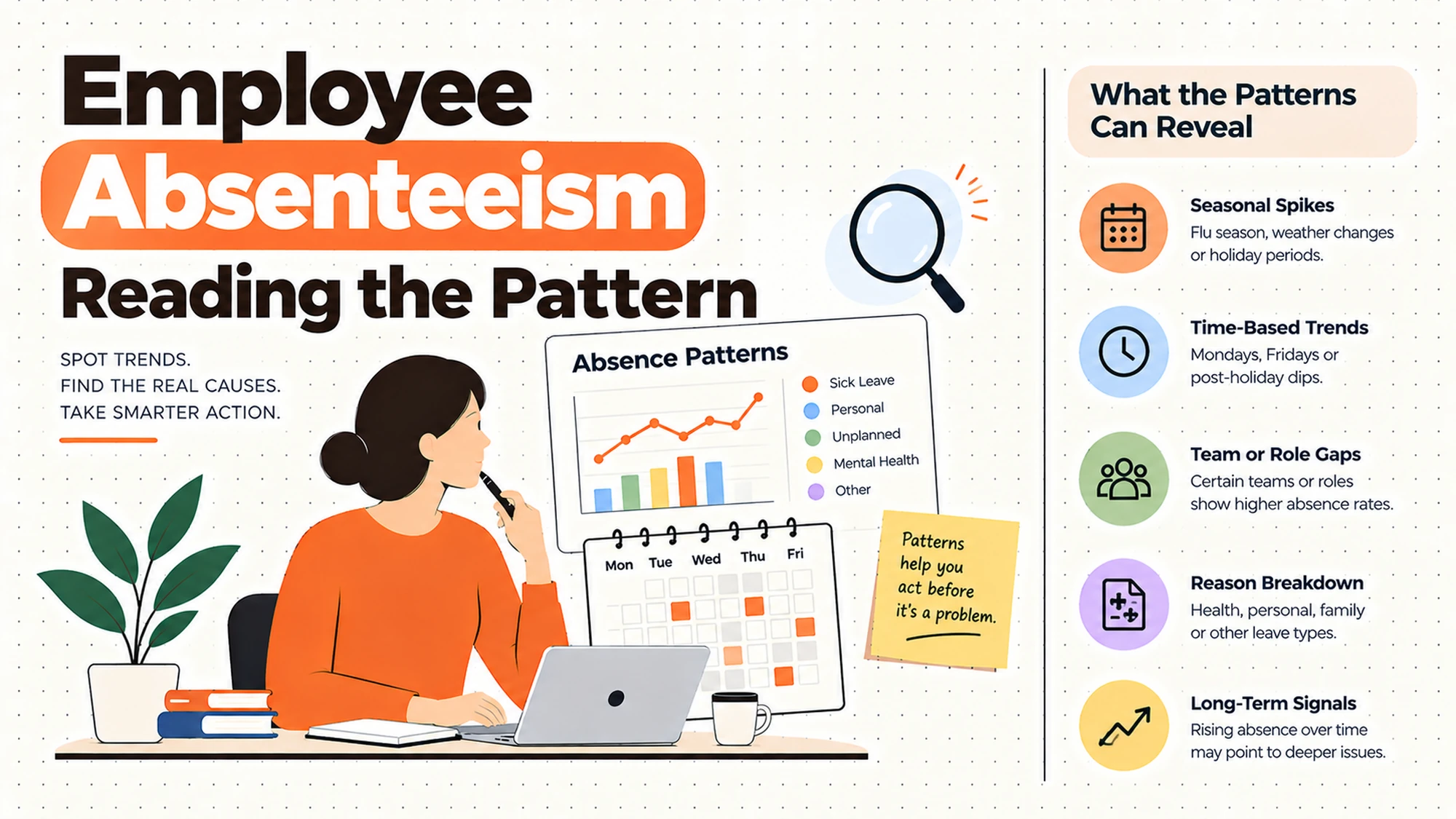
Where is it concentrated? Cut by team, by shift pattern, by tenure, by season, by role. You're looking for the cut where one group looks unlike the others, and there almost always is one. That group is the finding, and everything you do next should be about them rather than about the organisation.
What's different about that group? Once you've located it, list the things that distinguish them: a pattern, a physical demand, a manager, a location, a recent change. The cause is usually in that list, and it's usually visible to anybody who works there and has never been asked.
Are the absences clustered in time? Look at which days and which points in the shift cycle. Absence clustering after a particular shift, or on particular days, points at the pattern rather than the person, and it's a distinction that determines whether your response is a rota change or a conversation.
Has anything changed for that group recently? A new pattern, a new manager, a change in workload, a redundancy round, a site change. Absence responds to circumstances with a lag, so a rise now frequently traces to something a couple of months earlier that nobody connected to it.
Five Responses to Rising Absence, Reviewed
Tightening the policy for everybody
Lower thresholds, more formal steps, stricter evidence requirements. It earns its place in the narrow case where an investigation has shown a genuine pattern of avoidable absence and the existing policy is demonstrably too loose to address it. It's also fast and visible, which matters when somebody senior wants a response.
Where it falls short is in who it reaches. A universal tightening applies to everybody, and most of your absence is genuine illness among people who've done nothing unusual. They experience the change as an accusation, which damages the relationship without affecting their behaviour, since their absence wasn't a choice. Meanwhile it produces attendance rather than health: people come in unwell, work badly, and in public-facing, food or care settings pass illness on.
It also removes your information. Once absence carries a cost, people find alternatives, and the signal you were reading disappears while the underlying thing continues.
The alternatives are worth naming, because they're what the improved figure is actually made of. Annual leave taken at short notice. Attending and achieving very little. Working through something that then takes longer to recover from. And eventually leaving, which arrives months later as turnover and gets attributed to the market. None of those appear in an absence report, which is precisely why the report looks better.
Investigating where the increase is concentrated
Cut the data, find the cluster, and look at what's different about it. It earns its place as the only response that identifies a cause rather than a symptom, and it's remarkably cheap: the data already exists, the cuts take an afternoon, and the conversation with the relevant manager takes an hour.
It falls short on speed and on comfort. It's slower than announcing something, which is difficult when the figure has been raised at a senior level and a response is expected. And it sometimes produces a finding that's politically awkward, such as that one manager's team is the source, or that a shift pattern introduced recently is the cause, both of which are harder to act on than a general policy change.
Do it first regardless. Any response chosen before the concentration is known is a response to an average.
The investigation also protects whoever has to present the findings. Arriving with a location and a likely cause is a much stronger position than arriving with a proposal, because it moves the conversation from what we should do about absence to what we should do about this specific team on this specific pattern. The second question has answers. The first mostly produces policy.
Changing the shift pattern or workload underneath
Alter the rota, add rotation to a physically demanding role, adjust workload or staffing on a particular shift. It earns its place when the investigation has pointed at something structural, and it's the only approach that can actually reduce absence rather than suppressing its expression.
It falls short on cost and on certainty. Changing a pattern is disruptive for everybody on it, including the people who were fine, and the effect on absence takes time to show, which makes it hard to defend if somebody wants a result this quarter. It also assumes the cause was correctly identified, and a rota change made on a wrong diagnosis is expensive and achieves nothing.
Where it works, it works permanently, which nothing else on this list does.
One thing to plan for is that the figure may get worse before it improves. Changing a pattern disrupts everybody on it, including people who were managing fine, and the adjustment period frequently shows up as a short-term rise. Where nobody has been warned to expect that, a genuine fix gets abandoned in its first month as evidence that it didn't work, so say in advance what the curve is likely to look like and when you'll actually judge it.
Introducing an attendance incentive
A bonus, a reward, or recognition for people who don't take absence. It earns its place in almost no circumstances, and it's included here because it's proposed so often. The appeal is obvious: it's positive rather than punitive, it's easy to explain, and it appears to reward the behaviour you want.
It falls short comprehensively. It rewards attending while unwell, which is actively harmful in care, food and public-facing work, and produces poor work everywhere else. It penalises people whose absence was genuinely unavoidable, which includes anybody with a health condition and most people with caring responsibilities. It creates pressure among colleagues, since a team-based version makes somebody's illness everybody else's financial loss. And where some absence carries specific protection, an incentive scheme that effectively penalises it can create exposure, with requirements differing by jurisdiction.
If somebody proposes one, the useful question is which specific behaviour they believe it will change, and whether that behaviour is actually present in your data.
Doing nothing while continuing to watch
Acknowledge the rise, decide not to respond yet, and keep looking. It earns its place more often than it's chosen, particularly where the rise is small, recent, or explained by one long absence. Absence fluctuates, a single quarter is weak evidence, and a response to noise costs credibility that you'll want when something real happens.
It falls short when it's avoidance rather than a decision, which is the usual failure. Watching without a stated review point and a stated threshold for acting is simply not dealing with it, and the difference matters because one of them is defensible and the other isn't.
If you choose this, say so explicitly, name what you'll look at, and set a date. That converts inaction into a decision somebody can be held to.
It helps to decide the trigger at the same time, rather than leaving it to judgement at the review. Naming in advance what would make you act, whether that's a concentration appearing, coverage being affected, or the rise persisting past a stated point, means the review is a check against something rather than a fresh discussion of the same number. It also stops the decision drifting with whoever happens to be in the room.
The Decision Table
| Situation | Scale | Setup | Primary Pain | Recommended Starting Point |
|---|---|---|---|---|
| Figure moves, nothing concentrated | Any | Any | None | Watch, with a stated review point |
| Rise disappears when you split long-term out | Any | Small teams | Arithmetic, not a trend | Nothing, and explain why to whoever asked |
| One team unlike the others | Any | Any | Something local is causing it | Investigate that team specifically |
| Absences cluster after a particular shift | Any | Shift-based | The pattern, not the people | Look at the rota before the individuals |
| Concentrated in a physically demanding role | Any | Any | The work is the cause | Rotation or workload, not policy |
| One individual, no explanation offered | Any | Any | A conversation has not happened | Have it, before anything formal |
| Absence may relate to a health condition | Any | Any | Standard responses may not apply | Take local advice before changing anything |
| Senior pressure for a visible response | Any | Any | The wrong thing will be announced | Buy a fortnight, produce the concentration |
| Somebody has proposed an attendance bonus | Any | Any | It will reward attending while unwell | Ask which behaviour it is meant to change |
The eighth row is the one that determines how the rest go. Most poor absence decisions are made because a response was expected before anybody had looked, and the investigation takes an afternoon. Asking for a fortnight to produce the concentration is nearly always granted if you say what you'll come back with.
Where the Increase Is Actually Coming From
The cuts that matter are few and you already hold the data. Each one, if it shows a concentration, points at a different cause and a different response.
| The cut | What a concentration there would mean | What to do about it |
|---|---|---|
| Long-term against short-term | One serious illness, not a trend | Nothing organisational. Manage the case properly |
| By team | Something local: a manager, a workload, a site | Talk to that manager, and to the team |
| By shift pattern | The rota is not allowing recovery | Look at transitions and rest, not at people |
| By day of the week | A specific shift or a specific recurring demand | Examine what happens on that day |
| By tenure | New joiners leaving in all but name, or a training gap | Look at induction and at early experience |
| By role | Physical demand, or exposure with no rotation | Rotation, workload, or protective measures |
| By season | Ordinary seasonal illness, or seasonal workload | Staff for it rather than trying to prevent it |
| By location | Site conditions, travel, or local management | Visit, and ask people who work there |
The fifth row is the one most often missed and the most informative when it shows something. A concentration of absence among people in their first months usually means they're disengaging rather than falling ill, and absence is the visible part of a departure that's already underway. That's an induction or early-experience problem, and treating it as an attendance matter accelerates exactly what you were trying to prevent. The check that confirms it is whether the same people also stop volunteering for extra shifts and stop raising things in team meetings. Where all three move together, you are watching disengagement rather than illness, and the response belongs in the first weeks of the job rather than in the absence policy.
The third row is the one to check in any shift-based operation. Absence that clusters after a particular transition, or in the days following a run of nights, is a rota finding rather than a people finding, and it's the single most common structural cause of a rise that nobody can otherwise explain. It is also among the easiest to test. Lay the absence dates against the shift cycle for that team and look at where they fall relative to the pattern rather than relative to the calendar. A concentration on the second day after a run, or on the first day back from a rotation turn, is visible immediately once the data is arranged that way and invisible in every standard report.
Why Attendance Incentives Backfire
Attendance incentives are proposed in almost every organisation that sees a rise, and they're worth examining closely because the reasoning behind them is genuinely appealing.
The first problem is what's being rewarded. An incentive for attendance pays people for being present, and the person most affected by the offer is the one deciding whether they're well enough to come in. That's exactly the decision you don't want to influence with money, because the answer it produces is people attending while unwell, which spreads illness in care, food and public-facing settings and produces poor work in every other.
The second is who it penalises. Most absence is genuine and unavoidable. An incentive doesn't distinguish, so it functions as a pay reduction for people who were ill, which includes anybody with an ongoing health condition and most people with caring responsibilities. Where absence carries specific protection, a scheme that effectively penalises it can create real exposure, and requirements differ considerably by jurisdiction, so any such scheme should be reviewed locally before it goes anywhere near a payslip.
The third is what it does inside teams. Team-based versions are worse than individual ones, because somebody's illness becomes a financial loss for their colleagues, which produces pressure to attend that no policy intended and no manager can see. People turn up unwell to avoid letting the team down, and the person who's genuinely ill most often becomes the one everybody resents.
And the fourth is what happens when it's removed. An incentive creates an expectation, so withdrawing it later is experienced as a pay cut, which means these schemes are much easier to start than to stop. Organisations frequently find themselves paying indefinitely for an effect they can no longer measure.
If somebody proposes one, the most useful response isn't to argue against it in principle. It's to ask which specific behaviour they believe it will change, then look for that behaviour in the data. The proposal usually rests on an assumption about avoidable absence that the concentration analysis will either support or quietly dissolve. If the assumption does hold, and there is a genuine cluster of unexplained absence, an incentive is still the wrong instrument for it. A small number of specific situations needs a small number of specific conversations, not a scheme that pays everybody else for being well.
What to Put in Writing
The analysis is worth recording, because absence is a question that recurs annually and the previous investigation is always missing.
| Artefact | Who owns it | When it is written | What it prevents |
|---|---|---|---|
| Long-term and short-term, kept as separate measures | Whoever reports absence | Every report | A single figure that describes neither population |
| The concentration analysis, cut by team and pattern | Whoever reports absence | Before any response is proposed | Responding to an average with a universal remedy |
| What was different about the group it concentrated in | Whoever investigated | At the time | Losing the finding before anybody acts on it |
| The decision not to act, where that is the decision | The person accountable | When taken | Watching being indistinguishable from avoidance |
| Local requirements on protected absence | HR, with local advice | Before any policy change | A blanket change applied where it should not be |
| What any proposed incentive is meant to change | Whoever proposes it | Before approval | Paying indefinitely for an unmeasured effect |
The second row is the one that changes outcomes. A standing rule that no absence response gets proposed without the concentration analysis attached would prevent most of the poor decisions described in this article, and it costs an afternoon each time.
Questions to Ask Before You Commit
On the split. Does the rise survive separating long-term from short-term? A bad answer is a single figure.
On concentration. Which team or pattern is it coming from? A bad answer is that it's across the board, offered without checking.
On the difference. What's different about that group? A bad answer is that they're less committed.
On timing. Has anything changed for them in the last few months? A bad answer is nothing, given without asking them.
On the proposal. Which specific behaviour is this response meant to change? A bad answer is absence generally.
On protection. Could this change catch absence that's protected, and who checked? A bad answer is that the policy applies to everyone equally.
What Getting This Wrong Costs
The first cost is presence without health. Tighten enough and attendance improves, because presence is easy to measure and wellness isn't. What you get is people at work unwell: slower, more error-prone, and in food, care or customer-facing settings passing illness to others. The absence figure falls, the intervention is recorded as a success, and the actual outcome is worse than the one you were trying to fix.
The second cost is that the response lands on the wrong people. Most of your absence is unavoidable, so a universal tightening is experienced as an accusation by people who were genuinely ill, while the small number of cases that prompted it are barely affected. That trade is poor in itself and worse in what it signals: an organisation that reaches for a blanket response is telling everybody it hasn't looked at who's actually involved.
The third cost is the loss of the signal. Absence is one of the few things that surfaces a problem nobody has reported: a rota that's become unworkable, a manager people are avoiding, a physically demanding role with no relief. Make absence costly and people find other routes, and the underlying problem continues unobserved. You'll see it eventually, as turnover, and by then the connection is impossible to make.
So before you respond, work out which of three things you have. An arithmetic problem means one long absence moved a small team's figure, and the answer is to explain that rather than to act. A concentration problem means one group is unlike the others, and the answer is in whatever makes them different. A genuine pattern problem means specific individual absence has no explanation, and the answer is a conversation rather than a policy. Only the third is about attendance at all, and it's the least common of the three.
When You Are Ready to Go Further
None of this needs a system or a budget. It needs long-term separated from short-term, the figure cut by team and by shift pattern, and an hour with the manager of whichever group stands out.
The step beyond the analysis is the harder one: acting on what it finds even when the finding is inconvenient. Concentration analysis frequently points at a rota, a workload or a manager rather than at the workforce, and those are harder to address than a policy change. But they're the only things that reduce absence rather than suppressing the record of it.
HROpsLab publishes independent comparison work across HR tooling, applicant tracking and payroll. We sell nothing, we take no vendor money, and we publish no paid placements. If the next step is looking at what your current systems can actually cut the data by, our comparison work is one place to start.
Frequently Asked Questions
What does absenteeism mean?
In ordinary usage it means employees being absent from work, though the word carries an implication the data rarely supports: that the absence is avoidable or habitual. Most absence in most organisations is genuine illness, caring responsibility or something else outside the person's control, so starting from the word tends to frame the question as a behaviour problem before anybody has established whether it is one. A more useful starting point is to treat a rise as a symptom of unknown cause, then find out where it's concentrated, because the answer determines whether you're looking at behaviour, at a rota, at a workload or simply at arithmetic.
How do you calculate an absence rate?
The usual calculation is days or occurrences lost against days scheduled, over a defined period. The arithmetic is the easy part; the decisions that matter come before it. Separate long-term from short-term absence and treat them as two measures, because they behave completely differently and a combined figure describes neither: one person off for a quarter can move a small team's number more than a real pattern across a dozen people. Then cut by team, shift pattern, tenure and season. A single organisation-wide rate is an average across populations doing different things, and averages of that kind support only one action, which is a blanket response.
What causes employee absenteeism?
More things than the framing usually allows, and the mix differs by organisation. Genuine illness accounts for most of it. Beyond that: caring responsibilities, a shift pattern that doesn't allow recovery, physically demanding work with no rotation, a specific manager people are avoiding, a workload that's become unsustainable, and occasionally disengagement that's really an early stage of somebody leaving. The data won't tell you which, but it will tell you where, and the where narrows the why considerably. A concentration by shift pattern points somewhere very different from one by tenure or by role.
Do attendance bonuses work?
They change attendance and rarely for the better. What an attendance incentive most directly rewards is coming to work while unwell, which is harmful in care, food service and public-facing work and produces poor output everywhere else. It also functions as a pay reduction for anybody whose absence was unavoidable, which includes people with health conditions and most people with caring responsibilities, and where absence carries specific protection such a scheme can create real exposure, with requirements differing by jurisdiction. Team-based versions are worse, since one person's illness becomes everybody else's financial loss, producing pressure no manager can see.
How do you tell absenteeism from genuine sickness?
Mostly by having a conversation, since the data will show you a shape and never a cause. What the numbers can do is tell you where to look: absences clustered on particular days, following a particular shift, or concentrated in one team all suggest something structural worth examining. Be careful with the inference, though. A cluster after a specific shift is far more likely to be telling you about the shift than about the people working it, and treating it as individual attendance removes the only signal you had about a rota problem. Assume a cause in the work before assuming one in the person.
What is a normal level of employee absence?
Not a comparison worth chasing, because absence varies legitimately for reasons management doesn't control. Physical roles, shift patterns, public contact, the age profile of a team and even local illness patterns all move it, so an organisation benchmarked against an unlike population will be judged for something structural. Your own history is the far more useful baseline, split by team and shift pattern and tracked over a long enough period that seasonal variation is visible. What matters is the direction and the concentration rather than the level, since a stable figure with a growing cluster inside it is a worse position than a slightly higher figure spread evenly.
How do you reduce absence without punishing people?
By finding the concentration and addressing what's underneath it. In most organisations a rise is located somewhere specific: a shift pattern with insufficient recovery, a physically demanding role with no rotation, a team with a new manager, or a group of recent joiners disengaging. Each of those has a fix that isn't a policy, and each fix reduces absence rather than suppressing the record of it. The universal tightening is popular because it's fast and visible, and its main effects are people attending while unwell and the loss of the signal that would have told you where the problem was.
When does absence become a performance issue?
Later than most policies imply, and only after you've distinguished between somebody unable to attend reliably and somebody whose pattern has no explanation. The first is usually a health matter, may carry specific protections, and requires a different process entirely, with obligations that differ sharply by jurisdiction and have been changing. Take local advice before treating any persistent absence as performance, particularly where a condition or disability may be involved. Where there genuinely is an unexplained pattern and a conversation has already happened without change, that's the point at which a formal route becomes reasonable, and it should be reached deliberately rather than automatically by a counting scheme.
A rise in absence is a location problem before it's a behaviour problem. Find out where it's coming from before you decide what it means.