TL;DR
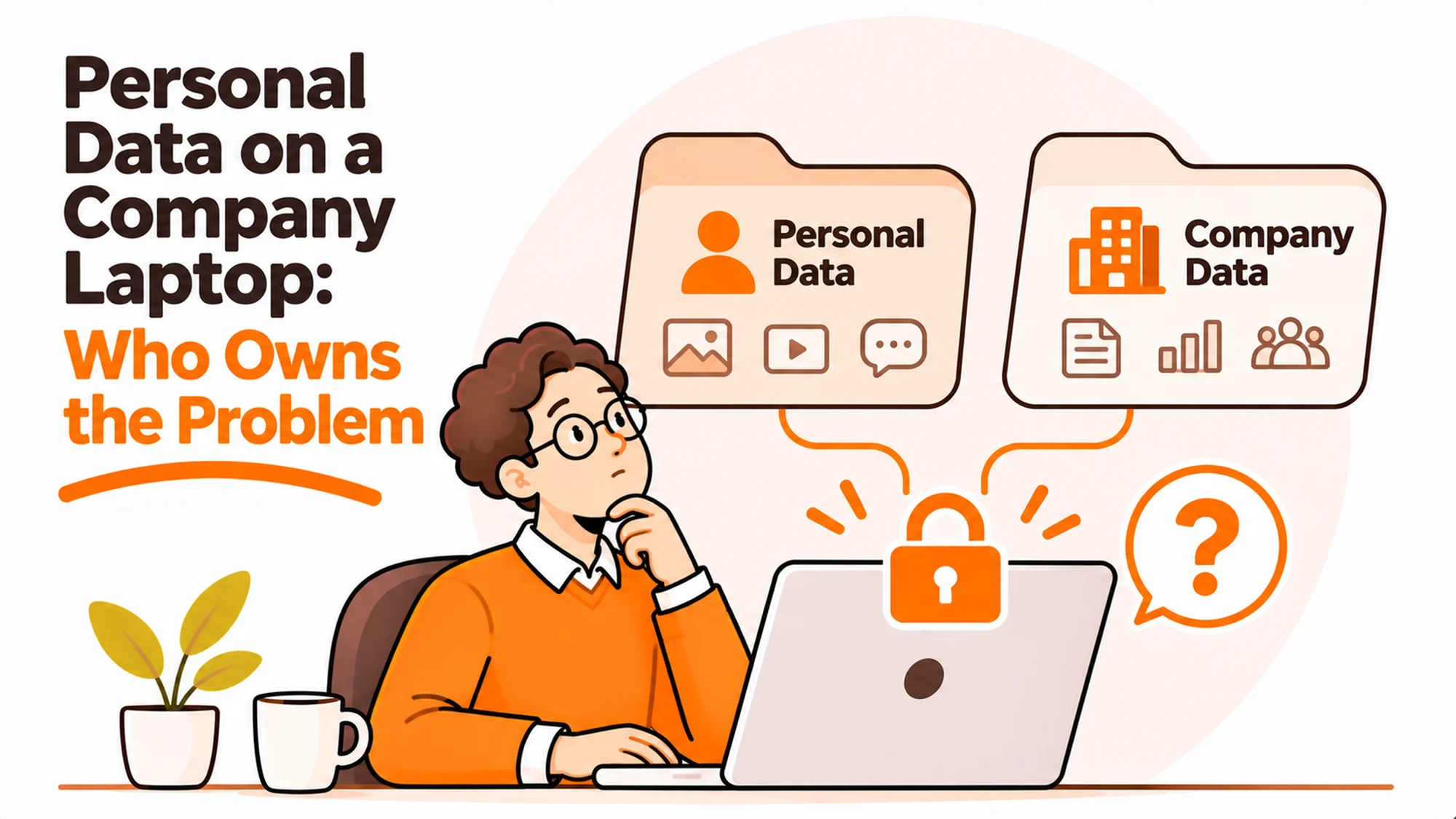
Personal data on company devices runs in two directions and most policies only address one. There is company data you need protected, and there is the employee’s own material that ends up on the machine because people live on their laptops. Offboarding is where the two collide, usually at the worst possible moment and without anybody having decided the rule in advance.
- Two directions: your data on their device and theirs on yours.
- Say in the policy that personal use creates personal data.
- Offer a retrieval window before the wipe, in writing.
- Never promise to search for and return personal files.
- Monitoring and access are separate questions. Keep them separate.
- The wipe is the point of no return. Set the date early.
Both directions are real
Policies almost always cover one and ignore the other, which is why offboarding goes wrong. Personal data on company devices is not an edge case; it is the normal state of a working laptop.
Company data on a device the employee holds. This is the one everybody writes about: confidentiality, encryption, return at the end.
Best tools for HR Operations
The employee’s own data on a device you own. Photos, messages, personal documents, a browser full of saved passwords for personal accounts. It arrives because people work from the same machine they live on.
Pretending the second does not happen is not a policy position, it is an omission. the consolidated text of the GDPR on EUR-Lex applies to that material and the obligations do not evaporate because the hardware is yours.
Why this matters most at the end
Through the employment, nobody looks. At offboarding, the device is collected and wiped, and if nobody set a rule then somebody’s family photographs are destroyed without warning or somebody’s personal files sit in your storage indefinitely. Both are avoidable.
What the policy should actually say
Four sentences, and the third is the one usually missing.
Say whether limited personal use is permitted. Most companies permit it in practice, so write that rather than banning it on paper and tolerating it in life.
Say that personal material stored on a company device may not be recoverable once the device is returned.
Say that the employee is responsible for removing their own material before return, and that a window will be provided.
Say what the company will and will not do, specifically that it will not search for, extract or return personal files.
| Question | Good policy answer |
|---|---|
| Can I use it personally? | Yes, within limits, stated |
| Who removes my files? | You, before return |
| How long do I have? | A stated window |
| Will you retrieve them later? | No |
| What happens to the device? | Wiped to a named standard |
our information security policy guide is where this normally sits, and it belongs beside the equipment policy rather than buried in security.
The retrieval window
This is the single practical change that prevents most disputes, and it costs nothing.
Between the last working day and the wipe, give a defined period in which the person can remove their own material. State it in the offboarding email, not only in a policy nobody reread.
Two things make it work. A specific date, because “before you return it” is not a date. And a reminder, because the last week of a job is busy and this is nobody’s priority until it is too late.
Keep the window short, between three and seven days after the final day is typical. Long windows delay the retrieval, and a device sitting at home for a month is a different risk entirely.
What happens when they miss it
The wipe proceeds. That is the point of setting a date. Make an exception once and it becomes the expectation, and the retrieval process stops having an end.
Record that the window was offered and the date it closed. That record is what makes the decision defensible later. RemoAsset’s data wiping and offboarding service documents the wipe itself against the serial, which is the other half of the same record.
The promise not to make
Do not offer to look for an employee’s personal files after the device is returned.
It sounds generous and it creates three problems at once. Somebody has to access a device holding both company and personal material, which is itself a data handling question. You take on responsibility for completeness, and you will miss something. And it delays the wipe, which delays redeployment and keeps data alive longer than necessary.
The kind version is the window, communicated early and clearly, not a rescue afterwards.
If an exception is genuinely warranted, for instance bereavement or a medical absence that made the window impossible, handle it as a named exception with a specific person authorising it and a record of what was accessed and why.
The related question
Personal accounts signed in on the device. Remind people to sign out of personal email, cloud storage and password managers, because a wipe removes access but a device in transit before the wipe does not.
Keep monitoring out of this
Questions about monitoring and questions about personal data on company devices get tangled together, and they should not be.
Whether you monitor activity on company devices is a separate policy decision with its own legal considerations and its own employee communication. It is not solved by the equipment policy and it should not be smuggled into one.
What belongs here is narrower: what happens to data at the end of the relationship, and who is responsible for removing what.
Mixing them causes real harm. An equipment policy that reads as a surveillance notice gets resisted, and the practical instruction about removing personal files gets lost inside the argument.
the NCSC device security guidance covers device security without straying into monitoring, which is a useful model for how to write this.
Access during employment
If you do need to access a device while somebody still works there, for an investigation or a technical fault, say who authorises it and whether the employee is told. Writing that down protects both sides and it is a short paragraph.
Where it fits in offboarding
The sequence that avoids most of the trouble.
At notice, send the equipment return instructions including the retrieval window date. At the final day, revoke access to company systems, which is a separate thing from the device. A few days later, collect the device. On receipt, wipe to a named standard and record the outcome against the serial.
Note the order. Access revocation happens on the last day. The device comes back afterwards. People often try to do both at once and end up either leaving access open for a week or taking the laptop before the person has finished.
RemoAsset’s laptop retrieval service for remote teams handles the collection leg, which is the step most likely to stretch from days into weeks when it is run by email.
The small thing that helps most
Put the window date in the same message as the return label. One message, one date, one action. Splitting it across a policy document, an HR email and an IT ticket is how it gets missed.
The cases that need a named decision
Four that recur, and each wants a rule rather than improvisation.
The device is not returned at all. You cannot wipe it, so the question becomes access revocation and remote wipe, and eventually a write off. what to do about unreturned equipment covers that path.
The person has died. Handle with a named senior decision maker, take no technical action quickly, and expect to deal with family. This is the one case where a longer window and more help is clearly right.
A dispute or legal matter is live. Preserve rather than wipe, and take advice. A wipe during a dispute is a serious problem regardless of how routine the process was.
The device is shared with family. More common than policies assume. The practical answer is a longer notice on the window and a clear statement that the whole machine is wiped.
Decide these once. The point is not that the rules are clever; it is that somebody does not have to invent one during a difficult week.
[Two-CTA block: Case Studies | Talk to Expert]
Frequently asked questions
Who is responsible for personal data on company devices?
Both parties, in different directions, and most policies only cover one. You are responsible for company data held on a device the employee carries. You also have obligations toward the employee’s own material that ends up on a machine you own, because data protection rules apply to that material regardless of who owns the hardware. The practical split is that the employee removes their own files within a stated window and you wipe the device afterwards.
What should the equipment policy say about personal use?
Four things. Whether limited personal use is permitted, written honestly rather than banned on paper and tolerated in practice. That personal material on a company device may not be recoverable after return. That the employee is responsible for removing it before return and will be given a window. And specifically what the company will not do, which is search for, extract or return personal files after the fact.
How long should the retrieval window be?
Typically three to seven days after the final working day, with a specific date rather than a phrase like before you return it. Put the date in the same message as the return label, and send one reminder, because the last week of a job is busy and this is nobody’s priority until it is too late. Keep it short, since a device sitting at home for a month is a different and larger risk.
Should we recover personal files for a leaver who asks?
As a rule, no, and the policy should say so in advance. It sounds generous and creates three problems: somebody must access a device holding mixed company and personal material, you assume responsibility for completeness and will miss something, and the wipe is delayed which keeps data alive longer. Genuine exceptions such as bereavement should be handled as named exceptions with a specific authoriser and a record of what was accessed.
Does this belong in the monitoring policy?
No, and mixing them causes real harm. Whether you monitor activity on company devices is a separate decision with its own legal considerations and its own communication. What belongs in the equipment policy is narrower: what happens to data at the end of the relationship and who removes what. An equipment policy that reads like a surveillance notice gets resisted, and the practical instruction gets lost inside that argument.
What order should offboarding steps run in?
Send return instructions with the window date at notice. Revoke access to company systems on the final day, which is separate from the device. Collect the device a few days later. Wipe to a named standard on receipt and record the outcome against the serial. The order matters because teams often try to revoke access and collect the laptop simultaneously, and end up either leaving access open for a week or taking the machine too early.
What about someone who has died, or a live dispute?
Both need a named decision rather than the standard process. For a bereavement, involve a senior decision maker, take no quick technical action, allow a longer window and expect to deal with family, since this is the clearest case for extra help. Where a dispute or legal matter is live, preserve rather than wipe and take advice, because wiping a device during a dispute is a serious problem however routine the process normally is.