
TL;DR
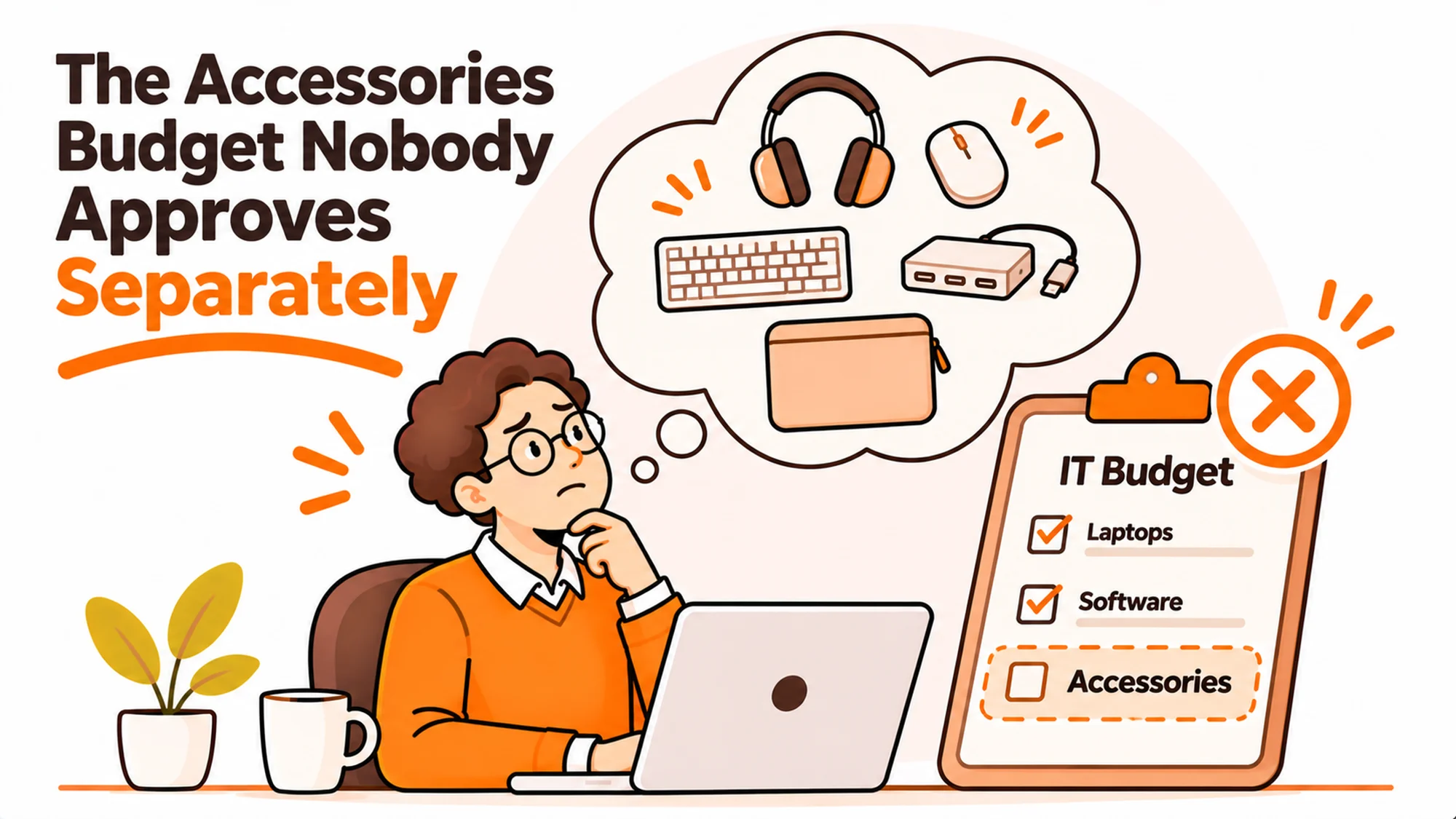
Nobody signs off an accessories budget. Monitors, docks, headsets, keyboards, chairs and cables get bought one request at a time, charged to whatever code is nearest, and never totalled. Then somebody runs the numbers for a year and finds the figure sits uncomfortably close to what was spent on the laptops themselves, with none of the control.
- Accessories are bought one request at a time and never totalled.
- Standardise the common items, leave the rare ones open.
- A list with prices reduces spend more than an approval step.
- Accessories are rarely retrieved, which is the real leak.
- Separate health and accessibility items from preference ones.
- Track spend per new joiner, not spend per month.
It is bigger than it feels
The reason this escapes attention is structural. A laptop is a single approved purchase with a number attached. Accessories arrive as a long tail of small requests, each individually trivial.
Count what a fully equipped remote desk actually contains. A monitor, often two. A dock. A keyboard and mouse. A headset. Cables and adapters. A webcam if the laptop camera is poor. A laptop stand. Frequently a chair and a desk.
Best tools for HR Operations
Each one is a small decision. Together they are a second purchase, and in many companies the total is within sight of the device spend.
buying peripherals at scale covers the buying side at scale. The governance side is what is usually missing.
The first thing to do
Total last year. Not estimate, total. Pull every purchase that was not a computer and group it. Most teams are surprised, and the surprise is what makes the rest of this possible to fund.
Standardise the common, leave the rare open
The instinct is either to standardise everything or to let people choose everything. Both fail.
Full standardisation produces a catalogue nobody fits and a steady stream of exceptions that cost more to process than they save. Full freedom produces incomparable kit, no volume pricing and a support burden.
The workable split is by frequency. Items almost everyone needs get a single standard option. Items some people need get a short list. Items few people need get a request route with a named approver.
| Item | Approach | Why |
|---|---|---|
| Dock, keyboard, mouse | One standard | Everyone, little preference |
| Headset | Two options | Fit genuinely varies |
| Monitor | One standard, size choice | Volume pricing matters |
| Chair | Short list | Body shape varies |
| Specialist input devices | Request route | Rare, individual |
Publish the list with prices. That single act reduces spend more reliably than adding an approval step, because most people choose reasonably when they can see the cost.
Keep accessibility out of the budget conversation
This is the distinction that matters most and gets blurred most often.
A second monitor because somebody prefers one is a preference. A specific chair, an ergonomic keyboard or a screen reader because somebody needs one is not, and routing it through the same approval queue as a preference request is both wrong and slow.
Separate the routes entirely. Health, accessibility and adjustment requests go to a named person, are not subject to the standard catalogue, and are not charged against a team budget that a manager might feel protective of.
the OSHA computer workstations guidance covers workstation setup usefully, and the principle holds wherever you are: the cost of getting this wrong is not the equipment.
The practical test
If a request would be uncomfortable to decline in writing, it is not a budget decision and should not be in a budget queue. Move it, and say in the policy that it has a separate route.
our guide to equipment stipends covers the stipend model, which can work for preference items and is a poor fit for adjustments, because a fixed sum caps something that should not be capped.
Accessories almost never come back
Here is the part that turns a budget into a recurring cost.
Laptops are retrieved. Monitors, docks, keyboards and headsets usually are not, because they are bulky, low value individually, and awkward to ship. So each leaver takes a desk’s worth of equipment with them and the next joiner is equipped from new.
At any scale that is a meaningful annual cost, and it is invisible because it appears as new purchases rather than as losses.
Three sensible positions. Retrieve the valuable items only, typically monitors and docks. Retrieve nothing and treat the spend as consumable, but budget it honestly. Or hold a regional pool so items are reused without long shipments. RemoAsset’s device storage and redeployment service supports the third, which is the only one that genuinely reduces the number.
Be explicit about it
Write the position in the equipment policy. Leavers currently guess, and the guess is usually that the keyboard is theirs. If that is your position, say so; if it is not, say that too, in the same place as the laptop instructions. what to do about unreturned equipment covers the mechanics of asking.
Measure it per joiner, not per month
Monthly accessory spend is almost useless as a number, because it tracks hiring rather than behaviour.
Spend per new joiner is the figure that tells you something. It is comparable across periods, it exposes drift, and it is the number that lets you forecast.
Two supporting cuts help. Spend per joiner by team, which usually reveals one department equipping very differently from the rest. And replacement spend separate from new joiner spend, which separates growth cost from running cost.
how to set a device budget per employee covers the device side of the same calculation, and the two together are what finance actually wants when they ask about equipment cost per head.
What good looks like
- One figure per joiner, tracked quarterly.
- A published standard list with prices.
- Replacement spend visible separately.
- Adjustments excluded from the comparison entirely.
When a stipend is the better instrument
Handing over a sum and letting people buy their own kit solves several problems and creates others. It is worth being clear about which.
It works well for preference items, for countries where your supply chain is weak, and for small teams where running a catalogue is disproportionate. It removes shipping, storage and most of the administration.
It works badly where you need equipment back, where you want consistent kit for support reasons, or where tax treatment makes a cash payment awkward. the UK guidance on homeworking expenses and benefits is a reminder that the treatment of allowances is not uniform and needs checking per market.
The hybrid most teams land on: the company supplies the laptop, dock and monitor, and a stipend covers the desk, chair and personal preference items. That puts company money into the items worth retrieving and employee choice into the items that were never coming back anyway.
our guide to equipment stipends covers the design in more detail, and how RemoAsset prices its service is a useful comparison when deciding which items are cheaper to supply than to reimburse.
A sequence that works
Four steps, in order, over about a quarter.
Total it. Last twelve months, every non computer purchase, grouped by item type. No decisions yet.
Publish a list. The common items, one or two options each, with prices. Expect spend to fall on publication alone.
Split the routes. Standard items, request items, and adjustments, with different owners and different speeds.
Decide the retrieval position. Which items come back, and write it where leavers will read it.
Then measure per joiner and leave it alone for two quarters. The most common mistake here is adding an approval step first, which slows everything down and saves less than publishing prices does.
The thing not to do
Do not run a one off cull of pending requests to show a saving. It produces a quarter of good numbers, a backlog of resentment, and a return to the previous pattern as soon as attention moves.
[Two-CTA block: Case Studies | Talk to Expert]
Frequently asked questions
How big is an accessories budget really?
Larger than it feels, because a laptop is one approved purchase with a number attached while accessories arrive as a long tail of individually trivial requests. Count what a fully equipped remote desk contains: one or two monitors, a dock, keyboard, mouse, headset, cables, often a webcam, a stand, and frequently a chair and desk. Totalled across a year, many companies find the figure within sight of their device spend.
Should we standardise everything?
No, and nor should you leave everything open. Full standardisation produces a catalogue nobody fits and a stream of exceptions costing more to process than they save. Full freedom produces incomparable kit, no volume pricing and a support burden. Split by frequency: one standard option for items almost everyone needs, a short list for items some people need, and a request route with a named approver for the rare ones.
What is the single most effective change?
Publishing the list with prices on it. That reduces spend more reliably than adding an approval step, because most people choose reasonably once they can see what things cost, and it does not slow anything down. Approval steps add delay and administration for a saving that usually turns out to be smaller than the visibility effect, which is why teams that add approval first are often disappointed.
How should accessibility requests be handled?
Through a completely separate route, not the budget queue. A second monitor because somebody prefers one is a preference; a specific chair, ergonomic keyboard or screen reader because somebody needs one is not. Send those to a named person, exempt from the standard catalogue and not charged against a team budget a manager may feel protective of. A useful test: if a request would be uncomfortable to decline in writing, it is not a budget decision.
Do accessories need to be retrieved?
Decide explicitly, because this is where the budget quietly becomes a recurring cost. Laptops come back; monitors, docks, keyboards and headsets usually do not, since they are bulky, individually low value and awkward to ship. Three defensible positions exist: retrieve the valuable items only, retrieve nothing but budget it honestly as consumable, or hold a regional pool so items are reused without long shipments.
What should we measure?
Spend per new joiner rather than spend per month, because the monthly figure tracks hiring rather than behaviour and tells you almost nothing. Per joiner is comparable across periods, exposes drift and supports a forecast. Add two cuts: spend per joiner by team, which usually reveals one department equipping very differently, and replacement spend separately from new joiner spend, which separates growth cost from running cost.
Is a stipend better than supplying the kit?
For some items. A stipend works well for preference items, in countries where your supply chain is weak, and for small teams where a catalogue is disproportionate. It works badly where you need equipment back, want consistent kit for support reasons, or where the tax treatment of a cash payment is awkward. The common hybrid is company supplied laptop, dock and monitor, with a stipend covering desk, chair and personal preference.