TL;DR
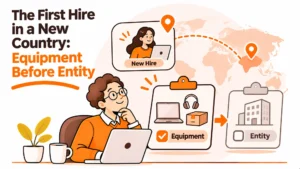
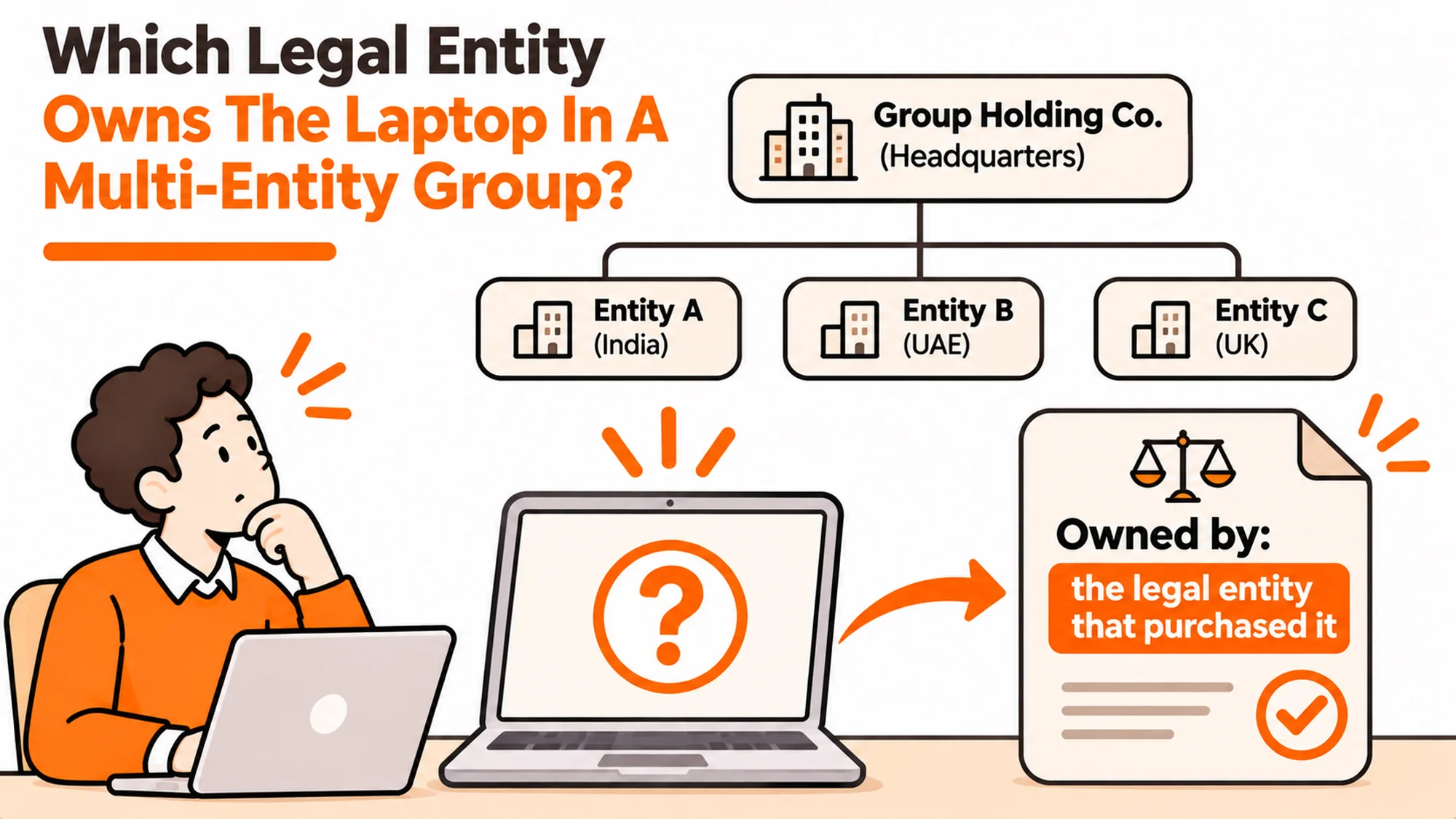
Moving equipment across group entities feels like an internal transfer and is treated as one, right up until an auditor asks which company owns the laptop in Lisbon. Two subsidiaries are two separate legal persons, and a device bought by one and used by an employee of the other sits in a position nobody documented at the time.
- Two subsidiaries are two legal persons, not one company.
- Whoever bought it owns it until a transfer is recorded.
- The employing entity should usually hold the asset.
- Cross border transfers can carry customs and tax consequences.
- Keep one register with an entity column, not several registers.
- Decide the rule once, at the point you open entity two.
Why this stops being theoretical
For a while, equipment across group entities genuinely does not matter. One company, one bank account, one asset register.
Then a second entity opens, usually to employ people in another country, and devices start being bought by whichever entity has a card that works with the supplier. Nobody decides anything.
Best tools for Global HR
It surfaces in four places. At audit, when an entity’s fixed asset listing does not match what its employees are holding. At depreciation, when the entity claiming the expense is not the one that bought the machine. At disposal, when the proceeds belong to one company and the device was in another. And at a transaction, when somebody does diligence on a single subsidiary.
our comparison of an EOR against your own entity covers the related decision about how people are employed, which usually drives the entity structure in the first place.
The cost of leaving it
It is not large and it is irritating, because unpicking three years of informal transfers is slow archaeological work. Deciding the rule when entity two opens costs an hour.
Who actually owns it
The default is simple and often ignored. The entity that paid for the device owns it until a transfer is recorded.
Not the entity that employs the user. Not the parent. Not the group. The buyer.
That default causes problems because purchasing is usually centralised for sensible reasons: one supplier relationship, better pricing, one process. So the parent buys everything and employees of five subsidiaries use the devices.
| Arrangement | Who owns | Main complication |
|---|---|---|
| Parent buys, all use | Parent | Recharge and depreciation mismatch |
| Each entity buys its own | Each entity | Loses volume pricing |
| Parent buys, recharges | Receiving entity | Needs a transfer record |
| Nobody decided | Unclear | Audit finding |
The third row is usually the right answer: buy centrally for the pricing, transfer formally so the asset sits with the employing entity.
What a transfer actually needs
Less than people fear, and more than nothing, which is what usually happens.
An intercompany transfer typically needs a price, a date, a record on both sides, and a basis for the price. The price is usually net book value, which finance already has. equipment depreciation and what finance needs covers how that figure is built and IRS Publication 946 on depreciating property is the underlying reference in the United States.
What makes it awkward is not the accounting. It is that nobody tells finance the device moved, because moving a laptop does not feel like a transaction.
The practical fix is a quarterly sweep rather than a per device process. List devices whose holder changed entity in the quarter, price them at net book value, post one journal, update the register.
When it is genuinely more complicated
Where the transfer crosses a border, there may be customs and tax consequences even between related companies. HM Revenue and Customs and the equivalent authority in the other market are the places to check, and this is one to ask about rather than assume.
Most teams discover the question exists only when a shipment is held. what causes a customs clearance delay covers that experience.
One register, with an entity column
The instinct when a second entity opens is a second spreadsheet. Resist it.
Separate registers diverge immediately, because a person moves and only one sheet gets updated. Then reconciling them becomes a project and nobody does it.
One register with an entity column gives you everything the separate ones would, plus the ability to produce a per entity listing on demand, which is what the auditor actually asks for.
Four columns carry the load: serial, current holder, employing entity, owning entity. The last two differ more often than people expect, and the gap between them is the work.
ISO 55001 on asset management is the framing, and RemoAsset’s device tracking and asset register is one way to hold it when the devices are bought and shipped by the same supplier that records them.
The report to be able to run
Devices owned by entity A, held by employees of entity B. If that list is long, your recharge arrangement is out of date. If you cannot produce it, you do not have an entity column.
When a person moves between entities
This is the event that creates most of the mess, and it is increasingly common as companies hire across borders and people relocate.
Somebody employed by the UK entity relocates and becomes an employee of the Spanish one. They keep the same laptop, because of course they do.
Three things should happen and usually none does. The asset moves to the new entity’s register. The physical device crossing a border is considered. And whoever handles payroll for the new entity learns there is equipment attached to this person.
keeping equipment parity across countries covers the related question of whether the person should even keep the same specification, which varies more than people assume once local supply differs.
The simplest workable rule
The asset follows the employment. When somebody’s employing entity changes, the device transfers at net book value in the same quarter. One rule, applied every time, with no judgement calls.
It will occasionally be slightly inefficient. It will never be an audit finding, which is the trade worth making.
Where an employer of record changes the picture
Many companies employ in a country through an EOR rather than opening an entity, and the equipment question is different in a way that catches people out.
The worker is employed by the EOR. Your company still owns the laptop. So you have an asset in a country where you have no legal presence, held by somebody who is not your employee.
That is workable and it needs deciding rather than drifting. Who ships it, who owns it, who retrieves it at the end, and whether the EOR will act for you on any of that. Some will, some explicitly will not, and the contract usually says.
equipping staff employed through an EOR covers the arrangement in detail. The common failure is assuming the EOR handles equipment because it handles everything else, and discovering otherwise when somebody leaves.
RemoAsset for remote and hybrid teams exists partly for this case, where there is no local entity to receive or hold anything.
The question to ask at contract stage
Will you receive, hold or return company equipment on our behalf, and what happens if the worker does not return it? Get the answer in writing before the first laptop ships.
Doing this when you open entity two
Handling equipment across group entities compresses into a short decision taken once.
Decide who buys. Usually central, for pricing.
Decide who owns. Usually the employing entity, via transfer.
Decide the transfer basis. Usually net book value, quarterly.
Add the entity column. Before there are two registers.
Decide the relocation rule. Asset follows employment.
Write those five lines, agree them with finance, and the rest runs itself. RemoAsset’s laptop lifecycle management service is one way to keep the physical side aligned with that record rather than tracking them separately.
If you are already three entities deep
Do not try to reconstruct history. Draw a line at a date, reconcile the current position properly, record transfers from that point, and tell the auditor what you did. A clean position from a stated date is accepted far more readily than an incomplete attempt to rebuild four years of informal movement.
[Two-CTA block: Case Studies | Talk to Expert]
Frequently asked questions
Who owns equipment across group entities by default?
The entity that paid for the device, until a transfer is recorded. Not the entity that employs the user, not the parent and not the group. That default causes problems because purchasing is usually centralised for good reasons, so the parent buys everything while employees of several subsidiaries hold the devices. The usual right answer is to buy centrally for the pricing and transfer formally so the asset sits with the employing entity.
What does an intercompany transfer actually require?
Less than people fear. Typically a price, a date, a record on both sides and a basis for the price, where the basis is usually net book value that finance already holds. What makes it awkward is not the accounting but that nobody tells finance the device moved, because moving a laptop does not feel like a transaction. A quarterly sweep of devices whose holder changed entity is more practical than a per device process.
Should each entity keep its own asset register?
No. Separate registers diverge immediately, because a person moves and only one sheet is updated, after which reconciling them becomes a project nobody does. Keep one register with an entity column, which gives you everything separate registers would plus the ability to produce a per entity listing on demand, which is what an auditor actually asks for. Four columns carry it: serial, holder, employing entity, owning entity.
What happens when someone moves between entities?
Three things should happen and usually none does. The asset should move to the new entity’s register, the physical device crossing a border should be considered, and whoever runs payroll for the new entity should learn there is equipment attached to this person. The simplest workable rule is that the asset follows the employment: when the employing entity changes, the device transfers at net book value in the same quarter.
Does this change if we use an employer of record?
Yes, and it catches people out. The worker is employed by the EOR while your company still owns the laptop, so you hold an asset in a country where you have no legal presence with somebody who is not your employee. Decide who ships, who owns, who retrieves and whether the EOR will act for you, because some will and some explicitly will not. Get that in writing before the first device ships.
Are there customs or tax consequences between related companies?
There can be, and it varies by country, by route and by circumstance, so it is a question to ask rather than assume. A transfer crossing a border may carry consequences even between companies in the same group. Check with the relevant authority in both markets, and do it before shipping rather than after, since most teams only discover the question exists when a shipment is held at the border.
What if we are already several entities deep with no records?
Do not try to reconstruct history. Draw a line at a date, reconcile the current position properly against what people are actually holding, record transfers from that point forward, and tell the auditor what you did and why. A clean position from a stated date is accepted far more readily than an incomplete attempt to rebuild several years of informal movement from memory and old invoices.