TL;DR
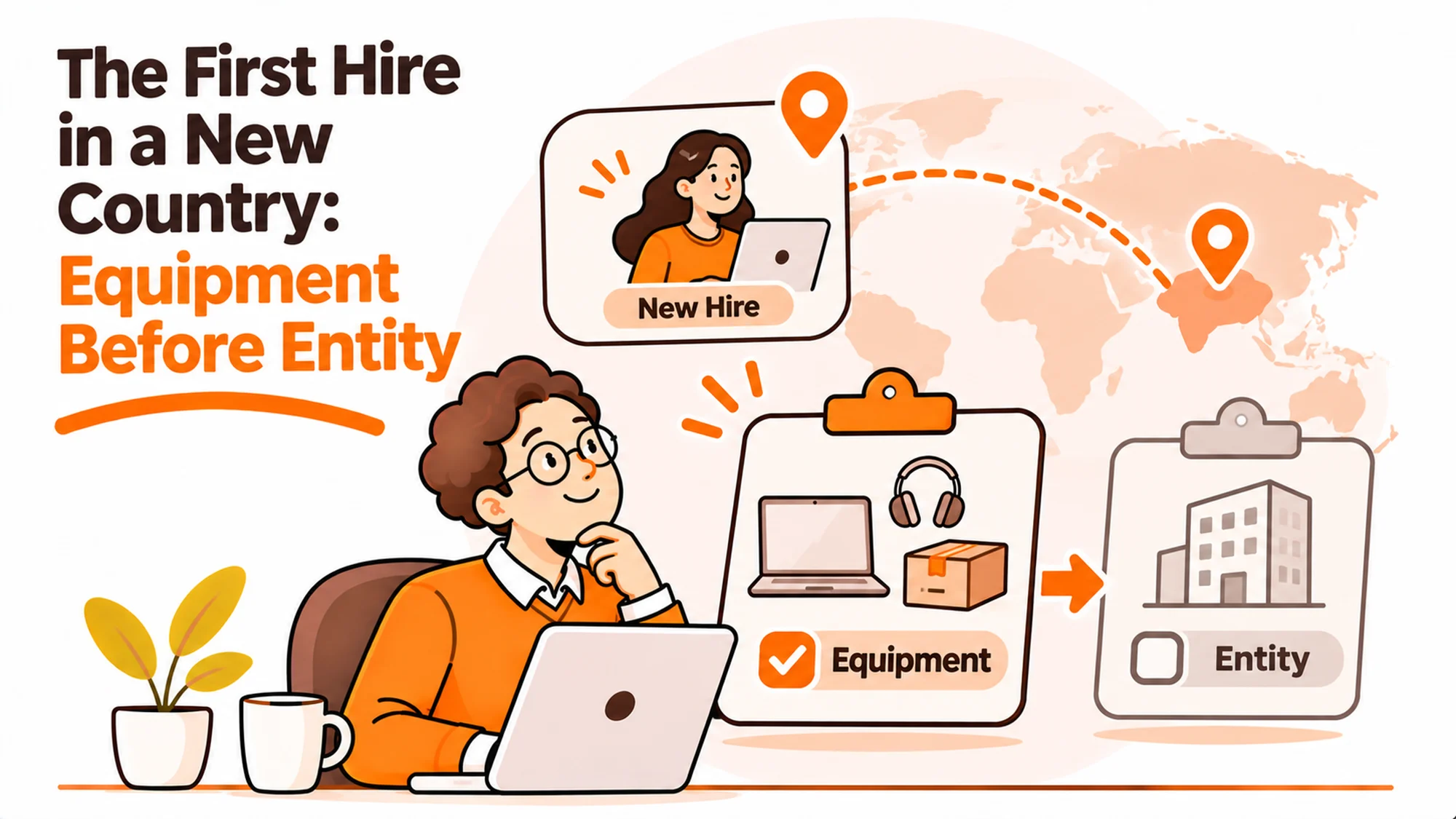
You hire somebody in a country where you have no company, no address and no bank account, and they start in three weeks. Sorting equipment before entity setup is not an edge case, it is the normal sequence, because the first hire usually arrives long before any decision about incorporating. The question is which of the four available routes fits.
- The hire almost always comes before the entity.
- Four routes: ship, buy local, reimburse, or vendor.
- Reimbursement is fastest and creates an ownership problem.
- Shipping is clean and can be slow and taxed.
- The EOR usually will not handle equipment. Check.
- Decide the retrieval route before the device ships.
The sequence is backwards and that is normal
The orderly version is: decide to enter a market, incorporate, set up payroll, then hire. Almost nobody does that.
The real version is: a strong candidate appears in a country you had not planned for, you hire them through an employer of record, and somebody realises a fortnight before the start date that they need a laptop.
Best tools for Global HR
Treating that as a failure of planning does not help. It is how distributed hiring works, and the useful response is a route that functions without a local company rather than a complaint about sequencing.
our comparison of an EOR against your own entity covers the employment side of the same decision, which usually gets resolved first because it has a legal deadline attached and equipment does not.
What you do not have
No local entity to import goods. No local address to ship to other than the person’s home. Often no local bank account or payment method. And no local support if the device fails in month two.
Four routes for equipment before entity setup
Each works and each has a cost somewhere.
Ship from where you are. Clean ownership, consistent specification, and the device is yours throughout. Slower, and it may attract duty and handling charges on arrival that somebody has to pay.
Buy locally through a vendor who can invoice you. Fast, locally supported, warranty works. Needs a supplier willing to sell cross border and a way to pay them.
Reimburse the employee. Fastest of all and the one most commonly chosen under time pressure. Creates an ownership question that nobody resolves at the time.
Use a service that already operates there. Someone else holds the local relationship, the stock and the import route. RemoAsset’s laptop procurement service is that model, and it exists because the first three all break somewhere.
| Route | Speed | Main risk |
|---|---|---|
| Ship from head office | Slow | Duty, delay, no local support |
| Local vendor | Fast | Finding and paying one |
| Employee reimbursement | Immediate | Ownership and retrieval |
| Equipment service | Fast | Cost per device |
The reimbursement trap
It deserves its own section because it is chosen so often and the consequences arrive so much later.
The employee buys a laptop and you reimburse them. Everyone is happy and the person starts on time.
Then: who owns it? The invoice is in their name. The warranty is in their name. If they leave in a year, is it yours to ask for? If it is yours, how is that evidenced? If it is theirs, why did the company pay for it?
None of that is unanswerable. All of it is much harder to answer eighteen months later than at the point of purchase.
If you reimburse, do this
- State in writing before purchase that the device is company property.
- Record the serial number on receipt, not just the invoice amount.
- Specify roughly what to buy, so the fleet stays supportable.
- Add it to the asset register the same week.
Four lines in an email. equipping staff employed through an EOR covers the EOR variant of this, where the ownership question is sharper because the worker is not your employee at all.
What the EOR will and will not do
The most common wrong assumption in this whole area.
Because an employer of record handles employment, payroll, benefits and compliance, teams assume it handles equipment. Many explicitly do not. Some offer it as a separate paid service. A few will receive a shipment on the worker’s behalf and most will not.
Ask four questions before the first hire, not before the first laptop. Will you receive equipment on our behalf? Will you hold it between hires? Will you arrange return when somebody leaves? And what happens if the worker does not return it?
The last answer is usually that it is your problem, which is reasonable and worth knowing in advance rather than discovering during an offboarding.
RemoAsset for remote and hybrid teams exists for this gap specifically, where there is no entity and no EOR willing to act.
The related trap
Assuming the EOR will deduct the value of unreturned equipment from a final payment. Usually they will not, and in many jurisdictions they could not even if they wanted to.
Decide retrieval before you ship
This is the single most useful habit in this article and almost nobody does it.
Before the device goes out, answer one question: when this person leaves, how does the laptop come back? Write the answer down.
If the answer is “we will work it out”, you have created a device that is very likely to become a write off, because working it out in a country you have never shipped to, under time pressure, with somebody who has already left, is the hardest version of the problem.
Acceptable answers include a vendor who collects in that country, a forwarding arrangement, a local colleague who can receive it, or an accepted decision that the device is a consumable in that market and will not be recovered.
That last one is legitimate. Deciding in advance that a low value device in a difficult market will not be retrieved is far better than discovering it by accident. RemoAsset’s laptop retrieval service for remote teams covers the markets where collection is practical, which is the information that makes the decision possible.
Specification and support
Two practical decisions that shape the next two years.
Keep the specification close to the rest of the fleet. Not identical, which is rarely possible across markets, but close enough that support, software and security baselines apply. keeping equipment parity across countries covers how far apart is too far.
Check what support actually exists locally. A manufacturer warranty that is excellent in one country can be slow or absent in another, and the time to discover that is before purchase rather than when a screen fails.
Where local support is weak, a spare matters more than specification. One working machine available quickly beats a slightly faster one that is unusable for three weeks.
Record the device against the market it sits in from day one. ISO 55001 on asset management treats location as part of the asset record rather than an afterthought, and in a country with no entity it is the only thing telling you the device exists at all.
Security baseline
Whatever route you choose, the device joins your fleet and should be enrolled, encrypted and reporting before it reaches the person. the NCSC device security guidance is the reference, and the practical point is that a device bought locally and handed over directly is the easiest one to miss.
Build it before it ships, or have the vendor build it. Do not plan to enrol it afterwards remotely, because that depends on the person completing a setup step on their first morning.
What changes when you do incorporate
Eventually some of these markets get a real entity, and the equipment position needs tidying.
Three things to do, none urgent and all easier if done together. Transfer the devices in that country to the new entity at net book value. Update the register’s entity column. And review whether the local route you built is still the cheapest now that a local company can buy and import directly.
Often it is not. Arrangements built for the no entity case carry a premium for the flexibility, and that premium stops being worth paying once you have a local presence.
equipment depreciation and what finance needs covers the transfer value, and RemoAsset’s device storage and redeployment service is worth revisiting at the same point, because a local entity usually makes holding stock in market viable for the first time.
The thing to keep
The retrieval route. Entities make buying easier and change nothing about getting a laptop back from somebody who has left. That problem is identical before and after incorporation, which is why it deserves the decision up front.
[Two-CTA block: Case Studies | Talk to Expert]
Frequently asked questions
How do I equip a hire in a country where we have no entity?
Four routes exist and each has a cost. Ship from head office, which keeps ownership clean but is slow and may attract duty. Buy from a local vendor who will invoice you, which is fast and gives local warranty support but requires finding and paying one. Reimburse the employee, which is immediate and creates an ownership problem. Or use a service that already operates in that market and holds the local relationship and import route.
What is wrong with reimbursing the employee?
Nothing at the time, which is the problem. The invoice and warranty are in their name, so when they leave a year later it is unclear whether the device is yours to ask for, how that is evidenced, and why the company paid for it if it is not. All answerable, and far harder eighteen months later. If you reimburse, state in writing before purchase that the device is company property and record the serial on receipt.
Will our employer of record handle equipment?
Often not, and this is the most common wrong assumption in the area. Because an EOR handles employment, payroll, benefits and compliance, teams assume equipment is included. Many explicitly exclude it, some offer it as a separate paid service, and most will not receive a shipment on the worker’s behalf. Ask before the first hire whether they will receive, hold or return equipment, and what happens if the worker does not return it.
What should I decide before shipping the device?
How it comes back. Answer that question in writing before the laptop goes out, because working it out later in a country you have never shipped to, under time pressure, with somebody who has already left, is the hardest version of the problem. Acceptable answers include a vendor who collects there, a forwarding arrangement, a local colleague who can receive it, or an explicit decision that it will not be recovered.
Is it acceptable to decide not to retrieve a device?
Yes, and deciding it deliberately is far better than discovering it by accident. For a low value device in a market where collection is impractical or costs more than the machine is worth, treating it as a consumable is a legitimate commercial decision. What is not legitimate is making that decision implicitly by never planning retrieval, because then it applies to devices where recovery would have been straightforward.
How close should the specification be to the rest of the fleet?
Close enough that your support, software and security baselines apply, though rarely identical, since availability differs by market. The more important check is what support actually exists locally, because a manufacturer warranty that is excellent in one country can be slow or absent in another. Where local support is weak, having a spare available matters more than a slightly better specification.
What changes once we do incorporate there?
Three things, none urgent and all easier done together. Transfer the devices in that country to the new entity at net book value, update the entity column in the register, and review whether the route you built is still cheapest now a local company can buy and import directly. Often it is not, because arrangements built for the no entity case carry a premium for flexibility you no longer need.