TL;DR
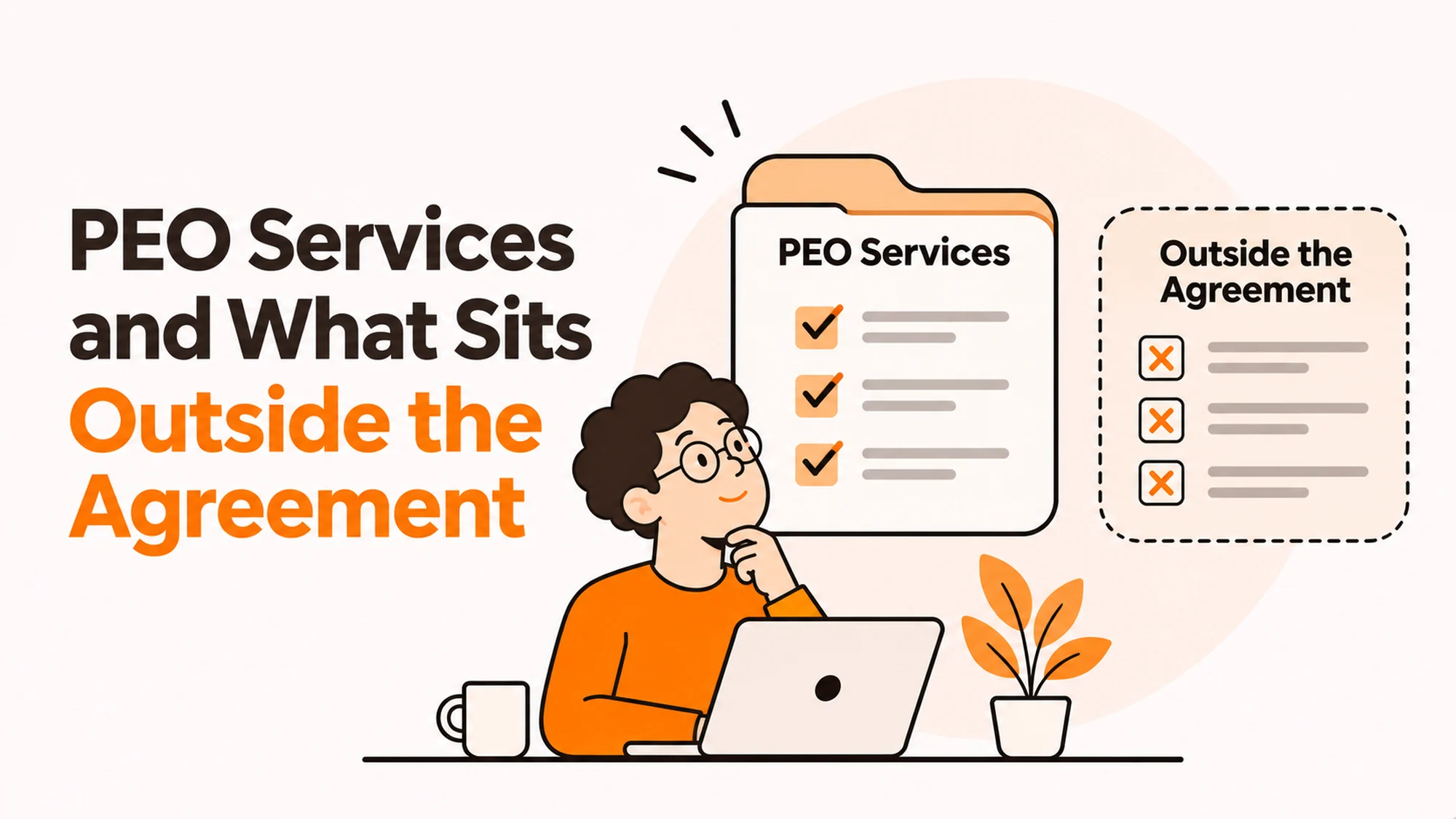
PEO services bundle payroll, benefits and administration into one arrangement, which is genuinely convenient. The surprises are all at the edges, and the largest edge is that nothing physical is included anywhere.
- The bundle is wide and the edges are sharp.
- Equipment appears in no agreement.
- Your own policies still have to exist.
- Ask what happens in a country not on the list.
- Exit planning belongs at the start.
- Legal questions go to your own adviser.
What is normally in the bundle
The appeal is real: one arrangement covering several things that are each annoying to run separately.
Typically included are payroll processing and the filings that go with it, benefits administration and usually access to plans a small company could not obtain alone, onboarding paperwork, and an HR helpline for routine questions.
Best tools for HR Operations
For a company without an HR function that is a lot of ground covered by one relationship, and the benefits access in particular is often the thing that makes the arithmetic work.
What this article is not
It is not a statement about who legally employs anybody, what the arrangement transfers, or what any law or authority requires. Those answers differ by jurisdiction and by circumstance, and they belong with your own adviser rather than with a blog. how the two employment models compare compares the models at a higher level if that is the question you are on.
What follows is about the practical edges: the operational work that nobody has agreed to do.
Nothing physical is included
The largest edge, and the one that surprises people most because the bundle is otherwise so wide.
A PEO arrangement will get somebody onto payroll, enrolled in benefits and through their paperwork. It will not get them a laptop, a monitor or a chair, and it will not get any of it back.
For an office-based company that barely registers, because equipment is a cupboard and a desk. For a distributed team it is a recurring operational task in every market you hire in.
The question to ask directly: when somebody starts in a country where we have nobody, who buys and ships their equipment. The answer will be you, and it is better heard during evaluation than during somebody’s first week.
who ships devices to staff employed through a provider covers the same question for the other employment model, and the answer is the same in both: the employment arrangement and the equipment arrangement are separate purchases, and only one of them is in front of you.
Your policies still have to exist
A common misunderstanding, and an expensive one.
A PEO will usually supply template policies and a handbook, which is useful and is not the same as having your own. Templates describe a generic company. Yours describes how you actually work: your approach to flexible hours, your equipment rules, your expectations about availability.
Where this bites is in the gap between the template and your practice. A handbook saying one thing while managers do another is worse than no handbook, because it creates an expectation nobody is meeting.
So treat the templates as a starting point requiring a pass by somebody who knows your company. The equipment policy in particular is almost never in a template in a form that fits a distributed team, since templates assume people work somewhere you control.
the HSE guidance on home working is worth knowing on the home working side, because what you provide for somebody working at home is a genuine consideration rather than a perk, and a template handbook rarely addresses it.
Ask about the country not on the list
The operational edge that causes the most friction in a growing distributed company.
Every provider has a list of places they can support. The list is usually in an appendix and is usually shorter than the sales conversation implies.
Three questions worth asking before signing. What happens when we want to hire somewhere not on the list. How long does adding a country take, in weeks. And what does it cost, both in setup and in ongoing terms.
| Situation | Usual answer | What to confirm |
|---|---|---|
| Country on the list | Straightforward | Lead time to first payroll |
| Country not on the list | Case by case | Weeks and cost, in writing |
| One person only | Sometimes declined | Minimum headcount per country |
| Contractor rather than employee | Often out of scope | Who handles it instead |
The third row catches people. Some arrangements have a practical minimum per country, which means your first hire somewhere is the hardest one rather than the easiest.
Who owns the relationship with the employee
A softer edge and a real one, worth thinking about before it matters.
When payroll questions, benefits queries and routine HR requests route to a provider, your people start having a relationship with a service desk rather than with somebody in your company.
For transactional things that is fine and is the point. Where it matters is that the early signal of a problem often arrives through a transactional conversation, and a provider has no way to recognise it.
The practical mitigation is to keep somebody internal visible and reachable, even part time, and to be explicit with managers about what goes to the provider and what comes to you.
what shared services actually centralise covers the same tension in an internal shared services model, where it shows up identically: efficiency at the transaction layer can quietly remove the surface where problems used to surface early.
Plan the exit at the start
Unromantic, and the same advice as every other outsourcing arrangement, for the same reason.
Three things to establish before signing. How you get your employee data back, in what format, and how quickly. What notice is required and whether it can be served at any point. And what the practical sequence looks like if you move to another arrangement or bring things in house.
The data point is the practical one. Employee records in a structure you can actually use are the difference between changing arrangement and reconstructing years of history.
Ask also what happens to benefits continuity during a change, because that is the part your people will notice and the part most likely to generate anxiety if it is handled badly. The answer will depend on the arrangement and the jurisdiction, which is another reason to have your own adviser rather than relying on reassurance.
And settle the equipment position in the same conversation. If any devices were procured through the arrangement, work out whose they are and where the records live before you need to know. storage and redeployment for returned laptops and similar arrangements exist partly because equipment that belongs to nobody in particular is how fleets go missing.
The data and security edge
A third party holding employee records and payroll data deserves the same scrutiny as any supplier with access to sensitive information.
Worth asking: where data sits, who inside the provider can see it, whether access is scoped or general, and what their own security practices look like. NIST’s small business cybersecurity resources is a reasonable yardstick for what to expect, and CISA and its Secure Our World guidance is plain enough to share with a non-technical colleague evaluating the same supplier.
The device angle recurs here too. If equipment is bought through the arrangement, the record of who holds what may live in the provider’s system. A register you cannot export is one you do not really have, and the NIST Cybersecurity Framework treats asset knowledge as foundational rather than optional.
None of this is a reason not to use a PEO. It is a reason to ask four questions during evaluation rather than after an incident, when the answers are the same and the conversation is much worse.
When the arrangement does not fit
Three cases worth recognising early.
You already have a functioning HR team. The main value is covering ground you cannot cover. If you can, you are paying for a bundle to get one or two components, and buying those separately is usually cheaper.
Your hiring is concentrated in places not on the list. The arrangement then works for part of your company and not the part that is growing, which is the worst shape.
You need judgement more than administration. A helpline answers documented questions. It does not help with a restructure, a difficult exit or a cultural problem, and those are where companies most often need help.
And the point this publication keeps returning to, because it keeps being true. Whatever employment arrangement you choose, somebody still has to put a laptop in a box, get it to a house in another country, and get it back afterwards with evidence that the data was dealt with. NIST Special Publication 800-88 on media sanitization is what that evidence should look like and the EPA on electronics and batteries management covers where the machine goes at the end. That work is not in your PEO agreement and it will not become somebody else’s by being overlooked.
The employment arrangement and the equipment arrangement are separate purchases. See laptop procurement across 80+ countries or a managed laptop lifecycle service.
Frequently asked questions
What do peo services normally include?
Payroll processing and associated filings, benefits administration including access to plans a small company could not obtain alone, onboarding paperwork, and a helpline for routine questions. For a company with no HR function that is a lot of ground in one relationship.
Does a PEO arrangement cover equipment?
No. It will get somebody onto payroll, into benefits and through their paperwork, and it will not get them a laptop or get one back. For an office company that barely registers; for a distributed team it is recurring work in every market you hire in.
Do we still need our own policies?
Yes. Templates describe a generic company and yours has to describe how you actually work. The equipment policy in particular is rarely in a template in a form that suits a distributed team, because templates assume a workplace you control.
What should we ask about country coverage?
What happens when you want to hire somewhere not on the list, how many weeks adding a country takes, and what it costs in setup and ongoing terms. Also whether there is a practical minimum headcount per country, which makes your first hire somewhere the hardest rather than the easiest.
What should we settle about leaving before we join?
How you get employee data back and in what usable format, what notice applies and whether it can be served at any point, and what happens to benefits continuity during a change. Settle the equipment position in the same conversation.
Who do employees go to with problems?
Transactional questions route to the provider, which is the point. The risk is that early signals of a real problem often arrive inside a transactional conversation and a service desk cannot recognise them, so keep somebody internal visible and reachable.
When does a PEO not fit?
When you already have a functioning HR team and are buying a bundle to get one or two components, when your hiring is concentrated in places not on the coverage list, or when what you actually need is judgement rather than administration.