
TL;DR
An hr consultant is the right purchase for a problem with an end. A hire is the right purchase for work that keeps arriving. Most teams get this wrong in one direction and pay for it for a year.
- Projects suit a consultant. Flow suits a hire.
- Define the deliverable, not the days.
- Expect to supply the context yourself.
- They will not run anything operational.
- Handover is the part that fails.
- Cheaper per hour, dearer per year.
Project work or flow work
One distinction settles most of this decision, and it has nothing to do with budget.
Project work has a beginning, an end and a deliverable. Writing a handbook. Designing a pay structure. Running a redundancy process. Building an onboarding programme. When it is finished, it is finished.
Best tools for HR Operations
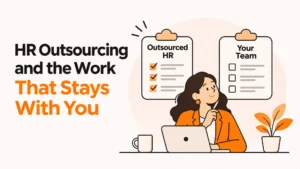
Flow work arrives continuously and never completes. Questions from managers, hiring, employee relations, the hundred small decisions a week that are nobody’s project.
Consultants are excellent at the first and structurally poor at the second, because flow work depends on being around, knowing the history and being trusted enough that people bring things early.
The common error
Hiring a consultant for flow work, usually described as interim support. You get somebody capable spending most of their time acquiring the context a permanent person would already have, and losing it when they leave.
Define the deliverable, not the days
The single change that most improves these engagements, and it is about how you buy rather than who you buy.
A day-rate engagement with a vague brief drifts. Everybody is busy, work happens, and three months later it is unclear what exists that did not before.
A defined deliverable makes the conversation concrete. A written pay framework with bands and a process for applying it. A handbook covering a specified list of topics, reviewed by your adviser. An onboarding programme with materials and a trained manager.
Write the deliverable down before agreeing a rate. If a consultant resists defining one, that is information: either the problem is not as defined as you thought, which is itself worth knowing, or they prefer open-ended work.
defending an HR budget is relevant if you need to justify the spend internally, because a named deliverable is far easier to defend than a number of days.
You will supply the context
Underestimated, and it is the hidden cost in every engagement of this kind.
A consultant arrives knowing their subject and nothing about you. Before anything useful happens, somebody internal has to explain how the company works, what has been tried, who the difficult relationships are and what is politically impossible.
That is real time from the person who is already busiest, and it does not appear on the invoice.
Two practical consequences. Budget your own time, realistically, at something like a day for every five of theirs early on. And front-load it: a thorough briefing at the start costs less than a drip of corrections over months.
It also argues for fewer, longer engagements with the same person over time rather than a new consultant per problem, since the context cost is paid once rather than repeatedly.
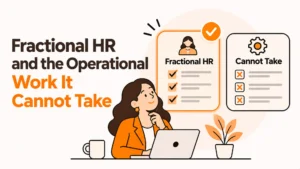
They will not run anything
Worth being explicit about, because it is where expectations most often misalign.
A consultant designs, advises and builds. They do not become the person who processes the thing they designed, answers the questions it generates, or chases the people who have not completed it.
So a beautifully designed process can arrive and then not happen, because nobody internally picked up the running of it. That is not a failure of the consultant; it is a gap in the plan.
| Need | Consultant | Hire | Outsourcer |
|---|---|---|---|
| Design a process | Yes | Sometimes | Rarely |
| Run it weekly | No | Yes | Yes, if transactional |
| Handle a grievance | Sometimes | Yes | No |
| Ship a laptop | No | No | No |
The bottom row is deliberately there. Nobody in this table does it, which is the point this publication keeps making: the physical work sits outside every HR arrangement you can buy. choosing an equipment partner without an IT team covers who does handle it.
Handover is where it fails
The predictable ending, and it is preventable with one conversation at the start.
The work finishes, the consultant leaves, and six months later the process has quietly reverted because the person who understood it is gone and nobody internal ever owned it.
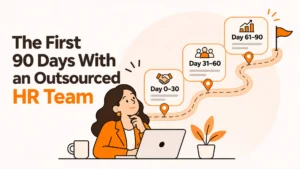
Three things prevent that. Name the internal owner at the start, not at the end, and have them involved throughout rather than briefed at the finish. Require documentation written for somebody who was not there, which is a different document from a consultant’s working notes. And schedule a check-in at ninety days, paid for in the original engagement so nobody has to ask for it.
That last one is cheap and it is the single best predictor of whether the work survives. Knowing somebody will come back and look changes how seriously the handover is taken on both sides.
designing an HR operating model is useful on where the ownership should sit structurally, which is a question worth answering before the consultant starts rather than after they leave.
Cheaper per hour, dearer per year
The arithmetic that is usually done badly in both directions.
A consultant costs more per day than an employee and less per year, because you only buy the days. For genuine project work that is straightforwardly good value.
Where it inverts is on continuing work. Two or three days a week of consultant time, sustained, costs more than a permanent hire doing the same work, and you get less of it: no institutional knowledge accumulating, no availability between visits, no relationship with the team.
The crossover is roughly around two days a week sustained for more than a few months. Below that, buying days is efficient. Above it, you are paying a premium to avoid a decision you have already effectively made.
Worth running the comparison honestly, including the context cost from earlier, before extending an engagement for a third time. Most teams that end up well over the line got there by renewing rather than by deciding, which is a different and much easier thing to do.
There is a quality argument alongside the cost one. A permanent person accumulates knowledge about your company that nobody can hand over in a document: who works well with whom, which manager needs warning before a change, what was tried in 2024 and why it failed. That knowledge is the thing a consultant is structurally unable to build, and past a certain amount of sustained work it is worth more than the specialist expertise you are paying for.
Choosing one
Four questions that separate people faster than a credentials list.
- Ask for a piece of work they produced, redacted. The quality of a handbook or a framework tells you more than any conversation.
- Ask what they would not take on. Somebody who claims every HR specialism is describing a sales position rather than an expertise.
- Ask how a similar engagement ended. Listen for whether the work survived, and whether they know.
- Ask what they need from you. A good answer is specific about your time and access; a vague one means they have not thought about the context cost either.
On jurisdiction: if your question touches what is required or permitted anywhere, confirm the consultant is qualified to advise in that place, and take legal questions to a legal adviser. A consultant with deep experience in one country is not automatically a guide to another, and the honest ones will say so first.
When neither a consultant nor a hire is the answer
Three cases, because this is framed as a binary and often is not one.
The problem is a system, not a process. If the pain is that records live in four places and nothing reconciles, a consultant will document the mess accurately. Fixing it is a tooling project. what shared services actually centralise covers that distinction.
The problem is capacity in one manager. Sometimes what looks like an HR problem is one team leader who needs support. That is coaching, not consulting, and it is a smaller and cheaper intervention.
The problem is physical. If what is actually eating the week is equipment, shipping and recovery, no HR arrangement touches it. a managed laptop lifecycle service is the relevant purchase and it is not an HR one.
And a closing note on something consultants reliably surface and rarely finish. Reviews of this kind usually turn up that nobody can say what equipment the company owns or prove what happened to machines that left. The design advice will be sound; the execution is a logistics job. NIST Special Publication 800-88 on media sanitization is what the evidence should look like, the EPA on electronics and batteries management covers where retired machines go, and neither is in anybody’s consulting scope.
Design advice does not move hardware. See a managed laptop lifecycle service or a laptop retrieval service for remote employees.
Frequently asked questions
When is an hr consultant better than hiring?
When the work is a project with a beginning, an end and a deliverable: a handbook, a pay structure, a restructure, an onboarding programme. Continuous work that keeps arriving suits a hire, because it depends on being around and knowing the history.
How should we scope the engagement?
By deliverable rather than by days. A day rate with a vague brief drifts and three months later nobody can say what exists that did not before. Write the deliverable down before agreeing a rate.
What is the hidden cost?
Your own time. A consultant arrives knowing their subject and nothing about you, so somebody internal has to supply the context. Budget roughly a day of your time for every five of theirs early on, and front-load it rather than drip-feeding corrections.
Will a consultant run the process they design?
No. They design, advise and build; they do not become the person who runs it weekly, answers the questions it generates or chases people. A well designed process that nobody internal owns quietly stops happening.
How do we stop the work unravelling afterwards?
Name the internal owner at the start rather than the end, require documentation written for somebody who was not there, and pay for a ninety day check-in inside the original engagement. That last one is cheap and is the best predictor of whether it survives.
At what point should we hire instead?
Roughly two days a week sustained for more than a few months. Below that, buying days is efficient. Above it you are paying a premium for less: no accumulating knowledge, no availability between visits, no relationship with the team.
What should we ask when choosing one?
For a redacted piece of work they produced, what they would not take on, how a similar engagement ended and whether they know, and what they need from you. The last answer shows whether they have thought about the context cost.