TL;DR
Equipment under a peo arrangement is the question nobody asks during evaluation and everybody asks during somebody’s first week. The arrangement covers employment administration and stops well short of a cardboard box.
- The arrangement covers administration, not objects.
- Settle it before the first hire, not during.
- Who buys and who owns are two questions.
- Recovery is harder when you never met them.
- Keep your own register regardless.
- Data evidence is yours to produce.
Why equipment under a peo is nobody’s job
Not an oversight by anybody, which is why it persists.
These arrangements exist to handle employment administration: payroll, benefits, the paperwork of taking somebody on in a place where you have no presence. That is what the agreement describes and what the provider is set up to deliver.
Best tools for HR Operations
Equipment is a different kind of task entirely. It needs a supplier, a courier, somewhere to hold stock and somebody who understands importing things into that country. None of that is in the agreement because none of it is in the business.
So the laptop sits in a space between you and the provider that nobody wrote down, and it stays there until somebody’s start date forces the question.
What this article does not cover
It says nothing about who legally employs anybody, what any arrangement transfers, or what any law requires about equipment, deductions or liability. Those differ by jurisdiction and by circumstance and belong with your own adviser. how the two employment models compare covers the model comparison; this is about who physically does the work.
Two questions, not one
They get merged in conversation and they have different answers.
Who buys it and gets it there. An operational question about suppliers, shipping and lead times.
Who owns it afterwards. A commercial and accounting question about whose asset it is, who insures it, and who bears the loss if it never comes back.
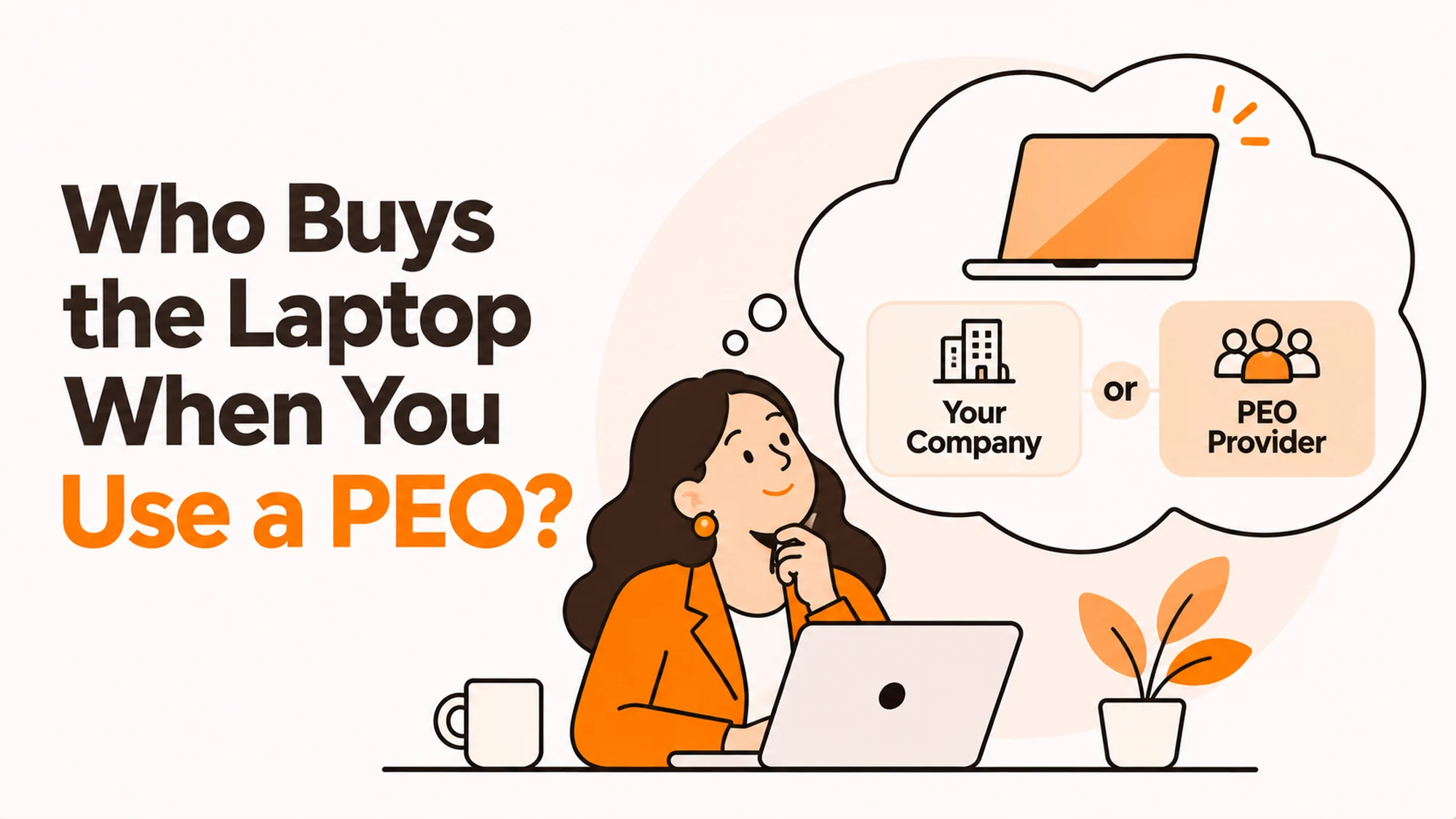
You can have any combination. You buy and own it. A local supplier sells to you and you own it. The provider buys it, invoices you, and ownership depends entirely on what was agreed. Somebody else buys, holds and ships it on your behalf and you own it throughout.
Confusion between the two is what produces the awkward conversation later, when a machine needs recovering and nobody can say whose it was. Write both answers down, once, in a sentence each.
The realistic options
Four, with honest trade-offs.
| Approach | Works when | Problem |
|---|---|---|
| Ship from your own country | Occasional, nearby | Duty, delay, customs |
| Local purchase, expensed | One or two hires | No standard, poor records |
| Provider sources it | They offer it | Markup, and many do not |
| Specialist equipment partner | Several markets, ongoing | Another relationship |
The second row is the most common and the most quietly expensive. Letting somebody buy their own machine and claim it back is fast and produces a fleet of different specifications, no serial numbers, no enrolment, and no realistic prospect of recovery.
If you do use it, capture the device details as a condition of the expense claim. That one requirement turns an invisible machine into a recorded one at no cost, which is the single highest return change available here.
The fourth row is worth understanding honestly: you are buying coordination across markets rather than cheaper hardware, and whether that trade is worth it depends entirely on how many markets you are in.
Recovery is the harder half
Getting equipment out is always harder than getting it in, and this arrangement makes it harder still.
Three reasons. You may never have met the person. The relationship ran through a provider, so your direct contact may be thin. And they are in a country where you have no presence and possibly no courier relationship.
What works is the same as everywhere, applied earlier. Arrange collection before the last working day, while they are still a colleague rather than a former one. Send packaging to them rather than asking them to find a box. And make it somebody’s job rather than an action item on a leaver checklist.
Decide in advance what happens when a device is not returned, including the point at which you stop chasing and write it off with a reason recorded. who ships devices to staff employed through a provider covers the same question for the adjacent employment model and the mechanics are identical.
In the countries where you have nobody at all, which is most of them in this situation, recovery is a courier and coordination problem rather than a relationship one, and it needs somebody who can act locally.
Keep your own register
Non-negotiable, and easy to lose sight of when somebody else is handling the employment side.
Whoever buys the machine, you need a record: what it is, its serial number, who holds it, when it was issued and what happened to it. In a system you control.
Two reasons it has to be yours. The provider’s records are about employment, not assets, and they have no reason to track a device after the first week. And if the arrangement ends, anything held only in their system becomes difficult to retrieve at exactly the moment you are busy.
A spreadsheet is enough for a long time. What matters is that it exists at all, that one named person owns it, and that it gets updated at the moment of issue and the moment of return rather than reconstructed once a year from memory and guesswork.
the NIST Cybersecurity Framework treats knowing what you have as foundational rather than optional, and the argument applies regardless of who processes the payroll.
The data evidence is yours
The obligation that most reliably surprises people, because the arrangement feels like it covers everything employment related.
A machine used by somebody employed through a provider still holds your company’s information. When that machine comes back, or does not, the question of what happened to the data is yours to answer.
No employment arrangement produces that evidence. It comes from whoever physically handles the device at the end, which means it has to be arranged separately and specified.
NIST Special Publication 800-88 on media sanitization sets out the distinction between clearing, purging and destroying, which is the level of detail a serious question expects. A policy saying devices are wiped is not evidence; a certificate naming a serial number is. certified data wiping at offboarding is one route that produces it per device.
The disposal end has an environmental dimension as well, and the EPA on electronics and batteries management is the plain reference. Both obligations sit with you rather than with the provider handling the employment, and both are far cheaper to arrange before the first machine retires.
Put it in the budget
The practical consequence, and the reason this gets raised late.
When somebody models the cost of hiring through one of these arrangements, they count the provider fee, the salary and the benefits. Equipment appears nowhere, so the cost per head looks lower than it is.
Three lines worth adding. The machine itself, amortised over a refresh cycle rather than charged in the month it was bought. Getting it there, which varies enormously by market. And getting it back or disposing of it, including the proportion you will not recover.
That third line is the one nobody includes and it is the one that makes a market look cheap until the first person leaves. Estimate it honestly rather than optimistically; the recovery rate from a country where you have no presence is not the same as from your own office.
defending an HR budget is relevant when presenting this, because an equipment line in a hiring model is easy to defend and nearly impossible to add retrospectively once a number has been agreed.
When this is simpler than it sounds
Two cases where the whole question shrinks.
One hire, nearby, and they already have a machine. Some roles genuinely do not need company hardware, and a documented arrangement about using their own is a legitimate answer provided you have thought about the data side.
A market where local purchase is easy and cheap. In several countries buying locally is faster and cheaper than shipping anything, and the only real work is capturing the record and planning recovery.
And the general point. The question is not difficult; it is just unowned. Ten minutes deciding who buys, who owns, who recovers and where the record lives prevents nearly everything in this article from becoming a problem.
Have that conversation before your first hire through the arrangement rather than during their first week, when the only available answer is whatever is fastest. choosing an equipment partner without an IT team covers choosing somebody to perform the work if the answer turns out to be that nobody internal can.
Decide who performs it before the first hire. See laptop procurement across 80+ countries or a laptop retrieval service for remote employees.
Frequently asked questions
Does a PEO arrangement cover equipment?
No. These arrangements handle employment administration: payroll, benefits and the paperwork of taking somebody on. Equipment needs suppliers, couriers, storage and import knowledge, none of which is in the agreement because none of it is in the business.
What two questions need separate answers?
Who buys the machine and gets it there, which is operational, and who owns it afterwards, which is commercial and accounting. They get merged in conversation and having different answers written down prevents the awkward conversation at recovery.
Is letting the employee buy their own machine a good idea?
It is the most common approach and the most quietly expensive: different specifications, no serial numbers, no enrolment and little prospect of recovery. If you do it, make capturing the device details a condition of the expense claim.
Why is recovery harder in this arrangement?
You may never have met the person, your direct relationship ran through a provider, and they are somewhere you have no presence or courier relationship. Arrange collection before the last working day and send packaging rather than asking them to find a box.
Should we keep our own asset register?
Yes, regardless of who buys the machine. The provider’s records are about employment rather than assets, and anything held only in their system becomes hard to retrieve if the arrangement ends. A spreadsheet is enough for a long time.
Who produces the data destruction evidence?
You do. No employment arrangement produces it; it comes from whoever physically handles the device at the end, so it has to be arranged and specified separately. A policy saying devices are wiped is not evidence.
What should go in the hiring budget?
Three lines usually missing: the machine amortised over a refresh cycle, getting it to the market in question, and getting it back or disposing of it including the proportion you will not recover. That last one is what makes a market look cheap until somebody leaves.