TL;DR
Fractional hr gives a small company access to senior thinking it could not otherwise afford. What it does not give you is somebody to run the week, and companies that confuse the two end up paying senior rates for administration.
- You are buying judgement, not capacity.
- The admin underneath does not disappear.
- Two days a month is advisory, not operational.
- Decide what happens between visits.
- Pair it with somebody junior or a service.
- Equipment is nobody’s in this model either.
What you are actually buying
The model is sound and the value is specific: seniority you could not justify full time.
A company of forty people often needs somebody who has handled a restructure before, knows what a pay framework should look like, and can tell the founder something they do not want to hear. It does not need that person five days a week, and could not afford them if it did.
Best tools for HR Operations
Buying two or three days a month of that experience is a genuinely good trade, and it is the best available answer to a real problem.
The thing it is not
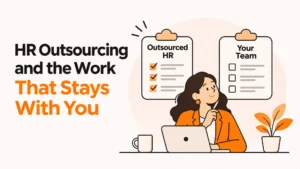
It is not capacity. The contracts still need issuing, the questions still need answering, the payroll inputs still need preparing. Seniority does not reduce the volume of administration; it just makes somebody expensive available to think about it.
The work underneath does not disappear
The practical failure, and it arrives about two months in.
Engagements of this kind usually start with strategy. A plan, a structure, a set of priorities. Everybody is pleased.
Then the operational work that was always there starts reaching the fractional person, because they are the HR person now. Contract queries. A manager with a difficult conversation coming. Benefits questions. Somebody leaving.
Two days a month disappears into that within weeks, and the strategic work that justified the arrangement stops happening. Nobody decides this; it is simply what happens when the only HR person available is the one with the title.
The fix is deciding in advance what they will not do, and making sure there is somewhere else for it to go. Which is the next section.
Decide what happens between visits
The design question that determines whether this works, and it is usually unanswered.
Things arrive on days your fractional person is not there. Somebody resigns, a manager needs advice before a conversation tomorrow, a candidate needs an offer today.
Three workable arrangements, and the wrong one is having none.
- A junior or coordinator internally who handles the routine and escalates the rest. The most common and usually the best, since it also builds somebody.
- An agreed availability window outside scheduled days, paid for, for urgent matters.
- An outsourced transactional layer handling payroll and administration, with the fractional person doing only judgement work.
designing an HR operating model covers the structural version of this decision. The point here is narrower: if nobody has decided, the default is that everything waits for the next visit or goes to a founder, and both of those are worse than any of the three options.
Pair it with something
The arrangement that works best, and the one people arrive at after trying the other.
Senior judgement plus junior execution is considerably more effective than senior judgement alone, at a lower blended cost than a single mid-level hire. The fractional person designs and decides; somebody internal runs it and learns.
| Arrangement | Works when | Fails when |
|---|---|---|
| Fractional alone | Genuinely advisory need | Admin reaches them |
| Fractional plus coordinator | Most companies 30 to 100 | Rarely |
| Fractional plus outsourcer | Payroll heavy, multi country | Boundary undefined |
| Fractional plus nothing | Under 20 people, briefly | Almost immediately after |
The bottom row is where most engagements start and it is only viable for a short period. Noticing when you have outgrown it is the thing to watch for, and the signal is reliable: strategic work has stopped happening and every visit is spent on whatever arrived that week.
That signal is easy to miss because the visits still feel productive. Somebody senior is solving real problems and everybody leaves the room satisfied. The thing to compare against is not whether the day was useful but whether the work you originally hired them for has moved since the last one, and the honest answer after three months is frequently no.
Equipment is nobody’s here either
The recurring finding, and it lands harder in this model than in most.
A fractional HR person is on site or available a few days a month. They are not going to order laptops, chase a courier, work out import duty or arrange a collection from somebody who has left.
Nor should they: it is the least leveraged possible use of the most expensive person in your HR arrangement.
Yet in companies of this size it frequently lands there, because they are the only person whose job title is adjacent to onboarding. The result is senior rates spent on logistics and strategic work that keeps slipping.
Decide explicitly that it is not theirs, and decide what it is instead: the coordinator, an operations person, or a service that performs it. a managed laptop lifecycle service is the third option and the questions to ask an equipment vendor covers what to ask before choosing one.
Making the days work
Practical, and it makes a surprising difference to what you get.
Cluster the days rather than scattering them. Two consecutive days achieves more than two separated by a fortnight, because context is reloaded once rather than twice.
Send the agenda in advance, and let them see the problems before arriving. A fractional person who learns about something at ten in the morning spends the day catching up.
Protect some of the time for the work you hired them for. If every visit is consumed by whatever is on fire, you have bought firefighting at a senior rate.
Give them access to the systems, read-only if nothing else. A senior person who cannot see your data is advising on description rather than fact, and descriptions are reliably optimistic.
NIST’s small business cybersecurity resources is worth noting on that last point: giving an external person access to employee data is a supplier decision like any other and deserves the same basic questions about scope and termination.
Knowing when it ends
Fractional arrangements are naturally transitional and frequently outlast their usefulness.
Three signals that it has run its course. The strategic work is finished and the visits have become status meetings. The operational load has grown to the point where you are paying for seniority to do administration. Or the company has reached a size where somebody needs to be present daily.
Ending it is not a failure and good fractional practitioners expect it. Many will help you hire their replacement, which is a reasonable final deliverable and worth asking for.
What matters is that the transition is handled rather than drifted into. Documentation handed over, the internal owner identified, and a handover period while both are available. The same failure mode as every other arrangement in this batch: the knowledge leaves with the person unless somebody deliberately keeps it.
what shared services actually centralise is useful on what the next structure looks like once you are past this one.
What to keep from the arrangement
Whatever was written down. The frameworks, the policies, the documented processes and the reasoning behind each. A fractional engagement that ends with artefacts has compounded; one that ends with a departing person and some good meetings has not.
Ask for that explicitly in the final weeks rather than hoping. The request is entirely reasonable and it is the difference between having bought an asset and having rented an opinion.
When fractional is not the right shape
Three cases.
You need hands rather than judgement. If the honest problem is volume, hire a coordinator. Senior thinking will not reduce the number of contracts that need issuing.
You will not act on the advice. The main deliverable is recommendations, and a founder who wanted validation rather than input will get expensive validation. Worth being honest with yourself before starting.
Everything is on fire. Two days a month cannot stabilise a company in crisis. That needs somebody present, even temporarily, and a fractional arrangement will frustrate everybody.
And the closing point this publication keeps returning to. Whatever arrangement you land on, somebody still has to get equipment to new starters and back from leavers with evidence that the data was handled. NIST Special Publication 800-88 on media sanitization is what that evidence should be, the HSE guidance on home working is relevant to what you provide for people working at home, and neither obligation is covered by buying senior HR thinking a few days a month.
Senior rates on logistics is the most expensive mistake here. See a managed laptop lifecycle service or laptop procurement across 80+ countries.
Frequently asked questions
What does fractional hr actually give you?
Senior judgement a few days a month: somebody who has handled a restructure, knows what a pay framework should look like and will tell a founder something unwelcome. It is access to seniority you could not justify full time, which is a genuinely good trade.
What does it not give you?
Capacity. Contracts still need issuing, questions still need answering and payroll inputs still need preparing. Seniority does not reduce the volume of administration, it just makes somebody expensive available to think about it.
What usually goes wrong?
The operational work reaches them, because they are the HR person now. Two days a month disappears into contract queries and manager questions within weeks, and the strategic work that justified the arrangement quietly stops happening.
What should happen between visits?
Something decided in advance: a junior or coordinator internally who handles routine and escalates, a paid availability window for urgent matters, or an outsourced transactional layer. Having no answer means everything waits or goes to a founder.
What is the best pairing?
Senior judgement plus junior execution. More effective than senior alone and at a lower blended cost than a single mid-level hire, because the fractional person designs and decides while somebody internal runs it and learns.
How do we get more from the days?
Cluster them rather than scattering, send the agenda in advance, protect some time for the work you actually hired them for, and give them at least read access to systems. A senior person advising on description rather than data is advising on optimism.
When should the arrangement end?
When the strategic work is done and visits have become status meetings, when you are paying senior rates for administration, or when the company needs somebody present daily. Good practitioners expect this and will often help you hire their replacement.