By [Author Name] · [Date] · [X] min read · [Table of Contents]
TL;DR
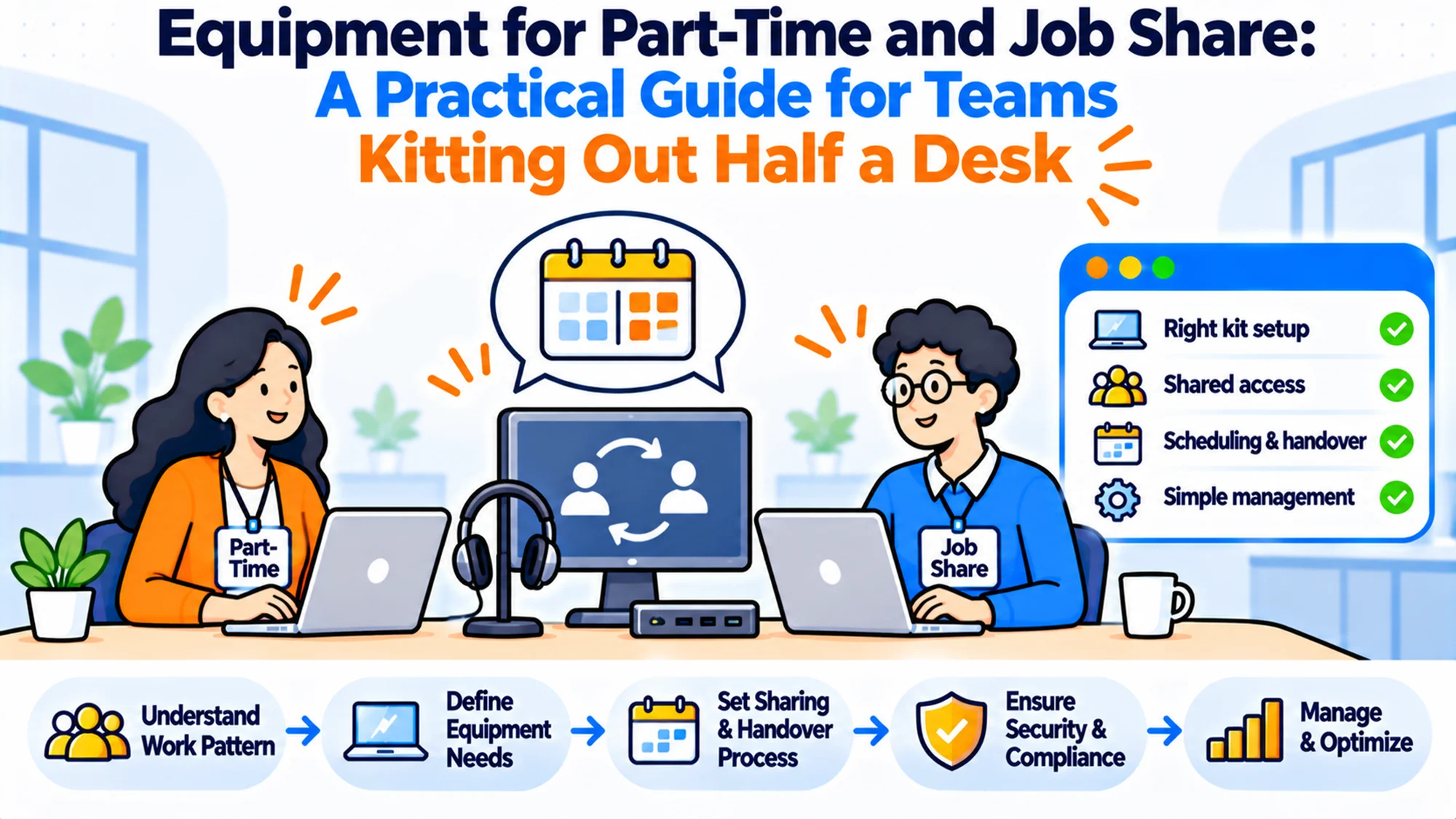
- Equipment for part-time staff is the question of what hardware somebody gets when they work two or three days rather than five.
- If everybody part-time works from one office on fixed days, a hot desk and a docking station already solve it.
- It does three jobs: it settles the fairness question, it stops a job share needing two of everything, and it keeps the asset register honest.
- Four models exist: full allocation, shared device, hot desk, and a reduced build.
- Choose on whether the people overlap in time and place, not on how many days they work.
- Done right, nobody notices, which is the whole objective.
Two people share one role. They overlap on Wednesdays, one works Monday and Tuesday, the other Thursday and Friday, and somebody in HR has been asked whether that means one laptop or two. The hiring manager assumed one, because it is one job. The person starting Thursday has reasonably assumed they get their own, because everybody else does.
These aren't edge cases. A company with 180 people probably has 14 part-time staff and one or two job shares, and the equipment standard was written as one machine per person without anybody considering that a role and a person aren't always the same unit. Another discovered its asset register could not represent a shared device at all, because the holder field takes one name. A third equipped a job share with two laptops, which was correct, and then charged both to a team budget sized for one head.
Best tools for HR Operations
The real issue isn't how many laptops. It's that the standard is written per person while the budget is written per role, and part-time working is where those two quietly disagree.
When You Don't Actually Need a Policy for This
Stage one: the existing standard is fine. If your part-time staff work fixed days in an office with hot desks and docking stations, the question answers itself. They get a laptop like everybody else, or they use a desk setup that's there whether they're or not. Nothing to decide.
Stage two: friction appears. Somebody asks whether a two-day-a-week employee should have a monitor at home, and nobody can say, so the answer becomes whoever asked most persistently. That inconsistency is what gets noticed, and it gets noticed by the people who were refused.
Stage three: it becomes a liability. A job share is equipped twice, or once, and either way somebody considers it unfair and says so. Equipment is unusually visible and unusually easy to compare, which makes it a poor place to have an undocumented practice.
Stage four: the edge case. Two people share a role across two countries, or a part-time employee also works elsewhere on their other days. That second one raises questions about whose equipment is used for what, and it is the situation most likely to need a conversation rather than a rule.
What HR Teams Actually Need from an Equipment Standard
> "Does a part-time employee get the same kit?" > Generally yes, and that should be the stated default. > A reduced build saves a few hundred and introduces a visible two-tier distinction, which is a poor trade in almost every direction.
> "Does a job share get one machine or two?" > Two, unless they genuinely never need it at the same time. > Sharing looks efficient on a plan and breaks the moment both people need to work on a Wednesday they both happen to be in.
> "Who pays, when the budget is per role?" > Decide this before the first job share, because it is the actual source of the argument. > The hardware cost scales with people and the budget was built on headcount, and nobody reconciles those two until it bites.
> "Can our register even represent this?" > Check, because many cannot. > A holder field that takes one name forces somebody to pick, and whoever is picked becomes accountable for a machine they don't solely control.
> "What happens when one of them leaves?" > Decide at setup, not at exit. > A job share where one person leaves is a half-recovery, a half-reissue and a continuity question all at once, and it is entirely predictable.
There's a sixth question. It comes up once and is worth settling early. If somebody reduces from five days to three, do they keep what they have? The answer should be yes and it should be written down, because the alternative is asking somebody to hand back a monitor as a consequence of a working pattern change, which is a conversation nobody should have to have.
The Four Models and What Each One Costs
Full allocation. What it is: every person gets the standard build, regardless of days worked. When it's right: almost always. It's simple, it is defensible, and the saving from any alternative is small relative to the complexity it introduces. When it fails: at genuine scale with very low utilisation, for example a bank of weekend-only staff, where the machines sit idle five days in seven and the volume makes that material.
Shared device. What it is: one machine, two people, separate accounts. When it's right: where the two genuinely never overlap and are in the same physical place, which is rarer than it sounds. When it fails: on the overlap day, on handover, and on everything to do with accountability. Two people sharing a laptop means neither is responsible for it, and the register can't say who has it.
Hot desk with docking. What it is: no personal peripherals, a shared desk setup, people bring a laptop. When it's right: office-based part-time work with fixed days, which is the classic case and the one this solves cleanly. When it fails: with any home working, because the question was never about the desk. It was about the second monitor in somebody's spare room.
Reduced build. What it is: a lower specification for part-time roles. When it's right: essentially never, for part-time status alone. Specification should follow what the work needs, and a three-day designer needs the same machine as a five-day one. When it fails: immediately and visibly. It encodes a judgement about part-time staff into something everybody can see on a desk, and it saves very little.
I'd default to full allocation and treat everything else as a specific exception with a stated reason. The reason matters more than the exception does, because an undocumented departure from the standard is indistinguishable from favouritism to anybody comparing two desks.
| Model | Simple? | Fair in practice? | Register works? | Real saving |
|---|---|---|---|---|
| Full allocation | Yes | Yes | Yes | None |
| Shared device | No | Disputed | Poorly | One machine |
| Hot desk and dock | Yes | Yes, if office-based | Yes | Peripherals |
| Reduced build | Yes | No | Yes | A few hundred |
How to Choose: Five Questions
Do they overlap? This is the only question that decides whether sharing is even possible. Two people who are both in on Wednesdays can't share a laptop, and a model that assumes they can will fail in its first week. Ask for the actual pattern rather than the contracted days.
Where do they work? A hot desk solves an office problem and nothing else. If any part of the week is at home, the question is about home equipment and the office arrangement is irrelevant to it.
What does the work need? Specification should follow the task. A part-time video editor needs the same machine as a full-time one, and tying specification to days worked produces the wrong answer in both directions.
How is the budget structured? If device cost is allocated per head, a job share costs the hiring team twice for one role unless somebody has decided otherwise. Find out before the first one rather than during.
Can the register hold it? Look at the actual field. Many asset registers accept one holder, which means a shared device is recorded as belonging to whoever was entered, and the audit trail is wrong from the first day.
Six Platforms Worth Knowing
RemoAsset Best for: distributed part-time and job-share staff who need equipment in their own homes. Why companies choose it: procurement and retrieval across 80+ countries with each device tracked through issue and return, which matters here because part-time and job-share arrangements generate more movements per role than a standard hire and the register has to keep up. Pricing is published, from $1,499 a year on the Subscription tier for companies with 50 to 5,000+ employees, including a 60 per cent reduction on retrieval charges. It's our own product, so weigh that accordingly. Where it struggles: no network discovery, so a machine issued informally for a few days a week is invisible unless somebody records it. No software licence management, which is a real gap for part-time staff because per-seat licensing is frequently the larger question. And only the Subscription tier publishes a figure, with pay-as-you-go quoted. It holds one holder per device, so a genuinely shared machine needs a convention rather than a field.
Workwize Best for: teams holding stock centrally for fluctuating patterns. Why companies choose it: its own warehouses, which suits equipment that moves in and out more often. Where it struggles: no published rate card, and the figures on its pricing page are savings claims rather than prices. The live domain is goworkwize.com.
Firstbase Best for: equipping quickly when a pattern changes. Why companies choose it: strong supply side and a clean subscription shape. Where it struggles: publishes nothing on price, and the supply-led model is weaker for kit you already hold.
GroWrk Best for: companies wanting an arrangement scoped around unusual patterns. Why companies choose it: flexible service design rather than a fixed package. Where it struggles: no rate card, and its pricing page runs a competitor cost estimator whose figures are its own estimates.
allwhere Best for: handing over the logistics entirely. Why companies choose it: managed service with minimal internal lift. Where it struggles: publishes nothing, so comparison needs a conversation.
Deel IT Best for: companies already employing through Deel. Why companies choose it: hardware and employment in one relationship, which helps where a job share spans two markets. Where it struggles: weaker standalone, no published pricing.
The Decision Table: Matching the Pattern to the Model
| Situation | Scale | Setup | Primary Pain | Recommended Starting Point |
|---|---|---|---|---|
| Part-time, fixed office days | Any | Hot desks exist | None | Hot desk and docking |
| Part-time, any home working | Any | Distributed | Home peripherals | Full allocation |
| Job share, overlapping days | Any | Any | Two people, one role | Two machines, central cost |
| Job share, no overlap, same site | Any | Single office | Accountability | Shared device, named owner |
| Pattern changes mid-year | Any | Any | Handing kit back | Keep what they have |
| Register cannot hold two names | Any | Any | Audit trail wrong | Full allocation, one holder each |
Most teams need rows two and three and have written a policy for row one.
The last row is a constraint. Not a preference, which makes it different from the others and worth noticing. If your register genuinely cannot hold two names against a device, then the shared-device model is unavailable whatever its merits, because adopting it means accepting a record you know to be wrong. That is a reasonable basis for a decision and it is one of the few places where a system limitation should settle an operational question rather than being worked around.
Costing the Four Models Properly
The comparison above is qualitative, which is not much use to anybody holding a budget. So here is the arithmetic, on a job share covering one role with both people working partly from home.
| Item | Full allocation | Shared device | Hot desk | Reduced build |
|---|---|---|---|---|
| Laptops | 2 at 1,430 | 1 at 1,430 | 2 at 1,430 | 2 at 980 |
| Home peripherals | 2 sets at 290 | 1 set at 290 | None | 2 sets at 290 |
| Office setup | Shared desk | Shared desk | 1 at 340 | Shared desk |
| Three-year total | 3,440 | 1,720 | 3,200 | 2,540 |
| Per month, per role | 96 | 48 | 89 | 71 |
The gap between the cheapest and the most expensive is about 48 a month. That is the entire financial question, and it is worth knowing before anybody spends a meeting on it, because the figure tends to be assumed much larger than it is.
Set against that, the shared-device column carries a scheduling conflict on every overlap day and a register entry that is wrong from the first week. The reduced-build column saves 25 a month and encodes a visible distinction between part-time and full-time staff. Neither looks like value at those numbers.
The hot desk column is the interesting one. It is nearly as cheap as full allocation only because it assumes no home working at all, and the moment either person works one day a week at home it converges on the first column with an office desk added. Which is why the model depends on where people work rather than on how many days.
Run the sum with your own figures before deciding anything. The shape holds across most price points: the models differ by tens of pounds a month and by substantial amounts of friction, and friction is the expensive term.
Why Sharing a Laptop Rarely Works
This deserves its own section because it is the model that sounds most sensible in a planning meeting and produces the most friction afterwards.
The theory is clean. Two people, one role, one machine and separate accounts, with the hardware used five days a week instead of sitting idle for three of them. On a utilisation spreadsheet it is obviously correct, and the saving is a whole laptop plus peripherals.
Three things go wrong. The first is the overlap. Job shares almost always have a handover day, because that's how the role stays coherent, and on that day both people need to work. One of them is now waiting, or using a spare, which means you needed the second machine anyway and have added a scheduling problem on top of owning it.
The second is accountability. A device with two users has no owner, so when it develops a fault, needs an update, or goes missing, nobody is responsible for it. Support requests about a shared machine are consistently slower to resolve for exactly this reason: the person reporting the problem isn't the person who will be inconvenienced tomorrow, and the diagnostic information is split between two people who each saw half of it.
The third is the register, and it is the one that causes trouble a year later. Most asset systems hold one holder per device. Forced to choose, somebody enters one name, and that person is now formally accountable for hardware they control two days a week. At the next audit it reconciles incorrectly, and at the next departure the recovery process chases the wrong person.
So the honest position is that sharing works where two people are in the same building, never overlap, and one of them is clearly designated as the owner. That's a real situation and it is uncommon, and everywhere else the second laptop is cheaper than the arrangement.
The Budget Argument Nobody Pre-Empts
Here is the structural problem underneath all of this, and it is the thing worth settling before the first job share rather than during it.
Headcount budgets are built per role. A role approved at one full-time equivalent carries a salary cost, an allocation for benefits, and in companies that allocate IT cost, a device charge for one person. Then the role is filled by two people at 0.6 and 0.4, and the salary works out roughly the same while the device cost doubles.
Nobody designed that. It's an artefact of two systems using different units, and it surfaces as a hiring manager being told their job share will cost them an extra device charge for a role they were approved one of. The predictable response is to resist the job share, or to push for the shared-laptop model, and both of those are the budget structure driving an operational decision it should have no view on.
The fix is a line in the allocation rules. Device cost for a job share is charged once at the role level, with the second machine absorbed centrally, or charged per head with the role budget uplifted to match. Either works. What doesn't work is leaving it undecided, because the default is whichever reading the finance system happens to produce.
Peripherals compound it quietly. Two people in a job share each need a home setup if either works from home, which is two monitors and two docks rather than one, and those are usually outside the headline device charge and therefore outside whatever was approved.
Worth getting the number before the argument. For most companies the whole thing is a few hundred a year per job share, which is small enough that settling it centrally is cheaper than the meeting about it.
The Licensing Question, Which Is Usually Bigger
The article called this the larger question and then moved on. It is worth returning to, because for part-time staff software frequently costs more than hardware and behaves differently.
Hardware is a one-off. Spread over three or four years. Per-seat software is a recurring monthly charge that does not care how many days somebody works, so a two-day-a-week employee on the same stack as a full-timer costs the same per month for software and about 40 per cent as much per month for hardware. That inverts the usual intuition about where part-time cost sits.
Check the licence model. Whether your main tools bill per named user or per concurrent user changes what a job share costs. Named-user licensing means two people in one role need two licences and the role costs double. Concurrent licensing means they share one, because they are rarely both working, and the role costs the same as a full-time equivalent. Most business software is named-user, so the first case is the common one.
That matters for the budget line this article recommends. Settling the device charge centrally while leaving a doubled software charge on the hiring team solves half the problem and leaves the larger half in place, which will produce the same resistance to job shares for a different reason. Settle both or neither.
One saving is real. It needs asking about rather than assuming. Some vendors price part-time or light users differently, and a few will discuss a reduced tier for somebody using a tool two days a week. It is not standard, it is worth one email per major vendor, and it is the only place in this whole area where the numbers are large enough to justify the effort.
RemoAsset does not help here at all, and it is our own product so this is worth stating plainly: it has no software licence management, which means the entire licensing side of a part-time arrangement sits in whatever system you use for that.
What to Do When Somebody Reduces Their Hours
This is the common case and it is where a policy can do real damage if it is written carelessly.
Somebody moves from five days to three. They already have a laptop, a monitor at home, a dock and a headset, all issued when they were full-time. If your standard says part-time staff get a reduced allocation, you've just created an obligation to collect equipment from an existing employee because of a change to their working pattern.
Don't do that. State explicitly that a change in hours doesn't change equipment allocation, and that existing kit stays with the person. The saving from recovering a two-year-old monitor is negligible and the cost in how it is received is not, and this is one of the few places in equipment policy where the reputational consideration clearly outweighs the financial one.
The same applies in reverse and gets forgotten. Somebody moving from three days to five may need something they didn't have, and the request should go through the normal route rather than being treated as an exception because their pattern changed. A standard that only operates in the restrictive direction isn't a standard, it is a cost-saving measure with a policy label on it.
Where this does need care is the refresh cycle. A machine issued to a full-time employee who is now part-time will come up for replacement on the usual schedule, and the question of whether utilisation should extend the cycle is a reasonable one to ask. The defensible answer is to leave the cycle alone, because a four-year-old laptop is a four-year-old laptop regardless of how many days a week it was used, and age rather than hours is what drives most failures.
Write the whole thing as two sentences. Equipment allocation follows the role and the work, not the hours, and a change in hours doesn't trigger a change in equipment.
Onboarding Two People Into One Role
Nobody plans this and it produces a poor first week for at least one of the two.
A job share usually starts with both people beginning in the same week, often on different days, into a role that has one requisition, one manager and one onboarding checklist. The checklist runs once. Which means the second person arrives on Thursday to find the laptop collected, the accounts created and the induction delivered, all for somebody else.
Run it twice. Two separate instances of the checklist, with the shared items marked, rather than one instance with an appendix for the second person. Equipment, accounts, access and induction are all per person, every time, with no shared shortcuts. The role handover, the stakeholder introductions and anything to do with the work itself can be shared or coordinated. Separating those two lists at the start takes ten minutes and removes almost all of the friction.
Order both sets of equipment at the same time even if the start dates differ by a fortnight. Procurement lead times are the thing most likely to leave the second person without a machine, and ordering on their start date rather than on the first person's means the gap is invisible until it is too late to fix.
And give them separate records from day one rather than retrofitting. A job share set up as one person plus an addition produces a register, an access list and an asset trail that all treat the second person as an exception, and every subsequent process that touches the role inherits that shape.
The departure case follows the same logic and is worth deciding now. When one of two leaves, their equipment and access are recovered individually while the role continues, which is only straightforward if the records were individual to begin with.
Where the Register Needs a Convention
A short practical section, because this is the part that produces incorrect audits and nobody notices for a year.
Most asset registers have one holder field. That's correct for the overwhelming majority of devices and it can't represent a genuinely shared machine, so somebody enters one of the two names and the record is partially false from the start.
Adopt a convention. If you run shared devices at all, improvising each case is what produces the wrong audit. Name one person as the accountable holder, record the second user in a notes or secondary field, and make sure whoever runs the quarterly reconciliation knows the convention exists. That's enough to keep the audit honest without changing any system.
Make it a real role. Not an alphabetical accident. The person who is responsible for reporting a fault, confirming the device at audit, and arranging its return should know that they are, which means telling them at issue. A convention nobody was informed of produces a reconciliation where somebody denies holding a machine the register says is theirs.
And flag these records. A handful of shared devices in a fleet of several hundred will be invisible unless they're marked, and they're precisely the records most likely to be wrong, which makes them worth a filter rather than a search.
Where Jurisdiction and Terms Come In
Two things here aren't equipment questions and shouldn't be answered as though they are.
Ask locally. How a part-time or job-share arrangement is structured, what terms apply to it, and what the people in it are entitled to all differ by jurisdiction and by the specific arrangement. That needs local advice rather than a policy written in one market and applied across all of them. The equipment consequence is simply that the arrangement may look different in different places and the hardware standard has to accommodate that rather than assume one shape.
The second is narrower. Anything about a part-time employee who also works elsewhere. Whether that's permitted, what it means for the use of company equipment, and how any of it interacts with their terms are questions for advice and for the contract rather than for an asset policy. What an equipment standard can usefully say is narrow and practical: company devices are for company work, and if somebody needs a clean separation between two employers, that's a conversation to have rather than a rule to impose.
Everything else on this page is safe to standardise. The default of full allocation, the rule that hours don't change allocation, the register convention, and the budget line, all of which you can write once and apply in every market. None of that needs advice and all of it is what actually determines whether this runs smoothly.
What Good Looks Like in Practice
Worth describing the finished state, because the sections above are a list of decisions rather than a picture of the result.
A part-time employee joins and nothing about the equipment process is different. They get the standard build, the standard home setup if they work from home, and nobody has a conversation about it. The register shows one device, one holder, one date. If they later change their hours in either direction, the equipment does not move.
A job share arrives. The onboarding checklist runs twice, as two separate instances. Two laptops are ordered on the same day even though the start dates are a fortnight apart, two sets of accounts are created, and the role-level handover is coordinated separately. The device cost sits centrally at the role level, the software licences are settled the same way, and the hiring manager has no financial reason to prefer one full-time hire over the arrangement they actually wanted.
Nobody notices any of this, which is the objective. Equipment decisions that work are invisible, and the only visible version of this topic is the one where somebody has been given different kit from the person doing the same job and has started asking why.
The test is whether a hiring manager can predict what their new part-timer will receive without asking anybody. If they can, the standard is doing its job. If they have to check, you have a practice rather than a standard, and practices drift in whichever direction the last person argued hardest.
The Cost of Getting This Wrong
The financial cost is genuinely small. A second laptop for a job share is a few hundred a year amortised, and a monitor for a part-time employee is less than that.
What's expensive is perception. Equipment is unusually exposed to it. Hardware sits on a desk where everybody can see it, it gets compared in a way salary does not, and a visible two-tier distinction between part-time and full-time staff is both easy to notice and hard to explain. I have seen a reduced-build policy generate more internal complaint than a pay review did, over a difference of about 400 per machine.
The second cost is that the budget structure quietly discourages the arrangement. Where a job share costs a hiring manager two device charges against a one-role budget, that manager has a small financial reason to prefer a single full-time hire, and nobody intended to create one. It's a minor distortion and it operates every time.
Third is register drift. That one produces work rather than feeling. Shared devices recorded against one of two holders reconcile incorrectly, chase the wrong person at departure, and are the entries most likely to be wrong in any audit sample. The cost is somebody's week, eighteen months after the decision that caused it.
So the question isn't how much a second laptop costs. It's whether your standard, your budget and your register are all using the same unit, because part-time working is where you find out that they're not.
When You're Ready to Move Beyond Case-by-Case
You will know when the second job share arrives and somebody asks what was decided last time, and the answer is in an email thread nobody can find.
What replaces it is four lines. Full allocation is the default, hours do not change allocation, job-share device cost is settled centrally, and shared devices use the register convention. That is a paragraph in the existing equipment standard rather than a new document, which is the only form of this that will still be accurate in two years.
RemoAsset is our own product, so weigh this accordingly. The part it addresses is getting equipment to and back from people in their own homes across 80+ countries, which matters more for these arrangements than for standard hires because the pattern changes more often. It holds one holder per device, so the shared-device convention is still yours to define.
If you are about to equip your first job share, settle the budget line first. It is the decision that produces the argument, it takes one conversation with finance, and getting it agreed before anybody is hired means the arrangement is judged on whether it suits the work rather than on an accounting artefact nobody intended. That is the one that causes the argument.
Frequently Asked Questions
Should part-time employees get the same equipment as full-time staff?
Yes, as a stated default. Specification should follow what the work requires rather than how many days a week it happens, so a three-day designer needs the same machine as a five-day one. A reduced build for part-time status saves a few hundred and creates a visible distinction that is easy to compare and hard to justify, which is a poor trade.
Does a job share need one laptop or two?
Two, in almost every case. Job shares usually have an overlap day because that is how the role stays coherent, and on that day both people need to work, so the shared machine fails in its first week. Sharing only holds up where the two people are in the same building, genuinely never overlap, and one of them is named as the accountable holder.
Why does sharing a device cause problems beyond scheduling?
Because nobody owns it. A device with two users has no clear person responsible for reporting faults, confirming it at audit or arranging its return, and support requests about shared machines are consistently slower to resolve because the diagnostic detail sits with two people. Most asset registers also hold one holder, so the record is partially wrong from the day it is created.
Who should pay for the second machine in a job share?
Settle it centrally before the first one. Headcount budgets are built per role while device cost is usually allocated per head, so filling one role with two people doubles the hardware charge against a budget approved for one. Either charge the role once and absorb the second machine centrally, or uplift the role budget, but decide rather than letting the finance system's default reading drive an operational choice.
If someone reduces their hours, should they hand equipment back?
No, and the standard should say so explicitly. The saving from recovering an existing monitor is negligible while the cost in how it is received is not, and asking somebody to return kit because of a working-pattern change is a conversation worth designing out. State that a change in hours does not change equipment allocation, and apply that in both directions.
How should the asset register handle a shared device?
With a convention rather than per-case improvisation. Name one person as the accountable holder, record the second user in a secondary field, flag the record so it can be filtered, and make sure whoever runs the reconciliation knows the convention exists. Also tell the accountable holder that they are, because a convention nobody was informed of produces disputes at audit.
Does utilisation justify a longer refresh cycle for part-time staff?
It is a reasonable question with an unhelpful answer. Age rather than hours drives most hardware failure, so a four-year-old machine is a four-year-old machine whether it was used two days a week or five, and extending the cycle on utilisation grounds tends to produce failures rather than savings. Leaving the cycle alone is the defensible position.
What about someone who works part-time for us and elsewhere?
That's a terms question. It varies by jurisdiction and by the specific arrangement, and it needs advice rather than an asset policy. What an equipment standard can usefully say is that company devices are for company work, and that anybody needing a clean separation between two employers should raise it so it can be handled deliberately. Do not try to settle the underlying question in an asset policy.
One standard that works whether somebody is here five days a week or two.