By [Author Name] · [Date] · [X] min read · [Table of Contents]
TL;DR
- Equipment when probation fails is the problem of recovering hardware from somebody who joined weeks ago and is now leaving.
- If you hire fewer than 20 people a year and almost all of them stay, the normal leaver process covers it.
- It does three jobs: it recovers nearly new kit worth redeploying, it avoids an awkward conversation, and it stops the cost landing in the wrong place.
- The failure is structural: the offboarding process assumes a tenure that generates a handover, and there isn't one.
- Choose your approach based on how fast you can redeploy, not on how the exit went.
- Done right, the machine is back in the pool inside a fortnight and the next starter gets it.
Somebody started seven weeks ago. The probation review was last Thursday, the decision isn't to confirm, and their last day is a week from Friday. They have a laptop issued on day one, a monitor shipped to their flat, a dock, two adaptors and a headset, and nobody has thought about any of it because the conversation everybody was dreading was about something else entirely.
These aren't edge cases. A company hiring 64 people a year with ordinary probation outcomes has perhaps five of these annually, which is frequent enough to matter and rare enough that nobody builds for it. Another had three in one quarter after a hiring push, and discovered its offboarding checklist starts with a handover document that a seven-week employee has no reason to produce. A third issues equipment on day one and books the retrieval courier from a template that assumes a leaver has been there long enough to have an address on file that somebody has checked.
Best tools for HR Operations
The real issue isn't recovering the hardware. It's that the whole offboarding process is built around a departure after years, and a departure after weeks breaks almost every assumption inside it.
When You Don't Actually Need a Separate Process
Stage one: the normal process is genuinely fine. If you hire a handful of people a year, in one country, into an office, the standard leaver flow handles a failed probation without modification. Somebody walks the laptop to IT and that's the end of it. Building anything else is overhead you won't recover.
Stage two: friction appears. You handle two or three early exits and each one is improvised differently. Usually the tell is that somebody asks whether the monitor shipped to a home address needs collecting, and nobody knows who decides.
Stage three: it becomes a liability. Nearly new hardware stops coming back, or comes back so slowly it misses the next starter who could have used it, and the company buys a replacement for a machine that's eleven weeks old and sitting in somebody's spare room. That's pure waste and it is invisible in any report.
Stage four: the edge case. The person was hired remotely in a country you don't operate in, equipped through a third party, and is leaving inside their first quarter. That combination produces a retrieval problem considerably larger than the value of the kit, and it is worth having thought about once before it happens.
What HR Teams Actually Need from an Early-Exit Equipment Process
> "Who tells them about the laptop?" > The person holding the probation conversation, in that conversation, in one sentence. > Leaving it to a follow-up email means the first thing they hear after being let go is an administrative demand, which lands badly and slows the return.
> "Is this kit worth recovering?" > Almost always, because it is weeks old and the best redeployment candidate you have. > This is the opposite of the usual calculation, where a three-year-old machine is barely worth the courier, and it is why early exits deserve attention rather than less.
> "Whose budget carries the cost?" > Decide in advance, because the answer isn't obvious and the argument is predictable. > A team that hired somebody who didn't work out has already absorbed a real cost, and loading the hardware onto them as well is a disincentive nobody designed.
> "Do we have a current address?" > Check, don't assume. New joiners move, and the address on file may be a temporary one. > This is the single most common cause of a failed collection in this situation and it takes thirty seconds to confirm.
> "What about the access and the automation?" > Same as any leaver, except the window is shorter and the handover doesn't exist. > There's nobody to transfer work to, which means the usual reason for a delayed access revocation doesn't apply here.
There's a sixth question nobody asks until the second time. What happens if the person disputes the probation outcome? Then the equipment decision sits inside a situation that may become formal, the kit should stay where it is rather than being chased, and the right move is the same as for any contested exit: stop, preserve, take advice on the rest.
The Three Approaches and What Each One Costs
Treat it as a normal leaver. What it is: run the standard offboarding flow unchanged. When it's right: single-site teams where the person hands the machine over in person and the process has no tenure-dependent steps. When it fails: wherever the flow assumes a handover document, a notice period long enough to book logistics, or a verified home address. A seven-week employee has none of those, and the steps that depend on them stall silently rather than failing visibly.
Run a short-tenure variant. What it is: the same flow with the tenure-dependent steps removed and a faster retrieval path. When it's right: most companies past about 50 people with any remote hiring. It's a one-page variation rather than a separate process. When it fails: if nobody maintains it, which is likely given it runs a handful of times a year. The fix is to make it a branch in the main checklist rather than a separate document that drifts.
Hold equipment back during probation. What it is: issue a lower-specification or pooled machine for the first few months, upgrade on confirmation. When it's right: honestly, rarely. It works in high-volume, high-attrition hiring where the pattern is predictable and the cost is material. When it fails: everywhere else, and it fails on something more important than logistics. A new starter given visibly worse equipment knows exactly what it signals, and you've paid for a worse first month across every hire in order to recover kit from the few who leave.
I'd take the second option in almost every case. The third comes up in planning conversations regularly and it trades a real cost across everybody for a saving on a handful.
| Approach | Recovery speed | Redeploy value | Signals badly? | Maintenance |
|---|---|---|---|---|
| Normal leaver flow | Slow if remote | Often missed | No | None |
| Short-tenure variant | Fast | High | No | One checklist branch |
| Hold kit back | Fast | High | Yes, to every hire | Two build standards |
How to Choose: Five Questions Before the Review
How many early exits do you actually have? Count the last two years rather than estimating. Teams assume this is rarer than it is, because each one is handled by a different person and nothing aggregates them, and the real figure is usually enough to justify a checklist branch.
Can the kit be redeployed? If your next starter is three weeks away and the machine is eleven weeks old, that's a direct saving and the retrieval should be prioritised accordingly. If you've no pipeline, the urgency drops and the honest answer is that it goes into the spare pool.
Does your flow depend on tenure? Walk the checklist and mark every step that assumes months of service. Handover, knowledge transfer, address verification, notice-period logistics. Those are the steps that break, and marking them is a twenty-minute exercise that removes most of the improvisation from every early exit that follows.
Who holds the conversation? The equipment sentence belongs in the probation conversation, said by the person holding it, which means they need the line in advance. Not a policy, one sentence, written for them.
Where is the person? Same building is an hour. Same country is a week. Another country is three weeks and a courier, and that changes which approach is genuinely available to you rather than merely preferable on paper.
Six Platforms Worth Knowing
RemoAsset Best for: getting nearly new kit back quickly from wherever the person is. Why companies choose it: procurement and retrieval across 80+ countries with each device tracked through issue and return, which matters more than usual here because the machine was issued weeks ago and the record of what went out is the only reliable list of what should come back. Pricing is published, from $1,499 a year on the Subscription tier for companies with 50 to 5,000+ employees, including a 60 per cent reduction on retrieval charges. It's our own product, so weigh that accordingly. Where it struggles: no network discovery, so anything issued outside the register is invisible, and day-one issuing is exactly where informal extras get handed over without being recorded. No software licence management, so the access side is elsewhere. And only the Subscription tier publishes a figure, with pay-as-you-go quoted. It won't have the conversation for you.
Workwize Best for: returns that need somewhere defined to land before redeployment. Why companies choose it: its own warehouses, which gives recovered kit a destination and a condition check. Where it struggles: no published rate card, and the figures on its pricing page are savings claims rather than prices. The live domain is goworkwize.com now.
Firstbase Best for: fast outbound equipping, which is the other half of this. Why companies choose it: strong supply side and a clean subscription model. Where it struggles: publishes nothing on price, and retrieval is the weaker half of a supply-led offer.
GroWrk Best for: companies that want the service shaped to their own pattern. Why companies choose it: a flexible arrangement rather than a fixed package. Where it struggles: no rate card, and its pricing page runs a competitor cost estimator whose figures are its own estimates rather than anybody's published prices.
allwhere Best for: outsourcing the whole lifecycle including the awkward cases. Why companies choose it: managed service with very little internal lift. Where it struggles: publishes nothing, so comparison requires a conversation first.
Deel IT Best for: companies already employing through Deel. Why companies choose it: hardware and employment in one relationship, which reduces the handoffs at an early exit. Where it struggles: weaker standalone, and no published pricing.
The Decision Table: Matching the Situation to the Approach
| Situation | Scale | Setup | Primary Pain | Recommended Starting Point |
|---|---|---|---|---|
| Office-based, same site | Under 100 | Single country | None | Normal leaver flow |
| Remote hire, first quarter | Any | Distributed | Address and logistics | Short-tenure variant |
| Next starter imminent | Any | Any | Missed redeployment | Prioritise retrieval, skip storage |
| No hiring pipeline | Any | Any | Kit sits unused | Return to spare pool, triage |
| Hired through a third party | Any | No local entity | Nobody owns return | RemoAsset or the provider |
| Outcome is disputed | Any | Any | May become formal | Leave it alone, take advice |
Most companies need the second row and have only built the first.
The sixth row is the one worth reading twice. A disputed probation outcome changes the equipment question completely, because the device stops being an asset to recover and becomes something that may matter to a process nobody has defined yet. The correct move there is to do nothing: leave the machine where it is, make sure no automation acts on it, and take advice before any contact about the hardware. Chasing a monitor during a dispute is the kind of detail that gets quoted back, and the hardware is worth almost nothing against that risk.
Why the Offboarding Process Breaks
This is worth walking through properly, because the failure is specific rather than general and knowing which steps break tells you exactly what to change.
A standard leaver flow assumes tenure. It starts with notice, which gives you two to twelve weeks of logistics runway. It includes a handover, which is the step that forces a conversation about what the person holds. It assumes a verified home address, because the person has been through at least one payroll cycle and probably a benefits enrolment. And it assumes somebody who feels some residual obligation to tie things off neatly.
A seven-week employee breaks three of those four. The notice period is short, the handover doesn't exist because there's nothing to hand over, and the address on file is whatever was typed in during onboarding and has never been used for anything. The fourth, goodwill, is actually usually intact, which is the part teams get wrong when they treat an early exit as adversarial.
The handover step does the most damage. The reason is subtle. In a normal departure, the handover conversation is where somebody enumerates what they have: the files, the accounts, the kit. Remove it and nobody ever asks what hardware the person holds, so the recovery works from the issue record alone. Which would be fine if the issue record were complete, and on day-one issuing it frequently is not, because somebody handed over an adaptor from a drawer and never logged it.
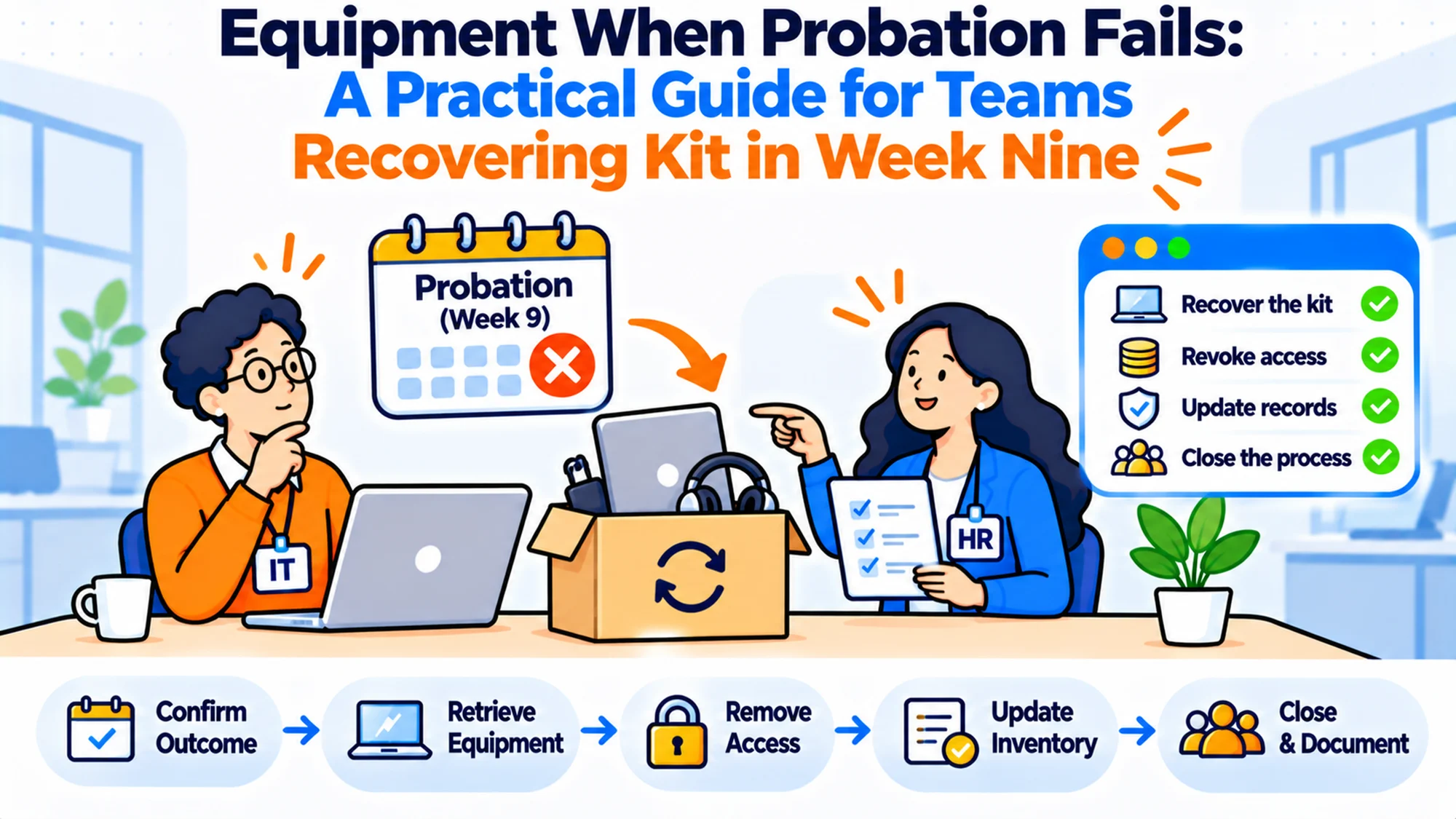
So the two changes that matter are a branch in the checklist that skips the tenure-dependent steps, and a question in the probation conversation that does the handover's job in one sentence. Neither is a process redesign.
A Ten-Day Timeline
The article has described the pieces without putting them in order, so here is the order. Ten working days from decision to redeployed, which is achievable in a single country and roughly doubles across a border.
| Day | Who | Action |
|---|---|---|
| 0, the review | Manager | One prepared sentence about the equipment, said last |
| 0 | Manager | Ask whether anything else was sent to them |
| 1 | Offboarding owner | Confirm the collection address directly, not for agreement |
| 1 | IT | Check the issue record, list what should come back |
| 2 | Offboarding owner | Book the courier, send the slot |
| Last working day | IT | Revoke access, confirm it applied in every system |
| 3 to 5 after | Courier | Collection, with a rebook expected in one case in six |
| 6 to 8 after | IT | Triage on arrival: check, wipe, reimage, record issue-ready |
| 9 to 10 | Offboarding owner | Tell whoever owns the next requisition it is available |
Two rows carry the whole thing. Day 1, confirming the address, prevents the most common failure. And days 6 to 8, the triage, is what converts a returned machine into a saving rather than into cupboard contents.
Notice there's no chasing in the list. A collection booked while goodwill is intact doesn't usually need chasing, and the sequence is designed so that nobody has to send a reminder about a monitor to somebody who has just lost a job.
If a row slips, slip the triage rather than the booking. A late booking compounds, because the person's engagement with the whole thing decays by the day, while a late triage costs only the redeployment window.
What to Say in the Conversation
One sentence, delivered by the person holding the probation review, and it should be the last thing rather than the first.
Something like: we will arrange collection of the laptop and the monitor, somebody will email you today with a slot, and please keep hold of everything until then. That covers the expectation, the mechanism and the timing, and it removes any need for the person to work out what they're supposed to do.
Writing it for them matters. The person holding that review is managing a difficult conversation and won't improvise an equipment paragraph well, so handing them the line in advance is the difference between a clear instruction and a vague "somebody will be in touch about the equipment", which produces four emails and a fortnight of delay.
Say it last, after the substance. Equipment delivered early in that conversation reads as though the hardware is the priority, which is both untrue and the kind of detail people repeat afterwards. Delivered at the end, as a practical note, it lands as administration rather than as a statement about how the company sees them.
And ask one question rather than making an assumption: is there anything else we sent you? That's the handover step, compressed into eight words, and it catches the adaptor from the drawer that nobody logged.
What Gets Issued on Day One That Nobody Records
The article mentioned an adaptor from a drawer. That throwaway detail is worth a section, because it is the specific reason early-exit recovery is less complete than ordinary offboarding.
Day-one issuing is informal. Nothing else in the lifecycle is. The laptop goes through the proper process and gets recorded. Then somebody notices the new starter needs a dongle, a second cable, a headset because the standard one was out of stock, a monitor stand, or a keyboard because they asked. Those come out of a cupboard, handed over by a colleague, and not one of them touches the register.
Eleven weeks later the issue record says laptop and monitor, so that's what comes back, and four smaller items stay in a flat indefinitely. Individually trivial. Barely worth a line. Collectively this is where a surprising share of a fleet's peripheral spend disappears, and it is entirely invisible because nothing ever claimed those items existed.
The fix isn't a stricter process. Nobody follows one for a cable. It's the question in the conversation: is there anything else we sent you? People answer that honestly and comprehensively, because they have no reason not to, and it recovers more than any register discipline you could realistically impose on day one.
A second cheap control helps. Give whoever equips new starters a single shared list to add extras to, with no approval and no form, just a line per item. A list somebody will actually use beats a register nobody updates, and at the point of an early exit it is the only record of the dongle that exists.
And accept the losses that remain. Chasing a 14 cable isn't worth a second email, and a process that tries to will damage the thing that recovers the laptop.
The Address Problem
Here is the small thing that causes the most failed collections in this specific situation, and it is almost comically avoidable.
Nobody ever uses it. A new joiner's address is captured during onboarding and typically used for nothing at all before their first payroll run. It may be a temporary address, a parent's house, a short-term let that has already ended, or simply typed with a transposed number. In a normal departure the address has been exercised repeatedly by then; in week nine it may never have been used at all.
Confirm it directly. In the conversation, or in the first email. Not "we have your address as X", which invites a yes from somebody who isn't really reading, but a direct request to confirm where a courier should attend and on what day. Thirty seconds, and it removes the single most common reason the first collection attempt fails.
Then expect a second attempt to be needed anyway, in perhaps one case in six, and build that into the timeline rather than treating it as a problem. A collection window missed by somebody who has just lost a job isn't a sign of bad faith; it is entirely predictable and the right response is to rebook without any escalation at all.
The Access Side, Which Is Simpler Here
One part of this is genuinely easier than an ordinary departure, and it is worth saying because teams carry over caution that does not apply.
In a normal exit, access revocation gets delayed. Somebody needs to forward mail, finish a handover, transfer ownership of documents, or answer a question for a fortnight. So the account lingers, often for weeks, and the usual argument for that lingering is real.
None of it applies at seven weeks. There is no mail worth forwarding, no documents anybody is waiting on, and no institutional knowledge sitting in a mailbox. Which means access can be revoked cleanly on the last working day, in every system, with no residual argument for an exception.
Do exactly that. It removes the most common source of drift in offboarding, where an account stays live for a month because somebody meant to review it, and it simplifies the equipment side too: a laptop that cannot reach anything is a far smaller problem while it sits in a flat waiting for a courier.
The one thing to check is that revocation actually applied everywhere. Half-applied access changes are common and usually involve one system nobody remembered, and a short confirmation list is worth more than an assumption. Three minutes, once, on the last working day.
And confirm the device encryption state while you are in there. An encrypted machine with no access is close to inert, which is the position you want it in during the week before collection.
Where the Cost Should Land
This argument happens in every company that allocates IT cost to teams, and it is worth settling before it arrives rather than during.
A team hires somebody, the hire doesn't work out, and the team has already absorbed a genuine cost in management time and disruption. Charging them the hardware as well, in a model that allocates device cost per head, creates a small but real disincentive against ending a probation that should be ended. Nobody designs that and it happens by default.
The cleaner arrangement is that the device charge stops when the device comes back, and that any cost specific to the early exit, usually a courier, sits centrally. That keeps the allocation honest without making a manager pay twice for a decision you want them to make cleanly.
Where the kit is redeployed to the next starter, which is the common case, there's no net hardware cost at all. Worth saying out loud in the budget conversation, because the instinctive framing is that a failed probation wasted a laptop, and it almost never does.
The one genuine cost is the retrieval, and it is small. For most teams this entire question is about a figure in the low hundreds, which is a useful thing to establish early so that nobody spends a meeting on it.
Redeploying Nearly New Kit
This is the upside and it gets missed because the attention is all on the exit.
Eleven weeks old. That is the best redeployment candidate in your estate. It is current-generation, under warranty, cosmetically fine and already on your standard build, which means it can go to the next starter with a wipe and a reimage rather than a procurement cycle. The saving is the full price of a machine you didn't have to buy.
What stops it is the pool. If returns go into a cupboard to be triaged later, the machine sits there, the next starter gets a new one because nobody knew the spare existed, and the saving evaporates. Triage on arrival is the whole of the fix: check, wipe, reimage, record as issue-ready, and tell whoever handles the next requisition that it is available.
Do it within a week. The window matters because hiring moves, and a machine that is issue-ready a fortnight after the next starter was equipped has missed the only opportunity it had. Companies that get this right treat an early-exit return as a priority triage rather than as ordinary inbound.
And keep the record straight through both movements. Issued to one person, returned, reissued to another, inside about three weeks, is a sequence that will confuse any register maintained by hand, and getting it wrong means the next audit shows a machine with two holders.
Where Jurisdiction Changes the Picture
Two things vary and neither belongs in a process document written centrally.
Ask locally. Whether a probation period has any particular status, what ending an arrangement during one requires, and what the person's position is as a result all differ by jurisdiction and by the specific arrangement. That needs local advice every time rather than one policy applied across every market. The equipment consequence is only that your timeline may differ by country, so the logistics have to follow the process rather than lead it.
The second is anything involving the person's pay in connection with unreturned equipment, which is a separate question with its own answer in each market and which should not be reached for here at all. In this situation the goodwill is usually intact and the hardware usually comes back, so the aggressive route addresses a problem that is not occurring.
So standardise the rest. Everything on this page except those two points is safe to write down once and apply in every market you operate in. The checklist branch, the conversation sentence, the address confirmation, the priority triage. None of that needs advice, and all of it is what actually determines whether the laptop comes back.
Counting It, So the Pattern Becomes Visible
The article ends by saying to start by counting. Here is what to count, because an instruction to measure something without naming the measure is not advice.
Three numbers, annually. How many probations were not confirmed, how many of those devices came back within 14 days, and how many were redeployed rather than stored. That is it, and all three come out of records you already keep.
The third is the interesting one. Nobody has it. Companies can usually produce the first with some digging, occasionally the second, and essentially never the third, which means the saving this whole process exists to capture is unmeasured. A company recovering 9 machines in 10 and redeploying 2 of them has a triage problem rather than a recovery problem, and those need completely different fixes.
Report it once a year rather than monthly. The volumes are small, a quarterly figure is noise, and the only question worth answering is whether the pattern is stable or growing. If early exits are rising, that is a hiring signal rather than an equipment one, and it belongs in a different conversation with different people.
Keep the write-up to one line per number. A dashboard for something that happens five times a year will be built once and never opened again, which is true of most reporting built around rare events.
The Case for Doing Nothing Differently
Worth putting the opposite argument, because this article has spent a long time on a situation that happens a handful of times a year.
A company with 40 people, one office and two early exits a year should not build any of this. The laptop gets handed over at a desk, somebody wipes it that afternoon, and the entire problem is already solved by proximity. Writing a checklist branch for that is the kind of process work that makes a team feel organised while changing nothing at all.
The threshold is not headcount, it is distance. The moment any of your hires are remote, every cheap step in this article stops being automatic and starts needing somebody to do it deliberately, and that is the point at which twenty minutes of preparation starts paying. A single-site company at 300 people may genuinely need less of this than a distributed one at 60.
So the honest recommendation is narrow. If your hires are all in one place, read the conversation sentence and ignore the rest. If any of them are not, the checklist branch and the address confirmation are the two things worth having, and everything else here is optional detail.
That is also the test for whether this ever needs revisiting. Not growth in headcount, but the first early exit in a market where nobody has shipped a laptop before.
The Cost of Getting This Wrong
The visible cost is a courier and some admin, which is trivial, and that is precisely why this gets no attention.
What's expensive is the redeployment you miss. A nearly new machine that does not come back inside the window, or comes back and sits untriaged, means buying a replacement for hardware you already own that is eleven weeks old. Across five early exits a year that is a meaningful number, and it appears nowhere as a line item because the purchase looks like ordinary hiring cost.
The second cost is reputational. How the exit is experienced is worth taking seriously even on purely commercial grounds. Somebody whose probation was not confirmed and whose first contact afterwards is a chasing email about a monitor will tell people about it. I have seen the same company handle the conversation well and the equipment badly, and the equipment is what got repeated.
Third is the quiet structural one. Because each early exit is handled by a different person, nothing ever aggregates, so a company with a real pattern of them never sees it. The absence of a count is the problem rather than any individual case, and the count is the thing that would justify the twenty minutes of process work.
So the question is not how to recover the laptop. It is whether you know how many of these you had last year and where those machines ended up.
When You're Ready to Move Beyond Improvising
You will know by the third one. The signal is somebody asking in a channel whether anybody knows the process for a probation exit, and getting two different answers from people who have both done it.
What replaces it is small enough to write in an afternoon. A branch in the offboarding checklist with the tenure-dependent steps removed, one sentence for the probation conversation, an address confirmation step, and a rule that early-exit returns get triaged within a week.
RemoAsset is our own product, so weigh this accordingly. The part it addresses is retrieval across 80+ countries with the device tracked from issue to return, which matters here because the issue record is doing the job the missing handover would have done. It does not hold the conversation, decide the outcome, or triage anything for you.
If you cannot currently say how many early exits you had last year, start by counting. That number is usually the thing that settles whether any of this is worth twenty minutes, and most teams are surprised by it in the direction that makes the answer yes.
Frequently Asked Questions
Why does a failed probation break the normal offboarding process?
Because that process assumes tenure. It relies on a notice period long enough to arrange logistics, a handover conversation that enumerates what somebody holds, and a home address that has been exercised through a payroll cycle. A seven-week employee has none of those, so the steps depending on them stall quietly rather than failing visibly, and the equipment is the part that goes missing.
Who should mention the equipment, and when?
The manager, at the end. One prepared sentence, inside the probation conversation itself rather than in a follow-up. Leaving it to a follow-up email means the first contact after somebody is let go is an administrative demand, which both lands badly and slows the return. Write the line for them in advance, because nobody improvises that paragraph well in a difficult conversation.
Is it worth holding back good equipment during probation?
Rarely. And it fails on something more important than logistics. A new starter given visibly worse kit understands exactly what it signals, so you have degraded the first month for every hire in order to simplify recovery from the few who leave. It can make sense in high-volume, high-attrition hiring where the pattern is predictable, and almost nowhere else.
How quickly should early-exit kit be redeployed?
Within a week of arrival. The window is the whole value. A machine issued eleven weeks ago is the best redeployment candidate you have, current generation and under warranty, and it can go to the next starter after a wipe and reimage. Left untriaged in a cupboard it misses the next requisition entirely and you buy a replacement for hardware you already own.
What if we do not have a current address?
Confirm it directly. Don't present what you hold for agreement. A new joiner's address may be temporary, may belong to a relative, or may simply contain a typing error, and in week nine it has often never been used for anything. This is the most common cause of a failed first collection and it takes half a minute to prevent.
Whose budget should carry the cost?
Settle it before it arises. A team that ended a probation has already absorbed real cost in management time, and charging the hardware to them as well creates a quiet disincentive against a decision you want made cleanly. The cleaner arrangement is that the device charge stops on return and the retrieval cost sits centrally, which keeps the allocation honest.
What if the person disputes the outcome?
Then stop chasing it. Treat it as any other contested exit. Leave the device where it is, make sure nothing automated acts on it, and take advice on the rest before doing anything further. The hardware is worth very little next to the situation, and a chasing email during a dispute is the kind of detail that gets quoted back later.
How do we know whether this is worth building a process for?
Count the last two years. Teams consistently assume early exits are rarer than they are, because each one is handled by a different person and nothing aggregates them, so the real figure arrives as a surprise. If it is more than two or three a year, a checklist branch and one prepared sentence will pay for themselves immediately.
Get nearly new kit back fast enough that the next starter gets it.