By [Author Name] · [Date] · [X] min read · [Table of Contents]
TL;DR
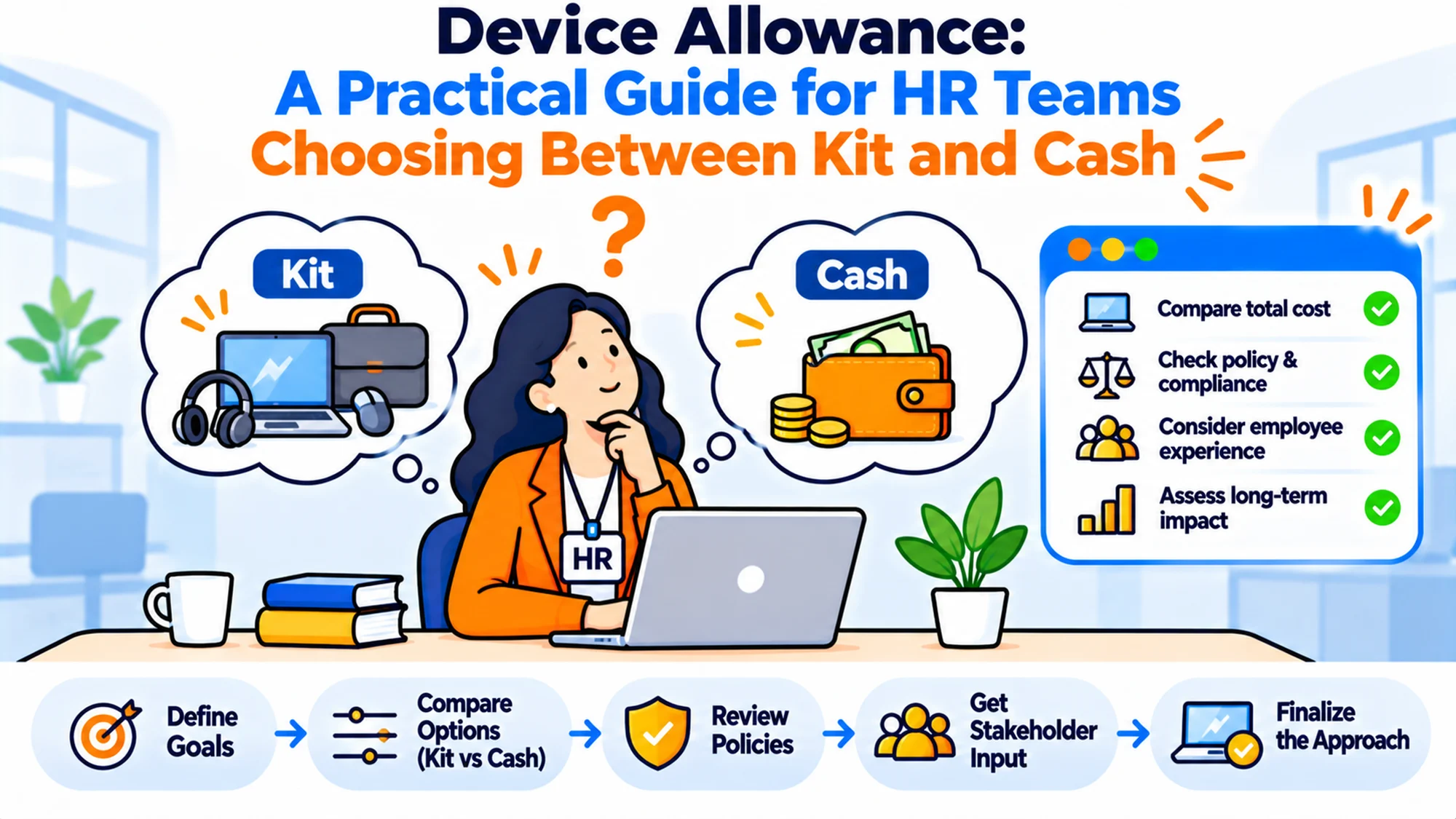
- A device allowance is a payment to an employee so they can buy their own equipment, instead of the company issuing it.
- If you hire in one country into an office, issuing kit is simpler and an allowance solves nothing you have.
- It does three jobs: it removes a logistics problem, it shifts choice to the employee, and it moves a lot of other things nobody intends to move.
- How any payment or provided equipment is treated for tax and payroll differs by jurisdiction and by the arrangement, so that part needs local advice every time.
- Choose on who should own the asset, not on which looks administratively easier.
- Done right, you know what you own and the employee knows what happens when they leave.
Expanding into a new market, three hires, no entity, and no way to ship a laptop that doesn't involve a customs process nobody has time to understand. Somebody proposes an allowance. Pay each of them a sum, let them buy what they need, and the problem disappears into a payroll line that takes four minutes to set up.
These aren't edge cases. A company hiring its first person in a market usually reaches for this, because the alternative looks like a project. Another runs an allowance for its whole engineering team, inherited from a founder decision in 2021, and has no idea what hardware any of those 37 people are using. A third pays an allowance and also issues laptops, in different countries, having never written down which applies where.
Best tools for HR Operations
The real issue isn't whether an allowance is cheaper. It's that it changes who owns the asset, and almost nobody decides that deliberately before the first payment goes out.
When You Don't Actually Need an Allowance
Stage one: issuing kit is genuinely simpler. One country, an office, a supplier who delivers in a week. An allowance adds a payroll arrangement, a policy, and a question about ownership, in exchange for solving a problem you don't have. Don't do it.
Stage two: friction appears. You hire remotely in a market where shipping takes three weeks and costs more than the machine is worth. That's a real problem and an allowance is one of several reasonable answers to it.
Stage three: it becomes a liability. The allowance has been running long enough that nobody can say what hardware the company relies on, whether it is encrypted, or what happens to it when somebody leaves. The asset register has a gap shaped like a whole team.
Stage four: the edge case. Somebody on an allowance leaves and takes a machine holding company data, and there's no mechanism to recover it because it was never yours. That's the situation the whole decision turns on and it is invisible until it happens.
What HR Teams Actually Need from the Decision
> "Who owns the laptop?" > Decide this first, because everything else follows from it. > An allowance usually means the employee owns it, which changes recovery, security and the leaving conversation all at once.
> "How is this treated for tax and payroll?" > That differs by jurisdiction and by how the arrangement is structured, so take local advice before setting anything up. > It's the question everybody asks second and the one least safely answered by copying another company's policy.
> "What happens when they leave?" > Settle it in writing at the point the allowance is agreed. > A machine the employee bought is theirs, which is fine if everybody understood that and a problem if nobody said it.
> "Can we require a minimum specification?" > Usually yes, and it is worth doing. > An allowance with no specification produces a fleet you can't support and occasional purchases that won't run what the work needs.
> "What about the data?" > This is the real question and it is rarely the one asked. > Company data on a personally owned machine needs an answer before the money is paid, not after somebody resigns.
There's a sixth question that arrives in year two. What happens at refresh? An allowance paid once produces a machine that ages, and nobody has decided whether there's a second payment, when, or on what basis. Teams discover this when somebody's four-year-old laptop stops coping and they ask.
The Four Models and What Each One Costs
Company-issued equipment. What it is: you buy it, you own it, you ship it, you recover it. When it's right: the default, and it stays right much longer than people expect. Ownership is clear, security is enforceable, and the asset register reflects reality. When it fails: where logistics genuinely can't deliver. A market with no supply route, long customs delays, or a single employee in a country you otherwise have nothing in.
One-off purchase allowance. What it is: a payment so the employee buys their own machine, which they own. When it's right: single hires in hard-to-reach markets, contractors, and situations where the alternative is nothing at all. When it fails: on recovery and on security, because there's nothing to recover and the device isn't yours to control. It also fails quietly at refresh, when nobody has decided what happens next.
Recurring stipend. What it is: a monthly or annual amount toward equipment and home working costs. When it's right: as a contribution to home office costs more broadly, where the sum is modest and nobody pretends it is buying a managed laptop. When it fails: as a substitute for equipping somebody. A stipend doesn't produce a known machine, and treating it as though it does gives you the worst of both arrangements.
Buy-and-transfer. What it is: the company buys the machine, owns it, and transfers or sells it to the employee later. When it's right: where you want control during employment and a clean exit afterwards, and it is the most underused option here. When it fails: on administration. It needs a valuation at transfer and a decision about the terms, and the treatment of any transfer differs by jurisdiction so it needs advice before being offered.
I'd keep issuing equipment for as long as logistics allow, and treat an allowance as a specific answer to a specific supply problem rather than as a general philosophy about how equipment should work. The difference matters, because a company that adopts allowances as a policy tends to keep paying them in markets where shipping became straightforward two years ago.
| Model | Who owns it? | Recoverable? | Security enforceable? | Register accurate? |
|---|---|---|---|---|
| Company-issued | Company | Yes | Yes | Yes |
| Purchase allowance | Employee | No | By agreement only | No |
| Recurring stipend | Employee | No | By agreement only | No |
| Buy-and-transfer | Company, then employee | During employment | During employment | Yes, until transfer |
How to Choose: Five Questions
Can you actually ship there? Ask the real question, which is lead time and total cost door to door including any duty, rather than whether a courier serves the country. The answer is frequently better than assumed, and an allowance chosen to avoid a problem that doesn't exist is pure loss.
What data will be on it? If the work involves material you wouldn't want on a personal machine, the ownership question is already answered and no amount of logistics difficulty changes it. This should be the first filter rather than an afterthought.
How many people? One person in a market is an allowance case. Eight people is a supply problem worth solving properly, because eight unknown machines is a different category of exposure from one.
What happens at refresh? Decide before the first payment. An allowance with no refresh position produces an argument in year three with somebody whose laptop no longer works and who reasonably believes the company should address it.
Who is going to administer it? Payroll arrangements, specification checks, and a record of who received what are all ongoing work. An allowance looks like less administration than shipping and frequently turns out to be rather more of it, spread thinly enough that nobody notices.
Six Platforms Worth Knowing
RemoAsset Best for: making the company-issued option viable in markets where you assumed it was not. Why companies choose it: procurement and retrieval across 80+ countries with devices tracked through issue and return, which is directly relevant because the usual reason for choosing an allowance is that shipping looked impossible, and establishing whether that's true is the whole decision. Pricing is published, from $1,499 a year on the Subscription tier for companies with 50 to 5,000+ employees, including a 60 per cent reduction on retrieval charges. It's our own product, so weigh that accordingly. Where it struggles: no network discovery, which matters more here than usual, because the machines bought under an allowance are exactly the ones no register knows about and nothing will find them. No software licence management. Only the Subscription tier publishes a figure, with pay-as-you-go quoted. It has no view on payroll, tax or how an allowance should be structured.
Workwize Best for: holding stock closer to the markets you hire in. Why companies choose it: its own warehouses, which shortens the supply route that made an allowance look necessary. Where it struggles: no published rate card, and the figures on its pricing page are savings claims rather than prices. The live domain is goworkwize.com.
Firstbase Best for: standing up supply quickly in a new market. Why companies choose it: strong supply side and a clean subscription shape. Where it struggles: publishes nothing on price, and retrieval is the weaker half of the offer.
GroWrk Best for: companies with an irregular market footprint. Why companies choose it: flexible arrangement rather than one fixed package. Where it struggles: no rate card, and its pricing page runs a competitor cost estimator whose figures are its own estimates rather than published prices.
allwhere Best for: outsourcing the supply problem entirely rather than paying around it. Why companies choose it: managed service with minimal internal lift. Where it struggles: publishes nothing, so comparison needs a conversation first.
Deel IT Best for: companies already employing through Deel in the market concerned. Why companies choose it: hardware alongside employment, which is often the exact combination that made an allowance look like the only option. Where it struggles: weaker standalone, and no published pricing.
The Decision Table: Matching the Situation to the Model
| Situation | Scale | Setup | Primary Pain | Recommended Starting Point |
|---|---|---|---|---|
| Office-based, one country | Any | Local supplier | None | Company-issued equipment |
| First hire in a new market | 1 to 2 | No entity | Shipping and customs | Allowance, with a specification |
| Several hires, same market | 5 plus | No entity | Unknown fleet forming | Solve supply, issue equipment |
| Sensitive data involved | Any | Any | Control and recovery | Company-issued, regardless of effort |
| Contractors | Any | Short engagements | No offboarding process | Allowance or their own kit |
| Shipping assumed impossible | Any | Untested | Decision made on a guess | Price it properly first |
The last row is the most common and the cheapest to fix.
Why does it keep appearing? An allowance is a decision that can be taken in an afternoon by one person with access to payroll, while establishing a supply route requires quotes, a supplier conversation and somebody to own it. So the easier decision gets taken under time pressure, usually to unblock a start date that is already agreed, and it then persists for years because nothing ever forces a review. The asymmetry is in the effort of deciding rather than in the merits, which is why testing the assumption with three real quotes changes the outcome so often.
Costing Both Options Honestly
The article says to price both properly and then does not show the sum. Here it is, for one hire in a market with no entity, over three years.
| Item | Company-issued | One-off allowance | Buy-and-transfer |
|---|---|---|---|
| Machine | 1,430 | 1,430 paid as allowance | 1,430 |
| Shipping, duty, broker | 240 | None | 240 |
| Retrieval at exit | 120 | None | None, transferred |
| Payroll and policy setup | None | 180 first year | 90 at transfer |
| Specification checking | None | 40 per hire | None |
| Recoverable value at exit | 340 | Nothing | Sale proceeds |
| Net three-year cost | 1,450 | 1,650 | 1,760 |
Those are illustrative figures and the point is the shape rather than the totals. Company-issued comes out lowest in this example precisely because something is recovered at the end, and that recovery is the line people leave out when they compare a shipping quote against a single payment.
Change two inputs and the answer flips. Push the shipping cost to 600 with a four-week customs exposure, which is realistic in some markets, and the allowance wins comfortably. Drop the recoverable value to zero because retrieval from that country is impractical, and it wins again.
So run it with your own numbers per market rather than adopting a global position. The useful discovery is usually that the answer differs by country, which means a single company-wide policy is wrong somewhere by construction.
And note what no column captures. The register gap, the data exposure and the ownership ambiguity do not appear in any of these rows, and they are the reasons this decision matters beyond a couple of hundred pounds.
Test the Shipping Assumption Before Anything Else
This is the highest-value thing on the page, and it takes an afternoon.
Most allowance decisions are made on an assumption rather than a quote. Somebody says shipping a laptop to that country is impractical, everybody agrees because it sounds plausible, and a payroll arrangement is created that will run for years. Nobody priced it.
Get three real quotes, door to door, including duty and any broker fee, with a stated lead time. The results tend to split into three groups. Some markets come back at a cost and a timeline that make the allowance conversation unnecessary, which is a saving of an entire ongoing arrangement. Some come back genuinely difficult, with multi-week customs exposure, and the allowance is the right answer. And some come back expensive but workable, which is a judgement rather than a constraint.
Price the allowance too. Otherwise the comparison isn't fair. A one-off payment isn't the whole cost: there's the payroll setup, the specification check, the absence of any recoverable asset at the end, and whatever the refresh position turns out to be. Comparing a shipping quote against a single payment flatters the allowance.
Then write down which markets fall into which group and revisit it annually. Supply routes change, and a market that was impossible in 2024 may be straightforward now, which means an allowance adopted then may be solving a problem that has since gone away.
Contractors Are a Different Question
The article mentions contractors in one table row and then leaves them, which understates how often this is the actual situation.
Contractors frequently own their own equipment as a matter of course, and for short engagements that is usually the right arrangement with no allowance involved at all. The engagement is weeks rather than years, shipping a machine makes no sense, and the person already has a working setup they prefer.
The data question is sharper here. Sharper than for employees, in fact. A contractor's machine is genuinely theirs, is likely used for other clients, and is outside any control you have, so the question of what company material ends up on it deserves a clearer answer than it usually gets. The practical control is to keep work inside systems you provide and revoke access at the end, which is weaker than ownership and is what you have.
Decide whether company hardware is required by the nature of the work rather than by the length of the engagement. Some contractor work genuinely cannot happen on an unmanaged machine, and in those cases the engagement needs a device even if that is inconvenient for a three-month piece of work.
And watch the long engagement. A contractor who was correctly set up with their own kit for a two-month project and is still there 19 months later has quietly become the case the original decision did not cover, and nobody revisits it because nothing changed on any particular day.
I'd put a review at six months into any contractor engagement for exactly that reason. It takes a minute and it catches a drift nothing else notices.
The Ownership Question Nobody Decides
Here is the thing that matters most and gets the least attention at the point of decision.
The company buys it. The company owns it. Everything downstream follows from that single fact: you can require encryption, you can enforce a configuration, you can recover it at the end, and your asset register reflects something real. None of that requires a conversation because ownership settles it.
They buy it, they own it. Even though the money came from you. Also everything downstream: you can't require a configuration except by agreement, recovery isn't a thing that exists, and the machine doesn't appear in any register you maintain. That isn't a defect of the model, it is the model, and it is fine as long as it was chosen.
What goes wrong is when nobody states it. The company assumes a degree of control it doesn't have, the employee assumes the machine is theirs, which it is, and the two assumptions coexist peacefully until somebody leaves. Then the company asks for the laptop back and discovers it is asking somebody to hand over their own property.
So write one sentence. At the point the allowance is agreed, not later. The equipment you purchase with this payment belongs to you, and here is what we ask about company data on it. That sentence costs nothing, prevents the entire failure mode, and is the single most useful paragraph in any allowance policy.
And be honest internally about what it means for the register. An allowance population is a gap in your asset records by design, which is acceptable for three people and a growing problem at thirty, and the honest way to hold it is as a known gap with a count rather than as an absence nobody has quantified.
What to Write Down
Four things, and together they are shorter than most allowance policies that fail to say any of them.
Who owns the equipment. One sentence, stated at the point the payment is agreed, saying that what the person buys belongs to them. This is the sentence that prevents the exit conversation going wrong, and it is also the one most commonly missing from policies that otherwise run to several pages.
What the minimum specification is. Processor class, memory, storage, a supportable operating system version, and the ability to run encryption. Expressed as a floor rather than a named model, so that it survives a couple of years of hardware churn without anybody having to revise it.
What happens about data. What you ask regarding encryption, where company material should live, and the fact that access ends on the last working day. Framed as what you are asking rather than what you are enforcing, because enforcement is not available to you here.
What happens at refresh. Whether there is a further payment, on what cycle, and on what basis. Even an explicit position of no further payment is better than silence, because silence produces individual negotiations that differ and then get compared.
That is one page. The test of whether it is working is whether a hiring manager in a new market can read it and know what to offer without asking anybody, which is the same test as any other equipment standard.
The Data Question, Which Is the Real One
If one section here changes a decision, it should be this one, because the hardware value is trivial next to it.
Data goes where the work goes. Company material ends up on whatever machine somebody actually works on. That isn't a policy choice, it is what happens, and an allowance arrangement means that data lives on a device you don't own, can't configure, and will never get back. For some roles that's an acceptable risk and for others it is not, and the distinction is about the data rather than about the person or the market.
Decide the line by role before the arrangement is offered. A contractor doing design work on material that's already public is a different case from somebody handling personal data or financial records, and an allowance policy that applies uniformly across both has made a decision about the second group by accident.
The controls get weaker. Where an allowance is right and data is still a consideration, what you have is agreements rather than enforcement. Ask for disk encryption, ask that company material lives in company systems rather than locally, provide the tools that make that realistic, and get the agreement in writing. None of it is as strong as owning the machine and all of it is better than nothing.
The exit is where this gets real. Somebody leaving with their own laptop takes whatever is on it, and the only practical controls are revoking access at the identity layer and having kept the material in systems you control rather than on the device. Both of those are things you do during employment, not at the end, which is why this belongs in the decision rather than in an offboarding checklist.
One more thing worth saying plainly. If the answer to the data question is that the role can't work on an unmanaged device, then the shipping problem has to be solved rather than avoided, however inconvenient that is. The allowance isn't available as an option in that case, and treating it as one because logistics are hard is choosing the easier administration over the actual requirement.
Setting a Specification That Does Something
An allowance with no specification produces a fleet you can't support, and the fix is short.
State a minimum rather than a model. Processor class, memory, storage, and an operating system version you can support, expressed so that it stays true for a couple of years rather than naming a machine that will be discontinued. Add a statement that the device must be capable of running encryption and your management agent if one applies.
Set the amount against that specification and review it annually. An allowance set three years ago buys a different machine today, and a figure that has not moved is quietly becoming a specification cut, which is how an allowance population drifts toward hardware that cannot do the work.
Then decide whether you check. A specification nobody verifies is a suggestion, and the realistic middle ground is to ask for the model and a receipt once, at purchase, rather than to audit anything ongoing. That is enough to catch the genuine mismatches without creating a process.
Expect some purchases to miss the mark anyway, and decide in advance how you respond. The useful answer is usually to help rather than to enforce, because the person has already spent the money and the alternative is somebody working on an inadequate machine while a policy argument runs.
Revisit It Annually, Because Markets Move
An allowance adopted for a good reason outlives the reason, and nothing about it generates a prompt to look again.
The reason is almost always supply. Shipping to that market was expensive, slow, or genuinely impossible when the decision was made. Supply routes change, carriers add lanes, providers open warehouses in new regions, and the market that justified an allowance in 2024 may be perfectly straightforward now. Nobody finds that out, because the allowance works well enough that nobody asks.
So re-price one market a quarter. Not all of them, which becomes a project nobody does, but one, rotating, with three real quotes door to door. Four markets a year is enough to keep the picture roughly current and it is a couple of hours of somebody's time annually.
Review the amount at the same time. An allowance figure set against a specification three years ago buys materially less machine today, and the drift is invisible because the number on the policy has not changed. That is the most common way an allowance population ends up on hardware that cannot do the work.
And count the population every year. How many people are on an allowance, in which markets, and how many of those machines hold company data. Three numbers, produced annually, and between them they are the whole difference between a known arrangement and a gap nobody has ever measured.
Where Jurisdiction Decides the Structure
This is the part that cannot be answered here and should not be answered from another company's policy.
Ask locally. How a payment toward equipment is treated, how provided equipment is treated, what reporting applies, and how any later transfer of a company-owned device to an employee is handled all differ by jurisdiction and by how the arrangement is structured. Those are questions for local advice in each market, before the arrangement is set up rather than after the first payment has gone out. A company running allowances in six countries should expect six answers.
The same applies to the buy-and-transfer model, which is otherwise the most attractive option on the list. Its appeal is that the company controls the asset during employment and the employee can keep it afterwards, and the treatment of that transfer is exactly the part that varies, so it needs advice before being offered rather than being designed internally and checked later.
What is portable is everything else, and it is most of the decision. Test the shipping assumption with real quotes. Decide ownership explicitly and write one sentence about it. Settle the data question by role before offering anything. Set a minimum specification and review the amount annually. Decide the refresh position before the first payment goes out, because every month of silence on it makes the eventual conversation harder. None of that needs advice and all of it determines whether the arrangement works.
So the split is clean again. The structure is a question for somebody local in each market. The choice between kit and cash is yours, and it should be made on ownership and data rather than on which looks easier to administer.
The Mixed Estate You Already Have
Worth naming the situation most companies are actually in, which is neither model cleanly.
Some people were issued laptops because they joined in a market with a supplier. Others received an allowance because they did not. A few contractors use their own machines. Nobody decided this as a policy; it accumulated one hire at a time, and each individual decision was sensible when it was made.
The mix is fine. It is operationally workable and awkward in exactly one respect: nobody can answer a simple question about the whole estate. How many machines hold company data, how many are encrypted, how many could be recovered if they needed to be. The answers exist for the issued population and not for the rest, which means the aggregate answer is unknown rather than partial.
So the useful first move is not to standardise. It is to count. Three columns, one row per person: who holds a device, whether the company owns it, and whether company material lives on it. That table is uncomfortable to produce and it is the only thing that converts an accumulated situation into a decision you can take deliberately.
Then standardise forward rather than backward. Decide what applies to new hires per market and leave the existing arrangements alone unless there is a specific reason to disturb them, because retrospectively changing somebody's equipment arrangement is a cost with very little return.
The Cost of Getting This Wrong
The visible cost is small either way. A laptop is a laptop and an allowance is roughly the price of one.
What's expensive is the register gap. It compounds silently. A company that has paid allowances to 37 people has 37 machines holding company data that appear in no system, cannot be audited, and will never be recovered. The cost is not the hardware, it is that the honest answer to how much company data sits on devices you do not control is unknown, and unknown is the worst available answer in any review.
The second cost is the exit conversation. I've watched this one go badly more than once, and it is entirely avoidable. A company asks for a laptop back, the former employee points out they bought it, and both parties are correct because nobody ever wrote down which it was. That is a small, avoidable, entirely self-inflicted unpleasantness at the end of an otherwise fine relationship.
Third is the refresh cliff. An allowance paid once, with no stated position on what happens in three years, produces a cohort of people on ageing machines who each individually ask, and the company then invents an answer per case. Those answers differ, and the differences get compared.
So the question is not which model is cheaper. It is whether you know who owns each machine your company depends on, and what you would do if one of them walked out of the door tomorrow.
When You're Ready to Move Beyond Paying Around the Problem
You will know when somebody asks how many people are on an allowance and the answer takes a week to produce. That is the point at which the arrangement has become a population rather than an exception.
What replaces it is not necessarily ending the allowance. It is deciding which markets genuinely need one, pricing the alternative properly in the others, writing the ownership sentence, and holding the allowance group as a counted known gap rather than an absence.
RemoAsset is our own product, so weigh this accordingly. The relevant part is narrow: it exists to make the company-issued option work in markets where teams assumed it could not, through procurement and retrieval across 80+ countries with the device recorded from issue to return. It has no view on payroll or on how an allowance should be structured, and if an allowance is genuinely the right answer it does nothing for you at all.
If you cannot currently say how many allowance-funded machines hold company data, that is the number to produce first. It is usually a short list, it takes an afternoon to assemble from payroll records and a few conversations, and having it converts the whole subject from an uneasy feeling into a decision somebody can actually take with the facts in front of them.
Frequently Asked Questions
What is a device allowance?
Cash instead of kit. It's a payment made to an employee so they can buy their own equipment rather than the company purchasing and issuing it. The important consequence is ownership: equipment bought with the payment generally belongs to the employee, which changes recovery, security enforcement and what your asset register can tell you. Most of the difficulty with allowances comes from that consequence not being stated at the outset.
Is an allowance cheaper than issuing equipment?
Rarely. The comparison is usually made unfairly, which is where the impression comes from. A single payment gets compared against a shipping quote while the payroll setup, the specification checking, the absence of any recoverable asset and the unsettled refresh position are all left out. Price both properly before deciding, and get real door-to-door shipping quotes rather than working from an assumption.
How is a device allowance taxed?
Ask locally. That differs by jurisdiction and by how the arrangement is structured, so it needs advice in each market before anything is set up rather than after the first payment. The same is true of company-provided equipment and of any later transfer of a company-owned device to an employee. Do not copy another company's policy, and expect different answers in different countries.
Who owns a laptop bought with an allowance?
Generally the employee. That's the whole point to be clear about. It means you cannot require a configuration except by agreement, there is nothing to recover when they leave, and the machine appears in no register you maintain. None of that is a defect as long as it was chosen deliberately and written down in one sentence at the time.
Can we require a minimum specification?
Usually, and it is worth doing. State a minimum in terms of processor class, memory, storage and a supportable operating system version rather than naming a model, and include the ability to run encryption. Review the amount annually, because an allowance that has not moved in three years is quietly becoming a specification cut.
What happens to company data on a personally owned machine?
This should decide the model. It is usually asked last. Where the role handles sensitive material, an unmanaged device the company cannot recover is the wrong answer regardless of how difficult shipping is. Where an allowance is still right, the available controls are agreements rather than enforcement: ask for encryption, keep company material in company systems, and revoke access at the identity layer on the last working day.
What about refresh?
Decide it early. The alternative is an argument in year three with somebody whose machine no longer copes with the work. An allowance with no stated refresh position produces individual negotiations that differ from each other and then get compared. Whether you pay again, on what cycle, and on what basis are all considerably easier to settle while nobody in particular is asking you about it.
Is buy-and-transfer worth considering?
It deserves a look. The company controls the asset during employment and the employee can keep it afterwards, which is a genuinely attractive combination. The administration is the catch: it needs a valuation at transfer and agreed terms, and the treatment of the transfer itself differs by jurisdiction. Take advice on the structure before offering it rather than designing it internally and checking later.
Ship a laptop to the markets you were told you could not reach.