By [Author Name] · [Date] · [X] min read · [Table of Contents]
TL;DR
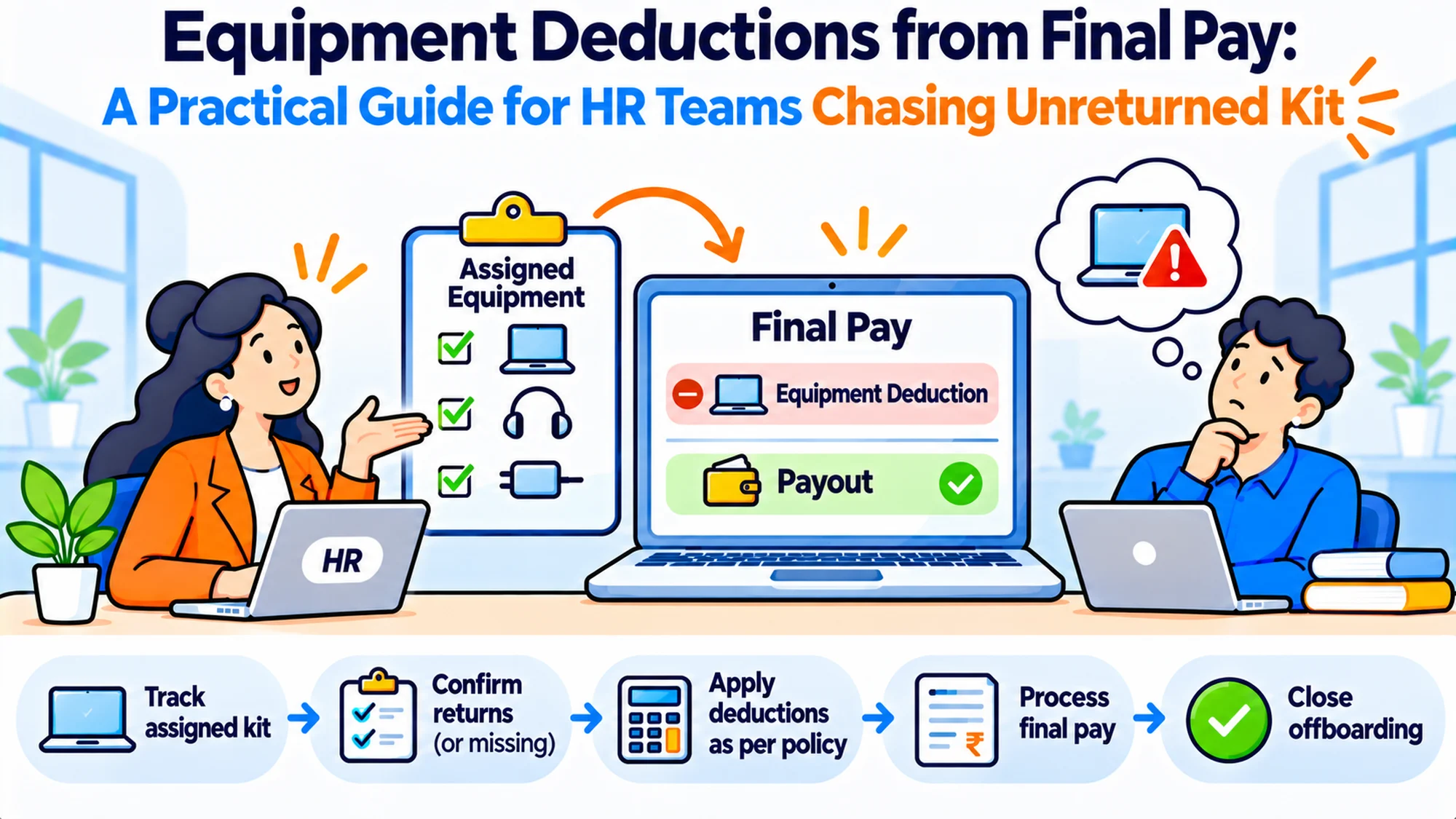
- Equipment deduction from final pay means recovering the cost of unreturned hardware by withholding it from somebody's last payment.
- If you recover more than nine devices in ten and your leavers are mostly amicable, you don't need this at all.
- It does three jobs badly and one job well: it recovers a little money, signals seriousness, and mostly it reveals that your return process starts too late.
- Whether any of it is permitted, and on what terms, differs by jurisdiction and by the specific arrangement, so that part needs local advice every time.
- Choose based on what the device is actually worth to you, which is usually far less than the argument costs.
- Done right, you almost never use it, because the kit comes back before final pay is calculated.
Somebody left 11 days ago and the laptop hasn't arrived. Payroll closes on Friday, the asset register says the machine was worth 1,430 when it was bought two years ago, and a manager asks whether it can simply come out of the final payment. It sounds clean. It's one line in a payroll system and the problem disappears.
These aren't edge cases. A company with 200 people and ordinary turnover has four or five of these open at any time, most of them nothing more than somebody who hasn't got round to it. Another has a clause in its contracts that nobody has ever used and nobody has checked, because the person who drafted it left in 2023. A third has used it twice, both times on leavers who were already unhappy, and both times it escalated.
Best tools for HR Operations
The real issue isn't whether you can deduct. It's that by the time anybody is asking, the process has already failed, and a deduction is an expensive way to paper over a return process that started two weeks too late.
When You Don't Actually Need a Deduction Route
Stage one: your return process works. If you recover more than nine devices in ten within a fortnight, you've a logistics system rather than a recovery problem, and building a deduction mechanism is solving something that isn't happening. The cheapest version of this whole article is that first sentence.
Stage two: friction appears. Recovery slips into the 70s or 80s as a percentage, usually because headcount grew faster than the offboarding process, and the gap starts being noticed in a quarterly asset reconciliation rather than at the time.
Stage three: it becomes a liability. Devices held by former employees accumulate to the point where somebody asks how much company data sits outside the company, which is a different and much more serious question than the hardware value. At that point the money was never the issue.
Stage four: the edge case. A contentious departure where the person has stopped responding, holds a device you can't physically reach, and has nothing left to lose. That's the situation deduction clauses are written for, and it is also the situation where using one is most likely to turn a hardware problem into a dispute.
What HR Teams Actually Need from Equipment Recovery
> "Can we take it out of their final pay?" > That depends on the jurisdiction, the arrangement and the circumstances, so take local advice before doing it. > It's the first question everybody asks and the one least safely answered from a template or from what another company did.
> "What's the device actually worth to us?" > Usually a fraction of what was paid for it, and less than the time spent arguing. > Teams routinely pursue a machine with a resale value in the low hundreds through a process that consumes several hours of senior attention.
> "Is this about the hardware or the data?" > Name it, because they lead to completely different urgency. > A device with company data on it outside your control is a serious matter at any resale value, and framing it as a money question gets the priority wrong.
> "Who owns chasing it?" > One named person with a schedule, not whoever remembers. > Recovery rates track almost entirely with whether somebody is responsible for the follow-up, rather than with any contractual term.
> "What did we tell them at the start?" > Check the offer, the handbook and the issue record before saying anything. > A deduction nobody was told about in advance is a far weaker position than one that was explained when the device was handed over.
There's a sixth question. It arrives once and it reframes everything. What proportion of your unreturned devices belong to people who left on good terms? For most companies it is the large majority, which means the recovery problem is logistical rather than adversarial, and the deduction conversation is addressing the wrong population entirely.
The Four Routes and What Each One Costs
Make returning easy. What it is: a prepaid label, a courier booked by you, a collection window the person picks. When it's right: always, and first. It's the only route on this list that improves the outcome rather than reacting to it, and it costs less per device than a single chased email thread. When it fails: with people who have genuinely decided not to return the kit, which is a much smaller group than the unreturned count suggests.
Chase it properly. What it is: a scheduled sequence of contacts from a named person, with a stated deadline. When it's right: for the bulk of cases, because most non-returns are inertia rather than refusal. When it fails: when it is nobody's job. An unowned chase produces two emails and then silence, and the device is written off by default rather than by decision.
Deduct from final pay. What it is: withholding the value, or part of it, from the last payment. When it's right: rarely, and only after advice, and only where the person was told at the outset. It recovers something and it is fast. When it fails: more often than teams expect. It turns a logistics matter into a grievance, it tends to be used on exactly the leavers most likely to escalate, and the amounts involved rarely justify the attention it attracts. Whether it is permitted at all varies by jurisdiction and by circumstance.
Write it off. What it is: accept the loss, wipe the device remotely if you can, close the record. When it's right: far more often than anybody admits. Where the resale value is low, the data risk is handled, and the person has gone quiet, this is frequently the commercially correct answer. When it fails: when it happens silently and becomes the default, so nobody ever sees the total and the number grows unexamined.
I'd reach for the first two in almost every case. The third is the one teams reach for first, and it is third on this list for a reason.
| Route | Recovers hardware? | Recovers money? | Relationship cost | Needs advice? |
|---|---|---|---|---|
| Make returning easy | Usually | N/A | None | No |
| Chase it properly | Often | N/A | Low | No |
| Deduct from final pay | No | Partly | High | Yes, every time |
| Write it off | No | No | None | No |
How to Choose: Five Questions Before You Act
What's the recovery rate? Count it before anything else. Teams that assume they have a recovery problem frequently discover they recover 94 per cent and the real issue is that the remaining few are never closed out, which is a reporting fix rather than a policy one.
What's the device worth today? Not what it cost. A two-year-old laptop has a resale value that's a fraction of its purchase price, and the honest number changes the calculation sharply. If the figure is under a few hundred, the deduction conversation costs more than the asset in almost every case.
Is there data on it? This is the question that should drive urgency and usually does not. A device you can't wipe remotely, holding company information, is a matter to escalate quickly regardless of its value, and the hardware is close to irrelevant next to it.
What were they told? Look at the actual documents rather than assuming. A clause in a contract nobody mentioned at the time is a weaker position than a short conversation at the point the device was issued, and the second costs nothing to introduce.
Is this person responsive? Most non-returns are people who haven't got round to it. A single phone call from a human being resolves a startling proportion of them, and it is worth trying before anything that involves payroll.
Six Platforms Worth Knowing
RemoAsset Best for: making return the easy option across borders, which is the only route here that prevents the problem. Why companies choose it: it handles procurement and retrieval across 80+ countries and records each device through issue and return, so a leaver gets a collection arranged rather than an instruction to find a box, and the register knows what's outstanding without anybody compiling a list. Pricing is published, from $1,499 a year on the Subscription tier for companies with 50 to 5,000+ employees, including a 60 per cent reduction on retrieval charges. It's our own product, so weigh that accordingly. Where it struggles: no network discovery, so a device that never entered the register is invisible to it, and those are disproportionately the ones that go missing. No software licence management. Only the Subscription tier publishes a figure, with pay-as-you-go quoted. It doesn't chase people, doesn't touch payroll, and won't tell you whether a deduction is permitted anywhere.
Workwize Best for: teams wanting collected kit to land somewhere defined. Why companies choose it: its own warehouses, which gives returns a destination rather than a desk. Where it struggles: no published rate card, and the figures on its pricing page are savings claims rather than prices. The live domain is goworkwize.com; the older address no longer resolves.
Firstbase Best for: fleets being built rather than recovered. Why companies choose it: strong supply side and a clean subscription shape. Where it struggles: publishes nothing on price, and the supply-led model makes retrieval the weaker half of the offer.
GroWrk Best for: companies wanting the service shaped around them. Why companies choose it: flexible arrangement rather than a fixed package. Where it struggles: no rate card. Its pricing page runs a competitor cost estimator whose figures are its own estimates, so nothing there belongs in a business case.
allwhere Best for: handing the whole lifecycle over. Why companies choose it: managed service, minimal internal effort. Where it struggles: publishes nothing, so comparison needs a conversation first.
Deel IT Best for: companies already employing through Deel. Why companies choose it: one relationship covering employment and hardware, which does reduce the number of handoffs at exit. Where it struggles: weaker standalone, and no published pricing.
The Decision Table: Matching the Situation to the Route
| Situation | Scale | Setup | Primary Pain | Recommended Starting Point |
|---|---|---|---|---|
| Recovery above 90 per cent | Any | Working process | None | Close out the stragglers |
| Leaver has not responded twice | Any | Any | Inertia | A phone call, then a deadline |
| Device holds company data | Any | Any | Data outside control | Escalate, remote wipe, ignore value |
| Low-value machine, gone quiet | Any | Any | Sunk attention | Write it off deliberately |
| Returns rely on the employee | Distributed | No collection service | Friction at exit | RemoAsset, prepaid collection |
| Contentious exit, high-value kit | Any | Clause exists | Escalation risk | Local advice before any deduction |
Most teams live in the first two rows and spend their attention on the last one.
That inversion is the finding. It is the most reliable one in this area. The contentious high-value exit is memorable, discussed at length and genuinely difficult, and it happens perhaps twice a year. The unresponsive leaver with a mid-range laptop happens most months, is entirely solvable with a phone call and a booked courier, and receives almost no process attention because nothing about it is interesting. Fixing the second row moves the recovery rate; fixing the last row moves nothing except how prepared you feel.
The Chase Sequence, Written Out
The article has twice said to chase properly on a schedule, which isn't advice anybody can act on. So here is the schedule.
| When | Who | What |
|---|---|---|
| Resignation received | Offboarding owner | Book the collection while they are still at their desk |
| 3 working days before last day | Offboarding owner | Confirm the collection slot and the address |
| Last working day | Line manager | Hand over in person if same site, or confirm the courier |
| Day 3 after | Offboarding owner | One short email, friendly, with the booking link |
| Day 7 after | Offboarding owner | A telephone call, not an email |
| Day 14 after | Named escalation | A stated deadline and what happens next |
| Day 21 after | Named escalation | Write-off or escalate, decided and recorded |
Two rows do most of the work. Booking the collection at resignation rather than at exit is the single highest-yield change available, because the person is still engaged, still has a work calendar, and still thinks of themselves as somebody who does things for the company. A fortnight later none of those is true.
The day 7 telephone call is the other one. It resolves a startling proportion of cases that two emails did not, for the straightforward reason that an email about a laptop is easy to leave unanswered and a person asking politely is not. Nobody enjoys making it, which is why it needs to be on a schedule rather than left to judgement.
Notice what isn't in the table. No legal language, no threat, nothing involving payroll until the very last row, and even then as a decision rather than an action. A sequence that reads as administrative rather than adversarial recovers more hardware, which is the whole point.
Put a name in the second column rather than a team. "Offboarding owner" works if one person holds it; "HR" does not, because a chase owned by a department is owned by nobody and stops after the second email.
Why the Deduction Question Is the Wrong Starting Point
Here is the part worth sitting with. The deduction question arrives at the end of a process, which means by the time somebody is asking it every cheap option has already expired.
Think about when the opportunities were. The day the device was issued, when a sentence explaining the return expectation would have cost nothing. The day the resignation was received, when a collection could have been booked while the person was still at their desk and still motivated to be helpful. The last day, when somebody could have handed it over in person. The first week after, when a single phone call would probably have resolved it.
Four chances, all free, all gone. And the question being asked is about the fifth option, which is the only one that costs something and the only one that needs advice.
That's why this article spends more words on the return process than on the deduction. The deduction is a symptom, and treating it as the subject produces companies with careful contractual clauses and a 71 per cent recovery rate, which is the wrong combination to optimise for.
There's a measurement point that follows from this. If you track one number here, track recovery rate within 14 days of the last working day, broken down by whether a collection was arranged for the person or they were asked to arrange it themselves. The gap between those two figures is usually large, and it is the entire business case for fixing the upstream process.
When You Cannot Wipe It Remotely
This has been mentioned three times as though it were always available. It frequently isn't, and the cases where it fails are precisely the cases that matter.
A remote wipe needs the device to check in. A laptop that has been switched off since somebody's last working day, or kept off the network deliberately, won't receive the command, and the wipe sits pending indefinitely while your console reports it as issued. That distinction matters: issued isn't completed, and a report counting issued commands as resolved is telling you something false about your exposure.
So check the state rather than the instruction. Most management platforms will tell you the last check-in time, and a device that hasn't checked in for 40 days is a device you should treat as unwiped regardless of what the pending queue says. Teams that discover this discover it during an audit, which is a bad time.
Treat it as unwiped. The honest position when a wipe can't be confirmed is that company data is outside your control, and that changes the priority completely. The hardware value stops being relevant, the question moves from recovery to exposure, and it is worth escalating to whoever owns information risk rather than keeping it in an asset reconciliation. This is the one scenario on this page where urgency is genuinely warranted.
Three things reduce it in advance. All unglamorous, all effective. Full-disk encryption as standard, so an unwiped device is considerably less useful to anybody who has it. Access revoked at the identity layer on the last working day, so the machine can't reach anything even if it is working. And a short list of what each role typically holds locally, so you can say what the exposure probably is rather than guessing.
Those three turn an unrecovered laptop from a serious problem into an accounting one. Which is the better outcome than any recovery route produces.
What to Tell People When You Issue the Device
This is the cheapest intervention available and most companies skip it, because it feels like a formality nobody needs.
A short, plain sentence at the point of issue does more work than a contractual clause. Something like: this equipment belongs to the company, we will arrange collection when you leave, and we will ask you to return it within a stated period. That's it. No legal language, no threat, just an expectation set at the moment somebody is receiving something and is well disposed towards you.
The reason it works is that most non-returns are genuine misunderstanding or inertia rather than refusal. A person who was never told what happens at the end will reasonably assume somebody will tell them when the time comes, and if nobody does, the laptop sits in a cupboard because there's no obvious thing to do with it.
Put it in the issue record rather than only in the handbook. Handbooks get read once, if at all. An acknowledgement attached to the device record, dated, is both more useful operationally and a considerably better position if anything ever becomes contested, and it takes one click to capture.
What not to do is lead with the deduction. A sentence about withholding pay, delivered on somebody's first day alongside a new laptop, sets a tone that costs more in goodwill than the policy will ever recover in hardware. If a deduction term exists, let it live in the contract where it belongs and keep the day-one conversation about the practical expectation.
And review the wording occasionally against what you actually do. A clause saying devices must be returned within seven days, in a company that routinely takes three weeks to arrange a courier, is a term you're breaching yourself, which isn't a strong footing for anything.
Contractors, Interns and Everybody Without Final Pay
Here is the population this entire framing misses. There's no final pay to deduct from.
A contractor engagement ends with an invoice rather than a payroll run, an intern finishes and goes back to university, and an agency worker simply stops appearing. None of them has a last payslip you're administering, which means the deduction question is moot and every other route on this page is all you have.
That would be fine. Except these are usually the worst-recovered group in any fleet. The reasons are structural rather than behavioural: nobody owns the end of the engagement the way a line manager owns a resignation, the finish date is often vague, and the device was frequently issued informally in the first place and may not be on the register at all. So the thing goes quiet and nobody notices for a year.
Fix it at the start rather than the end. Put the engagement end date in the device record when the device is issued, so the chase sequence fires on a date rather than on somebody remembering. Decide at issue whether a contractor needs company hardware at all, because often the answer is no and the cleanest version of this problem is the one you avoid entirely.
And treat the register entry as mandatory rather than optional for non-employees. An unregistered device issued to somebody with no offboarding process is the single most likely machine in your estate to disappear without anybody being able to say when.
The commercial recovery route for contractors, where one exists, generally runs through the engagement terms rather than through payroll, and that is a different conversation with different advice attached. Worth having settled before you need it, which for most companies means asking the question once rather than per case.
Where Jurisdiction Changes Everything
Two things here are not questions for an HR process document, and treating them as though they are is the main risk in this whole area.
Start with the obvious one. Whether a deduction from final pay is permitted at all, in what circumstances, with what consent, and subject to what limits. That differs by jurisdiction and by the specifics of the individual arrangement, and it is a question for local advice every single time rather than a policy written centrally and applied across every market you operate in. A company operating in nine countries may well have nine different answers, and the one it is most confident about is frequently its home market.
The second is what the person's position is in relation to the equipment and to any sum you believe is owed. Again, jurisdiction and circumstances, and again a question for advice.
What this means practically is narrower than it sounds. Do everything on this page that is not a deduction, because none of it needs advice: make return easy, chase it properly with a named owner, handle the data question urgently, and write off what is not worth pursuing. Then if you reach the point of considering a deduction, that specific step is the one you take advice on, in the market concerned, before acting rather than afterwards.
Multi-country teams should expect the answer to vary and should not let the variation become a reason to standardise on the most aggressive version. The recovery mechanics are the same everywhere; only the final step differs, and the final step is the one that matters least to your actual recovery rate.
Who Actually Signs Off a Write-Off
The article has said twice that a write-off should be decided rather than defaulted. That needs a name and a threshold, or it remains a thing that happens by silence.
Set a threshold. Under it, the offboarding owner closes the case themselves. For most companies that is somewhere around the resale value of a three-year-old machine, which means the routine cases never reach anybody senior and the chase sequence can actually conclude. Without that, cases stay open because nobody is allowed to shut them, and an open case nobody is working is indistinguishable from a write-off except that it pollutes the report.
Above it, one named person decides. And records the reason. Three lines: what the device was, what was attempted, and why pursuit stopped. That record is what makes the quarterly total meaningful, because a number with reasons behind it supports a decision about the process while a bare number supports nothing.
Then publish the total quarterly. To somebody who can act on it. Not the individual cases, which generate questions nobody needs, but the count and the value, trended. A figure moving from 6 devices a year to 19 is a process signal, and it is completely invisible when each case is closed quietly by whoever happened to be chasing it.
The review that follows should look at the process rather than the people. If write-offs are rising, the question is almost always whether collections are being booked at resignation or requested at exit, which is the upstream fix this article keeps coming back to.
And close the loop on the asset register. A written-off device should be marked as such with a date, not deleted and not left as issued, because both of those produce a register that disagrees with reality in ways somebody will have to reconcile later.
Working Out What the Device Is Actually Worth
This has come up four times now and the article has never said how to establish the figure. Worth fixing, because every decision on this page rests on it.
Don't use the purchase price, and don't use the depreciated book value either. Book value is an accounting convention chosen for reporting rather than an estimate of what anybody would pay, and on a three-year straight line it will tell you a two-year-old laptop is worth a third of what it cost, which is usually optimistic by a wide margin.
Use a resale quote instead. Any of the trade-in or buyback channels will price a specific model and condition in a few minutes, and that number is the only defensible one because somebody is actually offering it. Do it once per standard model rather than per device and you have a table that stays roughly right for a year.
The figures surprise people. A machine bought at 1,430 two years ago frequently prices at 300 to 400 in good condition, and lower once you account for the fact that you cannot confirm its condition because you do not have it. That is the real number against which to weigh an hour of HR time, let alone a dispute.
Then hold the comparison honestly. If the recoverable value is 340 and the chase has already consumed three hours across two people, the economics stopped working some time ago, and the only remaining reason to pursue it is the data question. Which is a good reason, and a different one, and it should be stated as such rather than dressed up as cost recovery.
The One Number Worth Reporting
If all of this reduces to a single figure on a page somewhere, make it this one: the percentage of devices recovered within 14 days of the last working day, split by whether a collection was arranged for the person or requested from them.
That split is the whole argument. The arranged number is usually in the nineties and the requested number is usually in the seventies, and the gap between them is larger than any contractual clause, deduction policy or chase sequence will ever move. One number, two columns, measured monthly.
It points somewhere. The usefulness is that it names a decision somebody can actually take, rather than inviting a general conversation about trying harder. A recovery rate on its own invites a conversation about chasing harder, which is the expensive answer. The same rate split by method points straight at booking the courier earlier, which is free and works.
Report the write-off count alongside it. Trended over three years rather than quoted for the quarter, because the quarterly volumes are too small to mean anything on their own. A single quarter's figure tells you nothing because the volumes are small. Three years tells you whether the process is holding, and that is the only question the report needs to answer.
And resist adding anything else. A device recovery dashboard with 14 metrics gets built once, read twice and then ignored, while two numbers in a monthly operations note get looked at for years.
The Cost of Getting This Wrong
The visible cost is small and that is precisely what makes it easy to misjudge. A laptop not recovered is a few hundred pounds of resale value and a line in a reconciliation.
What's expensive is attention. A contested deduction consumes HR time, sometimes legal time, and occasionally becomes a formal dispute, and all of that sits against an asset worth less than the first two hours of the argument. I've watched a team spend the better part of a fortnight on a machine they could have replaced for 380, and the replacement was never the point by the end of it.
The second cost hides. Data exposure gets lost inside the money conversation. Devices sitting with former employees frequently hold company information, and a company tracking the hardware value is measuring the wrong thing entirely. That is the exposure that would matter in any serious review, and it is invisible in an asset report that shows a modest write-off.
Third is the quiet one. Where write-offs happen by default rather than by decision, nobody ever sees the total, and a recovery rate drifting from 94 to 78 per cent over three years produces no signal at all until somebody counts. The absence of a number is the problem, not the number.
So the question worth asking is not whether you can deduct. It is what your recovery rate is, whether anybody owns it, and how much company data is currently sitting outside the company.
When You're Ready to Move Beyond Chasing Emails
You'll know when the list of outstanding devices lives in somebody's head or in a spreadsheet tab nobody else opens. That is the point at which the problem stops being individual cases and becomes a process that has no owner.
What fixes it is unglamorous. A collection arranged for the leaver rather than requested from them, a named person who owns the follow-up, a stated period, and a write-off decision that somebody actually makes rather than something that happens by silence.
RemoAsset is our own product, so weigh this accordingly. Where it helps is the first of those: arranging retrieval across 80+ countries so that returning the device is something done for the person rather than asked of them, with the record kept straight through issue and return. It does not chase anybody, touch payroll, or have any view on what a deduction requires.
If your recovery rate is the number you cannot currently produce, start by producing it.
Frequently Asked Questions
Can you deduct unreturned equipment from final pay?
Take local advice first. Whether that is permitted, in what circumstances and subject to what limits differs by jurisdiction and by the specific arrangement, so the advice has to come before you act rather than afterwards. What can be said generally is that it is the slowest, most contested and least effective of the available routes, and that teams reaching for it have usually already missed four cheaper opportunities. Get advice on the deduction specifically and do everything else without waiting.
What is a normal equipment recovery rate?
Above 90 per cent. That is achievable and common within a fortnight where a collection is arranged for the leaver rather than requested from them. Where the employee is asked to arrange return themselves the figure drops considerably, often into the 70s, and the gap between those two numbers is the clearest argument for changing the process rather than the policy. Measure it from the last working day rather than from the resignation date.
Is it about the hardware or the data?
The data, almost always. Framing it as a money question gets the urgency wrong. A device outside your control holding company information is a serious matter whatever its resale value, which means a low-value old laptop can be the more pressing case. Handle the data question first and let the hardware value decide only how much effort the recovery itself deserves.
What should we tell employees when we issue a device?
One plain sentence, at issue. The equipment belongs to the company, collection will be arranged when they leave, and return is expected within a stated period. Capture an acknowledgement against the device record rather than relying on the handbook, because that is both more useful operationally and a stronger position later. Avoid leading with any mention of pay deductions, which costs more in goodwill than it recovers.
When should we just write a device off?
More often than most teams do. Deliberately, rather than by default. Where the resale value is low, the data risk has been handled through a remote wipe, and the person has stopped responding, writing it off is frequently the commercially correct answer. The important part is that somebody decides and the total is visible, because silent write-offs are how a recovery rate drifts for three years unnoticed.
Does a contractual clause improve recovery?
Barely, in practice. Recovery rates track with whether somebody owns the follow-up and whether collection is arranged for the person, not with what the contract says, and most non-returns are inertia rather than refusal. A clause may matter at the margin in a contested case, which is a reason to have one reviewed, not a reason to expect it to change the numbers.
Who should own chasing unreturned equipment?
One named person. With a schedule rather than a reminder. An unowned chase produces two emails and then silence, after which the device is written off by default and never counted, and that pattern is the single largest cause of a drifting recovery rate. The role matters more than the seniority, and a phone call from a human being resolves a surprising proportion of cases.
What if the former employee is in another country?
Arrange the collection. Don't ask them to post it, because the friction you are asking them to absorb is considerably higher than in your home market. Expect a longer window and build it into the process rather than treating it as a failure at 14 days. And take local advice on anything involving their pay, because that answer varies by market and the one you are most confident about is usually not the relevant one.
Make returning the laptop the easy option, and the deduction question stops coming up.