TL;DR
- The onboarding experience is determined less by what you planned and more by the small frictions nobody owns.
- Week one is spent managing uncertainty, not absorbing information, which is why front loaded content does not stick.
- The dominant feeling is not confusion. It is the calculation about whether a question is worth the social cost of asking.
- A welcome gift does not offset a laptop that does not work. Fix the floor before raising the ceiling.
- Deskless and distributed starters have a materially different experience and most programmes are designed for neither.
- The most useful intervention is making it cheap to ask, which is a social design problem more than a tooling one.
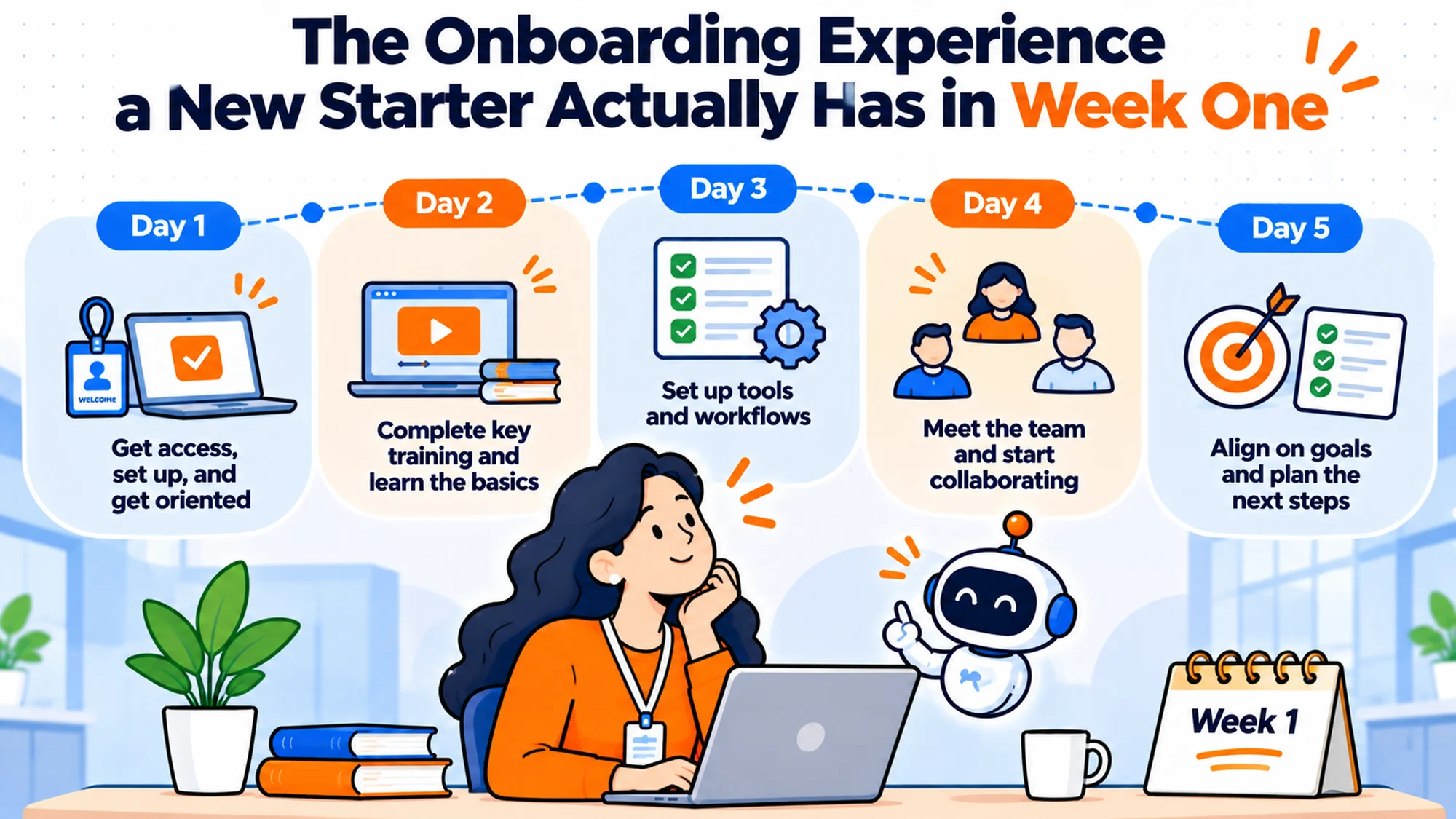
Somebody's first day is planned carefully. There is a welcome message, a structured schedule, a lunch, an introduction round and a kit that arrived on time.
Their actual experience of that day is this: they could not work out how to join the second call because the link was in a system they could not access, they did not want to interrupt anybody so they waited eleven minutes, they joined late, and they spent the rest of the meeting wondering whether anybody noticed and what it suggested about them.
Nothing in the planned day caused that. Nothing in the planned day prevented it either. The real issue is that onboarding experience is usually designed as a sequence of events and experienced as a sequence of small uncertainties, and the two have almost nothing to do with each other.
Best tools for HR Operations
When the experience is not the problem
If people cannot work, experience design is premature. A thoughtful first week sitting on top of broken provisioning is decoration. The order of operations is that things function, then things feel considered, and reversing it produces a company that sends a welcome box to somebody who has no laptop.
If your hiring volume is very low, the experience is a relationship rather than a programme. At fifteen starters a year the manager and one or two colleagues are the experience, and formalising it adds ceremony without adding warmth. Spend the effort on making sure those people have time rather than on designing a journey.
If the problem is actually role clarity, onboarding cannot fix it. A surprising share of bad first months are caused by a role that was never properly defined, and no amount of welcome improves the experience of not knowing what you are supposed to be doing. That is a hiring and management problem wearing an onboarding costume.
And the case that argues the other way. If you hire in cohorts, experience design earns its place early, because a cohort compares notes. Inconsistency that would be invisible with one starter a month becomes the main topic of conversation when four people start together and discover they were told different things.
What week one actually feels like
The useful frame is that a new starter is not primarily learning. They are managing uncertainty, continuously, and most of their attention goes there.
The uncertainty is rarely about the work. It is about whether it is acceptable to take a lunch break, whether the silence on a call means something, whether the person who has not replied is annoyed or just busy, whether finishing at the stated time looks keen or lazy, and whether anybody has noticed they have been quiet. None of this is in a handbook and all of it consumes capacity.
This is why information delivered in week one does not stick. The capacity it would need is already spent, and the content has no hook because none of it is yet attached to a situation the person recognises. Teams read the result as poor retention and add more content, which makes it worse.
It also explains the single most reliable finding about new starters, which is that they under-ask. Every question carries a small calculation: is this a reasonable thing not to know, will asking make me look slow, is this person busy, could I work it out myself in ten minutes. The calculation resolves against asking far more often than anybody designing the process assumes.
| What the starter is actually doing | What the programme assumes | Consequence |
|---|---|---|
| Managing social uncertainty | Absorbing information | Content does not stick |
| Deciding whether to ask | Asking when stuck | Problems stay hidden |
| Reading signals about norms | Following stated rules | Written policy is secondary |
| Working out who is safe to ask | Using the designated channel | Peers carry the real load |
| Conserving credibility | Building knowledge | Silence looks like confidence |
Why the first failure matters more than the tenth
New starters calibrate fast and on very little evidence, which means the sequence of what goes wrong matters as much as how much goes wrong.
A problem on the first morning is interpreted as a statement about the organisation, because the person has nothing else to go on. The same problem in week four is interpreted as an ordinary thing that happens, because by then they have seen enough normal operation to place it. One failure on day one does more damage than three in month two, and the programme that produces a flawless first day and a chaotic second week will be remembered more fondly than the reverse.
This has a practical implication that is slightly counterintuitive. If resources are limited, concentrate them on the first two days rather than spreading them evenly across the first month. Make the opening reliably excellent and accept that week three will be ordinary. Evenly distributed effort produces an acceptable first day, which is the version that sets the wrong expectation.
The second implication concerns recovery. Because the first failure carries so much weight, how it is handled matters disproportionately. A problem that is noticed by the company before the starter raises it, acknowledged plainly, and fixed quickly, can produce a better impression than no problem at all, because it demonstrates that somebody is paying attention. The same problem discovered by the starter, reported hesitantly and fixed slowly, confirms the worst reading.
That is the argument for the day one check at around eleven in the morning. It is not primarily about catching problems, though it does. It is about the problem being found by you rather than by them, which changes what the problem means.
And it is worth saying plainly to new starters that something will probably go wrong. Setting that expectation costs nothing, removes the interpretation that a failure says something about how much they were wanted, and makes it dramatically more likely they will mention it when it happens.
The frictions that nobody owns
Most of what degrades the experience is a set of small failures that fall between functions, each too minor to escalate and collectively decisive.
The calendar invite with a link to a system the person cannot access yet. The document shared with the wrong permissions. The channel nobody mentioned that turns out to be where the real conversation happens. The acronym used in every meeting that nobody has defined. The form that asks for an employee number the person does not have. The introduction to somebody who is on leave for a fortnight.
Each of these is a two minute fix and none of them has an owner, because they are not steps in anybody's process. They are the gaps between steps, and the only person who sees them all is the new starter, who is the least empowered person to raise them.
The repair is a feedback route with an extremely low threshold, and an explicit statement that small things are wanted. Not a survey, which collects judgements, but something closer to a running list the starter is invited to add to, with the explicit framing that it helps the next person. That framing matters, because most people are more willing to report a problem on behalf of a future colleague than on their own behalf.
Then somebody has to read it and fix things. A list nobody acts on is worse than no list, because it converts a minor irritation into evidence that reporting is pointless.
There is a second, better source for the same information that most companies never use: the person who joined three months ago. They have enough context to know what was genuinely confusing rather than merely new, they can still remember it, and they have enough standing now to say so without it costing them anything. Asking each starter at month three what they would change for the next person is the highest quality input to this available, and the answers are specific in a way that week one feedback never is. Keep the question narrow and about the next person rather than about themselves, because that framing consistently produces candour where a satisfaction question produces courtesy. Over a year, four of those conversations will tell you more about your onboarding than any survey, and the cost is an hour.
The floor matters more than the ceiling
There is a consistent asymmetry in how onboarding experiences are remembered. Positive touches add a little. Basic failures subtract a lot, and they subtract more than equivalent positives add.
A welcome box, a handwritten note and a thoughtful first lunch are genuinely good and they do not compensate for a laptop that arrives on day three. The person will remember both, and the version they tell their friends is about the laptop. This is not ingratitude, it is that the laptop affected their ability to do the thing they came to do, and the box did not.
So the order is to fix the floor first. Can the person log in on their first morning, reach every meeting they are invited to, find the room or the call, get lunch, and know who to ask when something does not work. Those five, reliably, outperform any amount of thoughtful extras layered on an unreliable base.
Once the floor is solid, the extras do real work, and the cheapest high value one is consistently the same: somebody senior enough to matter spending twenty unhurried minutes on the first day, not to transfer information but to establish that this person's presence was expected and wanted.
What does not work is scale substituting for attention. A generated welcome message addressed by name reads as exactly what it is, and the dominant reaction is to notice the mechanism rather than the welcome. If you cannot do it personally at your volume, doing it briefly and genuinely for fewer people beats doing it automatically for everybody.
The same asymmetry applies to timing, which is why so much onboarding effort is spent in the wrong place. The welcome box is prepared weeks in advance by somebody with time to think about it, and the broken calendar link is discovered at nine on a Monday by somebody with no time at all. One has an owner and a lead time; the other has neither. So the pleasant parts of the experience get better every year while the floor stays exactly where it was, and each year the gap between how considered onboarding looks and how it feels widens slightly. The correction is unglamorous: give the floor an owner and a checklist the way the extras already have one, and run it the working day before every start date rather than on the morning itself.
The distributed and deskless versions
Most onboarding experience design assumes an office, and the assumptions fail differently for the two main alternatives.
For distributed starters, the thing that disappears is incidental contact. In an office a new person is seen, greeted, and asked how it is going several times a day without anybody planning it, and that accumulation is most of what makes the first week feel welcoming. Remotely it has to be scheduled, which feels artificial to the people scheduling it and is nonetheless necessary, because the alternative is a person sitting alone forming the view that nobody noticed they joined.
The specific thing to schedule is not more meetings about work. It is short, low stakes contact with several different people, spread across the first fortnight, with the explicit purpose of giving the starter faces and names. Fifteen minutes each. The instinct to batch this into one large introduction call is understandable and produces nothing, because eleven names in an hour is zero names.
For deskless starters the problem is different again. They often have no company device, no persistent email, and limited time during a shift to read anything. An onboarding experience designed around a portal and a sequence of emails reaches them not at all, and the failure is usually invisible because nothing in the system records that they never engaged.
What works there is physical and human: a printed card with the three things they will need, a named person on their actual shift, and a phone number that a real person answers. It is unglamorous and it substantially outperforms anything built for a desk worker.
The common error in both cases is assuming the office programme can be adapted. Usually it has to be designed separately, because the constraints are different in kind rather than in degree.
The experience before day one
The period between accepting an offer and starting is where a surprising amount of the experience is set, and almost no organisation designs it, because the person is not yet an employee and no system owns them.
What happens by default is a gap. The offer is signed, the recruiter's involvement ends, and the person hears nothing for several weeks. They are, during that time, occasionally wondering whether they made the right decision, and the absence of contact is read as an answer to that question. Meanwhile their current employer is often making a counter effort, which is a competition your silence is losing.
The questions in that window are practical and nobody is obviously responsible for them. What time should I arrive. What should I bring. Will I need my own device on the first morning. Should I have read anything. Who will I actually be meeting. These are all answerable and the answers usually arrive through individual emails from whoever is nearest, which means two people joining the same week get different versions.
Three things fix most of it, and none is elaborate. A single pre-start message that is a template rather than a composition, so the content is at least consistent. One short piece of contact from the hiring manager about a fortnight before, which does more for confidence than anything else available. And a clear statement of what day one looks like, hour by hour, sent a few days before rather than on the morning.
There is also a practical check worth running: what happens if somebody follows a link to your onboarding content before their account exists. A login page is an acceptable answer. An error, a permission denied screen or a silent redirect to a generic page is not, and all three are common, because nobody tests the state a system is in before its users exist.
The second month, which nobody plans
Onboarding programmes almost universally end around week four, and the experience does not.
What happens at that point is that formal support stops and the person is treated as established, while they are still perhaps a third of the way to feeling it. The questions have not run out; they have become more specific and therefore feel less acceptable to ask, because a question in week one is expected and the same question in week six suggests you were not paying attention.
This is the period where under-asking does the most damage. Early questions are about where things are, which is harmless to get wrong for a day. Later questions are about how things are done, where guessing produces work that has to be redone, decisions made on wrong assumptions, and the particular embarrassment of discovering in month three that there was a process you never knew about.
The fix is to extend the structure past the point where it feels necessary, specifically by keeping a scheduled check at week six and again at week ten. These are conversations rather than content, and the useful question is not how are you getting on, which produces a positive answer, but what have you had to guess at.
It is also the period when the manager's attention naturally moves on, because the visible onboarding is complete and other things are pressing. Putting the week six and week ten checks in a calendar at the point of hire is the entire mechanism, and it survives a busy month in a way that good intentions do not.
One more thing belongs here. Month two is when a new starter has enough context to see what is odd about how you work and has not yet stopped noticing. That perspective is genuinely valuable and it expires. Asking directly what seems strange or inefficient, once, at around week six, produces observations nobody inside the company can make any more.
Five questions to diagnose your own
What did the last three starters have to ask a peer? Not what they asked formally, but what they worked around by asking the person nearest. That list is your actual experience gap, and it is invisible in every system you have, because nothing records a question asked quietly in a direct message to somebody sitting nearby.
How long was it before somebody asked them how it was going, genuinely? Count the hours. In distributed teams the honest answer is frequently more than a day, and it is the cheapest thing on this page to fix.
Could they reach everything they were invited to in week one? Test it rather than asking. Check whether a day one account can open every link in the first week's calendar invites.
What is the first thing that goes wrong, and who notices? Every onboarding has a characteristic first failure. If nobody can name yours, nobody is watching, which means the starter is absorbing it alone. Ask three people who run the process to answer independently, and compare. Agreement means the failure is known and tolerated, which is a decision somebody could revisit. Disagreement means nobody has looked, which is more common and more fixable.
Does anything make asking cheap? Not a channel, which is a place. Something that lowers the social cost: an explicit statement that week one questions are expected, a named person whose job it is to be asked, or a route that does not require interrupting somebody visibly.
The tools, and where each one struggles
Matram is our own product, stated here rather than buried, and judged on the same criteria as the rest. It is an answering agent: it reads your documentation and answers questions in the channel people already use. Its contribution to experience is narrow and real, which is that it lowers the cost of asking, because a question put to a system carries none of the social calculation that a question put to a colleague does. For the under-asking problem described above, that is the most direct intervention available. Pricing is flat at $29, $69 and $199 a month with unlimited seats and a 30 day trial that needs no card.
Its limits matter here. It has no free tier. It is not an HRIS, so it holds no records and runs no approval chains. Its actions reach HubSpot, Zendesk and webhooks only, so it can open a ticket but cannot provision anything or fix the frictions described above. WhatsApp is coming soon rather than available. And it does nothing at all for the part of experience that is about belonging, which is the larger part. A tool that answers questions does not make somebody feel expected, and treating it as though it does is how a company ends up with efficient onboarding that feels cold.
BambooHR publishes Core at $10.25 per employee per month, Pro at $17.50 and Elite at $25 above twenty five employees. It sequences tasks and holds records well, and the Pro tier bundles an assistant answering from your own policies. Where it struggles for experience specifically is that it is a system of record rather than a designed journey, so it ensures things happen without shaping how they feel.
Rippling starts from $8 per employee per month plus a monthly base fee. Its contribution to experience is indirect and substantial: by spanning devices and access it removes the day one failures that do most of the damage. Where it struggles is scope, since it is a platform decision rather than an experience one.
Workday publishes no public rate, its pricing URL returning a 404, so figures attributed to it are estimates. Enterprise scale, implemented over quarters.
Enboarder is the one specialist here, built specifically around the onboarding experience: sequencing, nudges, manager prompts and structured contact points. For the problems in this article it is the most directly aimed tool in the comparison. It publishes no price. Where it struggles is that it will not decide what you want the experience to be, and a team arriving without that will produce well timed prompts carrying nothing in particular.
Leena AI and Moveworks are enterprise agents, neither publishing a price. The Moveworks pricing page carries a Forrester study rather than a rate card, and the figures there are claimed savings rather than costs.
| Tool | Published price | Experience contribution | Where it struggles |
|---|---|---|---|
| Matram | $29, $69 or $199 flat | Lowers the cost of asking | Nothing for belonging, no free tier |
| BambooHR | $17.50 per employee per month | Ensures things happen | Does not shape how they feel |
| Rippling | From $8 plus a base fee | Removes day one failures | Platform scale decision |
| Workday | None published | Enterprise consistency | Quarters to implement |
| Enboarder | None published | Designed journey and prompts | Needs you to decide the content |
| Leena AI | None published | Answers questions | Procurement cycle |
| Moveworks | None published | Answers questions | Only an ROI study is public |
The decision table
| Situation | Scale | Setup | Primary Pain | Recommended Starting Point |
|---|---|---|---|---|
| Basics fail on day one | Any | Any | Floor, not ceiling | Fix provisioning before experience |
| Starters are quiet and polite | Any | Process works | Under-asking | Make asking cheap, ask directly |
| Distributed team | Any | Remote | No incidental contact | Scheduled short contact, several people |
| Deskless workforce | Any | Low tooling | Never reached | Printed card, named person, phone |
| Cohort hiring | Any | Any | Inconsistency | One source, same answers |
| Low volume | Under 15 a year | Informal | Nothing structural | Protect manager time |
The experience is not the same for everybody
A programme that produces a good average experience can produce a poor one for identifiable groups, and because those groups are individually small the pattern is rarely visible in aggregate feedback.
People who need an adjustment have the hardest version of the week one calculation. Asking for something they need means disclosing something personal to an organisation they have known for four days, through a process they probably cannot find, to a person they have not met. Most of the design response to this is to put the policy somewhere findable, which helps and is not sufficient. What helps more is the request route being visible on the first screen rather than filed under benefits, and somebody stating early that adjustments are normal rather than exceptional.
People joining a team where they are the only one of something carry an additional load that the programme does not see. The ordinary uncertainty of week one is compounded by working out whether a given reaction is about the work or about them, and that is exhausting in a way that no welcome sequence addresses. The useful interventions here are structural rather than ceremonial: making sure they meet people beyond their immediate team early, and making sure the named person they can ask is not their only possible route.
People in a different timezone from the centre of gravity experience a quieter version of the same problem. Their questions wait, their contributions arrive after decisions, and the informal contact that helps everybody else is happening while they sleep. Scheduling contact inside their working hours rather than at the convenience of the majority is the fix, and it is usually resisted because it is inconvenient for more people.
People joining a team that is itself under strain will have a bad first month regardless of the programme, because the colleagues who would normally absorb their questions have no capacity. This is worth naming because it is often known in advance and almost never acted on. Hiring into a stretched team is sometimes necessary, and when it is, the onboarding support has to come from outside that team rather than being left to it.
The general point is that averaging hides the cases that matter. If you only ever look at aggregate feedback, the experience of the quietest quarter of your starters is invisible, and that is the quarter most likely to leave.
What the colleagues experience
Onboarding is usually analysed from the starter's side, and there is a second population whose experience determines whether any of it works.
Existing team members absorb a real cost when somebody joins. They answer questions, review work more carefully, explain things they consider obvious, and carry the slack while the new person comes up to speed. None of this is in anybody's objectives, none of it is visible in their output, and in a team under pressure it competes directly with work that is.
The consequence, when this goes unacknowledged, is predictable and quiet. People become slightly less available. Answers get shorter. The new starter senses it accurately, reads it as a signal about themselves, and asks less, which is exactly the outcome everything in this article is trying to prevent.
Two things help. The first is simply naming the cost: telling a team that supporting a new starter is part of the job this month and will be reflected in what is expected of them. That acknowledgement does most of the work on its own, because the resentment comes from the invisibility rather than from the effort.
The second is distributing it deliberately rather than letting it land on whoever is most helpful. Left alone, the burden concentrates on one or two people, usually the same ones every time, and that is both unfair and fragile. Naming different people for different areas spreads it and gives the starter more than one route.
There is a third benefit that is easy to miss. The person explaining something to a new starter is the person most likely to notice that the documentation for it is wrong. If you ask them, at the end of the first month, what they had to explain that should have been written down, you get a better documentation backlog than any audit produces.
The cost of getting this wrong
The measurable cost is early attrition, and it is both real and hard to attribute, because people who leave at month five rarely say it was onboarding. They say the role was not what they expected, or that they never quite got going, which is usually the same thing described from the inside.
The larger cost is quieter and compounds. Somebody whose first fortnight taught them that asking is expensive carries that for the rest of their tenure. They ask less, work around more, and surface problems later than they otherwise would. Multiply across several cohorts and you have a culture that looks self sufficient and is actually under-communicating, and nobody can point at when it started.
The third cost falls on the people the experience already serves worst. A programme that depends on confidence, on reading unwritten signals, and on being comfortable interrupting people will work well for those who find that easy and badly for everybody else. The result is that onboarding quietly selects for a personality type, and the organisation reads the outcome as a difference in capability.
So the question worth asking is not whether your onboarding experience is good. It is whether the quietest person in your last cohort had a materially worse first fortnight than the most confident one, and whether anything in your process would have told you.
Consistency beats quality at cohort scale
A single excellent onboarding and a batch of merely adequate ones are not equivalent, and once you hire in cohorts the variance matters more than the average.
The mechanism is comparison. Four people starting in the same week will talk, and what they talk about is the differences. One was told expenses work one way and another was told something else. One had a manager who had planned the week and another did not. One's laptop arrived early and another's did not arrive at all. Individually these are ordinary variation. Together, discussed over lunch on the third day, they become a shared conclusion about how organised the company is.
The conclusion is formed from the worst case rather than the average, because the person whose experience went badly tells the story and the others recognise the shape of it. So a cohort of four where three went well and one went poorly is experienced by all four as a company where onboarding is unreliable.
This argues for a specific priority order that differs from the single-starter case. With one person a month, investing in a better experience is the right move. With cohorts, investing in a more consistent one is, even if it means the ceiling comes down slightly. A standard that everybody meets beats an aspiration that most people meet.
Practically that means one source for every answer rather than several people each answering well, templates rather than compositions for anything sent to multiple starters, and checking the slowest person in each cohort rather than the average. It also means resisting the natural tendency to give the most interesting new hire the most attention, which is how variance gets introduced deliberately by people trying to be helpful.
The other cohort-specific effect is worth planning for and is more positive. A cohort has each other, which supplies some of the social reassurance that otherwise has to come from the organisation. They are poor sources of factual information, since none of them knows anything yet, but they are excellent for the uncertainty load described earlier, because discovering that somebody else also does not know whether it is acceptable to take a lunch break resolves the question immediately.
Fixing the cheapest things first
If this reads as a large design project, the useful version is a short list that can be done this month.
Make one person responsible for being asked, by name, for the first fortnight, and tell the starter explicitly that this person's job includes answering obvious questions. Naming it removes most of the social calculation, which is the single largest source of friction.
Schedule three short conversations with three different people in the first two weeks, with no agenda beyond introduction. In a distributed team this is not optional, and the batching instinct must be resisted.
Test every link in the first week's calendar invites against a day one account. This takes twenty minutes and removes the most common and most demoralising failure.
Ask the last three starters what they had to ask a peer, write the answers down, and fix the top three. That list is better than any survey and it costs forty five minutes.
And say out loud, in writing, that questions in the first month are expected rather than tolerated. It sounds trivial. It is the cheapest intervention available and it changes behaviour more than anything else on this page, because the thing it removes is a calculation that nobody realises their starters are making.
Frequently asked questions
What is the employee onboarding experience?
It is what joining actually feels like from the new person's side, as distinct from the process that was designed. It is shaped less by the planned events than by small frictions, by how easy it is to ask questions, and by whether basic things work on the first morning. Two companies can run identical processes and produce very different experiences.
Why does our onboarding feel cold despite a good programme?
Usually because the programme delivers information and events while the experience is largely about belonging, and those are served by different things. A structured first week with no unhurried human contact feels administrative. The cheapest correction is short, low stakes conversations with several people rather than more content or better scheduling.
Why do new starters not ask questions?
Because every question carries a calculation about whether not knowing is acceptable, whether asking looks slow and whether the other person is busy. That calculation resolves against asking far more often than process designers assume, and it is strongest in week one. Naming somebody whose job includes answering obvious questions removes most of it.
Do welcome gifts help?
A little, and they do not offset basic failures. The asymmetry is consistent: a thoughtful touch adds modestly while a laptop arriving late subtracts a great deal, because one affected the person's ability to do their job and the other did not. Make the first morning reliably work before investing in anything that decorates it.
How is this different for remote starters?
The incidental contact disappears, and with it most of what makes a first week feel welcoming. In an office somebody is greeted and asked how it is going repeatedly without anybody planning it. Remotely that has to be scheduled, which feels artificial and is necessary, and it should be several short conversations rather than one large introduction call.
What about deskless workers?
Most onboarding programmes do not reach them at all, because they assume a device, an inbox and time to read. The approaches that work are physical and human: a printed card with the essentials, a named person on the same shift, and a number that a real person answers. Adapting a desk based programme usually fails, since the constraints differ in kind.
What is the single highest value change?
Telling new starters explicitly, in writing, that asking questions in the first month is expected rather than tolerated, and naming a person whose job includes answering the obvious ones. It costs nothing, it addresses the calculation that suppresses most problems, and it tends to surface the small frictions that nobody else can see.