
TL;DR
An employee equipment request process competes with a company card and an expense claim. If the official route is slower than buying it directly, people will buy it directly, and no policy reminder changes that.
- The process competes with an expense claim.
- Lead time decides compliance, not policy.
- Publish the real wait, including slow markets.
- Set a threshold needing no approval.
- Capture the serial even on an exception.
- Say no clearly rather than slowly.
What your employee equipment request process competes with
The framing that changes how you design this, and it is rarely stated.
Your request process is not the only route to equipment. The alternative is somebody buying what they need and claiming it back, and that alternative is available to most people in most companies.
Best tools for HR Operations
So the process competes. If it is slower, more confusing or more likely to end in a no, people take the other route, and you lose the record, the standard, the warranty position and the ability to recover the device later.
That is not an attitude problem and it does not respond to a reminder about policy, however firmly worded. It is an entirely rational response to being offered two options, only one of which reliably produces a laptop before the date somebody needs it.
The practical consequence
Design the official route to win on speed and clarity rather than trying to close off the alternative. Closing it off mostly produces people buying equipment and not claiming, which is worse because you lose visibility entirely.
What winning looks like in practice
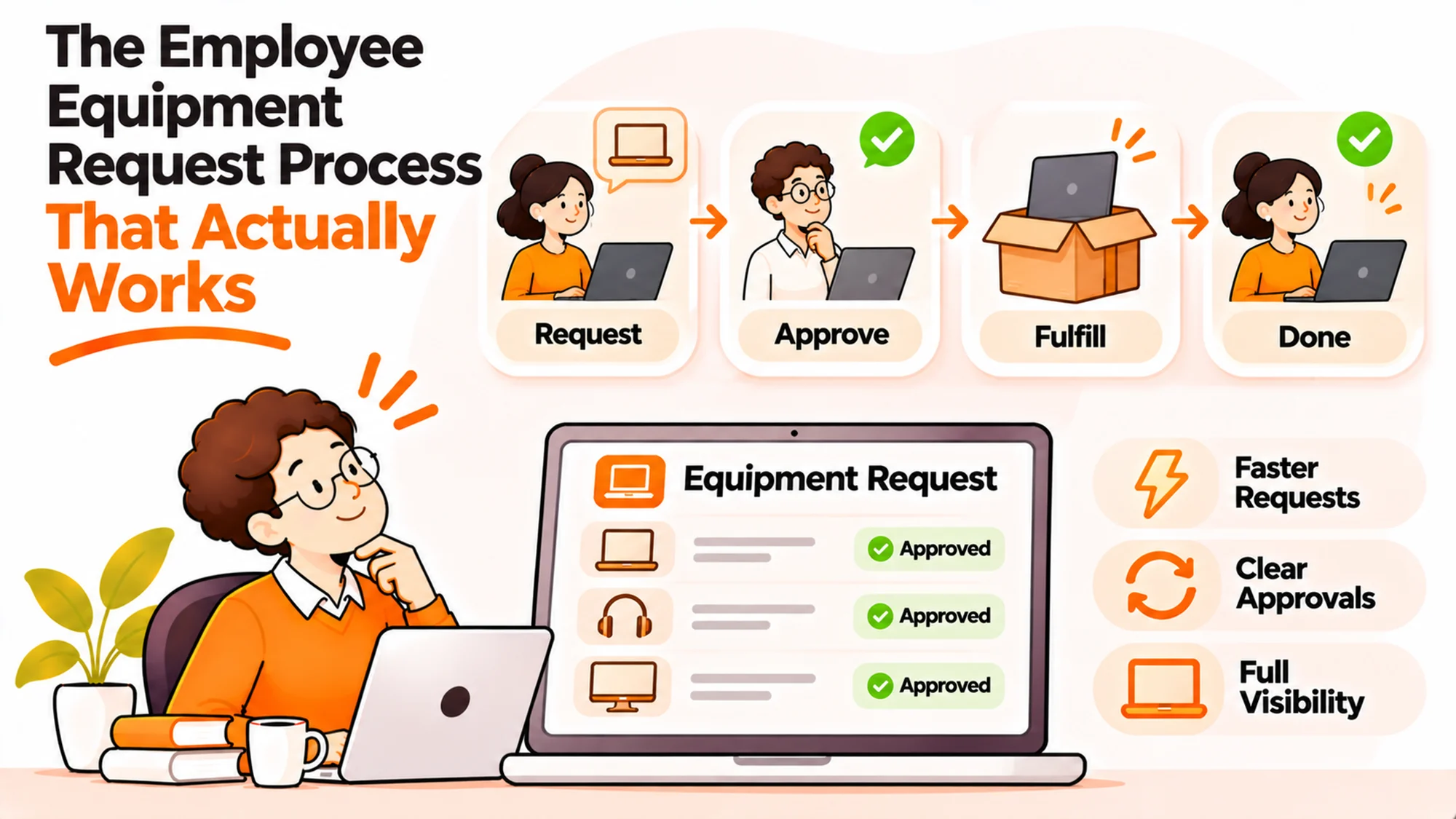
Three things, and none of them is about the form. The request takes less time to submit than an expense claim takes to fill in. The answer arrives within a day for anything standard. And the person can see where their request has got to without asking anybody.
That third point is underrated. A large share of the frustration in these processes is not the wait itself but not knowing whether anything is happening, and a visible status removes most of it at almost no cost. People will wait considerably longer for something they can see moving than for silence.
Lead time is the whole game
The single factor that determines whether people use your process.
Most requests have a date attached. Somebody starts on the fifteenth. A laptop died this morning. A new project needs a second screen by next week. The question is always whether the official route arrives in time.
Which means the most useful thing you can publish is not the policy. It is the honest lead time, by market, including the slow ones.
Honest matters. Publishing the supplier’s estimate rather than your own history sets an expectation you break, and a manager who gets burned once routes around you permanently afterwards.
Measure it from the moment somebody asks to the moment they have a working machine, not from order confirmation to despatch. Those are different numbers and only the first is the one your colleague experiences. getting a starter ready for day one covers the joining case specifically.
Approval thresholds
Approval exists to control spend and routinely causes the leakage it was meant to prevent.
A standard machine for a confirmed hire does not need a signature. It was decided when the role was approved, and routing it through a chain adds days and no control.
What deserves approval is anything non-standard, anything above a threshold, and anything for somebody who is not an employee.
| Request type | Approval | Why |
|---|---|---|
| Standard kit, confirmed hire | None | Already decided at headcount |
| Standard replacement | None | Failure is not a decision |
| Accessory under threshold | None | Costs more to approve than to buy |
| Non-standard request | Named approver | Sets a precedent |
| Non-employee | Named approver | Recovery is harder |
The pattern is that approval should attach to the unusual rather than the routine, and a surprising number of processes have it exactly the other way round: every standard laptop queues for a signature while an unusual request made by somebody senior goes through without comment. designing an equipment approval workflow goes into the design in more depth.
Make the exception route official
The highest return change available in this whole area, and it costs nothing.
Sometimes somebody genuinely has to buy locally. A start date too close, a market you cannot ship to, an urgent failure. If there is no official way to do that, it happens anyway and leaves no trace.
So build the route. A documented way to buy locally and claim it, with one condition: the serial number and the device details are captured as part of the claim.
That single condition converts an invisible device into a recorded one. The purchase still happens outside the normal flow, which is sometimes unavoidable, but it stops being a machine nobody knows exists.
The security case is straightforward. A device bought outside the process is one nobody enrolled, nobody encrypted, and nobody will wipe when its holder leaves. CISA and its Secure Our World guidance covers the basics and the NIST Cybersecurity Framework the governance framing, and both come down to the same thing: you cannot protect what you do not know about.
Saying no quickly
The part of request handling that damages trust most, and it is not the refusals.
People accept a no. What they do not accept is three weeks of silence followed by a no, and that experience teaches them to route around the process permanently.
So the design goal for refusals is speed and clarity. A clear no within a day is a better experience than a maybe for a fortnight, even though it feels worse to deliver.
Three things make refusals land better. A reason, even a short one. An alternative where one exists, such as the standard option instead of the requested one. And a route to challenge it for the cases where the requester knows something the policy does not anticipate.
That third one matters more than it appears. A process with no appeal route gets treated as arbitrary, and arbitrary processes get bypassed by exactly the senior people whose example sets the norm for everybody else.
The accessories nobody tracks
A specific blind spot worth naming, because it is where most of the unrecorded spend sits.
Laptops get recorded. Monitors, docks, keyboards, chairs, headsets and adapters usually do not, because individually they feel too small to bother with.
Collectively they are not small. A fully equipped home setup can approach the cost of the laptop, and none of it appears in your register, your cost per employee figure, or your recovery list when somebody leaves.
The fix is to record them at the point of purchase rather than attempting to catch up later, because catching up means asking several hundred people what is in their spare room and believing the answers. It costs one extra field in the request form, and it is the difference between knowing what you own and estimating it.
For home workers there is a related obligation worth understanding, and the HSE guidance on home working sets out why what you provide for somebody working at home is a real consideration. Whatever you supply for that reason should be in the same record as everything else. joining an asset register to your HRIS covers joining that record to the person.
When not to build a process
Two cases, and a warning about over-engineering.
Under about twenty people. A conversation and a shared spreadsheet genuinely works. A request form with routing rules at that size is ceremony, and it will be abandoned within a quarter.
When the real problem is supply. If requests are slow because you cannot get machines rather than because the process is bad, redesigning the form changes nothing. That is a supply problem rather than a process one, and redesigning the request form will not touch it.
The warning: it is easy to build a process with more control points than the spend justifies. Every approval, every form field and every routing rule adds delay, and delay is what drives people out of the process. The test is whether each control prevents something that has actually happened to you, rather than something that might.
And the one thing most worth building regardless of size: a record of what was issued, to whom, when, and with a serial number attached. Everything else in this article is optimisation on top of that record. That record is what makes recovery, reconciliation and disposal possible later, and a managed laptop lifecycle service depends on it being right.
Speed is what keeps people inside the process. See laptop procurement across 80+ countries or tracked laptop procurement and delivery.
Frequently asked questions
Why do people buy equipment outside the official process?
Because the official route is slower than the alternative. It is a rational response to two options rather than an attitude problem, and it does not respond to policy reminders. The fix is making the sanctioned route faster, not closing off the other.
What should we publish about lead times?
The honest figure by market, measured from when somebody asks to when they have a working machine, including the slow countries. Publishing a supplier estimate sets an expectation you break, and a manager who gets burned once routes around you permanently.
What should need approval?
The unusual rather than the routine. A standard machine for a confirmed hire was already decided when the role was approved, and routing it through a chain adds delay without control. Non-standard requests, anything above a threshold, and anything for a non-employee are where approval earns its place.
Should we allow people to buy equipment themselves?
Allow it through a documented route with one condition: the serial number and device details are captured as part of the expense claim. It happens anyway when it needs to, and the condition converts an invisible device into a recorded one at no cost.
How should refusals be handled?
Quickly and with a reason. A clear no within a day is a better experience than three weeks of silence followed by the same answer, and the slow version teaches people to bypass the process. Include a route to challenge it, or the process gets treated as arbitrary.
Why do accessories matter?
Because collectively they can approach the cost of the laptop, and almost nobody records them. That means they are missing from your register, from cost per employee, and from the recovery list when somebody leaves. Capture them at purchase rather than catching up later.
At what size is a formal process worth it?
Above roughly twenty people. Below that a conversation and a spreadsheet work and a form with routing rules is ceremony that gets abandoned. What is worth having at any size is a record of what was issued, to whom, when, with a serial number.