TL;DR
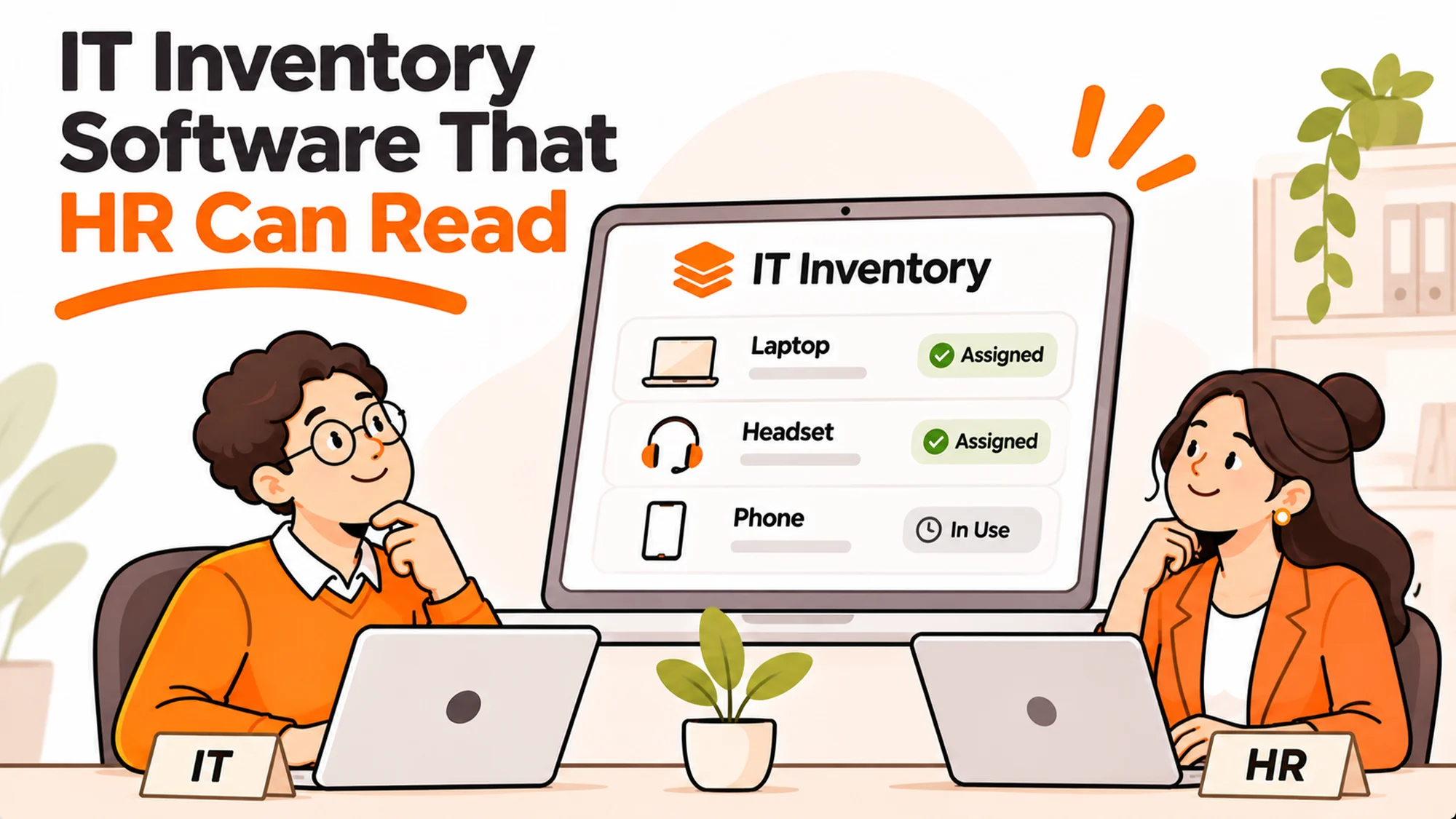
It inventory management software is almost always chosen by the IT team and then depended on by people who were not in the room. HR needs to know what a leaver holds. Finance needs a number for the accounts. Neither question is what these tools are optimised to answer, and both are what they get asked.
- IT buys it. HR and finance depend on it.
- Every device needs a named person, including spares.
- A discovery tool only sees what connects.
- Leaver reporting is the test that matters most.
- Finance needs value and date, not a serial number.
- Pick on the questions you will be asked.
Three teams, three different questions
The register is one dataset and it is read by people who want different things from it.
IT wants configuration state: what is enrolled, what is patched, what is out of support. This is what the tools are built for.
Best tools for Device Management
HR wants custody: who holds what, since when, and what is outstanding from somebody who is leaving on Friday.
Finance wants value: what was paid, when, what it is worth now, and what has been disposed of.
Most tools answer the first question well and the other two by accident. That is why the register is usually accurate about operating system versions and vague about who has the laptop.
The question to ask at selection
Can it produce, in one click, a list of everything assigned to one named person? If that takes a database query, HR will not use it, and a register HR does not use stops being accurate within a quarter.
Every device needs a named owner
The single cheapest control available and the one most often missing.
Devices with no assigned person accumulate quietly. A leaver’s machine where the record was never closed. A spare bought by a manager on a card. A loan laptop handed over at a desk and never logged.
These are the devices that disappear, because nobody notices they are gone. An unowned device has no one to ask about it.
Assign an owner to everything, including stock. The owner of a spare is whoever holds the cupboard key. It sounds bureaucratic and it converts an unowned pool into an accountable one at zero cost.
equipment tracking software covers the tooling side of this. The discipline matters more than the product: a spreadsheet where every row has a name beats an expensive register where a tenth of rows do not.
Discovery only sees what connects
An important limit, and it is easy to mistake a discovery tool’s output for a complete picture.
Agent-based and network-based discovery both find devices that are powered on and reachable. They are very good at that. They are blind to a laptop in a drawer, a machine that has not been switched on since somebody left, and anything that was never enrolled.
So a register built purely from discovery systematically undercounts in exactly the direction that costs you: the devices you have lost track of are the devices it cannot see.
The fix is to reconcile against something that does not depend on the device being online. Purchase records are the usual source, since finance has them whether or not the machine ever connected.
IT asset management software covers the reconciliation in more detail. The headline is that two independent sources disagreeing is how you discover what is missing, and one source alone can never tell you.
Leaver reporting is the real test
Everything else is housekeeping. This is the moment the register either earns its cost or does not.
Four things HR needs on the day somebody resigns, and needs without asking IT.
Everything assigned to that person, including peripherals and anything on loan.
Where it was shipped and to which address, because that is often where it still is.
What it is worth, for any final pay conversation that might arise.
What has already come back, updated as it arrives rather than in a single reconciliation weeks later.
| Question | Asked by | Usually answerable |
|---|---|---|
| What is this person holding | HR, on resignation | Sometimes |
| Where was it sent | Whoever arranges collection | Rarely |
| What is it worth now | Finance | Rarely |
| Has it come back | HR, two weeks later | Only if updated |
writing an employee equipment policy covers the policy side that makes the request legitimate in the first place.
What finance needs is different again
And it is the requirement most often discovered during an audit rather than during selection.
Finance does not care about operating system version. It wants acquisition date, purchase value, a depreciation basis, a disposal date and disposal evidence.
Several asset tools hold none of that, because they were built to manage configuration rather than to support a fixed asset register. IRS Publication 946 on depreciating property sets out what depreciation involves and makes clear why a date and a value are not optional fields.
equipment depreciation covers how this is usually handled. The practical question at selection is whether the tool has fields for acquisition value and disposal evidence at all, because adding them later tends to mean a second system and a reconciliation nobody wants to own.
the EPA on electronics and batteries management is the reference for the disposal end, and the evidence it implies is what finance will ask for when a device leaves the register.
Choosing on the questions you will be asked
Rather than on the feature list, which is written for the IT reader.
Five tests, all of which can be run in a demo.
Produce everything assigned to one person, in one click. Produce every device with no assigned person. Produce every device not seen in sixty days. Produce acquisition value and date for a given device. And export any of these to something finance can open.
A tool that fails three of these will be accurate about patching and useless on the day somebody leaves, which is the day you will be judged on it.
the NIST Cybersecurity Framework is a reasonable frame for showing how the register supports your wider controls, which is the argument that usually gets the budget approved.
The report nobody asks for and everybody needs
Devices not seen in sixty days, sent monthly to whoever owns the register.
It is a short list, it is actionable while the trail is warm, and it catches the two situations that become expensive later: somebody who left without returning hardware, and a machine that failed and was quietly replaced without the record being closed. Both are cheap to resolve in month one and difficult in month nine.
The thing that decides accuracy
Not the tool. Whether updating it is part of a process somebody already does, such as onboarding and offboarding, rather than a separate task that depends on goodwill.
The register is not the hardware
Worth saying at the end, because it is the gap that turns a tidy register into an expensive surprise.
A perfect record of a laptop you cannot get back is a perfect record of a loss. The software tells you what is outstanding; it does not collect anything.
That work is procurement, shipping, collection, storage between employees and disposal with evidence. RemoAsset publishes coverage of 80+ countries for procurement and 25+ for retrieval, and RemoAsset’s laptop lifecycle management is the shape of that service.
NIST Special Publication 800-88 on media sanitization is the standard any disposal evidence is judged against, and it concerns the completed operation rather than the instruction, which is the distinction that matters when somebody asks for proof.
Budget the physical half alongside the software. A register that is accurate and a recovery process that does not exist is a common and expensive combination.
A register tells you what is outstanding. RemoAsset gets it back, across 25+ countries. See RemoAsset’s laptop lifecycle management or RemoAsset’s pricing.
Frequently asked questions
Who actually relies on it inventory management software?
Three teams with three different questions. IT wants configuration state, meaning what is enrolled, patched and out of support, which is what the tools are built for. HR wants custody: who holds what, since when, and what is outstanding from somebody leaving on Friday. Finance wants value: what was paid, when, what it is worth now and what has been disposed of. Most tools answer the first well.
Why does every device need a named owner?
Because unowned devices are the ones that disappear, since nobody notices they are gone. They accumulate quietly: a leaver’s machine where the record was never closed, a spare bought by a manager on a card, a loan laptop handed over at a desk and never logged. Assign an owner to everything including stock, where the owner of a spare is whoever holds the cupboard key.
Is a discovery tool enough on its own?
No, and mistaking its output for a complete picture is a common error. Agent-based and network-based discovery find devices that are powered on and reachable, and are blind to a laptop in a drawer, a machine not switched on since somebody left, and anything never enrolled. A register built purely from discovery undercounts in exactly the direction that costs you.
What does HR need on the day somebody resigns?
Four things, without having to ask IT. Everything assigned to that person including peripherals and loans. Where it was shipped and to which address, because that is often where it still is. What it is worth, for any final pay conversation. And what has already come back, updated as it arrives rather than reconciled weeks later.
What does finance need that is different?
Acquisition date, purchase value, a depreciation basis, a disposal date and disposal evidence. It does not care about operating system version. Several asset tools hold none of that because they were built to manage configuration rather than support a fixed asset register, so check at selection whether the fields exist at all, since adding them later usually means a second system.
How should I judge a tool in a demo?
Five tests. Produce everything assigned to one person in one click. Produce every device with no assigned person. Produce every device not seen in sixty days. Produce acquisition value and date for a given device. And export any of these to something finance can open. A tool failing three will be accurate about patching and useless on the day somebody leaves.
What keeps a register accurate?
Not the tool. Whether updating it is part of a process somebody already does, such as onboarding and offboarding, rather than a separate task depending on goodwill. A spreadsheet where every row has a name beats an expensive register where a tenth of rows do not. And remember a perfect record of a laptop you cannot get back is a perfect record of a loss.