
TL;DR
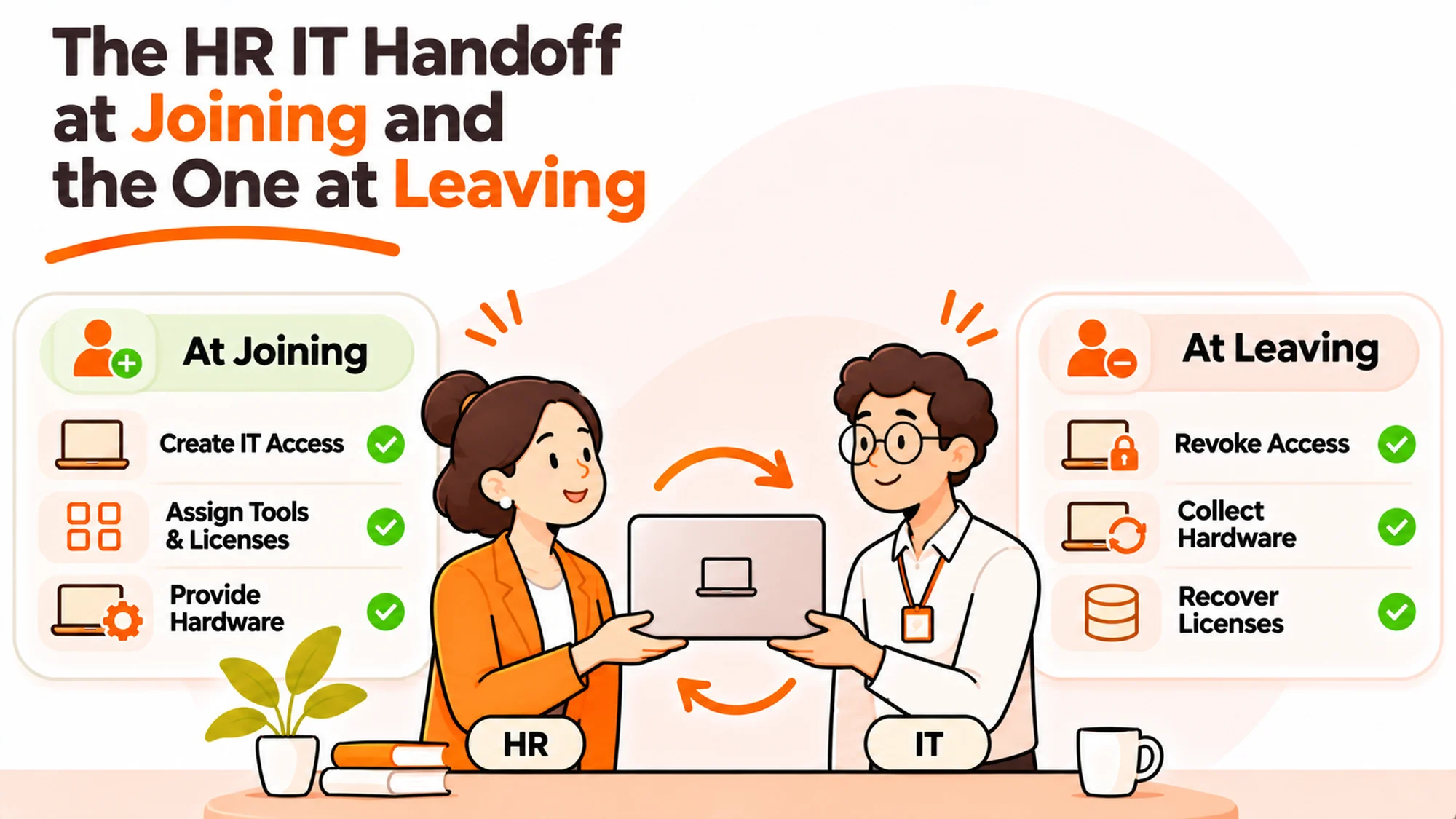
The hr it handoff is a seam, and seams are where things fall through. Both teams believe the other is handling the device, and nobody finds out until somebody starts without a laptop or leaves with one.
- Both sides assume the other owns the device.
- Define the handoff as an event, not a feeling.
- The joining seam shows up immediately.
- The leaving seam shows up never.
- Name an owner for the gap itself.
- Where there is no IT team, say so explicitly.
Why the seam exists
Two teams, two systems, two sets of priorities, and a task that crosses between them.
HR owns the person: the hire, the start date, the departure, the record. IT owns the systems: accounts, access, devices. The equipment sits awkwardly between, because it is a physical object attached to a person and managed by technical people.
Best tools for HR Operations
Neither team is wrong about its scope, and neither is being careless. The problem is that the handoff between them is usually implicit rather than defined, which means it works well when the people involved happen to be conscientious and fails quietly the moment either of them is busy with something more urgent.
The question that exposes it
Ask both teams who is responsible for making sure a leaver’s laptop comes back. If you get two different answers, or two versions of “the other one, I think”, the seam is undefined and it is costing you devices.
It is worth asking the question in those words rather than asking who owns offboarding, because the second phrasing gets a confident answer from both sides about the parts they do own. The failure lives in a specific task, so the question has to name that task.
The same seam exists at role changes
Less costly than the leaving seam and considerably more common. Somebody moves between roles, their equipment needs change, and neither team treats the move as an event that touches hardware at all. HR records the role change and IT sees nothing, so the person keeps working with whatever they had, which is sometimes fine and sometimes the reason their work is slow.
The joining handoff fails loudly
Which is why it mostly gets fixed, and worth understanding before looking at the other end.
If the handoff fails at joining, somebody turns up on their first morning with nothing to work on. That is visible, embarrassing and immediate, so it generates pressure and the process gets repaired.
The common failure is timing rather than ownership. HR knows the start date weeks ahead; IT finds out days ahead because nothing automatically told them. Then lead times do not fit and somebody improvises.
The fix is a trigger rather than a message. The HRIS knows the start date, and that record should generate the equipment task directly rather than relying on somebody remembering to forward it. joining an asset register to your HRIS covers the join, and getting a starter ready for day one the readiness question in detail.
Worth noting what good looks like: the task exists the moment the offer is accepted, not the moment somebody notices the start date approaching.
The leaving handoff fails silently
And silence is why it is the expensive one.
At departure, access removal happens because it is a security concern with a clear owner. The device is different. HR assumes IT will arrange collection. IT assumes HR will tell them when and where to collect. Neither is unreasonable and the laptop stays where it is.
Nobody finds out. The employee has gone, the manager is covering their work, and the only trace is a row in an asset register nobody is reading.
| Joining | Leaving | |
|---|---|---|
| Failure visible? | Immediately | Rarely |
| Who complains? | The new starter | Nobody |
| Pressure to fix | High | None |
| Cost when it fails | A bad first day | A device and its data |
The bottom row is the argument. A bad first day is recoverable by lunchtime. A device in a former employee’s house is a permanent loss and an open data question. what to do about unreturned equipment covers what to do once it has happened.
Defining the handoff properly
Four elements, and writing them down is most of the work.
- The trigger. What event starts the task, in which system, automatically.
- The payload. What information passes: person, devices held, address, dates, and what has already been done.
- The acceptance. Who confirms they have picked it up, which turns a message into a transfer.
- The fallback. What happens if nobody accepts within a defined window.
The third is the one teams skip and it is the one that matters. A notification sent is not a task received. Without an acceptance step, both sides can honestly believe the handoff happened.
The fourth prevents the quiet failure. If a task sits unaccepted for a few days, something should escalate to a named person rather than ageing into the background.
When there is no IT team at all
The situation a large number of companies reading this are actually in, and it changes the problem rather than removing it.
With no IT function, the equipment tasks land on whoever is nearest: operations, the people team, a technically confident person who became the default. The handoff is not between two teams; it is between a defined process and nobody in particular.
That is worse rather than better, because at least two teams can argue about scope and the argument itself surfaces the gap. An undefined owner produces no argument at all, and tasks that get done when somebody happens to notice them and not otherwise.
The answer is not necessarily to hire. It is to name the owner explicitly, in writing, including what they decide and what they can spend. Much of the execution can then be bought in, so that somebody else performs the physical steps while your named person keeps the decisions and the record.
What does not work is leaving the question ambiguous while you decide, which can easily take a couple of quarters. The default outcome in the meantime is improvisation at joining and quiet leakage at leaving, and the leakage stays invisible right up until somebody finally counts what the company is supposed to own.
The part neither team wants to own
Worth naming because it falls into the seam more reliably than anything else: what happens to the data on a returned machine.
HR sees it as technical. IT sees it as a compliance matter driven by somebody else’s policy. Between the two it becomes an assumption that it is handled, which is not the same as evidence that it was.
NIST Special Publication 800-88 on media sanitization is the standard worth knowing, and the distinction that matters at audit is between a policy saying devices are wiped and a certificate naming a specific device. One is intent and the other is proof.
Assign it explicitly to one side or to a supplier. If a supplier does it, make the certificate a standing requirement rather than something somebody requests, because a request that depends on memory will be forgotten exactly when it matters. certified data wiping at offboarding produces that evidence per device, and the EPA on electronics and batteries management covers the responsible route for machines genuinely at end of life.
Testing whether your handoff works
Cheap, uncomfortable and more informative than any process review.
Take five people who left in the last six months. For each, ask both teams what happened to their equipment, separately, without letting them confer.
Three outcomes are possible and each tells you something different. Both teams answer the same way and the asset register agrees, which means the handoff works. They answer differently, which means it is undefined and both sides have been operating on an assumption. Or neither can answer at all, which means it is undefined and nobody has ever gone looking for the consequences.
Do the same at joining with five recent starters, asking when the equipment task was created relative to the start date. The gap between those two dates tells you whether your trigger is automatic or whether somebody has been remembering.
Both tests take under an hour between them and neither requires anybody’s cooperation beyond answering a single question honestly. the equipment evidence an audit actually asks for covers what the answers should look like if somebody external ever asks the same thing, and the useful part is that an auditor’s version of this test is identical to yours.
Own the decisions and the record; buy the physical steps. See a managed laptop lifecycle service or a laptop retrieval service for remote employees.
Frequently asked questions
What is the hr it handoff and why does it fail?
It is the point where responsibility for a person’s equipment passes between HR and IT. It fails because it is usually implicit, so both teams can reasonably believe the other is arranging the device, and neither finds out otherwise until something visible goes wrong.
Why is the leaving handoff worse than the joining one?
Because joining fails loudly and leaving fails silently. A starter without a laptop complains on their first morning, so the process gets fixed. A leaver’s laptop sitting in a house generates no complaint from anybody, so nothing prompts a repair.
What makes a handoff properly defined?
Four things: an automatic trigger from a system, a defined payload of information, an acceptance step where somebody confirms they have picked it up, and a fallback if nobody accepts within a window. The acceptance step is the one teams skip and the one that matters.
What if we have no IT team at all?
The problem changes rather than disappearing, and arguably gets worse, because at least two teams can argue about scope while an undefined owner simply means nothing happens. Name an owner in writing with decision rights and a budget, then buy the execution if that suits you.
Who should own data destruction on returned devices?
One side explicitly, or a supplier. It falls into the seam more reliably than anything else because HR sees it as technical and IT sees it as somebody else’s compliance policy. If a supplier does it, make the per-device certificate a standing requirement rather than a request.
How do we test whether our handoff works?
Take five recent leavers and ask both teams separately what happened to their equipment. If the answers differ, or neither can answer, the handoff is undefined. Repeat at joining by checking when the equipment task was created relative to each start date.
What does a good joining trigger look like?
The equipment task exists the moment the offer is accepted, generated from the HRIS record rather than from somebody remembering to forward an email. The common failure is timing rather than ownership: HR knows weeks ahead and IT finds out days ahead.