TL;DR
- Guru stopped publishing prices in 2026. Its page now offers a package built around your scale with a call booking, so comparison requires a sales conversation.
- Its verification model, where content carries an owner and a review cycle, is the best thing in this category and the main reason to stay.
- The card format suits short reusable snippets and fits policy documents awkwardly.
- Published-price Guru alternatives are Helpjuice, Slab, Tettra, Notion and Confluence, each suiting a different shape of team.
- If the complaint is that people read cards instead of getting answers, that is a retrieval problem and most alternatives share it.
- Fix ownership before switching, because no tool creates an owner and a migration consumes the attention ownership needs.
The Cards Nobody Read
The implementation went well. Four hundred cards, tidily categorised, each with an owner and a verification date. The browser extension meant people could pull up a card without leaving whatever they were doing, which was the whole pitch and it worked.
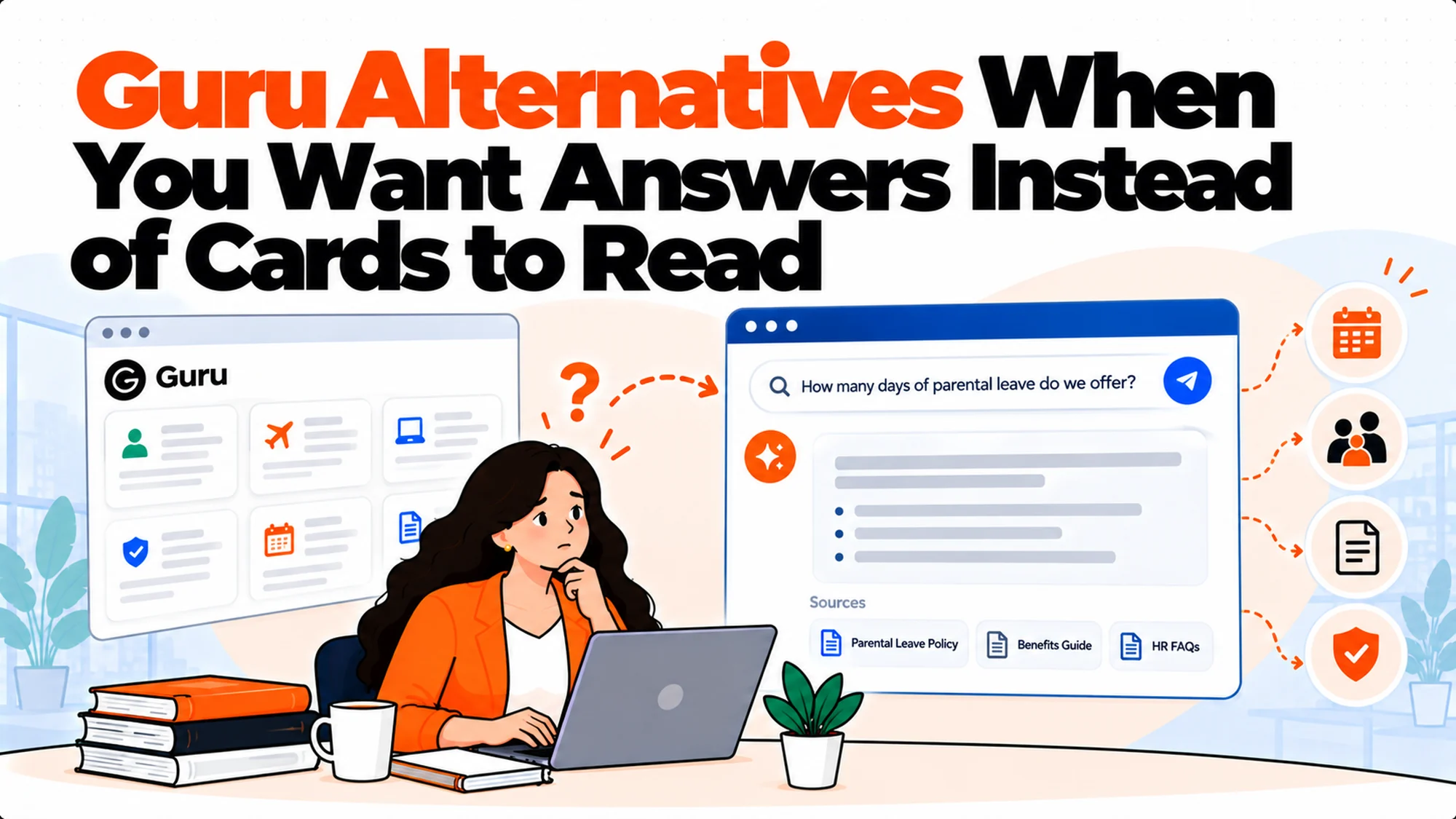
What happened next was that people stopped. Not immediately and not completely, but steadily. The questions that came to HR were the same questions the cards answered, and when asked, people said the same thing in different words: it was quicker to ask.
The cards were good. Finding the right card still meant knowing what to search for, reading the result, and deciding whether it applied. Asking a colleague skipped all three steps.
Best tools for HR Operations
The real issue is not that Guru is a weak product. It is that a card is a document, and the gap between a document and an answer is the gap every tool in this category has to cross.
What Changed This Year
The thing to know before shortlisting, because it changes the evaluation rather than the options.
Guru no longer publishes prices. As of October 2026 its pricing page describes a package built around your scale, knowledge complexity and AI maturity, with a call booking rather than a rate card. There are no figures on it.
Document360 did the same. Its pricing page is now a three-step questionnaire.
Glean has no pricing page at all. The URL redirects to its homepage.
Five of the eleven vendors we checked publish nothing. That is not evidence any is a weak product, and it does mean a shortlist with several of them becomes a procurement exercise with a multi-week calendar.
What to do: decide how many quote-based vendors you will carry before you start. Two alongside two you can price is manageable; four is a quarter of somebody's calendar.
What Guru Does Better Than Its Alternatives
Being fair before the comparison, because two of these are genuinely best in class.
Verification. Content carries an owner and a review cycle, so a card that has gone stale is visible as stale rather than silently wrong. This is the single most valuable capability in the whole category and nothing here matches it.
Permission-aware answering. Answers respect the permissions on the underlying content rather than exposing whatever was indexed. For HR content sitting near pay and performance material, that is not optional.
Working where people already are. The browser extension and chat integrations put knowledge in the workflow rather than in a portal somebody has to remember.
Analytics on gaps. It shows what people searched for and did not find, which is the list of documents worth writing next.
What to do: if verification is your binding requirement, weight it heavily. Among Guru alternatives nothing replaces it cleanly, and the honest advice for a compliance-driven team is often to stay and accept the sales conversation.
It is worth testing how much of that verification you are actually using before deciding it is binding. Open the product and check what proportion of your content is currently verified, when the last review cycle completed, and how many owners responded to it. A team that finds eighty per cent verified and owners responding within a week is genuinely relying on the feature and should weight it accordingly. A team that finds the review cycles were switched off after the first quarter is paying for a capability it abandoned, which changes the comparison substantially and is more common than anybody admits in a renewal meeting.
Why Teams Look at Guru Alternatives
Five reasons, roughly in order of how often they hold up.
No published price. Harder to budget and harder to compare, and it means a call before knowing whether it is in range.
The card format. Cards suit short reusable snippets. A twelve-page policy fits awkwardly, and splitting it into cards fragments something that was meant to be read as one thing.
Enterprise positioning. Current packaging bundles implementation support and solution engineering, which is valuable at scale and over-specified for an HR team of four.
It returns cards rather than answers. The opening story. Better than a page list and still a document to read.
Cost at smaller sizes. Aimed above the size where most HR teams sit.
What to do: separate the pricing complaint from the format complaint. They lead to different shortlists, and only one of them is solved by another knowledge base.
The Published-Price Guru Alternatives
The ones you can evaluate without a call, which is a real advantage right now.
Helpjuice prices by included users rather than per seat: 249 per month including 30 users, 449 including 100, and 799 for unlimited. For a library read by everybody and written by a few, that model fits. Its page shows no currency symbol anywhere.
Slab is the best writing experience here, with unified search across connected tools. Free to 10 users, then Startup at $6.67 and Business at $12.50 per user per month, both billed annually.
Tettra is the closest in spirit, answering in Slack with a question queue that turns unanswered questions into a documentation backlog. $8 per user per month on Scaling with a ten user minimum, billed yearly.
Notion is where many handbooks already live. Free, then $10 Plus and $20 Business per member per month.
Confluence is a configurator: $7.15 Standard per user per month at 25 seats, falling to $5.78 at 300 seats. Free to 10 users permanently.
What to do: price all five at your real headcount before any sales call. A priced baseline turns a discovery conversation into a comparison.
| Tool | Publishes a price | Verification | Answers in chat |
|---|---|---|---|
| Guru | No, as of 2026 | Best in class | Yes |
| Document360 | No, as of 2026 | Strong versioning | Limited |
| Helpjuice | Yes | Moderate | Limited |
| Slab | Yes | Post verification | Limited |
| Tettra | Yes | Page verification | Yes, Slack-native |
| Notion | Yes | Weak | Within the workspace |
| Confluence | Yes | Weak | Within Atlassian |
The Closest Replacement, Honestly
If you want one recommendation rather than a framework, this is it.
Tettra is the nearest in shape. Verification on pages, answering in Slack where questions get asked, and a question queue that does what Guru's gap analytics do. It is lighter in governance and published at $8 per user per month with a ten user minimum, billed yearly.
Helpjuice is the nearest on economics. If the complaint is cost at a company-wide reader population, its included-user model is the structural answer, and it still publishes.
Neither replaces the verification workflow entirely. Both have a version of it and Guru's is better. That is the trade and it should be made deliberately rather than discovered.
And neither is an answer to the card problem. They return documents too.
What to do: if verification is the binding requirement, stay and negotiate. If cost or format is, Tettra and Helpjuice are the two to price first.
The Arithmetic at Three Sizes
Pricing model matters more than rate, and this is why.
At 25 people. Tettra Scaling is $200 a month. Slab Business is $312.50. Notion Business is $500. Helpjuice is 249 flat for up to 30 users.
At 120 people. Tettra Scaling is $960. Slab Business is $1,500. Notion Business is $2,400. Helpjuice is 799 on its unlimited tier.
At 300 people. Tettra Scaling is $2,400. Slab Business is $3,750. Notion Business is $6,000. Helpjuice is still 799.
| Headcount | Tettra | Slab Business | Notion Business | Helpjuice |
|---|---|---|---|---|
| 25 | $200 | $312.50 | $500 | 249 |
| 120 | $960 | $1,500 | $2,400 | 799 |
| 300 | $2,400 | $3,750 | $6,000 | 799 |
What to do: run this at your twelve-month headcount. Per-seat tools multiply by the reader population, and for an HR library that population is everybody.
Evaluating Guru Alternatives Without a Rate Card
The practical process, since half this shortlist cannot be priced from a web page.
Start with the four that publish. Helpjuice lists its included-user tiers openly, and Slab, Tettra and Notion are equally plain. Twenty minutes gives you a priced baseline at your exact headcount.
Take that baseline into every quote call. The conversation changes completely when you can say what the alternatives cost at your size. It becomes comparative rather than exploratory, and it is much shorter.
Ask for a range in the first call. Not after a demo and a discovery questionnaire. A vendor that gives one immediately is not necessarily cheaper and is reliably faster to evaluate.
Have three numbers ready. Headcount, reader count and document count. Every quote-based vendor asks for all three, and having them prepared removes a round trip.
And set a decision date before you start. Open-ended evaluations in this category drift, because each quote-based vendor adds scheduling delay that nobody owns.
What to do: write the baseline on one page and bring it to every call. Among Guru alternatives the published ones are not necessarily better, and they are dramatically easier to compare, so be conscious of that bias rather than pretending it does not operate on you.
What the Guru Alternatives Share and Where They Differ
Reducing the comparison to what actually varies, because the feature lists overlap heavily.
They all store documents and search them. That is the commodity, and every tool here does it adequately.
They differ on verification. Guru is strongest, Tettra and Slab have real but lighter versions, Notion and Confluence are weak. If staleness is your failure mode, this column decides.
They differ on surface. Tettra answers in Slack. Confluence and Notion answer inside their own workspaces. Helpjuice is a portal. Where the answer appears matters more than most evaluations allow for.
They differ hugely on pricing model. Per seat against included users is the difference between a bill that tracks hiring and one that does not, and at 300 people it is several times the money.
They barely differ on the thing that matters most. All of them return something to read. None of them closes the gap in the opening story.
What to do: score on verification, surface and pricing model. Those three explain nearly every difference you will actually experience, and the rest of the feature matrix is noise.
What Verification Actually Buys You
Worth understanding properly, because it is the capability you would be giving up and most comparisons list it as a tick.
Content carries an owner. Not in a revision history, as a property of the document that readers can see.
And a review interval. The tool asks the owner to confirm the content is still correct on a schedule.
Unverified content is visibly unverified. A reader can see that a card has not been checked for eight months and weigh it accordingly, which is the part that changes behaviour.
It catches the failure that has no error message. Staleness produces no alert anywhere. Verification is the only mechanism in this category that surfaces it systematically.
What to do: if you move to a tool with weaker verification, replace it with a process. Named owners on each page and a quarterly calendar entry gets most of the benefit for no licence cost, and it is what the teams who succeed after switching actually do.
The Format Question
Cards versus documents is not cosmetic and it is worth thinking about directly.
Cards work for short reusable answers. A refund rule, a product fact, an escalation path. Things people need mid-task without context.
Documents work for policy. A leave policy has conditions, exceptions and interactions that make sense read together. Splitting it into eight cards loses the structure that made it coherent.
And policies get fragmented when forced into cards. The common result is eight cards that each answer part of a question, so a reader has to find and assemble several, which is worse than one document.
Which is why Guru fits support teams better than HR teams. Its natural customer is answering repeated external questions, not maintaining a handbook.
What to do: look at your five longest documents and ask whether they would survive being cards. If the answer is clearly no, format is a real reason to move rather than a preference, and it is one of the few in this comparison that cannot be fixed with process.
What the Cards Were Actually Good For
Before dismissing the format entirely, it is worth naming where it genuinely works, because you may be keeping some of it.
Short answers people need mid-task. The escalation path, the approval threshold, the three things to check before signing something off. These are better as cards than as sections of a long document.
Content with high repetition and low nuance. If the same fact is needed fifty times a week by different people, a card surfaced in the workflow beats a policy page every time.
Onboarding snippets. The handful of things a new joiner needs in week one, each self-contained, each reachable without reading forty pages first.
Where it fails is anything conditional. A policy with exceptions, interactions and edge cases loses its coherence when fragmented, and the reader has to reassemble it from several cards without knowing how many they are missing.
What to do: if you move to a document-shaped tool, keep a small set of short answers as short answers. The mistake is swinging entirely from cards to forty-page documents, which trades one retrieval problem for another.
When None of These Is the Answer
Three situations that invalidate the shortlist rather than reorder it.
Nobody owns the content. Every tool here, Guru most of all, assumes an owner with time. Without one, verification workflows are configuration you did once. We covered this in HR knowledge management.
The content is wrong rather than hard to find. Rewriting is the project.
Deskless staff with no accounts. If a third of your people cannot log in, the library is unreachable for them whichever tool wins.
What to do: check all three before shortlisting, because each makes the comparison moot rather than harder. The first is the most common by a wide margin, and it is also the only one that can be fixed in an afternoon at no cost, which makes it worth ruling out before anything else.
The Shape That Answers Rather Than Returns
The opening story is a retrieval problem, and no tool above solves it, because they all return something to read.
An answering layer reads documents where they are. No migration, no new format, and it returns a sentence with a link to the source rather than a card to interpret.
Matram is one of these, and it is owned by the same people who publish this site, which you should weigh against this whole section. It publishes flat pricing at $29, $69 and $199 per month with unlimited seats, which matters because the reader population here is the whole company.
Its limits are specific. There is no free tier, only a 30 day trial without a card. It answers rather than actioning tickets, so it states the policy and does not process the request. And it is not an ITSM or HR workflow platform, with no case management or approvals of its own.
It has no verification workflow. This is the direct trade against Guru. You gain answering and lose the mechanism that makes staleness visible, so the ownership process has to come from you.
What to do: if you go this route, put named owners and review dates on the documents first. An answering layer over unverified content delivers stale answers confidently, which is worse than the cards nobody read.
Migrating Off Guru
Four things take the time, and the export is not one of them.
Reassembling fragmented policies. If long documents were split into cards, somebody has to put them back together, and this is the single largest job in the migration. Budget it properly rather than discovering it in week two.
Recreating the verification state. Owners and review dates do not transfer as structured data to most destinations. You will be re-entering them, which is also an opportunity to cull.
Replacing the browser extension habit. People reach for knowledge in the flow of work. If the new tool is a portal, the habit breaks and usage falls, and nobody attributes the fall to the missing extension.
Redirecting everything that points at cards. Links in onboarding, in other policies, in Slack bookmarks.
What to do: do the reassembly first, as a content exercise, before choosing a destination. You will end up with a cleaner document set and a much clearer idea of what the new tool needs to handle.
Where Guru Alternatives Lose Quietly
Three gaps that only appear after a few months, and that no demo surfaces.
Nothing tells you content went stale. This is the verification gap restated as what actually happens. Twelve months in, nobody has reviewed anything, and the library is wrong in ways nobody can locate because there is no report that shows it.
Answering in the wrong place. A tool that answers beautifully in a portal loses to a colleague in Slack every time, because the portal requires a decision to visit and the colleague does not.
Permission drift. Content moved during a migration frequently ends up more open than it was, and nobody audits it afterwards. For HR libraries holding anything near pay or performance material this is the one that eventually causes a problem.
What to do: schedule a permissions audit ninety days after any migration, and a content-freshness check at six months. Both take under an hour and both catch failures that otherwise surface as incidents.
The Decision Table
| Situation | Scale | Setup | Primary Pain | Recommended Starting Point |
|---|---|---|---|---|
| Verification is the binding requirement | Any | Compliance pressure | Nothing matches Guru | Stay, negotiate the quote |
| Need a published price | Any | Budget approval first | Cannot compare without a call | Helpjuice, Tettra, Slab |
| Policies fragmented into cards | Any | Long documents | Format mismatch | A document-shaped tool |
| Questions asked in Slack | Any | Portal underused | Wrong surface | Tettra |
| Whole company reads the library | 120 plus | Per-seat pricing | Cost scales with readers | Helpjuice unlimited |
| Already on Confluence or Notion | Any | Licence exists | No marginal cost | Use what you have |
| Cards are good, questions continue | Any | Library healthy | Retrieval, not content | An answering layer |
Questions for Every Vendor
Six, and the first two disqualify fastest.
What does this cost at our headcount, counting readers? Readers drive per-seat pricing, and in HR they vastly outnumber writers.
How does a reader know content is current? Look for a visible review state rather than a revision history buried in settings.
What happens when the documents do not answer the question? Test it with three questions you know are not covered.
How quickly does an edit change the answer? Ask for a number in minutes or hours.
Can a reader flag something as wrong without editing it? This turns the workforce into a detection mechanism.
What does migration look like at our volume? Scale the question to your reality rather than accepting a standard answer built for larger customers.
What to do: ask the first in the first call. In this category, how directly a vendor answers a pricing question predicts the next six weeks with reasonable accuracy.
Replacing Verification With a Process
If you leave Guru, this is the work that has to replace what you are giving up, and it is entirely free.
Put an owner's name on every document, visible to readers. Not in revision history. A reader who spots an error and knows who to tell turns your whole workforce into a detection mechanism.
Put a last-reviewed date beside it. "Reviewed October 2026" lets a reader judge for themselves whether to trust the page, which is most of what verification achieves.
Split the library into quarterly and annual. The things people ask about most, leave, expenses, benefits, hours and notice, get a quarterly look. Everything else is fine annually.
Create one recurring calendar entry per owner. An intention to review is not a mechanism. An interruption is.
And stamp the page even when nothing changed. "Reviewed, no changes" is valuable information and it is what makes a library trustworthy over time.
What to do: do this before the migration rather than after. A library with owners and dates is worth more in a mediocre tool than an unowned library is in an excellent one, and doing it first also tells you whether you needed to move at all.
A Two-Week Trial Worth Running
Structured, because an unstructured trial produces a preference rather than a finding.
Move five real documents, not samples. Your five most-asked-about policies, moved by the person who will maintain them.
Set your hardest permission rule. The case where a document must be visible to one group and hidden from an overlapping one. This is where products separate and where demos never go.
Ask twenty real questions. From last month's HR inbox. Count how many produce a usable answer without opening a document. That count is the result of the trial.
Ask three questions the documents do not cover. The honest behaviour is to say so and offer a person. A fluent sourceless answer is the failure that matters, because employees act on it.
And check the cost at twelve-month headcount. Not today's. The crossover between pricing models usually sits inside a year of hiring.
What to do: gather the twenty questions before the trial starts. They are the only consistent measurement across vendors, they take ten minutes to collect, and they remain useful as a regression test afterwards.
A Short Answer by Situation
Most people comparing Guru alternatives want a recommendation, so here is the short version by what is actually driving the search.
Verification is load-bearing. Stay. Nothing among the Guru alternatives replaces it cleanly, and the pricing conversation is less painful than rebuilding the discipline it gives you for free.
You need a number before you can get approval. Helpjuice, Tettra or Slab, all of which publish. Price them at your headcount and take that into any further conversation.
Long policies are fragmenting into cards. A document-shaped tool. Among Guru alternatives, Slab and Helpjuice both handle long-form better, and the reassembly work is worth doing regardless of where you land.
Cost is rising with headcount. Helpjuice, because included-user pricing is the structural fix for a reader population that equals your headcount.
People read cards instead of getting answers. None of these. That is retrieval, and it needs a different shape entirely.
What to do: match yourself to one line above and stop comparing. The distance between the right category and the wrong one is far greater than the distance between any two tools within it.
What Getting This Wrong Costs
The visible cost is a migration that improves the library and changes nothing about question volume, which is the opening story repeated in a different tool.
The more expensive version is losing verification without replacing it. Guru's review cycles are doing work that is easy to undervalue because they prevent a failure that never announces itself. Move to a lighter tool, skip the process replacement, and twelve months later the library is stale in exactly the way verification existed to prevent, with nobody aware because staleness produces no alert. That is a worse position than before the move, and it is reached by a decision that looked like a cost saving.
The second cost is the evaluation itself. With five of eleven vendors requiring a call to produce a number, a thorough comparison consumes weeks of somebody senior. That time rarely gets counted against the tool, and it is frequently larger than the first year's price difference between the shortlisted options.
And the third is buying format when the problem was retrieval. Cards versus documents is a real distinction and it is not what made people stop using the library in the opening story. They stopped because asking a person returned an answer and the tool returned something to read. A different document format does not change that, and the team that migrates for format reasons usually finds question volume unchanged.
There is a fifth cost that only shows up at renewal, and it is worth planning for. Moving off a tool whose pricing you cannot see means you have no benchmark for what you were paying relative to the market, so the next negotiation starts from nothing. Teams that keep a dated record of what the published alternatives cost at their headcount, refreshed annually, arrive at renewals with something to argue from. Teams that do not are quoting from memory against a vendor who is not, which is not a negotiation so much as an acceptance. That record takes twenty minutes a year to maintain and it is the cheapest negotiating position available in a category where half the vendors have stopped publishing.
So the question is not which Guru alternative is best. It is whether you are replacing a format, a price or a behaviour, because only the third one changes what employees actually do.
Who in the Company Should Be Consulted
A knowledge tool decision made entirely inside HR gets reversed, usually for a reason nobody in the room raised.
IT cares about accounts and offboarding. Another tool with its own seats is another place to add and remove people. If the library lives somewhere nobody else uses, that overhead lands on IT.
Security cares about where the content sits and who can reach it. HR libraries hold material that is sensitive by default, and any tool with an answering layer raises questions about what it indexed and what it can repeat.
Finance cares about a per-seat line growing with headcount. Both the per-seat alternatives here do that automatically, and it is a question that arrives at renewal rather than at purchase.
Managers care about whether it reduces the questions they get. They are a large part of the current answering burden and they will judge the whole project on that one measure.
What to do: show the requirements to one person from each group before deciding. A day of consultation prevents the version of this project that gets unpicked eight months later.
What This Category Looks Like Next Year
Two trends that affect a decision made today, both visible already.
More vendors will stop publishing prices. Two did this year. As answering features raise the value and the complexity of these products, rate cards become less useful to vendors and shortlists get harder to assemble.
Answering quality will become the whole comparison. Every tool either has an answering layer or is building one. The differences are currently large and almost impossible to see in a feature matrix, because every vendor describes the capability in identical language.
Which argues for testing over reading. Twenty of your own questions asked of each shortlisted product is worth more than any published comparison, including this one, and it is the artefact that stays useful when the market moves.
What to do: keep your twenty questions and the date you ran them. When you revisit this in two years, you will have a measurement rather than a memory, and the vendors will have changed more than you expect.
When You're Ready to Switch
Establish whether verification is a real requirement first. If it is, the honest answer is often to stay and have the pricing conversation, because nothing in this comparison replaces it and the process substitute requires discipline you may not have.
Then price the published vendors at your twelve-month headcount before any sales call. A baseline turns a discovery session into a comparison and shortens the whole process noticeably.
And test retrieval rather than features. Ask each shortlisted tool the twenty questions your HR inbox actually received last month, and count how many come back as a usable answer rather than something to read. That number tells you whether you are shopping in the right category at all.
A closing thought on sequencing, because it determines how much of this effort is wasted. Ownership first, since nothing stays true without it and it costs an afternoon. Content second, because a library that is wrong is worse than one that is hard to find. Retrieval third, since it is only worth solving once there is something worth retrieving. Tool choice last, and smaller than it looks, because every option in this comparison hosts a well-owned, current, findable library adequately and none of them rescues a neglected one. Teams that run this sequence in reverse, which is most teams, end up having bought something before they knew what was broken.
Frequently Asked Questions
Why does Guru no longer show prices?
As of October 2026 its pricing page offers a package built around your scale, knowledge complexity and AI maturity, with a call booking and no figures. Document360 made the same change this year and Glean has no pricing page at all. The pattern follows the category moving upmarket into enterprise AI packaging, where price depends on connected systems, volume and implementation work, and it means comparison now requires a sales conversation.
What is the closest alternative to Guru?
Tettra in shape and Helpjuice in economics. Tettra verifies pages, answers in Slack where questions actually get asked, and its question queue does much of what Guru's gap analytics do. Helpjuice addresses the cost problem for a company-wide reader population through included-user pricing. Neither matches Guru's verification workflow, which is the trade and should be made deliberately.
Is the card format a problem for HR content?
Often, yes. Cards suit short reusable answers that people need mid-task. A leave policy has conditions, exceptions and interactions that make sense read together, and splitting it into eight cards means a reader has to find and assemble several of them. Look at your five longest documents and ask whether they would survive being cards; if the answer is clearly no, format is a genuine reason to move.
What do we lose by leaving Guru?
Primarily verification, which is the best in this category. Content carries an owner and a review cycle, unverified material is visibly unverified, and that catches staleness, a failure which otherwise produces no alert at all. If you move to a lighter tool, replace it with a process: named owners on every page and a quarterly review date in somebody's calendar gets most of the benefit for no licence cost.
How much do the published alternatives cost?
It depends on your reader count more than anything else. At 25 people the per-seat options are all competitive. At 300 people a per-seat tool costs several times the included-user option, because an HR library is read by everybody and written by a handful. The table in this article prices four alternatives at three company sizes so the crossover point is visible, and it usually arrives sooner than budgets assume.
Will switching stop employees asking HR the same questions?
Probably not on its own. Every alternative here returns something to read, whether a card, a page or a document, and people ask a colleague because that returns an answer in one step. If question volume is your complaint, that is a retrieval problem rather than a library problem, and moving between libraries reproduces it. Establish that before a migration rather than four months after one.
Should we keep Guru and add something else?
It is a reasonable arrangement if verification is load-bearing and retrieval is the complaint. Keep the governed library, add a layer that answers questions from it, and accept two subscriptions. The thing to avoid is running two libraries with overlapping content, because readers then have to guess which holds the current version and that is worse than either arrangement alone.
How do we evaluate vendors who will not publish a price?
Price the published ones first so you arrive with a baseline and a specific headcount, then ask each quote-based vendor for a figure at your exact size in the first call rather than after a demo. Limit yourself to two of them. Each adds roughly two weeks of calendar for scheduling and follow-up, and beyond two the evaluation costs more in time than the first-year difference between the options.