
TL;DR
- Tettra's published price carries a ten user minimum, so a team of four pays for ten seats and the real floor is $80 a month.
- Its question queue, which turns unanswered questions into a documentation backlog, is the best idea in this category and nothing else matches it.
- Most Tettra alternatives are portals rather than chat-native, which changes where answering happens and that matters more than feature counts.
- Published-price options are Helpjuice, Slab, Notion and Confluence. Guru and Document360 both stopped publishing this year.
- Per-seat pricing multiplies by your reader population, which for a handbook is everybody, so the model matters more than the rate.
- If the complaint is that people ask a person instead of searching, surface is the whole problem and most alternatives do not address it.
The Portal Nobody Visited
They moved from Tettra to something with better authoring. The new tool had versioning, approval workflows and a genuinely nicer editor, and the policies looked considerably more professional once they had been moved across.
Questions to HR went up.
It took a while to work out why, because nothing about the content had got worse. What had changed was that answering used to happen in the channel where somebody asked. Now it happened in a portal, which meant remembering the portal existed, opening it, searching, and reading. Four steps replaced one, and people did what people do, which was ask a colleague.
Best tools for HR Operations
The migration improved everything except the thing that was working.
The real issue is not that the new tool was worse. It is that surface is a feature, and it is the one that never appears in a comparison table.
What the Ten User Minimum Actually Costs
The most common reason teams look at Tettra alternatives, and it is worth doing the arithmetic properly.
The published rate is $8 per user per month on Scaling, billed yearly. That is the figure quoted everywhere.
It carries a ten user minimum. So a team of four pays for ten, which is $80 a month rather than $32.
Which makes the effective rate at four people $20 per person. That is more than twice the headline, and it is why small teams look elsewhere despite the published figure looking competitive.
Above ten users the minimum stops mattering entirely. At 25 people it is $200 a month at the stated rate, and the minimum is irrelevant.
What to do: check whether you are above or below ten seats before anything else. Below, the minimum is the whole story and the free tiers elsewhere are worth looking at. Above, it is a non-issue and Tettra competes on its merits.
One nuance that catches people out. The minimum applies to licensed seats rather than to the number of people who read answers in Slack, so the arithmetic depends on how the product counts a reader. Ask that question directly in a trial rather than inferring it, because the difference between licensing writers only and licensing everybody who can receive an answer is the difference between a small bill and a company-wide one, and vendors in this category do not all draw that line in the same place.
What Tettra Does That the Alternatives Do Not
Two things, and both are the reason to think carefully before moving.
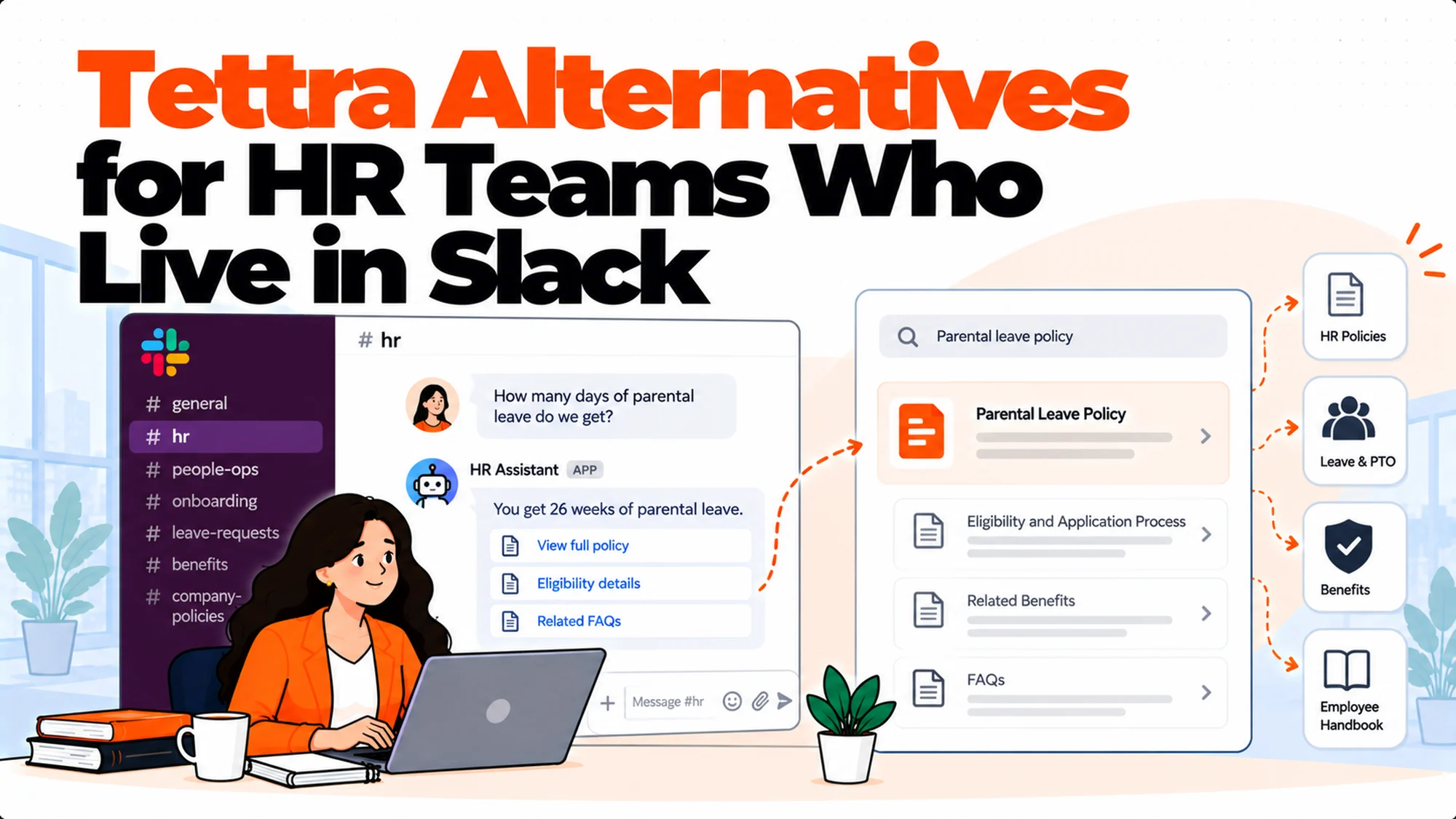
It answers in Slack. Not a notification that links to a portal. The answer appears where the question was asked, which removes three of the four steps in the story above.
The question queue. Unanswered questions collect as a visible backlog, which becomes the list of documents worth writing next. Almost nothing else in this category does this, and it is the single best mechanism for keeping a library aligned with what people actually need.
Both are about behaviour rather than storage. Every tool here stores documents competently. These two change where and whether people ask.
What to do: if your questions arrive in Slack rather than a ticket queue, weight surface heavily. Among Tettra alternatives very few are chat-native, and the ones that are not will move answering into a place people have to choose to visit.
Why Teams Look at Tettra Alternatives
Five reasons, in rough order of frequency.
The ten user minimum. Below ten seats it makes a cheap tool expensive per head.
Light on governance. No deep versioning, no multi-stage approval workflows. Fine for most HR libraries and not fine for a compliance-heavy one.
Only one tier is published. The Scaling plan has a figure; above it is a conversation.
Authoring is deliberately simple. Good for getting pages written, limiting if you want structured documentation with hierarchies.
Not a fit if Slack is not the centre. If your company runs on Microsoft Teams or questions arrive by email, the main advantage does not apply.
What to do: separate the pricing complaint from the capability complaint. The first has a clear answer below ten seats and the second points at an entirely different category.
The Published-Price Tettra Alternatives
The ones you can evaluate without a sales call.
Helpjuice prices by included users: 249 per month including 30 users, 449 including 100, and 799 for unlimited. The best economics here for a company-wide reader population. Its page shows no currency symbol anywhere.
Slab has the best writing experience, with unified search across connected tools. Free to 10 users, then $6.67 Startup and $12.50 Business per user per month, both billed annually.
Notion is where many handbooks already sit. Free, then $10 Plus and $20 Business per member per month.
Confluence is a configurator: $7.15 Standard per user per month at 25 seats, falling to $5.78 at 300. Free to 10 users permanently.
What to do: note that three of the four have real free tiers. For a team under ten people that is the direct answer to the minimum problem, and it costs nothing to test.
| Tool | Published entry | Free tier | Chat-native answering |
|---|---|---|---|
| Tettra | $8 per user per month, 10 minimum | 30 day trial | Yes, Slack |
| Helpjuice | 249 per month for 30 users | No, trial only | No |
| Slab | $6.67 per user per month, annual | Yes, to 10 users | No |
| Notion | $10 per member per month | Yes, genuinely usable | Within the workspace |
| Confluence | $7.15 per user per month at 25 seats | Yes, to 10 users | Within Atlassian |
| Guru | Quote-based | No | Yes |
| Document360 | Quote-based | No | Limited |
The Quote-Based Options
Two worth a call, both of which changed this year.
Guru is the closest on surface, answering in chat and through a browser extension, with the strongest verification workflow in the category. It stopped publishing prices in 2026 and now offers packages built around your scale.
Document360 has the strongest versioning and review reminders, suited to structured documentation. It also stopped publishing and now runs a three-step questionnaire.
If surface is what you are protecting, Guru is the one to call. It is the only alternative here that competes directly on answering where people already are.
What to do: price the published four first so you arrive at any call with a baseline. It makes the conversation comparative rather than exploratory.
What Tettra Alternatives Look Like on Authoring
The other half of the trade, since surface is only one axis and most teams care about writing too.
Tettra is deliberately light. A simple editor aimed at getting pages written rather than formatted, which is a genuine design choice and the reason content gets created at all in some teams.
Slab is the clear upgrade. The best editor in this comparison, with a reading experience to match. If the maintainer finds writing unpleasant, documents do not get written, and that is a real failure mode rather than a comfort issue.
Notion offers the most structure. Databases alongside prose, which suits a policy register with owners and review dates. It also permits enough freedom that libraries drift into several competing structures.
Confluence and the documentation platforms are heavier. More capability, more administration, and generally more than an HR library of forty documents requires.
The trade is consistent. Tools that are pleasant to write in tend to be lighter on governance, and tools with strong governance tend to be heavier to use. Nothing here is both.
What to do: have the person who will actually maintain the content do the writing test, not the person running the evaluation. Their comfort predicts whether the library stays current, which predicts everything else about whether the purchase was worth making.
The Arithmetic at Three Sizes
Model matters more than rate, and here is the shape of it.
At 25 people. Tettra Scaling is $200 a month. Slab Business is $312.50. Notion Business is $500. Helpjuice is 249 flat for up to 30 users. Tettra is cheapest.
At 120 people. Tettra Scaling is $960. Slab Business is $1,500. Notion Business is $2,400. Helpjuice is 799 on its unlimited tier. Helpjuice has overtaken.
At 300 people. Tettra Scaling is $2,400. Slab Business is $3,750. Notion Business is $6,000. Helpjuice is still 799.
| Headcount | Tettra | Slab Business | Notion Business | Helpjuice |
|---|---|---|---|---|
| 25 | $200 | $312.50 | $500 | 249 |
| 120 | $960 | $1,500 | $2,400 | 799 |
| 300 | $2,400 | $3,750 | $6,000 | 799 |
What to do: run this at your twelve-month headcount. Tettra is competitive in the middle and loses badly at scale, like every per-seat option here.
Checking the Published Figures Yourself
Worth doing, because minimums and billing terms are exactly what gets lost when a rate is quoted second-hand.
Tettra states its minimum on its own page. Its pricing is published openly with the ten user minimum beside the rate and the yearly billing toggle visible. Most comparison tables drop both.
Slab's paid tiers are annual. A monthly budget built on those figures describes something you cannot buy monthly.
Confluence changes with seat count. Any Confluence figure quoted without its headcount belongs to a different company, and the gap between a 25-seat and a 300-seat rate is substantial.
Helpjuice shows no currency symbol. Its tiers are plain and the currency is not stated on the page, which is worth confirming before it goes into a budget.
What to do: check three things on any comparison you did not build, this one included. The headcount behind each figure, whether a minimum applies, and whether the rate requires annual billing. Those three corrections reorder tables more often than the rates themselves.
How Tettra Alternatives Handle Growth
The thing that decides whether today's choice survives two years of hiring.
Per-seat tools track headcount automatically. Every hire adds cost, invisibly and continuously, and nobody re-examines it because it arrived gradually.
Included-user tools step. Nothing changes between thresholds and then one hire crosses a line. Lumpy and predictable, which is easier to budget if you write the thresholds down.
Tettra is per seat with a floor. The floor hurts at the bottom and the per-seat model hurts at the top, so it is most competitive in the middle, roughly between fifteen and eighty people.
And the surface advantage does not scale away. Answering in chat remains valuable at 300 people. The pricing stops being competitive long before the capability does, which is the awkward part of this particular decision.
What to do: if you are growing quickly and want to keep chat-native answering, price the quote-based option rather than assuming a portal is the only affordable path at scale. The conversation is worth having before the per-seat bill forces it.
Replacing the Question Queue
If you leave, this is the capability you are most likely to miss, and it can be partly rebuilt.
Keep a running list of unanswered questions. Anywhere. A spreadsheet works. The point is that the question somebody could not answer becomes a visible item rather than a conversation that ends.
Review it monthly and write the top five. That list is more useful than any content audit, because it is derived from what people actually wanted rather than what somebody assumed.
Tag the source. Whether a question came from a new joiner, a manager or a specific team tells you which document to write and for whom.
And close the loop. When a question gets documented, tell the person who asked. It is the thing that makes people keep asking rather than giving up.
What to do: start the list before you migrate. You will have a month of real data about your own gaps, and it makes the first weeks in any new tool considerably more productive.
The habit matters more than the mechanism, which is why it transfers. A team that has internalised the idea that an unanswered question is an item of work will keep doing it in a spreadsheet, a shared channel or a project tool. A team that only did it because the software prompted them stops within a month of switching, and nobody notices for about a year, by which point the library has drifted toward whatever the maintainers happened to find interesting rather than what the company kept asking about.
Why Chat-Native Answering Is Rare
Worth understanding, because it explains why the shortlist of genuine Tettra alternatives on this dimension is so short.
Most knowledge tools were built as destinations. A place content lives, with chat integration added later as a notification channel rather than an answering surface. Those are different things and the marketing language for both is identical.
Real chat answering requires solving permissions in chat. The tool has to know who is asking and what that person may see, inside a channel where other people are watching. That is harder than it sounds and it is why many integrations only post links.
And it requires the content to be answerable in a sentence. A tool whose unit is a forty-page document cannot answer well in a channel, so the format and the surface are connected.
Which is why the Slack-first tools are lighter. They optimised for short answerable units and chat delivery, and traded away the deep documentation features. That trade is the product rather than an oversight.
What to do: ask every vendor to demonstrate answering in a channel, with a question whose answer sits in a restricted document, asked by somebody without access. What happens next tells you whether the integration is an answering surface or a notification.
What Surface Actually Means
Worth being concrete, because it is the thing the opening story turned on and it is rarely discussed.
A portal requires a decision. Somebody must remember it exists, choose to open it, and search. Three opportunities to give up and ask a colleague instead.
Chat-native answering removes all three. The question gets asked where people already are and the answer arrives in the same place.
Which is why usage differs so sharply. The same content in a portal and in chat produces very different question volumes, and the difference is entirely about friction rather than quality.
And it is why Slack-first tools punch above their features. Tettra is lighter than most alternatives on governance and wins on the measure that actually matters in a lot of companies.
What to do: check where your questions currently arrive. If the answer is Slack, a portal-shaped tool will reduce usage regardless of how much better its documents are, and the comparison tables will not warn you.
There is a measurable version of this worth running before any decision. For one week, log where each question to HR arrived: a channel, a direct message, email, or in person. Most teams discover the distribution is far more concentrated than they assumed, and usually in chat. That single week of tallying is better evidence than any vendor demo, because it describes your company rather than a generic one, and it frequently settles the surface question outright.
Running a Trial That Measures Surface
Standard trials measure documents. This one measures behaviour, which is what the decision turns on.
Put five real policies in each shortlisted tool. The five people ask about most, moved by whoever will maintain them.
Then do not tell anybody where they are. Instead, answer the next two weeks of questions by pointing at whichever tool you are testing, and watch what people do the following week.
Count unprompted returns. Did anybody go back to the tool without being sent there. That number, not satisfaction scores, tells you whether the surface works.
Ask twenty real questions in each. From last month's HR inbox, counting usable answers rather than relevant pages.
And ask three the documents do not cover. The honest behaviour is to say so. A confident sourceless answer is the failure that matters most because people act on it.
What to do: run the unprompted-return count in both a chat-native and a portal tool. The difference is usually larger than anybody expects and it is invisible in every other form of evaluation.
Two Mistakes That Repeat
Both common, both expensive, both avoidable with a number taken in advance.
Treating surface as a preference. It is the strongest predictor of whether a library gets used, and it sits in no feature matrix. Teams that rank tools on document capability and then wonder why usage fell have made this mistake.
Optimising for the smallest team you will ever be. A tool chosen because it was cheapest at twelve people is, at eighty, frequently the most expensive option and holds all your content. The minimum that annoyed you at four people stops mattering entirely at twenty, and the per-seat curve that looked fine at twelve does not at eighty.
What to do: price at three sizes and test at the surface where questions actually arrive. Those two checks prevent nearly every regret reported in this category.
When None of These Is the Answer
Three situations that make the shortlist irrelevant.
Nobody owns the content. Governance features assume an owner with time. Without one they are configuration. We covered this in HR knowledge management.
The content is wrong rather than hard to find. Rewriting is the project and no tool does it.
The company is not on Slack. Tettra's main advantage does not apply, and the comparison becomes an ordinary knowledge base choice.
What to do: check all three first, because each one changes which article you should be reading.
If the Problem Is Answers Rather Than Documents
Even Tettra returns a document, albeit in the right place. If people still ask after finding the page, the gap is interpretation rather than location.
An answering layer returns a sentence with a source. Not a page to read in a channel, an answer, with a link to check it.
Matram is one of these, and it is owned by the same people who publish this site, which you should weigh against this section. It publishes flat pricing at $29, $69 and $199 per month with unlimited seats, which matters because the reader population for a handbook is everybody and per-seat pricing multiplies against exactly that.
Its limits are specific. There is no free tier, only a 30 day trial without a card. It answers rather than actioning tickets, so it states the policy and does not process the request. And it is not an ITSM or HR workflow platform, so there is no case management or approvals.
It has no authoring or question queue. You keep documents wherever they are and you would need to rebuild the backlog habit yourself.
What to do: be precise about the complaint. "People cannot find the page" and "people find the page and still ask" are different problems, and only the second one needs this shape. The way to tell them apart is to watch somebody ask. If they search, find the right document, open it and then message a colleague anyway, the document is not answering the question even though it contains the answer, and that is an interpretation problem no amount of better search fixes.
Migrating Without Losing Usage
Four steps that protect the thing most likely to break, which is habit rather than content.
Keep answering in chat during the transition. Even if the new library is a portal, bridge it so questions asked in channels still get answered there for the first few months.
Move the five most-asked documents first and announce only those. A gradual move keeps the old surface working while people learn the new one.
Link from chat, not from a wiki index. Pinned links in the channels where questions arrive do more for adoption than any landing page.
And measure weekly for the first two months. Question volume to HR is the signal. If it rises after week three, the surface change is the cause and it is recoverable at that point.
What to do: do not switch off the old surface until the new one is demonstrably being used. The temptation to force adoption by removing the alternative usually produces questions to humans rather than visits to a portal.
Three Things Tettra Alternatives Get Wrong for HR
Common gaps, worth checking specifically rather than assuming.
Permissions that cannot separate the handbook from pay content. HR libraries hold material with sharply different audiences, and lighter tools express that awkwardly. Test your hardest rule before committing.
No visible review date. A reader who cannot tell whether a document is current stops trusting the library, and that belief outlasts any content fix. Check what a reader sees, not what an administrator sees.
No way for a reader to flag an error. Without it, the only people who notice staleness are the ones maintaining the content, which is the smallest group and the least likely to spot it.
What to do: add those three to your evaluation checklist. They are cheap to test, rarely demoed, and they are what determines whether a library stays trustworthy after the first year.
The Decision Table
| Situation | Scale | Setup | Primary Pain | Recommended Starting Point |
|---|---|---|---|---|
| Fewer than ten users | Under 10 | Tettra priced | Minimum doubles the real rate | A free tier elsewhere |
| Slack is where questions arrive | Any | Chat-first company | Portals lose usage | Stay, or Guru |
| Whole company reads the handbook | 120 plus | Per-seat pricing | Cost scales with readers | Helpjuice unlimited |
| Compliance needs versioning | Any | Light governance | No version proof | Document360 or Guru |
| Company runs on Microsoft Teams | Any | Not a Slack shop | Main advantage does not apply | Confluence or Helpjuice |
| Already on Confluence or Notion | Any | Licence exists | No marginal cost | Use what you have |
| Page found, question still asked | Any | Library healthy | Interpretation, not location | An answering layer |
Questions for Every Vendor
Six, and the first two matter most for this particular switch.
Where does the answer appear? In chat, in a portal, in a browser extension. This is the surface question and it is the one most likely to change outcomes.
What does this cost at our headcount, with any minimum applied? Minimums and annual billing terms are where published rates mislead.
Does it show what people searched for and did not find? The question queue equivalent, and it varies widely.
What happens when documents do not contain the answer? Test it with three questions you know are not covered.
How quickly does an edit change the answer? Ask for a number.
Can a reader flag a document without editing it? Cheap capability, measurable improvement over a year.
What to do: ask the first question first. It is the one that predicts whether usage will survive the migration, and it is almost never on a standard evaluation checklist.
A Short Answer by Situation
Most people comparing Tettra alternatives want a recommendation, so here it is by what is driving the search.
Under ten people and the minimum hurts. Take a free tier. Confluence to ten users, Slab to ten users, or Notion's free plan. At that size you should not be paying for a knowledge base at all.
Slack-first and growing past the point where per-seat hurts. Guru is the closest on surface, and you will need to have the pricing conversation because it no longer publishes.
Whole company reads and cost is the problem. Helpjuice, on included-user pricing, accepting that answering moves to a portal and planning for that.
Compliance needs real versioning. Document360 or Guru. The lighter Tettra alternatives will not produce the version that was live on a given date.
Already standardised on Confluence or Notion. Use it, test its answering, and spend the saved effort on ownership and content rather than on a migration.
What to do: match yourself to one line and stop comparing. In this category the distance between the right shape and the wrong shape is much larger than the distance between any two products within a shape.
What a Good Outcome Looks Like
Worth defining, because "better knowledge management" is not a result anybody can check.
Question volume to HR about documented things falls. Measured, with a before-number. This is the only outcome that matters.
The library stays current without heroics. Owners named, review dates in calendars, and a visible last-reviewed stamp on every page.
People can tell whether a document is current. Which is what stops the slow collapse of trust that kills libraries regardless of their content.
And the cost is predictable at next year's headcount. Either flat, or per seat with the growth modelled rather than discovered.
What to do: write those four down as the success criteria before you choose anything. A project with stated criteria gets reviewed honestly; one without becomes a thing nobody mentions, and the next person to raise it starts where you did.
What Getting This Wrong Costs
The visible cost is a nicer library that gets used less, which is the opening story and is genuinely demoralising for the person who ran the project.
The larger cost is that question volume is the measure nobody took before moving. Without a before-number, the increase afterwards is invisible, and the project gets recorded as a success because the documents are better. Six months later somebody observes that HR is answering a lot of repeat questions, and nobody connects it to a migration that improved everything except the surface.
The second cost is the minimum, in the other direction. A team of four that moves away from Tettra to avoid paying for ten seats frequently lands on a per-seat tool that costs more as soon as the company reaches twenty people. The saving was real for a year and the trajectory was wrong, and by then the content has moved and moving again is a project.
And the third is losing the question queue without replacing it. It is the mechanism that keeps a library pointed at what people actually need, and it is easy to undervalue because it works quietly. Teams that lose it tend to notice about a year later, when the library has drifted toward what the maintainers found interesting rather than what the company kept asking.
There is also an organisational cost to a migration that reduces usage, and it is worth naming because it affects what you can do next. A knowledge project that visibly failed makes the next one harder to fund, regardless of whether the diagnosis was right the second time. The person who championed the move spends their credibility on it, and the company concludes that knowledge tooling does not work here rather than that the surface was wrong. That is why getting this particular decision right matters more than its cost suggests: you probably get one attempt every few years, and spending it on a tool that improves documents while reducing usage is the worst available outcome.
So the question is not which Tettra alternative has more features. It is where your people ask questions, how many seats you really need, and whether the thing you are about to buy answers where they already are.
When You're Ready to Switch
Work out whether you are above or below ten seats. Below, the minimum is the entire argument and the free tiers elsewhere answer it directly. Above, Tettra competes on its merits and the minimum is a non-issue.
Then check where your questions actually arrive. If the answer is Slack, treat surface as a hard requirement rather than a preference, because a portal-shaped tool will reduce usage no matter how much better its documents look.
And count questions to HR before you move anything. It is the only measure that reflects whether the thing works, and without a before-number you will not be able to tell whether a better library made things better.
If you take one thing from this comparison, take the distinction between storage and behaviour. Every tool here stores documents competently, and they differ by small amounts on editors, hierarchies and workflows. They differ by large amounts on where an answer appears and on what the bill does as you hire. Those two properties determine whether the library gets used and whether you still want it in three years, and both of them are easy to check before you commit. The feature matrix, which is where most evaluations spend their time, decides almost nothing you will notice.
Frequently Asked Questions
What does Tettra actually cost for a small team?
Its published Scaling rate is charged per user per month, billed yearly, with a ten user minimum, and the body of this article gives the figure. For a team of four that means paying for ten seats, so the effective rate per person is more than twice the headline. Above ten users the minimum becomes irrelevant and the stated rate applies normally, which is why this is a problem specifically for very small teams and a non-issue for everybody else.
What is the question queue and why does it matter?
Unanswered questions collect as a visible backlog, which becomes the list of documents worth writing next. Almost nothing else in this category does it, and it matters because it keeps the library aligned with what people actually ask rather than what the maintainers assume. If you leave Tettra, rebuild it manually with a running list reviewed monthly, because losing it is the capability teams most often miss afterwards.
Which alternatives answer inside Slack?
Guru is the closest, answering in chat and through a browser extension, though it stopped publishing prices this year. Notion and Confluence both answer within their own workspaces rather than in chat. Helpjuice and Slab are portal-shaped. If chat-native answering is what you are protecting, the shortlist is genuinely short, and that is worth knowing before a comparison based on document features.
Why did questions go up after we moved to a better tool?
Because surface changed. Answering in the channel where somebody asks removes the need to remember a portal exists, open it, search and read. A portal reintroduces all four steps, and people reasonably ask a colleague instead. The documents got better and the friction got worse, and friction is what determines whether people use a library at all.
How do the alternatives compare on price?
It depends almost entirely on your reader count. At 25 people Tettra is the cheapest of the published options. At 120 people the included-user model overtakes it, and at 300 people nothing priced per seat is close. The table in this article prices four options at three sizes, and the crossover usually arrives sooner than a budget built on today's headcount assumes.
Is Tettra too light on governance?
For most HR libraries, no. It verifies pages and shows owners, which covers the common failure of content going stale unnoticed. It does not have multi-stage approval workflows or the deep versioning that documentation platforms offer. If you need to produce the exact version of a policy that was live on a given date, that is a real gap and it points at Document360 or Guru rather than at the lighter options.
What if our company uses Microsoft Teams rather than Slack?
Then Tettra's main advantage largely does not apply and the comparison becomes an ordinary knowledge base choice. Confluence and Notion both answer within their own surfaces, and Guru integrates with Teams. The useful question becomes where your people currently ask questions, since the principle holds regardless of which chat tool you run: answering where the question is asked beats answering in a portal.
Should we keep Tettra and add something else?
It is a sensible arrangement if the gap is interpretation rather than location. Keep the Slack-native library and the question queue, and add a layer that returns answers rather than pages from the same documents. You are paying twice, so compare that against the migration cost rather than against the licence alone. What to avoid is two libraries with overlapping content, because readers then have to guess which one is current.