TL;DR
- The pricing unit decides who absorbs the cost of a bad month. That matters more than the rate attached to it.
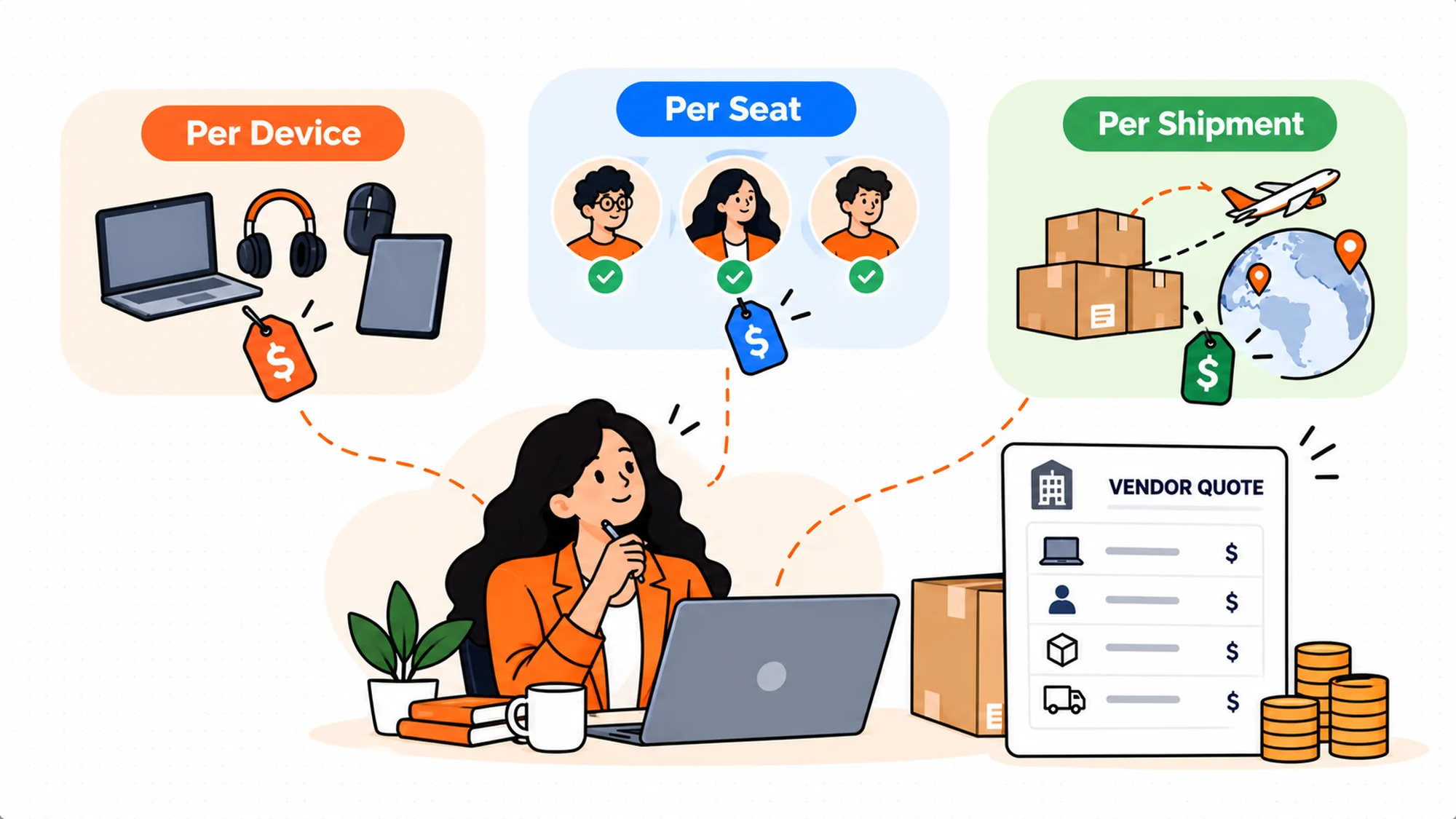
- Four models exist in this category: per device, per person, per transaction, and a platform fee with transactional extras. Each suits a different shape of company.
- Nobody publishes any of them. Six vendors checked against their own pages on 14 October 2026 and not one shows a figure, so you will be reverse-engineering the model from a quote.
- Per person is predictable and overcharges a company with spare machines. Per transaction is efficient and punishes a hiring push.
- Your turnover rate decides this more than your headcount does. Pull last year's real joiner and leaver numbers before any conversation.
- Ask every vendor to break a quote into recurring and transactional components. A single blended figure cannot be stress-tested.
The Same Fleet, Three Very Different Bills
Take a company of two hundred people with two hundred and thirty machines, because spares and devices with leavers exist.
Priced per device, you pay on two hundred and thirty. Spares cost you money while sitting in a cupboard, which is irritating and also an incentive to keep the fleet tight.
Priced per person, you pay on two hundred. The thirty extra machines ride along free, which looks like a win and is paid for in a higher rate per head.
Best tools for Device Management
Priced per transaction, you pay nothing for either number and everything for movement. A quiet year is cheap. The year you onboard sixty people and offboard forty is not.
Same company, same hardware, three bills that can differ by a meaningful margin in either direction depending on what kind of year it turns out to be. The rate is a detail. The unit is the decision.
The Four Models
Per device
You pay for each machine under management, whether somebody is holding it or not.
Suits a company with tight fleet discipline and few spares, and anybody who wants the cost of idle hardware to be visible rather than hidden.
Punishes a company that keeps a healthy spare pool, which is exactly what you want for fast replacement. There is a real tension here: the model charges you for the thing that makes your service good.
Per person or per seat
You pay for each employee covered, regardless of how many devices exist.
Suits companies where people hold more than one device, and anybody who values a predictable number that tracks headcount and therefore tracks the budget everybody already understands.
Punishes a company with a lean device footprint, because you are paying a per-head rate built on an assumption of roughly one machine each.
Per transaction
You pay per shipment, per collection, per storage month. No standing fee, or a small one.
Suits stable teams with low turnover, where the fleet mostly sits still and the vendor's work is genuinely occasional.
Punishes growth and churn. A hiring push doubles the bill, and so does a redundancy round, which is the worst possible month to receive an unexpected invoice.
Platform fee plus transactional
A standing charge for the system and the register, with movement billed on top. The most common shape in practice.
Suits most companies, which is why it is common, and makes the quote harder to compare because two components can be traded against each other.
Punishes nobody particularly, and hides the exposure. A vendor can quote a low platform fee and high transactional rates, or the reverse, and the same company will pay very different totals depending which they chose.
| Model | Cheap when | Expensive when | Who it suits |
|---|---|---|---|
| Per device | Lean fleet, few spares | Healthy spare pool | Tight fleet discipline |
| Per person | Multiple devices each | One device each | Predictable budgeting |
| Per transaction | Low turnover | Hiring push or layoffs | Stable headcount |
| Platform plus transactional | Depends on the split | Depends on the split | Most companies, if split is visible |
The Invoice That Arrived in the Wrong Month
A 160-person company on transactional pricing had a good first year. Low turnover, steady headcount, and a bill that was genuinely cheaper than the per-person quotes they had turned down. The model fitted and the decision looked correct.
Then they raised a funding round and hired forty people in a single quarter. Every one generated a device order, a shipment and a configuration charge, and several generated a second delivery because the first address was wrong. The equipment invoice for that quarter was roughly four times the previous one.
Nothing was overcharged. Every line was at the rate agreed, for work genuinely performed, during a quarter when the company had deliberately chosen to spend money on growth. The problem was that nobody had modelled what the model did under the conditions the company was actively planning for.
The reverse case is just as common and less discussed. A company on per-person pricing through a flat year pays a predictable sum for a vendor doing almost nothing, which feels like waste and is in fact insurance that did not pay out. Both outcomes come from the same failure: choosing a unit without asking what it does in the year you are expecting.
The Number That Actually Decides It
Not headcount. Movement per year, as a percentage of your fleet.
Count last year's joiners, leavers and reassignments, add them, and divide by your device count. That single figure tells you which half of the table you are in.
Under roughly fifteen per cent, transactional pricing is usually cheaper, because you are paying for work the vendor genuinely is not doing most of the time.
Over roughly thirty per cent, a recurring model is usually cheaper and considerably less alarming, because the bill stops tracking your worst quarters.
In between, it depends on whether your movement is steady or spiky, which is a separate question worth answering. Thirty people joining evenly across a year is a different cost shape from thirty joining in one quarter, even though the annual figure is identical.
Most companies do not know this number, and it takes twenty minutes to produce from an HR export. It is the single most useful thing you can bring to a vendor conversation.
A second figure is worth producing at the same time and almost nobody has it: how long devices actually sit idle between holders. Count the machines returned last year, and for each one the gap between the return and the reissue. That total in device-months is what storage charges attach to, and it is the line most often absent from an estimate and present on an invoice. Companies with a healthy spare pool and slow reissue frequently discover this is their second largest cost component after the hardware itself.
Where the Hardware Sits in the Quote
A complication worth separating out, because it causes more confusion than the models themselves.
Hardware can be inside the price or outside it, and both arrangements exist under every model above. A per-person figure that includes the machine is a completely different number from a per-person figure that covers management only and bills hardware separately at cost or at a markup.
Ask explicitly: does this figure include the device itself. Then ask what the markup on hardware is, because a vendor buying at volume and reselling to you is a legitimate and normal arrangement and you should know the margin you are paying for the convenience.
The subscription models fold hardware in by design, which is their defining feature and the reason they leave you with no residual asset. The management-only models leave you buying machines and owning them, which gives you something to sell at the end and makes the annual cost lumpier.
Neither is better. They are different answers to whether you want an asset or a predictable line item, and that is a finance question rather than an IT one.
So involve finance in the model conversation rather than only in the approval. Whether equipment lands as capital or as operating expenditure, and whether anything sits on the balance sheet, changes which option your own organisation prefers for reasons that have nothing to do with device logistics. Teams that bring finance in at the end frequently find a decision reopened on grounds nobody in the evaluation had considered.
What to Ask Before the Rate
Six questions, and none is about the number.
Which unit is this quoted in, and what exactly counts as one? A device in storage, a device with a leaver, a contractor's machine. Definitions vary and the edges are where the surprise lives.
What is the split between recurring and transactional? Insist on the breakdown rather than a blended figure. A single number cannot be stress-tested against a bad month.
What happens in a month with triple the normal movement? Ask them to price your actual worst month from last year. The gap between that and the normal month is the risk they have left with you.
Is there a minimum commitment or a floor? Common, rarely volunteered, and the thing that makes a small buyer discover in week four that they were never the target customer.
Does the figure include hardware, and at what markup?
And what is excluded? Retrieval, storage between holders, second-address shipping and devices the vendor did not supply are the four that recur, each phrased as a reasonable scope boundary. Together they are routinely the difference between the cheapest quote and the most expensive.
Ask all six in one go rather than across several calls. A vendor who can answer the set in a single conversation knows their own commercial model well, and one who needs to come back on three of them is telling you that the arrangement is being assembled for you rather than selected from something that already exists.
The Definitions That Decide What You Are Billed
A model is only as clear as the words underneath it, and those words are where quotes diverge from invoices. Six definitions are worth pinning down before signature.
What counts as a device under management. Is a machine in storage billable? One with a leaver, awaiting collection? A spare that has never been issued? One in repair? Different vendors answer differently and all four answers are defensible, so this is a question rather than an accusation.
What counts as a movement. A shipment to a new starter is obvious. Less obvious: a redelivery after a failed first attempt, a collection that is attempted and fails, a device moved between two warehouses, a reissue of a machine already in stock. Each may or may not be billable.
What counts as a person. Under per-seat pricing, does a contractor count? Somebody on long leave? A leaver whose device has not come back? The device population and the employed population are not the same list, and the gap between them is money.
When billing starts and stops. From order, from dispatch, from delivery, or from the start date. On the leaving side, from the resignation, the last working day, or the day the machine is received back. A device sitting with a former employee for six weeks is billable under some definitions and not others.
What a storage month is. Calendar month, thirty days, or pro rata. A machine returned on the twenty-eighth and reissued on the third can cost two storage months under one definition and a few days under another.
And what the floor is. Minimum devices, minimum spend, minimum term. Common, rarely volunteered, and the thing a small buyer most often discovers after investing weeks.
None of these is a trap being set. They are the ordinary fine detail of an operational contract, and the only failure is not asking.
How to Model It Before You Ask
You can build a usable estimate of your own costs before any vendor conversation, which gives you something to test quotes against in a category with no public benchmark.
Start with your fleet count, not your headcount. Devices in use, plus spares, plus anything with a leaver, plus anything in repair. That total is usually ten to fifteen per cent above headcount and it surprises people.
Add last year's movements. Shipments out, collections back, reassignments, redeliveries. Pull the real figures rather than estimating, because the estimate is always low.
Then work out your storage months. Devices returned and not immediately reissued, multiplied by the weeks they sat. Most companies have never calculated this and it is frequently the largest hidden line in a quote.
Put a rough rate against each. You do not have real rates yet, and that is fine. The point is the shape: how much of your cost is standing and how much is movement. If movement dominates, a transactional model exposes you. If the standing fleet dominates, a per-device model does.
Write the expected total down. When quotes arrive, a figure far below your own estimate is almost always excluding something rather than being generous, and having a prior makes that visible immediately rather than in month eleven.
The Options
RemoAsset, named below, is owned by the same people who publish HROpsLab. Its limitations are stated as plainly as everybody else's.
RemoAsset
Procurement, deployment, tracking and retrieval, with devices enrolled into your management system before dispatch.
On pricing specifically: it publishes no price and requires a demo, so the model has to be established in conversation like everybody else's. Its other limits are that it is weaker for hardware it did not supply, which affects what counts as a billable device if you already own a fleet, and it is not a device management system.
Workwize
Hardware lifecycle with owned warehouses. Domain is now goworkwize.com; the older address no longer resolves, verified 14 October 2026.
On pricing: warehousing means storage is a real line item rather than an excluded afterthought, which makes the quote more honest and sometimes larger. Ask how storage months are counted. No published price.
Firstbase
Equipment on a subscription basis with retrieval and replacement included.
On pricing: the clearest per-person model in the group, with hardware inside the figure. Predictable, and you hold no asset at the end, so run the four-year arithmetic against your real average tenure before deciding it is cheaper. No published price.
GroWrk and allwhere
Both scope per customer rather than selling tiers.
On pricing: a scoped arrangement can be built in whichever unit suits you, which is a genuine advantage and makes benchmarking impossible, since there is nothing standard to compare against. Neither publishes a figure.
Deel IT
Devices attached to an employment platform.
On pricing: usually shaped around the employed population, which means the unit is effectively per person and the population is narrower than your device count if anybody is employed directly. No published price.
The Comparison
| Vendor | Typical shape | Hardware included | Pricing visibility |
|---|---|---|---|
| RemoAsset | Establish in conversation | Verify | None published, demo required |
| Workwize | Platform plus transactional | Verify | None published |
| Firstbase | Per person, subscription | Yes, by design | None published |
| GroWrk | Scoped to you | Verify | None published |
| allwhere | Scoped to you | Verify | None published |
| Deel IT | Per employed person | Verify | None published |
Every row in the last column reads the same, which is the state of this category and the reason the model matters more than the rate.
The Decision Table
| Situation | Scale | Setup | Primary Pain | Recommended Starting Point |
|---|---|---|---|---|
| Low turnover, stable team | Any | Transactional | Paying for work nobody is doing | Transactional, with a movement floor agreed |
| High or spiky turnover | Any | Recurring, per person | Invoices spiking in your worst month | Recurring, and price the bad month anyway |
| Healthy spare pool | 100 plus | Per person, not per device | Charged for the thing that helps | Per person, or negotiate spares out |
| Lean fleet, one device each | Any | Per device | Per-head rate assumes more | Per device, where it is offered |
| Want an asset at the end | Any | Management-only, buy hardware | Subscription leaves no residual | Separate the hardware from the service |
| Want one predictable number | Under 200 | Subscription with hardware in | Lumpy capital plus variable service | Per-person subscription |
| Quote is a single blended figure | Any | Ask for the split | Cannot stress-test anything | Insist on recurring versus transactional |
| Do not know your movement rate | Any | Produce it first | Choosing a model blind | Twenty minutes on last year's HR export |
How the Model Changes as You Grow
The right unit is not fixed. It moves as the company does, and the transitions are reasonably predictable, which means you can anticipate them at signature rather than discovering them at renewal.
Early, with few people and fewer countries, transactional pricing is almost always right. Movement is genuinely occasional, a standing fee buys a platform you barely use, and paying per event keeps the arrangement proportionate to the work.
Through a growth phase, transactional becomes the worst possible model. Every hire is a billable event, the bill tracks your hiring exactly, and the invoice peaks in the quarter where every other cost is also peaking. This is the most common point at which a company feels overcharged, and the model rather than the rate is the cause.
At stable scale, a recurring model usually wins on both cost and predictability. The fleet is large enough that a per-head or per-device figure is a reasonable approximation of the work, and finance gets a number that moves with headcount, which is a number they already forecast.
And at large scale with a healthy spare pool, per person beats per device, because the spares that make your replacement service good stop being a line item you are penalised for.
So the useful question at signature is not only which model suits you now but what happens if you double. Ask each vendor to quote the same arrangement at twice your current headcount and twice your current movement. Two quotes cost them very little and tell you whether the model bends or breaks.
When the Cheapest Quote Is Not
Worth stating plainly, because it is the single most common outcome of a well-run process in this category.
With published pricing, cheaper usually means fewer features. Here, cheaper most often means fewer inclusions, and inclusions are invisible unless you name them. The four that recur are retrieval, storage between holders, second-address shipping and devices the vendor did not supply, and each is a legitimate scope boundary phrased as a capability.
So the comparison has to be rebuilt rather than read. Put your own inclusion list down the side of a table, each vendor across the top, fill it in from their own words, then add every extra at their own stated rates using your real volumes rather than an average month.
The ranking changes surprisingly often. When it does not, you have a decision you can defend when it is questioned, which is worth the hour by itself.
And do the arithmetic in the unit you chose rather than the unit each vendor quoted in. Converting four different shapes into cost per person per year, fully loaded, is tedious and it is the only way four quotes become four comparable numbers.
What Getting This Wrong Costs
The visible cost is a bill that does not match the budget, and it arrives in the specific month you can least afford a surprise. Transactional pricing during a hiring push and transactional pricing during a redundancy round both produce their largest invoices at exactly the moment the company is under strain.
The subtler cost is behavioural. A per-device model quietly discourages keeping spares, which is the single cheapest way to make replacement fast. Teams on that model trim the spare pool to save a small recurring amount and then discover that every failure becomes a shipment, which costs more and takes longer. The pricing unit shaped an operational decision, and nobody connected the two.
And there is the comparison failure, which is the commonest of the three. Four vendors quoting in four different units cannot be ranked, so teams convert everything to a monthly figure, pick the lowest, and discover the following year that the models diverge under their actual conditions rather than under the average month everybody quoted against.
Ask it this way before signing. If next year looks like your worst year rather than your typical one, which of these quotes goes up the most?
When You're Ready to Negotiate
Two things are genuinely negotiable in this category and the rate is usually not one of them.
The unit is negotiable more often than people assume. A vendor quoting per device will frequently price per person if asked, and the conversation about why you want it surfaces useful information in both directions. It costs nothing to ask and it reframes the discussion from haggling to fit.
The inclusion list is where the real movement is. If every quote exceeds the budget, go back with a reduced scope rather than asking for a discount. Dropping storage and redeployment, or taking retrieval only in your top three countries, moves the number far more than negotiation does, and it is an explicit decision about what you will do yourself rather than a discount that quietly removes something anyway.
And a floor or a cap is worth asking for on either side. If you are on a transactional model and worried about a growth quarter, ask for a cap above which rates step down. If you are on a recurring model and worried about paying for a quiet year, ask whether unused movement allowance carries forward. Neither is standard and both are reasonable asks in a category where every arrangement is scoped individually anyway.
Then get the resulting model written down with its definitions. What counts as a device, what counts as a movement, what the floor is, and what happens in a month three times your average. A model you understand at signature is a model you can still explain to finance two years later when the person who signed it has moved on.
Frequently Asked Questions
How do equipment vendors usually price their service?
Four shapes exist: per device under management, per person covered, per transaction such as each shipment or collection, and a platform fee with transactional charges on top. The last is the most common and the hardest to compare, because a vendor can quote a low standing fee with high movement rates or the reverse, and the same company pays very different totals depending which they chose.
Which pricing model is cheapest?
It depends on your movement rate rather than your headcount. Count last year's joiners, leavers and reassignments, divide by your device count, and under roughly fifteen per cent transactional pricing usually wins while over roughly thirty per cent a recurring model usually does. Most companies have never calculated that figure and it takes about twenty minutes from an HR export.
Why does per-device pricing discourage keeping spares?
Because you pay for machines whether or not anybody is holding them, so a spare pool becomes a visible recurring cost. The tension is real: spares are the cheapest way to make replacement fast, and the model charges you for exactly the thing that makes your service good, which leads teams to trim the pool and then find every failure turns into a shipment.
Is hardware included in these prices?
Sometimes, and it varies under every model, so ask explicitly whether the figure includes the device and what markup applies if the vendor buys on your behalf. Subscription models fold hardware in by design, which is why they leave you no residual asset, while management-only models leave you buying and owning machines with something to sell at the end and a lumpier annual cost.
What should I ask for instead of a single monthly figure?
The split between recurring and transactional components. A blended number cannot be stress-tested, whereas a breakdown lets you ask what a month with triple your normal movement actually costs. Ask them to price your real worst month from last year, because the gap between that and a normal month is precisely the risk the vendor has left sitting with you.
Can I negotiate which unit I am charged in?
More often than people assume. A vendor quoting per device will frequently price per person if asked, and the conversation about why you want it surfaces useful information both ways. The larger movement is usually in the inclusion list rather than the rate, so if every quote exceeds budget, go back with reduced scope rather than asking for a discount.
Do any of these vendors publish their pricing?
None of the six checked on 14 October 2026. Every pricing page routes to a demo request or a conversation, because cost genuinely depends on country mix, volume and inclusions. The practical effect is that you will be reverse-engineering the model from a quote rather than reading it, which is why the definitions matter as much as the figures.
HROpsLab takes no vendor money and publishes no paid placements.