TL;DR
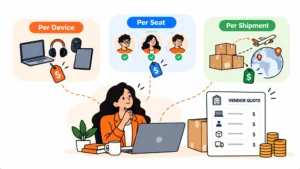
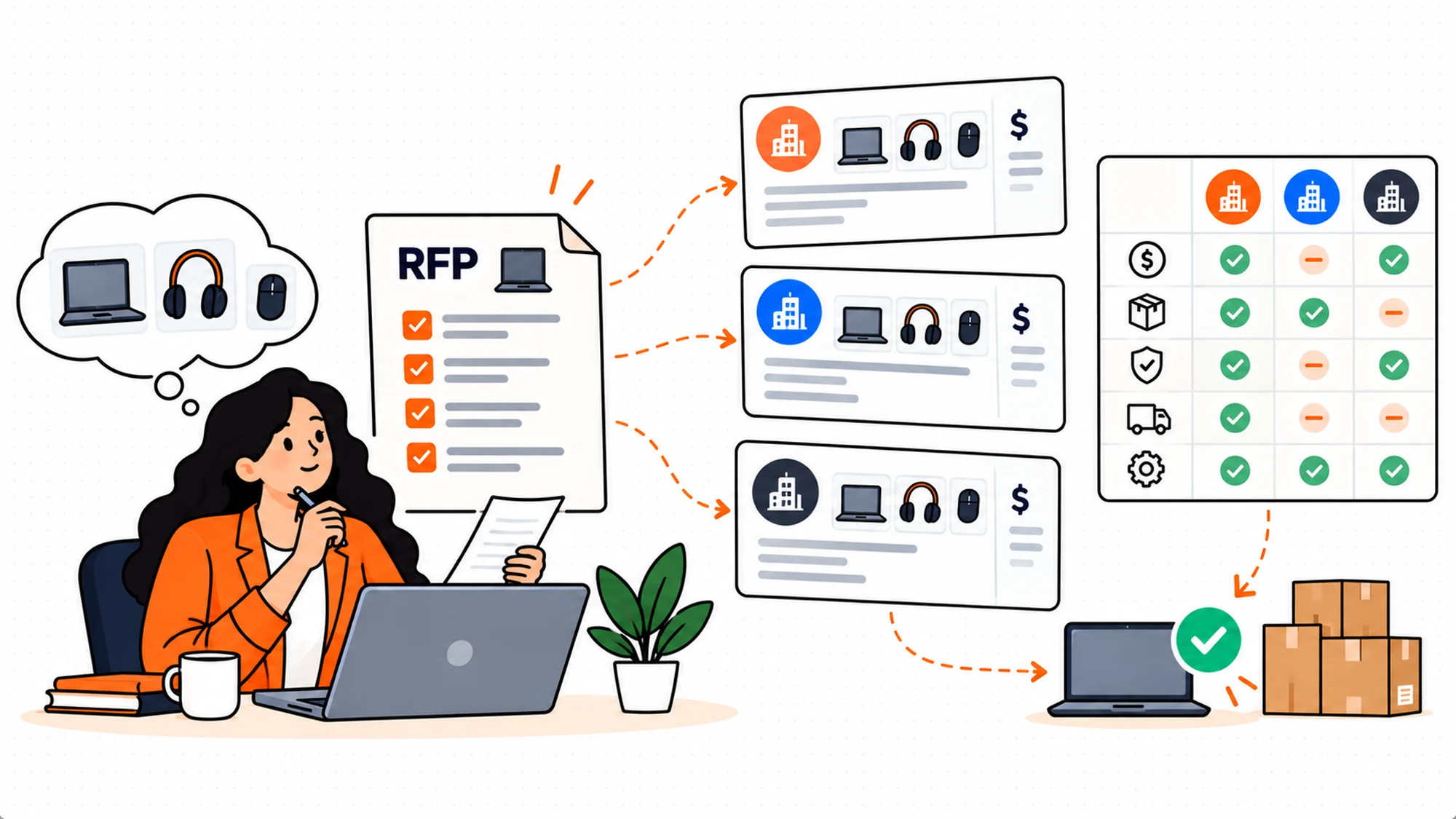
- Four vendors given the same brief will return four incomparable numbers, because the brief constrains what they do and not what they include.
- Nobody in this category publishes a price. Six vendors checked against their own pages on 14 October 2026 and not one shows a figure, so your specification is the only lever you have.
- Specify inclusions, not outcomes. A ten-item list each vendor marks as included, extra or not offered does more than everything else on the page.
- Describe your worst month rather than your average one. Quotes are built on averages and averages are not what breaks.
- Normalise the answers yourself afterwards. Adding each vendor's extras at their own stated rates frequently changes the ranking.
- Four vendors is the right number. Three gives you no spread and six consumes a month of calls for no extra information.
The Quote That Was Cheapest and Then Was Not
A 180-person company ran a textbook process. Four vendors, one brief, a scoring matrix, a decision in six weeks. One quote came in well below the others and they took it, because the brief had been identical and the capability lists looked the same.
Eleven months later the actual spend had passed the second-cheapest quote. Retrieval had been excluded and was billed per collection. Storage between holders was billed monthly and nobody had modelled how many machines sit idle at any time. Two countries turned out to be served through a partner at a markup. And the ninety devices bought before the contract were never imported, so a second spreadsheet ran alongside the platform all year.
None of it was hidden. Every item was in the document, phrased as a scope boundary rather than an exclusion, and nobody had written a brief that forced those boundaries into the open.
Best tools for Device Management
So the lesson is narrow and fixable. An identical brief does not produce comparable quotes when each vendor remains free to decide what the brief covers.
Why This Category Needs a Real Specification
In most software purchases you can shortlist from a pricing page, arrive at a demo knowing the approximate number, and spend the conversation on fit.
Here there is no such page. Every vendor routes to a demo request, a contact form or an invitation to a conversation, and that is not evasiveness peculiar to these companies. Cost genuinely depends on country mix, volume and which jobs you want covered, and those vary enough that a published tier would mislead almost everybody who read it.
Three consequences follow and all of them land on you.
You cannot benchmark. There is no public reference point, so the only comparison available is between your own quotes. That makes an identical specification the entire basis of the decision rather than good practice.
Cheap carries different information. With published pricing, cheaper usually means fewer features. Here it most often means fewer inclusions, and inclusions are invisible unless you name them.
Shortlisting happens after the first call. You will spend hours on vendors you were never going to pick. Sending the specification before the call shortens that considerably, because the first conversation starts from your numbers.
The One Page
Everything that matters fits on a single side. Longer documents get skimmed and produce worse answers, not better ones.
Headcount by country, including the countries with one person. Those single-person markets are where quotes diverge most and where vendors most often assume you meant somewhere easier.
The device standard as a specification, not a model. Processor class, memory, storage, screen size, operating system. Models go out of stock constantly and a quote anchored on one specific machine expires within months.
Last year's real joiners and leavers. This drives cost far more than headcount does. A stable two-hundred-person company and a two-hundred-person company with thirty per cent turnover are completely different customers generating completely different volumes of shipments and collections.
Your replacement expectation as a working-day target you would accept, per country tier rather than globally. Stating what you would accept gets a real conversation. Stating what you would like gets a sales answer.
Whether you already own a fleet, and how many. Vendors handle inbound hardware very differently and several will say yes and mean partly.
What you do not have. No management system, no internal owner, no register. Vendors who cannot serve that will withdraw early, which saves you weeks, and the rest will quote against reality.
The Inclusion Table That Does Most of the Work
This single table is worth more than the rest of the document combined. List the jobs down the side and give each vendor three options across the top: included, extra, or not offered.
| Job | Included | Extra | Not offered |
|---|---|---|---|
| Procurement | |||
| Configuration and enrolment | |||
| Shipping, duty included | |||
| In-country stock | |||
| Tracking devices you did not supply | |||
| Retrieval from leavers | |||
| Storage between holders | |||
| Redeployment | |||
| Repair handling | |||
| Disposal |
Four exclusions recur across the category and every one is a reasonable scope boundary phrased as a capability. Retrieval, often a priced module, which at any meaningful leaver rate is not a rounding error. Storage between holders, billed monthly on every idle machine. Second-address shipping, because people relocate and quotes assume one delivery per lifecycle. And devices the vendor did not supply, which are usually your oldest and nearest to replacement.
Together those four are routinely the entire difference between the cheapest quote and the most expensive one.
Describe Your Worst Month
Vendors price and design around the average, and the average is not what breaks.
Write down three real weeks from the last year. The month you onboarded nine people. The week three laptops failed at once. The quarter you opened a country nobody had planned for. Then ask each vendor what that month costs under their arrangement.
A quote built against a realistic bad month is both more expensive and more honest, and the gap between the two numbers tells you exactly how much variable risk the vendor was quietly leaving with you.
This also surfaces the difference between a platform fee and a transactional one. A vendor charging mostly per shipment looks cheap in a quiet quarter and expensive in a hiring push. A vendor charging mostly a platform fee is the reverse. Neither is wrong, and which suits you depends entirely on whether your volume is steady, which is a fact about you rather than about them.
Who to Send It To, and How Many
Four vendors. Three gives you no spread, and when one withdraws you are down to two and comparing nothing. Six consumes a month of calls and the fifth and sixth rarely change the answer.
Pick them on different models rather than on similarity, because the comparison is more useful when it spans approaches. One warehousing-led platform, one subscription model, one scoped or consultative vendor, and one that fits a specific constraint you have, whether that is an unusual country or an existing relationship.
Send the identical page to all four. Tailoring per vendor feels helpful and destroys the only thing that makes four quotes comparable. If a vendor asks a clarifying question worth answering, send the answer to all four.
One note on tone, because it changes the quality of what comes back. None of this needs to be adversarial, and treating it that way produces worse answers rather than better ones. Vendors in this category deal with a great many vague briefs and most would rather talk to somebody who knows what they are asking. Framing the exercise as help me scope this properly gets fuller answers than framing it as a cross-examination, and the information you want is identical either way.
Give them a deadline and a decision date. Vendors in this category respond to a real timeline, and an open-ended process drifts for months while the person running it gets pulled onto other things. Two weeks for a written response and a stated decision date four weeks out is enough for everybody and short enough that the process stays somebody's active task rather than becoming background noise.
Normalising the Answers
This is the step that changes decisions and the one most processes skip, because by the time quotes arrive everybody wants to choose.
Build one table with your own inclusion list down the side and each vendor across the top. Fill it in from their own words rather than your interpretation. Then add each vendor's extras at their own stated rates, using your real volumes rather than an average month.
The ranking frequently changes. When it does not, you have a decision you can defend when somebody senior asks why, which is worth the hour on its own.
Convert everything to one unit before comparing. Cost per person per year, fully loaded, works across subscription models, ownership models and scoped arrangements, which no vendor-supplied unit will. Write down what you expect the total to be before the quotes arrive, because a number far below your own estimate is usually excluding something and a prior makes that visible immediately.
The Questions to Put in the Covering Email
The specification sets the frame. Six questions in the covering note get you the information a document cannot, because they are about the vendor's own operation rather than about your requirements.
Where does stock physically sit, by country? Not the coverage list, which counts countries a courier reaches and is the least informative figure any vendor publishes. The warehouse list is always far shorter and it is what predicts replacement time.
What happens when a laptop fails in month four, in my hardest country, named? The single most useful question in the set. A good answer carries a number and a caveat, and a vendor naming their weak market before you find it is the strongest signal available in this process.
Who is importer of record, and is duty inside your figure? Per country, for your top five. The three possibilities are that the vendor handles and includes it, that the courier bills your employee at the door on their first morning, or that the obligation sits with you. If one quote is notably cheaper, check this first.
Is there a minimum commitment, in devices or spend? Small buyers hit these constantly and discovering one in week four wastes three weeks.
What do I get on exit? An export of the register in a named format, with a deletion commitment. The register is yours and the answer should be immediate. Hesitation says something about how often customers leave.
And who is my named contact, with what out-of-hours position? If you have no internal IT function, the vendor is effectively filling that gap, and a ticket queue with next-business-day response is a different product from a person who answers.
Ask for somebody technical on the call as well as sales. Sales can answer capability questions accurately and usually cannot answer the stock question with precision, while a solutions engineer either knows or can find out in a day.
What Good Answers Sound Like
It helps to recognise a good answer, because several of these can be answered honestly in ways that sound unimpressive.
On the inclusion table, a good vendor goes through ten items in two minutes. Hesitation usually means the answer depends on the contract, which is fine, and the honest version is to say so rather than describe a capability.
On the bad-month question, a good vendor asks you questions back. Working out what a spike costs requires your volumes, your countries and your failure rate. Anyone quoting without asking has not calculated anything and you will see a revised figure later.
On retrieval, a good answer mentions packaging unprompted. Vendors who actually recover devices know that a prepaid, pre-labelled box arriving at the door is the single largest factor in the return rate. Vendors who describe their chase process instead are telling you where their effort goes.
And on the named contact, a good answer is a person rather than a tier. If the honest answer is a shared queue, that is a legitimate product and you should know you are buying it.
Three answers worth treating with caution. We cover a hundred and fifty countries is a courier statement. That is handled during onboarding sometimes means an implementation detail and sometimes means an unanswered question being moved past the decision point, and if it genuinely is the former it can go in the contract now. We can be flexible on that is the most agreeable answer in any evaluation and the least useful, because flexibility expressed in a call is not a term.
The Options
RemoAsset, named below, is owned by the same people who publish HROpsLab. Its limitations are stated as plainly as everybody else's.
RemoAsset
Procurement, deployment, tracking and retrieval for distributed teams, with enrolment into your management system before dispatch.
Against a specification: it publishes no price and requires a demo, so it cannot be shortlisted from a page any more than its competitors can. It is weaker for hardware it did not supply, which is the existing-fleet row in your table and a real limitation to test with a genuine export. And it is not a device management system, so the configuration row stays your problem.
Workwize
Hardware lifecycle with owned warehouses. Its domain is now goworkwize.com; the older address no longer resolves, verified 14 October 2026.
Against a specification: strongest answers on the storage and redeployment rows, which are the two most often excluded elsewhere. No published price.
Firstbase
Equipment on a subscription basis with retrieval and replacement included by design.
Against a specification: fewer surprises on the inclusion table, because the model bundles more by default. The tradeoff sits on ownership rather than coverage. No published price.
GroWrk and allwhere
Both scope arrangements per customer, GroWrk across a wide country list and allwhere closer to a managed service.
Against a specification: both answer the inclusion table well, because a scoped model can be written to match it exactly. Both take longer, because nothing is comparable until somebody has scoped it. Neither publishes a figure.
Deel IT
Devices attached to an employment platform.
Against a specification: simplifies several rows where the employment relationship already exists in that country. Press on the in-country stock row, since the device product is younger than the employment one. No published price.
The Comparison
| Vendor | Strongest row | Weakest row | Pricing |
|---|---|---|---|
| RemoAsset | Configuration before dispatch | Devices it did not supply | Quote-based, demo required |
| Workwize | Storage and redeployment | Countries without warehouses | Quote-based |
| Firstbase | Inclusion breadth | No residual asset | Quote-based |
| GroWrk | Country coverage | Time to a comparable number | Quote-based, tailored |
| allwhere | Service and ownership gap | Benchmarking, by design | Quote-based |
| Deel IT | Countries already open | In-country stock depth | Quote-based |
The Decision Table
| Situation | Scale | Setup | Primary Pain | Recommended Starting Point |
|---|---|---|---|---|
| First time buying this | Under 200 | One page, four vendors | No idea what to specify | Inclusion table first, everything else after |
| One quote far below the rest | Any | Re-ask on an identical list | Exclusions priced as scope | Re-quote all four on your inclusion table |
| High leaver rate | Any | Retrieval in the base | Per-collection billing compounding | Price retrieval as included before comparing |
| Large pre-existing fleet | 100 plus | Hand over a real export | Two registers in parallel | Test import during evaluation, not after |
| Spiky hiring | Any | Bad-month pricing | Quote built on an average | Ask what your worst month costs |
| Unusual country mix | Any | Scoped vendors in the four | Tiered products decline quietly | Include one consultative vendor |
| No internal owner | Under 150 | Managed service in the four | Nobody to receive the service | Name an owner before sending anything |
| Decision keeps slipping | Any | Deadline and a decision date | Process drifts for months | Set both in the covering email |
Scoring Without Fooling Yourself
Four vendors times a dozen questions produces a lot of information and no decision. Scoring is where most processes quietly go wrong, usually by weighting everything equally.
Weight by what you cannot fix later. Stock location cannot be fixed by you. Response time in a country where the vendor has no presence cannot be fixed by you. An exclusion you discovered in advance can be priced and budgeted, which makes it a cost rather than a risk. So the stock and replacement questions should outweigh the inclusion table, even though the inclusion table is what moves the invoice.
Score the specificity, not just the content. Four working days to a named city from named local stock is something you can hold a vendor to. A statement about aiming for rapid turnaround is a sentence. Both might be true and only one is a commitment, and the difference predicts the relationship better than the stated number does.
Avoid the twenty-criterion weighted matrix. It produces a figure that feels objective and mostly encodes whichever weights somebody chose on a Tuesday. Three tiers across the questions that matter, something like strong, acceptable and concerning, gives the same decision with less false precision and a much easier conversation when it is challenged.
And record who said what. Not to catch anybody out. Because in six months the account manager will have changed and your notes will be the only record of what was promised, and a claim attached to a named person is far easier to re-raise than an anonymous assurance.
Run a Pilot Before You Sign the Term
The last step before signature is worth more than any amount of additional evaluation, and most teams skip it because the decision already feels made.
Take one real hire, in a country that is not your easiest, through the entire chain. Order, ship, configure, confirm the person can work on day one. Then raise a support issue on purpose and watch what happens.
A pilot that only tests the happy path tells you nothing you did not see in the demo. The deliberately raised problem is the whole point, because how a vendor handles a real issue while they are still selling to you is the best available prediction of how they will handle one afterwards.
A vendor who will not support a single-hire pilot has answered a different question honestly, and that answer is also useful. In a category where switching costs are high enough that most companies live with a poor fit for a full term, two weeks of real testing before signature is cheap.
What Getting This Wrong Costs
The direct cost is the gap between the quote and the spend, which in the opening example was most of a year's budget arriving as a series of individually small invoices.
The harder cost is internal. A team that ran a proper process, scored four vendors and chose the cheapest has done everything it was asked to do. When the spend overruns anyway, the lesson learnt is often the wrong one, that vendor quotes cannot be trusted or that procurement processes do not work. The real lesson is narrower: an identical brief does not produce comparable quotes unless it specifies inclusions.
And there is the switching cost that makes this matter more here than elsewhere. Changing equipment vendors means migrating a register, re-papering in-flight shipments and possibly moving physical stock. It is expensive enough that most companies live with a poor fit for a full term rather than fix it, which is exactly why the inclusion table belongs before signature rather than after.
What Belongs in the Contract Rather Than the Quote
A quote is a snapshot and a contract is what you can hold somebody to when the account manager has changed. Four things move from one to the other, and none needs a lawyer.
The replacement commitment, per country, with a remedy. Not a global service level, which is a marketing number. A working-day target for each of your top five markets and a stated consequence if it is missed. Expect confidence on some and hedging on others, which is honest; identical confidence everywhere usually means nobody checked.
Whether duty is included, per country. Covered above and it belongs in the document rather than the email, because the email is what gets lost and the courier asking your new designer for money at the door is what happens next.
What you get on exit. Export format, which fields, and a deletion commitment with a timescale. The register is yours and the arrangement holds your employees' home addresses, so this is a privacy question as much as a housekeeping one.
And the named contact with an out-of-hours position. Ask again at every renewal, because account managers change constantly in this category and the time to discover that yours left in March is not during an incident.
Four of the twelve questions are worth re-asking annually for the same reason: where stock sits, who the contact is, what is included, and what exit looks like. Vendors open and close warehouses as their own customer base moves, scope creeps in both directions during renewals, and the first sign of a change is usually a replacement that takes a week instead of a day.
When You're Ready to Run It
Two things before you send anything, and neither involves a vendor.
Build the register first. Every device, serial, holder, location, date, cost. It will be incomplete, the gaps are themselves a finding, and it is what lets you answer the existing-fleet question with a number rather than an estimate. It also survives whichever vendor you pick.
Name the owner. One person, with time, who will receive the quotes, run the normalisation and make the call. Vendors can tell within one conversation whether there is an owner on your side, and processes without one produce quotes shaped for a customer who is not paying attention.
Then send the page, give them two weeks, and spend the hour on normalisation when the answers come back. The whole exercise is a day of work spread across six weeks, and it is the difference between choosing a vendor and choosing a number.
Frequently Asked Questions
Why do equipment vendor quotes vary so much on the same brief?
Because an identical brief does not constrain what each vendor decides to include. Retrieval, storage between holders, shipping to a second address and tracking devices they did not supply are all reasonable scope boundaries, and all four are commonly phrased as capabilities rather than exclusions, so the cheapest quote is frequently the one that left the most out.
What is the most important part of an equipment RFP?
A table listing the jobs down the side with three columns across the top for each vendor to mark included, extra or not offered. Procurement, configuration, shipping with duty, in-country stock, tracking existing devices, retrieval, storage, redeployment, repair and disposal. That single table forces the quiet exclusions into a format where they can be compared, which nothing else on the page does.
How many vendors should I approach?
Four, chosen on different models rather than on similarity. Three leaves you comparing two when one withdraws, and six consumes a month of calls while the fifth and sixth rarely change the answer. Pick one warehousing-led platform, one subscription model, one scoped or consultative vendor and one that fits a specific constraint you already have.
Should I describe my average month or my busiest one?
Your worst one, with real numbers from the past year. Vendors price around averages and averages are not what breaks, so ask what the month with nine onboardings or three simultaneous failures actually costs. The gap between that figure and the normal one tells you how much variable risk the vendor was leaving with you.
How do I compare quotes when nobody publishes a price?
Normalise them yourself. Build one table with your own inclusion list down the side and each vendor across the top, fill it from their own words, then add every extra at their stated rates using your real volumes. Convert everything to cost per person per year, fully loaded, which is the only unit comparable across subscription, ownership and scoped models.
What should I write down before the quotes arrive?
What you expect the total to be. Without a public reference point there is no benchmark, so your own estimate is the only prior you have, and a quote materially below it is usually excluding something rather than being generous. Having the number written down makes that visible immediately instead of in month eleven.
What should the specification say about what I do not have?
Say it plainly. No management system, no internal owner, no existing register. The vendors who cannot serve that will withdraw early, which saves weeks of evaluation, and the ones who stay will quote against your actual situation rather than a tidier version of it that produces a number you cannot rely on.
HROpsLab takes no vendor money and publishes no paid placements.