
TL;DR
- Bundling devices with your employment provider is genuinely simpler while every person holding a laptop is employed through that provider. It stops being simpler the moment anybody is employed directly.
- The question is not which product is better. It is whether your device population and your employed population are the same set, and for most companies they diverge.
- Neither option publishes a price. Six vendors checked against their own pages on 14 October 2026 and not one shows a figure.
- Replacement coverage is where bundles are typically thinner than specialists, because a specialist's whole business is stock location.
- The device half of an employment platform is a younger product than the employment half. Press on it rather than assuming parity.
- If you are already using an employment provider in most of your markets, the bundle is a reasonable default. If devices and employment do not line up, it is a false economy.
The Laptop That Belonged to Nobody
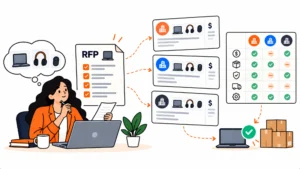
A 130-person company hired across eight countries through an employment provider and took the device bundle, reasonably, because it meant one relationship instead of two. For about a year it worked well.
Then they opened a London office and hired eleven people directly, because at that volume a local entity made sense. Those eleven needed laptops, and the bundle did not cover them, so somebody bought machines on a company card from a local reseller and recorded them in a spreadsheet.
Eighteen months later the company had two registers, neither complete. The provider's system held the devices it had supplied and knew nothing about the London machines. The spreadsheet held London and was last updated by somebody who had since changed roles. When a finance review asked how many laptops the company owned, the honest answer took a week to assemble and was still approximate.
Best tools for Device Management
Nothing went wrong with either vendor. The bundle did exactly what it said, the reseller delivered exactly what was ordered, and the failure sat in the gap between two populations that had been identical at the point the decision was made and were not any more.
The Two Populations
Almost every mistake in this decision comes from assuming two lists are the same list.
The employed population is everybody whose employment runs through a provider. For a company hiring across borders without local entities, that may be most of the workforce or a specific subset.
The device population is everybody holding company hardware. That includes contractors, agency staff, people in your home country employed directly, and sometimes people who are not employees at all.
Where those overlap completely, a bundle is coherent. Where they diverge, you end up with two arrangements and the bundle has saved nothing while adding a dependency.
The test is a two-minute exercise. List your countries by headcount, mark each person as employed through a provider or directly, and mark each as holding a company device or not. If the two marks match on every row, bundle. If they do not, you are choosing which population to serve well.
Where the Bundle Genuinely Wins
Being fair to it, there are real advantages and they are not marketing.
One contract and one invoice. Procurement, legal and finance each do one piece of work rather than two. At a small company where those functions are a founder and an accountant, this matters more than it sounds.
The country is already open. If your provider has an entity and a presence in a market, shipping a device there is a smaller problem than it is for a specialist entering that country for one person. The employment relationship carries some of the logistics.
The joiner trigger is already connected. Onboarding already fires through the employment provider, so the device order can hang off the same event rather than requiring a second integration. That removes one of the commonest day-one failures.
And nobody has to own a second relationship. For a team with no IT function, reducing the vendor count by one is a genuine operational saving.
| Dimension | Bundle | Specialist |
|---|---|---|
| Contracts to manage | One | Two |
| Covers directly employed staff | No | Yes |
| Covers contractors | Usually not | Yes |
| Replacement stock depth | Typically thinner | The core business |
| Onboarding trigger | Already connected | Needs an integration |
| Leaving is | Two decisions entangled | One decision |
Where It Breaks
The moment you employ anybody directly. Your home-country staff usually sit outside the provider arrangement entirely, which means their devices do too. Most companies have more directly employed people than they remember when they start this conversation.
Contractors and agency staff. These rarely sit inside an employment provider relationship and frequently hold hardware. If you issue devices to contractors, a bundle covers none of them.
Replacement depth. A specialist's entire business is knowing where stock sits. An employment platform's device offering is a younger product built alongside a larger one. Ask the same question you would ask anybody: which of my top five countries have local stock, and what is the working-day replacement target in each. The answers tend to be thinner, and that is not a criticism so much as a difference in what each company has spent years building.
Entanglement on exit. Changing employment providers is a significant undertaking. If devices are bundled, changing one means changing both, or unpicking an arrangement mid-term. Two separate relationships can each end on their own schedule.
Five Questions That Decide It
Do your two populations match? The exercise above. This single answer resolves most cases without any further analysis.
What share of your people are directly employed? If it is under ten per cent you may reasonably accept a small second arrangement for them. If it is forty per cent, the bundle is covering a minority of your fleet.
Do contractors hold devices? If yes, a bundle does not serve them and you need a specialist anyway, which removes most of the simplicity argument.
How fast do you need replacements, and where? Ask both options the same question about your hardest country. If the bundle's answer is materially worse and that country matters, the simplicity is being paid for in downtime.
How likely are you to change employment providers? If that is a live possibility within the contract term, entangling devices with it adds friction to a decision you may need to make for completely unrelated reasons.
The Options
RemoAsset, named below, is owned by the same people who publish HROpsLab. Its limitations are stated as plainly as everybody else's.
Deel IT
Device procurement and management attached to an employment platform, so hardware arrives through the same provider handling the employment arrangement.
Honest assessment: the bundle is real and the convenience is real, within the population it covers. The device product is younger than the employment product, so press specifically on stock location and replacement targets rather than assuming they match the maturity of the employment side. It publishes no price.
RemoAsset
Procurement, deployment, tracking and retrieval for distributed teams, with devices enrolled into your management system before dispatch.
Honest assessment, including the parts that count against it: it publishes no price and requires a demo, so it cannot be compared from a web page any more than Deel IT can. It is noticeably weaker for hardware it did not supply, which matters if you already own a fleet. And it is not a device management system, so it enrols into yours rather than replacing the need for one. What it does cover is every population regardless of how they are employed, which is the specific thing a bundle cannot do.
Workwize
Hardware lifecycle with its own warehouse network. Its domain is now goworkwize.com; the older address no longer resolves, verified 14 October 2026.
Honest assessment: owned warehousing is the clearest answer to the replacement-depth question raised above, and it is the capability bundles are furthest from matching. No published price.
Firstbase
Equipment on a subscription basis with retrieval and replacement included by design.
Honest assessment: a per-person subscription has a similar budgeting feel to a bundle, without tying devices to employment. Worth considering if the appeal of the bundle was predictable cost rather than vendor count. No published price.
GroWrk and allwhere
Both scope arrangements per customer rather than selling tiers, GroWrk across a wide country list and allwhere closer to a managed service.
Honest assessment: both can be scoped to cover a mixed population, which is exactly the case a bundle handles badly. Both take longer to evaluate for the same reason. Neither publishes a figure.
The Comparison
| Vendor | Covers directly employed | Covers contractors | Stock depth | Pricing |
|---|---|---|---|---|
| Deel IT | No | Usually not | Verify, typically thinner | Quote-based |
| RemoAsset | Yes | Yes | Partner network | Quote-based, demo required |
| Workwize | Yes | Yes | Own warehouses | Quote-based |
| Firstbase | Yes | Yes | Partner network | Quote-based |
| GroWrk | Yes | Yes | Partner network | Quote-based, tailored |
| allwhere | Yes | Yes | Partner network | Quote-based |
The first two columns are the whole decision. Everything else is a comparison between specialists once you have established that you need one.
The Decision Table
| Situation | Scale | Setup | Primary Pain | Recommended Starting Point |
|---|---|---|---|---|
| Entire workforce via one provider | Under 150 | Bundle | Two vendors for one population | Bundle, and re-check when you hire directly |
| Mixed employed and direct | Any | Specialist covering both | Bundle covers only half the fleet | Specialist, not the bundle |
| Contractors hold devices | Any | Specialist | Bundle excludes them entirely | Specialist, the simplicity is already gone |
| Home country is your largest | Any | Specialist | Your biggest population is outside it | Specialist for everybody |
| Replacement speed critical | Any | Vendor with local stock | Bundle depth is typically thinner | Ask both the hardest-country question |
| May change employment provider | Any | Keep them separate | Two decisions entangled | Separate contracts, separate exits |
| Wanted predictable cost, not fewer vendors | Under 200 | Subscription specialist | Bundling for the wrong reason | Per-person subscription instead |
| Already own a large fleet | 100 plus | Test existing-asset import | Neither handles it automatically | Hand both a real export and compare |
Offboarding Under Each Model
Recovery is where the two models differ most sharply, and it rarely comes up in an evaluation because procurement is the part with a deadline attached.
Under a bundle, the trigger is genuinely better. The employment provider knows somebody is leaving before anybody else does, because they are processing the termination. That is a real advantage, and it removes the single weakest link in device recovery, which is nobody noticing a leaver until after the last working day.
But the collection itself is usually a partner arrangement, the same as most specialists. Knowing early is worth a great deal and it does not by itself get a laptop out of somebody's flat in another country.
And the population problem reappears. A contractor finishing an engagement generates no leaver event in the employment platform, because they were never employed through it. Those are exactly the people most likely to keep a device, since nothing in your process fires at all.
So the honest split is that bundles win on detection and tie on execution, which is worth having if most of your leavers are employed through the provider. If a meaningful share are contractors, the detection advantage covers the population least at risk and misses the one most at risk.
Ask both options the same three questions: who notices a leaver and how, who sends packaging and to what address, and what the actual return rate is for home collections. The third question separates vendors more than the first two, and almost nobody asks it.
The Middle Option Nobody Proposes
The conversation gets framed as a binary and it does not have to be. A third structure works well for companies whose populations have diverged but not evenly.
Use the bundle where the populations overlap, and a specialist for the gap. If eighty per cent of your device holders are employed through one provider and the rest are directly employed in your home country, a local reseller handling that one market alongside the bundle is a perfectly reasonable arrangement.
The cost is a second relationship and a second register, and the second register is the real objection rather than the second invoice. Running two lists of what you own is how devices get lost, which is the whole argument for consolidating in the first place.
So the middle option works on one condition: you keep a single register that you control, in a spreadsheet or wherever, covering both arrangements. Neither vendor's system will hold the complete picture, and if you accept that from the start and maintain your own list, the split arrangement is fine. If you expect one of them to be the source of truth, it is not.
That condition is worth stating plainly because it is also the right answer regardless of which structure you choose. A register you control survives changing either vendor, and in a split arrangement it is the only thing that sees the whole fleet.
How the Cost Actually Compares
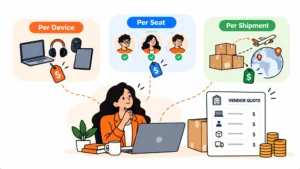
Neither side publishes a figure, so the comparison has to be built rather than looked up, and the unit matters more than the number.
Use cost per device per year, fully loaded, rather than anything either vendor offers. That means hardware amortised across your real average tenure, plus logistics, plus configuration, plus retrieval, divided by devices rather than by people. Devices rather than people is deliberate here, because the whole question is which fleet each option covers.
Then account for the thing that makes bundles look cheaper than they are. A bundle quote covers the employed population only, so dividing it by your total device count understates the real rate. Compare like for like by pricing the bundle for its population, pricing the gap separately, and adding them. Several companies have chosen a bundle on a per-person figure that turned out to cover sixty per cent of their machines.
And put a number on the second register. If a split arrangement means somebody spends two hours a month reconciling two lists, that is twenty-four hours a year, and it belongs in the comparison even though no invoice shows it.
Write down what you expect the answer to be before either vendor replies. A quote materially below your own estimate is usually covering less rather than being generous, and in this specific decision "covering less" has a precise meaning you can check.
What to Ask Both Sides
Send the same questions to the bundle and to two specialists, because the comparison only works if the questions are identical.
Which of my countries have local stock, listed individually rather than as a coverage number. What is the replacement target per country, in working days, with a remedy if missed. Who is importer of record and is duty included, per country. What happens to devices held by people you do not employ. What does leaving look like, including what happens to the device arrangement if the employment relationship ends or moves.
That last question is the one specific to this decision and the one most likely to be answered vaguely. A bundle where ending the employment contract leaves your device arrangement undefined is a risk worth surfacing before signing rather than during a provider change.
Two more worth adding, both cheap to ask and both revealing.
Who physically handles the device in each country, by name of the firm. Bundles and specialists alike operate partner networks in most markets, and it is entirely possible that both options use the same local partner in your second-largest country. Where that is true, the replacement-depth argument collapses for that market and the decision rests entirely on the population question.
And what reporting do I get, monthly, without asking. A fleet you cannot see is a fleet you cannot plan a refresh for. Bundles sometimes report devices alongside employment data, which is convenient, and sometimes report nothing at all because the device arm is a younger product. Ask to see a sample report rather than a description of one.
The Configuration Gap Applies to Both
One point of parity worth being explicit about, because it catches teams who assume a bundle is more complete than it is.
Neither option is a device management system. Both will enrol a machine into one you already run. Neither provides one. A company with no management system buys either of these and still has sealed laptops arriving at people who cannot configure them, which is the commonest surprise in this whole category.
That matters here specifically because the bundle is often bought by companies with no IT function, on the reasonable assumption that fewer vendors means more is handled. It does not extend that far. The employment provider handles employment, the device arm handles logistics, and configuration sits in the same gap it sits in with every specialist.
So check what you already have before assuming this is extra spend. Apple's own platform now carries management at no cost for Apple fleets, and most companies running a Microsoft estate already hold a licence that covers it through something they are paying for anyway. The gap is frequently a configuration job rather than a purchase.
And whichever way you go, name the person who performs setup on day one. If the answer is the new starter following a written document, that is a legitimate arrangement at small scale, and it only works if somebody has actually written the document.
What Changes at Fifty, One Hundred and Three Hundred
The right answer moves as the company does, and the transitions are reasonably predictable.
Around fifty people, a bundle is usually correct if you are hiring through a provider, because the alternative is a second vendor relationship for a fleet that generates very little work. The populations are also most likely to overlap at this size, since early international hiring tends to run entirely through one provider.
Around a hundred, the directly employed population starts to matter. Most companies have built a home-country team by then, and that team is outside the bundle. This is the point where the two-population test usually flips, and it is worth running deliberately rather than waiting for somebody to notice.
Around three hundred, the register problem dominates everything else. With a fleet that size spread across arrangements, not knowing what you own becomes the expensive failure rather than any individual replacement delay. That is the point at which consolidating onto one specialist covering every population usually pays for itself, even if the bundle was working adequately.
But the trigger is never really the headcount. It is the share of your device holders who sit outside the employment arrangement, and that number can cross the line at forty people or at four hundred depending on how you hire.
What Getting This Wrong Costs
The expensive version is not choosing the wrong vendor. It is discovering halfway through a year that the bundle covers sixty per cent of your fleet, standing up a second arrangement for the rest, and then running two systems with two registers and no single view of what you own.
That outcome is not hypothetical and it is not caused by a bad product. It comes from a decision made when the two populations happened to overlap, and from nobody re-checking when the company started employing people directly in its home market. The overlap is a snapshot, not a property.
And there is the entanglement cost, which arrives later and larger. A company that wants to change employment providers for reasons entirely unrelated to hardware finds that doing so also moves every laptop arrangement, or requires negotiating a carve-out mid-term. Two separate contracts cost marginally more to administer and leave both decisions independent, which is worth something on its own.
Ask it this way before you sign. If you hired five people directly in your home country next quarter, would this arrangement still make sense?
And there is a quieter cost that only shows up in a bad month. When a laptop fails in a market where the bundle's device arm holds no stock, the person waiting does not care which vendor structure you chose. They care that it is day four. Simplicity bought at the cost of replacement depth is a trade somebody else pays for, and they pay in a week of working on a borrowed machine or not working properly at all.
When You're Ready to Separate Them
The signal is not a complaint about the device service. It is a change in the shape of the workforce.
Watch for the point where directly employed staff exceed a meaningful share of device holders, where contractors start receiving hardware, or where a country opens that the employment provider does not serve well. Any of those turns a coherent bundle into partial coverage, and partial coverage is the state that produces two registers.
When that happens, the move is not necessarily to cancel the bundle. It is to run a specialist for the whole device population and let the employment arrangement do employment, which is what it is actually good at. The duplication during the transition is temporary and the single view of the fleet is permanent.
Do the separation in the order that protects the register. Export everything the bundle holds, with serials, holders, locations and dates, before giving any notice on the device element. Hand that export to the incoming specialist during evaluation and ask what survives an import, because your entire existing fleet arrives as hardware they did not supply. Then overlap for a full cycle rather than cutting over on a date, so nothing in transit belongs to neither party.
And keep the employment arrangement untouched throughout. The whole point of separating them is that each decision becomes independent, which only holds if you do not change both at once.
Frequently Asked Questions
Should I get devices from my employment provider or a specialist?
It depends on whether your device population and your employed population are the same set of people. Where everybody holding a laptop is employed through the provider, the bundle is genuinely simpler and gives you one contract, one invoice and an onboarding trigger that is already connected. Where they diverge, which happens the moment you employ anybody directly or issue devices to contractors, the bundle covers part of your fleet and you need a second arrangement anyway.
What does a device bundle not cover?
Typically anybody not employed through that provider, which usually means your directly employed home-country staff and any contractors or agency workers holding hardware. Most companies have more people in those categories than they remember when the conversation starts, so the two-minute exercise of listing countries by headcount and marking each person on both dimensions is worth doing before any vendor call.
Is replacement coverage worse with a bundle?
Typically thinner, and that is a difference in what each company has spent years building rather than a criticism. A specialist's entire business is knowing where stock physically sits, while an employment platform's device offering is a younger product alongside a larger one. Ask both the same question about your hardest country and compare the working-day targets rather than assuming parity.
Do any of these vendors publish pricing?
None of the six checked on 14 October 2026 shows a currency figure on its own pricing page, including both the bundle option and every specialist. Comparison therefore requires sending an identical written specification to each and normalising the answers yourself, since there is no public reference point for what any of this should cost.
What happens to devices if I change employment providers?
That is the question most likely to be answered vaguely and the one most specific to this decision. A bundle where the device arrangement becomes undefined if the employment relationship ends or moves is a real risk, so ask what leaving looks like for the hardware specifically, and get the answer in the contract rather than in a call.
If I want predictable cost rather than fewer vendors, what should I look at?
A per-person subscription from a specialist, which gives the same budgeting feel as a bundle without tying devices to employment. Teams frequently reach for a bundle because the appeal was a single predictable number, and a subscription model delivers that while still covering contractors and directly employed staff.
When should I separate devices from the employment arrangement?
When the shape of the workforce changes rather than when the service disappoints: directly employed staff becoming a meaningful share of device holders, contractors starting to receive hardware, or a country opening that the provider does not serve well. Any of those turns a coherent bundle into partial coverage, which is the state that ends with two registers and no single view of what you own.
HROpsLab takes no vendor money and publishes no paid placements.